A rough incline coupled to a hanging particle — 9709 P4
Combine the two bodies while retaining friction only on the contacting body.
Syllabus 4.4
Notes and key methods
Draw a separate diagram for the particle on the plane and the hanging particle. While the light string is taut over a smooth fixed pulley, they share one tension and equal acceleration magnitudes.
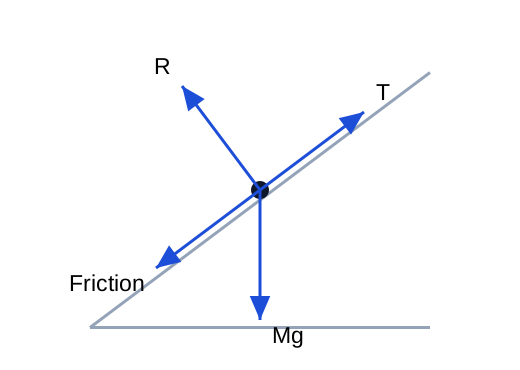
If the plane particle moves up, its weight component and sliding friction both oppose that motion. Its normal reaction is Mg cos α when the string is parallel to the plane. Add the two along-motion equations to remove tension, then use one body to recover it. Check the assumed motion and positive tension.
Check the conditions
Choose and retain a positive direction; distinguish signed quantities from magnitudes.
Use SI units and \(\displaystyle g= \frac{10m}{s^{2}}\) wherever gravity is relevant.
Apply only the model and time interval stated in the question.
Three worked examples
Example 1 · A rough incline coupled to a hanging particle
A 5 kg particle is on a rough fixed plane. The acute angle α satisfies \(\displaystyle \sin\alpha=\frac{3}{5},\quad\cos\alpha=\frac{4}{5}\). It is connected to a hanging 10 kg particle by a light inextensible string over a smooth fixed pulley. The string is parallel to the plane at the contacting particle. The hanging particle descends and the plane particle slides up with \(\displaystyle F=\mu R\), where \(\displaystyle \mu =\)\(\displaystyle \frac{1}{10}\). The string stays taut and no boundary is reached. Use \(\displaystyle g= \frac{10m}{s^{2}}\).
Schematic force diagram for the selected particle; arrow lengths are not a force scale.
Find the common acceleration magnitude in \(\displaystyle \frac{m}{s^{2}}\).
Find the tension in N.
Find the normal reaction on the plane particle in N.
Find the sliding friction magnitude in N.
Show the reasoning
(a)
Combine the two along-motion equations, including plane friction and the downslope weight component.
The net external driving force is \(66\) N on total mass 15 kg, giving \(\displaystyle \frac{22}{5}\) \(\displaystyle \frac{m}{s^{2}}\).
Answer: \(\displaystyle \frac{22}{5}\).
(b)
Use the hanging particle’s equation with its own mass.
The descending hanging particle gives \(\displaystyle T=H(g-a)=\)\(56\) N.
Answer: \(56\).
(c)
Resolve perpendicular to the plane for the contacting particle.
There is no normal acceleration and no normal string component, so \(\displaystyle R=Mg \cos \alpha =\)\(40\) N.
Answer: \(40\).
(d)
Apply the coefficient to the correct normal reaction and state its opposing direction.
The specified sliding law gives \(\displaystyle F=\mu R=\)\(4\) N, down the plane.
Answer: \(4\).
Example 2 · A rough incline coupled to a hanging particle
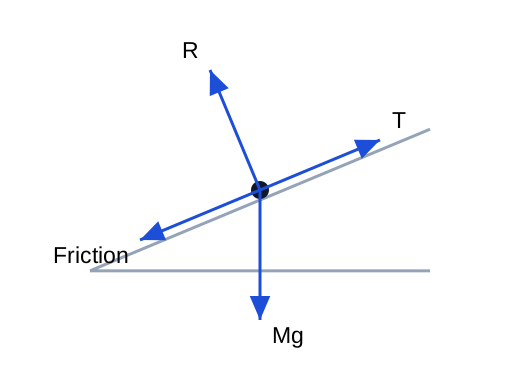
A 6 kg particle is on a rough fixed plane. The acute angle α satisfies \(\displaystyle \sin\alpha=\frac{5}{13},\quad\cos\alpha=\frac{12}{13}\). It is connected to a hanging 8 kg particle by a light inextensible string over a smooth fixed pulley. The string is parallel to the plane at the contacting particle. The hanging particle descends and the plane particle slides up with \(\displaystyle F=\mu R\), where \(\displaystyle \mu =\)\(\displaystyle \frac{1}{5}\). The string stays taut and no boundary is reached. Use \(\displaystyle g= \frac{10m}{s^{2}}\).
Schematic force diagram for the selected particle; arrow lengths are not a force scale.
Find the common acceleration magnitude in \(\displaystyle \frac{m}{s^{2}}\).
Find the tension in N.
Find the normal reaction on the plane particle in N.
Find the sliding friction magnitude in N.
Show the reasoning
(a)
Combine the two along-motion equations, including plane friction and the downslope weight component.
The net external driving force is \(\displaystyle \frac{596}{13}\) N on total mass 14 kg, giving \(\displaystyle \frac{298}{91}\) \(\displaystyle \frac{m}{s^{2}}\).
Answer: \(\displaystyle \frac{298}{91}\).
(b)
Use the hanging particle’s equation with its own mass.
The descending hanging particle gives \(\displaystyle T=H(g-a)=\)\(\displaystyle \frac{4896}{91}\) N.
Answer: \(\displaystyle \frac{4896}{91}\).
(c)
Resolve perpendicular to the plane for the contacting particle.
There is no normal acceleration and no normal string component, so \(\displaystyle R=Mg \cos \alpha =\)\(\displaystyle \frac{720}{13}\) N.
Answer: \(\displaystyle \frac{720}{13}\).
(d)
Apply the coefficient to the correct normal reaction and state its opposing direction.
The specified sliding law gives \(\displaystyle F=\mu R=\)\(\displaystyle \frac{144}{13}\) N, down the plane.
Answer: \(\displaystyle \frac{144}{13}\).
Example 3 · A rough incline coupled to a hanging particle
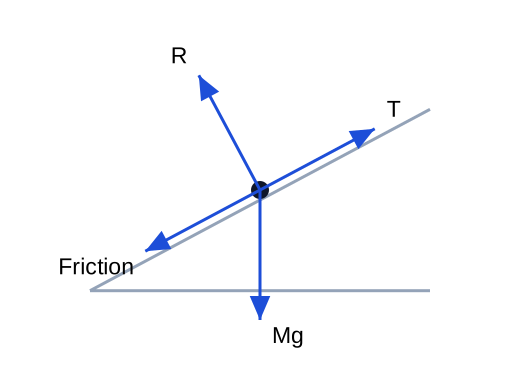
A 7 kg particle is on a rough fixed plane. The acute angle α satisfies \(\displaystyle \sin\alpha=\frac{8}{17},\quad\cos\alpha=\frac{15}{17}\). It is connected to a hanging 10 kg particle by a light inextensible string over a smooth fixed pulley. The string is parallel to the plane at the contacting particle. The hanging particle descends and the plane particle slides up with \(\displaystyle F=\mu R\), where \(\displaystyle \mu =\)\(\displaystyle \frac{3}{10}\). The string stays taut and no boundary is reached. Use \(\displaystyle g= \frac{10m}{s^{2}}\).
Schematic force diagram for the selected particle; arrow lengths are not a force scale.
Find the common acceleration magnitude in \(\displaystyle \frac{m}{s^{2}}\).
Find the tension in N.
Find the normal reaction on the plane particle in N.
Find the sliding friction magnitude in N.
Show the reasoning
(a)
Combine the two along-motion equations, including plane friction and the downslope weight component.
The net external driving force is \(\displaystyle \frac{825}{17}\) N on total mass 17 kg, giving \(\displaystyle \frac{825}{289}\) \(\displaystyle \frac{m}{s^{2}}\).
Answer: \(\displaystyle \frac{825}{289}\).
(b)
Use the hanging particle’s equation with its own mass.
The descending hanging particle gives \(\displaystyle T=H(g-a)=\)\(\displaystyle \frac{20650}{289}\) N.
Answer: \(\displaystyle \frac{20650}{289}\).
(c)
Resolve perpendicular to the plane for the contacting particle.
There is no normal acceleration and no normal string component, so \(\displaystyle R=Mg \cos \alpha =\)\(\displaystyle \frac{1050}{17}\) N.
Answer: \(\displaystyle \frac{1050}{17}\).
(d)
Apply the coefficient to the correct normal reaction and state its opposing direction.
The specified sliding law gives \(\displaystyle F=\mu R=\)\(\displaystyle \frac{315}{17}\) N, down the plane.
Answer: \(\displaystyle \frac{315}{17}\).
Common mistakes
Put friction on the plane particle only.
The normal reaction uses its own mass, not the hanging mass or their sum.