Two hanging particles and a smooth pulley — 9709 P4
Use equal tension and equal acceleration magnitudes while the string is taut.
Syllabus 4.4
Notes and key methods
A light inextensible string over a small smooth fixed pulley has a common tension in its two free sections. While it remains taut, the two attached particles have equal speed and acceleration magnitudes in their respective opposite vertical directions.
For a heavier mass M descending and lighter mass m rising, the equations are Mg−T=Ma and T−mg=ma. Adding cancels the internal tension. The assumptions of a light string and smooth pulley are what justify equal tensions; they are not properties of every pulley system.
Check the conditions
Choose and retain a positive direction; distinguish signed quantities from magnitudes.
Use SI units and \(\displaystyle g= \frac{10m}{s^{2}}\) wherever gravity is relevant.
Apply only the model and time interval stated in the question.
Three worked examples
Example 1 · Two hanging particles and a smooth pulley
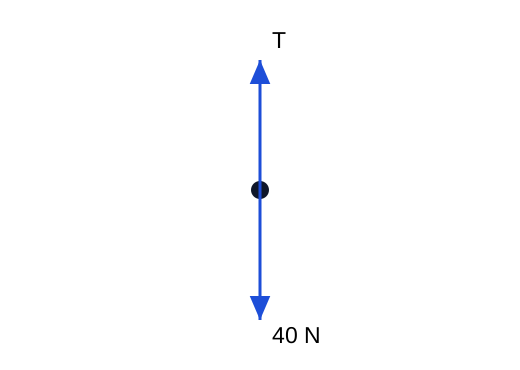
Particles of masses 6 kg and 4 kg hang at the ends of a light inextensible string over a fixed smooth pulley. They are released from rest with the string taut. Neither reaches the floor or pulley during the stated times. Use \(\displaystyle g= \frac{10m}{s^{2}}\).
Schematic force diagram for the selected particle; arrow lengths are not a force scale.
Find the acceleration, showing an equation for each particle.
Find the string tension in N.
Find their speed after 4 s, in m/s.
Find the distance moved by each particle in that time, in m.
Show the reasoning
(a)
For the heavier mass, \(60-T=6a\). For the lighter, \(T-40=4a\). Adding eliminates T and gives \(\displaystyle a=\)\(2\) \(\displaystyle \frac{m}{s^{2}}\).
Substitute the common acceleration into a single-particle equation.
For the rising lighter particle, \(\displaystyle T=L(g+a)=\)\(48\) N.
Answer: \(48\).
(c)
Use the common constant acceleration and elapsed time before any impact.
Starting from rest, v=at=\(8\) m/s.
Answer: \(8\).
(d)
Apply constant-acceleration kinematics while the constraint remains unchanged.
From rest, displacement magnitude is at²/2=\(16\) m.
Answer: \(16\).
Example 2 · Two hanging particles and a smooth pulley
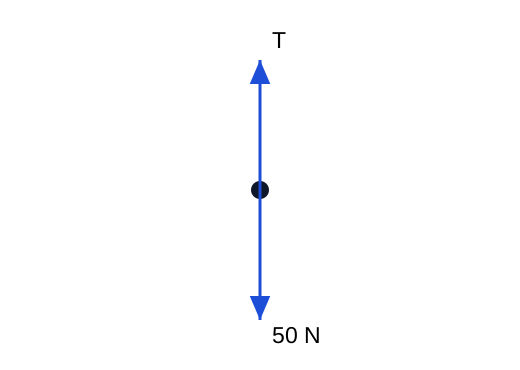
Particles of masses 8 kg and 5 kg hang at the ends of a light inextensible string over a fixed smooth pulley. They are released from rest with the string taut. Neither reaches the floor or pulley during the stated times. Use \(\displaystyle g= \frac{10m}{s^{2}}\).
Schematic force diagram for the selected particle; arrow lengths are not a force scale.
Find the acceleration, showing an equation for each particle.
Find the string tension in N.
Find their speed after 5 s, in m/s.
Find the distance moved by each particle in that time, in m.
Show the reasoning
(a)
For the heavier mass, \(80-T=8a\). For the lighter, \(T-50=5a\). Adding eliminates T and gives \(\displaystyle a=\)\(\displaystyle \frac{30}{13}\) \(\displaystyle \frac{m}{s^{2}}\).
Substitute the common acceleration into a single-particle equation.
For the rising lighter particle, \(\displaystyle T=L(g+a)=\)\(\displaystyle \frac{800}{13}\) N.
Answer: \(\displaystyle \frac{800}{13}\).
(c)
Use the common constant acceleration and elapsed time before any impact.
Starting from rest, v=at=\(\displaystyle \frac{150}{13}\) m/s.
Answer: \(\displaystyle \frac{150}{13}\).
(d)
Apply constant-acceleration kinematics while the constraint remains unchanged.
From rest, displacement magnitude is at²/2=\(\displaystyle \frac{375}{13}\) m.
Answer: \(\displaystyle \frac{375}{13}\).
Example 3 · Two hanging particles and a smooth pulley
Particles of masses 10 kg and 6 kg hang at the ends of a light inextensible string over a fixed smooth pulley. They are released from rest with the string taut. Neither reaches the floor or pulley during the stated times. Use \(\displaystyle g= \frac{10m}{s^{2}}\).
Schematic force diagram for the selected particle; arrow lengths are not a force scale.
Find the acceleration, showing an equation for each particle.
Find the string tension in N.
Find their speed after 2 s, in m/s.
Find the distance moved by each particle in that time, in m.
Show the reasoning
(a)
For the heavier mass, \(100-T=10a\). For the lighter, \(T-60=6a\). Adding eliminates T and gives \(\displaystyle a=\)\(\displaystyle \frac{5}{2}\) \(\displaystyle \frac{m}{s^{2}}\).