Friction when a particle reverses on a slope — 9709 P4
Redraw the friction direction for each separate stage of motion.
Syllabus 4.4
Notes and key methods
While a particle slides up a rough plane, gravity’s along-plane component and friction both act down the plane. With up positive, acceleration is −g(sin α+μ cos α). On the downward sliding stage, friction reverses to act up the plane.
Downward acceleration then has magnitude g(sin α−μ cos α), provided it is positive. At the top, first check whether static friction could hold the particle. The examples use sin α>μ cos α, so the particle must slide back. The same friction direction cannot be carried across the reversal.
Check the conditions
Choose and retain a positive direction; distinguish signed quantities from magnitudes.
Use SI units and \(\displaystyle g= \frac{10m}{s^{2}}\) wherever gravity is relevant.
Apply only the model and time interval stated in the question.
Three worked examples
Example 1 · Friction when a particle reverses on a slope
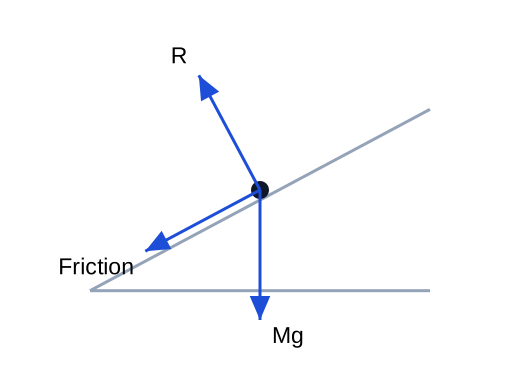
A 7 kg particle is projected up a fixed rough plane at \(\displaystyle \frac{13m}{s}\). The acute angle α satisfies \(\displaystyle \sin\alpha=\frac{8}{17},\quad\cos\alpha=\frac{15}{17}\). The coefficient is \(\displaystyle \frac{3}{10}\), with static limit \(\displaystyle F\le \mu R\) and sliding friction \(\displaystyle F=\mu R\). Use \(\displaystyle g= \frac{10m}{s^{2}}\). The plane is long enough for the complete motion to the first stop and subsequent return.
Schematic force diagram for the selected particle; arrow lengths are not a force scale.
Find the signed acceleration while moving up, taking up the plane as positive.
Find the distance travelled up the plane before its first stop, in m.
Explain whether the particle can remain at rest at its first stop; if not, find its subsequent acceleration down the plane.
Find the acceleration down the plane after it starts sliding back, in \(\displaystyle \frac{m}{s^{2}}\).
Show the reasoning
(a)
The normal reaction is Mg cos α. Both Mg sin α and μMg cos α act down the plane, so \(Ma=-Mg\sin\alpha-\mu Mg\cos\alpha\) gives \(\displaystyle a=\)\(\displaystyle - \frac{125}{17}\) \(\displaystyle \frac{m}{s^{2}}\).
Use the upward-stage deceleration and zero velocity at the first stop.
Using 0=\(\displaystyle U^{2}\)−2bs gives \(\displaystyle \frac{2873}{250}\) m.
Answer: \(\displaystyle \frac{2873}{250}\).
(c)
To remain still would require friction Mg sin α. Its cap is μMg cos α, which is smaller because \(\displaystyle \frac{8}{17}\) > \(\displaystyle \frac{9}{34}\). It slides back, with friction now uphill. Downward Newton balance gives \(\displaystyle a=g(\sin \alpha -\mu \cos \alpha )=\)\(\displaystyle \frac{35}{17}\) \(\displaystyle \frac{m}{s^{2}}\).
Answer: It cannot remain at rest; downward acceleration is \(\displaystyle \frac{35}{17}\) \(\displaystyle \frac{m}{s^{2}}\).
(d)
Reverse friction and subtract it from downslope weight in the returning-stage equation.
Example 2 · Friction when a particle reverses on a slope
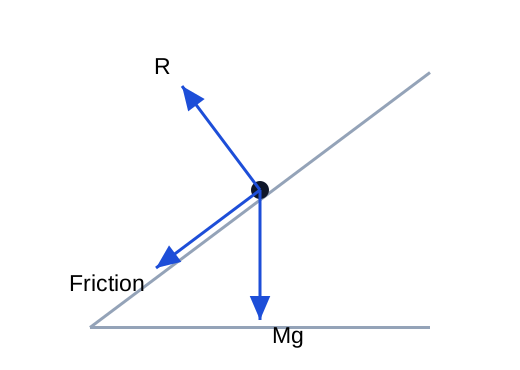
A 8 kg particle is projected up a fixed rough plane at \(\displaystyle \frac{14m}{s}\). The acute angle α satisfies \(\displaystyle \sin\alpha=\frac{3}{5},\quad\cos\alpha=\frac{4}{5}\). The coefficient is \(\displaystyle \frac{1}{10}\), with static limit \(\displaystyle F\le \mu R\) and sliding friction \(\displaystyle F=\mu R\). Use \(\displaystyle g= \frac{10m}{s^{2}}\). The plane is long enough for the complete motion to the first stop and subsequent return.
Schematic force diagram for the selected particle; arrow lengths are not a force scale.
Find the signed acceleration while moving up, taking up the plane as positive.
Find the distance travelled up the plane before its first stop, in m.
Explain whether the particle can remain at rest at its first stop; if not, find its subsequent acceleration down the plane.
Find the acceleration down the plane after it starts sliding back, in \(\displaystyle \frac{m}{s^{2}}\).
Show the reasoning
(a)
The normal reaction is Mg cos α. Both Mg sin α and μMg cos α act down the plane, so \(Ma=-Mg\sin\alpha-\mu Mg\cos\alpha\) gives \(\displaystyle a=\)\(\displaystyle - \frac{34}{5}\) \(\displaystyle \frac{m}{s^{2}}\).
Use the upward-stage deceleration and zero velocity at the first stop.
Using 0=\(\displaystyle U^{2}\)−2bs gives \(\displaystyle \frac{245}{17}\) m.
Answer: \(\displaystyle \frac{245}{17}\).
(c)
To remain still would require friction Mg sin α. Its cap is μMg cos α, which is smaller because \(\displaystyle \frac{3}{5}\) > \(\displaystyle \frac{2}{25}\). It slides back, with friction now uphill. Downward Newton balance gives \(\displaystyle a=g(\sin \alpha -\mu \cos \alpha )=\)\(\displaystyle \frac{26}{5}\) \(\displaystyle \frac{m}{s^{2}}\).
Answer: It cannot remain at rest; downward acceleration is \(\displaystyle \frac{26}{5}\) \(\displaystyle \frac{m}{s^{2}}\).
(d)
Reverse friction and subtract it from downslope weight in the returning-stage equation.
Example 3 · Friction when a particle reverses on a slope
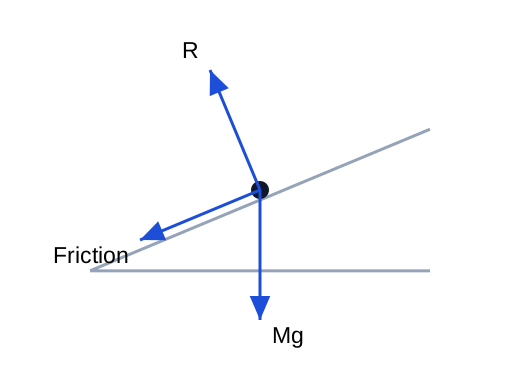
A 9 kg particle is projected up a fixed rough plane at \(\displaystyle \frac{15m}{s}\). The acute angle α satisfies \(\displaystyle \sin\alpha=\frac{5}{13},\quad\cos\alpha=\frac{12}{13}\). The coefficient is \(\displaystyle \frac{1}{5}\), with static limit \(\displaystyle F\le \mu R\) and sliding friction \(\displaystyle F=\mu R\). Use \(\displaystyle g= \frac{10m}{s^{2}}\). The plane is long enough for the complete motion to the first stop and subsequent return.
Schematic force diagram for the selected particle; arrow lengths are not a force scale.
Find the signed acceleration while moving up, taking up the plane as positive.
Find the distance travelled up the plane before its first stop, in m.
Explain whether the particle can remain at rest at its first stop; if not, find its subsequent acceleration down the plane.
Find the acceleration down the plane after it starts sliding back, in \(\displaystyle \frac{m}{s^{2}}\).
Show the reasoning
(a)
The normal reaction is Mg cos α. Both Mg sin α and μMg cos α act down the plane, so \(Ma=-Mg\sin\alpha-\mu Mg\cos\alpha\) gives \(\displaystyle a=\)\(\displaystyle - \frac{74}{13}\) \(\displaystyle \frac{m}{s^{2}}\).
Use the upward-stage deceleration and zero velocity at the first stop.
Using 0=\(\displaystyle U^{2}\)−2bs gives \(\displaystyle \frac{2925}{148}\) m.
Answer: \(\displaystyle \frac{2925}{148}\).
(c)
To remain still would require friction Mg sin α. Its cap is μMg cos α, which is smaller because \(\displaystyle \frac{5}{13}\) > \(\displaystyle \frac{12}{65}\). It slides back, with friction now uphill. Downward Newton balance gives \(\displaystyle a=g(\sin \alpha -\mu \cos \alpha )=\)\(2\) \(\displaystyle \frac{m}{s^{2}}\).
Answer: It cannot remain at rest; downward acceleration is \(2\) \(\displaystyle \frac{m}{s^{2}}\).
(d)
Reverse friction and subtract it from downslope weight in the returning-stage equation.