Total distance when a velocity changes sign — 9709 P4
Integrate separately on intervals with a consistent direction.
Syllabus 4.2
Notes and key methods
First solve \(\displaystyle v(t)=0\) and keep roots in the specified time interval. Test the sign of velocity between consecutive roots. The total distance is the sum of the absolute values of the corresponding definite velocity integrals.
Adding the signed integrals instead gives displacement. A repeated zero need not reverse direction, so use a sign test rather than assuming every root is a turning point. Count travel up to the stated end time only.
Check the conditions
Choose and retain a positive direction; distinguish signed quantities from magnitudes.
Use SI units and \(\displaystyle g= \frac{10m}{s^{2}}\) wherever gravity is relevant.
Apply only the model and time interval stated in the question.
Three worked examples
Example 1 · Total distance when a velocity changes sign
The velocity is \(v=t - 5\) m/s for \(0\le t\le 10\). The initial position is zero.
Use the labelled time and displacement or velocity axes, with the stated units.
Find the time of direction reversal in s.
Find the displacement during the first stage up to reversal, in m.
Find the distance travelled after reversal until the stated end time, in m.
Find the total distance travelled in m.
Show the reasoning
(a)
Solve \(\displaystyle v=0\) and verify the sign changes within the permitted interval.
The velocity is zero at \(\displaystyle t=5\) and changes from negative to positive.
Answer: \(5\).
(b)
Evaluate the first signed definite integral.
Integrating from 0 to 5 gives \(\displaystyle - \frac{25}{2}\) m.
Answer: \(\displaystyle - \frac{25}{2}\).
(c)
Integrate over the second sign-consistent interval and use a nonnegative path length.
Velocity is positive on the second half; its triangular area is \(\displaystyle \frac{25}{2}\) m.
Answer: \(\displaystyle \frac{25}{2}\).
(d)
Add the magnitudes of both stage displacements.
The two equal area magnitudes add to \(25\) m, although net displacement is zero.
Answer: \(25\).
Example 2 · Total distance when a velocity changes sign
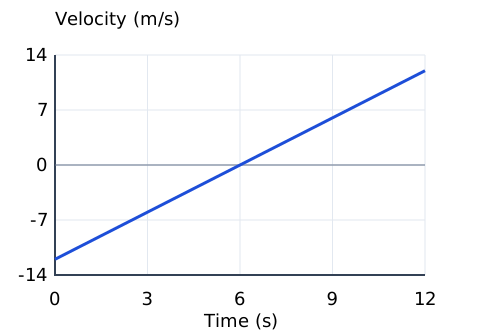
The velocity is \(v=2 t - 12\) m/s for \(0\le t\le 12\). The initial position is zero.
Use the labelled time and displacement or velocity axes, with the stated units.
Find the time of direction reversal in s.
Find the displacement during the first stage up to reversal, in m.
Find the distance travelled after reversal until the stated end time, in m.
Find the total distance travelled in m.
Show the reasoning
(a)
Solve \(\displaystyle v=0\) and verify the sign changes within the permitted interval.
The velocity is zero at \(\displaystyle t=6\) and changes from negative to positive.
Answer: \(6\).
(b)
Evaluate the first signed definite integral.
Integrating from 0 to 6 gives \(-36\) m.
Answer: \(-36\).
(c)
Integrate over the second sign-consistent interval and use a nonnegative path length.
Velocity is positive on the second half; its triangular area is \(36\) m.
Answer: \(36\).
(d)
Add the magnitudes of both stage displacements.
The two equal area magnitudes add to \(72\) m, although net displacement is zero.
Answer: \(72\).
Example 3 · Total distance when a velocity changes sign
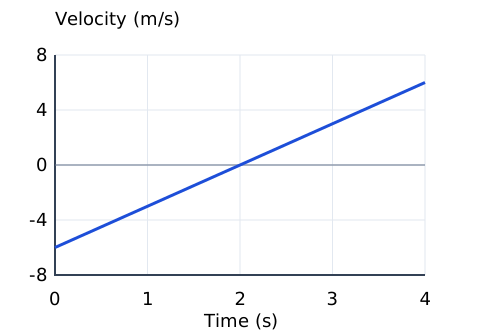
The velocity is \(v=3 t - 6\) m/s for \(0\le t\le 4\). The initial position is zero.
Use the labelled time and displacement or velocity axes, with the stated units.
Find the time of direction reversal in s.
Find the displacement during the first stage up to reversal, in m.
Find the distance travelled after reversal until the stated end time, in m.
Find the total distance travelled in m.
Show the reasoning
(a)
Solve \(\displaystyle v=0\) and verify the sign changes within the permitted interval.
The velocity is zero at \(\displaystyle t=2\) and changes from negative to positive.
Answer: \(2\).
(b)
Evaluate the first signed definite integral.
Integrating from 0 to 2 gives \(-6\) m.
Answer: \(-6\).
(c)
Integrate over the second sign-consistent interval and use a nonnegative path length.
Velocity is positive on the second half; its triangular area is \(6\) m.
Answer: \(6\).
(d)
Add the magnitudes of both stage displacements.
The two equal area magnitudes add to \(12\) m, although net displacement is zero.
Answer: \(12\).
Common mistakes
Do not take only the absolute value of the final net displacement.
Find and test all velocity zeros within the time domain.