Friction and the resultant contact force — 9709 P4
Find the friction actually needed before using its limiting value.
Syllabus 4.1
Notes and key methods
The contact force has two perpendicular components: normal reaction R and friction F. For a stationary particle, friction takes the value required for equilibrium, provided that the bound shown below is satisfied. It is not automatically at the limit.
The total contact-force magnitude is the square root of \(\displaystyle R^{2}+F^{2}\); its angle to the normal has tangent \(\displaystyle \frac{F}{R}\). Friction opposes impending or actual relative sliding. Check that the normal reaction remains nonnegative and the required static friction does not exceed its cap.
\(0\le F\le\mu R,\quad C=\sqrt{R^2+F^2}\)
Check the conditions
Choose and retain a positive direction; distinguish signed quantities from magnitudes.
Use SI units and \(\displaystyle g= \frac{10m}{s^{2}}\) wherever gravity is relevant.
Apply only the model and time interval stated in the question.
Three worked examples
Example 1 · Friction and the resultant contact force
A 5 kg particle rests on a rough horizontal surface. A horizontal pull \(\displaystyle \frac{5}{2}\) N acts right. The coefficient of friction is \(\displaystyle \frac{1}{5}\). No other horizontal forces act. Use \(\displaystyle g= \frac{10m}{s^{2}}\).
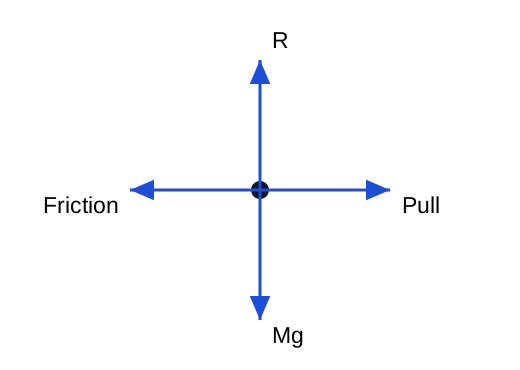
Schematic force diagram for the selected particle; arrow lengths are not a force scale.
Find the normal reaction.
Find the actual friction and justify that the particle can remain at rest.
Find the total contact-force magnitude to 3 significant figures and its angle to the upward normal to 1 decimal place.
Find the angle of the contact force to the upward normal, in degrees to 1 decimal place.
Show the reasoning
(a)
The applied pull is horizontal. Vertical equilibrium therefore gives \(\displaystyle R=Mg=50 N\).
Answer: 50 N.
(b)
Horizontal balance requires \(\displaystyle F=\)\(\displaystyle \frac{5}{2}\) N, while \(\displaystyle \mu R=\)\(10\) N. The required friction is strictly below the cap.
Answer: \(\displaystyle \frac{5}{2}\) N left; equilibrium is possible.
(c)
Combine the perpendicular actual friction and normal components by Pythagoras. The contact direction has tangent \(\displaystyle \frac{F}{R}=\)\(\displaystyle \frac{1}{20}\).
Answer: \(50.1\) N, 2.9° towards the left.
(d)
Use the actual friction-to-normal ratio, not automatically the coefficient of friction.
The contact force tilts towards the left; \(\displaystyle \tan \theta = \frac{F}{R}=\)\(\displaystyle \frac{1}{20}\), giving 2.9°.
Answer: \(2.9\).
Example 2 · Friction and the resultant contact force
A 6 kg particle rests on a rough horizontal surface. A horizontal pull \(9\) N acts right. The coefficient of friction is \(\displaystyle \frac{3}{10}\). No other horizontal forces act. Use \(\displaystyle g= \frac{10m}{s^{2}}\).
Schematic force diagram for the selected particle; arrow lengths are not a force scale.
Find the normal reaction.
Find the actual friction and justify that the particle can remain at rest.
Find the total contact-force magnitude to 3 significant figures and its angle to the upward normal to 1 decimal place.
Find the angle of the contact force to the upward normal, in degrees to 1 decimal place.
Show the reasoning
(a)
The applied pull is horizontal. Vertical equilibrium therefore gives \(\displaystyle R=Mg=60 N\).
Answer: 60 N.
(b)
Horizontal balance requires \(\displaystyle F=\)\(9\) N, while \(\displaystyle \mu R=\)\(18\) N. The required friction is strictly below the cap.
Answer: \(9\) N left; equilibrium is possible.
(c)
Combine the perpendicular actual friction and normal components by Pythagoras. The contact direction has tangent \(\displaystyle \frac{F}{R}=\)\(\displaystyle \frac{3}{20}\).
Answer: \(60.7\) N, 8.5° towards the left.
(d)
Use the actual friction-to-normal ratio, not automatically the coefficient of friction.
The contact force tilts towards the left; \(\displaystyle \tan \theta = \frac{F}{R}=\)\(\displaystyle \frac{3}{20}\), giving 8.5°.
Answer: \(8.5\).
Example 3 · Friction and the resultant contact force
A 7 kg particle rests on a rough horizontal surface. A horizontal pull \(21\) N acts right. The coefficient of friction is \(\displaystyle \frac{2}{5}\). No other horizontal forces act. Use \(\displaystyle g= \frac{10m}{s^{2}}\).
Schematic force diagram for the selected particle; arrow lengths are not a force scale.
Find the normal reaction.
Find the actual friction and justify that the particle can remain at rest.
Find the total contact-force magnitude to 3 significant figures and its angle to the upward normal to 1 decimal place.
Find the angle of the contact force to the upward normal, in degrees to 1 decimal place.
Show the reasoning
(a)
The applied pull is horizontal. Vertical equilibrium therefore gives \(\displaystyle R=Mg=70 N\).
Answer: 70 N.
(b)
Horizontal balance requires \(\displaystyle F=\)\(21\) N, while \(\displaystyle \mu R=\)\(28\) N. The required friction is strictly below the cap.
Answer: \(21\) N left; equilibrium is possible.
(c)
Combine the perpendicular actual friction and normal components by Pythagoras. The contact direction has tangent \(\displaystyle \frac{F}{R}=\)\(\displaystyle \frac{3}{10}\).
Answer: \(73.1\) N, 16.7° towards the left.
(d)
Use the actual friction-to-normal ratio, not automatically the coefficient of friction.
The contact force tilts towards the left; \(\displaystyle \tan \theta = \frac{F}{R}=\)\(\displaystyle \frac{3}{10}\), giving 16.7°.
Answer: \(16.7\).
Common mistakes
Use actual friction rather than μR when equilibrium is not limiting.
Distinguish the normal component from the entire contact-force magnitude.