Recognise that constant nonzero velocity also requires zero resultant force.
Syllabus 4.4
Notes and key methods
A particle remains at rest or at constant velocity when its resultant force is zero. Equilibrium of forces therefore does not by itself mean the particle is stationary. A nonzero applied force can be balanced by another force.
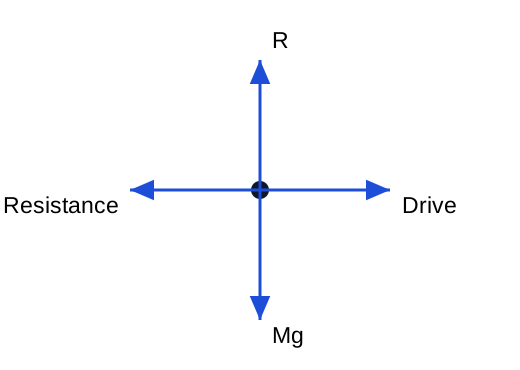
Draw all forces acting on the chosen object before writing balances. Weight and the supporting normal force can balance vertically, while drive and resistance balance horizontally. If resistance changes, an unchanged drive generally causes acceleration.
Check the conditions
Choose and retain a positive direction; distinguish signed quantities from magnitudes.
Use SI units and \(\displaystyle g= \frac{10m}{s^{2}}\) wherever gravity is relevant.
Apply only the model and time interval stated in the question.
Three worked examples
Example 1 · Balanced forces and Newton’s first law
A particle of mass 6 kg moves at constant nonzero velocity to the right on a horizontal surface. A drive acts right, resistance is 11 N left, and there is no vertical acceleration. Use \(\displaystyle g= \frac{10m}{s^{2}}\).
Schematic force diagram for the selected particle; arrow lengths are not a force scale.
Find the driving force in N.
Find the normal reaction in N.
Find the weight in N.
Resistance increases by 8 N. Find the new drive needed to retain constant velocity, in N.
Show the reasoning
(a)
Balance horizontal forces because the velocity is constant.
Zero horizontal resultant requires drive=11 N.
Answer: \(11\).
(b)
Balance the upward support against the weight.
Zero vertical acceleration gives \(\displaystyle R=Mg=60 N\).
Answer: \(60\).
(c)
Convert the given mass to weight using the stated g.
The gravitational force is \(\displaystyle Mg=60 N\) downward.
Answer: \(60\).
(d)
Balance the changed resistance rather than keeping the old drive.
The new opposing total is 19 N, which the drive must match.
Answer: \(19\).
Example 2 · Balanced forces and Newton’s first law
A particle of mass 7 kg moves at constant nonzero velocity to the right on a horizontal surface. A drive acts right, resistance is 12 N left, and there is no vertical acceleration. Use \(\displaystyle g= \frac{10m}{s^{2}}\).
Schematic force diagram for the selected particle; arrow lengths are not a force scale.
Find the driving force in N.
Find the normal reaction in N.
Find the weight in N.
Resistance increases by 2 N. Find the new drive needed to retain constant velocity, in N.
Show the reasoning
(a)
Balance horizontal forces because the velocity is constant.
Zero horizontal resultant requires drive=12 N.
Answer: \(12\).
(b)
Balance the upward support against the weight.
Zero vertical acceleration gives \(\displaystyle R=Mg=70 N\).
Answer: \(70\).
(c)
Convert the given mass to weight using the stated g.
The gravitational force is \(\displaystyle Mg=70 N\) downward.
Answer: \(70\).
(d)
Balance the changed resistance rather than keeping the old drive.
The new opposing total is 14 N, which the drive must match.
Answer: \(14\).
Example 3 · Balanced forces and Newton’s first law
A particle of mass 8 kg moves at constant nonzero velocity to the right on a horizontal surface. A drive acts right, resistance is 13 N left, and there is no vertical acceleration. Use \(\displaystyle g= \frac{10m}{s^{2}}\).
Schematic force diagram for the selected particle; arrow lengths are not a force scale.
Find the driving force in N.
Find the normal reaction in N.
Find the weight in N.
Resistance increases by 3 N. Find the new drive needed to retain constant velocity, in N.
Show the reasoning
(a)
Balance horizontal forces because the velocity is constant.
Zero horizontal resultant requires drive=13 N.
Answer: \(13\).
(b)
Balance the upward support against the weight.
Zero vertical acceleration gives \(\displaystyle R=Mg=80 N\).
Answer: \(80\).
(c)
Convert the given mass to weight using the stated g.
The gravitational force is \(\displaystyle Mg=80 N\) downward.
Answer: \(80\).
(d)
Balance the changed resistance rather than keeping the old drive.
The new opposing total is 16 N, which the drive must match.
Answer: \(16\).
Common mistakes
Constant velocity is compatible with several nonzero balanced forces.