Angled pulls, normal reactions and limiting friction — 9709 P4
Solve the normal balance and the limiting horizontal balance together.
Syllabus 4.1
Notes and key methods
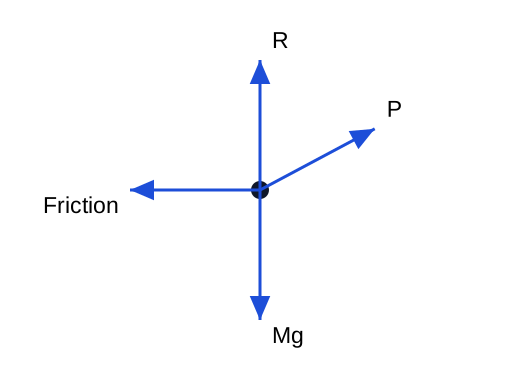
An upward angled pull reduces the normal reaction: \(\displaystyle R=Mg-P \sin \alpha\). At limiting equilibrium to the right, its horizontal component P cos α equals μR. The pull therefore appears in both equations.
A push below the horizontal increases the normal reaction instead, giving \(\displaystyle R=Mg+Q \sin \alpha\). Substitute that new expression before solving the limit. Check R>0 and any denominator restrictions; reusing \(\displaystyle R=Mg\) would miss the vertical force component.
Check the conditions
Choose and retain a positive direction; distinguish signed quantities from magnitudes.
Use SI units and \(\displaystyle g= \frac{10m}{s^{2}}\) wherever gravity is relevant.
Apply only the model and time interval stated in the question.
Three worked examples
Example 1 · Angled pulls, normal reactions and limiting friction
A 3 kg particle is in limiting equilibrium on a rough horizontal surface, about to move right. The coefficient of friction is \(\displaystyle \frac{2}{5}\). Pull P is at acute angle α above the rightward horizontal. The acute angle α satisfies \(\displaystyle \sin\alpha=\frac{8}{17},\quad\cos\alpha=\frac{15}{17}\). Use \(\displaystyle g= \frac{10m}{s^{2}}\). Only the stated push part changes the force direction.
Schematic force diagram for the selected particle; arrow lengths are not a force scale.
Find the limiting pull P.
Find the normal reaction and verify that the contact assumption is consistent.
Find the limiting friction magnitude for that pull, in N.
Instead a push Q acts at the same angle below the rightward horizontal. Find the limiting Q for impending motion right, in N.
Show the reasoning
(a)
Use \(\displaystyle R=30-\frac{8}{17}P\) and \(\displaystyle \frac{15}{17}P=\frac{2}{5}R\). Elimination gives \(\displaystyle P= \frac{\mu Mg}{\cos \alpha + \mu \sin \alpha }\), hence the stated pull.
Answer: \(\displaystyle P=\frac{1020}{91}\) N.
(b)
Substituting the limiting pull into \(\displaystyle R=Mg-P \sin \alpha\) gives \(\displaystyle \frac{2250}{91}\) N, which is positive.
Answer: \(\displaystyle \frac{2250}{91}\) N; contact is maintained.
(c)
Use the changed normal reaction in the limiting-friction formula.
The limit μR equals \(\displaystyle \frac{900}{91}\) N and balances P cos α.
Answer: \(\displaystyle \frac{900}{91}\).
(d)
Use the increased reaction for the downward-angled push before solving its limit.
Now \(\displaystyle R=Mg+Q \sin \alpha\), so \(\displaystyle Q(\cos \alpha -\mu \sin \alpha )=\mu Mg\) and \(\displaystyle Q=\)\(\displaystyle \frac{1020}{59}\) N.
Answer: \(\displaystyle \frac{1020}{59}\).
Example 2 · Angled pulls, normal reactions and limiting friction
A 4 kg particle is in limiting equilibrium on a rough horizontal surface, about to move right. The coefficient of friction is \(\displaystyle \frac{1}{5}\). Pull P is at acute angle α above the rightward horizontal. The acute angle α satisfies \(\displaystyle \sin\alpha=\frac{3}{5},\quad\cos\alpha=\frac{4}{5}\). Use \(\displaystyle g= \frac{10m}{s^{2}}\). Only the stated push part changes the force direction.
Schematic force diagram for the selected particle; arrow lengths are not a force scale.
Find the limiting pull P.
Find the normal reaction and verify that the contact assumption is consistent.
Find the limiting friction magnitude for that pull, in N.
Instead a push Q acts at the same angle below the rightward horizontal. Find the limiting Q for impending motion right, in N.
Show the reasoning
(a)
Use \(\displaystyle R=40-\frac{3}{5}P\) and \(\displaystyle \frac{4}{5}P=\frac{1}{5}R\). Elimination gives \(\displaystyle P= \frac{\mu Mg}{\cos \alpha + \mu \sin \alpha }\), hence the stated pull.
Answer: \(\displaystyle P=\frac{200}{23}\) N.
(b)
Substituting the limiting pull into \(\displaystyle R=Mg-P \sin \alpha\) gives \(\displaystyle \frac{800}{23}\) N, which is positive.
Answer: \(\displaystyle \frac{800}{23}\) N; contact is maintained.
(c)
Use the changed normal reaction in the limiting-friction formula.
The limit μR equals \(\displaystyle \frac{160}{23}\) N and balances P cos α.
Answer: \(\displaystyle \frac{160}{23}\).
(d)
Use the increased reaction for the downward-angled push before solving its limit.
Now \(\displaystyle R=Mg+Q \sin \alpha\), so \(\displaystyle Q(\cos \alpha -\mu \sin \alpha )=\mu Mg\) and \(\displaystyle Q=\)\(\displaystyle \frac{200}{17}\) N.
Answer: \(\displaystyle \frac{200}{17}\).
Example 3 · Angled pulls, normal reactions and limiting friction
A 5 kg particle is in limiting equilibrium on a rough horizontal surface, about to move right. The coefficient of friction is \(\displaystyle \frac{3}{10}\). Pull P is at acute angle α above the rightward horizontal. The acute angle α satisfies \(\displaystyle \sin\alpha=\frac{5}{13},\quad\cos\alpha=\frac{12}{13}\). Use \(\displaystyle g= \frac{10m}{s^{2}}\). Only the stated push part changes the force direction.
Schematic force diagram for the selected particle; arrow lengths are not a force scale.
Find the limiting pull P.
Find the normal reaction and verify that the contact assumption is consistent.
Find the limiting friction magnitude for that pull, in N.
Instead a push Q acts at the same angle below the rightward horizontal. Find the limiting Q for impending motion right, in N.
Show the reasoning
(a)
Use \(\displaystyle R=50-\frac{5}{13}P\) and \(\displaystyle \frac{12}{13}P=\frac{3}{10}R\). Elimination gives \(\displaystyle P= \frac{\mu Mg}{\cos \alpha + \mu \sin \alpha }\), hence the stated pull.
Answer: \(\displaystyle P=\frac{130}{9}\) N.
(b)
Substituting the limiting pull into \(\displaystyle R=Mg-P \sin \alpha\) gives \(\displaystyle \frac{400}{9}\) N, which is positive.
Answer: \(\displaystyle \frac{400}{9}\) N; contact is maintained.
(c)
Use the changed normal reaction in the limiting-friction formula.
The limit μR equals \(\displaystyle \frac{40}{3}\) N and balances P cos α.
Answer: \(\displaystyle \frac{40}{3}\).
(d)
Use the increased reaction for the downward-angled push before solving its limit.
Now \(\displaystyle R=Mg+Q \sin \alpha\), so \(\displaystyle Q(\cos \alpha -\mu \sin \alpha )=\mu Mg\) and \(\displaystyle Q=\)\(\displaystyle \frac{130}{7}\) N.
Answer: \(\displaystyle \frac{130}{7}\).
Common mistakes
Do not set \(\displaystyle R=Mg\) when the applied force has a vertical component.
An upward pull and a downward push change the reaction in opposite directions.