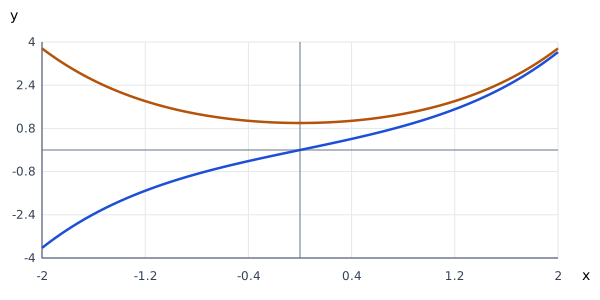
Use exponential definitions and identities consistently. Use logarithmic forms with their real domains.
Notes and key methods
Definitions are \(\sinh x=(e^x-e^{-x})/2\), \(\cosh x=(e^x+e^{-x})/2\), \(\tanh x=\sinh x/\cosh x\), and \(\operatorname{sech}x=1/\cosh x\). They imply cosh²x−sinh²x=1.
Unlike cos x, cosh x is at least one for real x. Sinh is odd and strictly increasing; cosh is even. Work from exponentials when proving a hyperbolic identity rather than borrowing an unchecked circular-trigonometric sign.
For real x, \(\operatorname{arsinh}x=\ln(x+\sqrt{x^2+1})\). On x≥1, \(\operatorname{arcosh}x=\ln(x+\sqrt{x^2-1})\) is nonnegative. For |x|<1, \(\operatorname{artanh}x=\frac12\ln[(1+x)/(1-x)]\).
These are inverse functions, not reciprocals. Solving an equation involving cosh requires choosing a branch unless its argument is explicitly restricted to be nonnegative.
Check the conditions
The argument is real unless stated otherwise.
Cosh is never zero on the real axis.
Arcosh has real domain [1,∞), with range [0,∞).
Artanh has real domain (−1,1).
Three worked examples
Example 1 · Hyperbolic functions
Let \(u=\ln 4\). Use exact exponential definitions.
Use the labelled scales alongside the numerical method.
Find sinh u.
Find cosh u.
Find tanh u.
Find sech u.
Show the reasoning
(a)
\((4-1/4)/2=\frac{15}{8}\)
Answer: \(\frac{15}{8}\).
(b)
\((4+1/4)/2=\frac{17}{8}\)
Answer: \(\frac{17}{8}\).
(c)
\(\sinh u/\cosh u=\frac{15}{17}\)
Answer: \(\frac{15}{17}\).
(d)
\(1/\cosh u=\frac{8}{17}\)
Answer: \(\frac{8}{17}\).
Example 2 · Inverse hyperbolic functions
Use the real inverse functions, with \(a=5,\ p=\frac{2}{3}\).
Find arsinh(a).
Find the nonnegative value arcosh(a).
Find artanh(p).
Find exp(2 artanh(p)).
Show the reasoning
(a)
\(\ln(a+\sqrt{a^2+1})=2.31243834127275\)
Answer: \(2.31243834127275\).
(b)
\(\ln(a+\sqrt{a^2-1})=2.29243166956118\)
Answer: \(2.29243166956118\).
(c)
\(\frac12\ln[(1+p)/(1-p)]=0.80471895621705\)
Answer: \(0.80471895621705\).
(d)
\((1+p)/(1-p)=5\)
Answer: \(5\).
Example 3 · Hyperbolic functions
Let \(u=\ln 6\). Use exact exponential definitions.
Use the labelled scales alongside the numerical method.
Find sinh u.
Find cosh u.
Find tanh u.
Find sech u.
Show the reasoning
(a)
\((6-1/6)/2=\frac{35}{12}\)
Answer: \(\frac{35}{12}\).
(b)
\((6+1/6)/2=\frac{37}{12}\)
Answer: \(\frac{37}{12}\).
(c)
\(\sinh u/\cosh u=\frac{35}{37}\)
Answer: \(\frac{35}{37}\).
(d)
\(1/\cosh u=\frac{12}{37}\)
Answer: \(\frac{12}{37}\).
Common mistakes
The fundamental identity has a minus sign.
Sech is a reciprocal, not an inverse function.
Sinh⁻¹x is not 1/sinh x when inverse notation is intended.
Do not drop the negative solution of cosh u=c without a branch condition.