Study guides › 9231 FP2 › Hyperbolic functions Maths4U Original · Learn, check, explain
Exponential forms of hyperbolic functions — 9231 FP2
Use exponential definitions and identities consistently.
1. Understand 2. See examples 3. Check answers 4. Explain your working Notes and key methods Definitions are \(\displaystyle \sinh x= \frac{e^{x}- e^{- x}}{2}\), \(\displaystyle \cosh x= \frac{e^{x}+ e^{- x}}{2}\), \(\displaystyle \tanh x= \frac{\sinh x}{\cosh x}\), and \(\displaystyle \operatorname{sech}x= \frac{1}{\cosh x}\). They imply \(\displaystyle \cosh ^{2}x-\sinh ^{2}x=1\).
Unlike cos x, cosh x is at least one for real x. Sinh is odd and strictly increasing; cosh is even. Work from exponentials when proving a hyperbolic identity rather than borrowing an unchecked circular-trigonometric sign.
Check the conditions The argument is real unless stated otherwise. Cosh is never zero on the real axis. Three worked examples Example 1 · Hyperbolic functions Let \(u=\ln 4\). Use exact exponential definitions.
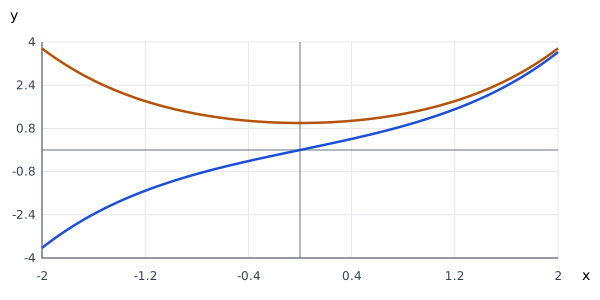
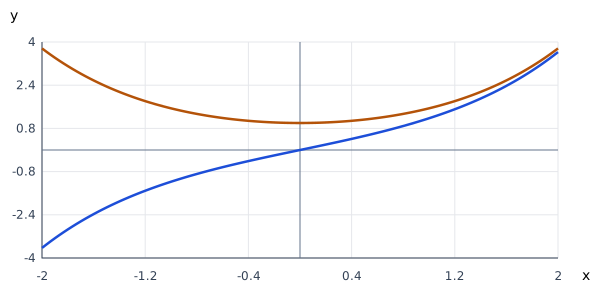
Use the labelled scales alongside the numerical method. Find sinh u. Find cosh u. Find tanh u. Find sech u. Show the reasoning (a) \(\displaystyle \frac{4- \frac{1}{4}}{2}= \frac{15}{8}\)
Answer: \(\displaystyle \frac{15}{8}\).
(b) \(\displaystyle \frac{4+ \frac{1}{4}}{2}= \frac{17}{8}\)
Answer: \(\displaystyle \frac{17}{8}\).
(c) \(\displaystyle \frac{\sinh u}{\cosh u}= \frac{15}{17}\)
Answer: \(\displaystyle \frac{15}{17}\).
(d) \(\displaystyle \frac{1}{\cosh u}= \frac{8}{17}\)
Answer: \(\displaystyle \frac{8}{17}\).
Example 2 · Hyperbolic functions Let \(u=\ln 5\). Use exact exponential definitions.
Use the labelled scales alongside the numerical method. Find sinh u. Find cosh u. Find tanh u. Find sech u. Show the reasoning (a) \(\displaystyle \frac{5- \frac{1}{5}}{2}= \frac{12}{5}\)
Answer: \(\displaystyle \frac{12}{5}\).
(b) \(\displaystyle \frac{5+ \frac{1}{5}}{2}= \frac{13}{5}\)
Answer: \(\displaystyle \frac{13}{5}\).
(c) \(\displaystyle \frac{\sinh u}{\cosh u}= \frac{12}{13}\)
Answer: \(\displaystyle \frac{12}{13}\).
(d) \(\displaystyle \frac{1}{\cosh u}= \frac{5}{13}\)
Answer: \(\displaystyle \frac{5}{13}\).
Example 3 · Hyperbolic functions Let \(u=\ln 6\). Use exact exponential definitions.
Use the labelled scales alongside the numerical method. Find sinh u. Find cosh u. Find tanh u. Find sech u. Show the reasoning (a) \(\displaystyle \frac{6- \frac{1}{6}}{2}= \frac{35}{12}\)
Answer: \(\displaystyle \frac{35}{12}\).
(b) \(\displaystyle \frac{6+ \frac{1}{6}}{2}= \frac{37}{12}\)
Answer: \(\displaystyle \frac{37}{12}\).
(c) \(\displaystyle \frac{\sinh u}{\cosh u}= \frac{35}{37}\)
Answer: \(\displaystyle \frac{35}{37}\).
(d) \(\displaystyle \frac{1}{\cosh u}= \frac{12}{37}\)
Answer: \(\displaystyle \frac{12}{37}\).
Original exam-style problems Write complete solutions before opening the worked solution. The marking guidance rewards reasoning as well as answers.
Next skill: Hyperbolic identities →
About these materials Prepared independently from learning objectives with AI assistance for Maths4U. Mathematical checks accompany the authored models; independent teacher review is pending. Maths4U marking guidance is not an official examination-board mark scheme. Existing questions keep their original sources and results.