Maths4U
Menu

Maths4U Original · Learn, check, explain

The polar system — 9231 FP1

Convert polar coordinates and use the polar sector-area integral.

Notes and key methods

Use \(x=r\cos\theta\), \(y=r\sin\theta\), and \(r^2=x^2+y^2\). A polar area is \(\displaystyle \frac12\int_\alpha^\beta r(\theta)^2\,d\theta\), with limits chosen to trace the intended region once.

A tangent gradient is \(\displaystyle \frac{r'\sin \theta + r\cos \theta }{r'\cos \theta - r\sin \theta }\) when the denominator is nonzero. Test both numerator and denominator when deciding between a horizontal tangent, a vertical tangent or a singular point.

Check the conditions

Three worked examples

Example 1 · Polar coordinates, tangents and areas

The closed polar curve is \(\displaystyle r=3(1+\frac{1}{2}\cos\theta)\) for \(0\le\theta\le2\pi\). Its radius is positive on this interval.

Diagram for this worked example
Use the labelled scales alongside the numerical method.
  1. Find the maximum radius.
  2. The enclosed area is Aπ. Find A.
  3. Find the tangent gradient at \(\displaystyle \theta = \frac{\pi }{2}\).
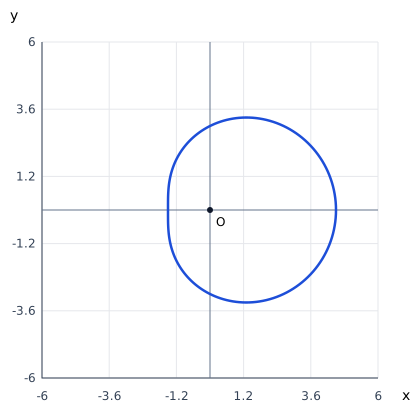
  4. Find the y-coordinate at \(\displaystyle \theta = \frac{\pi }{2}\).
Show the reasoning

(a)

\(\displaystyle r_{max}=3(1+\frac{1}{2})=\frac{9}{2}\)

Answer: \(\displaystyle \frac{9}{2}\).

(b)

\(\displaystyle \frac{1}{2}\int_{0}^{2\pi } r^{2}\, d\theta = \pi a^{2}(1+ \frac{b^{2}}{2})\); coefficient \(\displaystyle \frac{81}{8}\).

Answer: \(\displaystyle \frac{81}{8}\).

(c)

\(\displaystyle \frac{dy}{dx}= \frac{r'\sin \theta + r\cos \theta }{r'\cos \theta - r\sin \theta }= b= \frac{1}{2}\)

Answer: \(\displaystyle \frac{1}{2}\).

(d)

\(\displaystyle y= r\sin (\frac{\pi }{2})= 3\)

Answer: \(3\).

Example 2 · Polar coordinates, tangents and areas

The closed polar curve is \(\displaystyle r=4(1+\frac{3}{4}\cos\theta)\) for \(0\le\theta\le2\pi\). Its radius is positive on this interval.

Diagram for this worked example
Use the labelled scales alongside the numerical method.
  1. Find the maximum radius.
  2. The enclosed area is Aπ. Find A.
  3. Find the tangent gradient at \(\displaystyle \theta = \frac{\pi }{2}\).
  4. Find the y-coordinate at \(\displaystyle \theta = \frac{\pi }{2}\).
Show the reasoning

(a)

\(\displaystyle r_{max}=4(1+\frac{3}{4})=7\)

Answer: \(7\).

(b)

\(\displaystyle \frac{1}{2}\int_{0}^{2\pi } r^{2}\, d\theta = \pi a^{2}(1+ \frac{b^{2}}{2})\); coefficient \(\displaystyle \frac{41}{2}\).

Answer: \(\displaystyle \frac{41}{2}\).

(c)

\(\displaystyle \frac{dy}{dx}= \frac{r'\sin \theta + r\cos \theta }{r'\cos \theta - r\sin \theta }= b= \frac{3}{4}\)

Answer: \(\displaystyle \frac{3}{4}\).

(d)

\(\displaystyle y= r\sin (\frac{\pi }{2})= 4\)

Answer: \(4\).

Example 3 · Polar coordinates, tangents and areas

The closed polar curve is \(\displaystyle r=5(1+\frac{1}{4}\cos\theta)\) for \(0\le\theta\le2\pi\). Its radius is positive on this interval.

Diagram for this worked example
Use the labelled scales alongside the numerical method.
  1. Find the maximum radius.
  2. The enclosed area is Aπ. Find A.
  3. Find the tangent gradient at \(\displaystyle \theta = \frac{\pi }{2}\).
  4. Find the y-coordinate at \(\displaystyle \theta = \frac{\pi }{2}\).
Show the reasoning

(a)

\(\displaystyle r_{max}=5(1+\frac{1}{4})=\frac{25}{4}\)

Answer: \(\displaystyle \frac{25}{4}\).

(b)

\(\displaystyle \frac{1}{2}\int_{0}^{2\pi } r^{2}\, d\theta = \pi a^{2}(1+ \frac{b^{2}}{2})\); coefficient \(\displaystyle \frac{825}{32}\).

Answer: \(\displaystyle \frac{825}{32}\).

(c)

\(\displaystyle \frac{dy}{dx}= \frac{r'\sin \theta + r\cos \theta }{r'\cos \theta - r\sin \theta }= b= \frac{1}{4}\)

Answer: \(\displaystyle \frac{1}{4}\).

(d)

\(\displaystyle y= r\sin (\frac{\pi }{2})= 5\)

Answer: \(5\).

Common mistakes

Practise with answer checking

Original exam-style problems

Write complete solutions before opening the worked solution. The marking guidance rewards reasoning as well as answers.

Examination practice · 2020–2026

Apply the method to recent source-labelled questions from this chapter.

Browse recent examination questions · All topic resources and the full bank

Next skill: Applications of polar coordinates →