Separate a rational function into a polynomial part and a proper fraction. Use denominator exclusions and interval sign changes.
Notes and key methods
Polynomial division gives a rational curve in a useful form, for example \(\displaystyle f(x)= x+ a+ \frac{b}{x- c}\). If \(\displaystyle b\ne 0, x=c\) is a vertical asymptote and \(\displaystyle y=x+a\) is an oblique asymptote.
Differentiate the whole expression to find stationary points. In an inequality, move terms to one side and construct a sign chart including both zeros and denominator exclusions. A hole created by cancellation is not automatically a vertical asymptote.
For \(\displaystyle \frac{x- a}{x- b}> 0\), mark the numerator zero a and excluded denominator zero b on a number line. On each interval the sign is constant unless a zero or pole is crossed.
For \(|f(x)|<k\), solve −k<f(x)<k, keeping domain restrictions. A graph of |f(x)| reflects negative parts above the x-axis; f(|x|) instead copies the right-hand half across the vertical axis.
Check the conditions
Keep every original denominator exclusion.
Check that a numerator factor does not cancel before identifying a vertical asymptote.
Do not include a pole under any weak inequality.
Strict inequalities also exclude numerator zeros.
Three worked examples
Example 1 · Rational curves and asymptotes
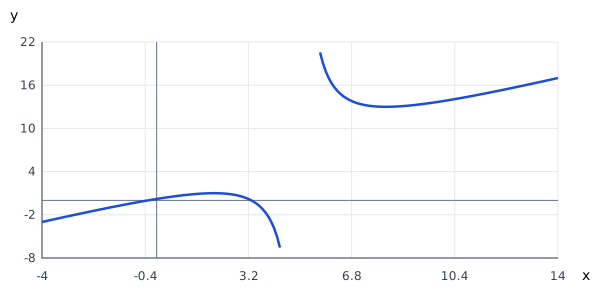
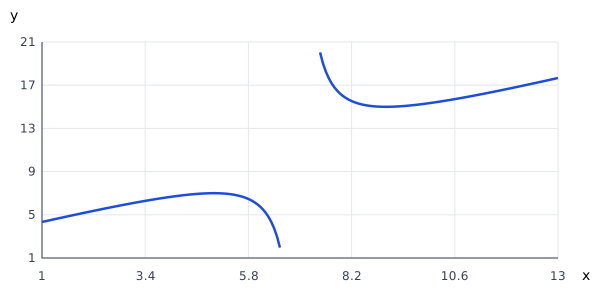
For \(x\ne 5\), let \(\displaystyle f(x)=x + 2 + \frac{9}{x - 5}\).
Use the labelled scales alongside the numerical method.
Find the x-coordinate of the vertical asymptote.
Find the y-intercept of the oblique asymptote.
Find the smaller stationary x-coordinate.
Find the y-coordinate at the larger stationary x-coordinate.
Show the reasoning
(a)
\(x=5\) because the proper fraction has a nonzero numerator.