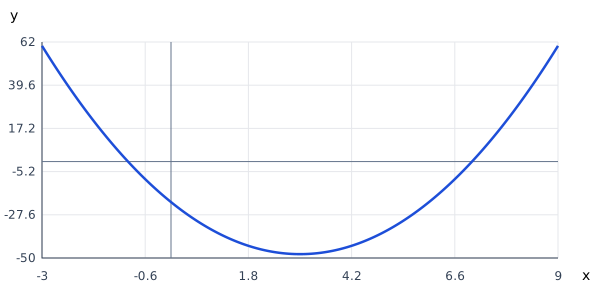
Use completed-square and factor forms for different questions.
Notes and key methods
The form \(a(x-h)^2+k\) reveals a vertex; a factor form reveals roots. With a>0 the vertex is a minimum. The discriminant \(\displaystyle b^{2}-4ac\) is positive, zero or negative according as there are two distinct, one repeated or no real roots.
For an upward-opening quadratic with distinct roots \(\displaystyle u<v, f(x)\le 0\) precisely on [u,v]. A line-intersection problem is a quadratic equation after substitution; check both coordinates.
Check the conditions
The leading coefficient is nonzero.
Use the sign of the leading coefficient in an inequality.
Three worked examples
Example 1 · Quadratics, roots and extrema
\(f{\left(x \right)} = 3 x^{2} - 18 x - 21\).
Use the labelled scales alongside the numerical method.
Express f(x) in completed-square form and state its minimum.
Solve \(\displaystyle f(x)=0\).
Solve \(\displaystyle f(x)\le 0\).
Find the discriminant.
Show the reasoning
(a)
\(3 \left(x - 3\right)^{2} - 48 = 3 \left(x - 3\right)^{2} - 48\); the minimum is -48 at \(\displaystyle x=3\).