Study guides › 0606 › Functions Maths4U Original · Learn, check, explain
Modulus functions and transformations — 0606
Use distance from a vertex to solve a modulus equation or inequality.
1. Understand 2. See examples 3. Check answers 4. Explain your working Notes and key methods For \(f(x)=a|x-h|+k\), a>0, the vertex is (h,k), the least value is k, and the two slopes are −a and a.
For d>0, \(|x-h|<d\) means h−d<x<h+d; the reversed strict inequality gives the two exterior intervals. Use closed endpoints for ≤ or \(\displaystyle \ge . A\) graph verifies which side of the boundary is required.
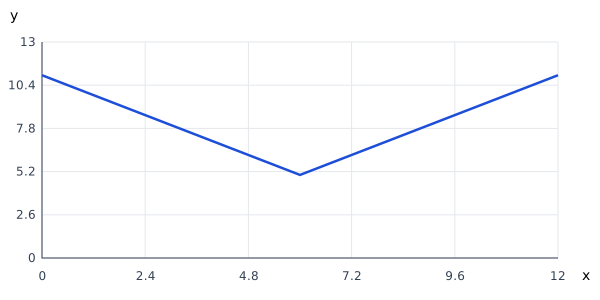
Check the conditions The coefficient a and distance d are positive. Check whether boundary points are included. Three worked examples Example 1 · Linear modulus graphs and inequalities \(f{\left(x \right)} = \left|{x - 6}\right| + 5\). Here \(\displaystyle a=1, h=6, k=5, d=3\).
Use the labelled scales alongside the numerical method. State the vertex and describe both straight-line branches. Solve f(x)=k+ad. Solve f(x)<k+ad, showing the interval endpoints. Find the length of the interval where f(x)<k+ad. Show the reasoning (a) The branches are \(\displaystyle y=1(h-x)+k\) for \(\displaystyle x\le h\) and \(\displaystyle y=1(x-h)+k\) for \(\displaystyle x\ge h\).
Answer: \(\left( 6, \ 5\right)\)
(b) \(\left|{x - 6}\right| = 3\) gives both boundary values.
Answer: \(\left\{3, 9\right\}\)
(c) \(\left|{x - 6}\right| < 3\) describes points less than distance d from h.
Answer: \(\left(3, 9\right)\)
(d) The interval runs from h−d to h+d.
\(6\)
Answer: \(6\).
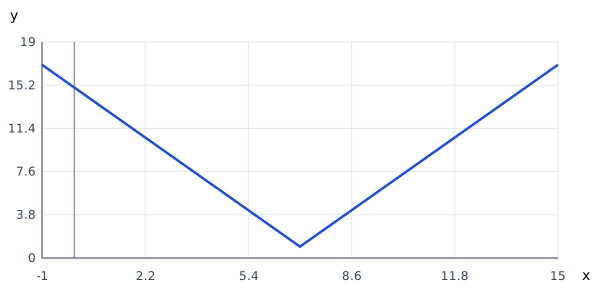
Example 2 · Linear modulus graphs and inequalities \(f{\left(x \right)} = 2 \left|{x - 7}\right| + 1\). Here \(\displaystyle a=2, h=7, k=1, d=4\).
Use the labelled scales alongside the numerical method. State the vertex and describe both straight-line branches. Solve f(x)=k+ad. Solve f(x)<k+ad, showing the interval endpoints. Find the length of the interval where f(x)<k+ad. Show the reasoning (a) The branches are \(\displaystyle y=2(h-x)+k\) for \(\displaystyle x\le h\) and \(\displaystyle y=2(x-h)+k\) for \(\displaystyle x\ge h\).
Answer: \(\left( 7, \ 1\right)\)
(b) \(\left|{x - 7}\right| = 4\) gives both boundary values.
Answer: \(\left\{3, 11\right\}\)
(c) \(\left|{x - 7}\right| < 4\) describes points less than distance d from h.
Answer: \(\left(3, 11\right)\)
(d) The interval runs from h−d to h+d.
\(8\)
Answer: \(8\).
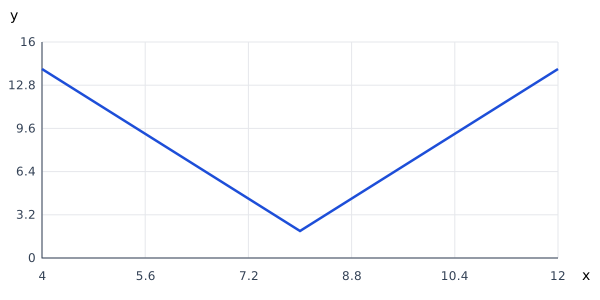
Example 3 · Linear modulus graphs and inequalities \(f{\left(x \right)} = 3 \left|{x - 8}\right| + 2\). Here \(\displaystyle a=3, h=8, k=2, d=2\).
Use the labelled scales alongside the numerical method. State the vertex and describe both straight-line branches. Solve f(x)=k+ad. Solve f(x)<k+ad, showing the interval endpoints. Find the length of the interval where f(x)<k+ad. Show the reasoning (a) The branches are \(\displaystyle y=3(h-x)+k\) for \(\displaystyle x\le h\) and \(\displaystyle y=3(x-h)+k\) for \(\displaystyle x\ge h\).
Answer: \(\left( 8, \ 2\right)\)
(b) \(\left|{x - 8}\right| = 2\) gives both boundary values.
Answer: \(\left\{6, 10\right\}\)
(c) \(\left|{x - 8}\right| < 2\) describes points less than distance d from h.
Answer: \(\left(6, 10\right)\)
(d) The interval runs from h−d to h+d.
\(4\)
Answer: \(4\).
Original exam-style problems Write complete solutions before opening the worked solution. The marking guidance rewards reasoning as well as answers.
Next skill: Inverse functions and restricted domains →
About these materials Prepared independently from learning objectives with AI assistance for Maths4U. Mathematical checks accompany the authored models; independent teacher review is pending. Maths4U marking guidance is not an official examination-board mark scheme. Existing questions keep their original sources and results.