Maths4U
Menu

Maths4U Original · Learn, check, explain

Exponential graphs and inverse rules — 0606

Read an exponential transformation and obtain its logarithmic inverse.

Notes and key methods

For \(\displaystyle f(x)=D+A\cdot 2^{B(x-h)}\) with A,B>0, the domain is all real x, the range is (D,∞), and the horizontal asymptote is \(\displaystyle y=D\). The function increases and never attains its asymptote.

To invert it, subtract D, divide by A, take a base-two logarithm and solve for the original input. The inverse graph reflects the original in \(\displaystyle y=x\), exchanging domain and range.

Check the conditions

Three worked examples

Example 1 · Exponential graphs and inverses

Let \(f(x)=4 \cdot 2^{3 x - 9} + 3\). For short checks use \(\displaystyle h=3, B=3, A=4, D=3\).

Diagram for this worked example
Use the labelled scales alongside the numerical method.
  1. State the domain, range and asymptote of f.
  2. Find \(\displaystyle f^{−1}\) and state its domain and range.
  3. Find \(\displaystyle f(h+ \frac{1}{B})\).
  4. Find the x-value where \(\displaystyle f(x)=D+4A\).
Show the reasoning

(a)

Every real input gives a positive exponential term. Thus the output is strictly above D, approaching but never reaching that height.
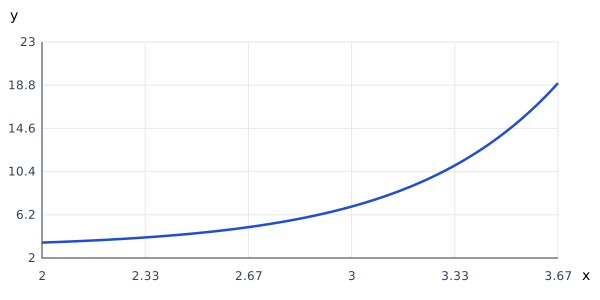
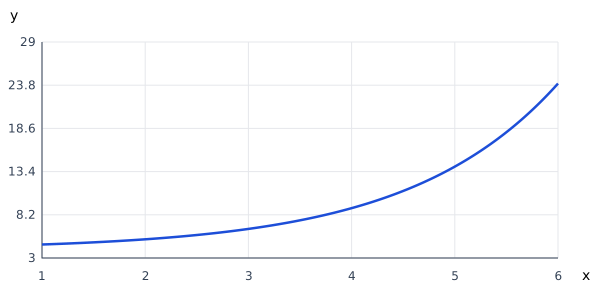
Answer: \(\mathbb{R}\); \(\left(3, \infty\right)\); \(y=3\).

(b)

Reverse the linear shift and scale, take \(\displaystyle \log _{2}\), divide by B and add h. Exchange the original domain and range.

Answer: \(\displaystyle \frac{\log{\left(\frac{x}{4} - \frac{3}{4} \right)}}{3 \log{\left(2 \right)}} + 3\); domain \(\left(3, \infty\right)\); range \(\mathbb{R}\).

(c)

The exponent is one.

\(11\)

Answer: \(11\).

(d)

Set the exponential factor equal to four, so \(\displaystyle B(x-h)=2\).

\(\displaystyle \frac{11}{3}\)

Answer: \(\displaystyle \frac{11}{3}\).

Example 2 · Exponential graphs and inverses

Let \(f(x)=5 \cdot 2^{x - 4} + 4\). For short checks use \(\displaystyle h=4, B=1, A=5, D=4\).

Diagram for this worked example
Use the labelled scales alongside the numerical method.
  1. State the domain, range and asymptote of f.
  2. Find \(\displaystyle f^{−1}\) and state its domain and range.
  3. Find \(\displaystyle f(h+ \frac{1}{B})\).
  4. Find the x-value where \(\displaystyle f(x)=D+4A\).
Show the reasoning

(a)

Every real input gives a positive exponential term. Thus the output is strictly above D, approaching but never reaching that height.
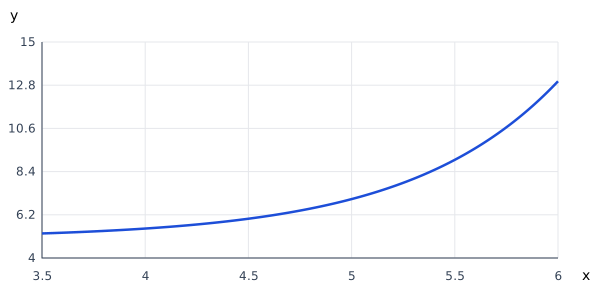
Answer: \(\mathbb{R}\); \(\left(4, \infty\right)\); \(y=4\).

(b)

Reverse the linear shift and scale, take \(\displaystyle \log _{2}\), divide by B and add h. Exchange the original domain and range.

Answer: \(\displaystyle \frac{\log{\left(\frac{x}{5} - \frac{4}{5} \right)}}{\log{\left(2 \right)}} + 4\); domain \(\left(4, \infty\right)\); range \(\mathbb{R}\).

(c)

The exponent is one.

\(14\)

Answer: \(14\).

(d)

Set the exponential factor equal to four, so \(\displaystyle B(x-h)=2\).

\(6\)

Answer: \(6\).

Example 3 · Exponential graphs and inverses

Let \(f(x)=2 \cdot 2^{2 x - 10} + 5\). For short checks use \(\displaystyle h=5, B=2, A=2, D=5\).

Diagram for this worked example
Use the labelled scales alongside the numerical method.
  1. State the domain, range and asymptote of f.
  2. Find \(\displaystyle f^{−1}\) and state its domain and range.
  3. Find \(\displaystyle f(h+ \frac{1}{B})\).
  4. Find the x-value where \(\displaystyle f(x)=D+4A\).
Show the reasoning

(a)

Every real input gives a positive exponential term. Thus the output is strictly above D, approaching but never reaching that height.

Answer: \(\mathbb{R}\); \(\left(5, \infty\right)\); \(y=5\).

(b)

Reverse the linear shift and scale, take \(\displaystyle \log _{2}\), divide by B and add h. Exchange the original domain and range.

Answer: \(\displaystyle \frac{\log{\left(\frac{x}{2} - \frac{5}{2} \right)}}{2 \log{\left(2 \right)}} + 5\); domain \(\left(5, \infty\right)\); range \(\mathbb{R}\).

(c)

The exponent is one.

\(9\)

Answer: \(9\).

(d)

Set the exponential factor equal to four, so \(\displaystyle B(x-h)=2\).

\(6\)

Answer: \(6\).

Common mistakes

Practise with answer checking

Original exam-style problems

Write complete solutions before opening the worked solution. The marking guidance rewards reasoning as well as answers.

Examination practice · 2020–2026

Apply the method to recent source-labelled questions from this chapter.

Browse recent examination questions · All topic resources and the full bank

Next skill: Logarithms and exponentials: review →