Recover a centre and radius from an expanded circle equation.
Notes and key methods
The equation \((x-h)^2+(y-k)^2=r^2\) describes a circle with centre (h,k) and radius r>0. Complete each square separately when the equation is expanded.
A point lies on, inside or outside according as its squared distance from the centre equals, is below or exceeds \(\displaystyle r^{2}. A\) negative recovered \(\displaystyle r^{2}\) gives no real circle.
Check the conditions
The radius is positive.
Use squared distance when comparing a point with a circle.
Three worked examples
Example 1 · Circle equations and completed squares
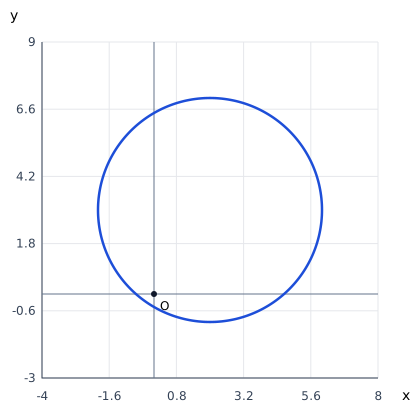
A circle has equation \(x^{2} - 4 x + y^{2} - 6 y - 3 = 0\).
Use the labelled scales alongside the numerical method.
Find the centre and radius.
Find both intersections with \(\displaystyle y=3\).
Find the squared radius.
Find the greatest x-coordinate on the circle.
Show the reasoning
(a)
\(\left(x - 2\right)^{2} + \left(y - 3\right)^{2} = 16\) is the completed-square form.
Answer: \(\left( 2, \ 3\right)\); \(4\)
(b)
Substitution gives \(\displaystyle (x-h)^{2}=r^{2}\), with two signs.