Distinguish signed integration from positive geometric area.
Notes and key methods
A definite integral is signed: portions below the x-axis contribute negatively. To find geometric area, locate intercepts and split the interval at sign changes. For two curves, integrate upper minus lower on each appropriate interval.
Include exact intersection limits in the working. A sketch helps identify signs but does not replace solving for the bounds.
Check the conditions
Identify intercepts or curve intersections first.
Geometric area is nonnegative.
Three worked examples
Example 1 · Areas and definite integrals
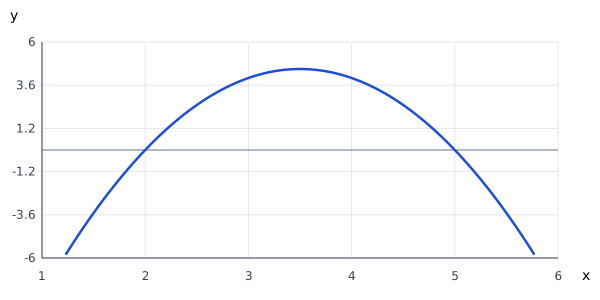
The curve is \(y=\left(5 - x\right) \left(2 x - 4\right)\). Consider the finite region bounded by the curve and the x-axis.
Use the labelled scales alongside the numerical method.
Find and justify the finite region bounds.
Calculate the area of the finite region.
Find the area between the curve and the x-axis.
Find the maximum height above the x-axis.
Show the reasoning
(a)
The intercept factors give the two endpoints; the leading coefficient is negative, so the curve is above the axis between them.
Answer: \(2\le x\le 5\)
(b)
Integrate \(\left(5 - x\right) \left(2 x - 4\right)\) from \(2\) to \(5\). A primitive is \(\displaystyle - \frac{2 x^{3}}{3} + 7 x^{2} - 20 x\), and upper minus lower gives \(9\).
Answer: \(9\)
(c)
The quadratic is nonnegative between its roots.
\(9\)
Answer: \(9\).
(d)
The vertex lies midway between the roots.
\(\displaystyle \frac{9}{2}\)
Answer: \(\displaystyle \frac{9}{2}\).
Example 2 · Areas and definite integrals
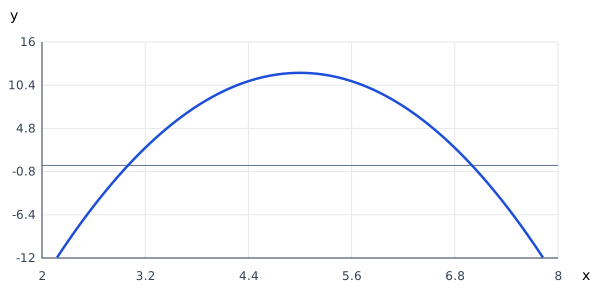
The curve is \(y=\left(7 - x\right) \left(3 x - 9\right)\). Consider the finite region bounded by the curve and the x-axis.
Use the labelled scales alongside the numerical method.
Find and justify the finite region bounds.
Calculate the area of the finite region.
Find the area between the curve and the x-axis.
Find the maximum height above the x-axis.
Show the reasoning
(a)
The intercept factors give the two endpoints; the leading coefficient is negative, so the curve is above the axis between them.
Answer: \(3\le x\le 7\)
(b)
Integrate \(\left(7 - x\right) \left(3 x - 9\right)\) from \(3\) to \(7\). A primitive is \(- x^{3} + 15 x^{2} - 63 x\), and upper minus lower gives \(32\).
Answer: \(32\)
(c)
The quadratic is nonnegative between its roots.
\(32\)
Answer: \(32\).
(d)
The vertex lies midway between the roots.
\(12\)
Answer: \(12\).
Example 3 · Areas and definite integrals
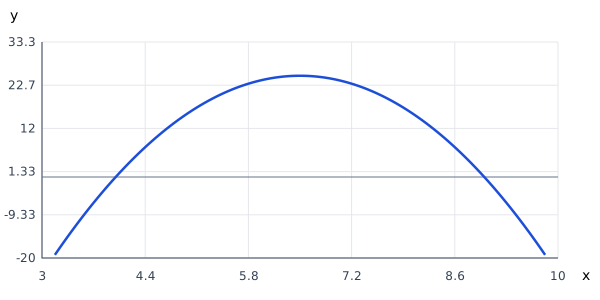
The curve is \(y=\left(9 - x\right) \left(4 x - 16\right)\). Consider the finite region bounded by the curve and the x-axis.
Use the labelled scales alongside the numerical method.
Find and justify the finite region bounds.
Calculate the area of the finite region.
Find the area between the curve and the x-axis.
Find the maximum height above the x-axis.
Show the reasoning
(a)
The intercept factors give the two endpoints; the leading coefficient is negative, so the curve is above the axis between them.
Answer: \(4\le x\le 9\)
(b)
Integrate \(\left(9 - x\right) \left(4 x - 16\right)\) from \(4\) to \(9\). A primitive is \(\displaystyle - \frac{4 x^{3}}{3} + 26 x^{2} - 144 x\), and upper minus lower gives \(\displaystyle \frac{250}{3}\).
Answer: \(\displaystyle \frac{250}{3}\)
(c)
The quadratic is nonnegative between its roots.
\(\displaystyle \frac{250}{3}\)
Answer: \(\displaystyle \frac{250}{3}\).
(d)
The vertex lies midway between the roots.
\(25\)
Answer: \(25\).
Common mistakes
Do not take an absolute value before checking internal sign changes.