Completing the square and quadratic turning points — 0580
Expose a quadratic vertex by completing the whole square.
Extended · Syllabus E2.2, E2.5, E2.11
Notes and key methods
Factor out the coefficient of \(\displaystyle x^{2}\) before completing the square inside the bracket. Use \(\displaystyle x^{2}\)+px=\(\displaystyle (x+ \frac{p}{2})^{2}- (\frac{p}{2})^{2}\), and multiply every correction back by the original coefficient.
The form \(\displaystyle a(x-h)^{2}+k\) has vertex (h,k). When a>0 its minimum is k; when a<0 it has a maximum. To solve a related equation, isolate the square and consider both real signs, checking whether the squared value can be nonnegative.
Check the conditions
Use the stated units and precision.
Show the method as well as the final answer.
Three worked examples
Example 1 · Completing the square and quadratic turning points
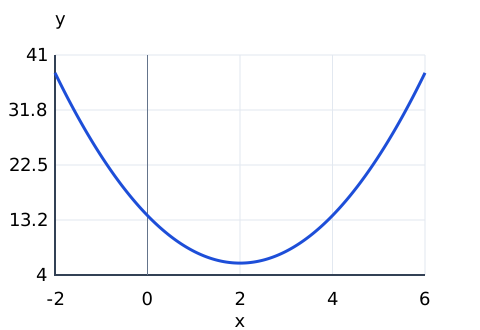
For real x, \(f(x)=2 x^{2} - 8 x + 14\).
Read the description and labels. Geometric sketches are schematic unless coordinate scales are shown.
Write f in completed-square form and state the vertex.
State the range of f and justify it.
Solve \(f(x)=24\).
Find the y-intercept of the graph.
Show the reasoning
(a)
\(f(x)=2 \left(x - 2\right)^{2} + 6\) expands to the given expression. The square vanishes at \(\displaystyle x=2\).