9709 P12 - Nov 2023 - Q10
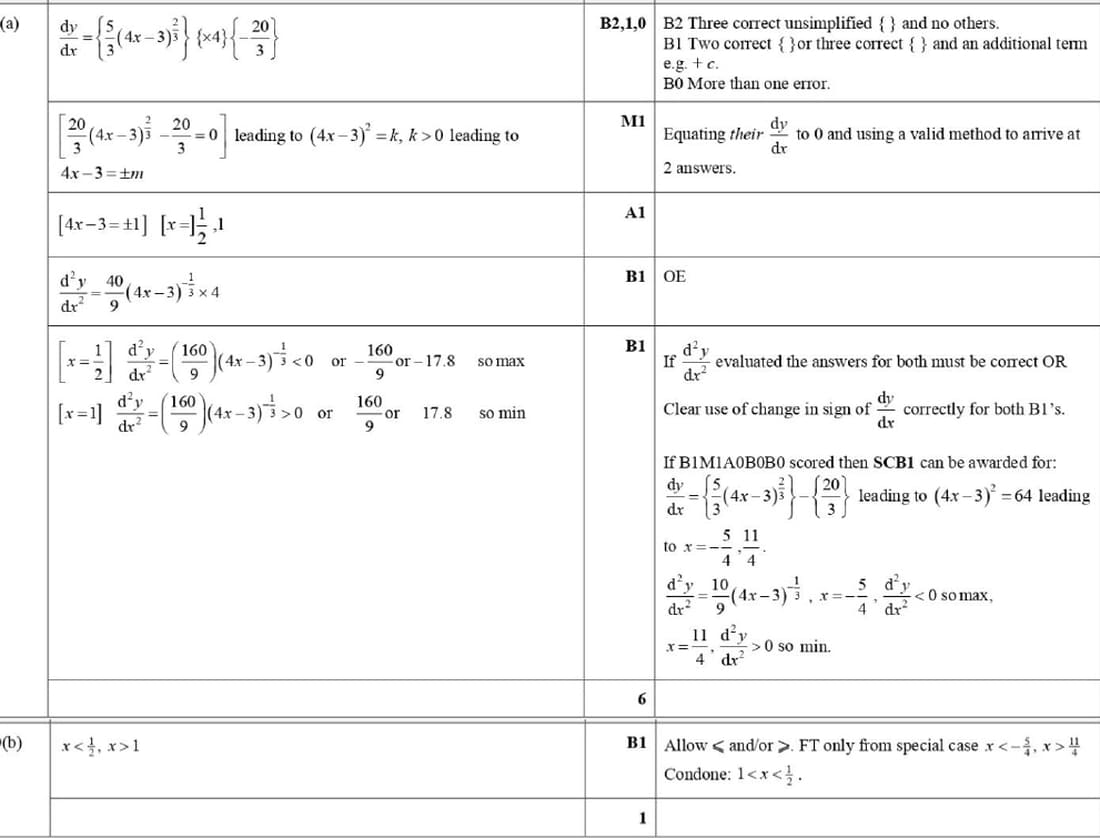
The equation of a curve is \(y = f(x)\), where \(f(x) = (4x - 3)^{\frac{5}{3}} - \frac{20}{3}x\).
(a) Find the \(x\)-coordinates of the stationary points of the curve and determine their nature.
(b) State the set of values for which the function \(f\) is increasing.
9709 P11 - Nov 2020 - Q6
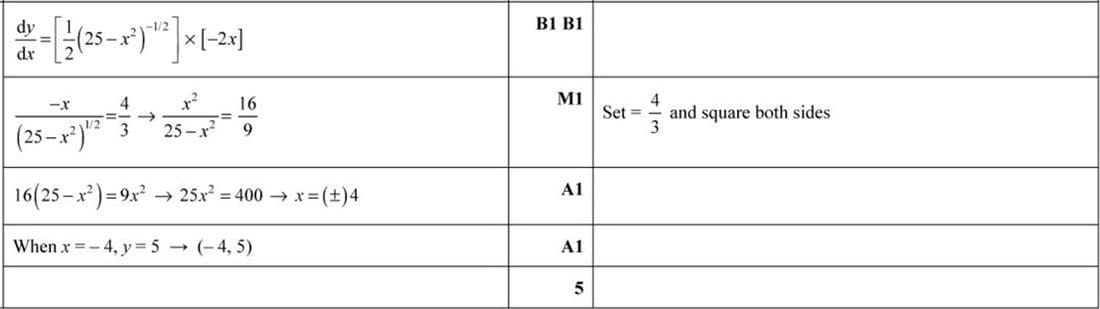
The equation of a curve is \(y = 2 + \sqrt{25 - x^2}\).
Find the coordinates of the point on the curve at which the gradient is \(\frac{4}{3}\).
9709 P12 - Jun 2020 - Q10
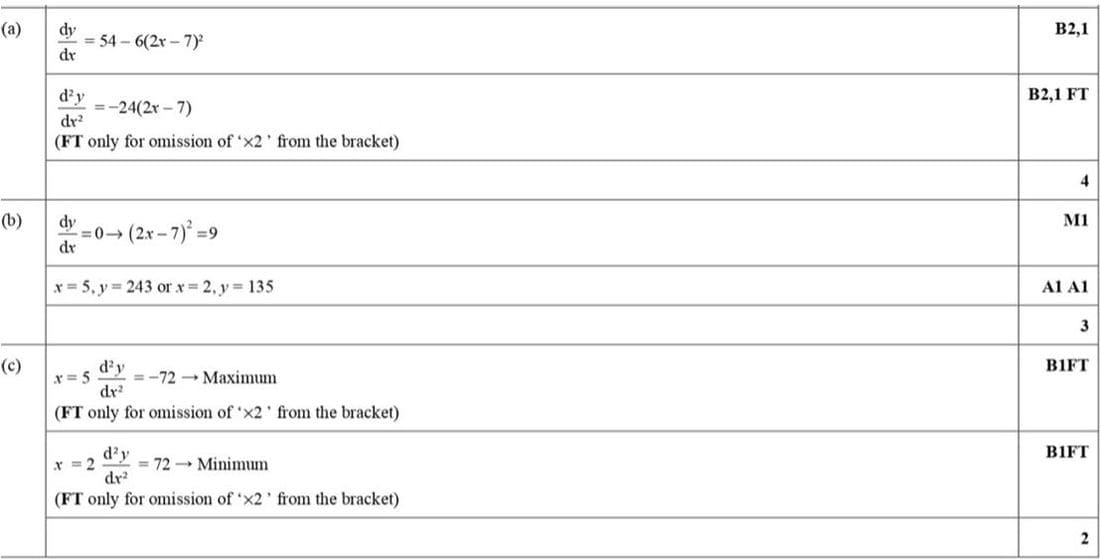
The equation of a curve is \(y = 54x - (2x - 7)^3\).
(a) Find \(\frac{dy}{dx}\) and \(\frac{d^2y}{dx^2}\).
(b) Find the coordinates of each of the stationary points on the curve.
(c) Determine the nature of each of the stationary points.
9709 P11 - Jun 2020 - Q9
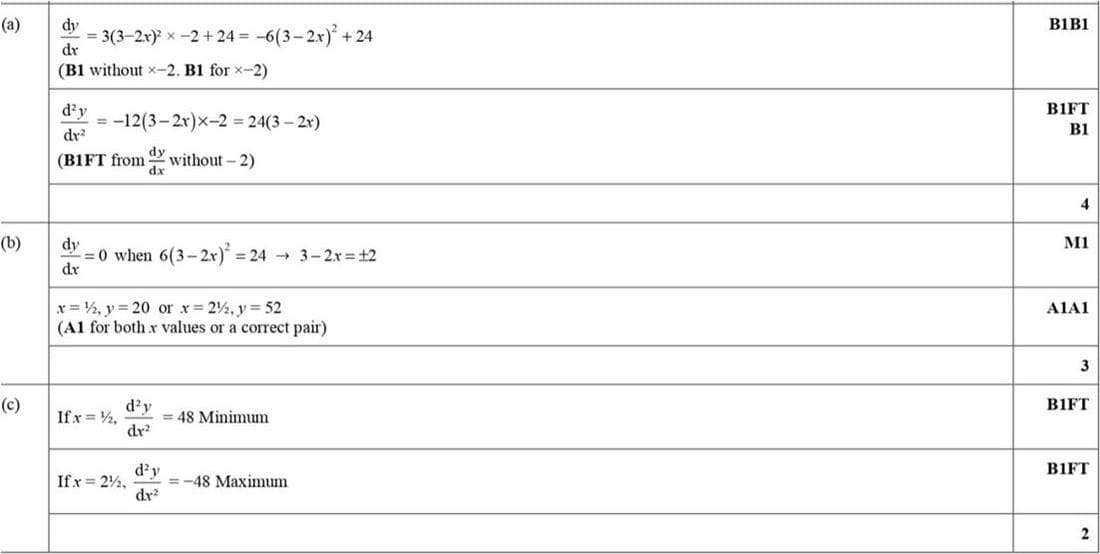
The equation of a curve is \(y = (3 - 2x)^3 + 24x\).
(a) Find expressions for \(\frac{dy}{dx}\) and \(\frac{d^2y}{dx^2}\).
(b) Find the coordinates of each of the stationary points on the curve.
(c) Determine the nature of each stationary point.
9709 P13 - Nov 2019 - Q3
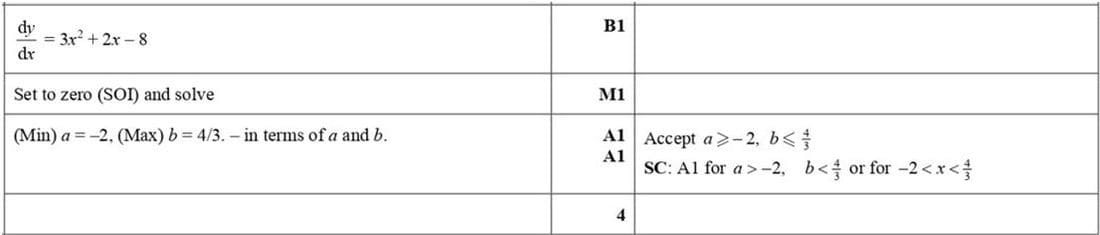
The equation of a curve is \(y = x^3 + x^2 - 8x + 7\). The curve has no stationary points in the interval \(a < x < b\). Find the least possible value of \(a\) and the greatest possible value of \(b\).
9709 P11 - Nov 2019 - Q3
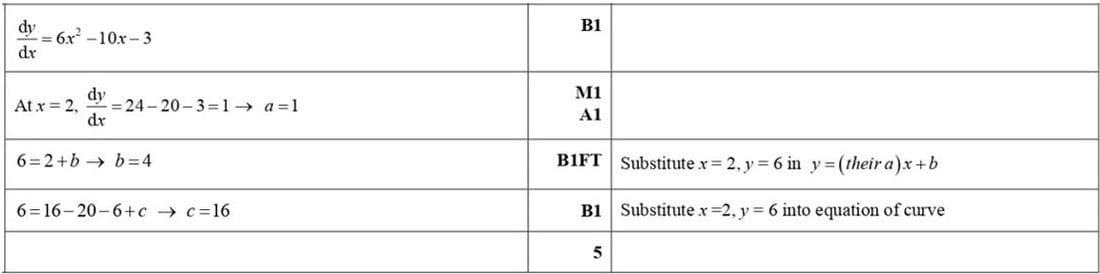
The line \(y = ax + b\) is a tangent to the curve \(y = 2x^3 - 5x^2 - 3x + c\) at the point \((2, 6)\). Find the values of the constants \(a, b\) and \(c\).
9709 P12 - Mar 2019 - Q4
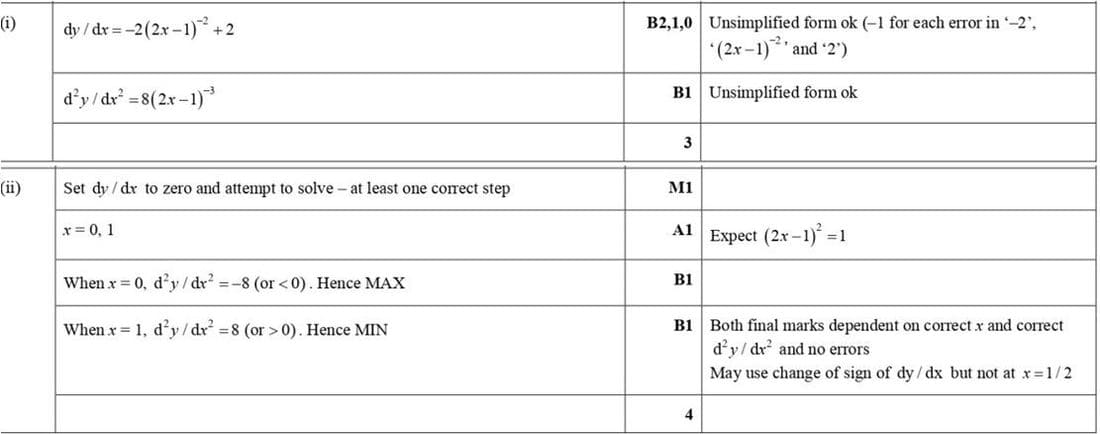
A curve has equation \(y = (2x - 1)^{-1} + 2x\).
(i) Find \(\frac{dy}{dx}\) and \(\frac{d^2y}{dx^2}\).
(ii) Find the \(x\)-coordinates of the stationary points and, showing all necessary working, determine the nature of each stationary point.
9709 P11 - Jun 2018 - Q10
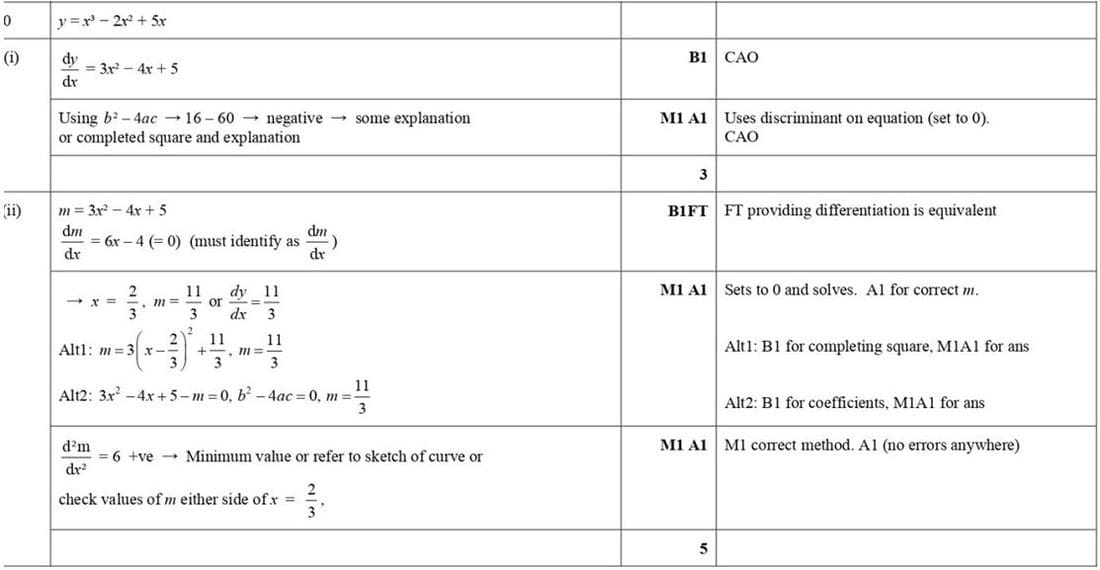
The curve with equation \(y = x^3 - 2x^2 + 5x\) passes through the origin.
(i) Show that the curve has no stationary points.
(ii) Denoting the gradient of the curve by \(m\), find the stationary value of \(m\) and determine its nature.
9709 P12 - Mar 2018 - Q10
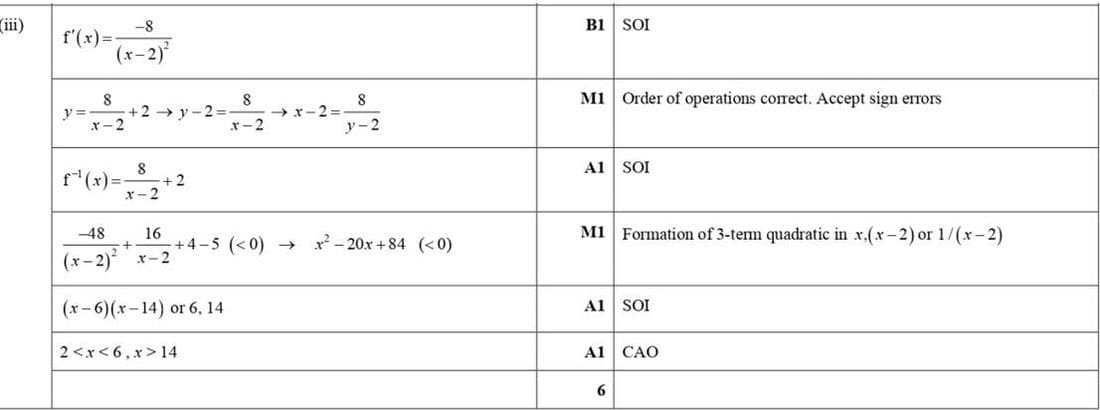
Functions f and g are defined by
\(f(x) = \frac{8}{x-2} + 2\) for \(x > 2\),
Find the set of values of \(x\) satisfying the inequality \(6f'(x) + 2f^{-1}(x) - 5 < 0\).
9709 P12 - Mar 2018 - Q8
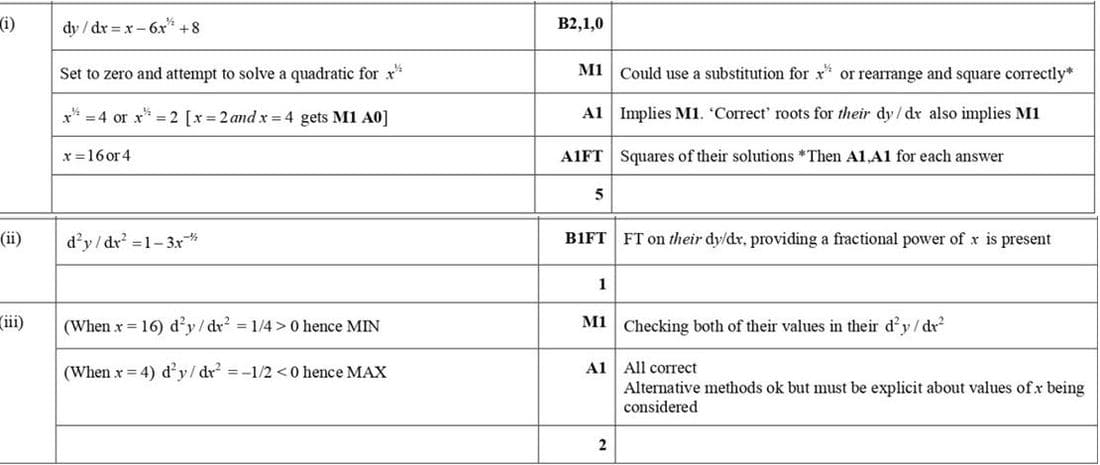
A curve has equation \(y = \frac{1}{2}x^{\frac{1}{2}} - 4x^{\frac{3}{2}} + 8x\).
(i) Find the \(x\)-coordinates of the stationary points.
(ii) Find \(\frac{d^2y}{dx^2}\).
(iii) Find, showing all necessary working, the nature of each stationary point.
9709 P12 - Nov 2017 - Q8
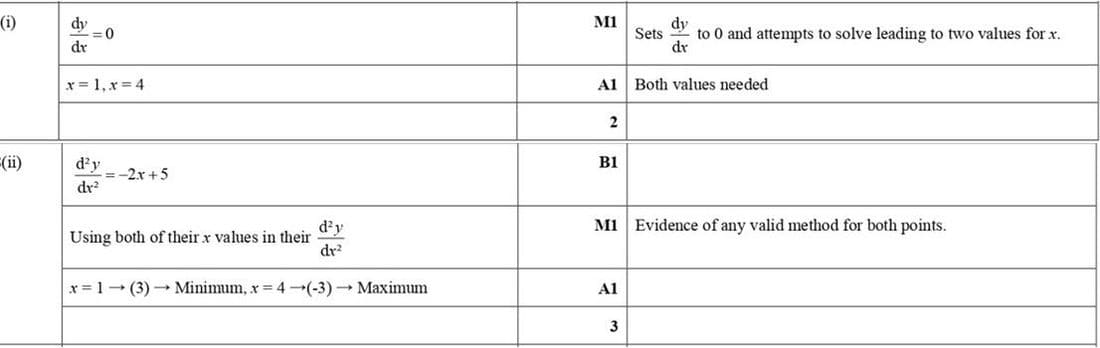
A curve is such that \(\frac{dy}{dx} = -x^2 + 5x - 4\).
(i) Find the \(x\)-coordinate of each of the stationary points of the curve.
(ii) Obtain an expression for \(\frac{d^2y}{dx^2}\) and hence or otherwise find the nature of each of the stationary points.
9709 P12 - Nov 2022 - Q11
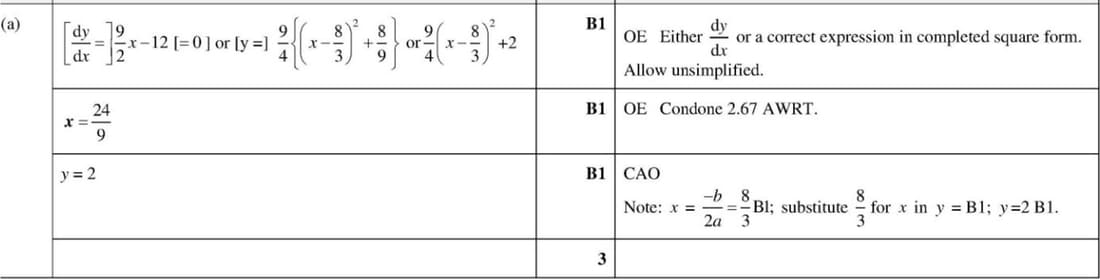
Find the coordinates of the minimum point of the curve \(y = \frac{9}{4}x^2 - 12x + 18\).
9709 P12 - Jun 2017 - Q9
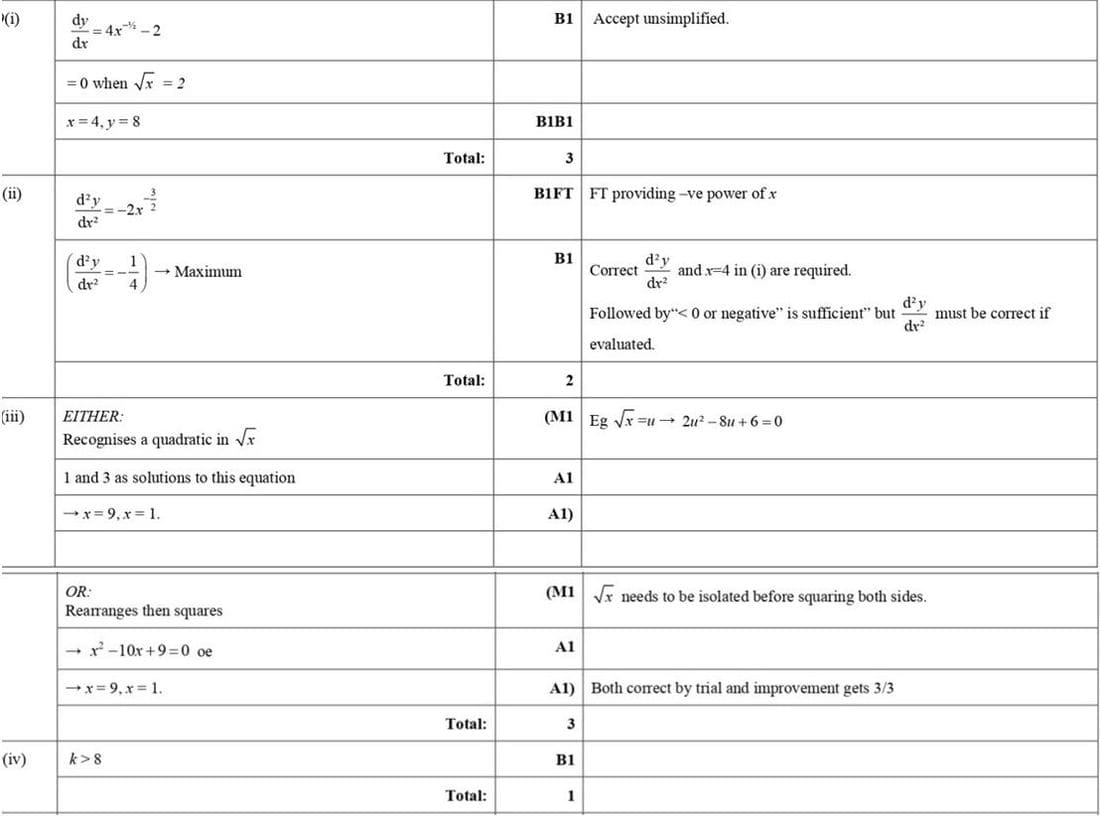
The equation of a curve is \(y = 8\sqrt{x} - 2x\).
- Find the coordinates of the stationary point of the curve. [3]
- Find an expression for \(\frac{d^2y}{dx^2}\) and hence, or otherwise, determine the nature of the stationary point. [2]
- Find the values of \(x\) at which the line \(y = 6\) meets the curve. [3]
- State the set of values of \(k\) for which the line \(y = k\) does not meet the curve. [1]
9709 P12 - Mar 2017 - Q7
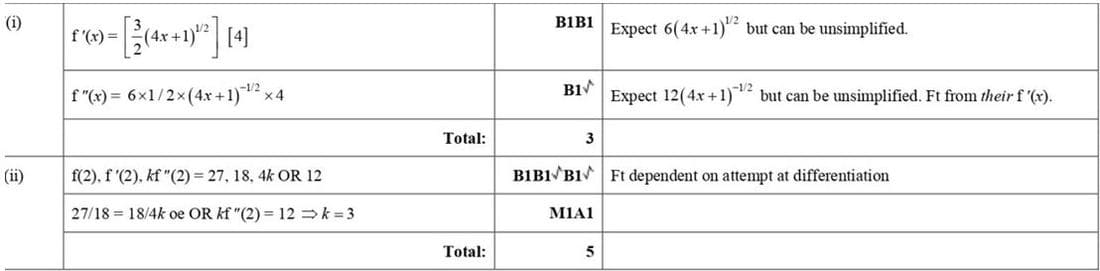
The function \(f\) is defined for \(x \geq 0\) by \(f(x) = (4x + 1)^{\frac{3}{2}}\).
(i) Find \(f'(x)\) and \(f''(x)\).
The first, second and third terms of a geometric progression are respectively \(f(2)\), \(f'(2)\) and \(kf''(2)\).
(ii) Find the value of the constant \(k\).
9709 P13 - Jun 2016 - Q5
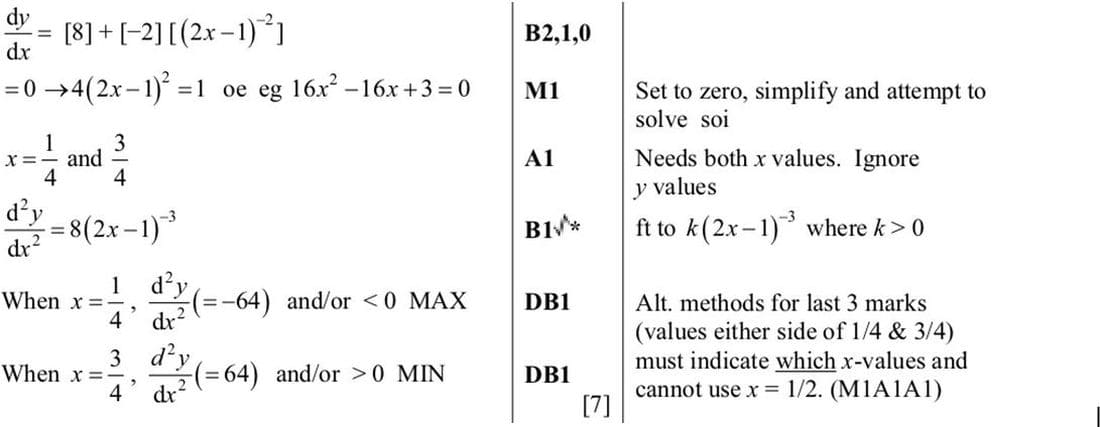
A curve has equation \(y = 8x + (2x - 1)^{-1}\). Find the values of \(x\) at which the curve has a stationary point and determine the nature of each stationary point, justifying your answers.
9709 P13 - Nov 2015 - Q10
The function f is defined by \(f(x) = 2x + (x + 1)^{-2}\) for \(x > -1\).
Find \(f'(x)\) and \(f''(x)\) and hence verify that the function f has a minimum value at \(x = 0\).

9709 P11 - Nov 2015 - Q5
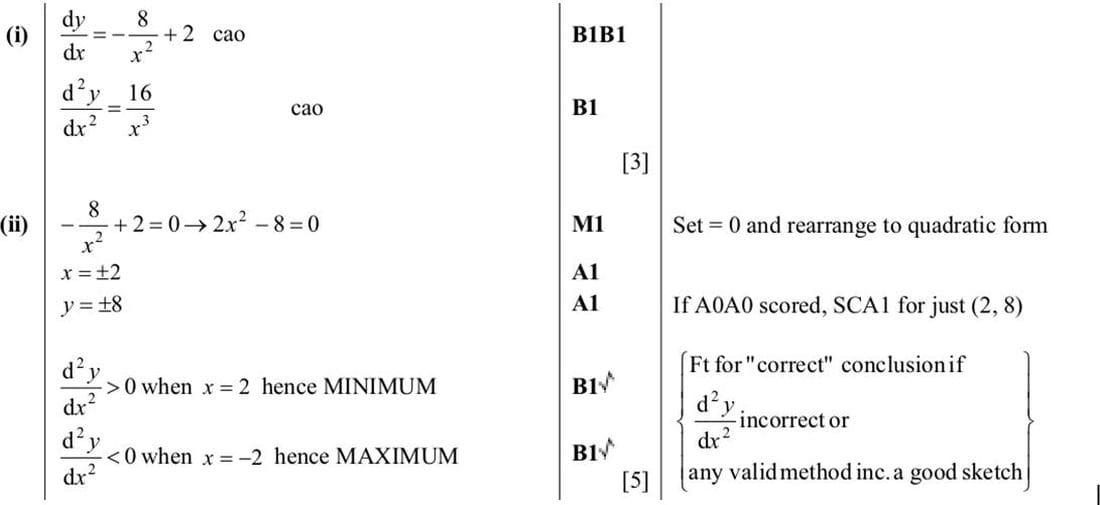
A curve has equation \(y = \frac{8}{x} + 2x\).
(i) Find \(\frac{dy}{dx}\) and \(\frac{d^2y}{dx^2}\).
(ii) Find the coordinates of the stationary points and state, with a reason, the nature of each stationary point.
9709 P12 - Jun 2015 - Q4
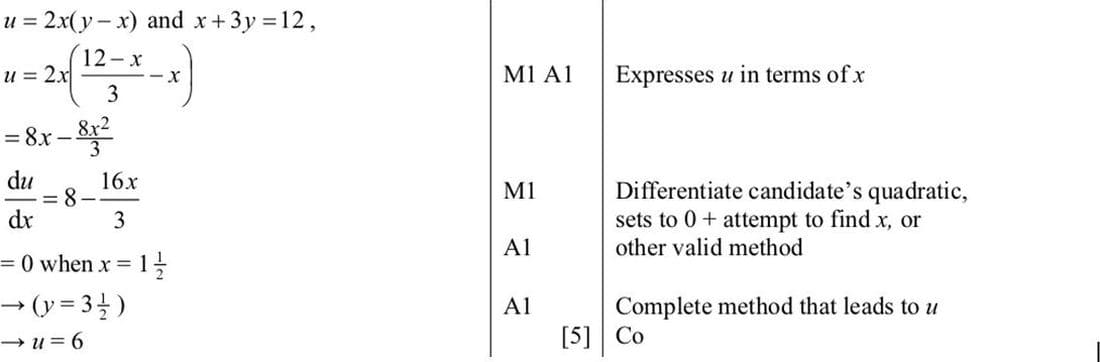
Variables u, x and y are such that \(u = 2x(y - x)\) and \(x + 3y = 12\). Express u in terms of x and hence find the stationary value of u.
9709 P11 - Jun 2015 - Q9
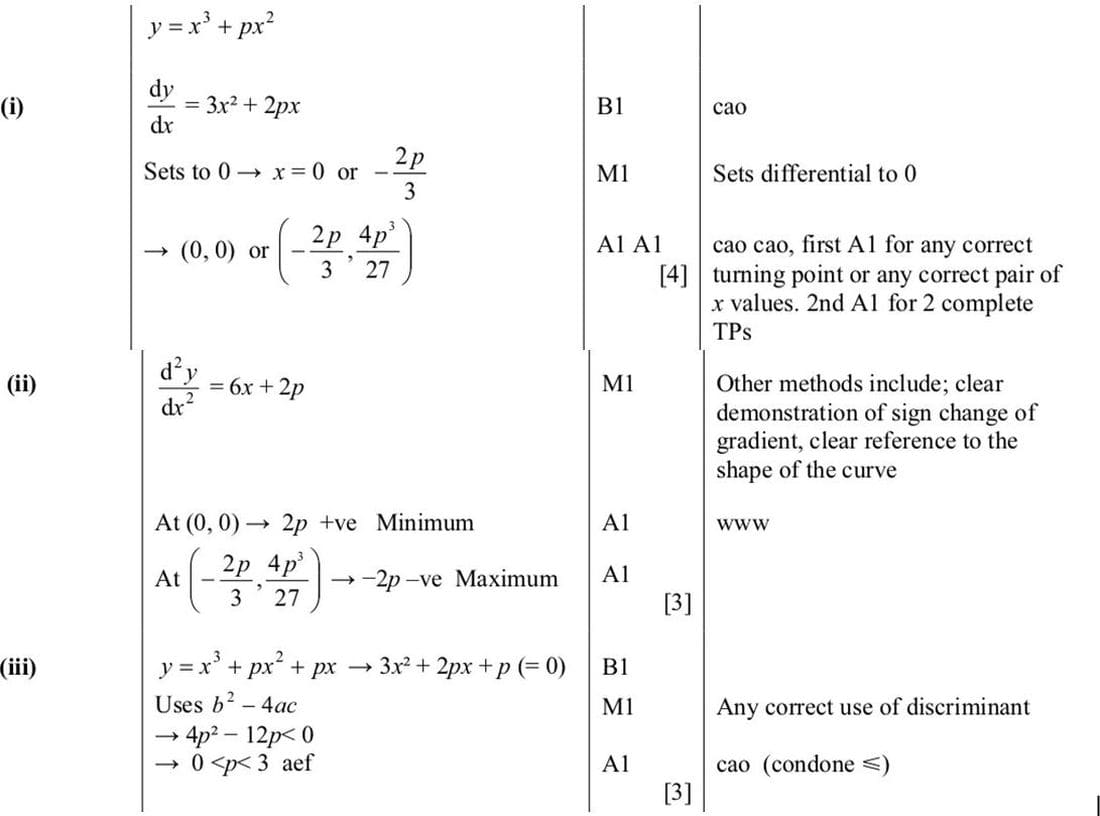
The equation of a curve is \(y = x^3 + px^2\), where \(p\) is a positive constant.
(i) Show that the origin is a stationary point on the curve and find the coordinates of the other stationary point in terms of \(p\).
(ii) Find the nature of each of the stationary points.
Another curve has equation \(y = x^3 + px^2 + px\).
(iii) Find the set of values of \(p\) for which this curve has no stationary points.
9709 P13 - Jun 2014 - Q5
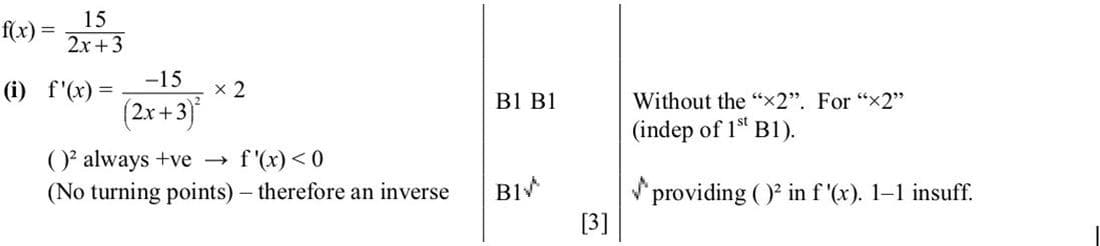
A function \(f\) is such that \(f(x) = \frac{15}{2x+3}\) for \(0 \leq x \leq 6\).
Find an expression for \(f'(x)\) and use your result to explain why \(f\) has an inverse.
9709 P13 - Nov 2013 - Q9
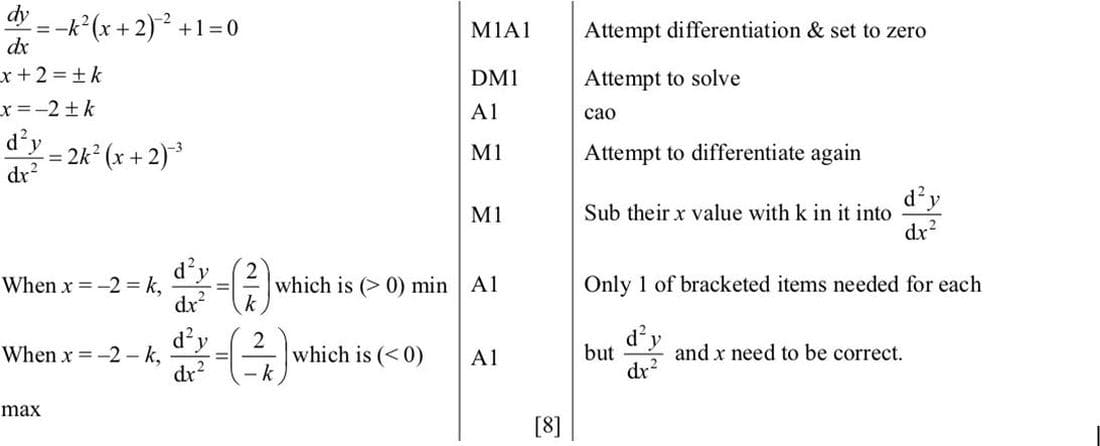
A curve has equation \(y = \frac{k^2}{x+2} + x\), where \(k\) is a positive constant. Find, in terms of \(k\), the values of \(x\) for which the curve has stationary points and determine the nature of each stationary point.
9709 P12 - Nov 2013 - Q3
The equation of a curve is \(y = \frac{2}{\sqrt{5x - 6}}\).
Find the gradient of the curve at the point where \(x = 2\).

9709 P11 - Nov 2022 - Q3
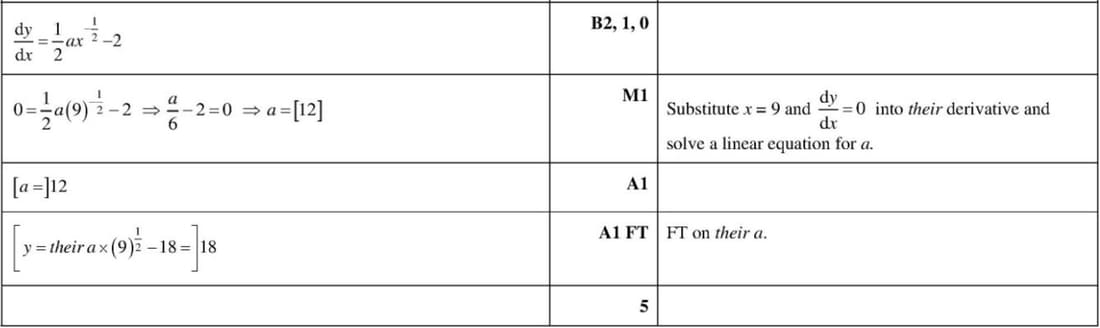
A curve has equation \(y = ax^{\frac{1}{2}} - 2x\), where \(x > 0\) and \(a\) is a constant. The curve has a stationary point at the point \(P\), which has \(x\)-coordinate 9.
Find the \(y\)-coordinate of \(P\).
9709 P13 - Jun 2013 - Q6
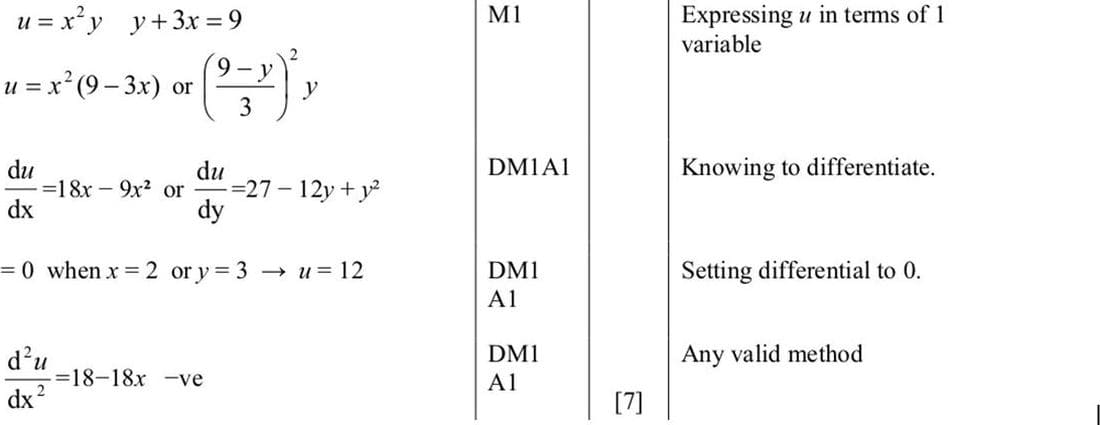
The non-zero variables x, y and u are such that u = x2y. Given that y + 3x = 9, find the stationary value of u and determine whether this is a maximum or a minimum value.
9709 P11 - Jun 2013 - Q9
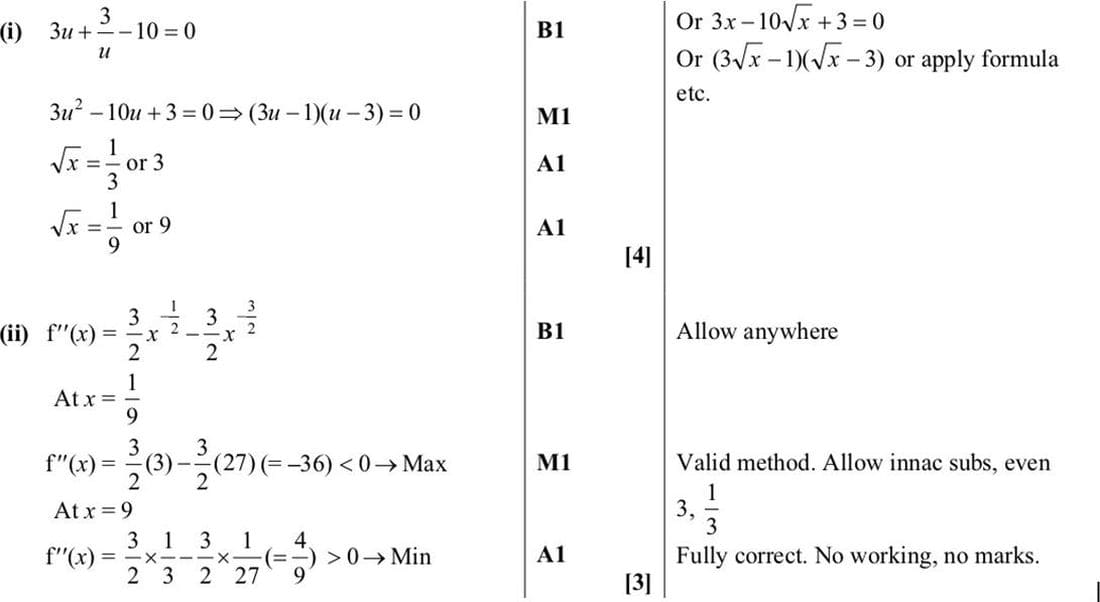
A curve has equation \(y = f(x)\) and is such that \(f'(x) = 3x^{\frac{1}{2}} + 3x^{-\frac{1}{2}} - 10\).
(i) By using the substitution \(u = x^{\frac{1}{2}}\), or otherwise, find the values of \(x\) for which the curve \(y = f(x)\) has stationary points.
(ii) Find \(f''(x)\) and hence, or otherwise, determine the nature of each stationary point.
9709 P13 - Nov 2012 - Q8
A curve is such that \(\frac{dy}{dx} = 2(3x + 4)^{\frac{3}{2}} - 6x - 8\).
(i) Find \(\frac{d^2y}{dx^2}\).
(ii) Verify that the curve has a stationary point when \(x = -1\) and determine its nature.

9709 P11 - Nov 2012 - Q5
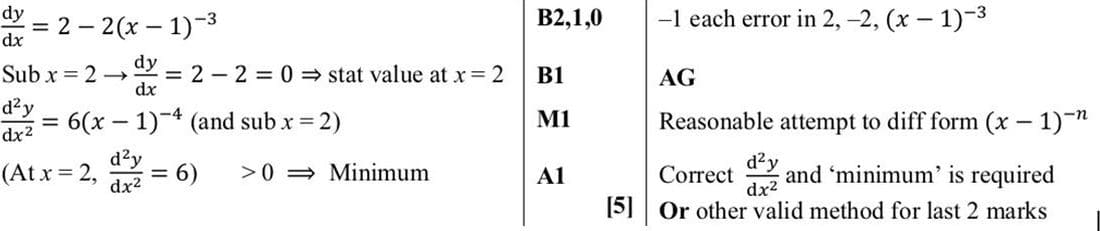
A curve has equation \(y = 2x + \frac{1}{(x-1)^2}\). Verify that the curve has a stationary point at \(x = 2\) and determine its nature.
9709 P11 - Jun 2012 - Q10
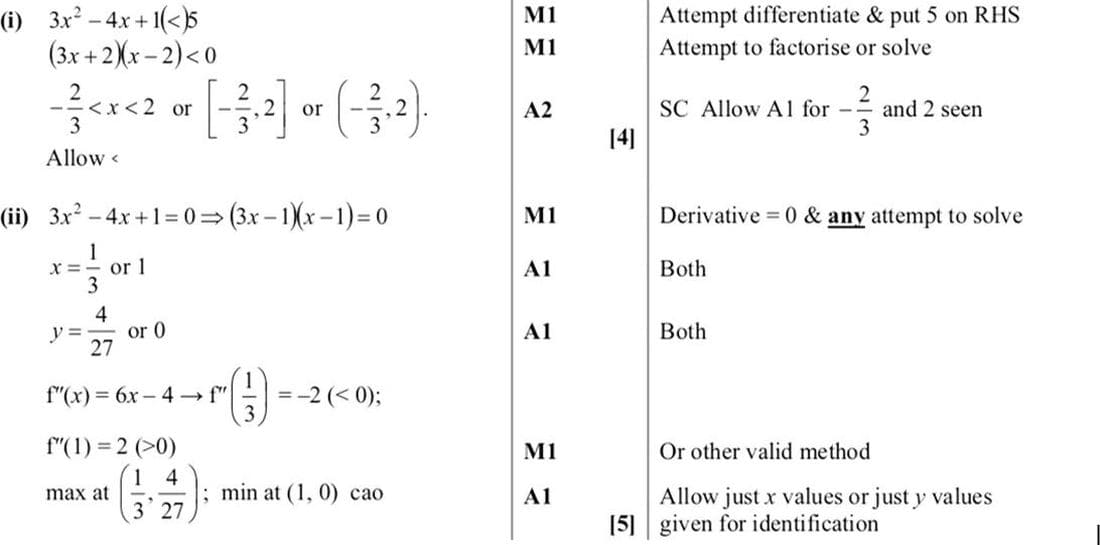
It is given that a curve has equation \(y = f(x)\), where \(f(x) = x^3 - 2x^2 + x\).
(i) Find the set of values of \(x\) for which the gradient of the curve is less than 5.
(ii) Find the values of \(f(x)\) at the two stationary points on the curve and determine the nature of each stationary point.
9709 P11 - Nov 2011 - Q2
A curve has equation \(y = 3x^3 - 6x^2 + 4x + 2\). Show that the gradient of the curve is never negative.

9709 P13 - Jun 2011 - Q10
Function g is defined by
\(g : x \mapsto 2(x-1)^3 + 8, \quad x > 1\).
Obtain an expression for \(g'(x)\) and use your answer to explain why \(g\) has an inverse.

9709 P11 - Jun 2011 - Q6
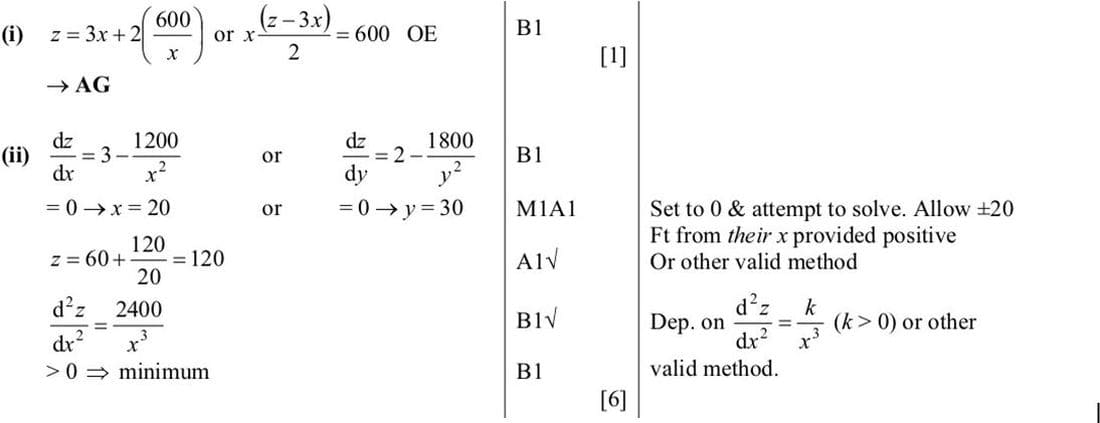
The variables x, y and z can take only positive values and are such that
\(z = 3x + 2y\) and \(xy = 600\).
(i) Show that \(z = 3x + \frac{1200}{x}\).
(ii) Find the stationary value of \(z\) and determine its nature.
9709 P13 - Nov 2010 - Q5
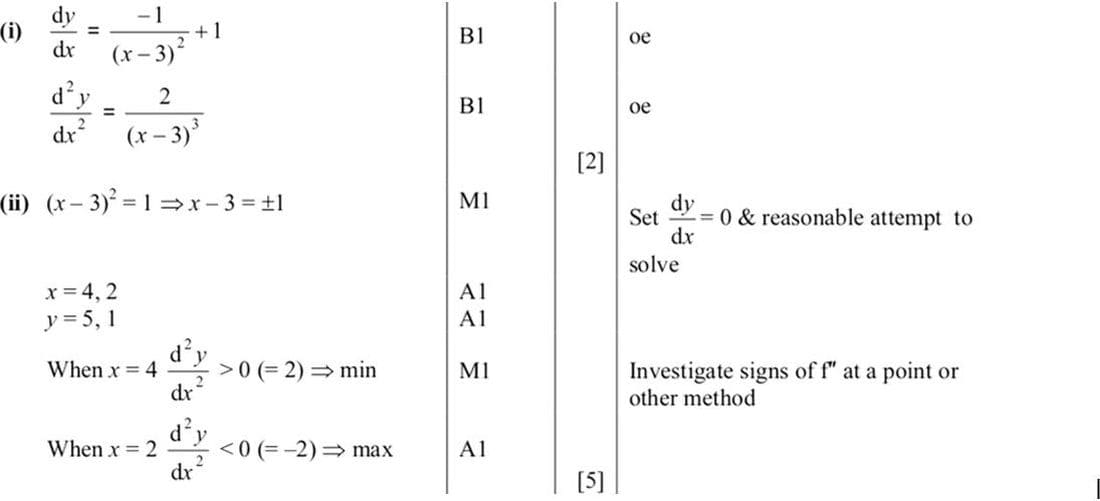
A curve has equation \(y = \frac{1}{x-3} + x\).
(i) Find \(\frac{dy}{dx}\) and \(\frac{d^2y}{dx^2}\).
(ii) Find the coordinates of the maximum point \(A\) and the minimum point \(B\) on the curve.
9709 P11 - Nov 2010 - Q11
The equation of a curve is \(y = \frac{9}{2-x}\).
Find an expression for \(\frac{dy}{dx}\) and determine, with a reason, whether the curve has any stationary points.

9709 P12 - Jun 2022 - Q9
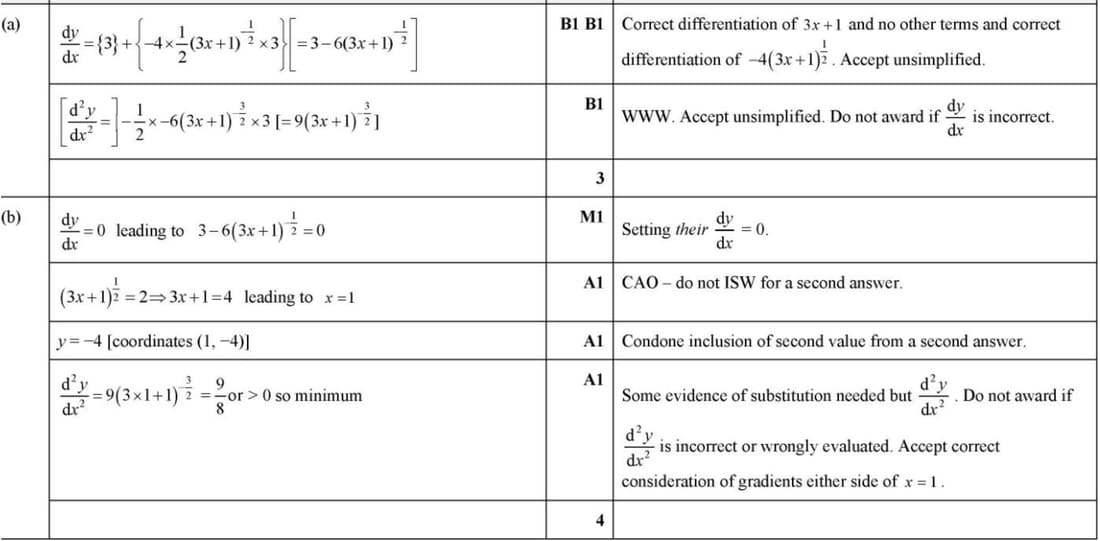
The equation of a curve is \(y = 3x + 1 - 4(3x + 1)^{\frac{1}{2}}\) for \(x > -\frac{1}{3}\).
(a) Find \(\frac{dy}{dx}\) and \(\frac{d^2y}{dx^2}\).
(b) Find the coordinates of the stationary point of the curve and determine its nature.
9709 P1 - Nov 2007 - Q8
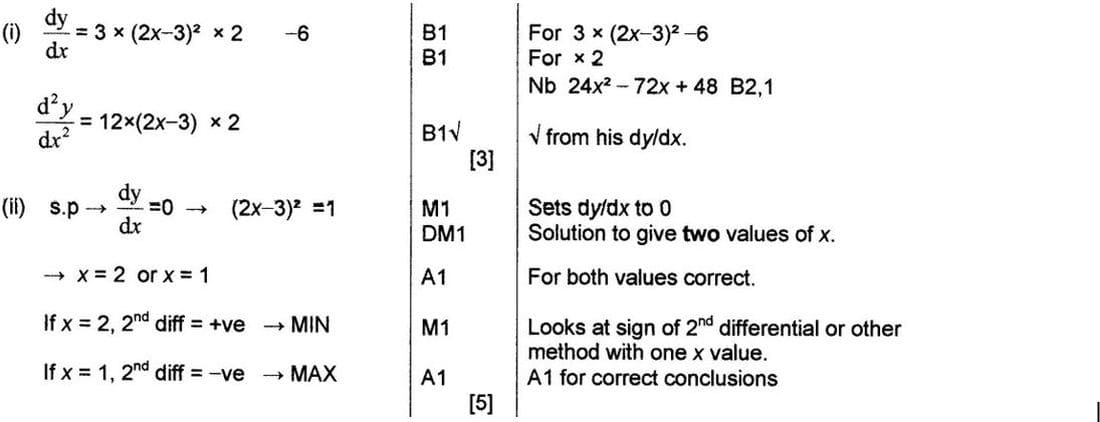
The equation of a curve is \(y = (2x - 3)^3 - 6x\).
(i) Express \(\frac{dy}{dx}\) and \(\frac{d^2y}{dx^2}\) in terms of \(x\).
(ii) Find the \(x\)-coordinates of the two stationary points and determine the nature of each stationary point.
9709 P1 - Jun 2006 - Q1
A curve has equation \(y = \frac{k}{x}\). Given that the gradient of the curve is \(-3\) when \(x = 2\), find the value of the constant \(k\).

9709 P1 - Jun 2005 - Q2
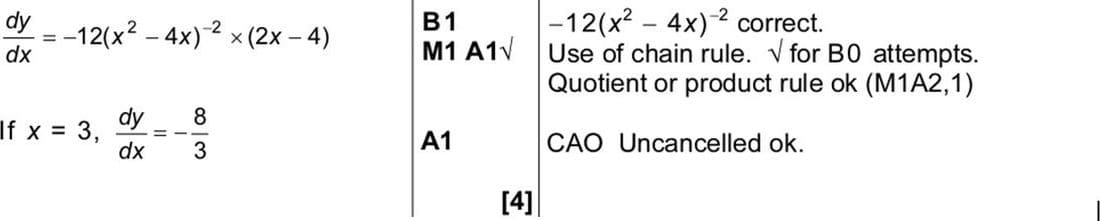
Find the gradient of the curve \(y = \frac{12}{x^2 - 4x}\) at the point where \(x = 3\).
9709 P1 - Nov 2004 - Q10
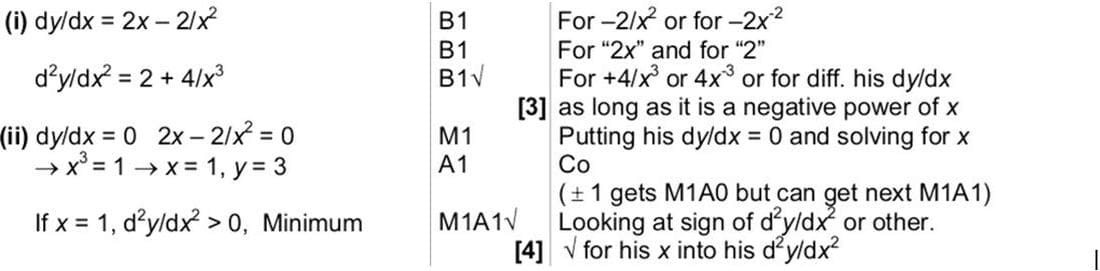
A curve has equation \(y = x^2 + \frac{2}{x}\).
(i) Write down expressions for \(\frac{dy}{dx}\) and \(\frac{d^2y}{dx^2}\).
(ii) Find the coordinates of the stationary point on the curve and determine its nature.
9709 P1 - Nov 2002 - Q8
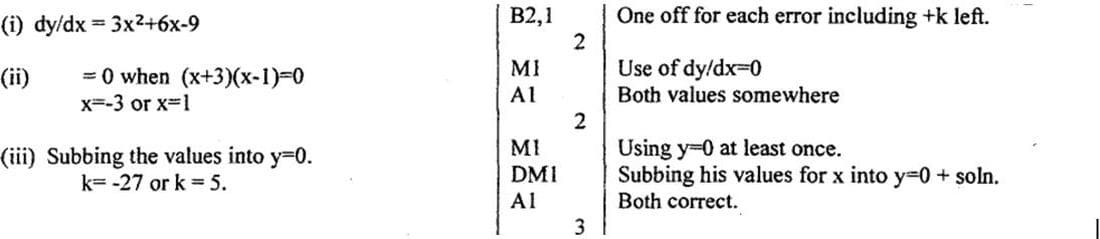
A curve has equation \(y = x^3 + 3x^2 - 9x + k\), where \(k\) is a constant.
(i) Write down an expression for \(\frac{dy}{dx}\).
(ii) Find the \(x\)-coordinates of the two stationary points on the curve.
(iii) Hence find the two values of \(k\) for which the curve has a stationary point on the \(x\)-axis.
9709 P12 - Nov 2021 - Q10
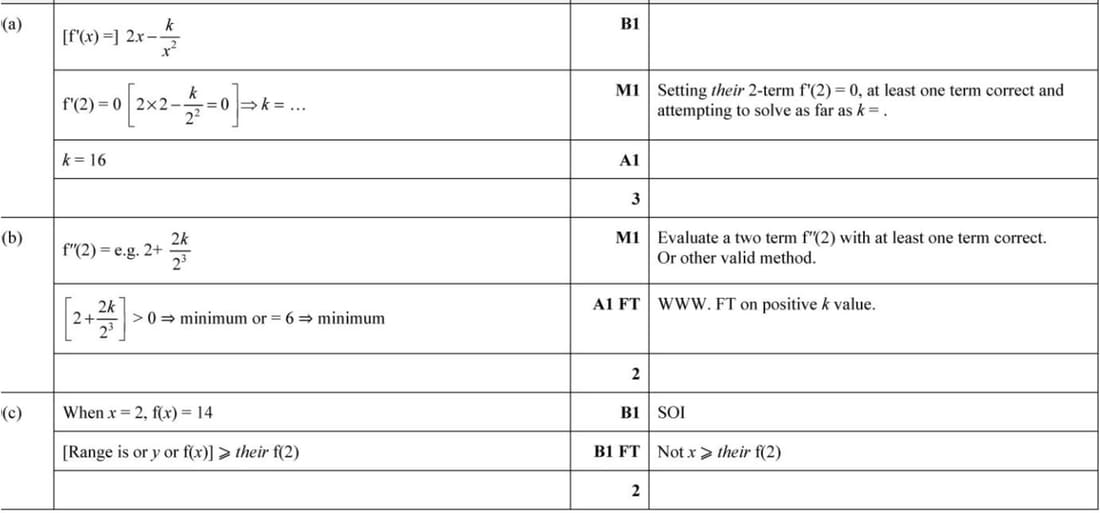
The function \(f\) is defined by \(f(x) = x^2 + \frac{k}{x} + 2\) for \(x > 0\).
(a) Given that the curve with equation \(y = f(x)\) has a stationary point when \(x = 2\), find \(k\).
(b) Determine the nature of the stationary point.
(c) Given that this is the only stationary point of the curve, find the range of \(f\).
9709 P12 - Jun 2021 - Q11
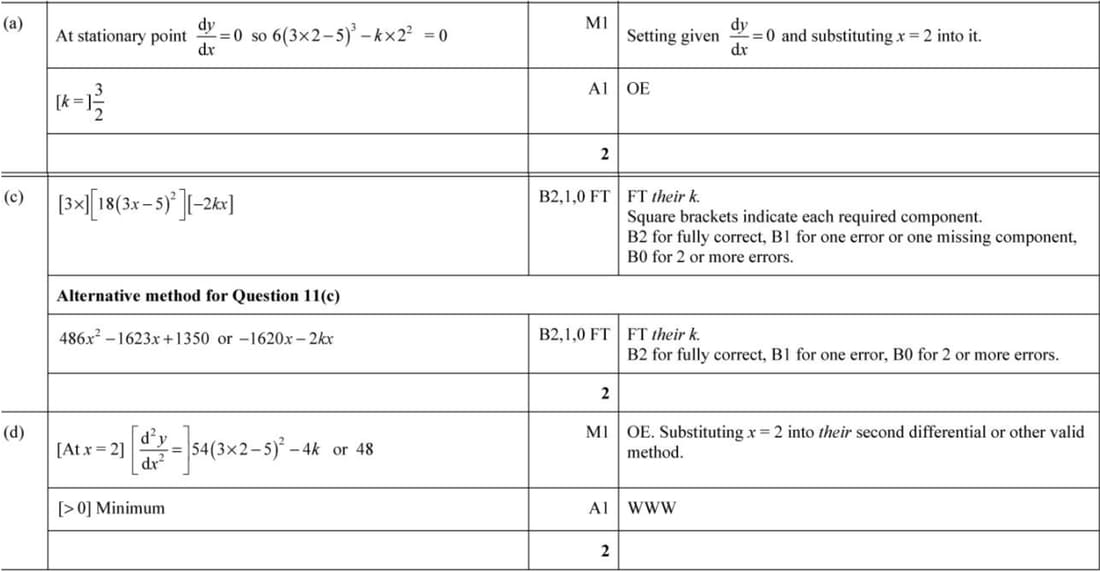
The gradient of a curve is given by \(\frac{dy}{dx} = 6(3x - 5)^3 - kx^2\), where \(k\) is a constant. The curve has a stationary point at \((2, -3.5)\).
(a) Find the value of \(k\).
(c) Find \(\frac{d^2y}{dx^2}\).
(d) Determine the nature of the stationary point at \((2, -3.5)\).
9709 P11 - Jun 2021 - Q11
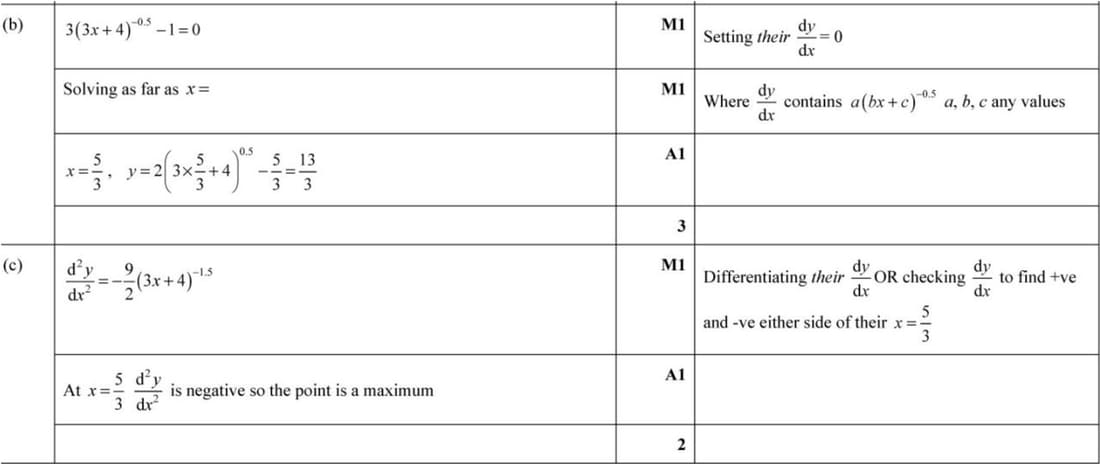
The equation of a curve is \(y = 2\sqrt{3x+4} - x\).
(b) Find the coordinates of the stationary point.
(c) Determine the nature of the stationary point.
9709 P13 - Nov 2020 - Q10
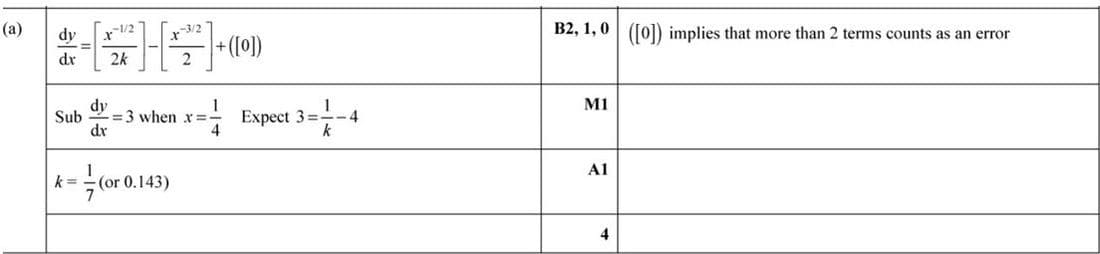
A curve has equation \(y = \frac{1}{k}x^{\frac{1}{2}} + x^{-\frac{1}{2}} + \frac{1}{k^2}\) where \(x > 0\) and \(k\) is a positive constant.
It is given that when \(x = \frac{1}{4}\), the gradient of the curve is 3.
Find the value of \(k\).
9709 P13 - Nov 2020 - Q8
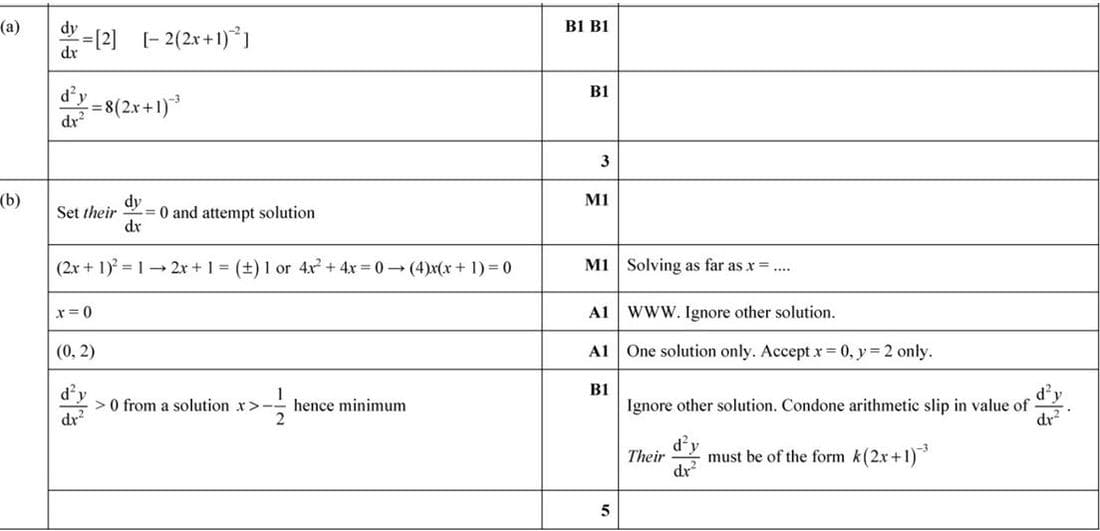
The equation of a curve is \(y = 2x + 1 + \frac{1}{2x+1}\) for \(x > -\frac{1}{2}\).
(a) Find \(\frac{dy}{dx}\) and \(\frac{d^2y}{dx^2}\).
(b) Find the coordinates of the stationary point and determine the nature of the stationary point.