0580 P42 - Mar 2026 - Q22 - 2 marks
The first five terms are \(\frac16,1,6,36,216\).
Find the \(n\)th term. [2]

0580 P21 - Jun 2026 - Q11 - 6 marks
The table describes three linear sequences.
| Sequence | 1st term | 2nd term | 3rd term | 4th term | nth term |
|---|---|---|---|---|---|
| A | 3 | ||||
| B | −4 | \(B_n=n-5\) | |||
| C | −1 | 2 | 5 | 8 |
(a) Given \(C_n=A_n+B_n\), find \(A_n\). [3]
Another sequence begins \(\frac12,\ 1,\ 2,\ 4,\ 8\).
(b(i)) Find its next term. [1]
(b(ii)) Find its nth term. [2]

0580 P22 - Jun 2026 - Q14 - 4 marks
(a) The nth term is \(n^2-3\). Write its first three terms. [2]
(b) Find the nth term of \(4,12,36,108,\ldots\). [2]

0580 P42 - Mar 2025 - Q13 - 6 marks
The table gives the first five terms of three sequences.
| Sequence | 1st | 2nd | 3rd | 4th | 5th |
|---|---|---|---|---|---|
| A | 5 | 12 | 31 | 68 | 129 |
| B | \(10/3\) | \(9/4\) | \(8/5\) | \(7/6\) | \(6/7\) |
| C | 4 | 8 | 16 | 32 | 64 |
Find the nth term of each sequence. [6]

0580 P22 - Jun 2025 - Q7 - 3 marks
The first four terms of a sequence are 11, 8, 5, 2.
(a) Find the next term. [1]
(b) Find the nth term. [2]


0580 P41 - Jun 2025 - Q5 - 6 marks
(a) A sequence begins 1, 8, 27, 64, 125. Find its 10th term. [1]
(b) Another sequence begins 5, 8, 13, 20, 29. Find its nth term. [2]
A third sequence has sum of its first n terms \(S_n=\frac n2(5n-1)\).
(c(i)) Find the sum of its first two terms. [1]
(c(ii)) Find its 3rd term. [2]

0580 P43 - Jun 2025 - Q11 - 8 marks
| Sequence | 1st | 2nd | 3rd | 4th | 5th | 6th | nth term |
|---|---|---|---|---|---|---|---|
| A | 28 | 22 | 16 | 10 | 4 | ? | ? |
| B | \(1/6\) | \(2/7\) | \(3/8\) | \(4/9\) | \(1/2\) | ? | ? |
| C | \(1/4\) | \(1/2\) | 1 | 2 | 4 | ? | ? |
Complete the sixth term and nth term for each sequence. [8]

0580 P23 - Nov 2025 - Q16 - 5 marks
| Sequence | 1st | 2nd | 3rd | 4th | 5th | nth |
|---|---|---|---|---|---|---|
| A | 8 | 13 | 18 | 23 | 28 | ? |
| B | \(3/2\) | \(4/3\) | \(5/4\) | \(6/5\) | \(7/6\) | ? |
| C | \(1/4\) | \(1/2\) | 1 | 2 | 4 | ? |
Complete the nth term for all three sequences. [5]

0580 P41 - Nov 2025 - Q20 - 3 marks
The first terms are 48,24,12,6,3.
(a) Find the next term. [1]
(b) Find the nth term. [2]

0580 P42 - Nov 2025 - Q10 - 4 marks
Find the nth term of each sequence.
(a) 17, 9, 1, −7, −15, … [2]
(b) 3, 12, 27, 48, 75, … [2]

0580 P43 - Nov 2025 - Q1 - 2 marks
The nth term is \(5-2n\).
(a) Find the 6th term. [1]
(b) Find the greatest number in the sequence. [1]

0580 P22 - Mar 2024 - Q8 - 4 marks
(a) A sequence has nth term \(n^2-3\). Find its first three terms. [2]
(b) Find the nth term of 1, 3, 9, 27, 81, … [2]

0580 P21 - Jun 2024 - Q8 - 2 marks
Find the nth term of 11,18,25,32,39,… [2]

0580 P21 - Jun 2024 - Q3 - 4 marks
(a) Complete the table. [2]
| Sequence | nth term | 5th term |
|---|---|---|
| A | \(60-4n\) | … |
| B | \(n^2-300\) | … |
(b) Find the smallest positive number in sequence B. [2]

0580 P43 - Jun 2024 - Q2 - 12 marks
A sequence has nth term \(120-n^3\).
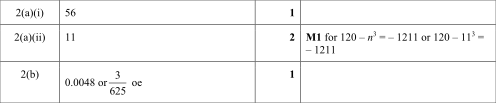
(a(i)) Find the 4 th term. [1]
(a(ii)) Find n for term−1211. [2]
(b) A different sequence has nth term \(3(0.2)^{n-1}\). Find its 5 th term. [1]
(c) Complete the 5 th term and nth term for each sequence. [8]
| Sequence | 1 st | 2 nd | 3 rd | 4 th | 5 th | nth |
|---|---|---|---|---|---|---|
| A | 7 | 4 | 1 | −2 | … | … |
| B | \(1/4\) | \(2/5\) | \(3/6\) | \(4/7\) | … | … |
| C | 0 | 2 | 6 | 12 | … | … |

0580 P21 - Nov 2024 - Q13 - 5 marks
(a) A sequence has nth term \(3n^2-1\). Find its second term. [1]
The first five terms of two sequences are:
| Sequence | 1 st | 2 nd | 3 rd | 4 th | 5 th |
|---|---|---|---|---|---|
| A | -6 | -2 | 2 | 6 | 10 |
| B | 3 | 17 | 55 | 129 | 251 |
(b) Find the nth term of each sequence. [4]

0580 P22 - Nov 2024 - Q1 - 2 marks
The first eight terms of a sequence are \(c,-3,-9,-15,-21,-27,-33,k\). Find c and k. [2]

0580 P22 - Nov 2024 - Q20 - 2 marks
Find the nth term of \(\frac17,1,7,49,343,2401,\ldots\). [2]

0580 P23 - Nov 2024 - Q13 - 4 marks
Find the nth term.
(a) \(21,13,5,-3,-11,\ldots\) [2]
(b) \(2.5,5,10,20,40,\ldots\) [2]

0580 P22 - Mar 2023 - Q20 - 4 marks
Find an expression for the \(n\)th term of each sequence.
(a) \(-1,\ 0,\ 7,\ 26,\ 63\) [2]
(b) \(24,\ 12,\ 6,\ 3,\ 1.5\) [2]

0580 P22 - Mar 2023 - Q4 - 3 marks
The first four terms of a sequence are \(23,\ 17,\ 11,\ 5\).
(a) Write down the next term. [1]
(b) Find an expression for the \(n\)th term. [2]

0580 P21 - Jun 2023 - Q8 - 4 marks
(a) The \(n\)th term is \(10-n^2\). Write down the first three terms. [2]
(b) The first four terms of another sequence are \(7,10,13,16\). Find its \(n\)th term. [2]

0580 P23 - Jun 2023 - Q22 - 5 marks
The first four terms are \(2.75,6,11.25,20\). The \(n\)th term is \(\frac14n^3+an^2+bn\).
Calculate \(a\) and \(b\). [5]

0580 P42 - Jun 2023 - Q6 - 8 marks
A sequence has nth term \(\frac{n}{2n+3}\).
(a(i)) Find its first three terms, as fractions. [2]
(a(ii)) Its kth term is \(12/25\). Find \(k\). [2]
(b(i)) Find the nth term of \(6,13,32,69,130,\ldots\). [2]
(b(ii)) Find the nth term of \(100,50,25,12.5,6.25,\ldots\). [2]


0580 P22 - Nov 2023 - Q19 - 4 marks
(a) Find the nth term of \(11,8,5,2,-1,\ldots\). [2]
(b) Find the nth term of \(1,5,25,125,625,\ldots\). [2]

0580 P41 - Nov 2023 - Q6 - 11 marks
| Sequence | 1st | 2nd | 3rd | 4th | 5th | nth |
|---|---|---|---|---|---|---|
| A | -7 | -3 | 1 | 5 | … | … |
| B | 7 | 13 | 23 | 37 | … | … |
| C | \(2/27\) | \(3/81\) | \(4/243\) | \(5/729\) | … | … |
(a) Complete the fifth term and nth term of all three sequences. [10]
(b) A sequence has \(S_{49}=7644,S_{50}=7975\). Find its 50th term. [1]

0580 P22 - Mar 2022 - Q10 - 4 marks
(a) Find the first three terms of the sequence with nth term \(n^2+7\). [2]
(b) Find the nth term of \(15,7,-1,-9,\ldots\). [2]

0580 P22 - Jun 2022 - Q21 - 5 marks
The nth term is \(an^2+bn-4\). Its first term is −3 and second term 2. Find \(a,b\). [5]

0580 P22 - Jun 2022 - Q8 - 2 marks
Find the first three terms when the nth term is \(n^2+12\). [2]

0580 P23 - Jun 2022 - Q5 - 2 marks
Find the first three terms of \(n^2-1\). [2]

0580 P21 - Jun 2022 - Q10 - 3 marks
\(22,17,12,7,2,\ldots\).
(a) Find the next term. [1]
(b) Find the nth term. [2]

0580 P23 - Jun 2022 - Q14 - 2 marks
\(8,17,32,53,80,\ldots\).
Find the nth term. [2]

0580 P21 - Nov 2022 - Q8 - 3 marks
(a) Find the next term: \(3,9,27,81,\ldots\). [1]
(b) Find the nth term: \(13,17,21,25,\ldots\). [2]

0580 P22 - Nov 2022 - Q6 - 6 marks
(a) Find the next two terms: \(27,26,23,18,11\). [2]
(b) Find nth terms for A: \(3,10,17,24,31\) and B: \(2,11,26,47,74\). [4]

0580 P43 - Nov 2022 - Q2 - 19 marks
(a(i)) Simplify \(p^3p^{11}\). [1]
(a(ii)) Simplify \(\frac{18m^6}{3m^2}\). [2]
(a(iii)) Simplify \(\left(\frac{27x^9y^{27}}{64}\right)^{-1/3}\). [3]
(b) Write the first three terms of the sequence with nth term \(3n^2\). [2]
(c(i)) Find the nth term of 13, 16, 19, 22, 25, … [2]
(c(ii)) Find the nth term of 3, 17, 55, 129, 251, … [2]
(d) Solve \(\frac{3x-22}{4}=23\). [3]
(e) Use the quadratic formula to solve \(3x^2+8x-20=0\), showing all working. Give answers to 2 decimal places. [4]

0580 P22 - Mar 2021 - Q14 - 4 marks
(a) Continue 29, 22, 15, 8 with two more terms. [2]
(b) Find the nth term of 4, 7, 12, 19, 28, … [2]

0580 P21 - Jun 2021 - Q6 - 4 marks
(a) The nth term is \(n^2+3n\). Write the first three terms. [2]
(b) Find the nth term of 25, 18, 11, 4, −3, … [2]

0580 P42 - Jun 2021 - Q10 - 9 marks
| Sequence | 1st | 2nd | 3rd | 4th | 5th | nth |
|---|---|---|---|---|---|---|
| A | 1 | 8 | 27 | 64 | ||
| B | 5 | 11 | 17 | 23 | ||
| C | 0.25 | 0.5 | 1 | 2 | 4 | |
| D | 4.75 | 10.5 | 16 | 21 |
Complete the table. [9]

0580 P43 - Jun 2021 - Q11 - 9 marks
Sequence: 11, 7, 3, −1, …
(a(i)) Find the next term. [1]
(a(ii)) Give the term-to-term rule. [1]
(a(iii)) Find its nth term. [2]
(b(i)) A different sequence has nth term \(2n/(n+1)\). Find the difference between terms 5 and 6 as a fraction. [2]
(b(ii)) Is 3/4 a term of this sequence? Show how you decide. [3]

0580 P21 - Nov 2021 - Q16 - 5 marks
(a) Find the nth term of 8, 15, 34, 71, 132, … [2]
(b) Find the nth term of \(\frac21,\frac34,\frac4{16},\frac5{64},\frac6{256},\ldots\). [3]

0580 P22 - Nov 2021 - Q12 - 5 marks
| Sequence | 1st | 2nd | 3rd | 4th | 5th | nth |
|---|---|---|---|---|---|---|
| A | 8 | 3 | -2 | -7 | -12 | … |
| B | 2 | \(3/2\) | \(4/3\) | \(5/4\) | \(6/5\) | … |
| C | \(1/2\) | 1 | 2 | 4 | 8 | … |
Complete the nth-term column. [5]

0580 P23 - Nov 2021 - Q10 - 3 marks
The first four terms are 3, −1, −5, −9.
(a) Find the next term. [1]
(b) Find the nth term. [2]

0580 P42 - Mar 2020 - Q7 - 10 marks
(a) Naga has n marbles and Panav has 3n. Naga loses 5; Panav buys 10. Together they then have more than 105. Form and solve an inequality in n. [3]
(b) y is inversely proportional to \(x^2\). At x = 4, y = 7.5. Find y at x = 5. [3]
(c(i)) Find the nth term of 4, 2, 0, −2, −4, … [2]
(c(ii)) Find the nth term of 1, 7, 17, 31, 49, … [2]


0580 P21 - Jun 2020 - Q5 - 3 marks
(a) The nth term is \(60-8n\). Find the largest term. [1]
(b) Find the nth term of 12, 19, 26, 33, 40, … [2]

0580 P41 - Nov 2020 - Q7 - 11 marks

The first four diagrams in a sequence contain white and black dots.
(a) Complete the table for Diagrams 5 and 6.
| Diagram | 1 | 2 | 3 | 4 | 5 | 6 |
|---|---|---|---|---|---|---|
| White | 1 | 4 | 9 | 16 | … | … |
| Black | 0 | 1 | 3 | 6 | … | … |
| Total | 1 | 5 | 12 | 22 | … | … |
(b) Give the number of white dots in Diagram n. [1]
The total number in Diagram n is \(\frac12(3n^2-n)\).
(c(i)) Find the total in Diagram 8. [1]
(c(ii)) Find a simplified expression for the black dots in Diagram n. [2]
(d) T is the total number of dots in all of the first n diagrams, and \(T=an^3+bn^2\). Find a and b, showing all working. [5]


0580 P42 - Nov 2020 - Q11 - 12 marks
(a) Complete the fifth and nth terms of the three sequences.
| Sequence | 1st | 2nd | 3rd | 4th | 5th | nth |
|---|---|---|---|---|---|---|
| A | 13 | 9 | 5 | 1 | … | … |
| B | 0 | 7 | 26 | 63 | … | … |
| C | \(\frac78\) | \(\frac8{16}\) | \(\frac9{32}\) | \(\frac{10}{64}\) | … | … |
(b) One term of C is \(p/q\). Write the next term in terms of p and q. [2]


0580 P43 - Nov 2020 - Q11 - 9 marks
Complete the fifth and nth terms.
| Sequence | 1st | 2nd | 3rd | 4th | 5th | nth |
|---|---|---|---|---|---|---|
| A | 4 | 9 | 14 | 19 | … | … |
| B | 3 | 10 | 29 | 66 | … | … |
| C | 1 | 4 | 16 | 64 | … | … |

0580 P42 - Mar 2019 - Q11 - 10 marks
| Term | 1 | 2 | 3 | 4 | 5 | 6 |
|---|---|---|---|---|---|---|
| A | 7 | 13 | 23 | 37 | 55 | … |
| B | 1 | 3 | 9 | 27 | 81 | … |
(a(i)) Complete the sixth terms. [2]
(a(ii)(a)) Find A’s nth term. [2]
(a(ii)(b)) Find B’s nth term. [2]
Another sequence has nth term \(4n^2+n+3\).
(b(i)) Find its second term. [1]
(b(ii)) Find n when its term is498. [3]

0580 P21 - Jun 2019 - Q22 - 4 marks
(a) A sequence begins 5, 8, 11, 14.
(a(i)) Write down the next term. [1]
(a(ii)) Find the nth term in terms of n. [2]
(b) Another sequence begins \(\frac12,\frac34,\frac76,\frac{13}8,\frac{21}{10}\). Find its next term. [1]

0580 P42 - Jun 2019 - Q11 - 10 marks

(a) Complete the table. [4]
| Diagram | 1 | 2 | 3 | 4 | 5 | 6 |
|---|---|---|---|---|---|---|
| Small lines | 4 | 10 | 18 | 28 | … | … |
| Dots | 4 | 8 | 13 | 19 | … | … |
(b) Find the number of small lines in diagram n. [2]
(c) Diagram r has10300 small lines. Find r. [2]
(d) Dots in diagram n number \(an^2+bn+1\). Find a,b. [2]

0580 P43 - Jun 2019 - Q10 - 8 marks
(a) A sequence starts19,15,11,7.
(a(i)) Give the next two terms. [2]
(a(ii)) Find the nth term. [2]
(a(iii)) Find n when the nth term is−65. [2]
(b) Another sequence has nth term \(2n^2+5n-15\). Find the difference between its4th and5th terms. [2]

0580 P23 - Nov 2019 - Q14 - 3 marks
Find the nth term:
(a) \(\frac12,\frac14,\frac16,\frac18,\frac1{10},\ldots\). [1]
(b) \(1,5,25,125,625,\ldots\). [2]

0580 P41 - Nov 2019 - Q10 - 16 marks
Complete each 5th term and nth term.
| 1st | 2nd | 3rd | 4th | 5th | nth |
|---|---|---|---|---|---|
| 9 | 5 | 1 | -3 | … | … |
| 4 | 9 | 16 | 25 | … | … |
| 1 | 8 | 27 | 64 | … | … |
| 8 | 16 | 32 | 64 | … | … |
(a) Complete the table. [11]
After the first two terms, a Fibonacci sequence adds the two previous terms to obtain the next.
| 1st | 2nd | 3rd | 4th | 5th |
|---|---|---|---|---|
| 2 | 4 | … | … | … |
| 1 | … | … | … | 11 |
| … | -1 | … | … | 1 |
(b) Complete the three sequences. [3]
Consider \(\frac13,\frac34,\frac47,\frac7{11},\frac{11}{18},\ldots\).
(c(i)) One term is p/q. Find the next in terms of p and q. [1]
(c(ii)) Find the 6th term. [1]

0580 P42 - Mar 2018 - Q11 - 13 marks
| Sequence | 1st | 2nd | 3rd | 4th | 5th | 6th |
|---|---|---|---|---|---|---|
| A | 0 | 1 | 4 | 9 | 16 | … |
| B | 4 | 5 | 6 | 7 | 8 | … |
| C | -4 | -4 | -2 | 2 | 8 | … |
(a) Complete the 6th terms. [3]
(b(i)) Find the nth term of A. [2]
(b(ii)) Find the nth term of B. [1]
(c) Find n when A’s nth term is 576. [2]
(d(i)) Find C’s nth term in simplest form. [3]
(d(ii)) Find C’s 30th term. [2]

0580 P22 - Jun 2018 - Q3 - 2 marks
Sequence: a, 13, 9, 3, −5, −15, b, …
Find a and b. [2]

0580 P23 - Jun 2018 - Q22 - 4 marks
(a) Find the nth term: 11, 7, 3, −1, … [2]
(b) Find the nth term: 3, 6, 12, 24, … [2]

0580 P41 - Jun 2018 - Q12 - 12 marks
Marco makes patterns using grey and white circular mats.

| Pattern number | 1 | 2 | 3 | 4 | 5 |
|---|---|---|---|---|---|
| Grey mats | 6 | 9 | 12 | 15 | ____ |
| Total mats | 6 | 10 | 15 | 21 | ____ |
(a) Complete Pattern 5 in the table. [2]
(b) Find the number of grey mats in Pattern n. [2]
(c) A pattern has 24 grey mats. Find its total number of mats. [2]
(d) The totals for the first one and first two patterns are 6 and 16. The total for the first n patterns is \(\frac16n^3+an^2+bn\). Find a and b. [6]

0580 P21 - Nov 2018 - Q11 - 3 marks
Sequence:8,11,14,17,20.
(a) Find the next term. [1]
(b) Find the nth term. [2]

0580 P22 - Nov 2018 - Q13 - 2 marks
Sequence:−4,2,8,14,20.
Find the nth term. [2]

0580 P43 - Nov 2018 - Q10 - 7 marks
(a) Find next term and nth term of \(\frac35,\frac47,\frac59,\frac6{11},\frac7{13},\ldots\). [3]
(b(i)) Find nth term of−1,−3,−5,−7,−9,… [2]
(b(ii)) Find nth term of 2,9,28,65,126,… [2]

0580 P42 - Mar 2017 - Q11 - 11 marks
On Monday Ankuri texts two friends: “Today is Day Number 1. Tomorrow, add 1 to the Day Number and send this text to two friends.” Everyone follows these instructions.
| Day | Mon | Tue | Wed | Thu | Fri | Sat | Sun |
|---|---|---|---|---|---|---|---|
| Day Number | 1 | 2 | 3 | ||||
| Messages sent today | 2 | 4 |
(a) Complete the table. [4]
(b) Give an expression for messages sent on Day Number n. [1]
(c(i)) Show that by the end of Day 3 the total sent is \(2^4-2\). [2]
(c(ii)) Complete: total by the end of Day 5 is___, equal to \(2^k-2\) where k=___. [2]
(c(iii)) Give an expression for the total by the end of Day n. [1]
(c(iv)) Find the Day Number when this total is 1022. [1]

0580 P41 - Jun 2017 - Q9 - 11 marks
The nth term of a sequence is 8n−3.
(a(i)) Write the first two terms. [1]
(a(ii)) Show that 203 is not in the sequence. [2]
Find the nth term of
(b(i)) 13,19,25,31,… [2]
(b(ii)) 4,8,14,22,… [2]
(c) A sequence has second term 20 and third term 50. The rule is subtract y then multiply by 5. Find y and the first term. [4]

0580 P43 - Jun 2017 - Q11 - 12 marks
| Sequence | 1st | 2nd | 3rd | 4th | 5th | nth |
|---|---|---|---|---|---|---|
| A | 16 | 25 | 36 | 49 | ||
| B | 5 | 8 | 11 | 14 | ||
| C | 11 | 17 | 25 | 35 | ||
| D | \(3/2\) | \(4/3\) | \(5/4\) | \(6/5\) |
Complete the table. [12]

0580 P22 - Nov 2017 - Q16 - 3 marks
The first terms are 23,17,11,5.
(a) Find the next term. [1]
(b) Find the nth term. [2]

0580 P23 - Nov 2017 - Q17 - 4 marks
(a) The nth term is 6−5n. Find the first three terms. [1]
(b) Another sequence has nth term \(5n^2+3\). Is 848 in it? Explain. [3]

0580 P41 - Nov 2017 - Q6 - 10 marks

| Diagram | 1 | 2 | 3 | 4 | 5 | n |
|---|---|---|---|---|---|---|
| Crosses | 6 | 10 | 14 | |||
| Squares | 2 | 5 | 10 |
(a) Complete the table. [6]
(b) Find the crosses in Diagram 60. [1]
(c) Which diagram has 226 squares? [1]
(d) Each small square side is 1 cm. The number of 1 cm lines is \(2n^2+2n+q\). Find q. [2]

0580 P22 - Mar 2016 - Q20 - 5 marks
The \(n\)th term of a sequence is \(an^2+bn\).
(a) Write the 3rd term in terms of \(a\) and \(b\). [1]
(b) The 3rd term is 21 and the 6th is 96. Find \(a\) and \(b\), showing all working. [4]

0580 P21 - Jun 2016 - Q15 - 3 marks
The sequence is \(7,5,3,1,-1,\ldots\).
(a) Find the next term. [1]
(b) Find the \(n\)th term. [2]

0580 P22 - Jun 2016 - Q18 - 4 marks
Find the \(n\)th term of each sequence.
(a) \(16,19,22,25,28,\ldots\). [2]
(b) \(1,3,9,27,81,\ldots\). [2]

0580 P43 - Jun 2016 - Q10 - 17 marks

Each diagram uses equilateral triangle tiles and rhombus tiles, all with side length 1 unit.
| Diagram | 1 | 2 | 3 | 4 | 5 |
|---|---|---|---|---|---|
| Triangle tiles | 2 | 3 | 4 | 5 | 6 |
| Rhombus tiles | 1 | 3 | 6 | ||
| Total tiles | 3 | 6 | 10 | ||
| Number of 1 unit lengths | 8 | 15 | 24 |
(a) Complete the table. [6]
The number of 1 unit lengths in Diagram \(n\) is \(n^2+4n+p\).
(b(i)) Find \(p\). [2]
(b(ii)) Find the number of 1 unit lengths in Diagram 10. [1]
(c) The total number of tiles in Diagram \(n\) is \(an^2+bn+1\). Find \(a\) and \(b\). [5]
A square-based glass pyramid at the Louvre has four triangular faces, each represented by Diagram 17.
(d(i)) Find the total tiles on one face. [2]
(d(ii)) 11 tiles are removed from one face for an entrance. Find the total tiles used for the pyramid. [1]


0580 P21 - Nov 2016 - Q19 - 4 marks
Find the nth term:
(a) 7, 13, 19, 25, 31, …; [2]
(b) 9, 16, 25, 36, 49, … . [2]

0580 P43 - Nov 2016 - Q10 - 16 marks
| Sequence | First four terms | Next term | \(n\text{th term}\) |
|---|---|---|---|
| A | 2, 5, 8, 11 | ||
| B | 20, 14, 8, 2 | ||
| C | 1, 4, 9, 16 | ||
| D | 0, 2, 6, 12 |
(a) Complete the table for all four sequences. [10]
The sum of the first n terms of another sequence is \(\frac{n(3n+1)}2\).
(b(i)) When this sum is 155, show that \(3n^2+n-310=0\). [2]
(b(ii)) Solve \(3n^2+n-310=0\). [3]
(b(iii)) Complete: “The sum of the first … terms is 155.” [1]

0580 P22 - Mar 2015 - Q5 - 2 marks
The first five terms are 13, 8, 3, −2, −7.
Find the nth term. [2]

0580 P42 - Mar 2015 - Q11 - 7 marks

Diagram 1 contains two unit lines meeting at a right angle. Add two such L shapes to get Diagram 2, then three to get Diagram 3, and continue in this way.
(a) Draw Diagram 5. [1]
| Diagram 1 | Diagram 2 | Diagram 3 | Diagram 4 | Diagram 5 | |
|---|---|---|---|---|---|
| Number of unit lines | 2 | 6 | 12 | 20 | |
| Number of small squares | 0 | 1 | 3 | 6 |
(b) Complete the table. [2]
(c) Find a formula in n for the number of unit lines in Diagram n. [2]
(d) Find a formula in n for the number of small squares in Diagram n. [2]


0580 P22 - Jun 2015 - Q8 - 2 marks
Find the nth term of 5, 11, 21, 35, 53, …. [2]

0580 P21 - Jun 2015 - Q11 - 3 marks
(a) Find the nth term of 4, 8, 12, 16, 20, …. [1]
(b) Find the nth term of 11, 20, 35, 56, 83, …. [2]

0580 P43 - Jun 2015 - Q11 - 12 marks
The first four terms are shown. Fill in the fifth term and nth term for each sequence.
| Sequence | 1st | 2nd | 3rd | 4th | 5th | nth |
|---|---|---|---|---|---|---|
| A | \(1/3\) | \(2/4\) | \(3/5\) | \(4/6\) | ||
| B | 3 | 4 | 5 | 6 | ||
| C | -1 | 0 | 1 | 2 | ||
| D | -3 | 0 | 5 | 12 |
(a) Complete the table. [8]
(b) Which term of A is \(36/37\)? [2]
(c) Which term of D is 725? [2]

0580 P41 - Nov 2015 - Q9 - 10 marks
The diagrams use lines of length 1 cm.

| Diagram | 1 | 2 | 3 |
|---|---|---|---|
| Area (cm²) | 1 | 4 | 9 |
(a(i)) Find the area of Diagram 4. [1]
(a(ii)) Find the area of Diagram n. [1]
| Diagram | 1 | 2 | 3 |
|---|---|---|---|
| Number of 1 cm lines | 4 | 13 | 26 |
(b(i)) Find the number of 1 cm lines in Diagram 4. [1]
(b(ii)) Which diagram uses 118 lines? [1]
(c) Total lines in Diagrams 1 and 2 are 17. Total lines in the first n diagrams are \(\tfrac23n^3+an^2+bn\). Find a and b, showing working. [6]

0580 P42 - Nov 2015 - Q10 - 13 marks
| Sequence | 1st | 2nd | 3rd | 4th | 5th | 6th |
|---|---|---|---|---|---|---|
| A | 3 | 4 | 5 | 6 | 7 | |
| B | 0 | 1 | 4 | 9 | 16 | |
| C | -3 | -3 | -1 | 3 | 9 |
(a) Complete the sixth terms. [2]
(b) Find the nth term of A. [1]
(c(i)) Find the nth term of B. [2]
(c(ii)) Find n when B’s nth term is 8281. [2]
(d(i)) Find the nth term of C in simplest form. [2]
(d(ii)) Find C’s eighth term. [1]
(e) Sequence D has nth term \((-1/2)^{n-1}\). Find its first four terms. [3]


0580 P43 - Nov 2015 - Q10 - 11 marks
Complete the fifth and sixth terms and nth term of each sequence.
| Sequence | 1st | 2nd | 3rd | 4th | 5th | 6th | nth |
|---|---|---|---|---|---|---|---|
| A | 15 | 8 | 1 | -6 | |||
| B | \(5/18\) | \(6/19\) | \(7/20\) | \(8/21\) | |||
| C | 2 | 5 | 10 | 17 | |||
| D | 2 | 6 | 18 | 54 |
Complete the table. [11]

0580 P22 - Jun 2014 - Q20 - 5 marks
The sequence starts 32, 25, 18, 11, 4. Find:
(a) the sixth term; [1]
(b) the nth term; [2]
(c) the index of the term −332. [2]

0580 P43 - Jun 2014 - Q11 - 11 marks

Diagram 1 has one equilateral triangle of side 1 unit. Diagram 2 has 4 smallest triangles of side ½; Diagram 3 has 16 of side ¼.
| Diagram | 1 | 2 | 3 | 4 | 5 | 6 | n |
|---|---|---|---|---|---|---|---|
| Side length | 1 | ½ | ¼ | ||||
| Side as a power of 2 | \(2^0\) | \(2^{-1}\) | \(2^{-2}\) |
(a) Complete the table for Diagrams 4, 5, 6 and n. [6]
| Diagram | 1 | 2 | 3 | 4 | 5 | 6 |
|---|---|---|---|---|---|---|
| Number of smallest triangles | 1 | 4 | 16 | |||
| Number as a power of 2 | \(2^0\) | \(2^2\) | \(2^4\) |
(b(i)) Complete the table for Diagrams 4, 5 and 6. [2]
(b(ii)) Give the number of smallest triangles in Diagram n as a power of 2. [1]
(c) Find the number of smallest triangles when their side length is 1/128 unit. [2]

0580 P23 - Nov 2014 - Q11 - 3 marks
\(U_1=1^3,\ U_2=1^3+2^3,\ U_3=1^3+2^3+3^3,\quad U_n=\tfrac14n^2(n+1)^2\).
(a) Find U39. [2]
(b) \(V_1=2^3,\ V_2=2^3+4^3,\ V_3=2^3+4^3+6^3\). Compare with Un to find Vn. [1]

0580 P41 - Nov 2014 - Q9 - 14 marks

| Diagram | 1 | 2 | 3 | 4 | n |
|---|---|---|---|---|---|
| White squares | 12 | 20 | 28 | ||
| Grey squares | 0 | 1 | 4 | ||
| Total squares | 12 | 21 | 32 | \((n+1)(n+5)\) |
(a) Complete the table for 4 and n. [6]
(b) Which diagram has 480 squares altogether? [2]
The total number of squares in the first n diagrams is \(\tfrac13n^3+pn^2+qn\).
(c(i)) Use n = 1 to show \(p+q=11\tfrac23\). [1]
(c(ii)) Use n = 2 to show \(4p+2q=30\tfrac13\). [2]
(c(iii)) Find p and q. [3]

0580 P42 - Nov 2014 - Q9 - 16 marks

Khadega stacks these layers to build towers.
| Layers | 1 | 2 | 3 | 4 | 5 | 6 |
|---|---|---|---|---|---|---|
| White cubes | 0 | 1 | 6 | 15 | ||
| Grey cubes | 1 | 5 | 9 | 13 | ||
| Total | 1 | 6 | 15 | 28 |
(a) Complete columns 5 and 6. [4]
(b(i)) Find grey cubes in n layers. [2]
(b(ii)) Find grey cubes in 60 layers. [1]
(b(iii)) With 200 grey cubes and unlimited white cubes, find the highest tower’s number of layers. [2]
(c) White cubes total \(pn^2+qn+3\). Find p and q with working. [5]
(d) Find the total cubes in n layers, simplified. [2]

0580 P22 - Jun 2013 - Q3 - 2 marks
The first five terms are 13, 9, 5, 1, −3. Find the nth term. [2]

0580 P41 - Jun 2013 - Q10 - 14 marks

Stars are made of lines and dots in this pattern.
| Star 1 | Star 2 | Star 3 | Star 4 | Star 5 | Star 7 | Star n | |
|---|---|---|---|---|---|---|---|
| Lines | 10 | 20 | 30 | 40 | … | … | … |
| Dots | 11 | 21 | 31 | 41 | … | … | … |
(a) Complete the table. [4]
The sums of dots in stars 1 and 2, 2 and 3, 3 and 4 are 32, 52, 72.
(b(i)) Find the sum for Star 10 and Star 11. [1]
(b(ii)) Find the sum for Star n and Star (n + 1). [1]
(b(iii)) Find the sum for Star (n + 7) and Star (n + 8). [1]
The total dots in the first n stars is \(5n^2+6n\).
(c(i)) Show this is correct for n = 3. [2]
(c(ii)) Find the total for the first 10 stars. [1]
(d) Add \(5n^2+6n\) and \(10(n+1)+1\) to show the total for the first (n + 1) stars is \(5(n+1)^2+6(n+1)\). Show each step. [4]

0580 P43 - Jun 2013 - Q10 - 16 marks
(a(i)) Solve \(2(3x-7)=13\). [3]
(a(ii)) Solve by factorising \(x^2-7x+6=0\). [3]
(a(iii)) Solve \((3x-2)/5+(x+2)/10=4\). [4]
\(1^2=1,\quad1^2+2^2=5,\quad1^2+2^2+3^2=14,\quad1^2+2^2+3^2+4^2=30\).
(b) \(1^2+2^2+\cdots+n^2=an^3+bn^2+n/6\). Find a and b. [6]

0580 P21 - Nov 2013 - Q9 - 3 marks
(a) Find the nth term of \(1/3,2/4,3/5,4/6,5/7,\ldots\). [1]
(b) Find the nth term of 0, 3, 8, 15, 24, … [2]

0580 P41 - Nov 2013 - Q10 - 12 marks
\(1=1;\quad1+2=3;\quad1+2+3=6;\quad1+2+3+4=10\).
(a(i)) Write the next line. [1]
(a(ii)) The first n integers sum to \(\frac n k(n+1)\). Show k = 2. [2]
(a(iii)) Find the sum of the first 60 integers. [1]
(a(iv)) Find n when this sum is 465. [2]
(a(v)) \(1+2+\cdots+x=\frac{(n-8)(n-7)}2\). Express x in terms of n. [1]
\(1^3=1;\quad1^3+2^3=9;\quad1^3+2^3+3^3=36;\quad1^3+2^3+3^3+4^3=100\).
(b(i)) Complete \(1^3+2^3+3^3+4^3+5^3=\ldots=(\ldots)^2\). [2]
(b(ii)) Find an expression for the sum of the first n cubes. [1]
(b(iii)) Find the sum of the first 19 cubes. [2]

0580 P42 - Nov 2013 - Q10 - 10 marks
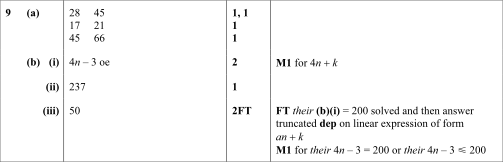
Complete each sequence with its next two terms and an expression for its nth term. The example 1, 5, 9, 13 gives 17, 21 and 4n − 3.
(a) 12, 21, 30, 39, … [3]
(b) 80, 74, 68, 62, … [3]
(c) 1, 8, 27, 64, … [2]
(d) 2, 10, 30, 68, … [2]

0580 P43 - Nov 2013 - Q9 - 17 marks

The diagrams use dots (filled circles) and squares, joined by lines.
| Diagram | 1 | 2 | 3 | 4 | 5 | n |
|---|---|---|---|---|---|---|
| Dots | 6 | 9 | 12 | … | … | … |
| Squares | 0 | 1 | 3 | … | … | \(\tfrac12n(n-1)\) |
| Triangles | 4 | 9 | 16 | … | … | … |
| Lines | 9 | 18 | 30 | 45 | 63 | \(\tfrac32(n+1)(n+2)\) |
(a) Complete the table. [9]
(b) Which diagram has 360 lines? [2]
The total lines in the first n diagrams is \(\tfrac12n^3+pn^2+qn\).
(c(i)) Use n = 1 to show \(p+q=8\tfrac12\). [1]
(c(ii)) Choose another n and find p and q. [5]

0580 P42 - Jun 2012 - Q6 - 13 marks

(a) Find x. [3]
| Term | 1 | 2 | 3 | 4 | 5 | n |
|---|---|---|---|---|---|---|
| A | -4 | … | 2 | 5 | 8 | \(3n-7\) |
| B | 1 | 4 | 9 | 16 | 25 | … |
| C | 5 | 10 | 15 | 20 | 25 | … |
| D | 6 | 14 | 24 | 36 | 50 | … |
(b(i)) Fill the four missing entries. [4]
(b(ii)) Which term of D equals 500? [2]
(c) Simplify \((x^2-16)/(2x^2+7x-4)\). [4]

0580 P43 - Jun 2012 - Q11 - 12 marks

Each diagram has one central dot and 8 dots on each circle. The first radius is 1 unit, and each new circle increases radius by 1 unit.
| Diagram | 1 | 2 | 3 | 4 | 5 |
|---|---|---|---|---|---|
| Dots | 9 | 17 | 25 | … | … |
| Largest-circle area | \(\pi\) | \(4\pi\) | \(9\pi\) | … | … |
| Total circumferences | \(2\pi\) | \(6\pi\) | \(12\pi\) | … | … |
(a) Complete the entries for diagrams 4 and 5. [4]
(b(i)) Give the dot count in diagram n. [2]
(b(ii)) Find n when there are 1097 dots. [2]
(c(i)) Give the largest-circle area in diagram n. [1]
(c(ii)) Give it in diagram 3n. [1]
(d) Give the total circumferences in diagram n. [2]

0580 P42 - Nov 2012 - Q10 - 12 marks
Consecutive integers are arranged in rows. Each highlighted shape selects a and b one row above its centre n, and c and d one row below, one column to either side.

(a(i)) For the 5-column grid and n = 13, find bc − ad. [1]
(a(ii)) Given a = n − 6, express b, c and d in terms of n. [2]
(a(iii)) Show algebraically that bc − ad = 20. [2]

(b(i)) For the 6-column grid and n = 10, find bc − ad. [1]
(b(ii)) Write bc − ad in terms of n without simplifying. [2]

(c) For the 7-column grid, show bc − ad = 28 when n = 17. [1]
(d) Write bc − ad for a grid with t columns. [1]

(e) For the last shape, find c, d and bc − ad. [2]


0580 P43 - Nov 2012 - Q10 - 16 marks
| Sequence | First five terms | 6th term | nth term |
|---|---|---|---|
| A | 11, 9, 7, 5, 3 | ||
| B | 1, 4, 9, 16, 25 | ||
| C | 2, 6, 12, 20, 30 | ||
| D | 3, 9, 27, 81, 243 | ||
| E | 1, 3, 15, 61, 213 |
(a) Complete the table for the sixth and nth terms. [12]
(b(i)) Find the 100th term of A. [1]
(b(ii)) Find the 100th term of C. [1]
(c) In D, find n when the nth term is 6561. [1]
(d) Find the 10th term of E. [1]


0580 P41 - Jun 2011 - Q10 - 13 marks
| Sequence | 1st | 2nd | 3rd | 4th | 5th | nth |
|---|---|---|---|---|---|---|
| A | 1 | \(n^3\) | ||||
| B | 4 | \(4n\) | ||||
| C | 4 | \((n+1)^2\) |
(a) Complete the table. [5]
(b)(i) Find the eighth term of A. [1]
(b)(ii) Find the twelfth term of C. [1]
(c)(i) Which term of A equals 15 625? [1]
(c)(ii) Which term of C equals 10 000? [1]
| Sequence | 1st | 2nd | 3rd | 4th | 5th | nth |
|---|---|---|---|---|---|---|
| D | 5 | 16 | 39 | 80 | ||
| E | 0 | 1 | 4 | 9 |
(d) Use the sequences in (a) to find the fifth and nth terms of D and E. [4]

0580 P42 - Jun 2011 - Q9 - 15 marks
(a)(i) Find the first three terms of \(n(n+2)\). [2]
(a)(ii) Which term equals 168? [3]
(b)(i) Find the nth term of 5, 8, 11, 14, 17, … . [2]
(b)(ii) Find the nth term of 1, 2, 4, 8, 16, … . [2]

Each small equilateral triangle has side 1 cm. Diagram 1 contains three 1 cm lines and diagram 2 contains nine. The total number of 1 cm lines in all the first n diagrams is \(an^3+bn^2+n\).
(c) Find a and b. [6]

0580 P43 - Jun 2011 - Q11 - 14 marks
(a)(i) Find the sum of the first 4 positive integers. [1]
The sum of the first n positive integers is \(n(n+1)/2\).
(a)(ii) Show this formula is correct when n = 3. [1]
(a)(iii) Find the sum of the first 120 positive integers. [1]
(a)(iv) Find 121 + 122 + … + 200. [2]
(a)(v) Find 2 + 4 + 6 + … + 800. [2]
| Cubes | Integers |
|---|---|
| \(1^3=1\) | \(1=1\) |
| \(1^3+2^3=9\) | \(1+2=3\) |
| \(1^3+2^3+3^3=\ldots\) | \(1+2+3=\ldots\) |
| \(1^3+2^3+3^3+4^3=\ldots\) | \(1+2+3+4=\ldots\) |
(b)(i) Complete the four blanks. [2]
(b)(ii) The first 14 integers sum to 105. Find the sum of the first 14 cubes. [1]
(b)(iii) Write a formula for the sum of the first n cubes. [1]
(b)(iv) Find the sum of the first 60 cubes. [1]
(b)(v) Find n when the sum of the first n cubes is 278784. [2]

0580 P21 - Nov 2011 - Q18 - 7 marks
\(T_1=1^2,\quad T_2=1^2+2^2,\quad T_3=1^2+2^2+3^2,\quad T_4=1^2+2^2+3^2+4^2\). The formula is \(T_n=n(n+1)(2n+1)/6\).
(a) Find \(T_{23}\). [2]
\(U_1=T_2-T_1,\quad U_2=T_3-T_2,\quad U_3=T_4-T_3,\ldots\).
(b)(i) Find U₁ and U₂. [2]
(b)(ii) Find a formula for Uₙ. [1]
\(V_1=2^2,\quad V_2=2^2+4^2,\quad V_3=2^2+4^2+6^2,\ldots\).
(c) Compare with (a) to find a formula for Vₙ. [2]

0580 P22 - Nov 2011 - Q9 - 3 marks
\(u_1=\sqrt1,\ u_2=\sqrt3,\ u_3=\sqrt5,\ u_4=\sqrt7,\ldots\).
(a) Find a formula for uₙ. [2]
(b) Find u₂₉. [1]

0580 P43 - Nov 2011 - Q12 - 11 marks
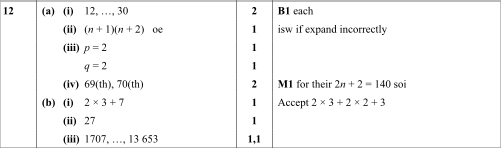
The nth term is \(n(n+1)\).
(a)(i) Fill the blanks: 2, 6, …, 20, … . [2]
(a)(ii) Write the (n+1)th term. [1]
(a)(iii) The difference between consecutive terms is pn+q. Find p and q. [2]
(a)(iv) Find the positions of the consecutive terms whose difference is 140. [2]
\(u_1=2,\ u_2=3,\quad u_n=2u_{n-2}+u_{n-1}\quad(n\ge3)\). For example, \(u_3=2(2)+3=7\).
(b)(i) Show u₄ = 13. [1]
(b)(ii) Find u₅. [1]
(b)(iii) Two consecutive terms are 3413 and 6827. Find the term before and the term after these. [2]
0580 P41 - Jun 2010 - Q11 - 11 marks

| Diagram | 1 | 2 | 3 | 4 |
|---|---|---|---|---|
| White dots | 1 | 4 | 9 | 16 |
| Black dots | 5 | 7 | 9 | 11 |
| Lines | 6 | 14 | 26 | 42 |

(a) Complete Diagram 5 and state its white dots, black dots and lines. [4]
(b) Find these three counts for Diagram 8. [3]
(c) Find the white-dot and black-dot counts in Diagram n. [2]
The number of lines is \(k(n^2+n+1)\).
(d)(i) Find k. [1]
(d)(ii) Find the number of lines in Diagram 100. [1]


0580 P42 - Jun 2010 - Q10 - 12 marks

| Sides | Polygon | Diagonals |
|---|---|---|
| 3 | triangle | 0 |
| 4 | quadrilateral | 2 |
| 5 | 5 | |
| 6 | hexagon | 9 |
| 7 | heptagon | 14 |
| 8 |
(a) Complete the table. [3]
(b)(i) Find the number of diagonals of a decagon (10 sides). [1]
(b)(ii) Find it for 12 sides. [1]
A polygon with n sides has \(\tfrac1p n(n-q)\) diagonals, with integers p,q.
(c)(i) Find p and q. [3]
(c)(ii) Find the number for 100 sides. [1]
(c)(iii) Find the number of sides if there are 170 diagonals. [2]
(d) A polygon with n+1 sides has 30 more diagonals than one with n sides. Find n. [1]

0580 P43 - Jun 2010 - Q10 - 11 marks

Dots lie on a grid, on the square sides and inside. The shaded square in Diagram 1 has area 1 unit².
(a) Complete Diagram 4 by marking all dots. [1]
| Diagram | 1 | 2 | 3 | 4 | 5 | n |
|---|---|---|---|---|---|---|
| Area | 1 | 4 | 9 | |||
| Inside dots | 1 | 5 | 13 | \((n-1)^2+n^2\) | ||
| Side dots | 4 | 8 | 12 | |||
| Total dots | 5 | 13 | 25 |
(b) Complete columns 4,5,n. [7]
(c)(i) Find the inside-dot count for Diagram 200. [1]
(c)(ii) Find the side-dot count for Diagram 200. [1]
(d) Which diagram has 265 inside dots? [1]


0580 P41 - Nov 2010 - Q9 - 14 marks
\(P_n=1+2+\cdots+n=\tfrac12n(n+1)\). First terms: 1,3,6,10,15.
(a)(i) Find P₆. [1]
(a)(ii) Show the formula holds for n = 6. [1]
(a)(iii) Find P₅₀. [1]
(a)(iv) Find 3+6+9+…+150 using (iii). [1]
(a)(v) Find 1+2+3+…+150. [1]
(a)(vi) Use (iv),(v) to sum the positive integers below 150 that are not multiples of 3. [1]
\(S_n=1\cdot n+2(n-1)+\cdots+n\cdot1=\tfrac16n(n+1)(n+2)\). First terms: 1,4,10,20,35.
(b)(i) Find S₆ from the products. [2]
(b)(ii) Show the formula holds for n = 6. [1]
(b)(iii) Find \(1(20)+2(19)+3(18)+\cdots+20(1)\). [1]
(c) Show S₆−S₅ = P₆. [1]
(d) Prove algebraically \(S_n-S_{n-1}=P_n\). [3]

0580 P42 - Nov 2010 - Q10 - 11 marks
In each sequence every term after the first two is the sum of the preceding two.
(a) Find the next two terms: 1,1,2,3,5,8,13,… [1]
(b) Find the first two terms: …,…,3,11,14. [2]
(c)(i) Find d,e in 2,d,e,10. [3]
(c)(ii) Find x,y,z in −33,x,y,z,18. [5]

0580 P43 - Nov 2010 - Q11 - 14 marks

Each diagram consists of dots and 1 cm segments, with each small square of area 1 cm².
| Diagram | 1 | 2 | 3 | 4 | 5 | 6 |
|---|---|---|---|---|---|---|
| Area (cm²) | 2 | 6 | 12 | 20 | ||
| Dots | 6 | 12 | 20 | 30 | ||
| 1 cm segments | 7 | 17 | 31 | 49 |
(a) Complete columns 5 and 6. [4]
\(A_n=n(n+1)\).
(b)(i) Find Diagram 50 area. [1]
(b)(ii) Which diagram has area 930 cm²? [1]
(c) Find the number of dots in Diagram n. [1]
\(L_n=2n^2+pn+1\).
(d)(i) Show p = 4. [2]
(d)(ii) Find the line count for Diagram 10. [1]
(d)(iii) Which diagram has 337 lines? [3]
(e) Find a relation between area A (number of unit squares), dots D and segments L that holds for every diagram. [1]
