0580 P22 - Mar 2026 - Q7 - 3 marks
Line \(L\) has equation \(y=2\).
(a) Find the equation of the line perpendicular to \(L\) passing through \((-1,5)\). [1]
(b) Find the coordinates where \(L\) intersects \(y=20-6x\). [2]

0580 P21 - Jun 2026 - Q12 - 2 marks
\(A=(3,20)\) and \(B=(5,10)\). Find the gradient of \(AB\). [2]

0580 P23 - Jun 2026 - Q8 - 4 marks

(a) Find the gradient of L. [2]
(b) Draw the line \(y-2x+3=0\). [2]


0580 P43 - Jun 2026 - Q14 - 7 marks
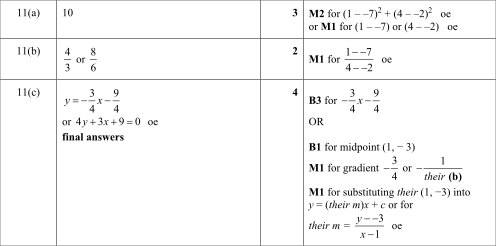
\(A=(5,2),B=(-3,6)\).
(a) Find AB. [3]
(b) Find the equation of the line perpendicular to AB through \((-2,5)\), in the form \(y=mx+c\). [4]

0580 P22 - Mar 2025 - Q21 - 6 marks
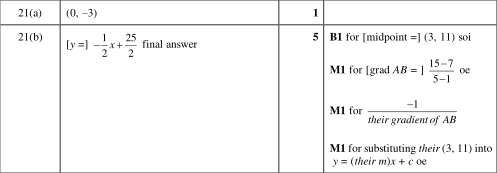
(a) Give the y-intercept coordinates of \(y=5x-3\). [1]
(b) \(A=(1,7),B=(5,15)\). Find the perpendicular bisector of AB in the form \(y=mx+c\). [5]
0580 P42 - Jun 2025 - Q25 - 5 marks
\(P=(8,0),Q=(20,6)\). Find the perpendicular bisector of PQ in the form \(y=mx+c\). [5]

0580 P43 - Jun 2025 - Q13 - 6 marks
Line L has equation \(y=2(x-5)\).
(a) Find where L intersects the y-axis. [1]
(b) Find its x-coordinate where it intersects y=19. [2]
(c) Line P is perpendicular to L and passes through (2,3). Find its equation in the form y=mx+c. [3]

0580 P23 - Nov 2025 - Q22 - 3 marks
L has equation \(y=-\frac12x+7\). Find the line perpendicular to L through (3,5), in the form y=mx+c. [3]

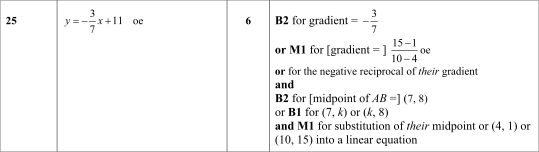
0580 P22 - Nov 2025 - Q17 - 11 marks
B=(−3,1), D=(−5,9). BD is a diagonal of kite ABCD.
(a) BD:AC=2:3. Find AC as a surd in simplest form. [5]
(b) Find the midpoint of BD. [2]
(c) AC passes through that midpoint. Find its equation in the form y=mx+c. [4]

0580 P41 - Nov 2025 - Q17 - 3 marks
Find the line through (2,0) and (0,4), in the form y=mx+c. [3]

0580 P22 - Mar 2024 - Q26 - 5 marks
A=(6,1), B=(2,7). Find the equation of their perpendicular bisector in the form y=mx+c. [5]

0580 P22 - Mar 2024 - Q9 - 2 marks
\(y=2x-5\) intersects \(y=3\) at P. Find P. [2]

0580 P23 - Jun 2024 - Q10 - 2 marks
Find the gradient of the line joining (−2,7) and (3,1). [2]

0580 P22 - Jun 2024 - Q14 - 2 marks

A=(0,2), B=(8,6). Find the equation of AB in the form y=mx+c. [2]

0580 P41 - Jun 2024 - Q5 - 17 marks
P=(1,7), Q=(5,−5), O is the origin.

(a(i)) Find \(\overrightarrow{PQ}\). [2]
(a(ii)) Show that OP=OQ. [3]
(a(iii)) PQ is a chord of a circle centre O. Find its circumference. [2]
(a(iv)) PQ is the diameter of a different circle centre R. Find R. [2]
(a(v)) Find the equation of the perpendicular bisector of PQ, in y=mx+c form. [4]
(b) A and B have position vectors a,b. AM:MB=2:3. Find the position vector of M, simplified. [4]


0580 P42 - Jun 2024 - Q10 - 12 marks
A=(6,2), B=(3,−4).
(a(i)) Find their midpoint. [2]
(a(ii)) Find AB. [3]
Line l: \(4x+3y-12=0\).
(b(i)) Find its gradient. [2]
(b(ii)) Find its y-axis intercept as coordinates. [2]
(b(iii)) p is perpendicular to l and passes through(6,5). Find p in y=mx+c form. [3]


0580 P22 - Nov 2024 - Q22 - 5 marks
A=(17,9) and B=(23,39). Find the perpendicular bisector of AB in the form y=mx+c. [5]

0580 P42 - Mar 2023 - Q6 - 11 marks

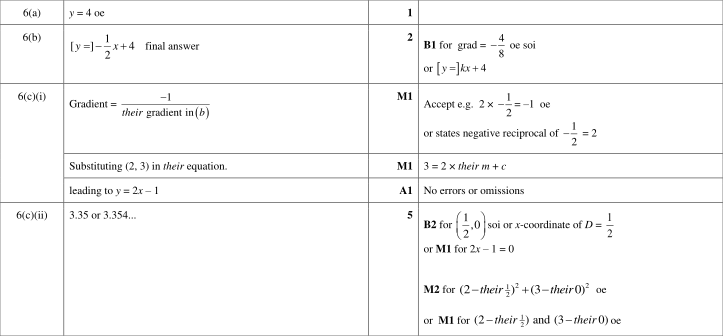
\(A=(0,4),\ B=(8,0)\). Line \(L_1\) through \(A\) is parallel to the \(x\)-axis; \(L_2\) passes through \(A,B\).
(a) Write down the equation of \(L_1\). [1]
(b) Find the equation of \(L_2\) in the form \(y=mx+c\). [2]
(c(i)) \(C=(2,3)\). Line \(L_3\) passes through \(C\) and is perpendicular to \(L_2\). Show that \(L_3\) has equation \(y=2x-1\). [3]
(c(ii)) \(L_3\) meets the \(x\)-axis at \(D\). Find \(CD\). [5]
0580 P22 - Jun 2023 - Q15 - 7 marks
\(C=(5,-1),\ D=(13,15)\).
(a) Find the midpoint of \(CD\). [2]
(b) Find its gradient. [2]
(c) Find the equation of the perpendicular bisector in the form \(y=mx+c\). [3]

0580 P41 - Jun 2023 - Q6 - 14 marks
In square \(ABCD\), \(A=(-2,1),B=(1,5),C=(a,b)\), where \(a,b\) are both positive integers.
(a) Find the coordinates of \(C,D\). You may use a coordinate grid to help. [4]
(b(i)) For \(P=(-1,3),Q=(6,4)\), find the midpoint of \(PQ\). [2]
(b(ii)) Find \(PQ\). [3]
(b(iii)) Find the gradient of \(PQ\). [2]
(b(iv)) Find the equation of the line parallel to \(PQ\) that meets the \(x\)-axis at \(x=2\). [3]

0580 P43 - Jun 2023 - Q11 - 9 marks
\(M=(4,1),\ N=(-2,-7)\).
(a) Find \(MN\). [3]
(b) Find its gradient. [2]
(c) Find the equation of its perpendicular bisector. [4]
0580 P42 - Nov 2023 - Q12 - 11 marks
\(O=(0,0),A=(8,1),B=(2,5)\).
(a(i)) Write \(\overrightarrow{OB}\) as a column vector. [1]
(a(ii)) Write \(\overrightarrow{AB}\) as a column vector. [1]
(b) Find the equation of \(AB\) in form \(y=mx+c\). [3]
(c) Find its perpendicular bisector in form \(y=mx+c\). [4]
(d) \(AB\) meets the y-axis at \(P\); its perpendicular bisector meets it at \(Q\). Find \(PQ\). [2]

0580 P43 - Nov 2023 - Q9 - 14 marks
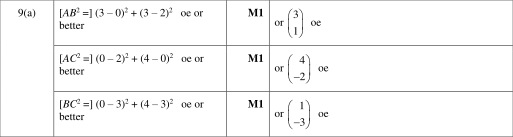
\(A=(0,2),B=(3,3),C=(4,0)\).
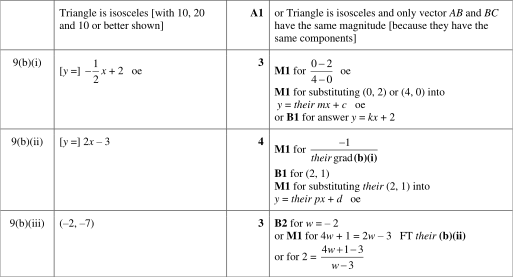
(a) Show \(ABC\) is isosceles. [4]
(b(i)) Find the equation of \(AC\) as \(y=mx+c\). [3]
(b(ii)) Find the perpendicular bisector of \(AC\) as \(y=mx+c\). [4]
(b(iii)) \(ABCD\) is a kite and \(D=(w,4w+1)\). Find \(D\). [3]
0580 P22 - Mar 2022 - Q16 - 4 marks
\(A=(-6,5),B=(-2,-3)\).
(a) Find the line \(l\) through \(A,B\) as \(y=mx+c\). [2]
(b) Find the line perpendicular to \(l\) passing through the origin. [2]

0580 P22 - Mar 2022 - Q5 - 2 marks
\(y=5x+7\).
(a) Write down its gradient. [1]
(b) Find its y-axis intercept. [1]

0580 P42 - Jun 2022 - Q3 - 12 marks
Line \(l\) joins \(F=(3,2)\) and \(G=(-5,4)\).
(a) Calculate its length. [3]
(b) Find the equation of its perpendicular bisector in the form \(y=mx+c\). [5]
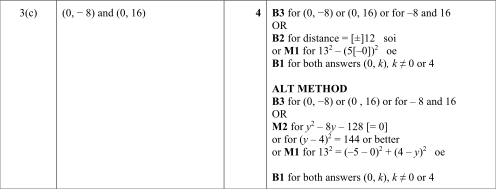
(c) \(H\) lies on the y-axis and \(GH=13\). Find both possible positions of H. [4]

0580 P43 - Jun 2022 - Q8 - 18 marks
\(A=(-2,7),B=(1,-5),C=(5,4)\).
(a(i)) Find the midpoint of AB. [2]
(a(ii)) Find the column vector \(\overrightarrow{AC}\). [2]
(a(iii)) Find the length \(|\overrightarrow{AC}|\). [2]
(a(iv)) Find AB’s equation in the form \(y=mx+c\). [3]
(a(v)) Find the line perpendicular to AB passing through C, in the same form. [3]
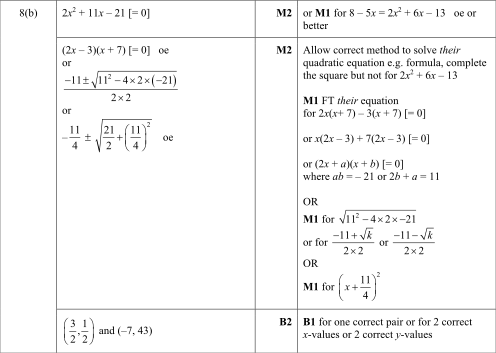
(b) The graphs \(y+5x=8\) and \(y=2x^2+6x-13\) meet at P and Q. Find both coordinates, showing all working. [6]

0580 P23 - Nov 2022 - Q16 - 3 marks
A kite’s diagonals meet at \((-2,-5)\). One has equation \(y=4x+3\). Find the other diagonal’s equation in the form \(y=mx+c\). [3]

0580 P42 - Nov 2022 - Q8 - 9 marks
AB has midpoint M. A = (2, 3) and M = (12, 7).
(a) Find B. [2]
(b) Show that the perpendicular bisector of AB has equation \(2y+5x=74\). [4]
(c) It passes through N = (2, n). Find n. [1]
(d) Find the area of triangle AMN. [2]

0580 P42 - Mar 2021 - Q12 - 14 marks
(a) Find the gradient of \(y=2x^3-7x+4\) at x = −2. [3]
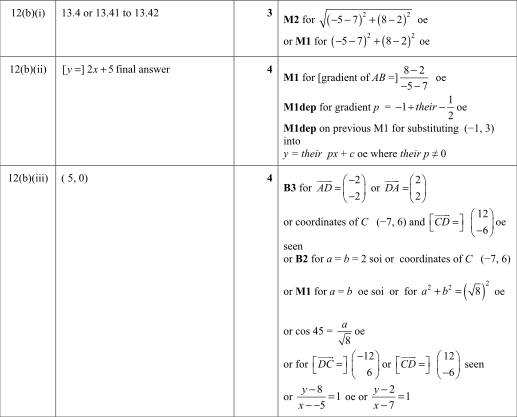
(b(i)) A = (7, 2), B = (−5, 8). Find AB. [3]
(b(ii)) Find the line perpendicular to AB through (−1, 3), in the form y = mx + c. [4]
(b(iii)) AB is a side of parallelogram ABCD. \(\overrightarrow{BC}=\binom{-a}{-b}\) where \(a>0,b>0\). Gradient of BC is 1 and \(|\overrightarrow{BC}|=\sqrt8\). Find D. [4]

0580 P22 - Jun 2021 - Q17 - 2 marks
Find the gradient of a line perpendicular to \(3y=4x-5\). [2]

0580 P21 - Jun 2021 - Q16 - 7 marks

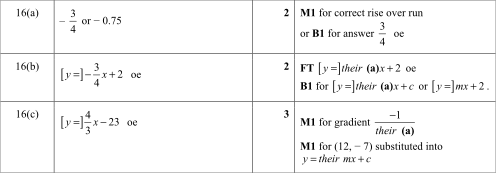
(a) Find the gradient of the line. [2]
(b) Find its equation. [2]
(c) Find the equation of the perpendicular line through (12, −7). [3]
0580 P22 - Jun 2021 - Q16 - 6 marks
A is (5, 7), B is (9, −1).
(a) Find AB. [3]
(b) Find the equation of AB. [3]

0580 P21 - Nov 2021 - Q11 - 3 marks
L has equation \(y=4-5x\). Find the equation of a line perpendicular to L through (0, 6). [3]

0580 P23 - Nov 2021 - Q18 - 3 marks
Find the line through (2, −2) and (3, 10) in the form \(y=mx+c\). [3]

0580 P22 - Nov 2021 - Q15 - 4 marks
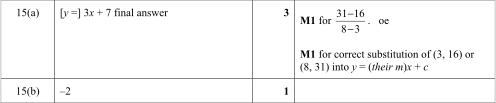
(a) A is (3, 16) and B is (8, 31). Find the equation of AB in the form \(y=mx+c\). [3]
(b) CD has equation \(y=.5x-11\). Find the gradient of a perpendicular line. [1]
0580 P22 - Mar 2020 - Q17 - 4 marks
A is (3, 5) and B is (1, −7). Find the equation of the line through A perpendicular to AB, in the form \(y=mx+c\). [4]

0580 P43 - Jun 2020 - Q9 - 13 marks
(a(i)) Line L has equation \(3x-8y+20=0\). Find its gradient. [2]
(a(ii)) Give its y-intercept coordinates. [1]
(b(i)) P=(−3,8), Q=(9,−2). Find PQ. [3]
(b(ii)) Find the equation of the line parallel to PQ through(6,−1). [3]
(b(iii)) Find the perpendicular bisector of PQ. [4]

0580 P21 - Nov 2020 - Q14 - 2 marks
Find the gradient of a line perpendicular to \(8y+4x=5\). [2]

0580 P22 - Nov 2020 - Q24 - 5 marks
A line through(2,3) is perpendicular to \(y=\frac13x+1\). They meet at P. Find P. [5]

0580 P23 - Nov 2020 - Q12 - 4 marks
\(y=5x+12\) is the equation of line l.
(a) Give its gradient. [1]
(b) Find its x-intercept coordinates. [2]
(c) Give the gradient k of a perpendicular line. [1]

0580 P22 - Mar 2019 - Q23 - 6 marks
A=(2,3), B=(7,−5).
(a) Find the midpoint of AB. [2]
(b) Find the line through A perpendicular to AB, in the form y=mx+c. [4]

0580 P23 - Jun 2019 - Q5 - 2 marks
(a) Find where \(y=3x-8\) crosses the y-axis. [1]
(b) Write down its gradient. [1]

0580 P21 - Jun 2019 - Q26 - 5 marks
Line L passes through (0,−3) and (6,9).
(a) Find its equation. [3]
(b) Find the equation of the line perpendicular to L through (0,2). [2]

0580 P42 - Jun 2019 - Q4 - 13 marks
(a) A line has equation2y=3x+4.
(a(i)) Find its gradient. [1]
(a(ii)) Find where it crosses the y-axis. [1]

(b(i)) Find the equation of L. [3]
(b(ii)) Find the equation of the line perpendicular to L through(9,3). [3]
(c) A=(8,5), B=(−4,1).
(c(i)) Calculate AB. [3]
(c(ii)) Find the midpoint of AB. [2]

0580 P43 - Jun 2019 - Q7 - 10 marks
A=(−2,−3), C=(1,9).
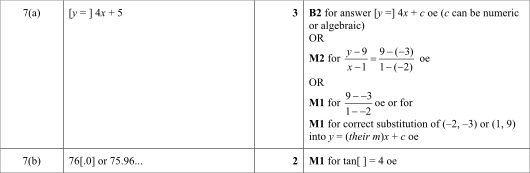
(a) Find the equation of AC in y=mx+c form. [3]
(b) Find the acute angle between AC and the x-axis. [2]
(c) ABCD is a kite with AC its longer diagonal and B=(3.5,2).
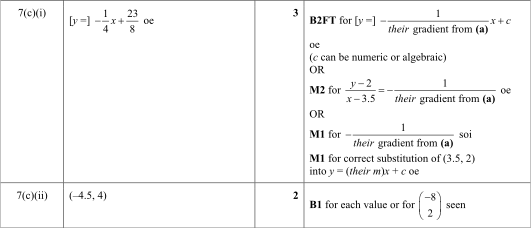
(c(i)) Find BD in y=mx+c form. [3]
(c(ii)) The diagonals intersect at(−.5,3). Find D. [2]
0580 P22 - Nov 2019 - Q14 - 3 marks
Show that \(4y=5x-10\) is perpendicular to \(5y+4x=35\). [3]

0580 P23 - Nov 2019 - Q13 - 3 marks
The line joining (3k,6) and (k,−5) has gradient 2. Find k. [3]

0580 P23 - Nov 2019 - Q7 - 2 marks
Find the gradient of a line perpendicular to \(2y=3+5x\). [2]

0580 P21 - Jun 2018 - Q24 - 6 marks
(a) A=(1,0), B=(2,5). Calculate the angle between AB and the x-axis. [3]
(b) PQ has equation y=3x−8 and P=(6,10). Find the equation through P perpendicular to PQ, in the form y=mx+c. [3]
0580 P22 - Jun 2018 - Q25 - 6 marks
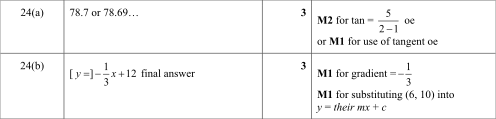
P=(16,9), Q=(22,24).
(a) Find the equation of the line perpendicular to PQ through (5,1), in the form y=mx+c. [4]
(b) N lies on PQ with PN=2NQ. Find N. [2]

0580 P22 - Nov 2018 - Q17 - 4 marks

C=(−1,2), D=(9,7). Find the equation perpendicular to CD through(1,3), in the form y=mx+c. [4]

0580 P41 - Nov 2018 - Q8 - 14 marks

(a) Read A’s coordinates. [1]
(b) Find line l as y=mx+c. [3]
(c) Find the parallel line through B. [2]
C=(8,14).
(d(i)) Find the line perpendicular to l through C. [3]
(d(ii)) Find AC. [3]
(d(iii)) Find the midpoint of BC. [2]

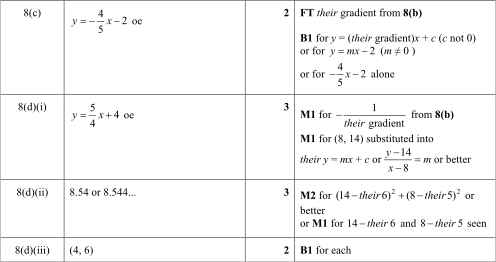
0580 P22 - Mar 2017 - Q20 - 6 marks

(a) Find the equation of l in the form y=mx+c. [3]
(b) A perpendicular line passes through (3,−1). Find its equation. [3]

0580 P21 - Jun 2017 - Q12 - 3 marks
A line has gradient 5. M=(x,8) and N=(k,23) are on the line. Find x in terms of k. [3]

0580 P22 - Jun 2017 - Q27 - 7 marks

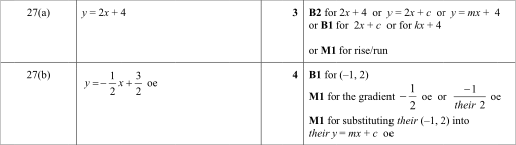
A=(−2,0) and B=(0,4).
(a) Find the equation of AB. [3]
(b) Find the equation of the perpendicular bisector of AB. [4]
0580 P41 - Jun 2017 - Q7 - 11 marks
A line joins A=(−3,8) and B=(2,−2).
(a) Find the midpoint of AB. [2]
(b) Find the equation of AB in the form y=mx+c. [3]
(c) A parallel line passes through (0,7). Write its equation. [2]
(d) A perpendicular line passes through (1,5). Find its equation as ax+by+c=0 with integer coefficients. [4]

0580 P21 - Nov 2017 - Q6 - 2 marks
The grid shows two sides of rhombus ABCD.

(a) Write the coordinates of A. [1]
(b) Complete ABCD on the grid. [1]


0580 P43 - Nov 2017 - Q8 - 14 marks
Line A: \(y=5x-4\). Line B: \(3x+2y=18\).
(a(i)) Find A’s gradient. [1]
(a(ii)) Find B’s gradient. [1]
(b) Find A’s x-axis intercept. [2]
(c) Find the line perpendicular to A through (10,9), as y=mx+c. [4]
(d) Find the intersection of A and B. [3]
(e) Find the area enclosed by A,B and the y-axis. [3]

0580 P21 - Jun 2016 - Q25 - 6 marks
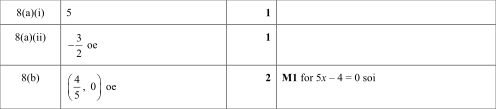
A is \((4,1)\) and B is \((10,15)\).
Find the equation of the perpendicular bisector of AB. [6]
0580 P23 - Jun 2016 - Q18 - 4 marks
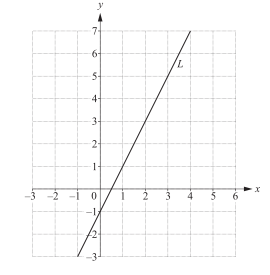
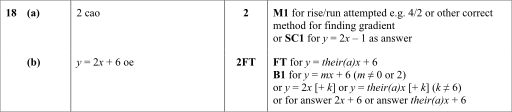
(a) Work out the gradient of L. [2]
(b) Write down the equation of the line parallel to L through \((0,6)\). [2]
0580 P42 - Jun 2016 - Q9 - 13 marks
A line joins A \((-2,-5)\) and B \((4,13)\).
(a) Calculate AB. [3]
(b) Find the equation of AB in the form \(y=mx+c\). [3]
(c) Give the equation of a parallel line through \((0,-5)\). [2]
(d) Find the equation of the perpendicular bisector of AB. [5]


0580 P22 - Nov 2016 - Q20 - 6 marks

A has coordinates (3, 6).
(a) Write the coordinates of B. [1]
(b) Find the gradient of AB. [2]
(c) Find the equation of the line perpendicular to AB through (0, 2). [3]

0580 P23 - Nov 2016 - Q17 - 3 marks
A = (8, 3) and B = (12, 1).
Find the equation of the line perpendicular to AB through (0, 0). [3]

0580 P22 - Mar 2015 - Q14 - 3 marks
Find the equation of the line perpendicular to \(y=3x-1\) and passing through (7, 4). [3]

0580 P22 - Jun 2015 - Q17 - 4 marks

(a) The line l passes through (0, 3) and (4, 11). Find its equation in the form y = mx + c. [3]
(b) Line p is perpendicular to l. Write its gradient. [1]

0580 P42 - Nov 2015 - Q8 - 11 marks
A = (3, 4) and B = (5, 8).
(a) Find the midpoint of AB. [2]
(b) Find AB. [3]
(c) Find the equation of AB. [3]
(d) A perpendicular to AB passes through the origin and (6, r). Find r. [3]

0580 P21 - Jun 2014 - Q14 - 4 marks
A = (5, 10), B = (13, −2). The perpendicular bisector of AB has gradient 2/3. Find its equation. [4]

0580 P23 - Jun 2014 - Q13 - 3 marks
Find the line through (5, 9) and (−3, 13). [3]

0580 P22 - Jun 2014 - Q5 - 2 marks

Line l is y = 5 − x.
(a) Find its y-intercept P. [1]
(b) Write its gradient. [1]

0580 P21 - Jun 2013 - Q17 - 3 marks
Find the equation of the line through (0, −1) and (3, 5). [3]

0580 P22 - Nov 2013 - Q18 - 6 marks
A = (5, 23), B = (−2, 2).
(a) Find the midpoint of AB. [2]
(b) Find the equation of AB. [3]
(c) Show (3, 17) lies on AB. [1]

0580 P22 - Jun 2012 - Q17 - 5 marks
(a) Find the midpoint of A(−8, 3) and B(−2, −3). [2]
(b) y = 4x + c passes through (2, 6). Find c. [1]
(c) The lines \(5x=4y+10\) and \(2y=kx-4\) are parallel. Find k. [2]

0580 P22 - Nov 2012 - Q20 - 7 marks
(a) The lines y = 2x + 8 and y = 2x − 12 meet the x-axis at P and Q. Find PQ. [2]
(b) Write the equation of the line with gradient −4 through (0,5). [2]
(c) Find the equation of the parallel line through (5,4). [3]

0580 P22 - Jun 2011 - Q18 - 4 marks

(a) Find the midpoint of AB. [1]
(b) Find the equation of CB. [3]

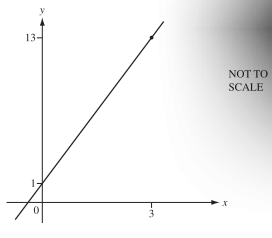
0580 P23 - Jun 2011 - Q14 - 3 marks

0580 P21 - Nov 2011 - Q16 - 6 marks

A = (1,3), B = (3,0), C = (9,7).
(a) Find AB. [3]
(b) Find the equation of AC. [3]

0580 P21 - Jun 2010 - Q15 - 4 marks
The points (2,5), (3,3), (k,1) are collinear.
(a) Find k. [1]
(b) Find the line equation. [3]

0580 P22 - Jun 2010 - Q15 - 5 marks

(a) y = 4 meets 2x+y = 8 at A. Find A. [1]
(b) 3x+y = 18 meets the x-axis at B. Find B. [1]
(c)(i) Find the midpoint M of AB. [1]
(c)(ii) Find the line through M parallel to 3x+y = 18. [2]

0580 P23 - Nov 2010 - Q15 - 3 marks
Find the line through (0,8) and (3,2). [3]

0580 P21 - Nov 2010 - Q21 - 6 marks

(a) Using only straight edge and compasses, construct the perpendicular bisector of AB. [2]
(b) Find the midpoint of A(1,8), B(7,−4). [1]
(c) Find the equation of AB. [3]


0580 P22 - Nov 2010 - Q22 - 6 marks
(a) y = 2x+7 meets the y-axis at A. Find A. [1]
(b)(i) A parallel line passes through B(0,3). Find its equation. [2]
(b)(ii) C lies on y = 2x+1 at x = 2. Find the midpoint of BC. [3]
