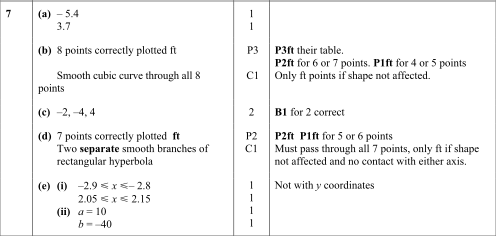
0580 P42 - Mar 2026 - Q17 - 3 marks
A curve has equation \(y=x^3-\frac52x^2+3\).
Find its gradient at \(x=1.5\). [3]

0580 P22 - Mar 2026 - Q22 - 7 marks
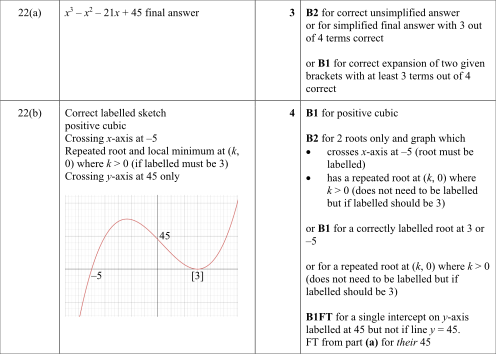
(a) Expand and simplify \((x+5)(x-3)^2\). [3]
(b) Sketch \(y=(x+5)(x-3)^2\), indicating where the graph crosses the axes. [4]

0580 P21 - Jun 2026 - Q24 - 9 marks
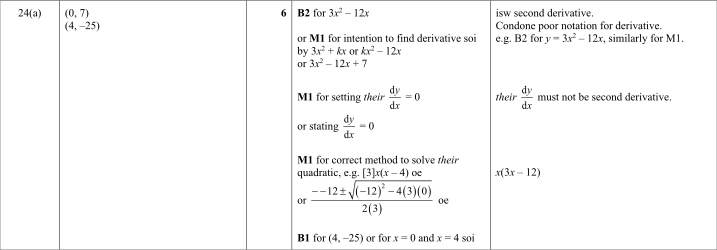
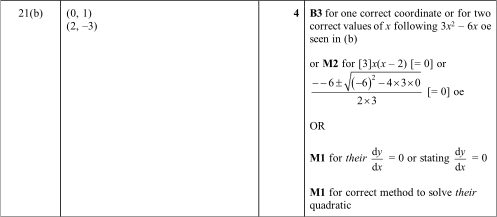
(a) Find the coordinates of the turning points of \(y=x^3-6x^2+7\). [6]
(b) Draw a suitable sketch and identify each turning point as a maximum or minimum. [3]


0580 P22 - Jun 2026 - Q23 - 7 marks
The curve has equation \(y=2x^2-11x+12\).
(a) Find the gradient of the tangent at \(x=2\). [3]
(b) Line L meets the curve at \(x=2\) and is perpendicular to this tangent. Find the equation of L. [4]

0580 P42 - Jun 2026 - Q8 - 11 marks
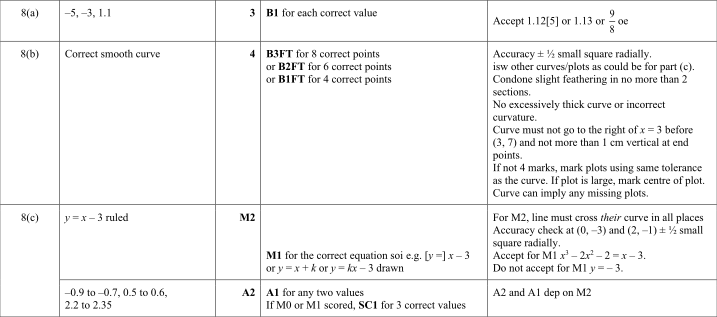
The table gives values of \(y=x^3-2x^2-2\), correct to 1 decimal place.
| x | −1 | −0.5 | 0 | 0.5 | 1 | 1.5 | 2 | 2.5 | 3 |
|---|---|---|---|---|---|---|---|---|---|
| y | −2.6 | −2 | −2.4 | −3.1 | −2 | 7 |
(a) Complete the three missing values. [3]
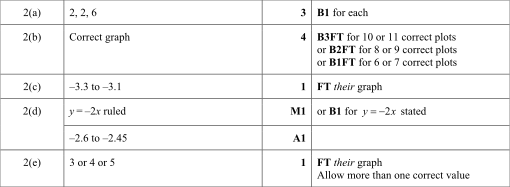
(b) Draw the curve for \(-1\le x\le3\). [4]

(c) Draw a suitable straight line and use it to solve \(x^3-2x^2-x+1=0\). [4]

0580 P43 - Jun 2026 - Q11 - 10 marks
The table gives values of \(y=3\times2^x-5\), correct to 1 decimal place.
| x | −2 | −1.5 | −1 | −0.5 | 0 | 0.5 | 1 | 1.5 | 2 |
|---|---|---|---|---|---|---|---|---|---|
| y | −3.9 | −2.9 | −0.8 | 1 | 3.5 | 7 |
(a) Complete the table. [3]
(b) Draw the graph for \(-2\le x\le2\). [4]

(c) Draw a suitable line to solve \(3\times2^x=7\). [2]
(d) Find the equation of the asymptote. [1]


0580 P43 - Jun 2026 - Q20 - 8 marks
(a) Find the turning points of \(y=8x^3-6x+5\). Show all working. [5]
(b) Classify each as a maximum or a minimum, with justification. [3]


0580 P22 - Mar 2025 - Q22 - 9 marks
\(y=x^3+x^2-x\) has a stationary point at \((\frac13,-\frac5{27})\).
(a) Find the other stationary point. [5]
(b) Sketch the graph and use it to classify \((\frac13,-\frac5{27})\) as a maximum or minimum. [2]
(c) \(x^3+x^2-x=k\) has fewer than 3 solutions. Find the possible range of k. [2]


0580 P21 - Jun 2025 - Q11 - 5 marks
The diagram shows \(y=f(x)\) and \(P=(-2,11)\). The tangent from P touches the curve at (a,b), where a and b are integers.

(a) Draw the tangent and find a and b. [2]
(b) Find the tangent equation in the form \(y=mx+c\). [3]


0580 P21 - Jun 2025 - Q22 - 6 marks
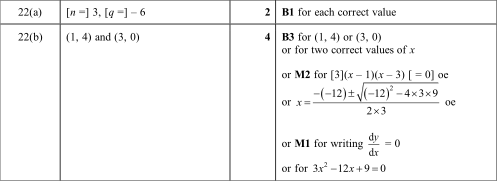
A curve has equation \(y=x^n+qx^2+9x\), with \(\frac{dy}{dx}=3x^2-12x+9\).
(a) Find n and q. [2]
(b) Find the coordinates of its turning points. [4]
0580 P21 - Jun 2025 - Q6 - 3 marks
The line \(x+y=7\) is drawn on the grid.

(a) Draw the line \(y=2x+1\) on the grid. [2]
(b) Use the graph to solve \(x+y=7,\ y=2x+1\). [1]


0580 P22 - Jun 2025 - Q15 - 6 marks
The graph is \(y=\frac2x-1\).

(a) Give the coordinates of the x-axis intersection. [1]
(b) Give the equations of the two asymptotes. [2]
(c) Draw a suitable straight line to solve \(\frac2x-x-1=0\). [3]


0580 P22 - Jun 2025 - Q21 - 9 marks
The graph of \(y=3x-x^3\) crosses the x-axis at A, O and B. Its turning points are P and Q.

(a) Find the exact x-coordinates of A and B. [3]
(b(i)) Differentiate \(3x-x^3\). [2]
(b(ii)) Find P and Q. [4]

0580 P23 - Jun 2025 - Q21 - 6 marks
(a) Differentiate \(x^3-3x^2+1\). [2]
(b) Find the turning points of \(y=x^3-3x^2+1\). [4]

0580 P42 - Jun 2025 - Q26 - 2 marks
\(y=ax^{11}+3x^b\) and \(dy/dx=44x^{10}+18x^c\). Find a, b and c. [2]

0580 P41 - Jun 2025 - Q14 - 11 marks
The table gives values for \(y=5x^2-x^3-4\).
| x | −2 | −1 | 0 | 1 | 2 | 3 | 4 | 5 |
|---|---|---|---|---|---|---|---|---|
| y | 24 | −4 | 8 | 14 | −4 |
(a) Complete the table. [3]

(b) Draw \(y=5x^2-x^3-4\) for \(-2\le x\le5\). [4]
(c) Draw a suitable straight line to solve \(x^3-5x^2-x+14=0\). [4]


0580 P42 - Nov 2025 - Q11 - 10 marks
The table gives values of \(y=x^3-2x+3\), to 2 decimal places where needed.
| x | −2 | −1.5 | −1 | −0.5 | 0 | 0.5 | 1 | 1.5 | 2 |
|---|---|---|---|---|---|---|---|---|---|
| y | −1 | … | 4 | 3.88 | 3 | 2.13 | 2 | … | 7 |
(a) Complete the table. [2]
(b) Draw the graph for \(-2\le x\le2\). [4]

(c) By drawing a suitable straight line, solve \(x^3-2.5x+1=0\). [4]


0580 P43 - Nov 2025 - Q20 - 4 marks
\(y=x^3+3x^2-13x\).
(a) Find \(dy/dx\). [2]
(b) Find the gradient when x=3. [2]

0580 P42 - Mar 2024 - Q10 - 12 marks
The table gives values of \(y=2x^3+6x^2-2.5\).
| x | −3 | −2.5 | −2 | −1.5 | −1 | −0.5 | 0 | 0.5 | 1 |
|---|---|---|---|---|---|---|---|---|---|
| y | … | 3.75 | 5.5 | 4.25 | 1.5 | … | −2.5 | −0.75 | … |
(a) Complete the table. [3]
(b) Draw the graph for \(-3\le x\le1\). [4]

(c) By drawing a suitable line, solve \(2x^3+6x^2=4.5\). [3]
(d) \(2x^3+6x^2-2.5=k\) has exactly two solutions. State the two possible values of k. [2]


0580 P42 - Mar 2024 - Q8 - 12 marks
(a) Sketch \(y=4-3x\). [2]

(b) Sketch \(y=-x^2\). [2]

(c(i)) Find both turning points of \(y=10+9x^2-2x^3\), showing all working. [5]
(c(ii)) Determine which is a maximum and which is a minimum. Show how you decide. [3]


0580 P21 - Jun 2024 - Q18 - 3 marks
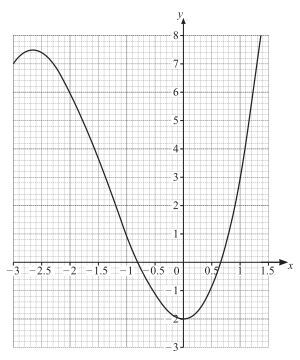
The graph is \(y=x^3+4x^2-2\), for \(-3\le x\le1.5\). By drawing a suitable straight line, solve \(x^3+4x^2-2=2x\) in this interval. [3]


0580 P22 - Jun 2024 - Q18 - 3 marks

(a) Draw the tangent at x=3. [1]
(b) Use your tangent to estimate the gradient of the curve at x=3. [2]


0580 P41 - Jun 2024 - Q8 - 15 marks
(a) Sketch \(y=x^2+7x-18\), labelling its intercepts. [4]

(b(i)) Find the derivative of \(y=x^2-3x-28\). [2]
(b(ii)) Find its turning point. [3]
(c) Find the intersections of \(y=5-2x\) and \(y=x^2-3x-28\), showing working. Give coordinates to 2 decimal places. [6]


0580 P42 - Jun 2024 - Q11 - 7 marks
(a) Point(−1,6) lies on a curve with \(dy/dx=-4x^3-9x^2+5\). Show it is stationary. [2]
A different curve is \(y=2x^3-6x+8\).
(b(i)) Find its tangent gradient at(−2,2). [3]
(b(ii)) Find the stationary points’ x-coordinates. [2]

0580 P43 - Jun 2024 - Q10 - 11 marks
\(y=x^7-7x^6\).
(a) Find dy/dx. [2]
(b) Find the tangent at x=−1 in y=mx+c form. [4]
(c) Find the coordinates of both turning points, showing working. [5]


0580 P43 - Jun 2024 - Q5 - 13 marks

Use the graph, drawn for−3≤x≤3.
(a(i)) Find f(2). [1]
(a(ii)) Solve f(x)=5. [3]
(a(iii)) f(x)=k has exactly two solutions. State k. [1]
(a(iv)) Choose the correct description of x=0: tangent, asymptote, root, perpendicular. [1]
(b(i)) Draw y=x−2 for−3≤x≤3. [2]
(b(ii)) Find x when f(x)=x−2. [1]
(c) \(f(x)=x^2-\frac cx\), x≠0. Use the graph to show c=2. [2]
(d) The equation f(x)=x−2 can be written \(x^3+px^2+qx=2\). Find p,q. [2]


0580 P21 - Nov 2024 - Q22 - 6 marks
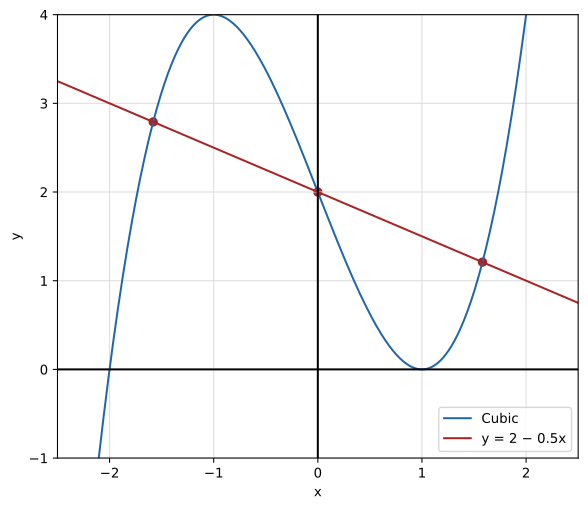
The graph of \(y=(x+2)(x-1)^2\) is shown.

(a) Show that \(y=x^3-3x+2\). [2]
(b) By drawing a suitable straight line, solve \(2x^3-5x=0\). [4]

0580 P42 - Nov 2024 - Q10 - 9 marks
\(y=x^3-9x^2-48x\).
(a) Differentiate. [2]
(b) Find both turning points, showing all working. [4]
(c) Classify each turning point, giving reasons. [3]


0580 P42 - Nov 2024 - Q2 - 13 marks
\(y=x^3+4x^2-4\).
| x | −4.5 | −4 | −3 | −2 | −1 | 0 | 1 | 1.5 |
|---|---|---|---|---|---|---|---|---|
| y | -14.1 | … | 5 | 4 | … | -4 | 1 | 8.4 |
(a) Complete the table. [2]
(b) Draw the curve for −4.5≤x≤1.5. [4]

(c(i)) Draw the tangent at (1,1). [1]
(c(ii)) Use it to estimate the gradient at (1,1). [2]
(d) Draw a suitable straight line to solve \(x^3+4x^2-x-6=0\). [4]


0580 P43 - Nov 2024 - Q10 - 11 marks

\(y=3+2x-x^2\), A=(−1,0), B=(2,3).
(a) Find the derivative. [2]
(b(i)) Show the tangent at A has equation y=4x+4. [3]
(b(ii)) Line L is perpendicular to y=4x+4 and passes through B. Find L in the form y=mx+c. [3]
(c) Find the maximum point. [3]


0580 P42 - Mar 2023 - Q9 - 9 marks
\(f(x)=x^3-3x^2-4\).
(a) Find the gradient of \(y=f(x)\) at \(x=1\). [3]
(b) Find the coordinates of its turning points. [4]
(c) Sketch the graph of \(y=f(x)\). [2]


0580 P21 - Jun 2023 - Q20 - 7 marks
\(y=3x^2-2x-1\).
| \(x\) | -1 | -0.5 | 0 | 0.5 | 1 | 1.5 |
|---|---|---|---|---|---|---|
| \(y\) | 4 | -1 | 0 | 2.75 |

(a) Complete the table. [1]
(b) Draw the graph for \(-1\le x\le1.5\). [3]
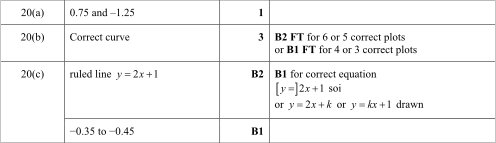
(c) By drawing a suitable straight line, solve \(3x^2-4x-2=0\) for \(-1\le x\le1.5\). [3]

0580 P21 - Jun 2023 - Q21 - 6 marks
A curve has equation \(y=x^3-12x\).
(a) Find its gradient at \((1,-11)\). [3]
(b) Find the coordinates of its turning points. [3]

0580 P42 - Jun 2023 - Q8 - 13 marks
(a(i)) Show that \(y=(x-4)(x+1)(x-2)\) can be written \(y=x^3-5x^2+2x+8\). [2]
(a(ii)) Sketch this graph, indicating the values where it crosses the axes. [4]
(b) The graph has two tangents with gradient 10. Find both equations in the form \(y=mx+c\), showing all working. [7]


0580 P43 - Jun 2023 - Q10 - 12 marks
The table gives some values for \(y=2^x-3\).
| \(x\) | -2 | -1 | 0 | 0.5 | 1 | 1.5 | 2 | 2.5 |
|---|---|---|---|---|---|---|---|---|
| \(y\) | -2.75 | … | … | -1.58 | … | -0.17 | 1 | 2.66 |

(a) Complete the three missing values. [3]
(b) Draw the graph for \(-2\le x\le2.5\). [4]
(c) Use your graph to solve \(2^x-3=2\). [1]
(d) Draw a suitable straight line to solve \(2^x-x-1.5=0\). [4]


0580 P43 - Jun 2023 - Q12 - 8 marks
\(y=x^4-8x^2+5\).
(a) Find \(dy/dx\). [2]
(b) Find the coordinates of all three turning points, showing working. [4]
(c) Determine which turning point is a maximum. Justify your answer. [2]


0580 P43 - Jun 2023 - Q7 - 10 marks

(a) Identify the shown function type: reciprocal, quadratic, cubic, exponential or linear. [1]
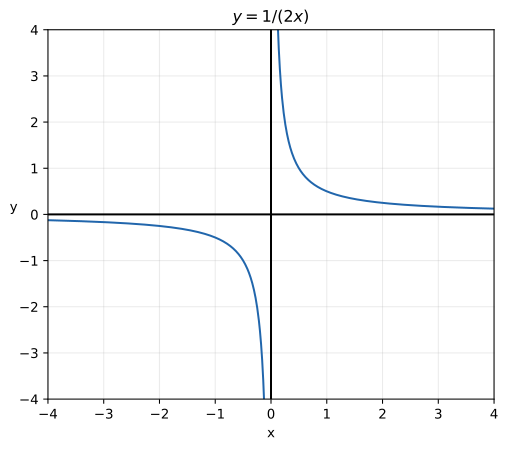
(b(i)) Sketch \(y=\frac1{2x},\quad x\ne0\). [2]
(b(ii)) Solve \(\frac1{2x}=2x\). [2]
(c(i)) Sketch \(y=\sin x\) for \(0^\circ\le x\le360^\circ\). [2]
(c(ii)) Solve \(3\sin x+1=0\) for \(0^\circ\le x\le360^\circ\). [3]


0580 P22 - Nov 2023 - Q25 - 2 marks
The derivative of \(2ax^7+3x^k\) is \(42x^6+15x^{k-1}\).
Find \(a,k\). [2]

0580 P41 - Nov 2023 - Q11 - 10 marks
(a) Differentiate \(x^3-4x^2-3x\). [2]
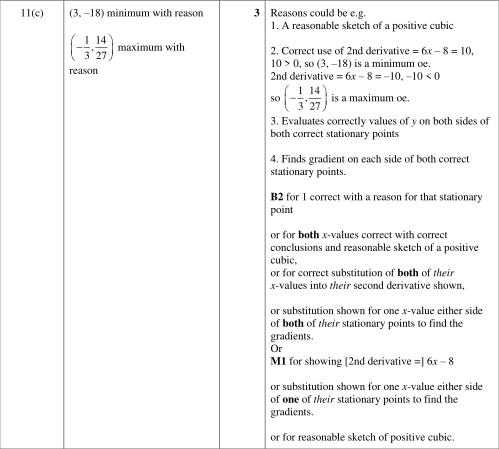
(b) For \(y=x^3-4x^2-3x\), find both stationary points, showing working. [5]
(c) Determine whether each is a maximum or minimum, showing working. [3]


0580 P42 - Nov 2023 - Q9 - 8 marks
The curve \(y=4x^3-x^4\) crosses the x-axis at \(O\) and positive point \(A\). \(B\) is its maximum.
(a) Differentiate \(4x^3-x^4\). [2]
(b) Find \(B\). [3]
(c) Find the gradient at \(A\). [3]


0580 P43 - Nov 2023 - Q11 - 9 marks

(a) Find the coordinates of \(A,B,C\). [4]
(b) Differentiate \(18+5x-2x^2\). [2]
(c) Find the point on this curve with gradient 17. [3]

0580 P42 - Mar 2022 - Q12 - 11 marks
(a) Solve \(\tan x=11.43\) for \(0^\circ\le x\le360^\circ\). [2]
(b) Sketch \(y=4x-x^3\). [3]
(c) The curve \(y=x^3+ax+b\) has stationary points \((2,k),(-2,10-k)\). Find \(a,b,k\). [6]


0580 P42 - Mar 2022 - Q2 - 8 marks
\(y=x^2-\frac1{3x},\quad x\ne0\). y-values are to 1 decimal place.
| x | -2 | -1.5 | -1 | -0.75 | -0.5 | -0.25 | -0.1 |
|---|---|---|---|---|---|---|---|
| y | 4.2 | 2.5 | 1.3 | 1.4 | 3.3 |

(a) Complete the table. [2]
(b) Draw the curve for \(-2\le x\le-0.1\). The positive branch is given. [4]
(c) Draw a suitable line to solve \(x^2-\frac1{3x}+1=0\). [2]



0580 P41 - Jun 2022 - Q6 - 14 marks

(a(i)) Read \(f(2)\). [1]
(a(ii)) Solve \(f(x)=0\) for \(-1.5\le x\le5\). [3]
(a(iii)) \(f(x)=k\) has three solutions in this interval, with integer \(k\). Find the smallest possible \(k\). [1]
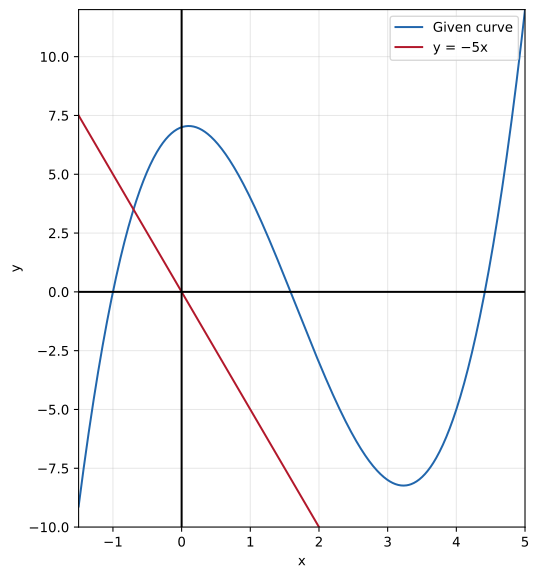
(a(iv)) Draw a line \(y=mx\) for which \(f(x)=mx\) has exactly one solution in this interval. [2]
(b(i)) For \(y=3x^2-12x+7\), find \(dy/dx\) at \(x=5\). [3]
(b(ii)) Find its stationary point. [2]
(c) If \(y=2x^p+qx^2\) and \(dy/dx=14x^6+6x\), find \(p,q\). [2]

0580 P42 - Jun 2022 - Q12 - 11 marks
Curve \(y=x^3-kx^2+1\) has gradient 6 at \(x=2\).
(a) Show that \(k=1.5\). [5]
(b) Find both stationary points of \(y=x^3-1.5x^2+1\), showing all working. [4]
(c) Sketch the curve. [2]
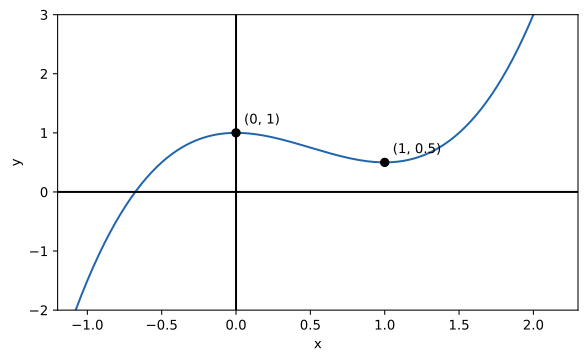

0580 P43 - Jun 2022 - Q9 - 16 marks
\(y=(x+1)(3-x)(3+x)\).
(a) Sketch the graph and label all x- and y-intercepts. [4]
(b(i)) Show the equation can be written \(y=9+9x-x^2-x^3\). [2]
(b(ii)) Find the x-coordinates of the turning points to 2 decimal places, showing all working. [7]
(b(iii)) The equation \(9+9x-x^2-x^3=k\) has exactly one solution for \(k<a\) and for \(k>b\), where a and b are integers. Find the maximum a and minimum b. [3]


0580 P21 - Nov 2022 - Q21 - 2 marks
A cubic has two turning points. Its gradient is positive for \(x<0\) and \(x>4\), and negative for \(0<x<4\). It passes through the origin. Sketch its graph. [2]


0580 P22 - Nov 2022 - Q11 - 3 marks
\(y=(x-3)(x+b)(x+2)\) crosses the y-axis at −30.
(a) Find b. [2]
(b) Find the only x-intercept with x > 0. [1]


0580 P41 - Nov 2022 - Q10 - 8 marks

(a(i)) For the shown graph on \(-1.5\le x\le6\), give an integer k such that \(f(x)=k\) has exactly two solutions. [1]
(a(ii)) \(f(x)=j\) has no solutions when \(j<a\) or \(j>b\). Find the maximum a and minimum b. [2]
(b) Find both stationary points of \(y=x^6-6x^5\), showing all working. [5]

0580 P42 - Nov 2022 - Q2 - 12 marks

All lengths are in centimetres. The cuboid has square base x by x and height \(9-x\). Its volume is \(V=x^2(9-x)\).
| x | 0 | 1 | 2 | 3 | 4 | 5 | 6 | 7 | 8 | 9 |
|---|---|---|---|---|---|---|---|---|---|---|
| V | 0 | 8 | 54 | 80 | 100 | 108 | 98 | 64 | 0 |
(a(i)) Complete the missing value. [1]
(a(ii)) Draw the graph of \(V=x^2(9-x)\) for \(0\le x\le9\). [4]
(a(iii)) Use the graph to find both values of x when the volume is \(44\text{ cm}^3\). [2]
(b(i)) Show that the total surface area is \((36x-2x^2)\text{ cm}^2\). [2]
(b(ii)) Find the surface area when the volume is a maximum. [3]


0580 P43 - Nov 2022 - Q9 - 17 marks
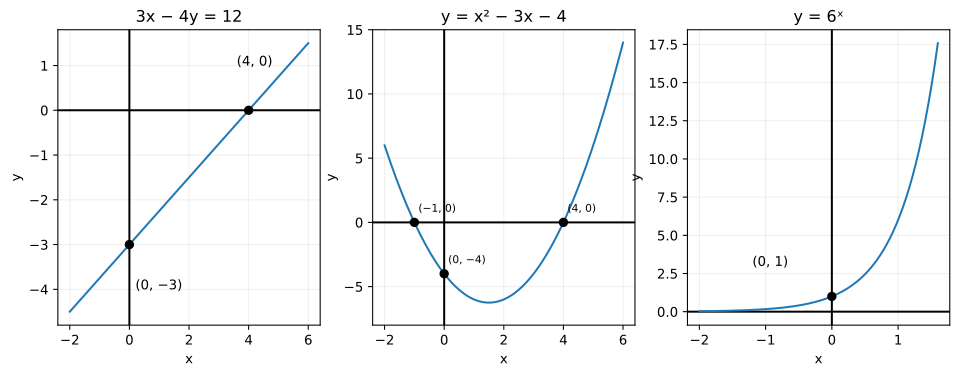
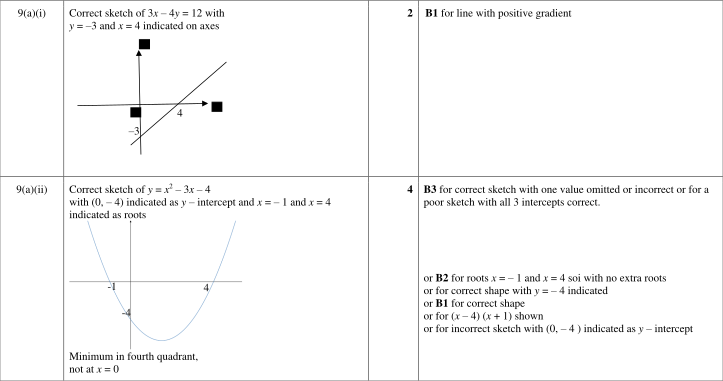
(a(i)) Sketch \(3x-4y=12\), indicating intercepts. [2]
(a(ii)) Sketch \(y=x^2-3x-4\), indicating intercepts. [4]
(a(iii)) Sketch \(y=6^x\), indicating intercepts. [2]
(b(i)) Differentiate \(y=5+8x-\frac43x^3\). [2]
(b(ii)) Find its gradient at x = −1. [2]
(b(iii)) A tangent has gradient −28. Find both possible points of contact on this curve. [5]

0580 P22 - Mar 2021 - Q21 - 4 marks
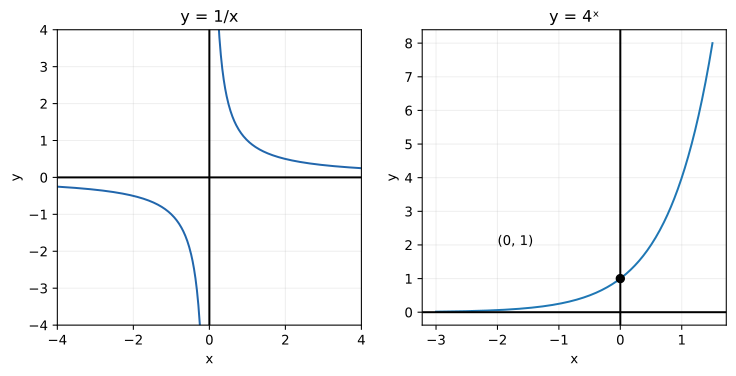
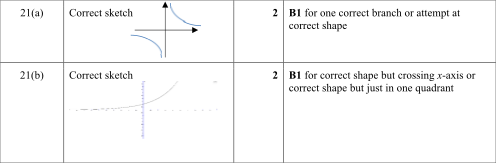
(a) Sketch \(y=1/x\). [2]
(b) Sketch \(y=4^x\). [2]
0580 P22 - Mar 2021 - Q24 - 5 marks
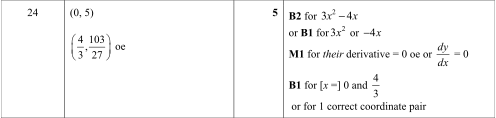
Find both stationary points of \(y=x^3-2x^2+5\). [5]
0580 P42 - Mar 2021 - Q6 - 18 marks

The graph is \(y=a+bx^2\) and passes through (0, 4), (1, 1).
| x | -2 | -1.5 | -1 | -0.5 | 0 | 0.5 | 1 | 1.5 |
|---|---|---|---|---|---|---|---|---|
| y | 2 | 2.11 | 2.43 | 3 | 4.33 |
(a(i)) Find a and b. [2]
(a(ii)) Write the tangent equation at (0, 4). [1]
(a(iii)) The tangent at x = −1 is y = 6x + 7. Find the tangent at x = 1. [2]
(b(i)) Complete the table for \(y=1+\frac5{3-x}\). [3]
(b(ii)) On the grid draw this second graph for \(-2\le x\le1.5\). [4]
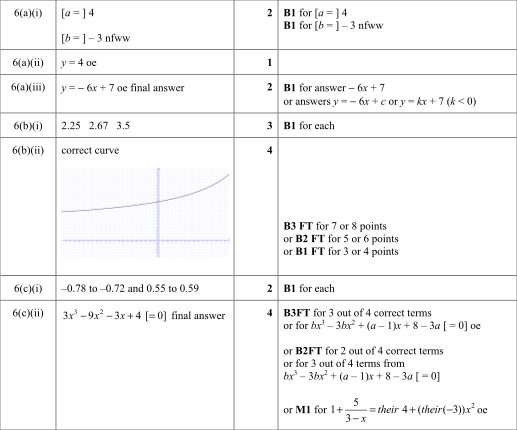
(c(i)) Read the x-coordinates of the intersections. [2]
(c(ii)) Form the cubic equation with integer coefficients satisfied by these intersections. [4]

0580 P23 - Jun 2021 - Q25 - 4 marks
Find the x-coordinates where \(y=x^5-5x^4\) has gradient 0. [4]

0580 P23 - Jun 2021 - Q24 - 4 marks
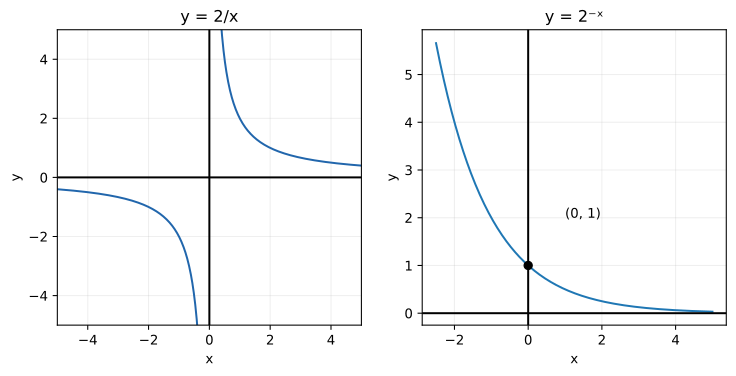
(a) Sketch \(y=2/x\). [2]
(b) Sketch \(y=2^{-x}\). [2]

0580 P41 - Jun 2021 - Q10 - 12 marks
\(y=3+4x-x^2\) for \(-1\le x\le5\).
| x | -1 | -0.5 | 0 | 1 | 2 | 3 | 4 | 4.5 | 5 |
|---|---|---|---|---|---|---|---|---|---|
| y | -2 | 6 | 6 | -2 |
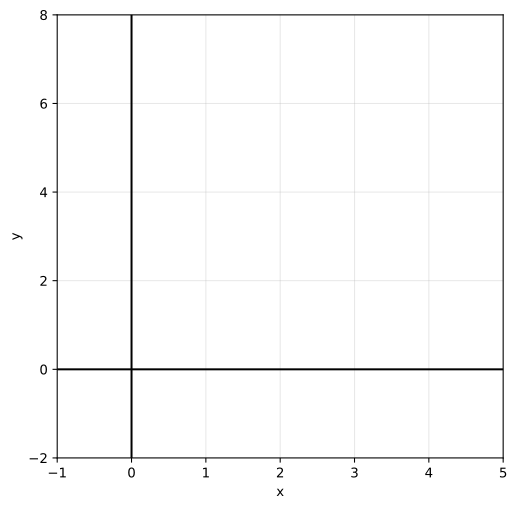
(a) Complete the table. [3]
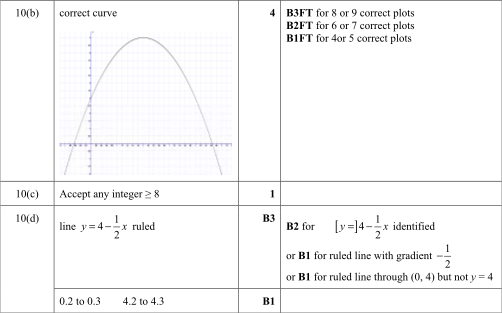
(b) Draw the graph. [4]
(c) Give an integer k for which \(3+4x-x^2=k\) has no solutions. [1]
(d) Draw a suitable straight line and solve \(-1+\tfrac92x-x^2=0\). [4]


0580 P41 - Jun 2021 - Q7 - 14 marks
(a) Simplify \(\frac{x^2-25}{x^2-x-20}\). [3]
(b) Write \(\frac{x+5}{x}+\frac{x+8}{x-1}\) as a single simplified fraction. [3]
(c(i)) For \(y=2x^3-4x^2+6\), find \(\frac{dy}{dx}\). [2]
(c(ii)) Find the gradient at x = 4. [2]
(c(iii)) Find both stationary points. [4]


0580 P42 - Jun 2021 - Q2 - 11 marks
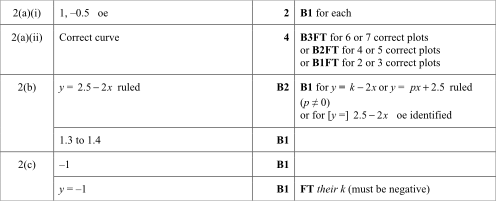
\(y=2(.5)^x-1\) for \(-1\le x\le2\).
| x | -1 | -0.5 | 0 | 0.5 | 1 | 1.5 | 2 |
|---|---|---|---|---|---|---|---|
| y | 3 | 1.83 | 0.41 | 0 | -0.29 |

(a(i)) Complete the table. [2]
(a(ii)) Draw the graph. [4]
(b) Draw a suitable straight line and solve \(2(.5)^x+2x-3.5=0\) in the given interval. [3]
(c) The equation \(2(.5)^x-1=k\) has no solutions for an integer k. Find the highest possible k and give the graph’s asymptote. [2]

0580 P42 - Jun 2021 - Q9 - 13 marks
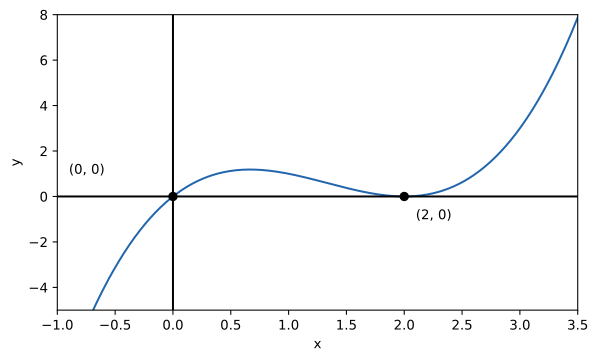
(a(i)) Write \(y=x^3-4x^2+4x\) as \(y=x(x-a)^2\) and find a. [2]
(a(ii)) Sketch the curve, labelling its intercepts. [4]
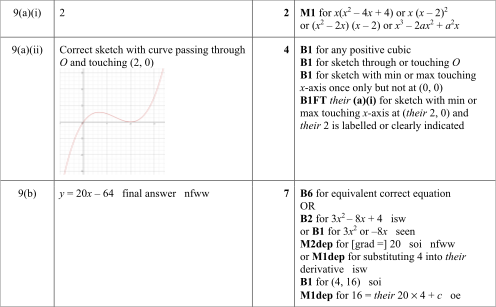
(b) Find the tangent at x = 4 in the form y = mx + c. [7]
0580 P41 - Nov 2021 - Q6 - 16 marks
\(y=x^2-\frac3{2x},\quad x\ne0\). Values are to 1 decimal place.
| x | -3 | -2 | -1 | -0.5 | -0.2 | 0.2 | 0.5 | 1 | 2 | 3 |
|---|---|---|---|---|---|---|---|---|---|---|
| y | … | … | 2.5 | 3.3 | 7.5 | -7.5 | -2.8 | -0.5 | 3.3 | … |
(a(i)) Complete the table. [3]
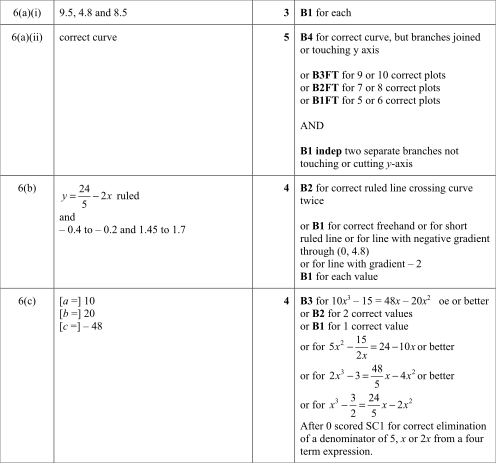
(a(ii)) Draw the graph for \(-3\le x\le-.2\) and \(.2\le x\le3\). [5]
(b) Draw a suitable straight line to solve \(x^2-\frac3{2x}=\frac{24}5-2x\) over the same intervals. [4]
(c) The solutions also satisfy \(ax^3+bx^2+cx-15=0\) for integer a, b, c. Find these integers. [4]

0580 P42 - Nov 2021 - Q10 - 8 marks
(a) Find the turning points of \(y=x^3-12x+6\). Show working. [5]
(b) Determine whether each is a maximum or minimum, showing how you decide. [3]

0580 P42 - Nov 2021 - Q5 - 11 marks
\(y=x^3-3x^2+3\).
| x | -1 | -0.5 | 0 | 0.5 | 1 | 1.5 | 2 | 2.5 | 3 |
|---|---|---|---|---|---|---|---|---|---|
| y | … | 2.125 | 3 | 2.375 | 1 | … | -1 | -0.125 | … |
(a) Complete the table. [3]
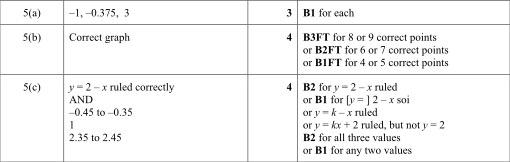
(b) Draw the graph for \(-1\le x\le3\). [4]
(c) Draw a suitable straight line to solve \(x^3-3x^2+x+1=0\). [4]

0580 P43 - Nov 2021 - Q9 - 14 marks
\(f(x)=x(x-1)(x-2)\).
(a) Find the x-axis intercepts of \(y=f(x)\). [2]
(b) Show \(f(x)=x^3-3x^2+2x\). [2]
(c) Find the turning points, showing working. Give coordinates to 1 decimal place. [8]
(d) Sketch \(y=f(x)\). [2]


0580 P22 - Mar 2020 - Q10 - 3 marks
(a) Sketch \(y=x-3\). [1]
(b) Sketch \(y=1/x\). [2]


0580 P42 - Mar 2020 - Q11 - 8 marks
(a) For \(y=x^3-3x+4\), find both stationary points. [5]
(b) Determine whether each is a maximum or minimum, giving reasons. [3]

0580 P42 - Mar 2020 - Q2 - 16 marks
(a) \(y=2x^3-4x^2+3\).
| x | -1 | -0.5 | 0 | 0.5 | 1 | 1.5 | 2 |
|---|---|---|---|---|---|---|---|
| y | -3 | 1.75 | 0.75 | 3 |
(a(i)) Complete the table. [3]
(a(ii)) Draw the graph for \(-1\le x\le2\). [4]
(a(iii)) Use the graph to solve \(2x^3-4x^2+3=1.5\). [3]
(a(iv)) Give an integer k for which \(2x^3-4x^2+3=k\) has exactly one solution in this interval. [1]
(b(i)) For the separate curve below, draw the tangent at x = 1.
(b(ii)) Use the tangent to estimate the gradient at x = 1. [2]
(b(iii)) Give its equation in the form \(y=mx+c\). [2]


0580 P21 - Jun 2020 - Q20 - 1 mark
A line intersects \(y=x^2-2x+1\) at the solutions of \(x^2-7x+5=0\). Find the equation of this line in the form \(y=mx+c\). [1]

0580 P41 - Jun 2020 - Q10 - 18 marks
(a) A rhombus ABCD has diagonal AC, with A = (−3,10) and C = (4,−4).
(a(i)) Find AC. [3]
(a(ii)) Show that AC has equation \(y=-2x+4\). [2]
(a(iii)) Find the equation of diagonal BD. [4]
(b(i)) The curve is \(y=x^3+8x^2+5x\). Find its two turning points. [6]
(b(ii)) Determine whether each is a maximum or minimum, giving reasons. [3]

0580 P42 - Jun 2020 - Q10 - 10 marks
(a(i)) For \(y=x^4-4x^3\), find y when x=−1. [2]
(a(ii)) Find its two stationary points. [6]
(b) \(y=x^p+2x^q,\quad\frac{dy}{dx}=11x^{10}+10x^4\). Find p and q. [2]

0580 P43 - Jun 2020 - Q10 - 7 marks
(a(i)) State the function represented by the first graph.
(a(ii)) State the function represented by the second graph.
(b) Draw a suitable tangent at P on this graph and estimate the gradient.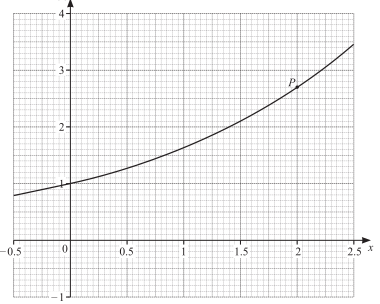


0580 P43 - Jun 2020 - Q12 - 11 marks
(a(i)) Find both stationary points of \(y=4x^3-3x+3\). [5]
(a(ii)) Classify each as a maximum or minimum, with reasons. [3]
(b) The supplied graph is \(y=x^2-x+1\). Draw a suitable line to solve \(x^2-2x-2=0\).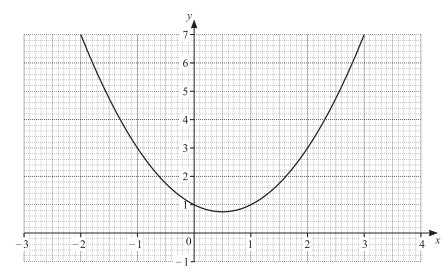


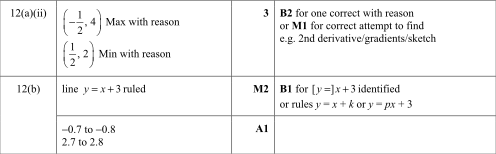
0580 P22 - Nov 2020 - Q21 - 4 marks
(a) Differentiate \(6+4x-x^2\). [2]
(b) Find the turning point of \(y=6+4x-x^2\). [2]

0580 P41 - Nov 2020 - Q10 - 14 marks

\(y=x^2+3x-4\).
(a(i)) Find the coordinates of A,B,C. [4]
(a(ii)) Differentiate \(x^2+3x-4\). [2]
(a(iii)) Find the tangent equation at (2,6). [3]

(b(i)) Sketch \(y=\tan x\) for \(0^\circ\le x\le360^\circ\). [2]
(b(ii)) Solve \(5\tan x=-7\) in this interval. [3]


0580 P41 - Nov 2020 - Q5 - 12 marks
The graph shows \(y=f(x),\quad-3\le x\le3\).
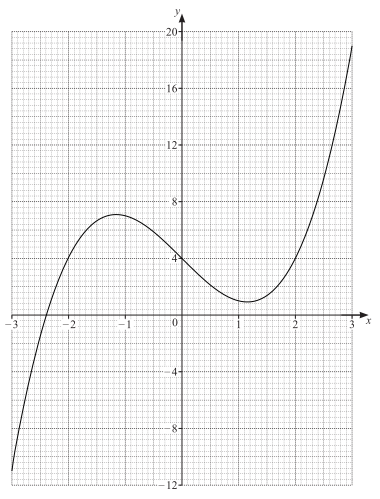
(a(i)) Solve \(f(x)=14\). [1]
(a(ii)) Draw a tangent and estimate the gradient at (−2,4). [3]
(a(iii)) Draw a suitable straight line and solve \(f(x)=2x-2\) for \(-3\le x\le3\). [3]

(b) The curve \(y=2x^2-2x-7\) and line \(y=3x+5\) intersect at A and B. Find their coordinates. [5]


0580 P42 - Nov 2020 - Q7 - 10 marks
\(y=x^2+\frac1x,\quad x\ne0\).
(a) Complete the table.
| x | 0.2 | 0.3 | 0.5 | 1 | 1.5 | 2 | 2.5 |
|---|---|---|---|---|---|---|---|
| y | 5.0 | 3.4 | 2.3 | … | 2.9 | … | 6.7 |
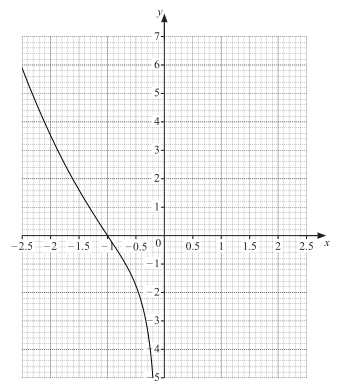
(b) Draw the positive branch for \(.2\le x\le2.5\). The negative branch for \(-2.5\le x\le-.2\) is supplied. [4]
(c(i)) Draw a suitable straight line to solve \(x^2+\frac1x=-2\). [1]
(c(ii)) Draw a suitable straight line to solve \(x^2+\frac1x+x-1=0\). [2]
(d) k is an integer and \(x^2+\frac1x=k\) has three solutions. Give one possible k. [1]


0580 P43 - Nov 2020 - Q7 - 15 marks
(a(i)) Factorise \(24+5x-x^2\). [2]

(a(ii)) The sketch is \(y=24+5x-x^2\). Find a,b,c. [3]
(a(iii)) Find its gradient at x=−1.5. [3]

(b(i)) Sketch \(y=(x+1)(x-3)^2\), labelling where it meets both axes. [4]
(b(ii)) Expand \((x+1)(x-3)^2\) into \(ax^3+bx^2+cx+d\). [3]


0580 P22 - Mar 2019 - Q16 - 3 marks

Draw a suitable tangent to estimate the gradient at P. [3]

0580 P42 - Mar 2019 - Q5 - 12 marks
\(y=\frac3{10}x^3-2x,\quad-3\le x\le3\).
(a) Complete the table.
| x | -3 | -2 | -1.5 | -1 | 0 | 1 | 1.5 | 2 | 3 |
|---|---|---|---|---|---|---|---|---|---|
| y | … | … | 2.0 | 1.7 | 0 | … | -2.0 | -1.6 | … |

(b) Draw the graph on the grid. [4]
(c) Draw a suitable straight line to solve \(\frac3{10}x^3-2x=\frac12(1-x)\) on the stated interval. [4]
(d) The equation \(\frac3{10}x^3-2x=1\) has n solutions in the interval. Find n. [1]


0580 P41 - Jun 2019 - Q2 - 11 marks
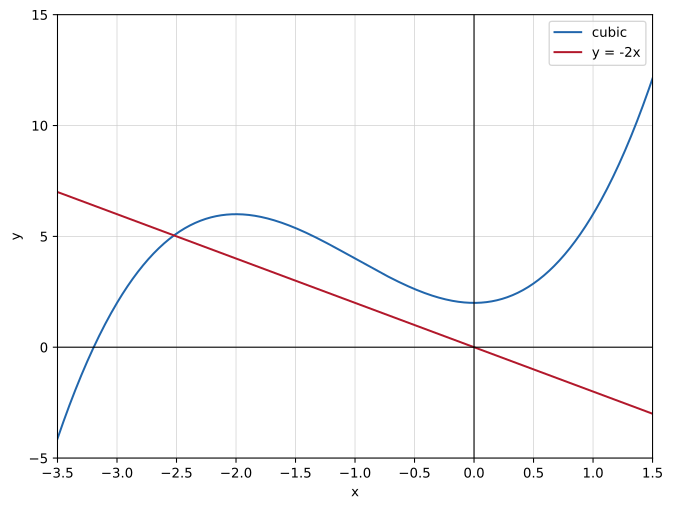
\(y=x^3+3x^2+2\).
| x | -3.5 | -3 | -2.5 | -2 | -1.5 | -1 | -0.5 | 0 | 0.5 | 1 | 1.5 |
|---|---|---|---|---|---|---|---|---|---|---|---|
| y | -4.1 | … | 5.1 | 6 | 5.4 | 4 | 2.6 | … | 2.9 | … | 12.1 |
(a) Complete the table. [3]
(b) Draw the graph for \(-3.5\le x\le1.5\). [4]
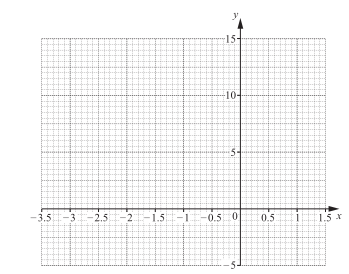
(c) Use the graph to solve \(x^3+3x^2+2=0\) in that interval. [1]
(d) Draw a suitable straight line to solve \(x^3+3x^2+2x+2=0\) in that interval. [2]
(e) The equation \(x^3+3x^2+2=k\) has three solutions in that interval; k is an integer. Give a possible k. [1]
0580 P42 - Jun 2019 - Q5 - 14 marks
\(y=\frac1{2x}-\frac x4,\quad .15\le x\le3.5\).
| x | 0.15 | 0.2 | 0.5 | 1 | 1.5 | 2 | 2.5 | 3 | 3.5 |
|---|---|---|---|---|---|---|---|---|---|
| y | 3.3 | … | 0.88 | … | -0.04 | … | -0.43 | -0.58 | -0.73 |
(a) Complete the table. [3]
(b) Draw the graph on the grid; the last two points are already plotted. [4]

(c) Use your graph to solve \(\frac1{2x}-\frac x4=\frac12\). [1]
(d(i)) Draw y=2−x on the grid. [2]
(d(ii)) Write the x-coordinates where the line crosses the curve. [2]
(e) Show how this curve can be used to find \(\sqrt2\) in the interval. [2]


0580 P43 - Jun 2019 - Q5 - 17 marks
\(f(x)=x^2-\frac2x-2,\quad x\ne0\).

(a(i)) Use the graph to find f(1). [1]
(a(ii)) Use the graph to find ff(−2). [2]
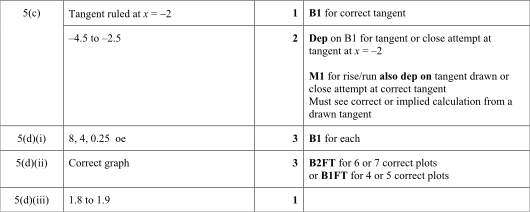
(b) Draw a suitable straight line to solve \(x^2-\frac2x-7=-3x\) for −3≤x≤3. [4]
(c) Draw a suitable tangent and estimate the gradient at x=−2. [3]
(d(i)) Complete the table for \(g(x)=2^{-x}\). [3]
| x | -3 | -2 | -1 | 0 | 1 | 2 | 3 |
|---|---|---|---|---|---|---|---|
| y | … | … | 2 | 1 | 0.5 | … | 0.125 |
(d(ii)) Draw g on the same grid. [3]
(d(iii)) Use the graph to find the positive solution of f(x)=g(x). [1]


0580 P42 - Nov 2019 - Q5 - 17 marks
\(y=\frac{x^2}2+\frac1{x^2}-\frac2x,\quad x\ne0\).
| x | -3 | -2 | -1 | -0.5 | -0.3 | 0.2 | 0.3 | 0.5 | 1 | 2 | 3 |
|---|---|---|---|---|---|---|---|---|---|---|---|
| y | 5.3 | 3.3 | … | 8.1 | 17.8 | … | 4.5 | 0.1 | -0.5 | 1.3 | … |
(a) Complete the table. [3]
(b) Draw the graph for \(-3\le x\le-.3\) and \(.2\le x\le3\). [5]
(c) Use the graph to solve \(\frac{x^2}2+\frac1{x^2}-\frac2x\le0\). [2]
(d) Find the smallest positive integer k for which \(\frac{x^2}2+\frac1{x^2}-\frac2x=k\) has two solutions within the stated intervals. [1]
(e(i)) Draw a suitable straight line to solve \(\frac{x^2}2+\frac1{x^2}-\frac2x=3x+1\) in the stated intervals. [3]
(e(ii)) Rewrite this equation as \(x^4+ax^3+bx^2+cx+2=0\). Find a, b, c. [3]


0580 P43 - Nov 2019 - Q3 - 13 marks
\(y=x^3+x^2-5x\).
| x | -3 | -2 | -1.5 | -1 | 0 | 1 | 1.5 | 2 | 2.5 | 3 |
|---|---|---|---|---|---|---|---|---|---|---|
| y | -3 | 6 | 6.4 | … | 0 | … | -1.9 | 2 | 9.4 | … |
(a) Complete the table. [3]

(b) Draw the graph for \(-3\le x\le3\). [4]
(c) Use the graph to solve \(x^3+x^2-5x=0\). [2]
(d) Draw a suitable tangent and estimate the gradient at x=2. [3]
(e) Find the largest integer k for which \(x^3+x^2-5x=k\) has three solutions in the stated interval. [1]


0580 P42 - Mar 2018 - Q3 - 15 marks
\(y=2x+\frac1x-3,\quad .125\le x\le3\).
| x | 0.125 | 0.25 | 0.375 | 0.5 | 0.75 | 1 | 1.5 | 2 | 2.5 | 3 |
|---|---|---|---|---|---|---|---|---|---|---|
| y | 5.25 | 1.5 | 0.42 | … | … | 0 | 0.67 | 1.5 | … | 3.33 |
(a) Complete the table. [3]
(b) Draw the graph over the given interval. [4]
(c) Use the graph to solve \(2x+\frac1x-3\ge2\). [3]
(d(i)) Find the straight-line equation which, together with your graph, solves \(\frac1x=7-3x\). [2]
(d(ii)) Draw that line and solve the equation. [3]



0580 P41 - Jun 2018 - Q7 - 15 marks
The graph \(y=10-8x^2,\quad-1.5\le x\le1.5\) is drawn.

(a) State the equation of its line of symmetry. [1]
(b) Draw the tangent at x=0.5 and find its gradient. [3]
| x | -1.5 | -1 | -0.5 | 0 | 0.5 | 1 | 1.5 |
|---|---|---|---|---|---|---|---|
| y for \(x^3+3x+4\) | -3.9 | ____ | ____ | ____ | 5.6 | 8 | 11.9 |
(c(i)) Complete the table. [3]
(c(ii)) Draw \(y=x^3+3x+4,\quad-1.5\le x\le1.5\) on the same grid. [4]
(d) Show that intersections of the two curves solve \(x^3+8x^2+3x-6=0\). [1]
(e) Draw a suitable straight line and solve \(x^3+5x+2=0,\quad-1.5\le x\le1.5\). [3]


0580 P42 - Jun 2018 - Q6 - 20 marks
\(y=\frac{x^3}3-\frac1{2x^2},\quad x\ne0\).
| x | -3 | -2 | -1 | -0.5 | -0.3 | 0.3 | 0.5 | 1 | 2 | 3 |
|---|---|---|---|---|---|---|---|---|---|---|
| y | -9.1 | -2.8 | -0.8 | ____ | -5.6 | -5.5 | -2.0 | ____ | ____ | 8.9 |
(a) Complete the table. [3]

(b) Draw the graph for \(-3\le x\le-0.3,\quad0.3\le x\le3\). [5]
(c(i)) Draw a tangent at x=−2 and estimate its gradient. [3]
(c(ii)) Give the tangent equation in the form y=mx+c. [2]
(d(i)) Use the graph to solve \(\frac{x^3}3-\frac1{2x^2}=0\). [1]
(d(ii)) Use the graph to solve \(\frac{x^3}3-\frac1{2x^2}+4=0\). [3]
(e) The equation in (d)(ii) can be written \(ax^n+bx^{n-3}-3=0\). Find a, b and n. [3]


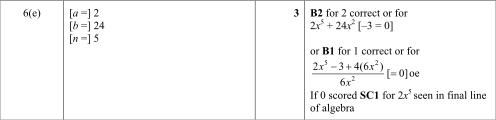
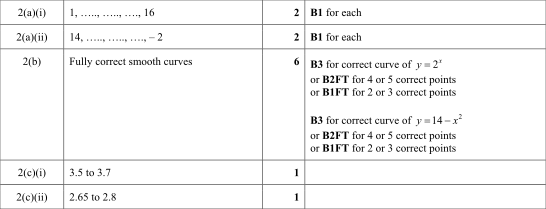
0580 P43 - Jun 2018 - Q2 - 15 marks
| x | 0 | 1 | 2 | 3 | 4 |
|---|---|---|---|---|---|
| y for \(2^x\) | ____ | 2 | 4 | 8 | ____ |
| y for \(14-x^2\) | ____ | 13 | 10 | 5 | ____ |
(a(i)) Complete the table for y=2ˣ. [2]
(a(ii)) Complete the table for y=14−x². [2]

(b) Draw both graphs for \(0\le x\le4\). [6]
(c(i)) Use the graphs to solve \(2^x=12\). [1]
(c(ii)) Use the graphs to solve \(2^x=14-x^2\). [1]
(d(i)) Draw the line through (4,2) with gradient −4. [1]
(d(ii)) Complete: The straight line is a ____ to y=14−x² at (____,____). [2]


0580 P41 - Nov 2018 - Q3 - 18 marks
\(y=x^3-3x^2+x\).
| x | -0.75 | -0.5 | -0.25 | 0 | 0.5 | 1 | 1.5 | 2 | 2.5 | 2.75 |
|---|---|---|---|---|---|---|---|---|---|---|
| y | -2.9 | -1.4 | -0.5 | -0.1 | -1 | -1.9 | -0.6 |
(a) Complete the table. [3]

(b) Draw the graph for \(-.75\le x\le2.75\). [4]
(c) Use the graph to complete the ranges for y>−1: __<x<__ and x>__. [3]
(d(i)) Which straight line solves \(x^3-3x^2+2x-1=0\) using this curve? [2]
(d(ii)) Draw the line and use it to solve that equation. [3]
(e) Draw a suitable tangent and estimate the gradient at x=−0.25. [3]


0580 P42 - Nov 2018 - Q5 - 15 marks
\(y=x^3-3x-1\).
| x | -3 | -2.5 | -2 | -1.5 | -1 | 0 | 1 | 1.5 | 2 | 2.5 | 3 |
|---|---|---|---|---|---|---|---|---|---|---|---|
| y | -19 | -9.1 | 0.1 | 1 | -1 | -3 | -2.1 | 1 | 7.1 |
(a) Complete the table. [2]

(b) Draw the graph for \(-3\le x\le3\). [4]
A straight line through(0,−17) is tangent to the curve.
(c(i)) Draw this tangent. [1]
(c(ii)) Find the point of contact. [1]
(c(iii)) Find its equation as y=mx+c. [3]
(d) Draw a suitable straight line and solve \(x^3-6x-3=0\). [4]


0580 P43 - Nov 2018 - Q4 - 17 marks
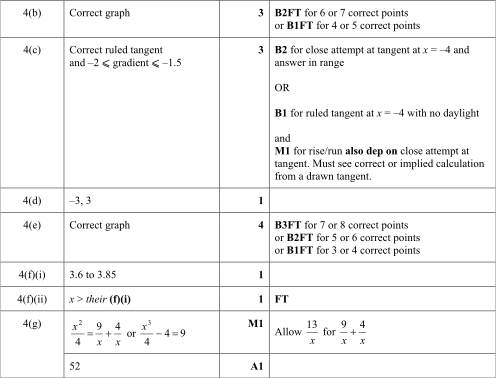
\(f(x)=\frac{x^2}4-\frac4x,\quad x\ne0\).
| x | 0.5 | 1 | 2 | 3 | 4 | 5 | 6 |
|---|---|---|---|---|---|---|---|
| f(x) | -7.9 | -3.8 | 0.9 | 5.5 | 8.3 |
(a) Complete the table. [2]
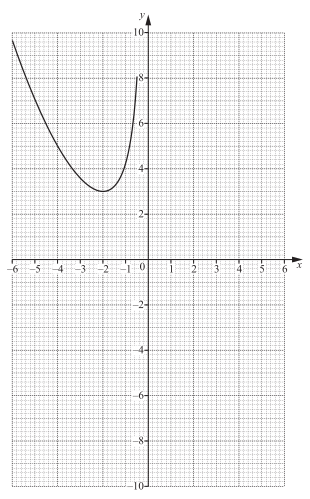
(b) Draw y=f(x) for.5≤x≤6 on the same grid. [3]
(c) Draw a tangent and estimate the gradient at(−4,5). [3]
\(g(x)=\frac9x,\quad x\ne0\).
| x | -4 | -3 | -2 | -1 | 1 | 2 | 3 | 4 |
|---|---|---|---|---|---|---|---|---|
| g(x) | -2.3 | -4.5 | -9 | 9 | 4.5 | 2.3 |
(d) Complete the table. [1]
(e) Draw y=g(x) for−4≤x≤−1 and 1≤x≤4. [4]
(f(i)) Read x where f(x)=g(x). [1]
(f(ii)) Give an inequality for positive x where f(x)>g(x). [1]
(g) The exact intersection answer is \(\sqrt[3]k\). Use algebra to find k. [2]


0580 P42 - Mar 2017 - Q3 - 16 marks
The table gives values for \(y=1.5^x-1\).
| x | -2 | -1 | 0 | 1 | 2 | 3 | 4 | 5 |
|---|---|---|---|---|---|---|---|---|
| y | −0.56 | −0.33 | 2.38 | 4.06 | 6.59 |
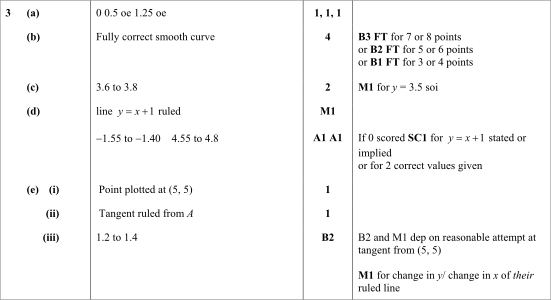
(a) Complete the table. [3]
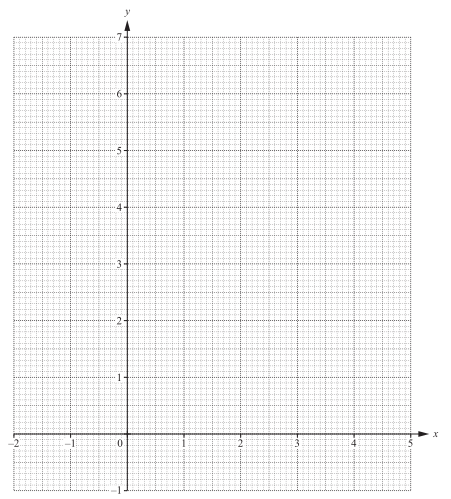
(b) Draw the graph for \(-2\le x\le5\). [4]
(c) Use the graph to solve \(1.5^x-1=3.5\). [2]
(d) Draw a suitable straight line and solve \(1.5^x-x-2=0\). [3]
(e(i)) Plot A=(5,5). [1]
(e(ii)) Draw the tangent to the curve passing through A. [1]
(e(iii)) Find its gradient. [2]

0580 P41 - Jun 2017 - Q4 - 10 marks
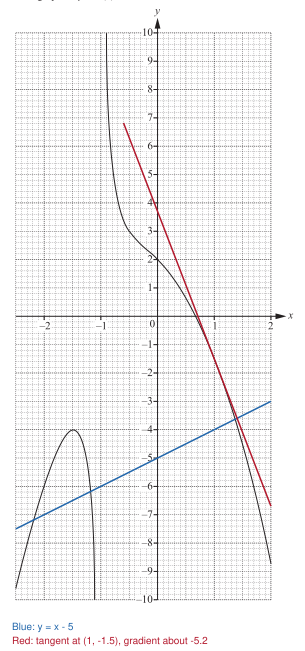
The diagram shows y=f(x), for \(-2.5\le x\le2\).

(a) Find f(1). [1]
(b) Solve f(x)=3. [1]
(c) f(x)=k has only one solution in the given domain. Write the range of k. [2]
(d) Draw a suitable straight line to solve f(x)=x−5. [3]
(e) Draw a tangent at x=1 and use it to estimate the gradient. [3]

0580 P42 - Jun 2017 - Q4 - 14 marks
\(f(x)=2x^2-1\). The graph is drawn for \(-2\le x\le2\).

(a) Use the graph to solve f(x)=5. [2]
(b(i)) Draw the tangent at (−1.5,3.5). [1]
(b(ii)) Estimate the gradient at x=−1.5 from the tangent. [2]
\(g(x)=2^x\).
| x | -2 | -1 | 0 | 1 | 2 |
|---|---|---|---|---|---|
| g(x) | 0.25 | 0.5 | 2 | 4 |
(c(i)) Complete the table. [1]
(c(ii)) Draw y=g(x) on the same grid for −2≤x≤2. [3]
(d(i)) Solve f(x)=g(x) using the graphs. [2]
(d(ii)) Solve f(x)
(e(i)) Write g(−3),g(−5),g(−10). [1]
(e(ii)) As x decreases, what value does g(x) approach? [1]


0580 P43 - Jun 2017 - Q3 - 15 marks
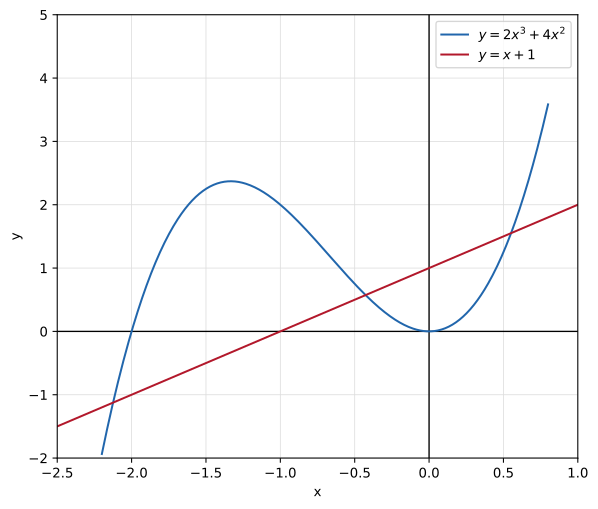
\(y=2x^3+4x^2\).
| x | -2.2 | -2 | -1.5 | -1 | -0.5 | 0 | 0.5 | 0.8 |
|---|---|---|---|---|---|---|---|---|
| y | -1.94 | 0.75 | 0 | 3.58 |
(a) Complete the table. [4]

(b) Draw the graph for −2.2≤x≤0.8. [4]
(c) How many solutions does \(2x^3+4x^2=3\) have? [1]
(d(i)) Write the equation of the straight line needed to solve \(2x^3+4x^2-x=1\). [1]
(d(ii)) Use the graph to solve that equation. [3]
(e) The tangent has negative gradient at x=k. Complete \(\ldots<k<\ldots\). [2]

0580 P41 - Nov 2017 - Q4 - 14 marks
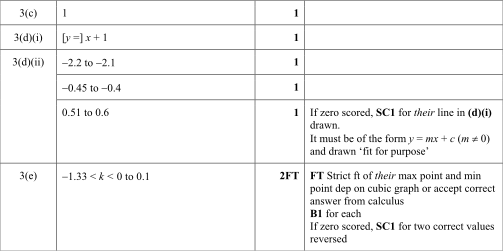
\(f(x)=x^3-4x^2+15\).
| x | -2 | -1 | -0.5 | 0 | 1 | 2 | 2.5 | 3 | 3.5 | 4 | 4.5 |
|---|---|---|---|---|---|---|---|---|---|---|---|
| f(x) | -9 | 13.9 | 15 | 12 | 5.6 | 6 | 8.9 | 15 | 25.1 |
(a) Complete the table. [2]
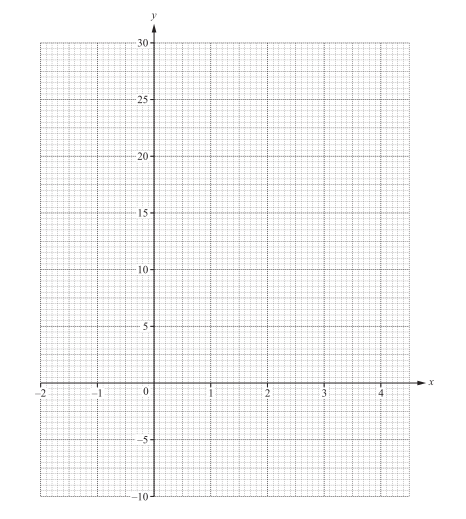
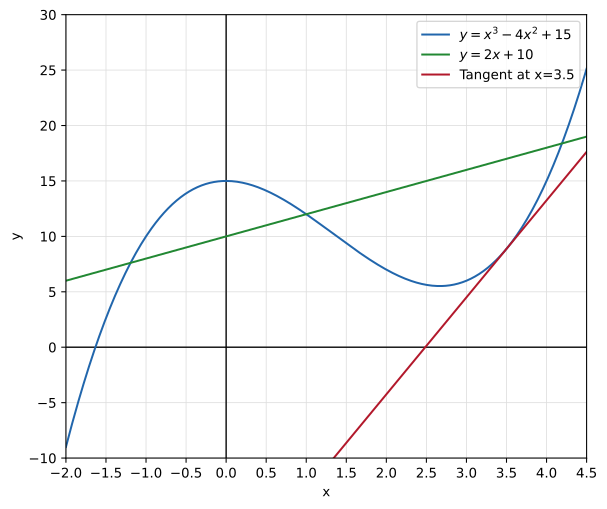
(b) Draw y=f(x) for −2≤x≤4.5. [4]
(c) Use the graph to solve f(x)=0. [1]
(d) Draw a tangent at x=3.5 and estimate its gradient. [3]
(e) Draw a suitable straight line to solve \(x^3-4x^2-2x+5=0\). [4]

0580 P42 - Nov 2017 - Q5 - 19 marks
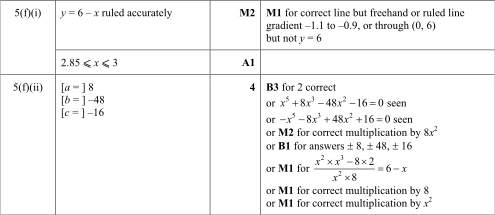
\(y=x^3/8-2/x^2,\quad x\ne0\).
| x | 0.5 | 1 | 1.5 | 2 | 2.5 | 3 | 3.5 |
|---|---|---|---|---|---|---|---|
| y | -8 | -1.9 | -0.5 | 0.5 | 1.6 |
(a) Complete the table. [2]

(b) The negative branch is already drawn for −3.5≤x≤−0.5. Draw the positive branch for 0.5≤x≤3.5. [4]
(c) Solve \(x^3/8-2/x^2=0\) using the graph. [1]
(d(i)) Give an integer k for which \(x^3/8-2/x^2=k\) has one answer. [1]
(d(ii)) Give an integer k for which it has three answers. [1]
(e) Draw a tangent at x=−3 and estimate its gradient. [3]
(f(i)) Draw a suitable line to solve \(x^3/8-2/x^2=6-x\). [3]
(f(ii)) This equation can be written \(x^5+ax^3+bx^2+c=0\). Find a,b,c. [4]


0580 P42 - Mar 2016 - Q7 - 17 marks
\(y=x+\frac1{x^2},\qquad x\ne0\).
| \(x\) | -2 | -1.5 | -1 | -0.75 | -0.5 | 0.5 | 0.75 | 1 | 1.5 | 2 | 3 |
|---|---|---|---|---|---|---|---|---|---|---|---|
| \(y\) | -1.75 | -1.06 | 0 | 1.03 | 4.5 | 2.53 | 2 | 2.25 |
(a) Complete the table, giving values to 2 decimal places where necessary. [3]

(b) Draw the graph for \(-2\le x\le-0.5\) and \(0.5\le x\le3\). [5]
(c) Use the graph to solve \(x+\frac1{x^2}=1.5\). [1]
The line \(y=ax+b\) can be used with this graph to solve \(\frac1{x^2}=2.5-2x\).
(d(i)) Find \(a\) and \(b\). [2]
(d(ii)) Draw the line and use it to solve the equation. [3]
(e) Draw a tangent to estimate the curve gradient at \(x=2\). [3]

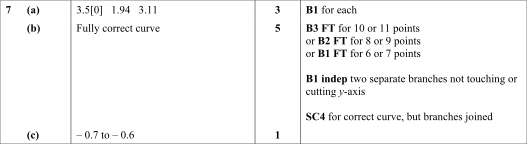
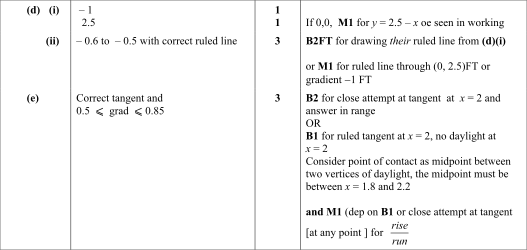
0580 P41 - Jun 2016 - Q5 - 18 marks
\(f(x)=\frac{20}{x}+x,\quad x\ne0\).
| \(x\) | -10 | -8 | -5 | -2 | -1.6 | 1.6 | 2 | 5 | 8 | 10 |
|---|---|---|---|---|---|---|---|---|---|---|
| \(f(x)\) | -12 | -10.5 | -9 | -12 | -14.1 | 14.1 | 12 | 12 |
(a) Complete the table. [2]

(b) Draw \(y=f(x)\) for \(-10\le x\le-1.6\) and \(1.6\le x\le10\). [5]
(c) Use the graph to solve \(f(x)=11\). [2]
(d) \(k\) is prime and \(f(x)=k\) has no solutions. Find the possible values of \(k\). [2]
(e) The gradient at \((2,12)\) is −4. Give the coordinates of the other point where the gradient is −4. [1]
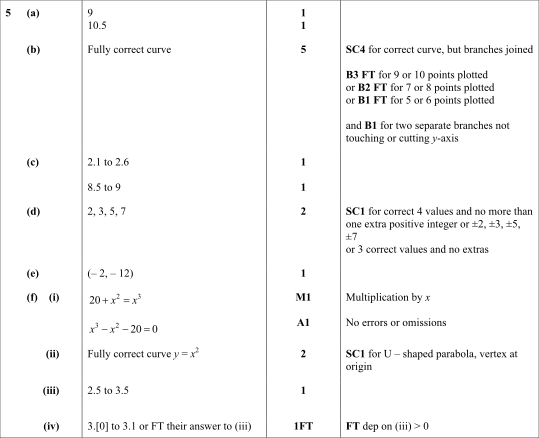
(f(i)) The equation \(f(x)=x^2\) can be written \(x^3+px^2+q=0\). Show that \(p=-1\) and \(q=-20\). [2]
(f(ii)) On the same grid draw \(y=x^2\) for \(-4\le x\le4\). [2]
(f(iii)) Use the graphs to solve \(x^3-x^2-20=0\). [1]

(f(iv)) The sketch shows \(y=x^3-x^2-20\). P is \((n,0)\). Write down \(n\). [1]

0580 P41 - Jun 2016 - Q9 - 14 marks

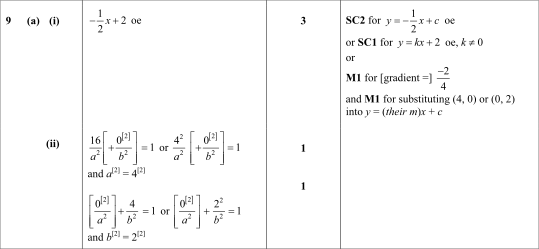
The curve is \(\frac{x^2}{a^2}+\frac{y^2}{b^2}=1\). A is \((4,0)\) and B is \((0,2)\).
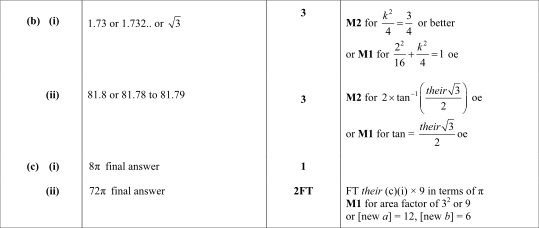
(a(i)) Find the equation of line AB in the form \(y=mx+c\). [3]
(a(ii)) Show \(a^2=16\) and \(b^2=4\). [2]

P \((2,k)\) and Q \((2,-k)\) lie on \(\frac{x^2}{16}+\frac{y^2}{4}=1\), with \(k>0\).
(b(i)) Find \(k\). [3]
(b(ii)) Calculate angle POQ. [3]
The area enclosed by \(\frac{x^2}{a^2}+\frac{y^2}{b^2}=1\) is \(\pi ab\).
(c(i)) Find the area enclosed by \(\frac{x^2}{16}+\frac{y^2}{4}=1\) as a multiple of \(\pi\). [1]
(c(ii)) A mathematically similar curve intersects the x-axis at \((12,0)\) and \((-12,0)\). Find its enclosed area as a multiple of \(\pi\). [2]
0580 P42 - Jun 2016 - Q4 - 17 marks
\(f(x)=x^2-\frac1x-4,\quad x\ne0\).
| \(x\) | -3 | -2 | -1 | -0.5 | -0.1 | 0.2 | 0.5 | 1 | 2 | 3 |
|---|---|---|---|---|---|---|---|---|---|---|
| \(f(x)\) | 5.3 | 0.5 | -1.8 | 6.0 | -9.0 | -5.8 | -4 | 4.7 |
(a(i)) Complete the table. [2]
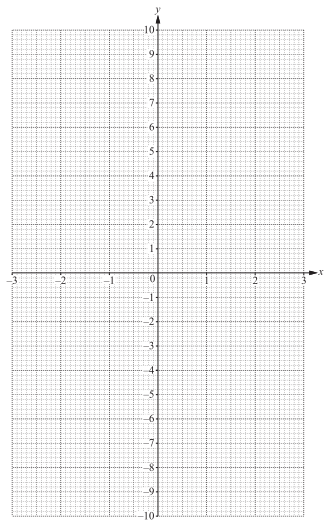
(a(ii)) Draw \(y=f(x)\) for \(-3\le x\le-0.1\) and \(0.2\le x\le3\). [5]
(b) Use the graph to solve \(f(x)=0\). [3]
(c) Give an integer \(k\) for which \(f(x)=k\) has one solution. [1]
(d(i)) Draw a suitable straight line to solve \(f(x)+2=-5x\). [4]
(d(ii)) The equation can be written \(x^3+ax^2+bx-1=0\). Find \(a\) and \(b\). [2]


0580 P43 - Jun 2016 - Q3 - 18 marks
The diagram shows \(y=f(x)\) for \(-3.5\le x\le2.5\).

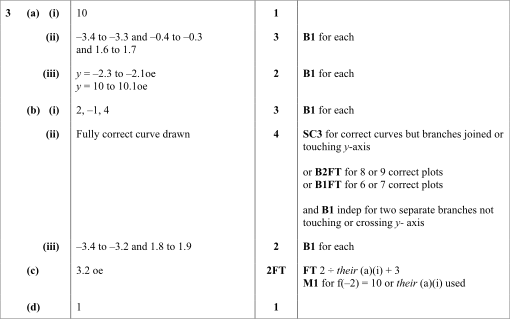
(a(i)) Find \(f(-2)\). [1]
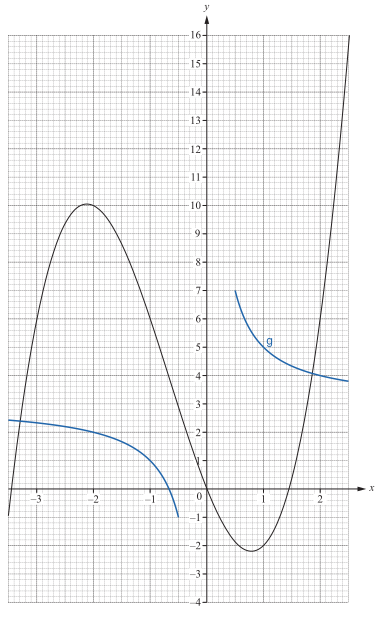
(a(ii)) Solve \(f(x)=2\). [3]
(a(iii)) Two tangents to the graph have gradient 0. Give their equations. [2]
\(g(x)=\frac2x+3\) for \(-3.5\le x\le-0.5\) and \(0.5\le x\le2.5\).
| \(x\) | -3.5 | -3 | -2 | -1 | -0.5 | 0.5 | 1 | 2 | 2.5 |
|---|---|---|---|---|---|---|---|---|---|
| \(g(x)\) | 2.4 | 2.3 | 1 | 7 | 5 | 3.8 |
(b(i)) Complete the table. [3]
(b(ii)) Draw \(y=g(x)\) on the same grid. [4]
(b(iii)) Use the graph to solve \(f(x)=g(x)\). [2]
(c) Find \(gf(-2)\). [2]
(d) Find \(g^{-1}(5)\). [1]
0580 P23 - Nov 2016 - Q19 - 4 marks
The curve \(y=x^3+2x^2-4x\) is shown.

(a) Draw a suitable tangent and estimate the gradient at \(x=1\). [3]
D is a point on the curve with a negative x-coordinate, where the tangent has gradient zero.
(b) Write the coordinates of D. [1]


0580 P41 - Nov 2016 - Q4 - 18 marks
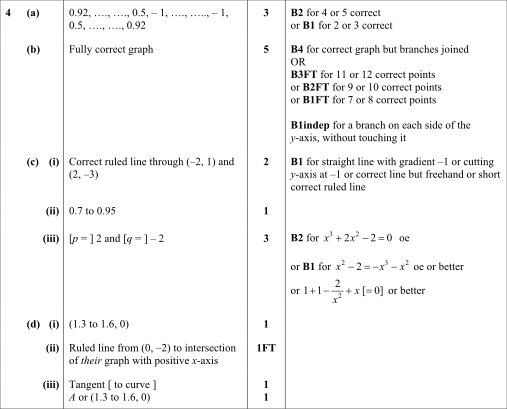
\(y=1-\frac2{x^2},\quad x\ne0\).
| \(x\) | -5 | -4 | -3 | -2 | -1 | -0.5 | 0.5 | 1 | 2 | 3 | 4 | 5 |
|---|---|---|---|---|---|---|---|---|---|---|---|---|
| \(y\) | 0.88 | 0.78 | -7 | -7 | 0.78 | 0.88 |
(a) Complete the table. [3]
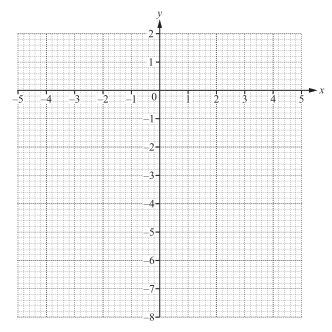
(b) Draw the graph for \(-5\le x\le-0.5\) and \(0.5\le x\le5\). [5]
(c(i)) Draw \(y=-x-1\) for \(-3\le x\le5\). [2]
(c(ii)) Use the graph to solve \(1-\frac2{x^2}=-x-1\). [1]
(c(iii)) Write this equation as \(x^3+px^2+q=0\). Find p and q. [3]
The curve meets the positive x-axis at A. B is (0, −2).
(d(i)) Write the coordinates of A. [1]
(d(ii)) Draw the straight line through A and B. [1]
(d(iii)) Complete: This straight line is a … to the curve at … . [2]

0580 P42 - Nov 2016 - Q2 - 14 marks
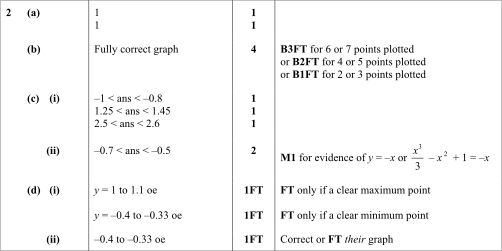
\(y=\frac{x^3}{3}-x^2+1\).
| \(x\) | -1.5 | -1 | -0.5 | 0 | 0.5 | 1 | 1.5 | 2 | 2.5 | 3 |
|---|---|---|---|---|---|---|---|---|---|---|
| \(y\) | -2.38 | -0.33 | 0.71 | 0.79 | 0.33 | -0.13 | -0.33 | -0.04 |
(a) Complete the table. [2]

(b) Draw the graph for \(-1.5\le x\le3\). [4]
Use your graph to solve:
(c(i)) \(\frac{x^3}{3}-x^2+1=0\); [3]
(c(ii)) \(\frac{x^3}{3}-x^2+x+1=0\). [2]
(d(i)) Write the equations of both horizontal tangents to the curve. [2]
(d(ii)) For \(0\le x\le3\), find the smallest possible y. [1]

0580 P43 - Nov 2016 - Q2 - 15 marks
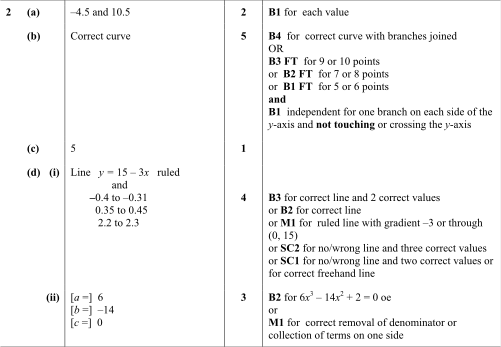
\(y=3x+\frac2{x^2}+1,\quad x\ne0\).
| \(x\) | -3 | -2 | -1 | -0.5 | -0.3 | 0.3 | 0.5 | 1 | 2 | 3 |
|---|---|---|---|---|---|---|---|---|---|---|
| \(y\) | -7.8 | 0 | 7.5 | 22.3 | 24.1 | 6 | 7.5 | 10.2 |
(a) Complete the table. [2]

(b) Draw the graph for \(-3\le x\le-0.3\) and \(0.3\le x\le3\). [5]
(c) Write the largest integer k for which \(3x+2/x^2+1=k\) has exactly one solution. [1]
(d(i)) By drawing a suitable straight line, solve \(3x+2/x^2+1=15-3x\). [4]
(d(ii)) The equation can be written \(ax^3+bx^2+cx+2=0\), with integer coefficients. Find a, b and c. [3]

0580 P42 - Mar 2015 - Q3 - 14 marks
\(y=x^3+3x^2-2\).
| \(x\) | -3 | -2.5 | -2 | -1.5 | -1 | -0.5 | 0 | 0.5 | 1 |
|---|---|---|---|---|---|---|---|---|---|
| \(y\) | -2 | 1.13 | 1.38 | -1.38 | -1.13 |
(a) Complete the table. [3]

(b) Draw the graph for \(-3\le x\le1\). [4]
(c) Draw a suitable line to solve \(x^3+3x^2-2=\frac12(x+1)\). [4]
(d) Draw a suitable tangent to estimate the gradient at x = −1.75. [3]


0580 P41 - Jun 2015 - Q2 - 17 marks
\(y=x^2-\frac1{2x},\quad x\ne0\).
| \(x\) | -2 | -1.5 | -1 | -0.5 | -0.25 | -0.2 | 0.2 | 0.25 | 0.5 | 1 | 1.5 | 2 |
|---|---|---|---|---|---|---|---|---|---|---|---|---|
| \(y\) | 4.25 | 2.58 | 2.06 | 2.54 | -2.46 | -1.94 | 1.92 | 3.75 |
(a) Complete the table. [4]
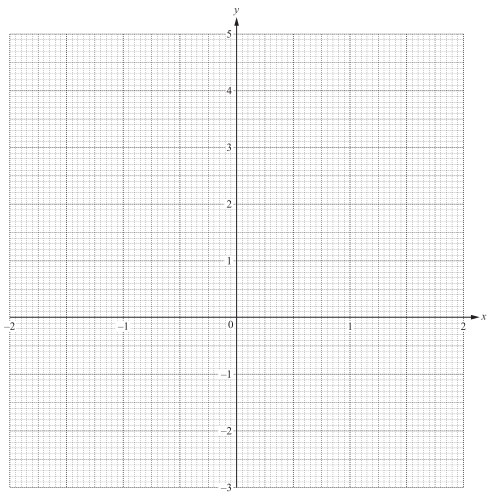
(b) Draw the graph for \(-2\le x\le-0.2\) and \(0.2\le x\le2\). [5]
(c) Draw a suitable line to solve \(x^2-1/(2x)=2\). [3]
(d) Write the range of k for which \(x^2-1/(2x)=k\) has exactly one solution. [2]
(e) Draw a tangent to estimate the gradient at x = −1. [3]


0580 P42 - Jun 2015 - Q5 - 16 marks
\(y=x^2-2x+12/x,\quad x\ne0\).
| \(x\) | -4 | -3 | -2 | -1 | -0.5 | 0.5 | 1 | 2 | 3 | 4 |
|---|---|---|---|---|---|---|---|---|---|---|
| \(y\) | 21 | 11 | -9 | -22.75 | 23.25 | 11 | 6 | 11 |
(a) Complete the table. [2]

(b) Draw the graph for \(-4\le x\le-0.5\) and \(0.5\le x\le4\). [5]
(c) Draw a tangent to estimate the gradient at (1, 11). [3]
\(x^2-2x+12/x=k\) has exactly two distinct solutions. Use the graph to find:
(d(i)) the value of k; [1]
(d(ii)) the two solutions. [2]
(e) \(x^3+ax^2+bx+c=0\) can be solved by drawing \(y=3x+1\). Find a, b and c. [3]


0580 P43 - Jun 2015 - Q3 - 15 marks
\(f(x)=8/x^2+x/2,\quad x\ne0\).
| \(x\) | -5 | -4 | -3 | -2 | -1.5 | 1.5 | 2 | 2.5 | 3 | 3.5 | 4 | 5 |
|---|---|---|---|---|---|---|---|---|---|---|---|---|
| \(f(x)\) | -2.2 | -1.5 | -0.6 | 2.8 | 4.3 | 2.5 | 2.4 | 2.4 | 2.8 |
(a) Complete the table. [3]

(b) Draw the graph for \(-5\le x\le-1.5\) and \(1.5\le x\le5\). [5]
(c) Solve f(x) = 0. [1]
(d) Draw a suitable line to solve f(x) = 1 − x. [3]
(e) Draw a tangent at (−3, −0.6) to estimate the gradient at x = −3. [3]


0580 P41 - Nov 2015 - Q2 - 17 marks
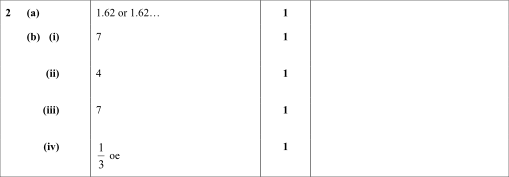
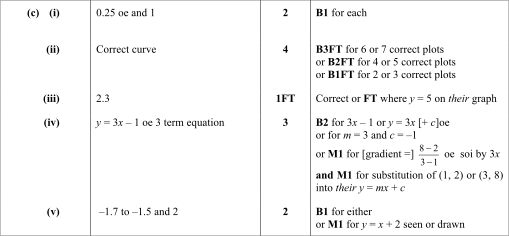
(a) Calculate \(2^{0.7}\). [1]
Find x:
(b(i)) \(2^x=128\); [1]
(b(ii)) \(2^x\times2^9=2^{13}\); [1]
(b(iii)) \(2^9\div2^x=4\); [1]
(b(iv)) \(2^x=\sqrt[3]2\). [1]
| \(x\) | -3 | -2 | -1 | 0 | 1 | 2 | 3 |
|---|---|---|---|---|---|---|---|
| \(y=2^x\) | 0.125 | 0.5 | 2 | 4 | 8 |
(c(i)) Complete the table. [2]

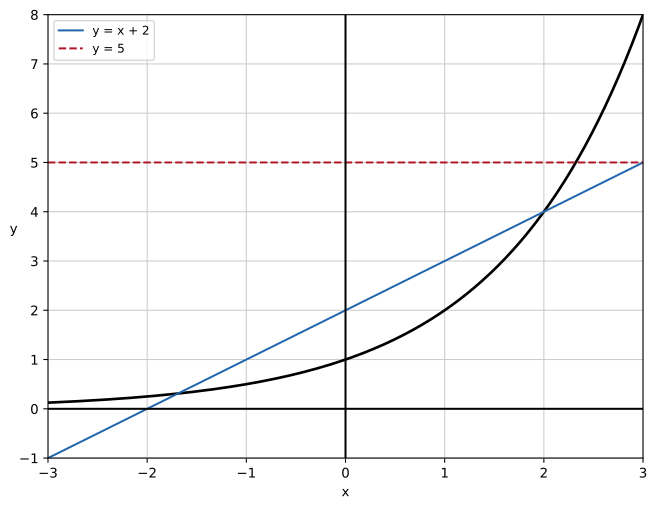
(c(ii)) Draw \(y=2^x\) for \(-3\le x\le3\). [4]
(c(iii)) Use the graph to solve \(2^x=5\). [1]
(c(iv)) Find the line through (1, 2) and (3, 8). [3]
(c(v)) Draw a suitable line to solve \(2^x-2-x=0\). [2]
0580 P42 - Nov 2015 - Q2 - 14 marks
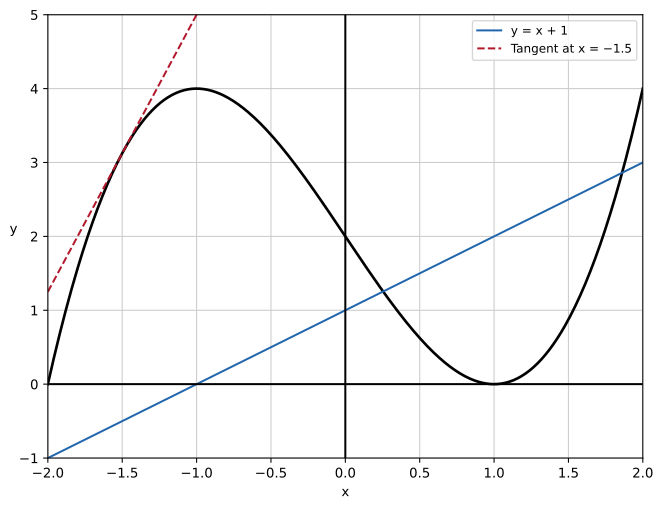
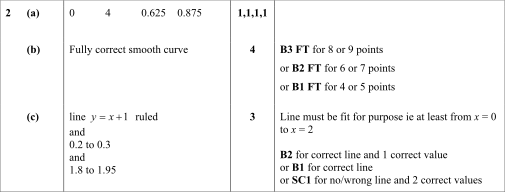
\(y=x^3-3x+2\).
| x | -2 | -1.5 | -1 | -0.5 | 0 | 0.5 | 1 | 1.5 | 2 |
|---|---|---|---|---|---|---|---|---|---|
| y | 3.125 | 3.375 | 2 | 0 | 4 |
(a) Complete the table. [4]
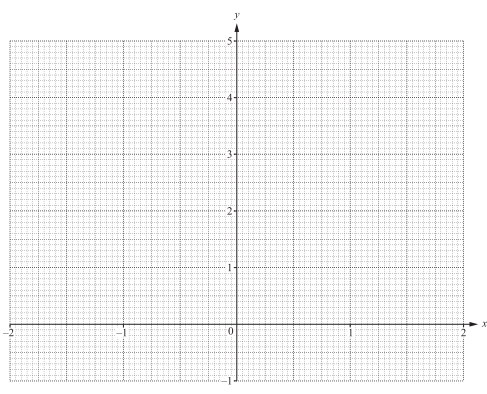
(b) Draw the curve for \(-2\le x\le2\). [4]
(c) Draw a suitable line to solve \(x^3-3x+2=x+1\) for \(-2\le x\le2\). [3]
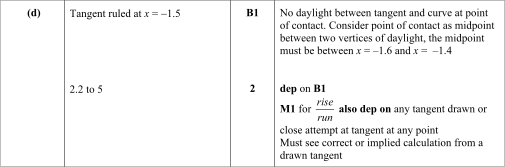
(d) Draw a tangent and estimate the gradient at x = −1.5. [3]
0580 P43 - Nov 2015 - Q4 - 13 marks
\(f(x)=x-\frac1{2x^2},\quad x\ne0\).
| x | -3 | -2 | -1.5 | -1 | -0.5 | -0.3 | 0.3 | 0.5 | 1 | 1.5 | 2 |
|---|---|---|---|---|---|---|---|---|---|---|---|
| f(x) | -3.1 | -2.1 | -1.7 | -2.5 | -5.9 | -5.3 | -1.5 | 1.3 | 1.9 |
(a) Complete the table. [2]
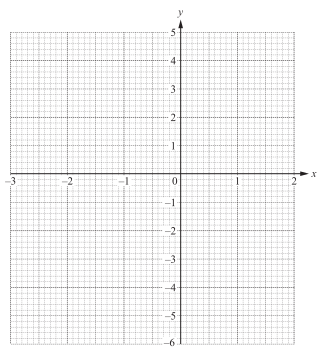
(b) Draw the graph for \(-3\le x\le-0.3\) and \(0.3\le x\le2\). [5]
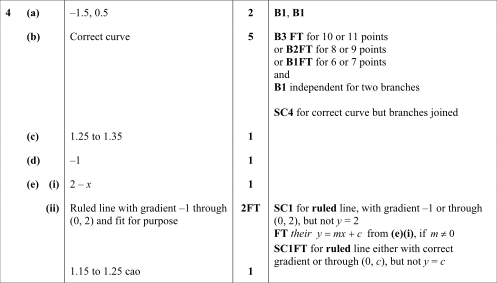
(c) Use the graph to solve f(x) = 1. [1]
(d) Find the only negative integer k for which f(x) = k has exactly one solution over all real x. [1]
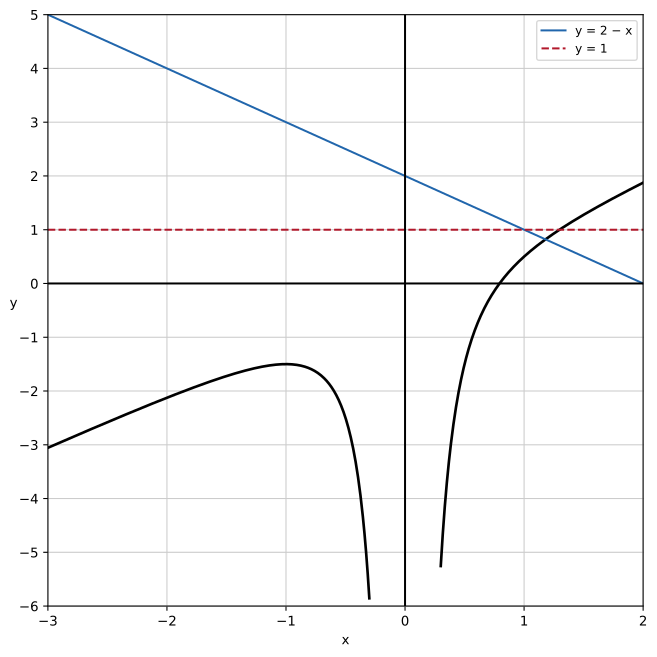
(e(i)) Find the straight line used with y = f(x) to solve \(2x-\frac1{2x^2}-2=0\). [1]
(e(ii)) Draw this line and solve the equation. [3]
0580 P41 - Jun 2014 - Q8 - 13 marks
\(y=x^3-3x+1\).
| x | -2.5 | -2 | -1.5 | -1 | -0.5 | 0 | 0.5 | 1 | 1.5 | 2 | 2.5 |
|---|---|---|---|---|---|---|---|---|---|---|---|
| y | -7.125 | -1 | 3 | 1 | -0.375 | -1 | -0.125 | 3 | 9.125 |
(a) Complete the table. [2]

(b) Draw the graph for −2.5 ≤ x ≤ 2.5. [4]
(c) Draw a tangent to estimate the gradient at x = 2. [3]
(d) Use the graph to solve \(x^3-3x+1=1\). [2]
(e) Find the strict range of k for which \(x^3-3x+1=k\) has three different solutions. [2]


0580 P42 - Jun 2014 - Q2 - 15 marks
\(f(x)=1/x^2-2x,\quad x\ne0\).
| x | -3 | -2.5 | -2 | -1.5 | -1 | -0.5 | 0.4 | 0.5 | 1 | 1.5 | 2 |
|---|---|---|---|---|---|---|---|---|---|---|---|
| f(x) | 6.1 | 5.2 | 4.3 | 3.4 | 5 | 5.5 | -2.6 | -3.8 |
(a) Complete the table. [3]
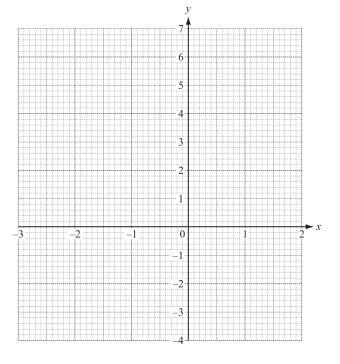
(b) Draw both branches for −3 ≤ x ≤ −0.5 and 0.4 ≤ x ≤ 2. [5]
(c) Solve f(x) = 2. [1]
(d) Solve f(x) = 2x + 3. [3]
(e(i)) Draw the tangent at x = −1.5. [1]
(e(ii)) Use it to estimate the gradient there. [2]

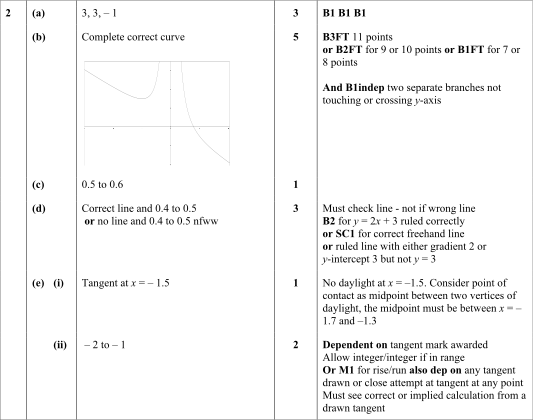
0580 P43 - Jun 2014 - Q4 - 20 marks
\(y=1/x^2+x,\quad x\ne0\).
| x | -3 | -2 | -1 | -0.5 | 0.5 | 1 | 2 | 3 | 4 |
|---|---|---|---|---|---|---|---|---|---|
| y | -2.89 | -1.75 | 3.5 | 2 | 2.25 | 4.06 |
(a) Complete the table. [3]

(b) Draw the graph for −3 ≤ x ≤ −0.5 and 0.5 ≤ x ≤ 4. [5]
(c) Use the graph to solve \(1/x^2+x-3=0\). [3]
(d) Use the graph to solve \(1/x^2+x=1-x\). [3]
(e) Draw a tangent to estimate the gradient at x = 2. [3]
(f) Using algebra, show that the graph at y = 0 gives \(\sqrt[3]{-1}\). [3]


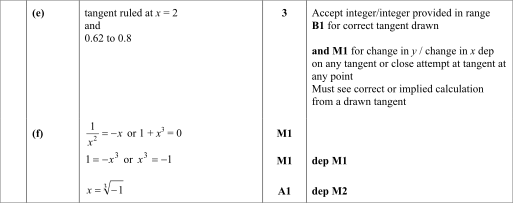
0580 P41 - Nov 2014 - Q5 - 14 marks
\(y=x^2+3/x,\quad x\ne0\).
| x | -3 | -2 | -1 | -0.5 | 0.4 | 0.6 | 1 | 1.5 | 2 | 3 |
|---|---|---|---|---|---|---|---|---|---|---|
| y | 8 | 2.5 | -5.8 | 7.7 | 5.4 | 4 | 4.3 | 10 |
(a) Complete the table. [2]

(b) Draw the graph for −3 ≤ x ≤ −0.5 and 0.4 ≤ x ≤ 3. [5]
(c) Use the graph to solve \(x^2+3/x=5\). [3]
(d) Draw a suitable line to solve \(x^2+3/x=x+5\). [4]



0580 P42 - Nov 2014 - Q6 - 16 marks
\(f(x)=5x^3-8x^2+10\).
| x | -1.5 | -1 | -0.5 | 0 | 0.5 | 0.75 | 1 | 1.5 | 2 |
|---|---|---|---|---|---|---|---|---|---|
| f(x) | -24.9 | 10 | 8.6 | 7.6 | 7 | 18 |
(a) Complete the table. [3]

(b) Draw the graph for −1.5 ≤ x ≤ 2. [4]
(c(i)) Give an integer k for which f(x) = k has exactly one solution. [1]
(c(ii)) Give an integer k for which it has three solutions. [1]
(d) Draw a suitable line to solve f(x) = 15x + 2 on −1.5 ≤ x ≤ 2. [4]
(e) Draw a tangent at x = 1.5 and use it to estimate the gradient. [3]


0580 P41 - Jun 2013 - Q2 - 15 marks
\(f(x)=3-x-x^2,\quad g(x)=3^x\).
| x | -1.5 | -1 | -0.5 | 0 | 0.5 | 1 | 1.5 |
|---|---|---|---|---|---|---|---|
| f(x) | 2.25 | 3 | 3.25 | … | 2.25 | 1 | -0.75 |
| g(x) | 0.19 | … | 0.58 | … | 1.73 | 3 | 5.2 |
(a) Complete the tables. [3]

(b) Draw y = f(x) and y = g(x) for \(-1.5\le x\le1.5\). [6]
(c(i)) Use the graphs to solve f(x) = 0 in this interval. [1]
(c(ii)) Solve g(x) = 4 using the graph. [1]
(c(iii)) Solve f(x) = g(x) using the graphs. [1]
(d) Draw a suitable tangent to estimate the gradient of y = f(x) at x = 0.5. [3]

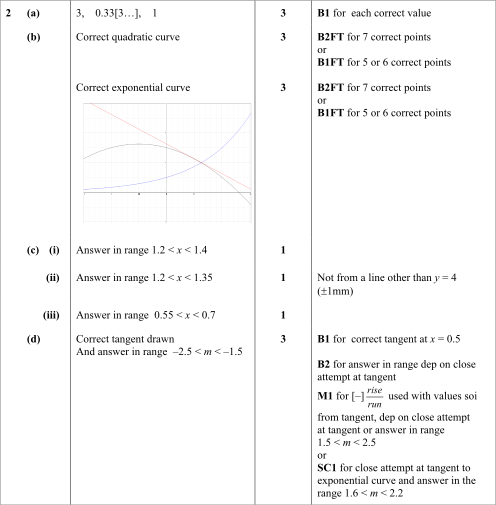
0580 P42 - Jun 2013 - Q3 - 13 marks
\(y=11x-2x^2-12,\quad1\le x\le4.5\).
| x | 1 | 1.5 | 2 | 2.5 | 3 | 3.5 | 4 | 4.5 |
|---|---|---|---|---|---|---|---|---|
| y | -3 | … | 2 | 3 | 3 | … | … | … |
(a) Complete the table. [3]

(b) Draw the curve on the grid. [4]
(c) Draw a suitable line and use the graph to solve \(11x-2x^2=11\). [2]
\(y=mx+2\) is tangent to the curve at P.
(d(i)) Draw the tangent and estimate P’s coordinates. [2]
(d(ii)) Find m. [2]


0580 P43 - Jun 2013 - Q5 - 17 marks
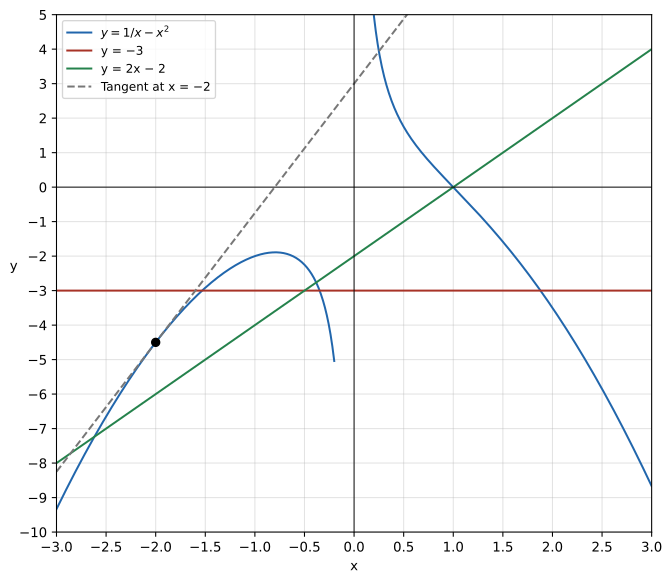
\(f(x)=1/x-x^2,\quad x\ne0\).
| x | -3 | -2 | -1 | -0.5 | -0.2 | 0.2 | 0.5 | 1 | 2 | 3 |
|---|---|---|---|---|---|---|---|---|---|---|
| f(x) | -9.33 | -4.5 | -2 | -2.25 | … | 4.96 | … | … | -3.5 | -8.67 |
(a) Complete the table. [3]
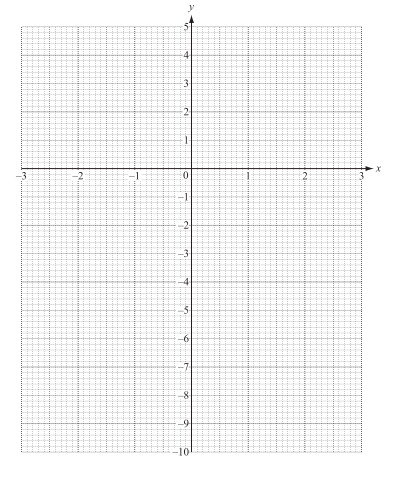
(b) Draw the graph for \(-3\le x\le-0.2\) and \(0.2\le x\le3\). [5]
(c) Use the graph to solve f(x) = −3. [3]
(d) Draw a suitable line and solve f(x) = 2x − 2 graphically. [3]
(e) Draw a tangent at x = −2 and estimate its gradient, showing working. [3]

0580 P42 - Nov 2013 - Q5 - 19 marks
\(y=\frac2{x^2}-\frac1x-3x\).
| x | -3 | -2 | -1 | -0.5 | -0.3 | 0.3 | 0.5 | 1 | 2 | 3 |
|---|---|---|---|---|---|---|---|---|---|---|
| y | 9.6 | … | 6 | … | 26.5 | 18.0 | … | -2 | -6 | -9.1 |
(a) Complete the table. [3]

(b) Draw the graph for \(-3\le x\le-0.3\) and \(0.3\le x\le3\). [5]
(c(i)) Use it to solve \(2/x^2-1/x-3x=0\). [1]
(c(ii)) Solve \(2/x^2-1/x-3x-7.5=0\). [3]
(d(i)) Draw a suitable straight line and solve \(2/x^2-1/x-3x=10-3x\). [4]
(d(ii)) Write that equation as \(ax^2+bx+c=0\), with integers a, b, c; give their values. [3]

0580 P43 - Nov 2013 - Q3 - 13 marks
A metal sheet measures 9 cm by 7 cm. A square of side x cm is cut from each corner, then the sheet is folded into an open box of height x cm.

(a) Give the length and width of the box in terms of x. [2]
(b) Show \(V=4x^3-32x^2+63x\). [2]
| x | 0 | 0.5 | 1 | 1.5 | 2 | 2.5 | 3 | 3.5 |
|---|---|---|---|---|---|---|---|---|
| V | 0 | … | 35 | 36 | 30 | … | 9 | 0 |
(c) Complete the table. [2]

(d) Draw the graph for \(0\le x\le3.5\). Three points are already plotted. [3]
(e) Volume is at least 30 cm³. Give the possible x values as an inequality. [2]
(f(i)) Read the maximum volume. [1]
(f(ii)) Read the x giving that volume. [1]


0580 P22 - Jun 2012 - Q16 - 5 marks

\(y=x/2+2/x,\quad0<x\le8\).
(a) Use the graph to solve \(x/2+2/x=3\). [2]
(b) Draw a tangent at x = 1 and estimate the gradient. [3]


0580 P41 - Jun 2012 - Q3 - 14 marks
\(y=x^3-2x,\quad-2\le x\le2\).
| x | -2 | -1.5 | -1 | -0.6 | -0.3 | 0 | 0.3 | 0.6 | 1 | 1.5 | 2 |
|---|---|---|---|---|---|---|---|---|---|---|---|
| y | -4 | -0.38 | … | … | 0.57 | … | -0.57 | … | … | 0.38 | 4 |
(a) Complete the table. [3]

(b) Draw the graph. The first two points are already plotted. [4]
(c(i)) Draw y = 0.8 over the given x interval. [1]
(c(ii)) Use the graph to solve \(x^3-2x=0.8\). [3]
(d) Draw a tangent at x = −1.5 and estimate the gradient, showing working. [3]

0580 P43 - Jun 2012 - Q7 - 14 marks
\(f(x)=2^x\).
| x | 0 | 0.5 | 1 | 1.5 | 2 | 2.5 | 3 | 3.5 | 4 |
|---|---|---|---|---|---|---|---|---|---|
| f(x) | … | 1.4 | 2 | 2.8 | 4 | 5.7 | 8 | … | … |
(a) Complete the table. [3]

(b) Draw y = f(x) for \(0\le x\le4\). [4]
(c) Use the graph to solve \(2^x=5\). [1]
(d) Draw a suitable straight line to solve \(2^x=3x\). [3]
(e) Draw a suitable tangent to find the point where the gradient is 3. [3]


0580 P41 - Nov 2012 - Q2 - 17 marks
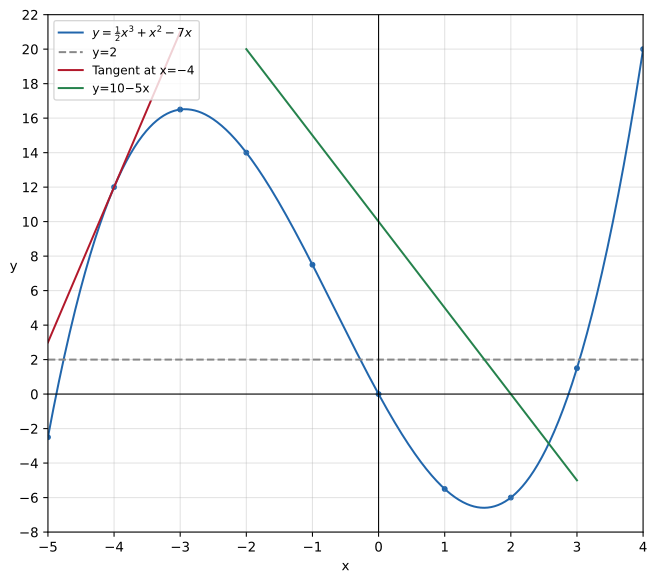
\(y=\tfrac12x^3+x^2-7x,\quad-5\le x\le4\).
| x | -5 | -4 | -3 | -2 | -1 | 0 | 1 | 2 | 3 | 4 |
|---|---|---|---|---|---|---|---|---|---|---|
| y | -2.5 | 12 | 16.5 | 7.5 | 0 | -6 | 1.5 |
(a(i)) Complete the table. [3]

(a(ii)) Draw the curve on the grid. [4]
(b) Use the graph to solve \(\tfrac12x^3+x^2-7x=2\). [3]
(c) Draw a tangent at x = −4 and estimate the gradient. [3]
(d(i)) Draw y = 10 − 5x for −2 ≤ x ≤ 3. [3]
(d(ii)) Use the graphs to solve \(\tfrac12x^3+x^2-7x=10-5x\). [1]

0580 P42 - Nov 2012 - Q8 - 13 marks
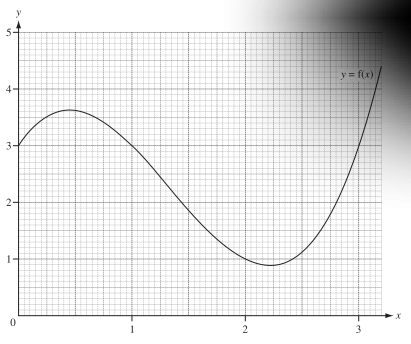
The curve y = f(x) is shown for 0 ≤ x ≤ 3.2.
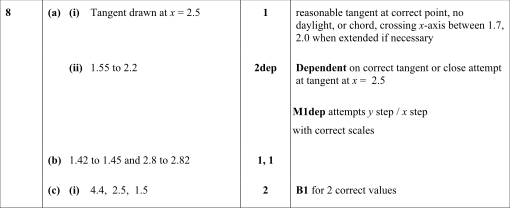
(a(i)) Draw a tangent at x = 2.5. [1]
(a(ii)) Estimate the gradient using the tangent. [2]
(b) Use the graph to solve f(x) = 2. [2]
\(g(x)=x/2+2/x^2,\quad x\ne0\).
| x | 0.7 | 1 | 1.5 | 2 | 2.5 | 3 |
|---|---|---|---|---|---|---|
| g(x) | 1.6 | 1.6 | 1.7 |
(c(i)) Complete the table to one decimal place. [2]
(c(ii)) Draw y = g(x) for 0.7 ≤ x ≤ 3. [3]
(c(iii)) Use the graphs to solve f(x) = g(x). [3]


0580 P43 - Nov 2012 - Q4 - 17 marks
\(f(x)=2/x^2-3x,\quad x\ne0\).
| x | -3 | -2.5 | -2 | -1.5 | -1 | -0.5 | 0.5 | 1 | 1.5 | 2 | 2.5 | 3 |
|---|---|---|---|---|---|---|---|---|---|---|---|---|
| f(x) | 9.2 | 7.8 | 6.5 | 5.4 | 9.5 | 6.5 | -3.6 | -5.5 | -7.2 | -8.8 |
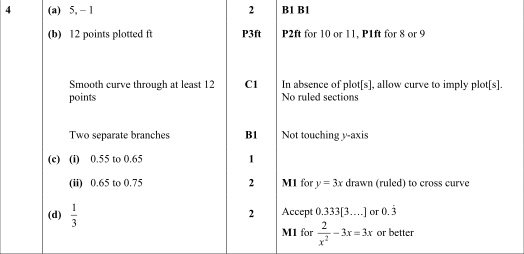
(a) Complete the table. [2]

(b) Draw y = f(x) for −3 ≤ x ≤ −0.5 and 0.5 ≤ x ≤ 3. [5]
(c(i)) Use the graph to solve f(x) = 4. [1]
(c(ii)) Use the graph to solve f(x) = 3x. [2]
(d) Write the equation in (c)(ii) as \(x^3=k\) and find k. [2]
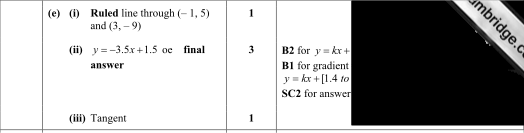
(e(i)) Draw the line through (−1,5) and (3,−9). [1]
(e(ii)) Find its equation. [3]
(e(iii)) Complete: this straight line is a … to y = f(x). [1]

0580 P23 - Jun 2011 - Q5 - 2 marks


0580 P41 - Jun 2011 - Q7 - 17 marks
\(y=4/x^2,\quad x\ne0\).
| x | -4 | -3 | -2 | -1 | -0.6 | 0.6 | 1 | 2 | 3 | 4 |
|---|---|---|---|---|---|---|---|---|---|---|
| y | 0.25 | 0.44 | 11.11 | 4 | 0.44 |
(a) Complete the table. [3]

(b) Draw y = 4/x² for −4 ≤ x ≤ −0.6 and 0.6 ≤ x ≤ 4. [5]
(c) Use the graph to solve 4/x² = 6. [2]
(d) Draw a tangent at x = 1.5 and estimate its gradient. [3]
(e)(i) Write the straight-line equation to use with the curve to solve \(4/x^2-x+2=0\). [1]
(e)(ii) Draw this line. [2]
(e)(iii) Use the intersection to solve the equation. [1]


0580 P42 - Jun 2011 - Q4 - 14 marks
\(y=x^2-3/x,\quad x\ne0\).
| x | -3 | -2 | -1 | -0.5 | -0.25 | 0.25 | 0.5 | 1 | 2 | 3 |
|---|---|---|---|---|---|---|---|---|---|---|
| y | 10 | 5.5 | 6.3 | 12.1 | -11.9 | 2.5 | 8 |
(a) Complete the table. [3]

(b) Draw the two branches for −3 ≤ x ≤ −0.25 and 0.25 ≤ x ≤ 3. [5]
(c) Use the graph to solve \(x^2-3/x=7\). [3]
(d) Draw a tangent at x = −2 and estimate the gradient. [3]


0580 P43 - Jun 2011 - Q5 - 17 marks
\(f(x)=x^2+1/x^2,\quad x\ne0\).
| x | -3 | -2.5 | -2 | -1.5 | -1 | -0.5 | 0.5 | 1 | 1.5 | 2 | 2.5 | 3 |
|---|---|---|---|---|---|---|---|---|---|---|---|---|
| f(x) | 6.41 | 2.69 | 4.25 | 4.25 | 2.69 | 6.41 |
(a) Complete the table. [3]

(b) Draw the graph for −3 ≤ x ≤ −0.5 and 0.5 ≤ x ≤ 3. [5]
(c)(i) Write the equation of the line of symmetry. [1]
(c)(ii) Draw a tangent at x = −1.5 and estimate its gradient. [3]
(c)(iii) Use the graph to solve \(f(x)=3\). [2]
(c)(iv) Draw \(y=2x\) and use the graph to solve \(f(x)=2x\). [3]
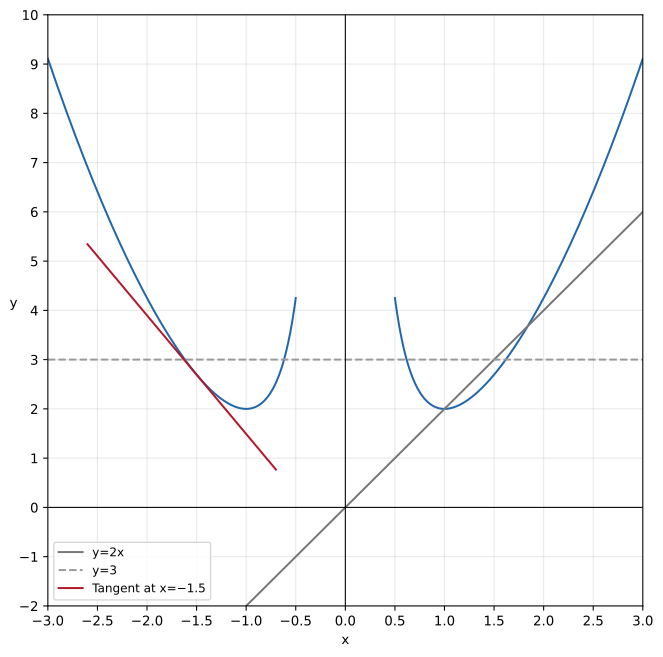

0580 P41 - Nov 2011 - Q5 - 19 marks
\(f(x)=x^3/2-3x-1\).
| x | -3 | -2 | -1.5 | -1 | 0 | 1 | 1.5 | 2 | 3 | 3.5 |
|---|---|---|---|---|---|---|---|---|---|---|
| f(x) | -5.5 | 1.8 | 1.5 | -3.5 | -3.8 | -3 | 9.9 |
(a) Complete the table. [3]
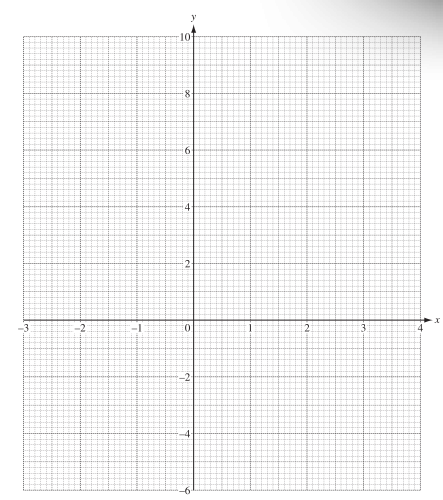
(b) Draw the graph for −3 ≤ x ≤ 3.5. [4]
(c)(i) Use the graph to solve f(x) = 0.5. [3]
(c)(ii) Find the two inequalities for k for which f(x) = k has only one answer. [2]
(d)(i) Draw y = 3x−2 for −1 ≤ x ≤ 3.5 on the same grid. [3]
(d)(ii) Write \(x^3/2-3x-1=3x-2\) in the form \(x^3+ax+b=0\) and find a and b. [2]
(d)(iii) Use the graph to find the positive solutions of this equation. [2]


0580 P42 - Nov 2011 - Q7 - 16 marks
\(f(x)=1/x+x^2,\quad x\ne0\). The accurate positive branch for 0 < x ≤ 3 is shown.

| x | -3 | -2 | -1 | -0.5 | -0.3 | -0.1 |
|---|---|---|---|---|---|---|
| f(x) | 3.5 | 0 | -1.8 |
(a) Complete the table. [3]
(b) Draw the negative branch for −3 ≤ x < 0. [3]
(c) Draw a tangent at x = 2 and estimate its gradient. [3]
(d) Give the inequality for k when f(x) = k has three answers. [1]
(e)(i) Draw y = 1−x for −3 ≤ x ≤ 3. [2]
(e)(ii) Use the graphs to solve \(1-x=1/x+x^2\). [1]
(f)(i) Rearrange \(x^3-x^2-2x+1=0\) into \(1/x+x^2=ax+b\). [2]
(f)(ii) State the line to draw to solve this cubic. [1]

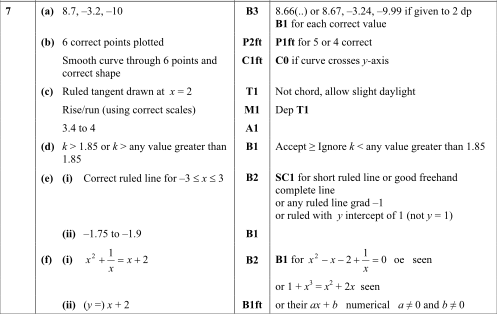
0580 P43 - Nov 2011 - Q2 - 11 marks
\(y=2^x\).
| x | -2 | -1 | 0 | 1 | 2 | 3 |
|---|---|---|---|---|---|---|
| y | 0.25 | 1 | 2 | 8 |
(a) Complete the table. [2]

(b) Draw the curve for −2 ≤ x ≤ 3. [3]
(c)(i) Draw the line through (0,2) and (3,8). [1]
(c)(ii) The line has equation y = mx+2. Show m = 2. [1]
(c)(iii) One solution of \(2^x=2x+2\) is x = 3. Use the graph to find the other. [1]
(d) Draw a tangent at x = 1 and estimate its gradient. [3]

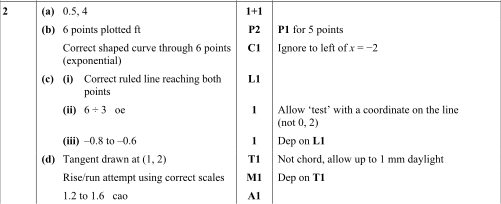
0580 P22 - Jun 2010 - Q19 - 7 marks
Braking distance d (m) at speed v (km/h) satisfies \(200d=v(v+40)\).
| v | 0 | 20 | 40 | 60 | 80 | 100 | 120 |
|---|---|---|---|---|---|---|---|
| d | 0 | 16 | 48 | 96 |
(a) Complete the missing distances. [2]

(b) Draw the graph for 0 ≤ v ≤ 120. [3]
(c) Find the braking distance at 110 km/h. [1]
(d) Find the speed for a braking distance of 80 m. [1]


0580 P41 - Jun 2010 - Q8 - 15 marks
\(f(x)=2^x\).
| x | -2 | -1 | 0 | 1 | 2 | 3 | 4 |
|---|---|---|---|---|---|---|---|
| f(x) | 0.5 | 1 | 2 | 4 |
(a) Complete the table. [3]
\(g(x)=x(4-x)\).
| x | -1 | 0 | 1 | 2 | 3 | 4 |
|---|---|---|---|---|---|---|
| g(x) | 0 | 3 | 3 | 0 |
(b) Complete the table. [2]
(c)(i) Draw f for −2 ≤ x ≤ 4. [3]
(c)(ii) Draw g for −1 ≤ x ≤ 4. [3]
(d)(i) Use the graphs to solve f(x) = 10. [1]
(d)(ii) Solve f(x) = g(x). [2]
(d)(iii) Solve \(f^{-1}(x)=1.7\). [1]


0580 P43 - Jun 2010 - Q6 - 15 marks
\(y=x+1/x\).
| x | -4 | -3 | -2 | -1 | -0.5 | 0.5 | 1 | 2 | 3 | 4 |
|---|---|---|---|---|---|---|---|---|---|---|
| y | -4.3 | -3.3 | -2.5 | 2.5 | 3.3 | 4.3 |
(a) Complete the table. [2]

(b) Draw the two branches for −4 ≤ x ≤ −0.5 and 0.5 ≤ x ≤ 4. [3]
(c) Find the three integer k for which \(x+1/x=k\) has no real solution. [2]
(d) State the ranges of x where the gradient is positive. [2]
(e)(i) Draw the straight line needed to solve \(x+1/x=2x+1\), for −2.5 ≤ x ≤ 1.5. [2]
(e)(ii) Show how to read both solutions. [1]
(e)(iii) Rearrange to \(x^2+bx+c=0\) and find b,c. [3]


0580 P41 - Nov 2010 - Q3 - 16 marks

A farmer uses a wall for one side of a rectangular enclosure and 72 m of fence for the other three. Width is x m, area A m².
(a) Show \(A=72x-2x^2\). [2]
(b) Factorise it fully. [2]
| x | 0 | 5 | 10 | 15 | 20 | 25 | 30 | 35 |
|---|---|---|---|---|---|---|---|---|
| A | 0 | 310 | 520 | 550 | 360 |
(c) Complete the table. [3]

(d) Draw A against x for 0 ≤ x ≤ 35. [4]
(e)(i) Use the graph to find both x when A = 450. [2]
(e)(ii) Find the maximum area from the graph. [1]
(f) Each animal needs at least 12 m². Find the greatest number allowed in a 500 m² enclosure. [2]


0580 P42 - Nov 2010 - Q7 - 16 marks
\(f(x)=2/x-x^2\).
| x | -3 | -2 | -1 | -0.5 | -0.2 | 0.2 | 0.5 | 1 | 2 | 3 |
|---|---|---|---|---|---|---|---|---|---|---|
| f(x) | -9.7 | -5 | -10 | 10 | 3.75 | 1 | -8.3 |
(a) Complete the table. [3]

(b) Draw f for −3 ≤ x ≤ −0.2 and 0.2 ≤ x ≤ 3. [5]
(c)(i) Use the graph to solve f(x) = 2. [1]
(c)(ii) Give a value k for which f(x) = k has three solutions. [1]
(d) Draw a suitable line and solve \(2/x-x^2=5x\) using the graphs. [3]
(e) Draw the tangent at x = −2 and estimate the gradient. [3]


0580 P43 - Nov 2010 - Q7 - 15 marks
\(f(x)=x^3/10+1\).
| x | -4 | -3 | -2 | -1 | 0 | 1 | 2 | 3 |
|---|---|---|---|---|---|---|---|---|
| f(x) | -1.7 | 0.2 | 0.9 | 1 | 1.1 | 1.8 |
(a) Complete the table. [2]

(b) Draw f for −4 ≤ x ≤ 3. [4]
\(g(x)=4/x,\ x\ne0\).
| x | -4 | -3 | -2 | -1 | 1 | 2 | 3 |
|---|---|---|---|---|---|---|---|
| g(x) | -1 | -1.3 | 2 | 1.3 |
(c) Complete the table. [2]
(d) Draw g for −4 ≤ x ≤ −1 and 1 ≤ x ≤ 3 on the same grid. [3]
(e)(i) Use the graphs to solve \(x^3/10+1=4/x\). [2]
(e)(ii) Write the equation as \(x^4+ax+b=0\) and find a,b. [2]