9709 P12 - Nov 2023 - Q2
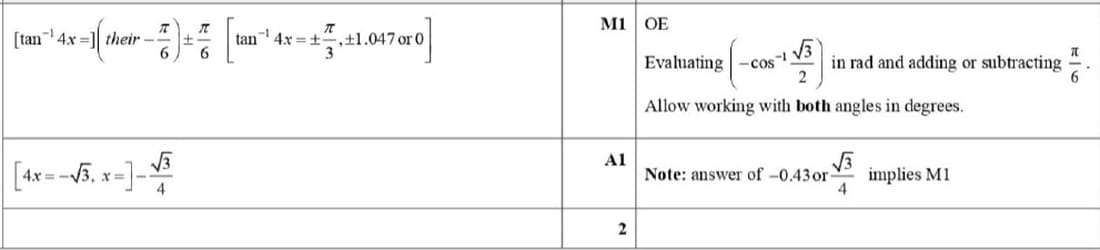
Find the exact solution of the equation
\(\frac{1}{6}\pi + \arctan(4x) = -\cos^{-1}\left(\frac{1}{2}\sqrt{3}\right)\).
9709 P13 - Jun 2018 - Q7
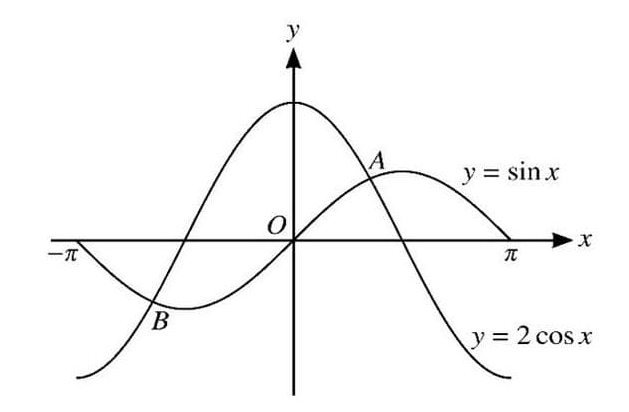
The diagram shows the graphs of \(y = \sin x\) and \(y = 2 \cos x\) for \(-\pi \leq x \leq \pi\). The graphs intersect at the points \(A\) and \(B\).
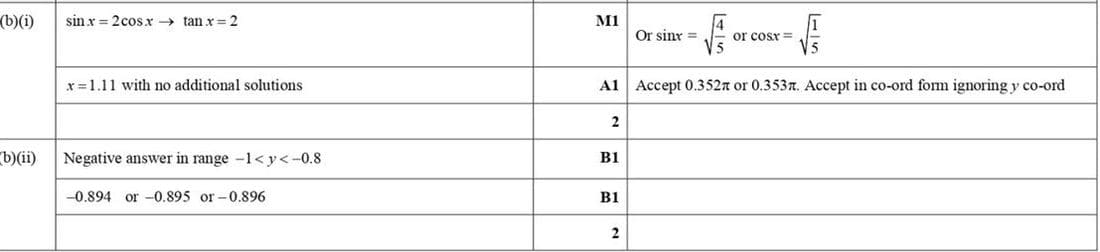
(i) Find the \(x\)-coordinate of \(A\).
(ii) Find the \(y\)-coordinate of \(B\).
9709 P12 - Jun 2018 - Q4
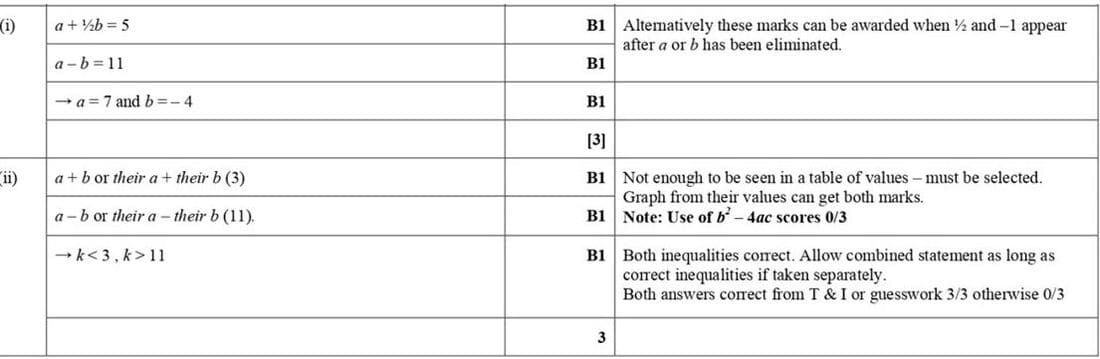
The function \(f\) is such that \(f(x) = a + b \cos x\) for \(0 \leq x \leq 2\pi\). It is given that \(f\left(\frac{1}{3}\pi\right) = 5\) and \(f(\pi) = 11\).
(i) Find the values of the constants \(a\) and \(b\).
(ii) Find the set of values of \(k\) for which the equation \(f(x) = k\) has no solution.
Problem #569
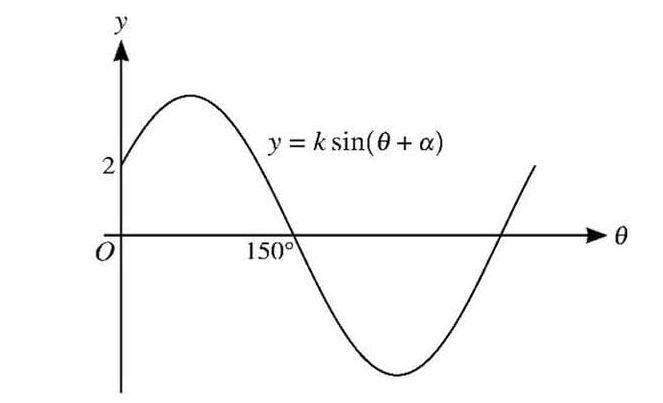
The diagram shows part of the graph of \(y = k \sin(\theta + \alpha)\), where \(k\) and \(\alpha\) are constants and \(0^\circ < \alpha < 180^\circ\). The graph has a maximum point at \(y = 2\) and \(\theta = 0^\circ\), and it crosses the \(\theta\)-axis at \(\theta = 150^\circ\). Find the value of \(\alpha\) and the value of \(k\).

9709 P12 - Mar 2018 - Q4
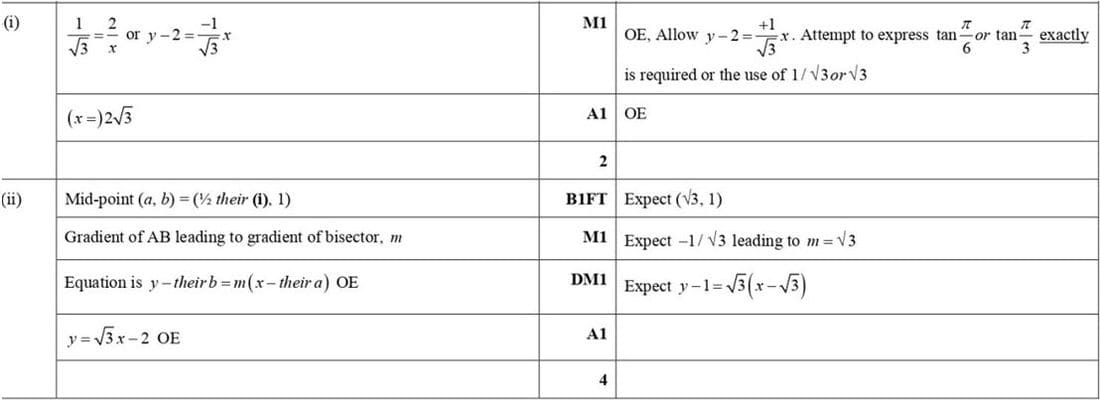
A straight line cuts the positive x-axis at A and the positive y-axis at B (0, 2). Angle BAO = \(\frac{1}{6} \pi\) radians, where O is the origin.
(i) Find the exact value of the x-coordinate of A.
(ii) Find the equation of the perpendicular bisector of AB, giving your answer in the form \(y = mx + c\), where \(m\) is given exactly and \(c\) is an integer.
9709 P12 - Nov 2017 - Q6
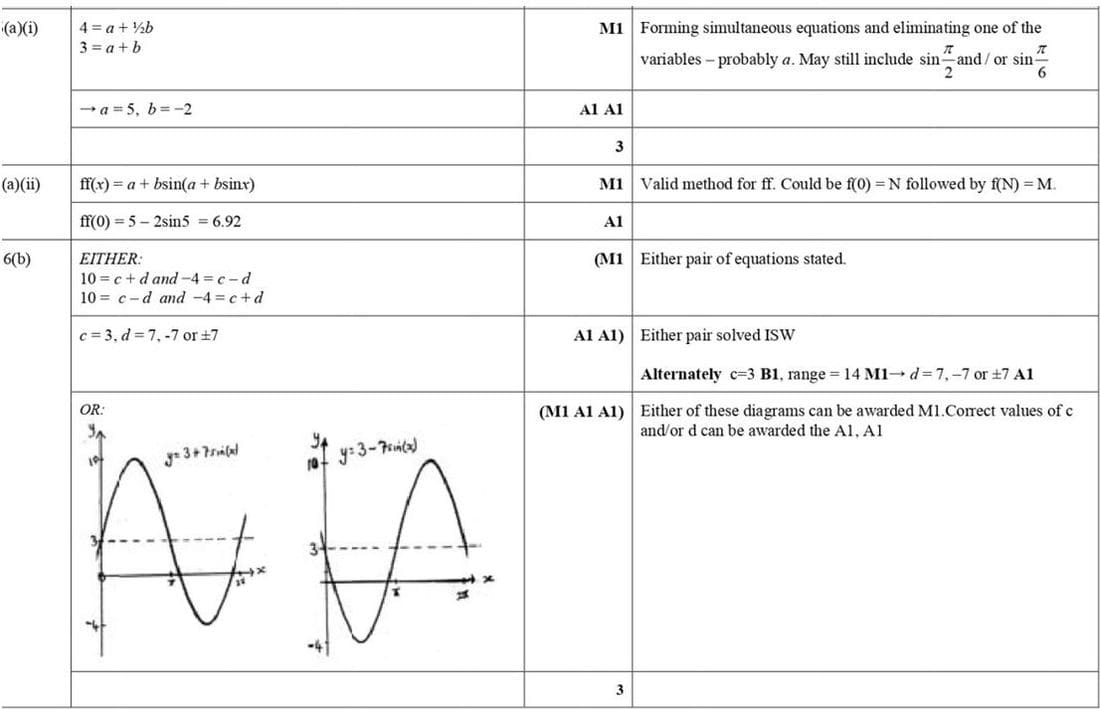
(a) The function f, defined by \(f : x \mapsto a + b \sin x\) for \(x \in \mathbb{R}\), is such that \(f\left(\frac{1}{6}\pi\right) = 4\) and \(f\left(\frac{1}{2}\pi\right) = 3\).
- Find the values of the constants \(a\) and \(b\).
- Evaluate \(ff(0)\).
(b) The function g is defined by \(g : x \mapsto c + d \sin x\) for \(x \in \mathbb{R}\). The range of g is given by \(-4 \leq g(x) \leq 10\). Find the values of the constants \(c\) and \(d\).
9709 P11 - Jun 2017 - Q5
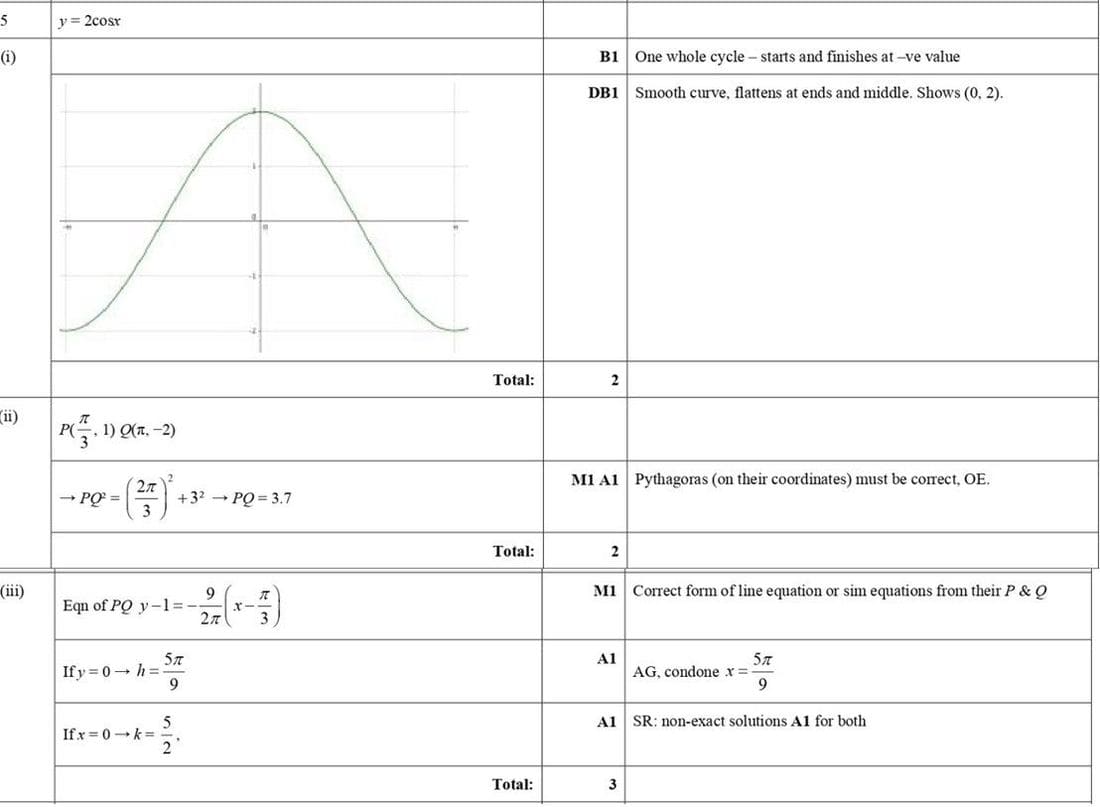
The equation of a curve is \(y = 2 \cos x\).
(i) Sketch the graph of \(y = 2 \cos x\) for \(-\pi \leq x \leq \pi\), stating the coordinates of the point of intersection with the \(y\)-axis.
Points \(P\) and \(Q\) lie on the curve and have \(x\)-coordinates of \(\frac{\pi}{3}\) and \(\pi\) respectively.
(ii) Find the length of \(PQ\) correct to 1 decimal place.
The line through \(P\) and \(Q\) meets the \(x\)-axis at \(H (h, 0)\) and the \(y\)-axis at \(K (0, k)\).
(iii) Show that \(h = \frac{5}{9} \pi\) and find the value of \(k\).
9709 P12 - Mar 2017 - Q5
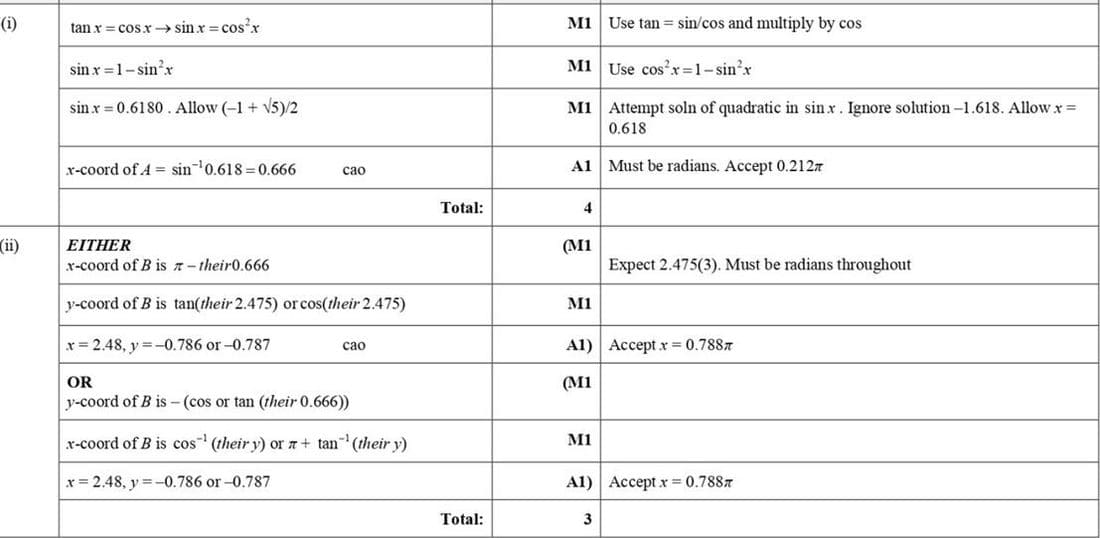
The diagram shows the graphs of \(y = \tan x\) and \(y = \cos x\) for \(0 \leq x \leq \pi\). The graphs intersect at points \(A\) and \(B\).
(i) Find by calculation the \(x\)-coordinate of \(A\).
(ii) Find by calculation the coordinates of \(B\).

9709 P12 - Mar 2016 - Q4
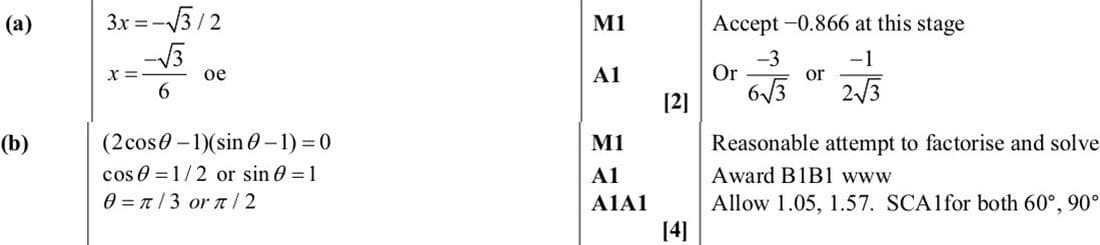
(a) Solve the equation \(\sin^{-1}(3x) = -\frac{1}{3}\pi\), giving the solution in an exact form.
(b) Solve, by factorising, the equation \(2 \cos \theta \sin \theta - 2 \cos \theta - \sin \theta + 1 = 0\) for \(0 \leq \theta \leq \pi\).
9709 P13 - Nov 2015 - Q7
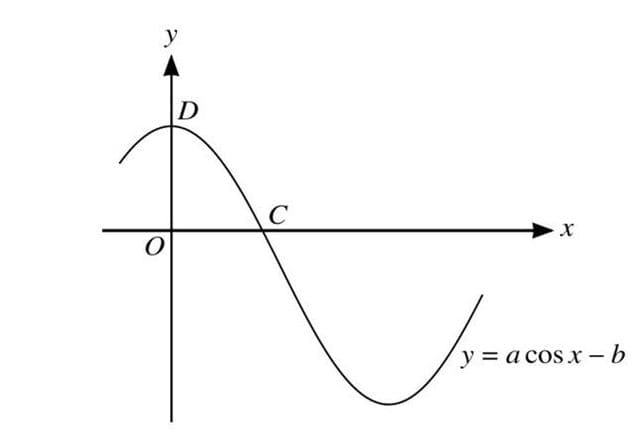
The diagram shows part of the graph of \(y = a \, \cos x - b\), where \(a\) and \(b\) are constants. The graph crosses the \(x\)-axis at the point \(C(\cos^{-1} c, 0)\) and the \(y\)-axis at the point \(D(0, d)\). Find \(c\) and \(d\) in terms of \(a\) and \(b\).

9709 P11 - Nov 2015 - Q3
Solve the equation \(\sin^{-1}(4x^4 + x^2) = \frac{1}{6}\pi\).

9709 P13 - Nov 2022 - Q6
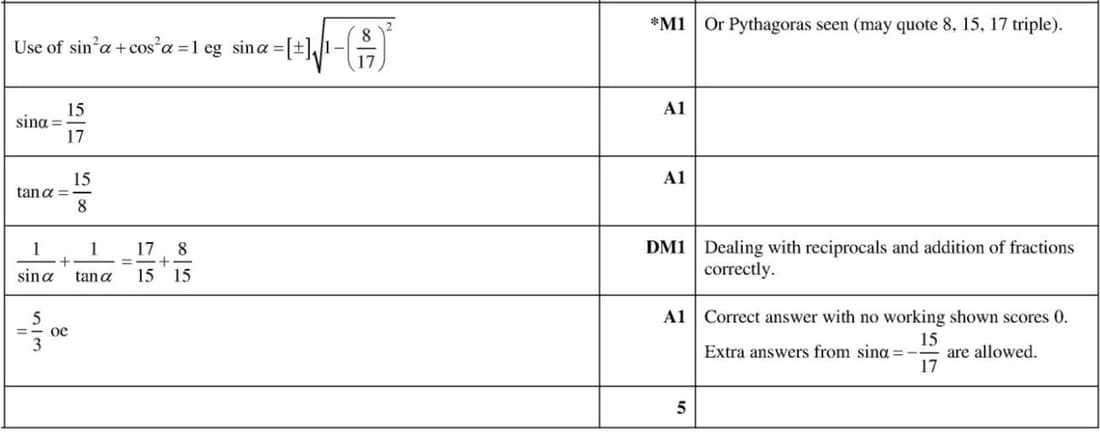
It is given that \(\alpha = \cos^{-1}\left(\frac{8}{17}\right)\).
Find, without using the trigonometric functions on your calculator, the exact value of \(\frac{1}{\sin \alpha} + \frac{1}{\tan \alpha}\).
9709 P12 - Jun 2015 - Q6
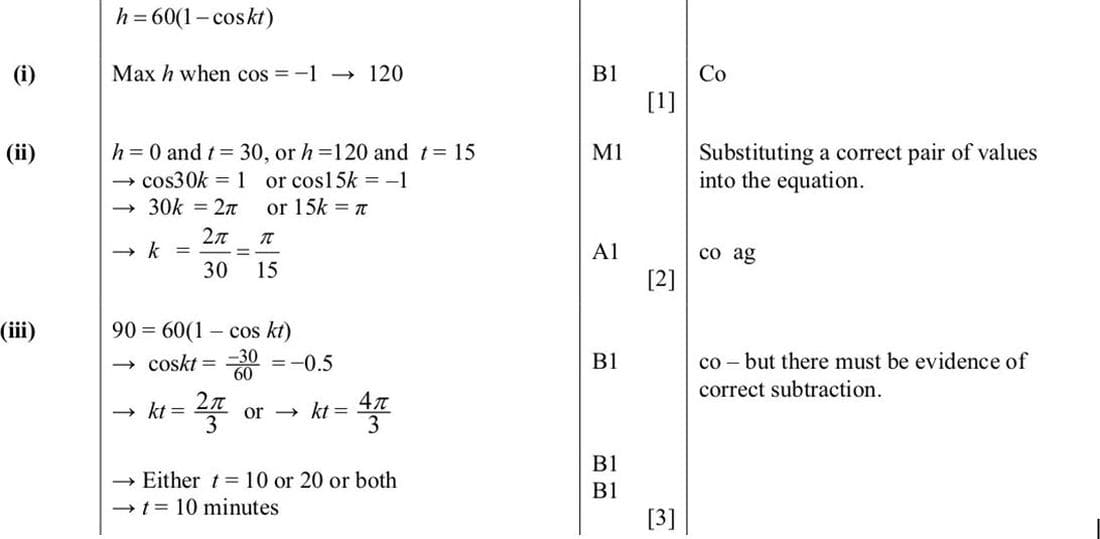
A tourist attraction in a city centre is a big vertical wheel on which passengers can ride. The wheel turns in such a way that the height, \(h\), in meters, of a passenger above the ground is given by the formula \(h = 60(1 - \cos kt)\). In this formula, \(k\) is a constant, \(t\) is the time in minutes that has elapsed since the passenger started the ride at ground level and \(kt\) is measured in radians.
(i) Find the greatest height of the passenger above the ground.
One complete revolution of the wheel takes 30 minutes.
(ii) Show that \(k = \frac{1}{15}\pi\).
(iii) Find the time for which the passenger is above a height of 90 m.
9709 P11 - Jun 2015 - Q1
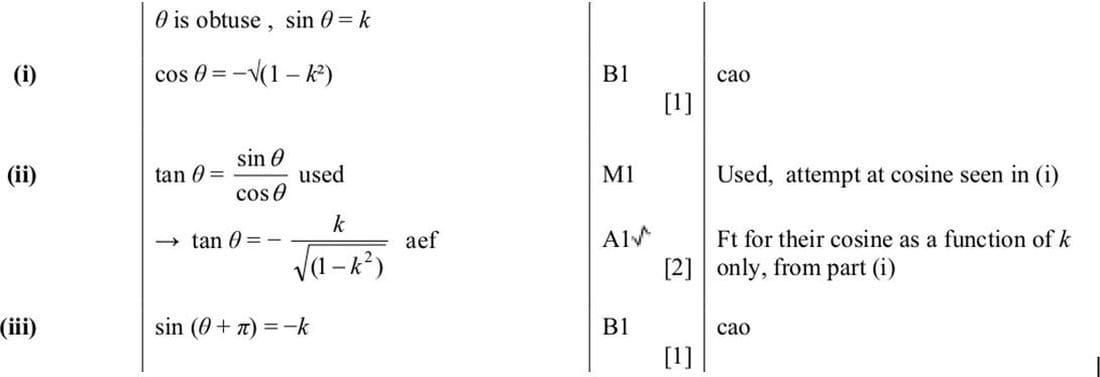
Given that \(\theta\) is an obtuse angle measured in radians and that \(\sin \theta = k\), find, in terms of \(k\), an expression for
- \(\cos \theta\),
- \(\tan \theta\),
- \(\sin(\theta + \pi)\).
9709 P11 - Nov 2014 - Q2
Find the value of x satisfying the equation \(\sin^{-1}(x - 1) = \arctan(3)\).

9709 P12 - Jun 2014 - Q3
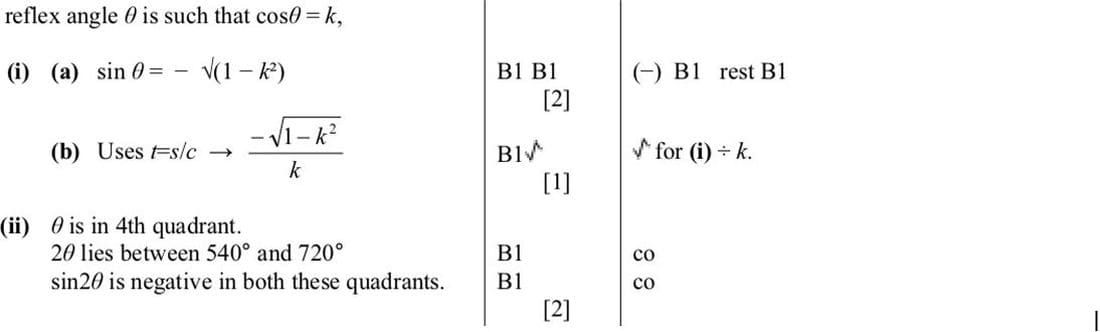
The reflex angle \(\theta\) is such that \(\cos \theta = k\), where \(0 < k < 1\).
(i) Find an expression, in terms of \(k\), for
(a) \(\sin \theta\),
(b) \(\tan \theta\).
(ii) Explain why \(\sin 2\theta\) is negative for \(0 < k < 1\).
9709 P13 - Nov 2013 - Q7
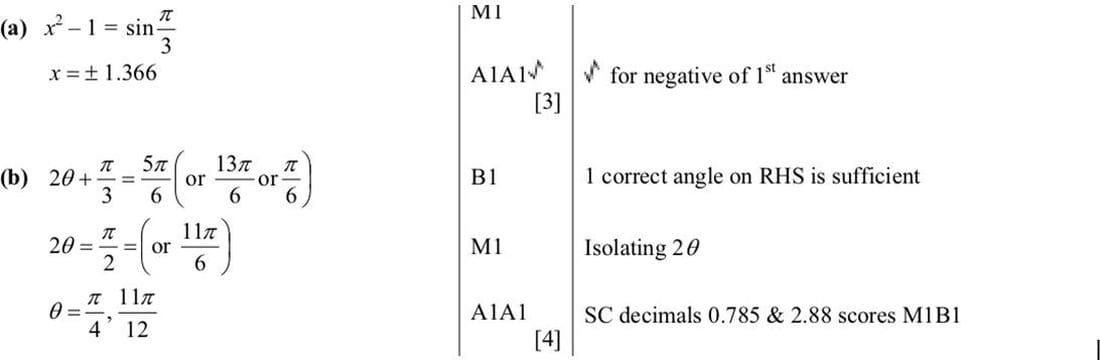
(a) Find the possible values of x for which \(\sin^{-1}(x^2 - 1) = \frac{1}{3}\pi\), giving your answers correct to 3 decimal places.
(b) Solve the equation \(\sin(2\theta + \frac{1}{3}\pi) = \frac{1}{2}\) for \(0 \leq \theta \leq \pi\), giving \(\theta\) in terms of \(\pi\) in your answers.
9709 P12 - Nov 2013 - Q1
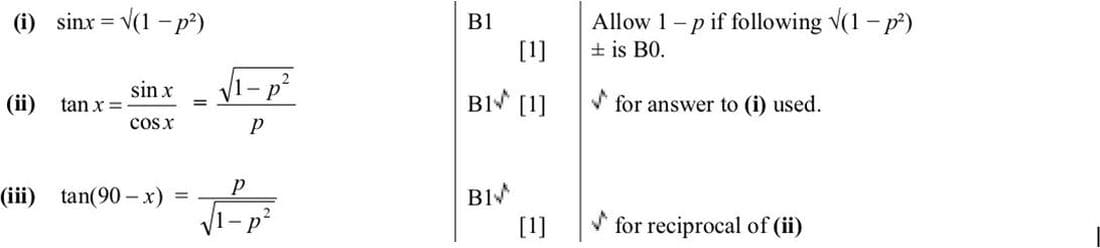
Given that \(\cos x = p\), where \(x\) is an acute angle in degrees, find, in terms of \(p\),
- \(\sin x\),
- \(\tan x\),
- \(\tan(90^\circ - x)\).
9709 P12 - Jun 2013 - Q5
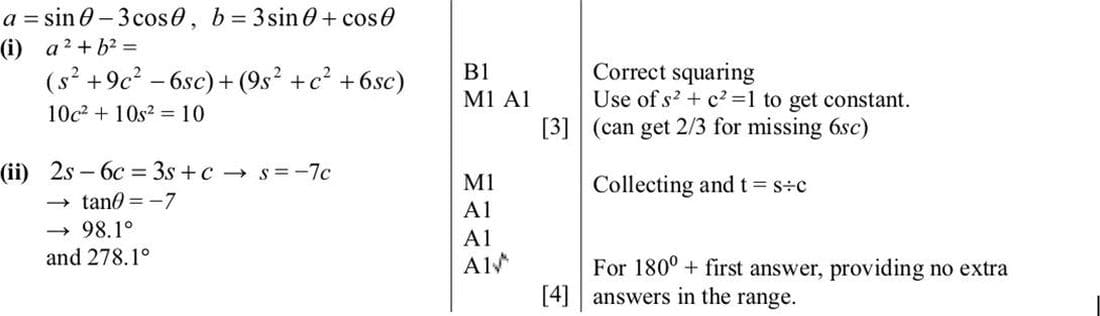
It is given that \(a = \\sin \theta - 3 \\cos \theta\) and \(b = 3 \\sin \theta + \\cos \theta\), where \(0^\circ \leq \theta \leq 360^\circ\).
(i) Show that \(a^2 + b^2\) has a constant value for all values of \(\theta\).
(ii) Find the values of \(\theta\) for which \(2a = b\).
9709 P13 - Nov 2012 - Q6
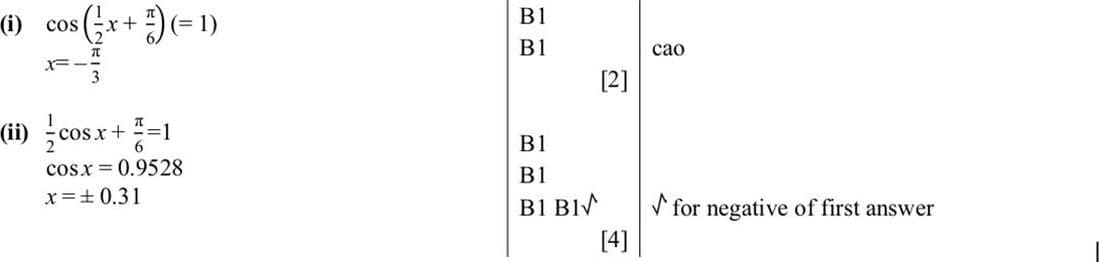
The functions f and g are defined for \(-\frac{1}{2}\pi \leq x \leq \frac{1}{2}\pi\) by
\(f(x) = \frac{1}{2}x + \frac{1}{6}\pi\),
\(g(x) = \cos x\).
Solve the following equations for \(-\frac{1}{2}\pi \leq x \leq \frac{1}{2}\pi\).
- \(gf(x) = 1\), giving your answer in terms of \(\pi\).
- \(fg(x) = 1\), giving your answers correct to 2 decimal places.
9709 P13 - Jun 2012 - Q1
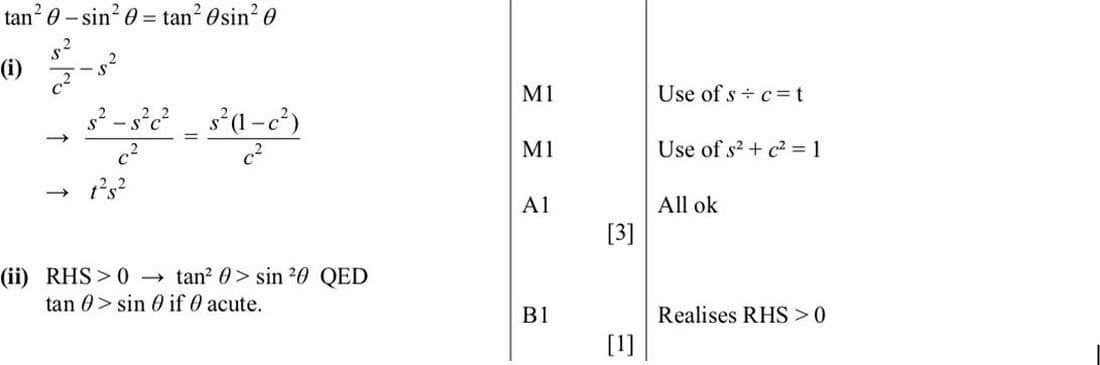
(i) Prove the identity \(\tan^2 \theta - \sin^2 \theta \equiv \tan^2 \theta \sin^2 \theta\).
(ii) Use this result to explain why \(\tan \theta > \sin \theta\) for \(0^\circ < \theta < 90^\circ\).
9709 P13 - Jun 2010 - Q3
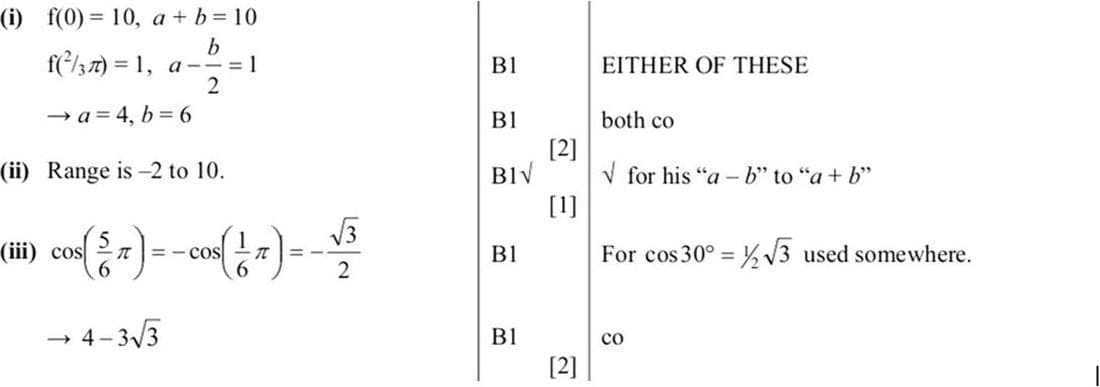
The function \(f : x \mapsto a + b \cos x\) is defined for \(0 \leq x \leq 2\pi\). Given that \(f(0) = 10\) and that \(f\left( \frac{2}{3}\pi \right) = 1\), find
- the values of \(a\) and \(b\),
- the range of \(f\),
- the exact value of \(f\left( \frac{5}{6}\pi \right)\).
9709 P12 - Jun 2020 - Q2
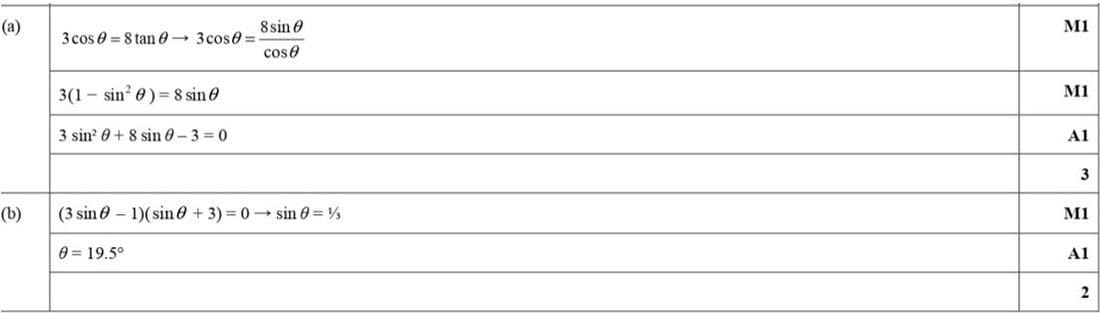
(a) Express the equation \(3 \cos \theta = 8 \tan \theta\) as a quadratic equation in \(\sin \theta\).
(b) Hence find the acute angle, in degrees, for which \(3 \cos \theta = 8 \tan \theta\).
9709 P11 - Jun 2010 - Q5
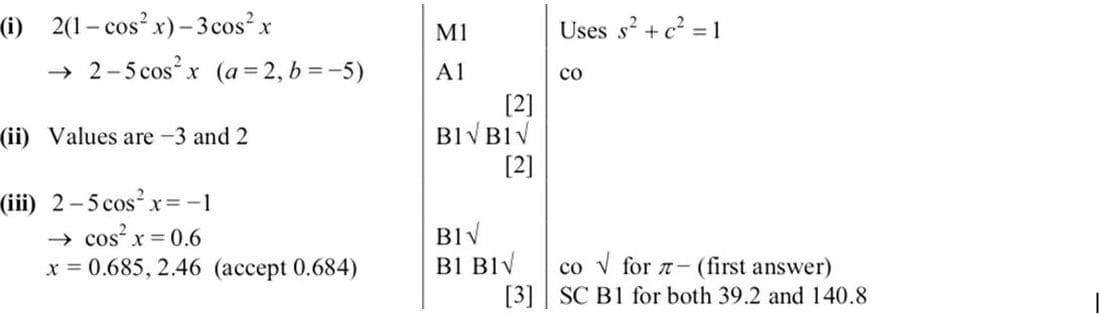
The function \(f\) is such that \(f(x) = 2 \sin^2 x - 3 \cos^2 x\) for \(0 \leq x \leq \pi\).
(i) Express \(f(x)\) in the form \(a + b \cos^2 x\), stating the values of \(a\) and \(b\).
(ii) State the greatest and least values of \(f(x)\).
(iii) Solve the equation \(f(x) + 1 = 0\).
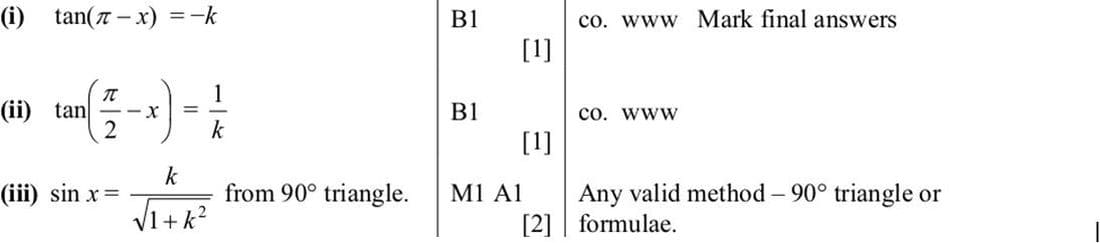
9709 P11 - Jun 2010 - Q1
The acute angle x radians is such that \(\tan x = k\), where \(k\) is a positive constant. Express, in terms of \(k\),
- \(\tan(\pi - x)\),
- \(\tan\left(\frac{1}{2}\pi - x\right)\),
- \(\sin x\).
9709 P1 - Nov 2006 - Q2
Given that \(x = \sin^{-1}\left(\frac{2}{5}\right)\), find the exact value of
(i) \(\cos^2 x\),
(ii) \(\tan^2 x\).

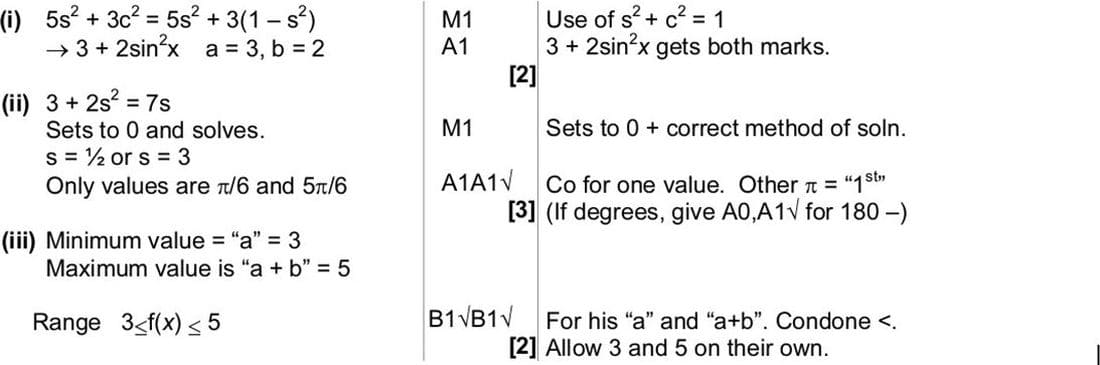
9709 P1 - Nov 2004 - Q6
The function \(f : x \mapsto 5 \sin^2 x + 3 \cos^2 x\) is defined for the domain \(0 \leq x \leq \pi\).
- Express \(f(x)\) in the form \(a + b \sin^2 x\), stating the values of \(a\) and \(b\).
- Hence find the values of \(x\) for which \(f(x) = 7 \sin x\).
- State the range of \(f\).
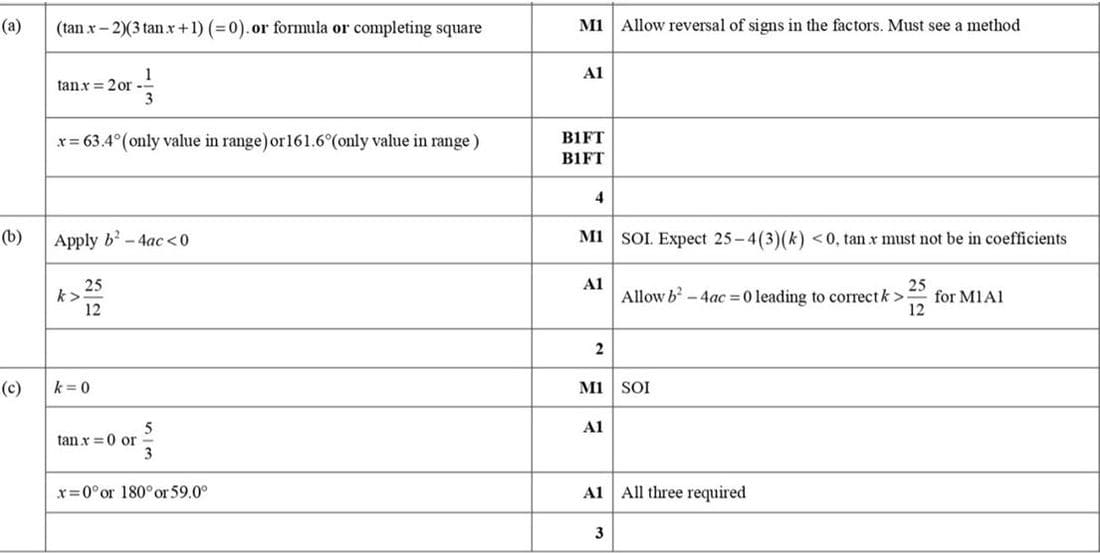
9709 P12 - Mar 2020 - Q11
(a) Solve the equation \(3 \tan^2 x - 5 \tan x - 2 = 0\) for \(0^\circ \leq x \leq 180^\circ\).
(b) Find the set of values of \(k\) for which the equation \(3 \tan^2 x - 5 \tan x + k = 0\) has no solutions.
(c) For the equation \(3 \tan^2 x - 5 \tan x + k = 0\), state the value of \(k\) for which there are three solutions in the interval \(0^\circ \leq x \leq 180^\circ\), and find these solutions.
9709 P12 - Nov 2019 - Q6
The function \(f : x \mapsto 3 \cos^2 x - 2 \sin^2 x\) is defined for \(0 \leq x \leq \pi\).
(i) Express \(f(x)\) in the form \(a \cos^2 x + b\), where \(a\) and \(b\) are constants.
(ii) Find the range of \(f\).

9709 P13 - Jun 2019 - Q9
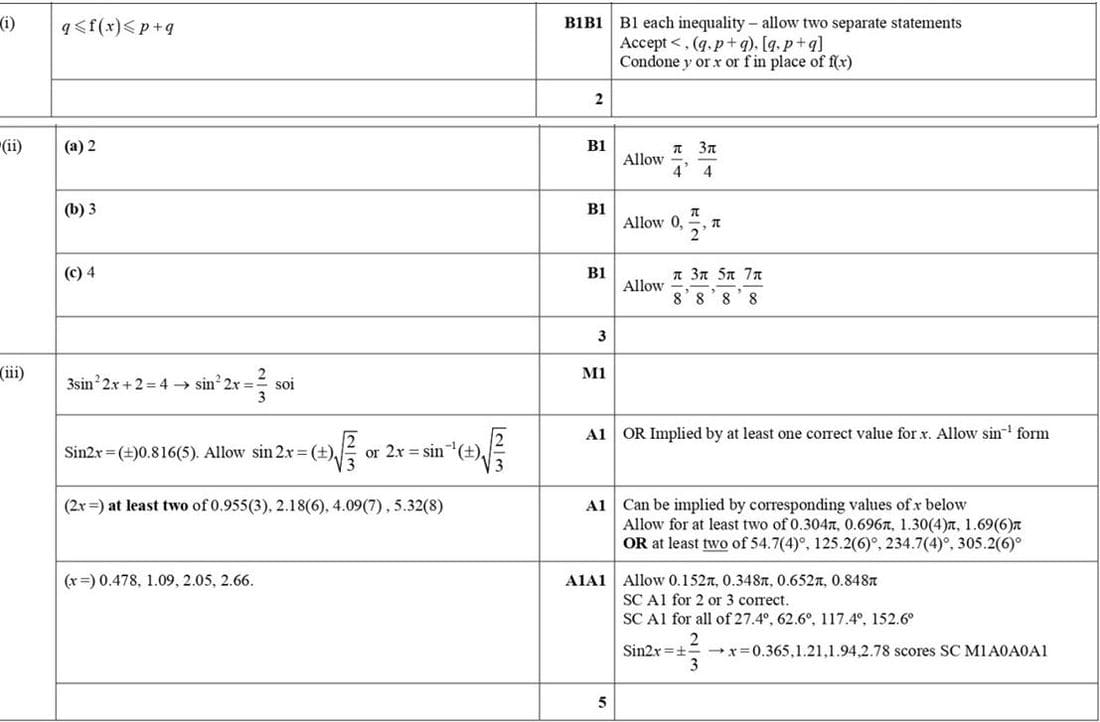
The function \(f : x \mapsto p \sin^2 2x + q\) is defined for \(0 \leq x \leq \pi\), where \(p\) and \(q\) are positive constants. The diagram shows the graph of \(y = f(x)\).
(i) In terms of \(p\) and \(q\), state the range of \(f\).
(ii) State the number of solutions of the following equations.
(a) \(f(x) = p + q\)
(b) \(f(x) = q\)
(c) \(f(x) = \frac{1}{2}p + q\)
(iii) For the case where \(p = 3\) and \(q = 2\), solve the equation \(f(x) = 4\), showing all necessary working.

9709 P12 - Jun 2019 - Q6
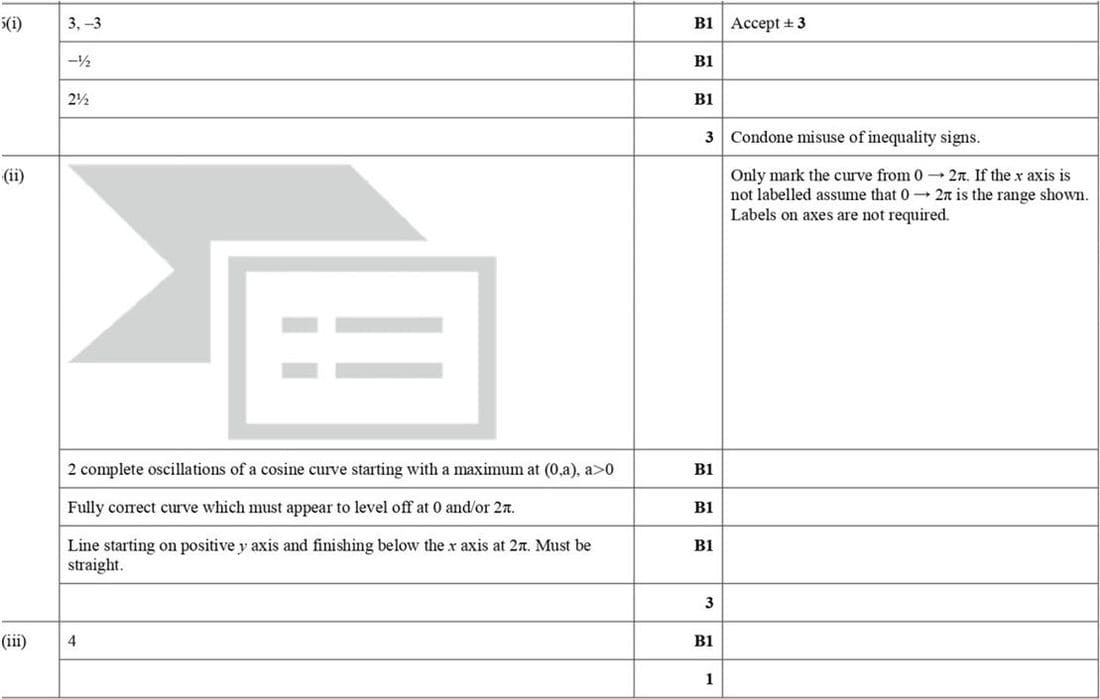
The equation of a curve is \(y = 3 \cos 2x\) and the equation of a line is \(2y + \frac{3x}{\pi} = 5\).
(i) State the smallest and largest values of \(y\) for both the curve and the line for \(0 \leq x \leq 2\pi\).
(ii) Sketch, on the same diagram, the graphs of \(y = 3 \cos 2x\) and \(2y + \frac{3x}{\pi} = 5\) for \(0 \leq x \leq 2\pi\).
(iii) State the number of solutions of the equation \(6 \cos 2x = 5 - \frac{3x}{\pi}\) for \(0 \leq x \leq 2\pi\).
9709 P12 - Jun 2019 - Q4
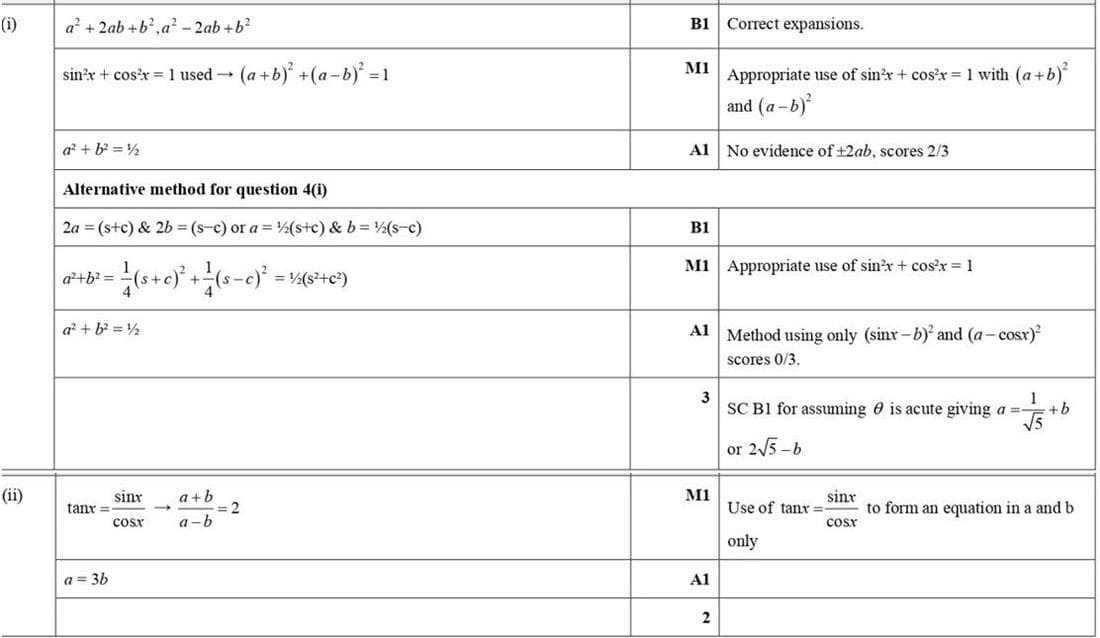
Angle x is such that \(\sin x = a + b\) and \(\cos x = a - b\), where a and b are constants.
(i) Show that \(a^2 + b^2\) has a constant value for all values of x.
(ii) In the case where \(\tan x = 2\), express a in terms of b.
Problem #598
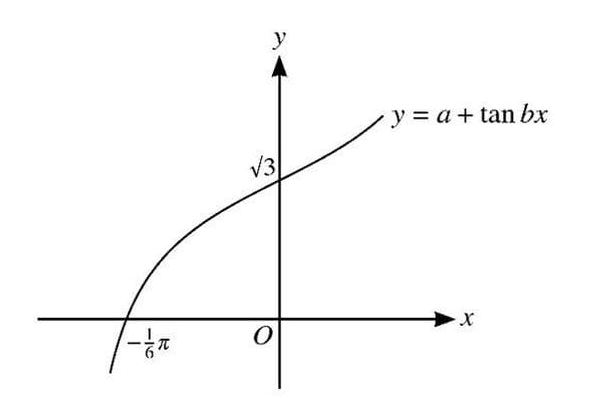
The diagram shows part of the graph of \(y = a + \tan bx\), where \(x\) is measured in radians and \(a\) and \(b\) are constants. The curve intersects the \(x\)-axis at \(\left(-\frac{1}{6}\pi, 0\right)\) and the \(y\)-axis at \((0, \sqrt{3})\). Find the values of \(a\) and \(b\).