9709 P62 - Mar 2026 - Q6 - 9 marks
The widths, \(X\text{ cm}\), of the stones found on a certain beach are modelled by the probability density function \[f(x)=\begin{cases}k(ax-x^2),&0<x<a,\\0,&\text{otherwise},\end{cases}\] where \(k\) and \(a\) are constants.
(a) Show that \(k=6/a^3\). [3]
(b) Without calculation, give an expression for \(\mathrm E(X)\) in terms of \(a\). [1]
(c)(i) Find \(P(X<a/4)\), showing that this probability is independent of \(a\). [3]
(c)(ii) Use your answer to 6(c)(i) to find \(P(a/4<X<3a/4)\). [2]


9709 P63 - Jun 2026 - Q3 - 6 marks

A random variable \(X\) takes values between 0 and 6 only and has probability density function \(f(x)\) as shown in the diagram, where \(a\) is a constant.
Given that \(\mathrm E(X)=2\), find \(\operatorname{Var}(X)\). [6]

9709 P61 - Jun 2026 - Q6 - 8 marks
A random variable \(X\) has probability density function given by \[f(x)=\begin{cases}\dfrac87\lambda e^{-\lambda x},&0<x<\ln2,\\0,&\text{otherwise},\end{cases}\] where \(\lambda\) is a constant.
(a) Show that \(\lambda=3\). [4]
(b) Use integration by parts to find \(\mathrm E(X)\). [4]


9709 P62 - Jun 2026 - Q7 - 10 marks
A random variable \(X\) has the probability density function \[f(x)=\begin{cases}a-x,&0\le x\le a,\\0,&\text{otherwise},\end{cases}\] where \(a\) is a constant.
(a) Show that \(\mathrm E(X)=k\sqrt2\), where \(k\) is a constant to be found. [6]
(b) Find the exact value of the median of \(X\). [4]


9709 P65 - Jun 2026 - Q4 - 9 marks

The diagram shows the graph of the probability density function, \(f(x)\), of a random variable \(X\). For \(0\le x\le a\), the graph is a straight line from \(O\) to the point \((a,b)\), where \(a\) and \(b\) are constants. Elsewhere \(f(x)=0\).
(a) Show that the median of \(X\) is \(a/\sqrt2\). [5]
(b) Given that \(\mathrm E(X)=4\), find \(a\). [4]


9709 P61 - Nov 2025 - Q7 - 7 marks
The time, in minutes, taken by students to complete a test is modelled by the random variable \(X\) with probability density function \[f(x)=\begin{cases}-\dfrac34(x-3)(x-5),&3\le x\le5,\\0,&\text{otherwise}.\end{cases}\]
(a) Find the probability that a randomly chosen student takes longer than 4.5 minutes to complete the test. [4]
(b) Write down the median of \(X\). [1]
(c) Without performing an integration, use your answer to part (a) to find \(\mathrm P(3.5<X<4.5)\). [2]

9709 P62 - Nov 2025 - Q5 - 9 marks
A random variable \(X\) has probability density function given by \[f(x)=\begin{cases}k(2x^2-x^3),&0\le x\le2,\\0,&\text{otherwise}.\end{cases}\]
(a) Show that \(k=\dfrac34\). [3]
The median of \(X\) is denoted by \(m\).
(b(i)) Write down the value of \(\mathrm P(X\le m)\). [1]
(b(ii)) Hence find \(\mathrm P(\mathrm E(X)\le X\le m)\). [5]


9709 P65 - Nov 2025 - Q6 - 11 marks
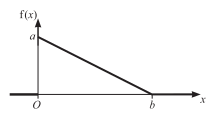
The diagram shows the graph of the probability density function, \(f\), of a random variable \(X\). The graph is a straight line from \((0,a)\) to \((b,0)\) where \(a\) and \(b\) are constants. Elsewhere \(f(x)=0\).
(a) Find an expression for \(b\) in terms of \(a\). [2]
(b) Given that \(\mathrm E(X)=\dfrac49\), find the value of \(a\). [5]
(c) Using the value of \(a\) found in part (b), find the value of \(k\) such that \(\mathrm P(X<k)=\dfrac34\). [4]


9709 P61 - Jun 2025 - Q7 - 8 marks
\(X\) is a random variable with probability density function given by \[f(x)=\begin{cases}1+\cos(\pi x),&0\le x\le1,\\0,&\text{otherwise}.\end{cases}\]
(a) Show that \(\mathrm P(X<\tfrac12)=\dfrac12+\dfrac1\pi\). [3]
(b) Show that \(\mathrm E(X)=\dfrac12-\dfrac2{\pi^2}\). [5]


9709 P62 - Jun 2025 - Q7 - 9 marks
The random variable \(X\) has probability density function given by \[f(x)=\begin{cases}\dfrac{kx^2}{a^2},&0\le x\le a,\\0,&\text{otherwise},\end{cases}\] where \(k\) and \(a\) are positive constants.
(a) Show that \(k=\dfrac3a\). [3]
It is given that \(\mathrm E(X)=1\).
(b) Find the value of \(a\). [3]
(c) Find the median of \(X\). [3]

9709 P63 - Jun 2025 - Q6 - 9 marks
A random variable \(X\) has probability density function given by \[f(x)=\begin{cases}ax,&0\le x\le b,\\0,&\text{otherwise},\end{cases}\] where \(a\) and \(b\) are constants.
(a) Show that \(a=\dfrac2{b^2}\). [3]
(b) Show that \(\mathrm P(X<\mathrm E(X))=\dfrac49\). [6]


9709 P65 - Jun 2025 - Q8 - 6 marks

The diagram shows the graph of the probability density function \(f\) of a random variable \(X\). Between \(x=0\) and \(x=a\) the graph consists of a straight line through \(O\) with gradient \(k\), where \(k\) and \(a\) are positive constants. Elsewhere \(f(x)=0\).
It is given that the median of \(X\) is \(\sqrt2\).
(a) Find the value of \(k\). [2]
(b) Find the value of \(\mathrm E(X)\). [4]


9709 P62 - Mar 2025 - Q4 - 11 marks
(a)
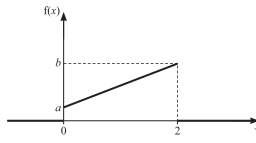
The diagram shows the graph of the probability density function, \(f\), of a random variable \(X\). The graph is a straight line from \((0,a)\) to \((2,b)\), where \(a\) and \(b\) are positive constants. Elsewhere, \(f(x)=0\).
(a(i)) Show that \(b=1-a\). [2]
(a(ii)) Given that \(\mathrm E(X)=1.2\), find the value of \(a\). [5]
(b) A random variable \(T\) has probability density function given by \[g(t)=\begin{cases}\dfrac12\cos t,&-\dfrac\pi2\le t\le\dfrac\pi2,\\0,&\text{otherwise}.\end{cases}\]
(b) Find the value of \(c\) such that \(\mathrm P(-c<T<c)=\dfrac12\). [4]


9709 P61 - Nov 2024 - Q4 - 6 marks
A random variable \(X\) has density \[f(x)=\begin{cases}\dfrac a{x^2}-\dfrac{18}{x^3},&2\le x\le3,\\0,&\text{otherwise},\end{cases}\] where \(a\) is a constant.
(a) Show that \(a=27/2\). [3]
(b) Show that \(E(X)=\dfrac{27}{2}\ln\dfrac32-3\). [3]


9709 P62 - Nov 2024 - Q6 - 11 marks
The time \(X\) hours to complete a challenge is modelled by \[f(x)=\begin{cases}1/x^2,&a\le x\le b,\\0,&\text{otherwise},\end{cases}\] where \(a,b\) are constants.
(a) State what a and b represent in this context. [1]
(b) Show that \(a=b/(b+1)\). [3]
It is given that \(E(X)=\ln3\).
(c) Show that \(b=2\) and find \(a\). [4]
(d) Find the median of X. [3]


9709 P61 - Jun 2024 - Q6 - 8 marks
The diagram shows the density \(f\) of a random variable \(X\). The graph is a quarter circle in the first quadrant, with centre \((0,0)\) and radius \(a>0\). Elsewhere \(f(x)=0\).
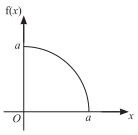
(a) Show that \(a=2/\sqrt\pi\). [2]
(b) Show that \(f(x)=\sqrt{4/\pi-x^2}\) on its non-zero domain. [2]
(c) Show that \(E(X)=8/(3\sqrt{\pi^3})\). [4]

9709 P62 - Jun 2024 - Q7 - 10 marks
\(X\) has density \[f(x)=\begin{cases}k(1+\cos x),&0\le x\le\pi,\\0,&\text{otherwise},\end{cases}\] with constant \(k\).
(a) Show that \(k=1/\pi\). [3]
(b) Verify that the median lies between 0.83 and 0.84. [3]
(c) Find the exact value of \(E(X)\). [4]


9709 P63 - Jun 2024 - Q5 - 10 marks
\(X\) has density \[f(x)=\begin{cases}ax-x^3,&0\le x\le\sqrt2,\\0,&\text{otherwise},\end{cases}\] with constant \(a\).
(a) Show that \(a=2\). [3]
(b) Find the median of X. [4]
(c) Find the exact value of \(E(X)\). [3]


9709 P62 - Mar 2024 - Q6 - 10 marks
The density of \(X\) is symmetric about \(x=2\), and \(P(2<X<5)=117/256\).
(a) Using only this information, show that \(P(X>-1)=245/256\). [2]
It is now given that \(f(x)=k(12+4x-x^2)\) on a suitable domain, with constant \(k\).
(b) Find \(k\). [3]
(c) A different random variable \(X\) has density \(g(x)=\frac29(2+x-x^2)\), on all \(x\) for which \(g(x)\ge0\). Find \(\operatorname{Var}(X)\). [5]


9709 P61 - Nov 2023 - Q6 - 8 marks
A continuous random variable \(X\) takes values from 0 to 6 only and has a probability distribution that is symmetrical. Two values, \(a\) and \(b\), of \(X\) are such that \(P(a<X<b)=p\) and \(P(b<X<3)=\frac{13}{10}p\), where \(p\) is a positive constant.
(a) Show that \(p\le\frac5{23}\). [1]
(b) Find \(P(b<X<6-a)\) in terms of \(p\). [2]
It is now given that the probability density function of \(X\) is \(f\), where \[f(x)=\begin{cases}\frac1{36}(6x-x^2),&0\le x\le6,\\0,&\text{otherwise}.\end{cases}\]
(c) Given that \(b=2\) and \(p=\frac5{27}\), find the value of \(a\). [5]


9709 P62 - Nov 2023 - Q5 - 9 marks
The random variable \(X\) has probability density function \(f\), given by \[f(x)=\begin{cases}1/x^2,&a<x<b,\\0,&\text{otherwise},\end{cases}\] where \(a\) and \(b\) are positive constants.
(a) It is given that \(E(X)=\ln2\). Show that \(b=2a\). [3]
(b) Show that \(a=\frac12\). [3]
(c) Find the median of \(X\). [3]


9709 P61 - Jun 2023 - Q2 - 8 marks
(a) The graph of the function f is a straight line segment from (0, 0) to (2, 1).

Show that \(f\) could be a probability density function. [2]
(b) The graph of the function g is a semicircle, centre (0, 0), entirely above the x-axis.

Given that \(g\) is a probability density function, find the radius of the semicircle. [2]
(c) The time, \(X\) minutes, taken by a large number of students to complete a test has probability density function \(h\), as shown in the diagram.

(c(i)) Without calculation, use the diagram to explain how you can tell that the median time is less than 15 minutes. [1]
It is now given that \[h(x)=\begin{cases}40/x^2-1/10,&10\le x\le20,\\0,&\text{otherwise}.\end{cases}\]
(c(ii)) Find the mean time. [3]

9709 P62 - Jun 2023 - Q7 - 8 marks
(a) The diagram shows the graph of the probability density function \(f\) of a random variable \(X\) which takes values between 0 and 4 only. Between these two values the graph is a straight line.

(a(i)) Show that \(f(x)=kx\) for \(0\le x\le4\), where \(k\) is a constant to be determined. [2]
(a(ii)) Hence, or otherwise, find \(E(X)\). [3]
(b) The diagram shows the graph of the probability density function \(g\) of a random variable \(W\) which takes values between 0 and \(a\) only, where \(a>0\). Between these two values the graph is a straight line.

Given that the median of \(W\) is 1, find the value of \(a\). [3]


9709 P63 - Jun 2023 - Q1 - 3 marks
A random variable \(X\) has probability density function \(f\), where \[f(x)=\begin{cases}\frac32(1-x^2),&0\le x\le1,\\0,&\text{otherwise}.\end{cases}\]
Find \(E(X)\). [3]

9709 P63 - Jun 2023 - Q7 - 8 marks
A random variable \(X\) has probability density function \(f\), where the graph of \(y=f(x)\) is a semicircle with centre \((0,0)\) and radius \(\sqrt{2/\pi}\), entirely above the \(x\)-axis. Elsewhere \(f(x)=0\) (see diagram).

(a) Verify that \(f\) can be a probability density function. [2]
\(A\) and \(B\) are the points where the line \(x=\sqrt{1/\pi}\) meets the \(x\)-axis and the semicircle respectively.
(b) Show that angle \(AOB\) is \(\frac14\pi\) radians and hence find \(P(X>\sqrt{1/\pi})\). [6]

9709 P62 - Mar 2023 - Q3 - 8 marks
The diagram shows the graph of the probability density function \(f\) of a random variable \(X\) that takes values between \(x=0\) and \(x=3\) only. The graph is symmetrical about the line \(x=1.5\).

(a) It is given that \(P(X<0.6)=a\) and \(P(0.6<X<1.2)=b\). Find \(P(0.6<X<1.8)\) in terms of \(a\) and \(b\). [2]
(b) It is now given that the equation of the probability density function of \(X\) is \[f(x)=\begin{cases}kx^2(3-x)^2,&0\le x\le3,\\0,&\text{otherwise},\end{cases}\] where \(k\) is a constant.
(b(i)) Show that \(k=\frac{10}{81}\). [3]
(b(ii)) Find \(\operatorname{Var}(X)\). [3]

9709 P61 - Nov 2022 - Q6 - 7 marks

The diagram shows the graph of the probability density function of a random variable \(X\) that takes values between \(-1\) and 3 only. It is given that the graph is symmetrical about the line \(x=1\). Between \(x=-1\) and \(x=3\) the graph is a quadratic curve.
The random variable \(S\) is such that \(E(S)=2E(X)\) and \(\operatorname{Var}(S)=\operatorname{Var}(X)\).
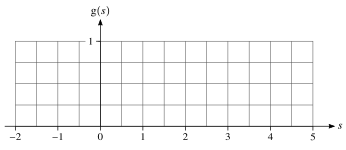
(a) On the grid below, sketch a quadratic graph for the probability density function of \(S\). [1]
The random variable \(T\) is such that \(E(T)=E(X)\) and \(\operatorname{Var}(T)=\frac14\operatorname{Var}(X)\).
(b) On the grid below, sketch a quadratic graph for the probability density function of \(T\). [2]

It is now given that \[f(x)=\begin{cases}\frac3{32}(3+2x-x^2),&-1\le x\le3,\\0,&\text{otherwise}.\end{cases}\]
(c) Given that \(P(1-a<X<1+a)=0.5\), show that \(a^3-12a+8=0\). [3]
(d) Hence verify that \(0.69<a<0.70\). [1]


9709 P62 - Nov 2022 - Q7 - 8 marks

The diagram shows the graph of the probability density function, \(f\), of a random variable \(X\) which takes values between \(-3\) and 2 only.
(a) Given that the graph is symmetrical about the line \(x=-0.5\) and that \(P(X<0)=p\), find \(P(-1<X<0)\) in terms of \(p\). [2]
(b) It is now given that the probability density function shown in the diagram is given by \[f(x)=\begin{cases}a-b(x^2+x),&-3\le x\le2,\\0,&\text{otherwise},\end{cases}\] where \(a\) and \(b\) are positive constants.
(b(i)) Show that \(30a-55b=6\). [3]
(b(ii)) By substituting a suitable value of \(x\) into \(f(x)\), find another equation relating \(a\) and \(b\) and hence determine the values of \(a\) and \(b\). [3]


9709 P61 - Jun 2022 - Q6 - 9 marks
A random variable \(X\) has probability density function \(f\). The graph of \(f(x)\) is a straight line segment parallel to the \(x\)-axis from \(x=0\) to \(x=a\), where \(a\) is a positive constant.
(a) State, in terms of \(a\), the median of \(X\). [1]
(b) Find \(P(X>\frac34a)\). [1]
(c) Show that \(\operatorname{Var}(X)=\frac1{12}a^2\). [5]
(d) Given that \(P(X<b)=p\), where \(0<b<\frac12a\), find \(P(\frac13b<X<a-\frac13b)\) in terms of \(p\). [2]


9709 P62 - Jun 2022 - Q5 - 9 marks
A random variable \(X\) has probability density function given by \[f(x)=\begin{cases}\frac3{16}(4x-x^2),&2\le x\le4,\\0,&\text{otherwise}.\end{cases}\]
(a) Show that \(E(X)=\frac{11}{4}\). [3]
(b) Find \(\operatorname{Var}(X)\). [3]
(c) Given that the median of \(X\) is \(m\), find \(P(m<X<3)\). [3]


9709 P63 - Jun 2022 - Q7 - 9 marks
The random variables \(X\) and \(W\) have probability density functions \(f\) and \(g\) defined as follows: \[f(x)=\begin{cases}p(a^2-x^2),&0\le x\le a,\\0,&\text{otherwise},\end{cases}\qquad g(w)=\begin{cases}q(a^2-w^2),&-a\le w\le a,\\0,&\text{otherwise},\end{cases}\] where \(a\), \(p\) and \(q\) are constants.
(a(i)) Write down the value of \(P(X\ge0)\). [1]
(a(ii)) Write down the value of \(P(W\ge0)\). [1]
(a(iii)) Write down an expression for \(q\) in terms of \(p\) only. [1]
(b) Given that \(E(X)=3\), find the value of \(a\). [6]

9709 P62 - Mar 2022 - Q6 - 11 marks
In a game a ball is rolled down a slope and along a track until it stops. The distance, in metres, travelled by the ball is modelled by the random variable \(X\) with probability density function \[f(x)=\begin{cases}-k(x-1)(x-3),&1\le x\le3,\\0,&\text{otherwise},\end{cases}\] where \(k\) is a constant.
(a) Without calculation, explain why \(E(X)=2\). [1]
(b) Show that \(k=\frac34\). [3]
(c) Find \(\operatorname{Var}(X)\). [3]
One turn consists of rolling the ball 3 times and noting the largest value of \(X\) obtained. If this largest value is greater than 2.5, the player scores a point.
(d) Find the probability that on a particular turn the player scores a point. [4]

9709 P61 - Nov 2021 - Q4 - 9 marks
A random variable \(X\) has probability density function given by \[f(x)=\begin{cases}\frac1{18}(9-x^2),&0\le x\le3,\\0,&\text{otherwise}.\end{cases}\]
(a) Find \(P(X<1.2)\). [3]
(b) Find \(E(X)\). [3]
The median of \(X\) is \(m\).
(c) Show that \(m^3-27m+27=0\). [3]


9709 P62 - Nov 2021 - Q7 - 9 marks
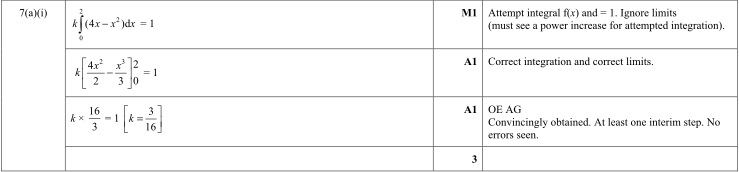
(a) The random variable \(X\) has probability density function \[f(x)=\begin{cases}kx(4-x),&0\le x\le2,\\0,&\text{otherwise},\end{cases}\] where \(k\) is a constant.
(a(i)) Show that \(k=\frac3{16}\). [3]
(a(ii)) Find \(E(X)\). [3]
(b) The random variable \(Y\) takes values between 0 and 5 only. Its probability density function is symmetrical.
(b) Given that \(P(Y<a)=0.2\), find \(P(2.5<Y<5-a)\), illustrating your method with a sketch on the axes provided. [3]



9709 P61 - Jun 2021 - Q3 - 2 marks
The graph of the probability density function of a random variable \(X\) is symmetrical about the line \(x=4\).
Given that \(P(X<5)=\frac{20}{27}\), find \(P(3<X<5)\). [2]

9709 P61 - Jun 2021 - Q6 - 6 marks
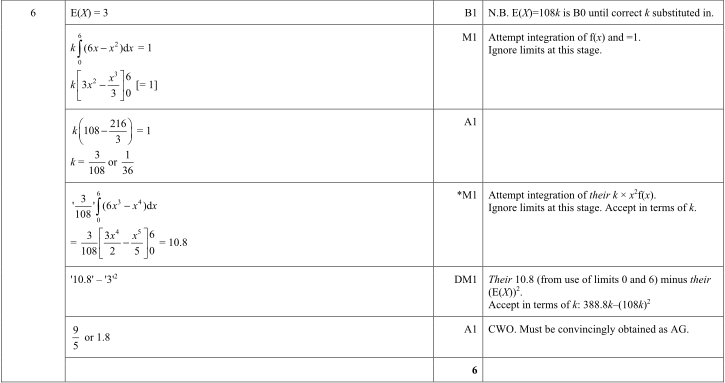
The probability density function, \(f\), of a random variable \(X\) is given by \[f(x)=\begin{cases}k(6x-x^2),&0\le x\le6,\\0,&\text{otherwise},\end{cases}\] where \(k\) is a constant.
State the value of \(E(X)\) and show that \(\operatorname{Var}(X)=\frac95\). [6]
9709 P62 - Jun 2021 - Q3 - 7 marks

The random variable \(X\) takes values in the range \(1\le x\le p\), where \(p\) is a constant. The graph of the probability density function of \(X\) is shown in the diagram.
(a) Show that \(p=2\). [2]
(b) Find \(E(X)\). [5]

9709 P63 - Jun 2021 - Q6 - 13 marks
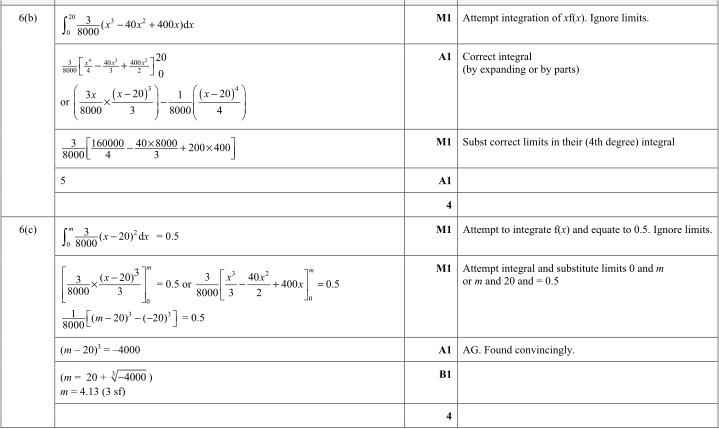
Alethia models the length of time, in minutes, by which her train is late on any day by the random variable \(X\) with probability density function given by \[f(x)=\begin{cases}\frac3{8000}(x-20)^2,&0\le x\le20,\\0,&\text{otherwise}.\end{cases}\]
(a) Find the probability that the train is more than 10 minutes late on each of two randomly chosen days. [4]
(b) Find \(E(X)\). [4]
(c) The median of \(X\) is denoted by \(m\).
(c) Show that \(m\) satisfies the equation \((m-20)^3=-4000\), and hence find \(m\) correct to 3 significant figures. [4]
(d) State one way in which Alethia’s model may be unrealistic. [1]


9709 P62 - Mar 2021 - Q2 - 9 marks

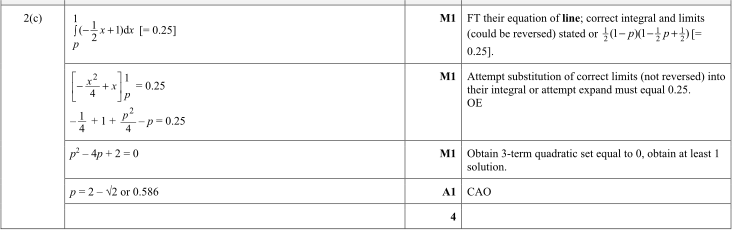
The diagram shows the graph of the probability density function, \(f\), of a random variable \(X\).
(a) Find the value of the constant \(k\). [2]
(b) Using this value of \(k\), find \(f(x)\) for \(0\le x\le k\) and hence find \(E(X)\). [3]
(c) Find the value of \(p\) such that \(P(p<X<1)=0.25\). [4]

9709 P61 - Nov 2020 - Q4 - 5 marks

The diagram shows the probability density function, \(f(x)\), of a random variable \(X\). For \(0\le x\le a\), \(f(x)=k\); elsewhere \(f(x)=0\).
(a) Express \(k\) in terms of \(a\). [1]
(b) Given that \(\operatorname{Var}(X)=3\), find \(a\). [4]

9709 P62 - Nov 2020 - Q3 - 7 marks

The diagram shows the probability density function, \(f(x)\), of a continuous random variable \(X\).
(a) Show that \(c=\frac23\). [1]
(b) Find \(\mathrm P(X>2)\). [2]
(c) Find \(\mathrm E(X)\). [4]


9709 P61 - Jun 2020 - Q6 - 11 marks
The length of time, \(T\) minutes, that a passenger waits for a bus at a certain bus stop is modelled by the probability density function \[f(t)=\begin{cases}\frac{3}{4000}(20t-t^2),&0\le t\le20,\\0,&\text{otherwise}.\end{cases}\]
(a) Sketch the graph of \(y=f(t)\). [1]
(b) Hence explain, without calculation, why \(\mathrm E(T)=10\). [1]
(c) Find \(\operatorname{Var}(T)\). [3]
It is given that \(\mathrm P(T<10+a)=p\), where \(0<a<10\).
(d) Find \(\mathrm P(10-a<T<10+a)\) in terms of \(p\). [2]
(e) Find \(\mathrm P(8<T<12)\). [3]
(f) Give one reason why this model may be unrealistic. [1]


9709 P62 - Jun 2020 - Q6 - 10 marks
A random variable \(X\) has probability density function \[f(x)=\begin{cases}k/x^2,&1\le x\le a,\\0,&\text{otherwise},\end{cases}\] where \(k\) and \(a\) are positive constants.
(a) Show that \(k=\frac{a}{a-1}\). [3]
(b) Find \(\mathrm E(X)\) in terms of \(a\). [3]
(c) Find the 60th percentile of \(X\) in terms of \(a\). [4]


9709 P63 - Jun 2020 - Q6 - 9 marks
The length, \(X\) centimetres, of worms of a certain type is modelled by \[f(x)=\begin{cases}\frac6{125}(10-x)(x-5),&5\le x\le10,\\0,&\text{otherwise}.\end{cases}\]
(a) State \(\mathrm E(X)\). [1]
(b) Find \(\operatorname{Var}(X)\). [3]
Two worms of this type are chosen at random.
(c) Find the probability that exactly one has length less than 6 cm. [5]


9709 P62 - Mar 2020 - Q5 - 9 marks
Bottles of Lanta contain approximately 300 ml of juice. The volume in a bottle is \(300+X\) millilitres, where \[f(x)=\begin{cases}\frac3{4000}(100-x^2),&-10\le x\le10,\\0,&\text{otherwise}.\end{cases}\]
(a) Find the probability that a randomly chosen bottle contains more than 305 ml of juice. [3]
(b) Given that 25% of bottles contain more than \((300+p)\) ml, show that \(p^3-300p+1000=0\). [4]
(c) Given that \(p=3.47\), and that 50% of bottles contain between \((300-q)\) and \((300+q)\) ml, find \(q\). Justify your answer. [2]

