9709 P22 - Mar 2026 - Q7 - 10 marks
Given \[\int_a^{2a}\frac14e^{2x}(2+e^{-x})\,dx=50,\qquad a>0,\]
(a) Show that \(a=\frac14\ln(200+e^a)\). [5]
(b) Show by calculation that \(1.0<a<1.5\). [2]
(c) Use an iterative formula based on (a) to find \(a\) to 4 significant figures. Give each iteration to 6 significant figures. [3]

9709 P21 - Jun 2026 - Q5 - 10 marks
Let \(p(x)=2x^4+3x^3+4x^2-8x\).
(a) Find the quotient when \(p(x)\) is divided by \(2x+3\), and show that the remainder is 21. [3]
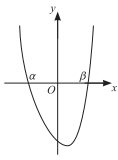
The curve \(y=p(x)-21\) crosses the \(x\)-axis at \((\alpha,0)\) and \((\beta,0)\), as shown.
(b) State \(\alpha\), and show that \(\beta\) satisfies \(x=\sqrt[3]{7-2x}\). [2]
(c) Show by calculation that \(1.5<\beta<1.6\). [2]
(d) Use an iterative formula based on (b) to find \(\beta\) to 4 significant figures. Give each iteration to 6 significant figures. [3]


9709 P22 - Jun 2026 - Q6 - 8 marks

The diagram shows the curve with equation \(y=f(x)\), where \[f(x)=ax^4+4x^3-3ax^2-21x-18\] and \(a\) is a constant. It is given that \((x+2)\) is a factor of \(f(x)\).
(a) Find the value of \(a\). [2]
(b) Show that the positive root of the equation \(f(x)=0\) satisfies the equation \[x=\sqrt[3]{3x+4.5}.\] [3]
(c) Use an iterative formula based on the equation \(x=\sqrt[3]{3x+4.5}\) to find the positive root of \(f(x)=0\) correct to 4 significant figures. Give the result of each iteration to 6 significant figures. [3]

9709 P22 - Nov 2025 - Q6 - 9 marks
(a) Given that \[\int_{-2a}^{a}\left(\frac12e^{2x}+\frac14e^{-x}\right)dx=5,\] where \(a\) is a positive constant, show that \[a=\frac12\ln\left(10+\frac12e^{-a}+\frac12e^{-4a}\right).\] [4]
(b) Show by calculation that \(1<a<1.2\). [2]
(c) Use the iterative formula \[a_{n+1}=\frac12\ln\left(10+\frac12e^{-a_n}+\frac12e^{-4a_n}\right)\] to find the value of \(a\) correct to 4 significant figures. Give the result of each iteration to 6 significant figures. [3]

9709 P21 - Jun 2025 - Q3 - 7 marks
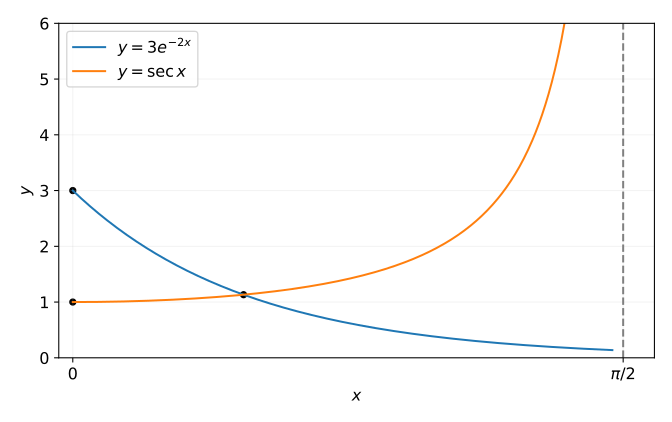
(a) Sketch, on a single diagram, the graphs of \(y=3e^{-2x}\) and \(y=\sec x\) for values of \(x\) such that \(0\le x<\frac\pi2\). [2]
(b) Show that the \(x\)-coordinate of the point of intersection of the two graphs satisfies the equation \(x=\frac12\ln(3\cos x)\). [2]
(c) Use an iterative formula, based on the equation in part (b), to find the \(x\)-coordinate of the point of intersection correct to 3 decimal places. Give the result of each iteration to 5 decimal places. [3]

9709 P22 - Mar 2025 - Q5 - 8 marks
(a) Sketch on the same diagram the graphs of \(y=|2x-3|\) and \(y=\ln(x+1)\). [2]
The \(x\)-coordinates of the points where the graphs intersect are denoted by \(\alpha\) and \(\beta\), where \(\alpha<\beta\).
(b) Show that \(\alpha=1.5-0.5\ln(\alpha+1)\). [1]
(c) Use an iterative formula, based on the equation in part (b), to find the value of \(\alpha\) correct to 3 significant figures. Give the result of each iteration to 5 significant figures. [3]
(d) Show by calculation that \(2.055<\beta<2.065\). [2]



9709 P21 - Nov 2024 - Q5 - 8 marks
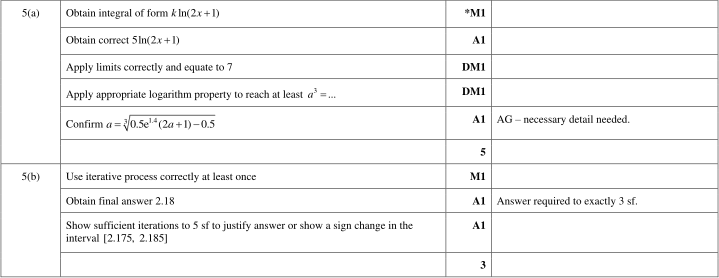
\(\int_a^{a^3}\dfrac{10}{2x+1}\,dx=7\), where \(a>1\).
(a) Show that \(a=\sqrt[3]{0.5e^{1.4}(2a+1)-0.5}\). [5]
(b) Use an iterative formula based on (a) to find a to 3 significant figures. Start with 2 and give every iteration to 5 significant figures. [3]
9709 P22 - Nov 2024 - Q4 - 7 marks
(a) Sketch \(y=1+e^{2x}\) and \(y=|x-4|\) on the same diagram. [2]
(b) They intersect at P. Show that its x-coordinate satisfies \(x=\frac12\ln(3-x)\). [2]
(c) Use this equation iteratively to find the x-coordinate to 3 significant figures. Start with 0.45 and show each iteration to 5 significant figures. [3]


9709 P21 - Jun 2024 - Q5 - 9 marks
\(y=(1+e^{2x})/(1+3x)\) has exactly one stationary point P.
(a) Find \(dy/dx\) and show that its x-coordinate satisfies \(x=1/6+\frac12e^{-2x}\). [4]
(b) Show by calculation that this x-coordinate lies between 0.35 and 0.45. [2]
(c) Use the formula in (a) iteratively to find x to 3 significant figures. Give each iteration to 5 significant figures. [3]


9709 P22 - Jun 2024 - Q6 - 9 marks
\(y=\ln(2x+1)/(x+3)\) has maximum point M.

(a) Find \(dy/dx\). [2]
(b) Show that M satisfies \(x=(x+3)/\ln(2x+1)-0.5\). [2]
(c) Show by calculation that its x-coordinate lies between 2.5 and 3.0. [2]
(d) Use the formula in (b) iteratively to find x to 4 significant figures; give every iteration to 6 significant figures. [3]


9709 P22 - Mar 2024 - Q5 - 9 marks
\(y=x^3/(x+2)\). At P the gradient is 6.

(a) Show that its x-coordinate satisfies \(x=\sqrt[3]{12x+12}\). [4]
(b) Show by calculation that this x-coordinate lies between 3.8 and 4.0. [2]
(c) Use the formula in (a) iteratively to find x to 3 significant figures; show every iteration to 5 significant figures. [3]


9709 P21 - Nov 2023 - Q7 - 11 marks
The curve with equation \(e^{2x}-18x+y^3+y=11\) has a stationary point at \((p,q)\).
(a) Find the exact value of \(p\). [4]
(b) Show that \(q=\sqrt[3]{2+18\ln3-q}\). [2]
(c) Show by calculation that the value of \(q\) lies between 2.5 and 3.0. [2]
(d) Use an iterative formula, based on the equation in (b), to find the value of \(q\) correct to 4 significant figures. Give the result of each iteration to 6 significant figures. [3]


9709 P22 - Nov 2023 - Q6 - 10 marks
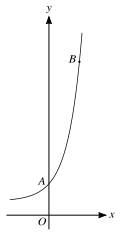
The diagram shows the curve with parametric equations \[x=3\ln(2t-3),\qquad y=4t\ln t.\] The curve crosses the \(y\)-axis at the point \(A\). At the point \(B\), the gradient of the curve is 12.
(a) Find the exact gradient of the curve at \(A\). [5]
(b) Show that the value of the parameter \(t\) at \(B\) satisfies the equation \(t=\frac9{1+\ln t}+\frac32\). [2]
(c) Use an iterative formula, based on the equation in (b), to find the value of \(t\) at \(B\), giving your answer correct to 3 significant figures. Use an initial value of 5 and give the result of each iteration to 5 significant figures. [3]

9709 P21 - Jun 2023 - Q3 - 7 marks
It is given that \(\displaystyle\int_0^a(3e^{2x}-1)\,dx=12\), where \(a\) is positive.
(a) Show that \(a=\frac12\ln(9+\frac23a)\). [4]
(b) Use an iterative formula based on the equation in (a) to find \(a\) correct to 4 significant figures. Use an initial value of 1 and give the result of each iteration to 6 significant figures. [3]

9709 P22 - Jun 2023 - Q4 - 7 marks
(a) The diagram shows \(y=3-e^{-x/2}\). On the diagram, sketch \(y=|5x-4|\) and show that \(3-e^{-x/2}=|5x-4|\) has exactly two real roots. [2]

The roots are denoted by \(\alpha,\beta\), where \(\alpha<\beta\).
(b) Show by calculation that \(\alpha\) lies between 0.36 and 0.37. [2]
(c) Use \(x_{n+1}=\frac15(7-e^{-x_n/2})\) to find \(\beta\) correct to 4 significant figures. Give each iteration to 6 significant figures. [3]



9709 P22 - Mar 2023 - Q5 - 8 marks
It is given that \(\displaystyle\int_1^a\left(\frac4{1+2x}+\frac3x\right)\,dx=\ln10\), where \(a>1\).
(a) Show that \(a=\sqrt[3]{90(1+2a)^{-2}}\). [5]
(b) Use an iterative formula based on the equation in (a) to find \(a\) correct to 3 significant figures. Use an initial value of 1.7 and give each iteration to 5 significant figures. [3]

9709 P21 - Nov 2022 - Q4 - 5 marks
(a) By sketching a suitable pair of graphs on the same diagram, show that the equation \(e^{-x/2}=x^5\) has exactly one real root. [2]
(b) Use the iterative formula \(x_{n+1}=\sqrt[5]{e^{-x_n/2}}\) to determine the root correct to 4 significant figures. Give the result of each iteration to 6 significant figures. [3]


9709 P22 - Nov 2022 - Q5 - 9 marks
The curve with equation \(y=x\ln(4x+1)-3x\) has one stationary point P.
(a) Show that the x-coordinate of P satisfies the equation \[x=\frac{2x+0.75}{\ln(4x+1)}-0.25.\] [4]
(b) Show by calculation that the x-coordinate of P lies between 1.8 and 1.9. [2]
(c) Use an iterative formula, based on the equation in part (a), to find the x-coordinate of P correct to 3 significant figures. Give the result of each iteration to 5 significant figures. [3]

9709 P21 - Jun 2022 - Q5 - 9 marks
(a) By sketching the graphs of \(y=|5-2x|\) and \(y=3\ln x\) on the same diagram, show that the equation \(|5-2x|=3\ln x\) has exactly two roots. [3]
(b) Show that the value of the larger root satisfies the equation \(x=2.5+1.5\ln x\). [1]
(c) Show by calculation that the value of the larger root lies between 4.5 and 5.0. [2]
(d) Use an iterative formula, based on the equation in part (b), to find the value of the larger root correct to 3 significant figures. Give the result of each iteration to 5 significant figures. [3]


9709 P22 - Jun 2022 - Q6 - 8 marks

The diagram shows the curve \(y=3e^{2x-1}\). The shaded region is bounded by the curve and the lines \(x=a\), \(x=a+1\) and \(y=0\), where \(a\) is a constant. It is given that the area of the shaded region is 120 square units.
(a) Show that \[a=\frac12\ln\bigl(80+e^{2a-1}\bigr)-\frac12.\] [5]
(b) Use an iterative formula, based on the equation in part (a), to find the value of \(a\) correct to 3 significant figures. Give the result of each iteration to 5 significant figures. [3]

9709 P22 - Mar 2022 - Q7 - 12 marks
A curve has equation \(e^{2x}y-e^y=100\).
(a) Show that \[\frac{dy}{dx}=\frac{2e^{2x}y}{e^y-e^{2x}}.\] [3]
(b) Show that the curve has no stationary points. [2]
It is required to find the x-coordinate of P, the point on the curve at which the tangent is parallel to the y-axis.
(c) Show that the x-coordinate of P satisfies the equation \[x=\ln10-\frac12\ln(2x-1).\] [4]
(d) Use an iterative formula, based on the equation in part (c), to find the x-coordinate of P correct to 3 significant figures. Use an initial value of 2 and give the result of each iteration to 5 significant figures. [3]


9709 P21 - Nov 2021 - Q4 - 8 marks
The curve with equation \(y=xe^{2x}+5e^{-x}\) has a minimum point M.
(a) Show that the x-coordinate of M satisfies the equation \[x=\frac13\ln5-\frac13\ln(1+2x).\] [5]
(b) Use an iterative formula, based on the equation in part (a), to find the x-coordinate of M correct to 3 significant figures. Use an initial value of 0.35 and give the result of each iteration to 5 significant figures. [3]

9709 P22 - Nov 2021 - Q6 - 8 marks
(a) By sketching a suitable pair of graphs on the same diagram, show that the equation \(\ln x=2e^{-x}\) has exactly one root. [2]
(b) Verify by calculation that the root lies between 1.5 and 1.6. [2]
(c) Show that if a sequence of values given by the iterative formula \[x_{n+1}=e^{2e^{-x_n}}\] converges, then it converges to the root of the equation in part (a). [1]
(d) Use the iterative formula in part (c) to determine the root correct to 3 significant figures. Give the result of each iteration to 5 significant figures. [3]


9709 P22 - Jun 2021 - Q7 - 11 marks

The diagram shows the curve with parametric equations \[x=4t+e^{2t},\qquad y=6t\sin2t,\] for \(0\le t\le1\). The point P on the curve has parameter p and y-coordinate 3.
(a) Show that \(p=\dfrac1{2\sin2p}\). [1]
(b) Show by calculation that the value of p lies between 0.5 and 0.6. [2]
(c) Use an iterative formula, based on the equation in part (a), to find the value of p correct to 3 significant figures. Use an initial value of 0.55 and give the result of each iteration to 5 significant figures. [3]
(d) Find the gradient of the curve at P. [5]


9709 P21 - Jun 2021 - Q5 - 8 marks

The diagram shows the curve with equation \(y=(3x+2)/\ln x\). The curve has a minimum point M.
(a) Find an expression for \(dy/dx\) and show that the x-coordinate of M satisfies the equation \(x=(3x+2)/(3\ln x)\). [3]
(b) Use the equation in part (a) to show by calculation that the x-coordinate of M lies between 3 and 4. [2]
(c) Use an iterative formula, based on the equation in part (a), to find the x-coordinate of M correct to 5 significant figures. Give the result of each iteration to 7 significant figures. [3]

9709 P22 - Mar 2021 - Q5 - 8 marks
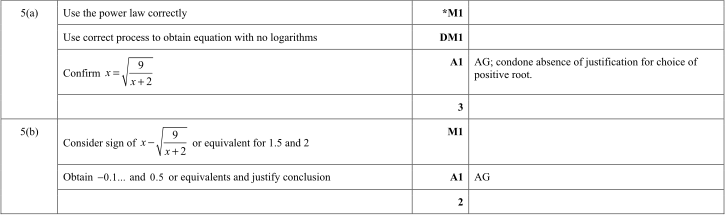
(a) Given that \(2\ln(x+1)+\ln x=\ln(x+9)\), show that \(x=\sqrt{9/(x+2)}\). [3]
(b) It is given that the equation \(x=\sqrt{9/(x+2)}\) has a single root.
(b) Show by calculation that this root lies between 1.5 and 2.0. [2]
(c) Use an iterative formula, based on the equation in part (b), to find the root correct to 3 significant figures. Give the result of each iteration to 5 significant figures. [3]