9709 P22 - Mar 2023 - Q1 - 4 marks
Find the exact value of \(\displaystyle\int_0^{\pi/2}2\tan^2(\frac{x}{2})\,dx\). [4]

9709 P22 - Mar 2026 - Q6 - 6 marks
Find the exact value of \[\int_{\pi/6}^{\pi/3}(4\cos^2(2x)+3\tan^2x)\,dx.\] [6]

9709 P21 - Jun 2026 - Q3 - 4 marks

The diagram shows \(y=\sqrt{x^3+9}\) for \(0\le x\le3\).
(a) Use the trapezium rule with three intervals to approximate \(\displaystyle\int_0^3\sqrt{x^3+9}\,dx\). Give the answer to 3 significant figures. [3]
(b) State, with a reason, whether this is an overestimate or an underestimate. [1]

9709 P21 - Jun 2026 - Q7 - 9 marks

The curve is \[y=3+\sin^2(2x)-\cos(2x),\qquad0\le x\le\pi.\] Its two maximum points have \(x\)-coordinates \(\alpha,\beta\). The shaded region is bounded by the curve, the \(x\)-axis and \(x=\alpha,\ x=\beta\). Find its exact area. [9]

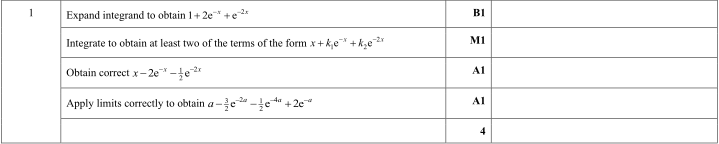
9709 P22 - Jun 2026 - Q1 - 4 marks
Find \(\displaystyle\int_a^{2a}(1+e^{-x})^2\,\mathrm{d}x\). Give your answer in terms of the positive constant \(a\). [4]
9709 P22 - Jun 2026 - Q7 - 7 marks

The diagram shows part of the curve with equation \(y=8\cos2x-\dfrac1{\cos^22x}\). The shaded region is bounded by the curve and the \(x\)-axis.
Find the exact area of the shaded region. [7]

9709 P21 - Nov 2025 - Q1 - 3 marks
Find \(\displaystyle\int6\sin^2x\,dx\). [3]

9709 P21 - Nov 2025 - Q5 - 7 marks

The diagram shows the curve with equation \(y=8e^{-x/2}-1\). The curve meets the axes at the points \(A\) and \(B\). The shaded region is bounded by the curve and the line segment \(AB\).
(a) Show that the \(x\)-coordinate of \(B\) is \(6\ln2\). [2]
(b) Find the area of the shaded region. Give your answer in the form \(p\ln2-q\), where \(p\) and \(q\) are positive integers. [5]

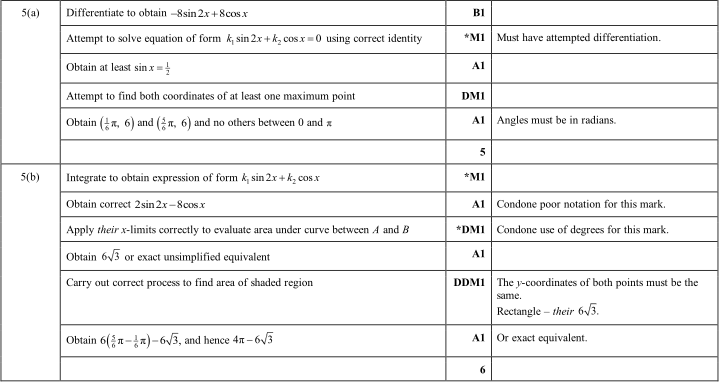
9709 P22 - Nov 2025 - Q5 - 11 marks

The diagram shows the curve with equation \(y=4\cos2x+8\sin x\) for \(0\le x\le\pi\). The maximum points on the curve are denoted by \(A\) and \(B\), and the shaded region is bounded by the line segment \(AB\) and the curve.
(a) Find the coordinates of \(A\) and \(B\). [5]
(b) Find the exact area of the shaded region. [6]
9709 P21 - Jun 2025 - Q4 - 7 marks

The diagram shows the curve with equation \(y=6e^{2x}-e^{3x}\). The shaded region is bounded by the axes and the curve.
(a) Find the exact \(x\)-coordinate of the maximum point. [3]
(b) Find the area of the shaded region. Give your answer in the form \(\dfrac pq\), where \(p\) and \(q\) are integers. [4]

9709 P22 - Jun 2025 - Q1 - 3 marks
Show that \(\displaystyle\int_2^{11}\frac8{4x+1}\,dx=\ln a\), where \(a\) is an integer to be found. [3]

9709 P22 - Jun 2025 - Q4 - 8 marks

The diagram shows parts of the curves with equations \(y=4e^{-2x}\) and \(y=1+0.5\sin3x\). Point \(P\) is a point of intersection of the curves, and the shaded region is bounded by the two curves and the \(y\)-axis.
(a) Show that the \(x\)-coordinate of \(P\) satisfies the equation \(x=-0.5\ln(0.25+0.125\sin3x)\). [1]
(b) Use an iterative formula, based on the equation in part (a), to find the \(x\)-coordinate of \(P\) correct to 4 significant figures. Use an initial value of 0.5 and give the result of each iteration to 6 significant figures. [3]
(c) Hence find the area of the shaded region. Give your answer correct to 2 significant figures. [4]

9709 P22 - Mar 2025 - Q2 - 3 marks
A curve passes through the point with coordinates \((\pi/2,5)\) and is such that \[\frac{dy}{dx}=4\sec^2(x/2).\]
Find the equation of the curve. [3]

9709 P22 - Mar 2025 - Q3 - 5 marks

The diagram shows the curves \(y=e^{2x}\) and \(y=8e^{-x}\). The shaded region is bounded by the two curves and the \(y\)-axis.
(a) Show that the \(x\)-coordinate of the point of intersection of the two curves is \(\ln2\). [2]
(b) Find the area of the shaded region. [3]

9709 P22 - Mar 2025 - Q6 - 8 marks
(a) Find the quotient and remainder when \(18x^3-6x^2-30x+4\) is divided by \((3x-1)\). [3]
(b) Hence find \[\int_1^5\frac{18x^3-6x^2-30x+4}{3x-1}\,dx.\] Give your answer in the form \(a-\ln b\), where \(a\) and \(b\) are integers. [5]

9709 P21 - Nov 2024 - Q3 - 7 marks
\(f(x)=\tan^2(x/2)\), for \(0\le x<\pi\).
(a) Find the exact value of \(f^\prime(2\pi/3)\). [3]
(b) Find \(\int_0^{\pi/2}(f(x)+\sin x)\,dx\) exactly. [4]


9709 P22 - Nov 2024 - Q2 - 6 marks
\(f(x)=4\sin^2(3x)\).
(a) Find \(f^\prime(\pi/4)\). [3]
(b) Find \(\int f(x)\,dx\). [3]

9709 P22 - Nov 2024 - Q6 - 9 marks
The curves \(y=\sqrt[3]{5x^2+7}\) and \(y=27/(2x+5)\), for \(x\ge0\), meet at (2,3). Region A lies under the cubic-root curve between \(x=0,x=2,y=0\). Region B lies between the curves and \(x=0\).

(a) Use the trapezium rule with two intervals to estimate the area of A, to 3 significant figures. [3]
(b) Find the exact total area of A and B in the form k ln m. [3]
(c) Deduce an estimate of B, to 3 significant figures. [1]
(d) State, with a reason, whether (c) overestimates or underestimates the area of B. [2]
9709 P21 - Jun 2024 - Q6 - 9 marks
The curve is \(y=\sqrt{\sin2x+\sin^22x}\), for \(0\le x\le\pi/6\). The shaded region lies under the curve, above \(y=0\), and to the left of \(x=\pi/6\).

(a) Use the trapezium rule with two intervals to estimate its area to 2 significant figures. [3]
(b) The region is rotated completely about the x-axis. Find the exact volume. [6]


9709 P21 - Jun 2024 - Q7 - 9 marks
\(p(x)=9x^3+6x^2+12x+k\), with constant \(k\).
(a) Find the quotient on division by 3x+2 and show the remainder is k−8. [3]
(b) Given \(\int_1^6\dfrac{p(x)}{3x+2}\,dx=a+\ln64\), with integer \(a\), find \(a,k\). [6]


9709 P22 - Jun 2024 - Q3 - 8 marks
\(y=8e^{-x}-e^{2x}\). It meets the y-axis at A and x-axis at B. The shaded region is bounded by the curve and both axes.

(a) Find the gradient at A. [3]
(b) Show that B has x-coordinate ln2 and hence find the shaded area. [5]

9709 P22 - Jun 2024 - Q5 - 8 marks
\(p(x)=9x^3+18x^2+5x+4\).
(a) Find the quotient when divided by 3x+2 and show the remainder is 6. [3]
(b) Find \(\int_0^2 p(x)/(3x+2)\,dx\), in the form \(a+\ln b\), with integer a,b. [5]


9709 P22 - Mar 2024 - Q4 - 7 marks
\(y=\sqrt{1+e^{0.5x}}\). The shaded region lies between the curve and \(x=0,x=6,y=0\).

(a) Use the trapezium rule with three intervals to estimate its area, to 3 significant figures. [3]
(b) The region is rotated completely about the x-axis. Find the exact volume. [4]

9709 P21 - Nov 2023 - Q3 - 6 marks
(a) Find \(\displaystyle\int_4^{10}\frac4{2x-5}\,dx\), giving your answer in the form \(\ln a\), where \(a\) is an integer. [4]
(b) Find the exact value of \(\displaystyle\int_4^{10}e^{2x-5}\,dx\). [2]

9709 P22 - Nov 2023 - Q3 - 5 marks

The diagram shows the curve with equation \(y=6e^{-x/2}\). The points on the curve with \(x\)-coordinates 0 and 2 are denoted by \(A\) and \(B\) respectively. The shaded region is enclosed by the curve, the line through \(A\) parallel to the \(x\)-axis and the line through \(B\) parallel to the \(y\)-axis.
(a) Find the exact gradient of the curve at \(B\). [2]
(b) Find the exact area of the shaded region. [3]

9709 P22 - Nov 2023 - Q5 - 8 marks
(a) Find the quotient when \(6x^3-5x^2-24x-4\) is divided by \((2x+1)\), and show that the remainder is 6. [3]
(b) Hence find \(\displaystyle\int_2^7\frac{6x^3-5x^2-24x-4}{2x+1}\,dx\), giving your answer in the form \(a+\ln b\), where \(a\) and \(b\) are integers. [5]

9709 P21 - Jun 2023 - Q6 - 7 marks
Show that \(\displaystyle\int_{\pi/4}^{\pi/3}\left(4\cos^22x+\frac1{\cos^2x}\right)\,dx=\frac{3\sqrt3}{4}+\frac{\pi}{6}-1\). [7]

9709 P22 - Jun 2023 - Q3 - 5 marks
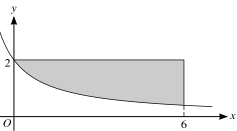
The diagram shows part of the curve \(y=\frac6{2x+3}\). The shaded region is bounded by the curve and the lines \(x=6\) and \(y=2\).
Find the exact area of the shaded region in the form \(a-\ln b\), where \(a\) and \(b\) are integers. [5]

9709 P21 - Nov 2022 - Q6 - 9 marks
The polynomial \(p(x)\) is defined by \[p(x)=12x^3-9x^2+8x-4.\]
(a) Find the quotient when \(p(x)\) is divided by \((4x-3)\) and show that the remainder is 2. [3]
(b) Hence find \(\displaystyle\int_2^{12}\left(\frac{p(x)}{4x-3}-3x^2\right)\,dx\), giving your answer in the form \(a+\ln b\). [6]

9709 P22 - Nov 2022 - Q6 - 9 marks

The diagram shows the curves \(y=\dfrac6{3x+2}\) and \(y=3e^{-x}-3\) for values of \(x\) between 0 and 4. The shaded region is bounded by the two curves and the lines \(x=0\) and \(x=4\).
Find the exact area of the shaded region, giving your answer in the form \(\ln a+b+ce^d\). [9]

9709 P21 - Jun 2022 - Q3 - 7 marks

The diagram shows the curve with equation \(y=3\sin x-3\sin2x\) for \(0\le x\le\pi\). The curve meets the x-axis at the origin and at the points with x-coordinates \(a\) and \(\pi\).
(a) Find the exact value of \(a\). [3]
(b) Find the area of the shaded region. [4]

9709 P21 - Jun 2022 - Q7 - 9 marks
The polynomial \(p(x)\) is defined by \[p(x)=2x^3+5x^2+ax+2a,\] where \(a\) is an integer.
(a) Find, in terms of \(x\) and \(a\), the quotient when \(p(x)\) is divided by \((x+2)\), and show that the remainder is 4. [3]
(b) It is given that \[\int_{-1}^1\frac{p(x)}{x+2}\,dx=\frac{22}3+\ln b,\] where \(b\) is an integer. Find the values of \(a\) and \(b\). [6]

9709 P22 - Jun 2022 - Q4 - 6 marks
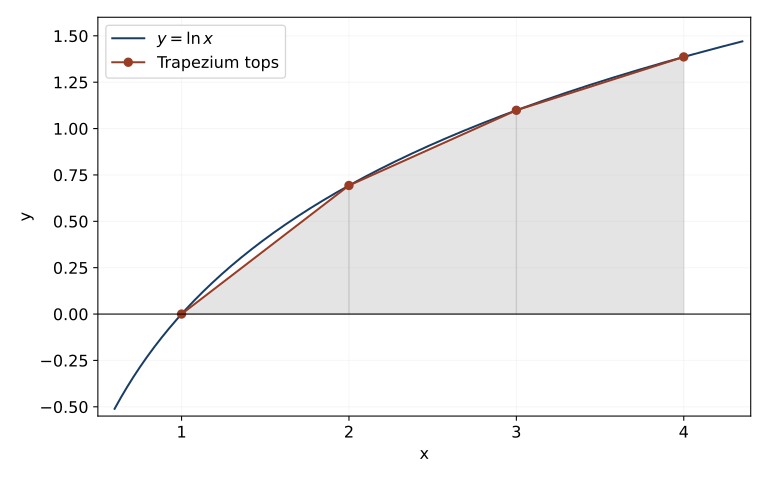
(a) Use the trapezium rule with three intervals to show that the value of \(\displaystyle\int_1^4\ln x\,dx\) is approximately \(\ln12\). [4]
(b) Use a graph of \(y=\ln x\) to show that \(\ln12\) is an under-estimate of the true value of \(\displaystyle\int_1^4\ln x\,dx\). [2]


9709 P22 - Jun 2022 - Q7 - 8 marks

The diagram shows the curves \(y=\sqrt{2\pi-2x}\) and \(y=\sin^2x\) for \(0\le x\le\pi\). The shaded region is bounded by the two curves and the line \(x=0\).
Find the exact area of the shaded region. [8]

9709 P22 - Mar 2022 - Q5 - 8 marks
(a) Given that \(y=\tan^2x\), show that \(\dfrac{dy}{dx}=2\tan x+2\tan^3x\). [2]
(b) Find the exact value of \(\displaystyle\int_{\pi/4}^{\pi/3}(\tan x+\tan^2x+\tan^3x)\,dx\). [6]

9709 P21 - Nov 2021 - Q1 - 4 marks
Find the exact value of \(\displaystyle\int_{-1}^{2}(4e^{2x}-2e^{-x})\,dx\). [4]

9709 P22 - Nov 2021 - Q4 - 5 marks
Given that \(\displaystyle\int_a^{a+14}\frac1{3x}\,dx=\ln2\), find the value of the positive constant a. [5]

9709 P22 - Jun 2021 - Q4 - 8 marks
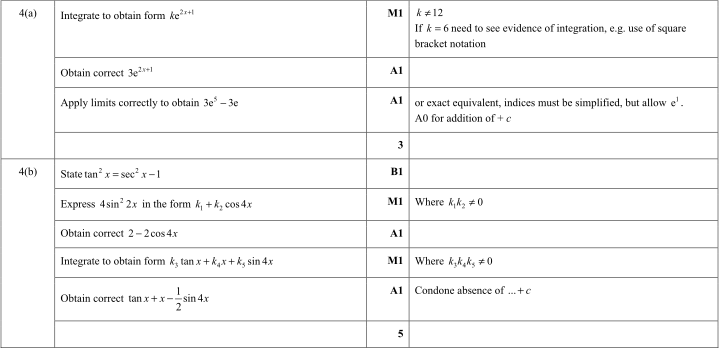
(a) Find the exact value of \(\displaystyle\int_0^2 6e^{2x+1}\,dx\). [3]
(b) Find \(\displaystyle\int(\tan^2x+4\sin^2 2x)\,dx\). [5]
9709 P21 - Jun 2021 - Q3 - 6 marks
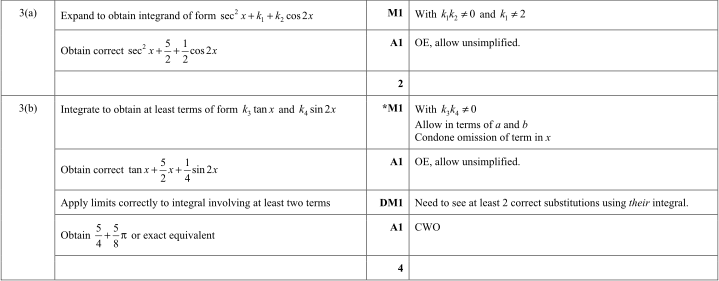
(a) Show that \((\sec x+\cos x)^2\) can be expressed as \(\sec^2x+a+b\cos2x\), where a and b are constants to be determined. [2]
(b) Hence find the exact value of \(\displaystyle\int_0^{\pi/4}(\sec x+\cos x)^2\,dx\). [4]
9709 P21 - Jun 2021 - Q6 - 9 marks
(a) Use the trapezium rule with three intervals to find an approximation to \(\displaystyle\int_1^4\frac6{1+\sqrt x}\,dx\). Give your answer correct to 5 significant figures. [3]
(b) Find the exact value of \(\displaystyle\int_1^4 2e^{x/2-2}\,dx\). [3]
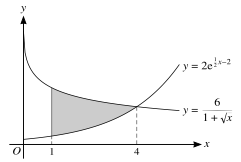
(c) The diagram shows the curves \(y=6/(1+\sqrt x)\) and \(y=2e^{x/2-2}\), which meet at a point with x-coordinate 4. The shaded region is bounded by the two curves and the line x=1.
(c) Use your answers to parts (a) and (b) to find an approximation to the area of the shaded region. Give your answer correct to 3 significant figures. [2]
(d) State, with a reason, whether your answer to part (c) is an over-estimate or under-estimate of the exact area of the shaded region. [1]

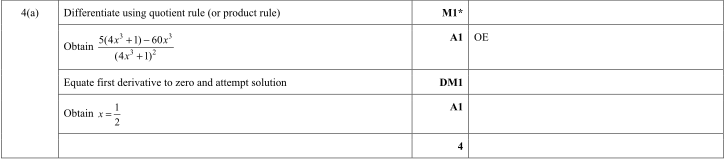
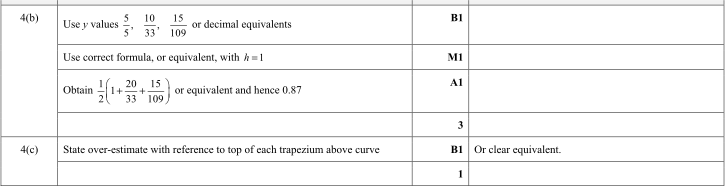
9709 P22 - Mar 2021 - Q4 - 8 marks

The diagram shows part of the curve with equation \(y=5x/(4x^3+1)\). The shaded region is bounded by the curve and the lines x=1, x=3 and y=0.
(a) Find \(dy/dx\) and hence find the x-coordinate of the maximum point. [4]
(b) Use the trapezium rule with two intervals to find an approximation to the area of the shaded region. Give your answer correct to 2 significant figures. [3]
(c) State, with a reason, whether your answer to part (b) is an over-estimate or under-estimate of the exact area of the shaded region. [1]