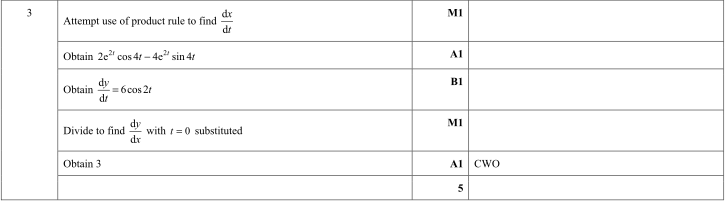
9709 P23 - Nov 2023 - Q2 - 5 marks
A curve has equation \(y=3\tan(\frac12x)\cos2x\).
Find the gradient of the curve at the point for which \(x=\frac13\pi\). [5]

9709 P22 - Mar 2026 - Q4 - 6 marks
A curve has equation \[(x^2-3)\cos y+4\cos^3y=1.\] Find its exact gradient at \((2,\pi/3)\). [6]

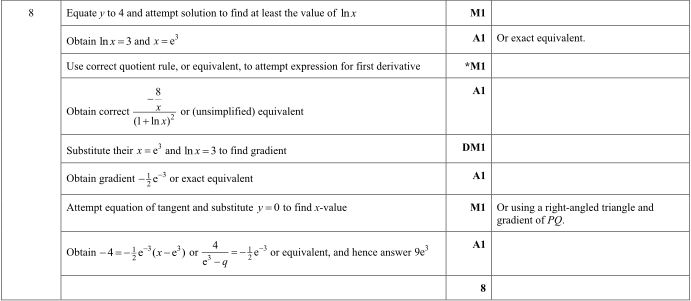
9709 P22 - Mar 2026 - Q8 - 8 marks
A curve has equation \[y=\frac{10+2\ln x}{1+\ln x}.\] Point \(P\) is the point where \(y=4\). Its tangent meets the \(x\)-axis at \(Q\). Find the exact \(x\)-coordinate of \(Q\). [8]
9709 P21 - Jun 2026 - Q6 - 10 marks
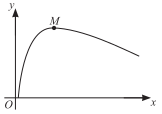
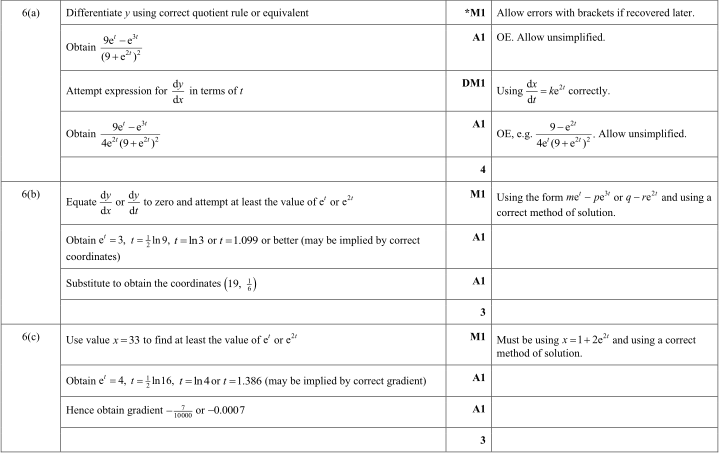
A curve has parametric equations \[x=1+2e^{2t},\qquad y=\frac{e^t}{9+e^{2t}}.\] Its maximum point is \(M\).
(a) Find \(dy/dx\) in terms of \(t\). [4]
(b) Find the coordinates of \(M\). [3]
(c) Find the gradient at the point where \(x=33\). [3]
9709 P22 - Jun 2026 - Q4 - 6 marks
A curve has equation \(y=\dfrac{e^{2x}}{e^x+2}\). The curve crosses the \(y\)-axis at the point \(P\).
Find an equation of the normal to the curve at \(P\). Give your answer in the form \(ax+by+c=0\), where \(a\), \(b\) and \(c\) are integers. [6]

9709 P22 - Jun 2026 - Q8 - 9 marks
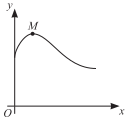
The diagram shows the curve with parametric equations \[x=6t-\sin2t,\qquad y=3\cos2t+5\sin t,\] for \(0\le t<\frac\pi2\). The curve has a maximum point, \(M\).
(a) Find the gradient of the curve at the point for which \(t=0\). [4]
(b) Find the exact \(y\)-coordinate of \(M\). [5]

9709 P21 - Nov 2025 - Q6 - 9 marks
A curve has parametric equations \[x=\tan\theta,\qquad y=\sin\theta-2\sin^3\theta,\qquad0<\theta<\frac\pi2.\]
(a) Show that \(\dfrac{dy}{dx}=6\cos^5\theta-5\cos^3\theta\). [4]
(b) Find the equation of the normal to the curve at the point where it crosses the \(x\)-axis. Give your answer in the form \(y=mx+c\), where \(m\) and \(c\) are exact constants. [5]

9709 P21 - Nov 2025 - Q8 - 6 marks
The equation of a curve is \(y=4e^{1-2x}\sqrt{3x-1}\).
Find the exact coordinates of the stationary point of the curve. [6]

9709 P22 - Nov 2025 - Q7 - 8 marks
A curve has equation \[5x^2y+4e^{2y}-7x+10=0.\]
(a) Find an expression in terms of \(x\) and \(y\) for \(\dfrac{dy}{dx}\), and hence find the gradient of the curve at the point for which \(y=0\). [6]
(b) Show that there is no point on the curve at which the tangent is parallel to the \(y\)-axis. [2]

9709 P21 - Jun 2025 - Q1 - 2 marks
Given that \(y=6x\cos(x^2+1)\),
find an expression for \(\dfrac{dy}{dx}\). [2]

9709 P21 - Jun 2025 - Q6 - 10 marks
The parametric equations of a curve are \[x=\frac{2t+1}{3t+4},\qquad y=2\ln(3t+4),\qquad t>-\frac43.\]
(a) Show that \(\dfrac{dy}{dx}\) can be expressed in the form \(c(3t+4)\) and state the value of the constant \(c\). [5]
(b) It is given that the gradient of the curve at the point \((a,\ln100)\) is \(m\). Find the values of \(a\) and \(m\). [4]
(c) State whether the curve represents a decreasing function or an increasing function or neither. Give a reason for your answer. [1]

9709 P22 - Jun 2025 - Q3 - 5 marks
Find the coordinates of the stationary points of the curve with equation \(y=\dfrac{8x}{2x+3}-6x+5\).
[5]

9709 P22 - Jun 2025 - Q6 - 9 marks
A curve has equation \((x^2-3)\ln y+6x=14\).
(a) Show that there is no point on the curve at which the \(y\)-coordinate is \(e^{-1}\). [3]
(b) Find the equation of the tangent to the curve at the point \((2,e^2)\). Give your answer in the form \(y=mx+c\), where \(m\) and \(c\) are exact constants. [6]

9709 P22 - Mar 2025 - Q4 - 6 marks
A curve has equation \(y=\dfrac{4\sin x}{3+\cos2x}\) for values of \(x\) such that \(0\le x\le2\pi\).
(a) Find \(\dfrac{dy}{dx}\). [2]
(b) Hence find the coordinates of the stationary points of the curve. [4]


9709 P22 - Mar 2025 - Q8 - 7 marks
A curve has equation \[3e^{2x}y+4e^{3x}+y^3=18.\]
(a) Show that \[\frac{dy}{dx}=\frac{-2e^{2x}y-4e^{3x}}{e^{2x}+y^2}.\] [4]
(b) Show that the curve has no stationary points. [3]

9709 P21 - Nov 2024 - Q6 - 7 marks
A curve has parametric equations \(x=(e^{2t}-2)/(e^{2t}+1)\), \(y=e^{3t}+1\).
(a) Find \(dy/dx\) in terms of \(t\). [4]
(b) Find its exact gradient where it crosses the y-axis. [3]

9709 P22 - Nov 2024 - Q3 - 6 marks
A curve satisfies \(6e^{-x}y^2+e^{2x}-12y+7=0\). Find its gradient at \((\ln3,2)\). [6]

9709 P21 - Jun 2024 - Q1 - 3 marks
\(y=2\tan x-5\sin x\), for \(0\le x<\pi/2\). Find the x-coordinate of the stationary point to 3 significant figures. [3]

9709 P21 - Jun 2024 - Q2 - 5 marks
A curve satisfies \(x^2\ln y+y^2+4x=9\). Find its gradient at (2,1). [5]

9709 P22 - Jun 2024 - Q4 - 7 marks
A curve has parametric equations \(x=4\cos^2t,\ y=\sqrt3\sin2t\), for \(0<t<\pi/2\). Find the normal at \(t=\pi/6\), in the form \(ax+by+c=0\) with integer coefficients. [7]

9709 P22 - Mar 2024 - Q6 - 9 marks
A curve has \(x=1+\sqrt t,\ y=(\ln t+2)(\ln t-3)\), for \(0<t<25\). It crosses the x-axis at A,B and has minimum M.
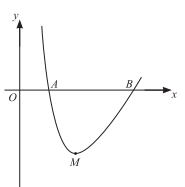
(a) Show \(dy/dx=(4\ln t-2)/\sqrt t\). [4]
(b) Find the exact gradient at B. [2]
(c) Find the exact coordinates of M. [3]


9709 P21 - Jun 2023 - Q2 - 5 marks
The curve with equation \(y=\frac{2+3\ln x}{1+2x}\) has a tangent at the point \((1,\frac23)\).
Find the equation of this tangent in the form \(ax+by+c=0\), where \(a,b,c\) are integers. [5]

9709 P21 - Jun 2023 - Q5 - 8 marks

The diagram shows the curve with parametric equations \[x=4e^{2t},\qquad y=5e^{-t}\cos2t,\qquad-\frac{\pi}{4}\le t\le\frac{\pi}{4}.\] The curve has a maximum point \(M\).
(a) Find \(\frac{dy}{dx}\) in terms of \(t\). [3]
(b) Find the coordinates of \(M\), giving your answers correct to 3 significant figures. [5]

9709 P22 - Jun 2023 - Q5 - 9 marks

The diagram shows \(y=e^{-x/2}(x^2-5x+4)\). The curve crosses the \(x\)-axis at \(A\) and \(B\), and has a maximum at \(C\).
(a) Find the exact gradient of the curve at \(B\). [5]
(b) Find the exact coordinates of \(C\). [4]

9709 P22 - Jun 2023 - Q7 - 9 marks
The curve has parametric equations \[x=\frac{2t+3}{t+2},\qquad y=t^2+at+1,\] where \(a\) is a constant. The gradient is 1 at the point \(P\).
(a) Show that the parameter \(t\) at \(P\) satisfies \(2t^3+(a+8)t^2+(4a+8)t+4a-1=0\). [4]
(b) Given that \((t+1)\) is a factor of the polynomial in (a), find \(a\). [2]
(c) Show that there is only one point on the curve at which the gradient is 1. [3]

9709 P22 - Mar 2023 - Q6 - 8 marks
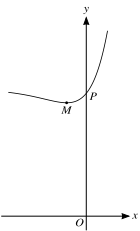
The diagram shows \(y=\frac{4e^{2x}+9}{e^x+2}\). The curve has a minimum \(M\) and crosses the \(y\)-axis at \(P\).
(a) Find the exact gradient at \(P\). [4]
(b) Find the exact coordinates of \(M\). [4]

9709 P22 - Mar 2023 - Q7 - 10 marks

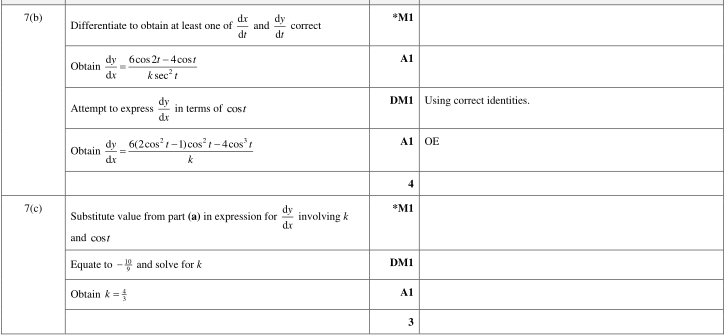
The curve has parametric equations \[x=k\tan t,\qquad y=3\sin2t-4\sin t,\qquad0<t<\frac\pi2,\] where \(k>0\). It crosses the \(x\)-axis at \(P\).
(a) Find \(\cos t\) at \(P\), as an exact fraction. [3]
(b) Express \(\frac{dy}{dx}\) in terms of \(k\) and \(\cos t\). [4]
(c) Given that the normal at \(P\) has gradient \(\frac9{10}\), find \(k\) as an exact fraction. [3]

9709 P21 - Nov 2022 - Q5 - 5 marks
A curve has equation \(4e^{2x}y+y^2=21\).
Find the gradient of the curve at the point \((0,-7)\). [5]

9709 P21 - Nov 2022 - Q7 - 9 marks
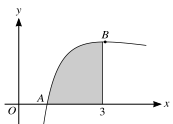
The diagram shows the curve with equation \(y=\dfrac{2\ln x}{3x+1}\). The curve crosses the x-axis at the point A and has a maximum point B. The shaded region is bounded by the curve and the lines \(x=3\) and \(y=0\).
(a) Find the gradient of the curve at A. [3]
(b) Show by calculation that the x-coordinate of B lies between 3.0 and 3.1. [3]
(c) Use the trapezium rule with two intervals to find an approximation to the area of the shaded region. Give your answer correct to 2 decimal places. [3]


9709 P22 - Nov 2022 - Q7 - 11 marks

The diagram shows the curve with parametric equations \[x=3\cos2\theta,\qquad y=4\sin\theta,\] for \(\pi\le\theta\le3\pi/2\). Points P and Q lie on the curve. The gradient of the curve at P is 2. The straight line \(3x+y=0\) meets the curve at Q.
(a) Find the value of \(\theta\) at P, giving your answer correct to 3 significant figures. [5]
(b) Find the gradient of the curve at Q, giving your answer correct to 3 significant figures. [6]



9709 P21 - Jun 2022 - Q4 - 7 marks
A curve has equation \(x^2y+2y^3=48\).
Find the equation of the normal to the curve at the point \((4,2)\), giving your answer in the form \(ax+by+c=0\) where \(a\), \(b\) and \(c\) are integers. [7]

9709 P21 - Jun 2022 - Q6 - 8 marks
A curve has equation \(y=\dfrac{9e^{2x}+16}{e^x-1}\).
(a) Show that the x-coordinate of any stationary point on the curve satisfies the equation \[e^x(3e^x-8)(3e^x+2)=0.\] [4]
(b) Hence show that the curve has only one stationary point and find its exact coordinates. [4]

9709 P22 - Jun 2022 - Q1 - 3 marks
Given that \(y=\dfrac{\ln x}{x^2}\), find the exact value of \(\dfrac{dy}{dx}\) when \(x=e\). [3]

9709 P22 - Jun 2022 - Q3 - 5 marks
A curve has equation \(e^{2x}\cos2y+\sin y=1\).
Find the exact gradient of the curve at the point \((0,\pi/6)\). [5]

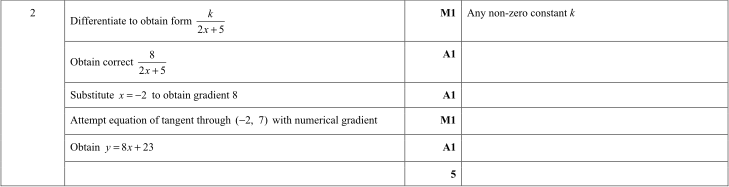
9709 P22 - Mar 2022 - Q2 - 5 marks
A curve has equation \(y=7+4\ln(2x+5)\).
Find the equation of the tangent to the curve at the point \((-2,7)\), giving your answer in the form \(y=mx+c\). [5]
9709 P21 - Nov 2021 - Q5 - 8 marks

The diagram shows the curve with parametric equations \[x=\ln(2t+3),\qquad y=\frac{2t-3}{2t+3}.\] The curve crosses the y-axis at the point A and the x-axis at the point B.
(a) Show that \(\displaystyle\frac{dy}{dx}=\frac6{2t+3}\). [4]
(b) Find the gradient of the curve at A. [2]
(c) Find the gradient of the curve at B. [2]

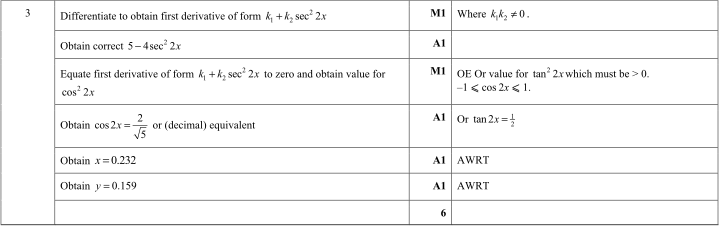
9709 P22 - Nov 2021 - Q3 - 6 marks
The curve with equation \(y=5x-2\tan2x\) has exactly one stationary point in the interval \(0\le x<\pi/4\).
Find the coordinates of this stationary point, giving each coordinate correct to 3 significant figures. [6]
9709 P22 - Nov 2021 - Q5 - 6 marks
A curve has equation \(x^2+4x\cos3y=6\).
Find the exact value of the gradient of the normal to the curve at the point \((\sqrt2,\pi/12)\). [6]

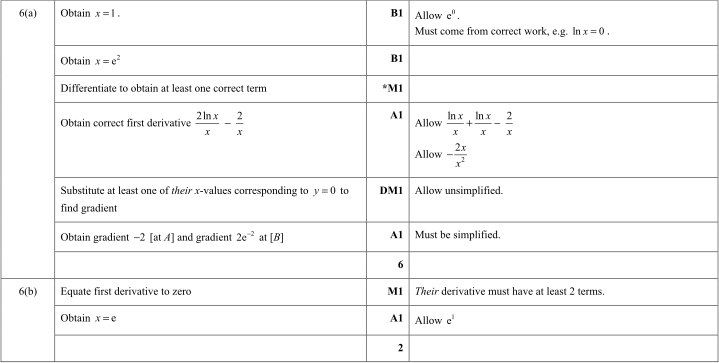
9709 P22 - Jun 2021 - Q6 - 8 marks

The diagram shows the curve with equation \(y=(\ln x)^2-2\ln x\). The curve crosses the x-axis at the points A and B, and has a minimum point M.
(a) Find the exact value of the gradient of the curve at each of the points A and B. [6]
(b) Find the exact x-coordinate of M. [2]
9709 P21 - Jun 2021 - Q4 - 8 marks
A curve has parametric equations \[x=\ln(2t+6)-\ln t,\qquad y=t\ln t.\]
(a) Find the value of t at the point P on the curve for which \(x=\ln4\). [3]
(b) Find the exact gradient of the curve at P. [5]

9709 P22 - Mar 2021 - Q3 - 5 marks
The parametric equations of a curve are \[x=e^{2t}\cos4t,\qquad y=3\sin2t.\]
Find the gradient of the curve at the point for which t=0. [5]