Problem #538
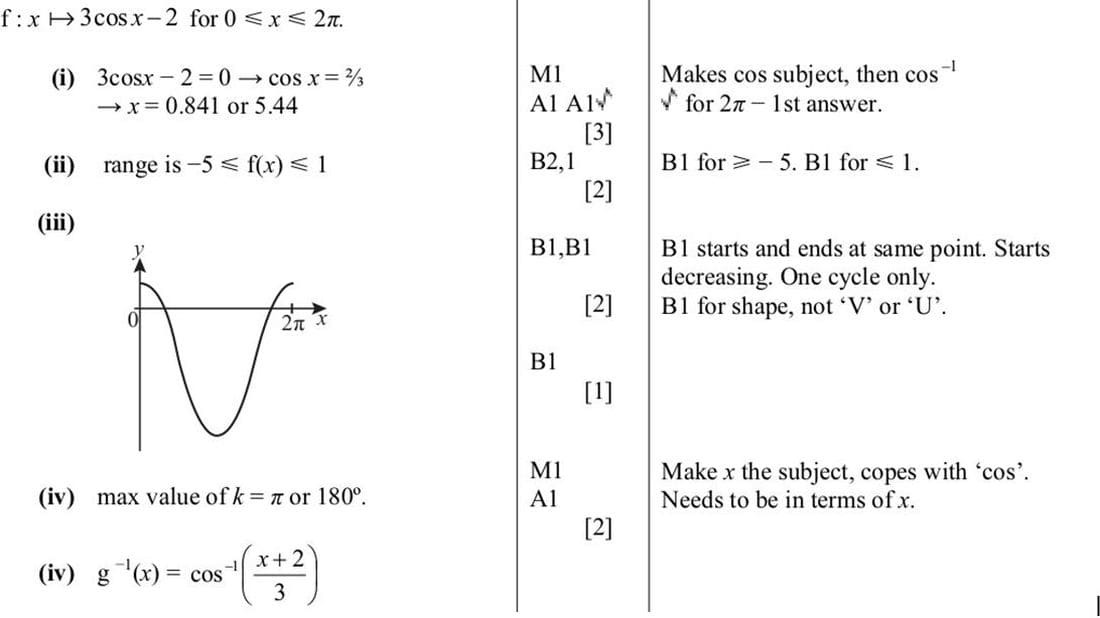
The diagram shows the graph of \(y = f(x)\) where the function \(f\) is defined by
\(f(x) = 3 + 2 \sin \frac{1}{4}x\) for \(0 \leq x \leq 2\pi\).
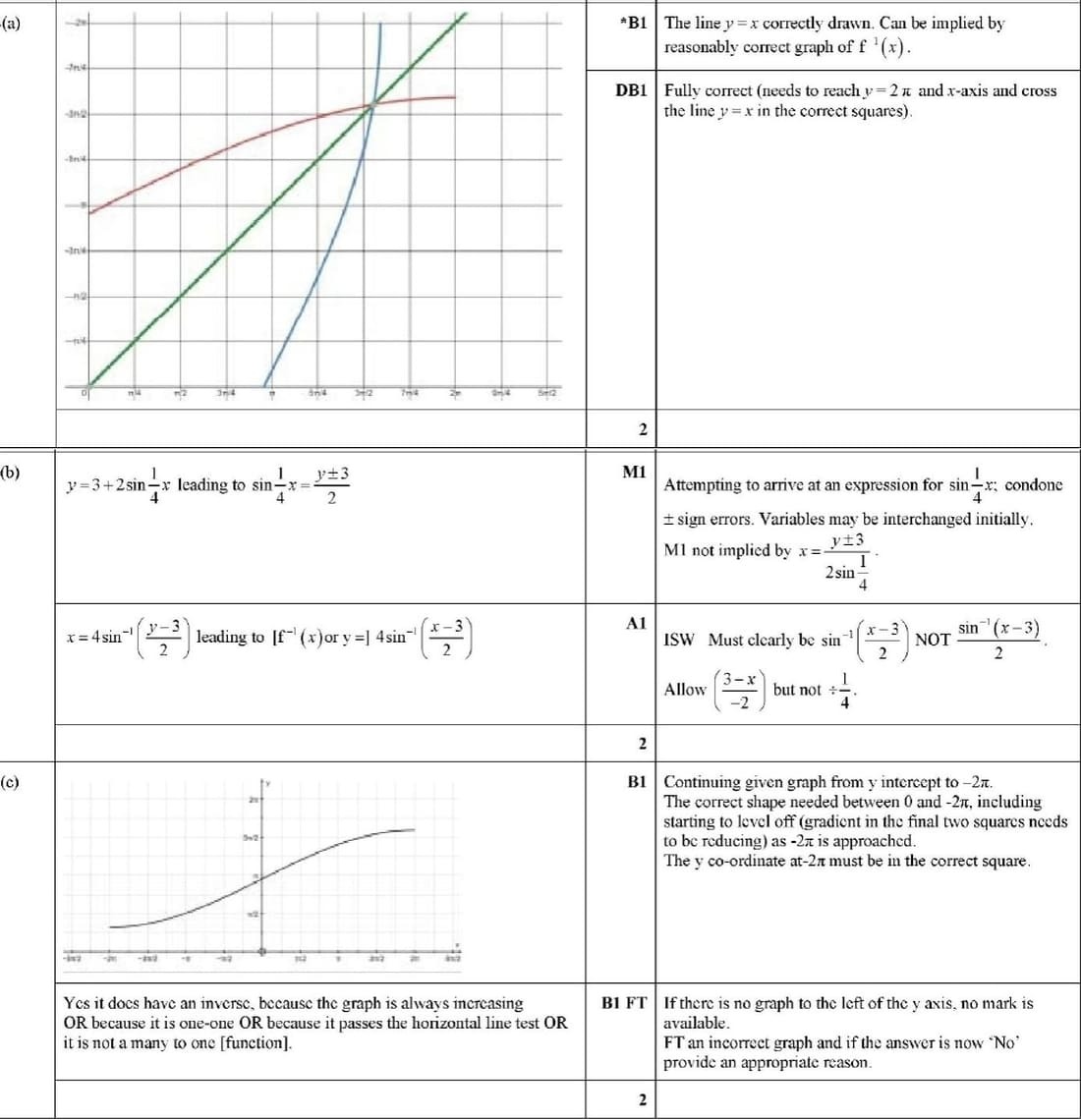
(a) On the diagram above, sketch the graph of \(y = f^{-1}(x)\). [2]
(b) Find an expression for \(f^{-1}(x)\). [2]
(c) The diagram above shows part of the graph of the function \(g(x) = 3 + 2 \sin \frac{1}{4}x\) for \(-2\pi \leq x \leq 2\pi\).
Complete the sketch of the graph of \(g(x)\) on the diagram above and hence explain whether the function \(g\) has an inverse. [2]
Problem #539
The function \(f\) is such that \(f(x) = 3 - 4 \cos^k x\), for \(0 \leq x \leq \pi\), where \(k\) is a constant.
(i) In the case where \(k = 2\),
(a) find the range of \(f\), [2]
(b) find the exact solutions of the equation \(f(x) = 1\). [3]
(ii) In the case where \(k = 1\),
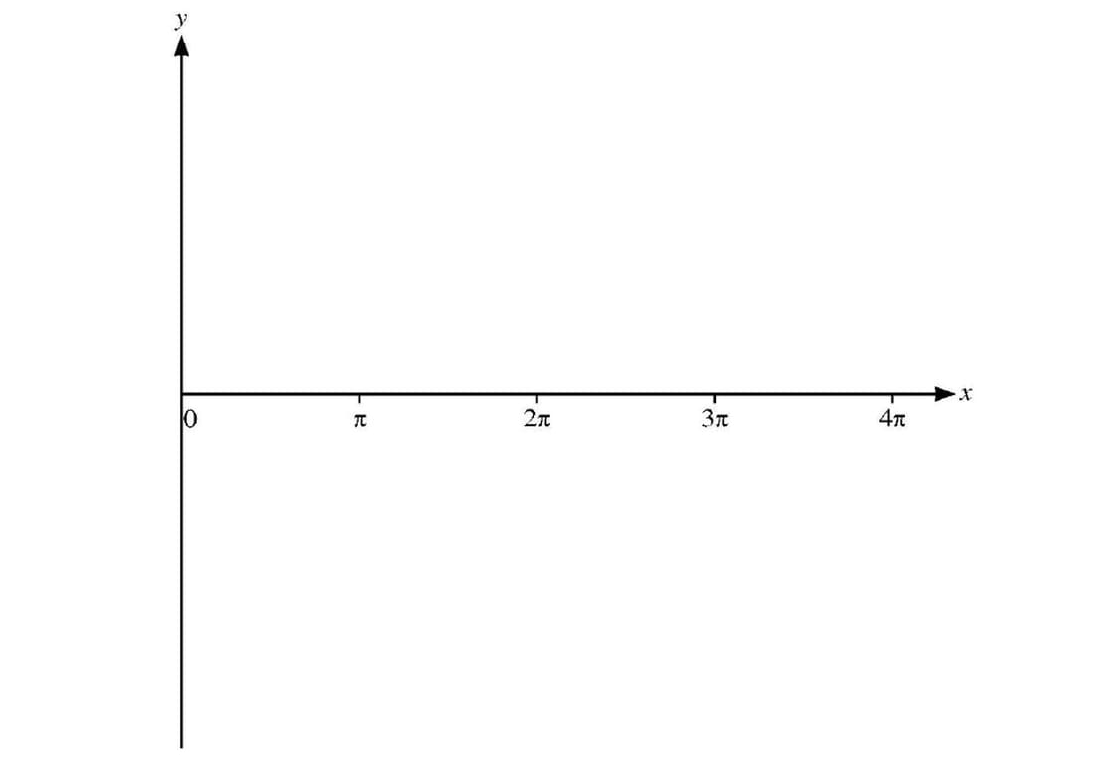
(a) sketch the graph of \(y = f(x)\), [2]
(b) state, with a reason, whether \(f\) has an inverse. [1]
Problem #540
A function f is defined by \(f : x \mapsto 3 - 2 \tan\left(\frac{1}{2}x\right)\) for \(0 \leq x < \pi\).
- State the range of \(f\). [1]
- State the exact value of \(f\left(\frac{2}{3}\pi\right)\). [1]
- Sketch the graph of \(y = f(x)\). [2]
- Obtain an expression, in terms of \(x\), for \(f^{-1}(x)\). [3]
Problem #541
The function \(f : x \mapsto 4 - 3 \sin x\) is defined for the domain \(0 \leq x \leq 2\pi\).
(i) Solve the equation \(f(x) = 2\). [3]
(ii) Sketch the graph of \(y = f(x)\). [2]
(iii) Find the set of values of \(k\) for which the equation \(f(x) = k\) has no solution. [2]
The function \(g : x \mapsto 4 - 3 \sin x\) is defined for the domain \(\frac{1}{2}\pi \leq x \leq A\).
(iv) State the largest value of \(A\) for which \(g\) has an inverse. [1]
(v) For this value of \(A\), find the value of \(g^{-1}(3)\). [2]
Problem #542
The function f is defined by \(f : x \mapsto 5 - 3 \sin 2x\) for \(0 \leq x \leq \pi\).
(i) Find the range of \(f\). [2]
(ii) Sketch the graph of \(y = f(x)\). [3]
(iii) State, with a reason, whether \(f\) has an inverse. [1]
9709 P1 - Jun 2005 - Q7 - 7 marks
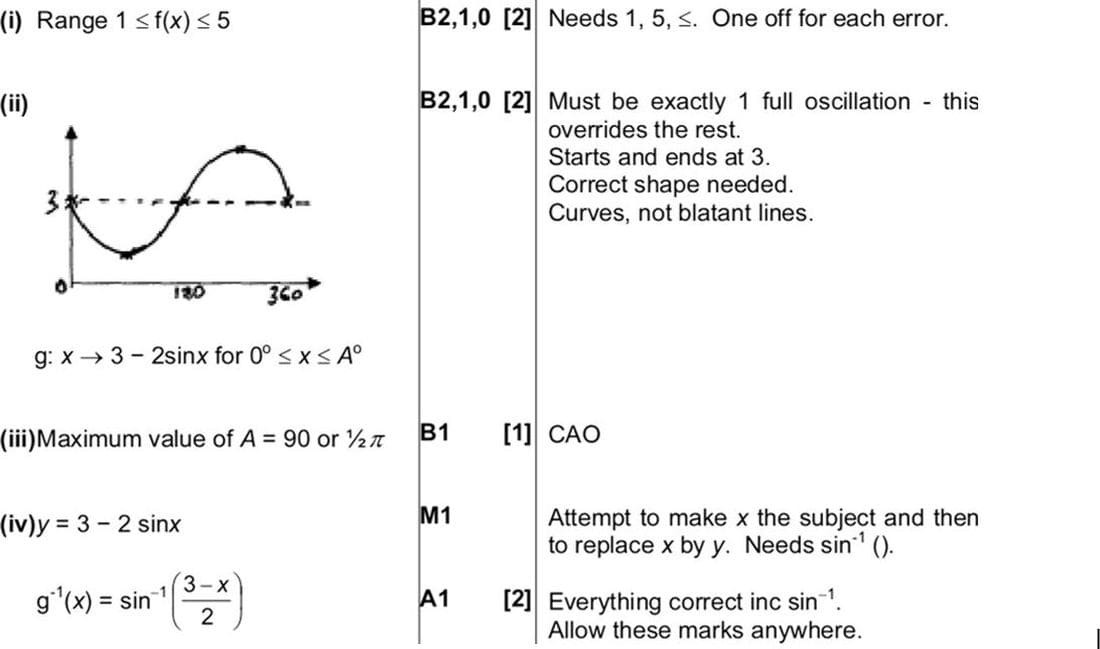
A function f is defined by \(f : x \mapsto 3 - 2 \sin x\), for \(0^\circ \leq x \leq 360^\circ\).
(i) Find the range of \(f\). [2]
(ii) Sketch the graph of \(y = f(x)\). [2]
A function \(g\) is defined by \(g : x \mapsto 3 - 2 \sin x\), for \(0^\circ \leq x \leq A^\circ\), where \(A\) is a constant.
(iii) State the largest value of \(A\) for which \(g\) has an inverse. [1]
(iv) When \(A\) has this value, obtain an expression, in terms of \(x\), for \(g^{-1}(x)\). [2]
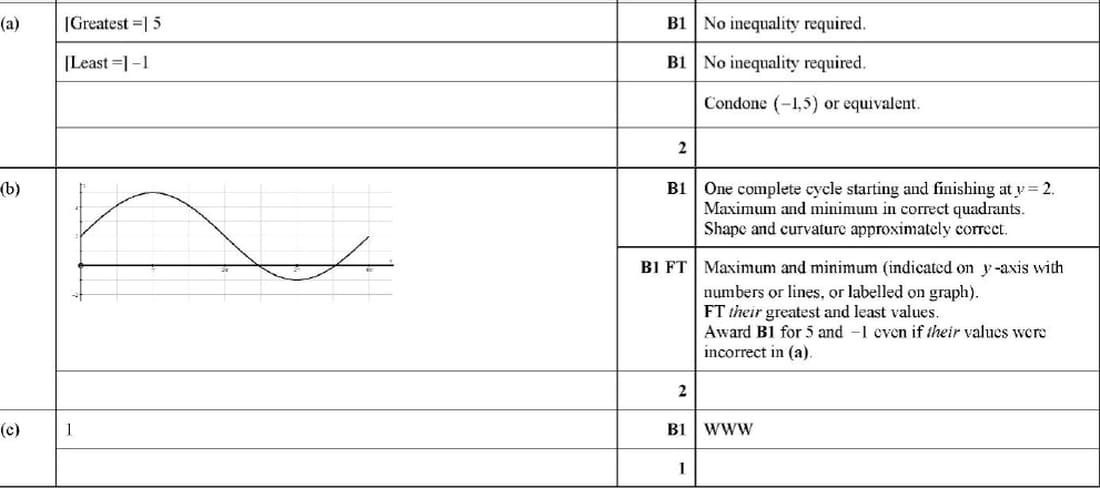
9709 P11 - Jun 2023 - Q7 - 5 marks
A curve has equation \(y = 2 + 3 \, \sin \frac{1}{2}x\) for \(0 \leq x \leq 4\pi\).
(a) State greatest and least values of \(y\). [2]
(b) Sketch the curve. [2]
(c) State the number of solutions of the equation \(2 + 3 \, \sin \frac{1}{2}x = 5 - 2x\) for \(0 \leq x \leq 4\pi\). [1]
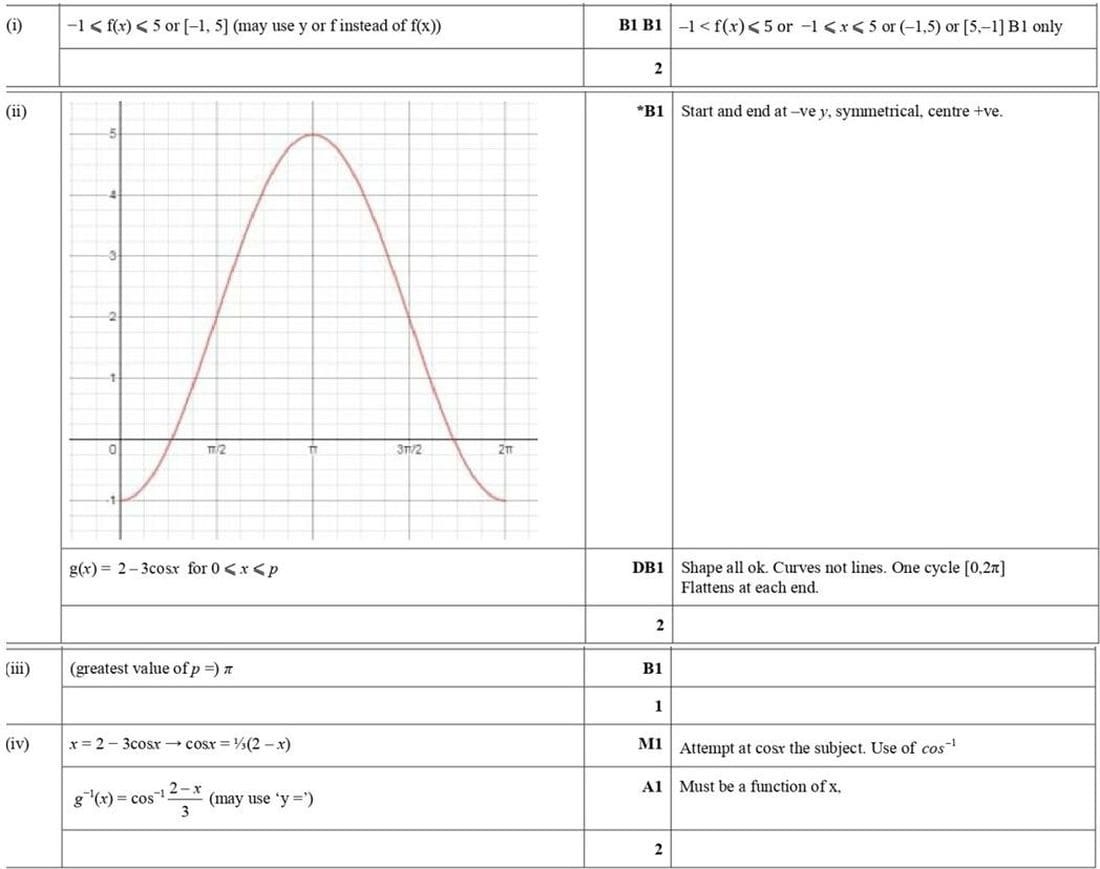
9709 P11 - Jun 2019 - Q9 - 7 marks
The function f is defined by \(f(x) = 2 - 3 \cos x\) for \(0 \leq x \leq 2\pi\).
- State the range of \(f\). [2]
- Sketch the graph of \(y = f(x)\). [2]
The function \(g\) is defined by \(g(x) = 2 - 3 \cos x\) for \(0 \leq x \leq p\), where \(p\) is a constant.
- State the largest value of \(p\) for which \(g\) has an inverse. [1]
- For this value of \(p\), find an expression for \(g^{-1}(x)\). [2]
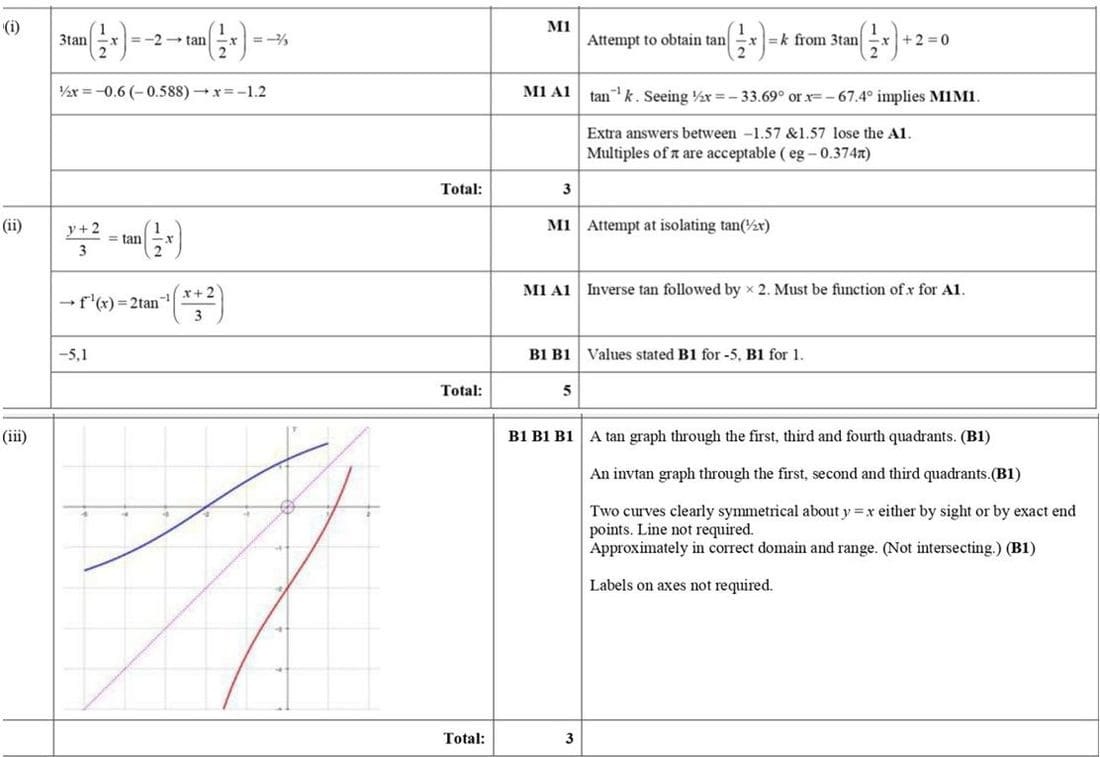
9709 P12 - Jun 2017 - Q10 - 11 marks
The function \(f\) is defined by \(f(x) = 3 \tan\left(\frac{1}{2}x\right) - 2\), for \(-\frac{1}{2}\pi \leq x \leq \frac{1}{2}\pi\).
(i) Solve the equation \(f(x) + 4 = 0\), giving your answer correct to 1 decimal place. [3]
(ii) Find an expression for \(f^{-1}(x)\) and find the domain of \(f^{-1}\). [5]
(iii) Sketch, on the same diagram, the graphs of \(y = f(x)\) and \(y = f^{-1}(x)\). [3]
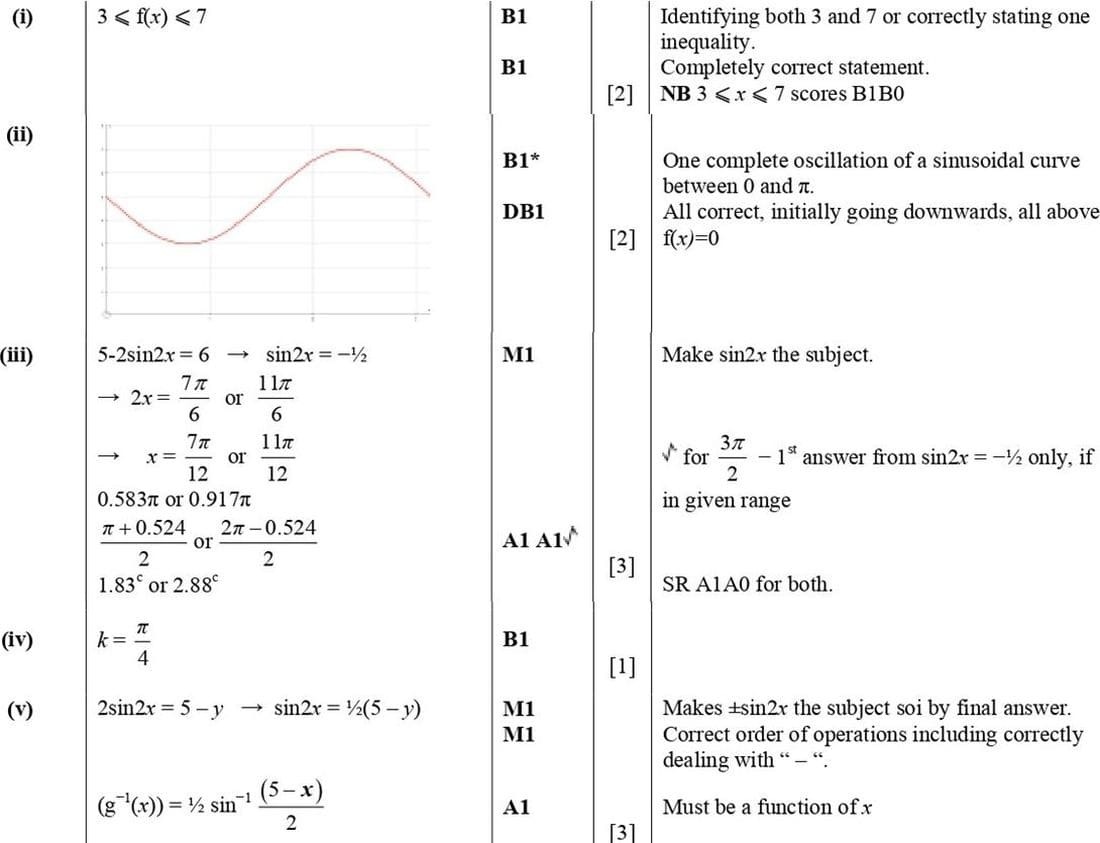
9709 P12 - Nov 2016 - Q10 - 11 marks
A function \(f\) is defined by \(f : x \mapsto 5 - 2 \sin 2x\) for \(0 \leq x \leq \pi\).
(i) Find the range of \(f\). [2]
(ii) Sketch the graph of \(y = f(x)\). [2]
(iii) Solve the equation \(f(x) = 6\), giving answers in terms of \(\pi\). [3]
The function \(g\) is defined by \(g : x \mapsto 5 - 2 \sin 2x\) for \(0 \leq x \leq k\), where \(k\) is a constant.
(iv) State the largest value of \(k\) for which \(g\) has an inverse. [1]
(v) For this value of \(k\), find an expression for \(g^{-1}(x)\). [3]
9709 P11 - Jun 2016 - Q11 - 11 marks
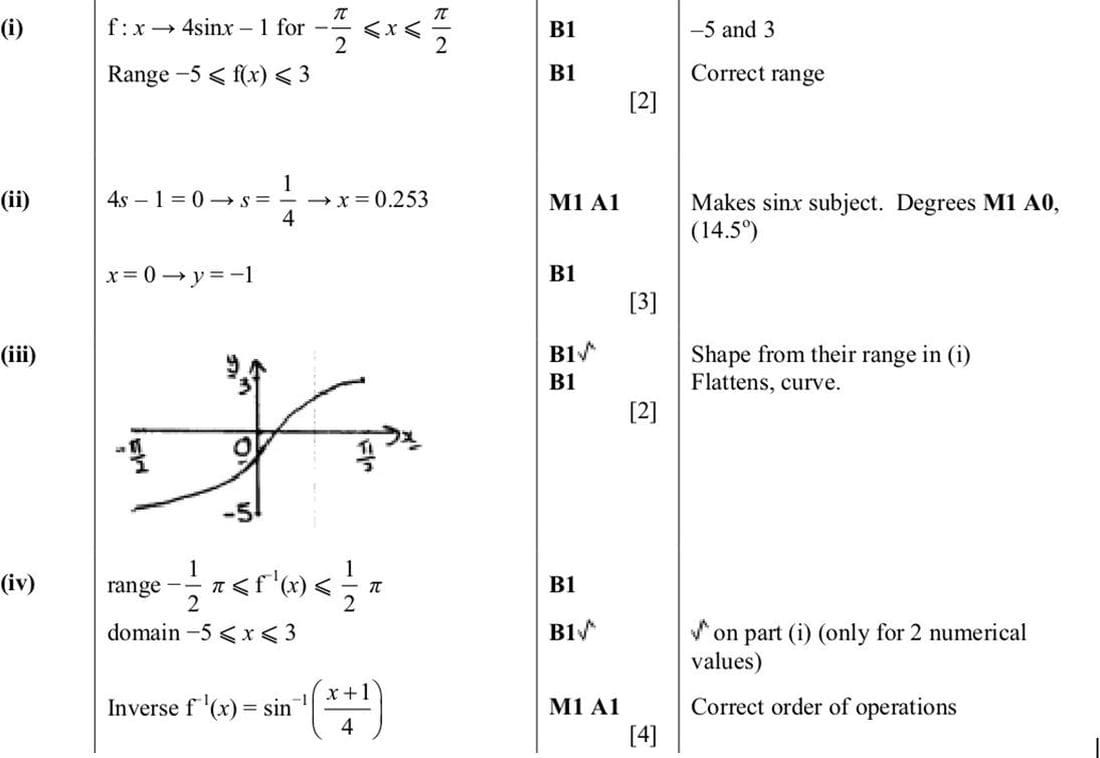
The function f is defined by \(f : x \mapsto 4 \sin x - 1\) for \(-\frac{1}{2}\pi \leq x \leq \frac{1}{2}\pi\).
- State the range of \(f\). [2]
- Find the coordinates of the points at which the curve \(y = f(x)\) intersects the coordinate axes. [3]
- Sketch the graph of \(y = f(x)\). [2]
- Obtain an expression for \(f^{-1}(x)\), stating both the domain and range of \(f^{-1}\). [4]
9709 P11 - Jun 2015 - Q8 - 9 marks
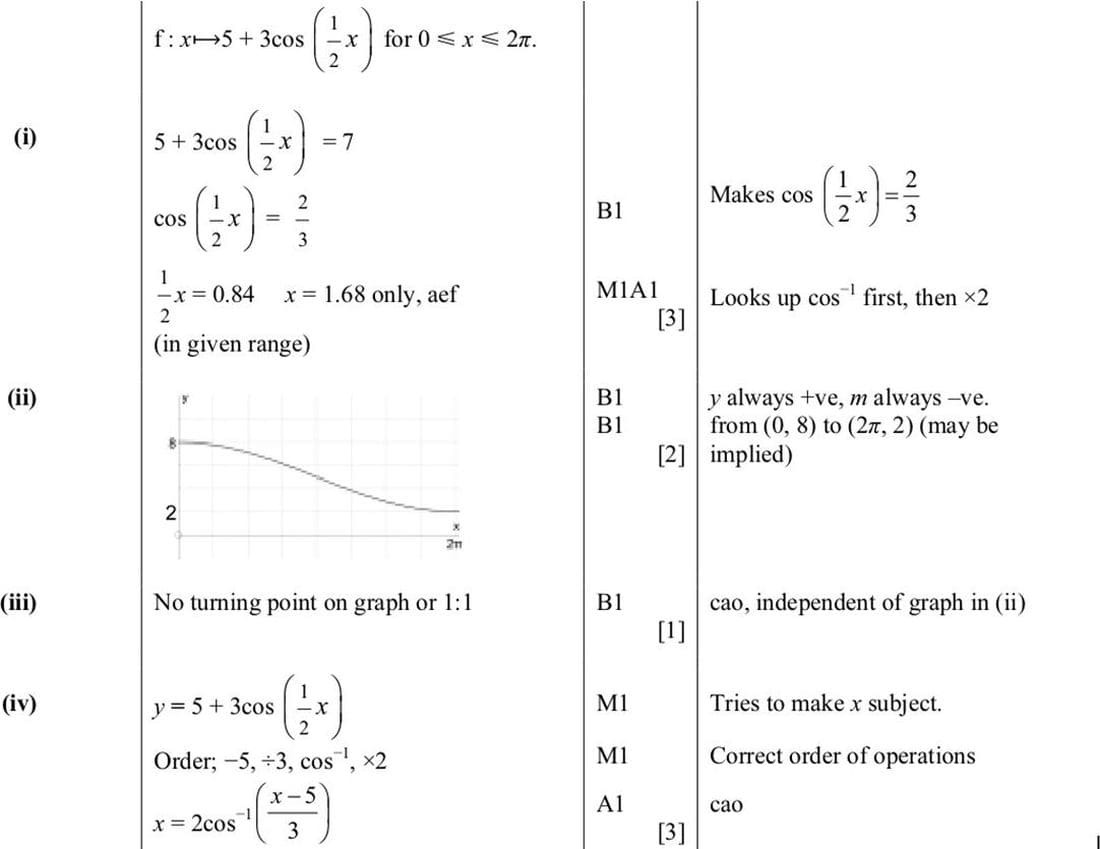
The function \(f : x \mapsto 5 + 3 \cos\left(\frac{1}{2}x\right)\) is defined for \(0 \leq x \leq 2\pi\).
- Solve the equation \(f(x) = 7\), giving your answer correct to 2 decimal places. [3]
- Sketch the graph of \(y = f(x)\). [2]
- Explain why \(f\) has an inverse. [1]
- Obtain an expression for \(f^{-1}(x)\). [3]
9709 P12 - Nov 2014 - Q11 - 10 marks
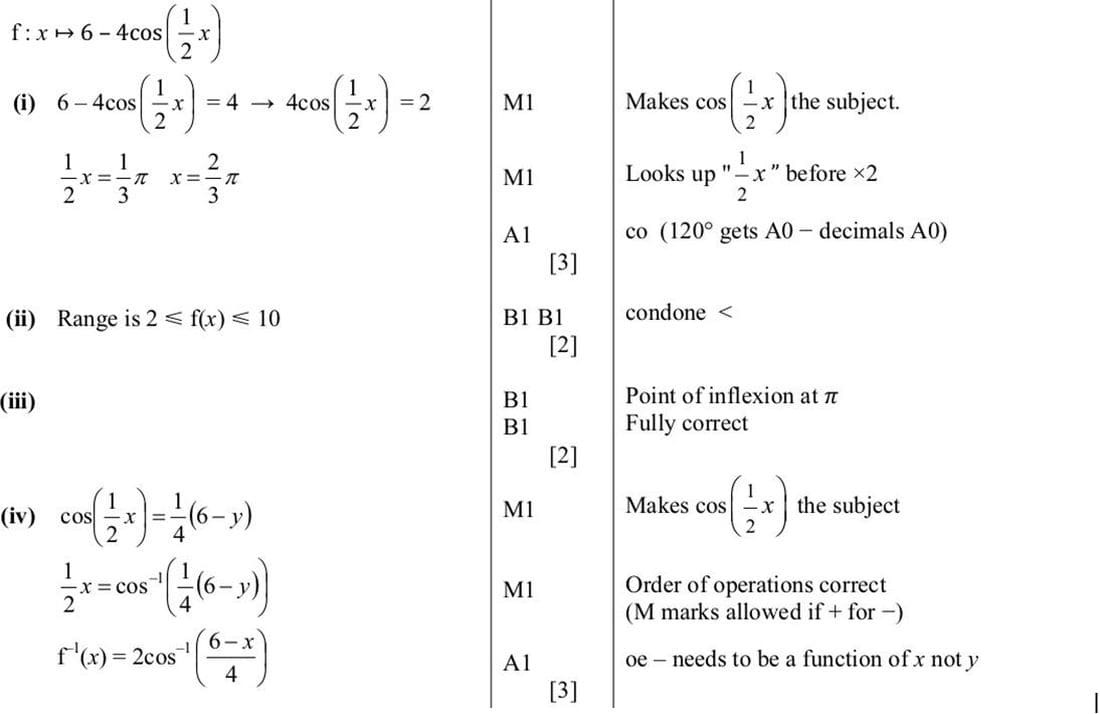
The function \(f : x \mapsto 6 - 4\cos\left(\frac{1}{2}x\right)\) is defined for \(0 \leq x \leq 2\pi\).
- Find the exact value of \(x\) for which \(f(x) = 4\). [3]
- State the range of \(f\). [2]
- Sketch the graph of \(y = f(x)\). [2]
- Find an expression for \(f^{-1}(x)\). [3]
9709 P12 - Nov 2013 - Q8 - 10 marks
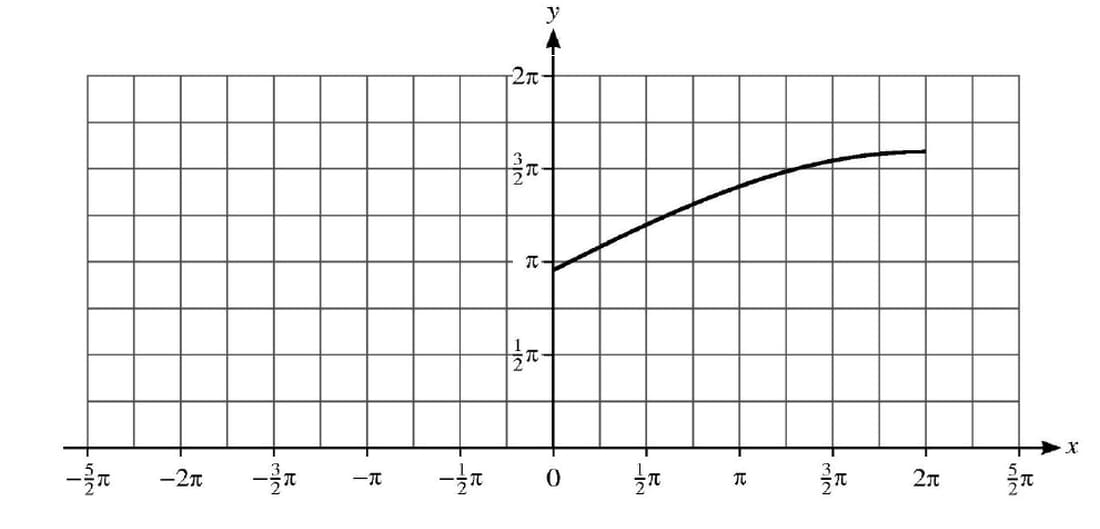
A function f is defined by \(f : x \mapsto 3 \cos x - 2\) for \(0 \leq x \leq 2\pi\).
- Solve the equation \(f(x) = 0\). [3]
- Find the range of \(f\). [2]
- Sketch the graph of \(y = f(x)\). [2]
A function g is defined by \(g : x \mapsto 3 \cos x - 2\) for \(0 \leq x \leq k\).
- State the maximum value of \(k\) for which \(g\) has an inverse. [1]
- Obtain an expression for \(g^{-1}(x)\). [2]