A4.1 — A strategy that always works
Years 5-7 · Lesson 4: A strategy that always works
There are \(14\) stones in a pile. In one move, a player may take \(1\) or \(2\) stones. Whoever takes the last stone wins. Who wins with perfect play?
A4.2 — A strategy that always works
Years 5-7 · Lesson 4: A strategy that always works
Two players take turns removing one, two or three stones from a pile of 30. A player with no legal move loses. Which player can force a win, and how?
Source: Games. Many games. — Khamovniki, Russian Grade 6, Series 20, 14 March 2015. K4, Problem 2. Preparation-circle worksheet.
A4.3 — A strategy that always works
Years 5-7 · Lesson 4: A strategy that always works
There are two piles of \(10\) stones each. In one move, a player may take any positive number of stones from one pile. The last move wins. Prove that the second player wins.
A4.4 — A strategy that always works
Years 5-7 · Lesson 4: A strategy that always works
Three piles contain 10, 15 and 20 stones. Players take turns splitting one pile containing more than one stone into two non-empty piles. A player who cannot move loses. Who wins? Prove that your answer does not depend on the choices made.
Source: Games. Many games. — Khamovniki, Russian Grade 6, Series 20, 14 March 2015. K4, Problem 3. Preparation-circle worksheet.
A4.5 — A strategy that always works
Years 5-7 · Lesson 4: A strategy that always works
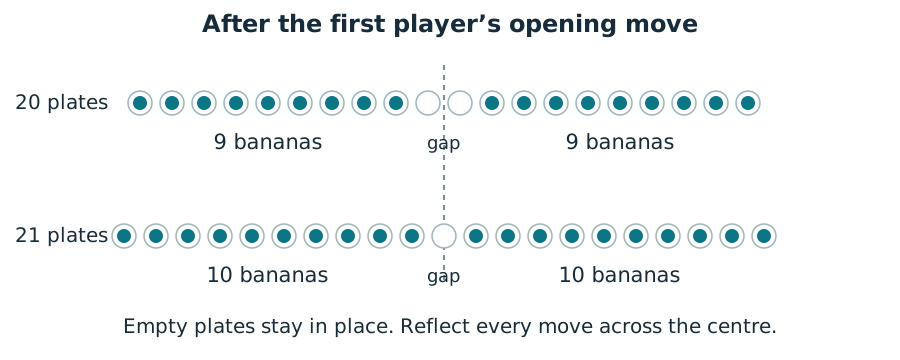
A row contains one banana on each plate. Players take turns taking a banana from one plate, or taking the bananas from two adjacent plates that both still contain a banana. Empty plates stay in place. The last player to take a banana wins. Find a winning strategy for (a) 20 plates and (b) 21 plates.
Source: Games. Many games. — Khamovniki, Russian Grade 6, Series 20, 14 March 2015. K4, Problem 5(a,b). Preparation-circle worksheet.
B4.1 — Squares give bounds
Year 10 · Lesson 4: Squares give bounds
Prove that for all real \(a,b\), \(a^2+b^2\ge2ab\).
B4.2 — Squares give bounds
Year 10 · Lesson 4: Squares give bounds
Find the least value of \(x^2-8x+y^2+2y+20\) for real \(x,y\).
Source: Maths4U Olympiad — Minimum of a quadratic expression
B4.3 — Squares give bounds
Year 10 · Lesson 4: Squares give bounds
Let \(x,y>0\) and \(x+y=10\). Prove that \(xy\le25\).
B4.4 — Squares give bounds
Year 10 · Lesson 4: Squares give bounds
Prove that \(a^2+b^2+c^2\ge ab+bc+ca\) for all real \(a,b,c\). State when equality holds.
Source: The very first inequality — Khamovniki, Russian Group 7, 9 November 2024. K7, Problem 0. Preparation-circle worksheet.
B4.5 — Squares give bounds
Year 10 · Lesson 4: Squares give bounds
Find the greatest possible value of
for real numbers \(x,y,z\).
Source: Algebraic formulas: continuation — Khamovniki, Russian Group 7, 19 October 2024. K6, Problem 5. Preparation-circle worksheet.
C4.1 — Inequalities from squares
Year 13 · Lesson 4: Inequalities from squares
For \(x>0\), find the least value of \(x+\frac{1}{x}\).
C4.2 — Inequalities from squares
Year 13 · Lesson 4: Inequalities from squares
Let \(x,y>0\). Prove that \(\frac{x^2}{y}+\frac{y^2}{x}\ge x+y\).
C4.3 — Inequalities from squares
Year 13 · Lesson 4: Inequalities from squares
For \(a,b>0\), prove that \(\frac{x^2}{a}+\frac{y^2}{b}\ge\frac{(x+y)^2}{a+b}\) for all real \(x,y\).
C4.4 — Inequalities from squares
Year 13 · Lesson 4: Inequalities from squares
Positive real numbers \(x,y\) satisfy \(x+y=1\). Prove that
Source: Algebraic formulas — Khamovniki, Russian Group 7, 5 October 2024. K5, Problem 4. Preparation-circle worksheet.
C4.5 — Inequalities from squares
Year 13 · Lesson 4: Inequalities from squares
Let \(a,b,c>0\). Prove