A1.1 — Examples and logical conclusions
Years 5-7 · Lesson 1: Examples and logical conclusions
Can three positive integers have their sum equal to their product? Give an example or prove that it is impossible.
Source: Can or Cannot? — Khamovniki, Russian Grade 6, Series 1, 20 September 2014. K1, Problem 1. Preparation-circle worksheet.
A1.2 — Examples and logical conclusions
Years 5-7 · Lesson 1: Examples and logical conclusions
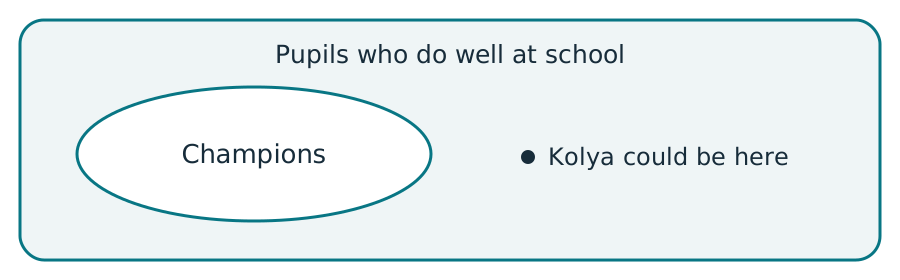
Kolya’s mother says, “Every champion does well at school.” Kolya replies, “I do well at school, so I am a champion.” Does his conclusion follow? Explain.
Source: Logic: the language of mathematics — Khamovniki, Russian Grades 5-7, Series 5, 18 October 2014. K2, Problem 1. Preparation-circle worksheet.
A1.3 — Examples and logical conclusions
Years 5-7 · Lesson 1: Examples and logical conclusions
A positive integer \(n\) is divisible by both positive integers \(a\) and \(b\). Can \(n\) fail to be divisible by \(ab\)? Give an example or a proof.
Source: Can or Cannot? — Khamovniki, Russian Grade 6, Series 1, 20 September 2014. K1, Problem 2. Preparation-circle worksheet.
A1.4 — Examples and logical conclusions
Years 5-7 · Lesson 1: Examples and logical conclusions
Some residents of a town have beautiful handwriting. No poet has beautiful handwriting, and every boxer is a poet. A visitor claims that every resident is a boxer or a poet. Can the claim be true? Explain.
Source: Logic: the language of mathematics — Khamovniki, Russian Grades 5-7, Series 5, 18 October 2014. K2, Problem 5. Preparation-circle worksheet.
A1.5 — Examples and logical conclusions
Years 5-7 · Lesson 1: Examples and logical conclusions
A zoo with both hippos and rhinos has no giraffes. Every zoo has at least a rhino or a hippo. Any zoo with hippos and giraffes also has rhinos. A particular zoo has a giraffe. Must it have a rhino? Can it have a hippo?
Source: Logic: the language of mathematics — Khamovniki, Russian Grades 5-7, Series 5, 18 October 2014. K2, Problem 6. Preparation-circle worksheet.
B1.1 — Use identities to see more
Year 10 · Lesson 1: Use identities to see more
Factor \( (2a+b)^2-(a-2b)^2 \).
B1.2 — Use identities to see more
Year 10 · Lesson 1: Use identities to see more
Let \(x+y=7\), \(xy=10\). Find \(x^2+y^2\) and \(x^3+y^3\) without finding \(x\) and \(y\) separately.
Source: Maths4U Olympiad — Symmetric Sum
B1.3 — Use identities to see more
Year 10 · Lesson 1: Use identities to see more
If \(x+y=1\), find \(x^3+y^3+3xy\).
B1.4 — Use identities to see more
Year 10 · Lesson 1: Use identities to see more
Real numbers \(a,b,c\) satisfy
Find all possible triples \((a,b,c)\).
Source: Algebraic formulas — Khamovniki, Russian Group 7, 5 October 2024. K5, Problem 1. Preparation-circle worksheet.
B1.5 — Use identities to see more
Year 10 · Lesson 1: Use identities to see more
Real numbers \(a,b,c,d\) satisfy \(a+b=c+d\) and \(a^2+b^2=c^2+d^2\). Must \(a^3+b^3=c^3+d^3\)? Prove your answer.
Source: Algebraic formulas: continuation — Khamovniki, Russian Group 7, 19 October 2024. K6, Problem 3. Preparation-circle worksheet.
C1.1 — Symmetric expressions
Year 13 · Lesson 1: Symmetric expressions
Let \(x\ne0\) and \(x+\frac1x=3\). Find \(x^2+\frac1{x^2}\).
C1.2 — Symmetric expressions
Year 13 · Lesson 1: Symmetric expressions
Let \(x\ne0\) and \(x+\frac1x=3\). Find \(x^3+\frac1{x^3}\).
C1.3 — Symmetric expressions
Year 13 · Lesson 1: Symmetric expressions
Let \(a+b+c=0\). Prove that \(a^2+b^2+c^2=-2(ab+bc+ca)\) and \(a^3+b^3+c^3=3abc\).
Source: Maths4U Olympiad — Zero Sum
C1.4 — Symmetric expressions
Year 13 · Lesson 1: Symmetric expressions
Real numbers \(a,b,c\) satisfy \(a+b+c=0\) and \(a^2+b^2+c^2=1\). Find \(a^4+b^4+c^4\).
Source: Algebraic formulas: continuation — Khamovniki, Russian Group 7, 19 October 2024. K6, Problem 7. Preparation-circle worksheet.
C1.5 — Symmetric expressions
Year 13 · Lesson 1: Symmetric expressions
Let \(x+y+z=0\) and \(x^2+y^2+z^2=2\). Prove that the numbers \(x^3-x\), \(y^3-y\), \(z^3-z\) are equal.
Source: Maths4U Olympiad — Equal values