0606 P21 - Nov 2021 - Q10 - 9 marks
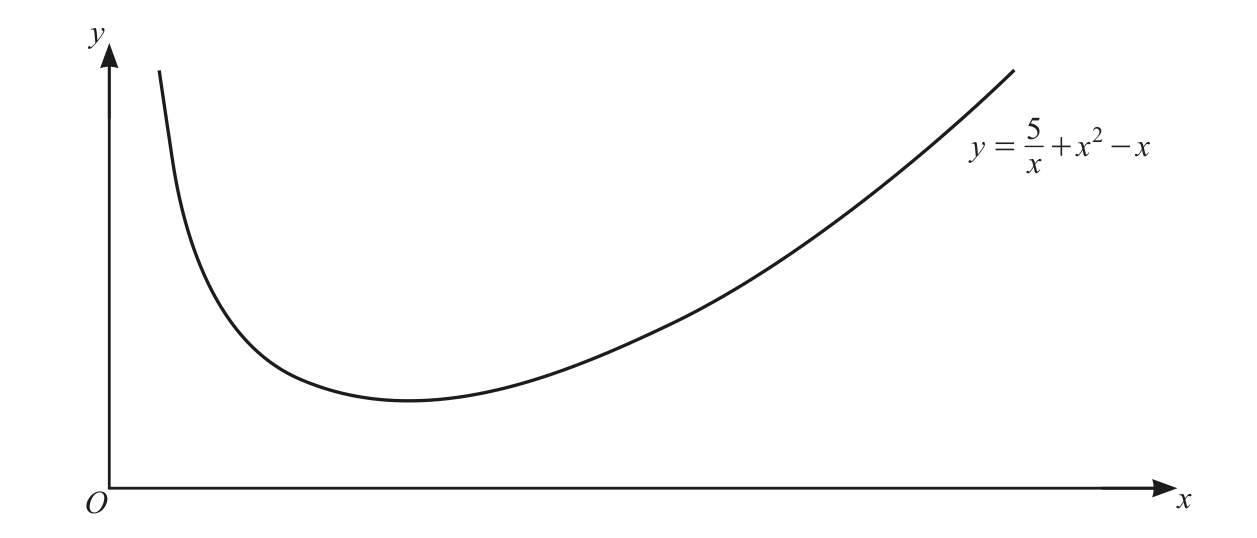
The diagram shows part of the curve
\(y=\frac5x+x^2-x.\)
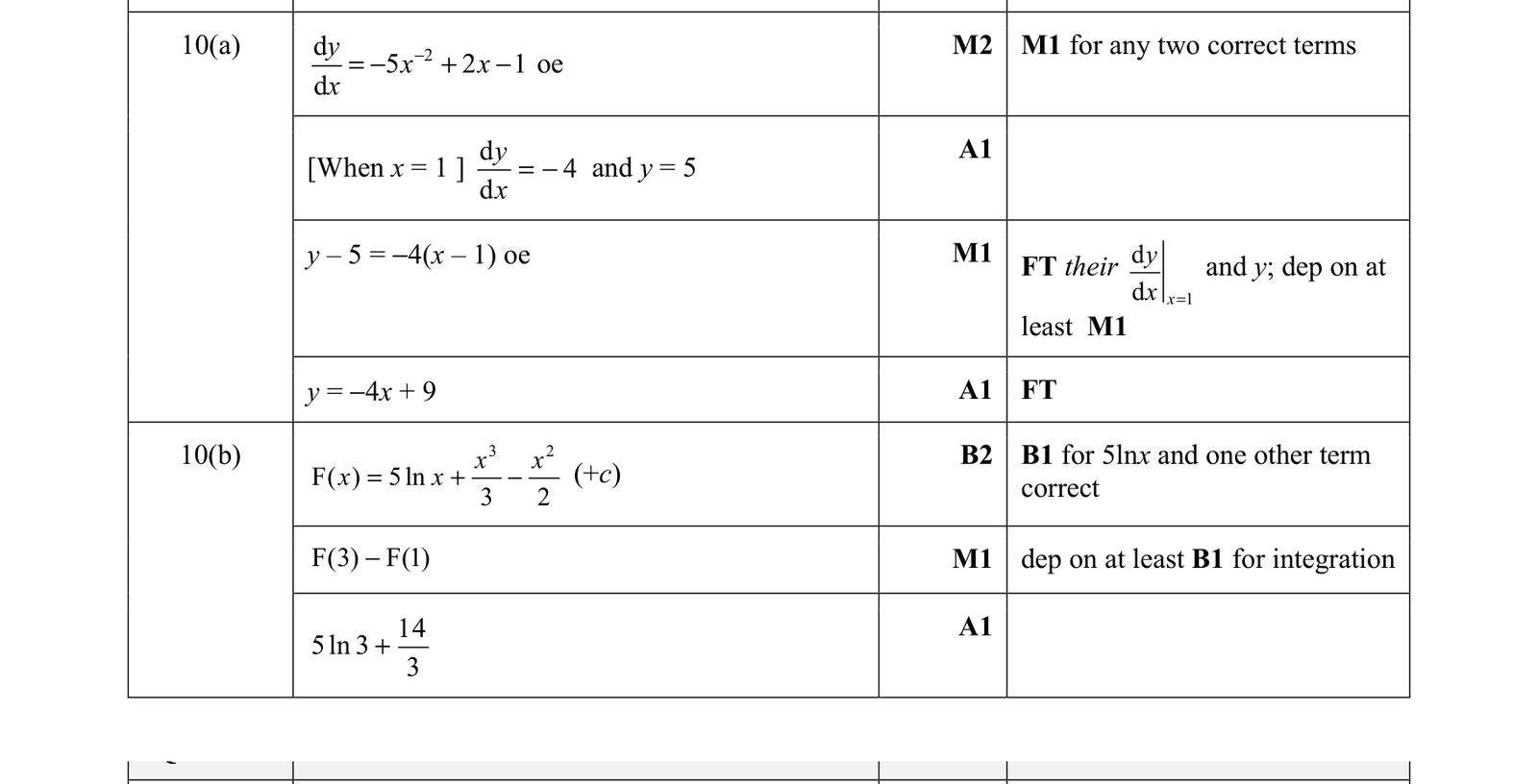
(a) Find, in the form \(y=mx+c\), the equation of the tangent to the curve at the point where \(x=1\).
(b) Find the exact area enclosed by the curve, the \(x\)-axis, and the lines \(x=1\) and \(x=3\).
0606 P21 - Nov 2020 - Q11 - 11 marks
The curve
\(y=x\sqrt{16-x^2},\qquad 0\leq x\leq 4,\)
has one stationary point.
(a) Find the coordinates of this stationary point, giving your answer in exact form.
(b)(i) Find \(\dfrac{d}{dx}\left(16-x^2\right)^{3/2}\).
(b)(ii) Find the area enclosed by the curve, the \(x\)-axis, and the lines \(x=1\) and \(x=3\), giving your answer to 3 significant figures.

0606 P23 - Jun 2019 - Q9 - 6 marks
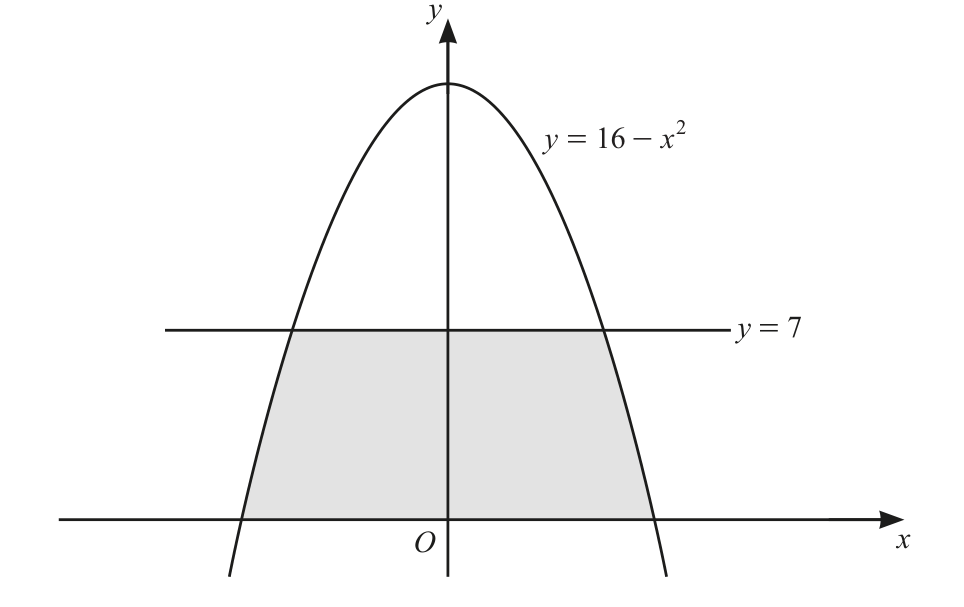
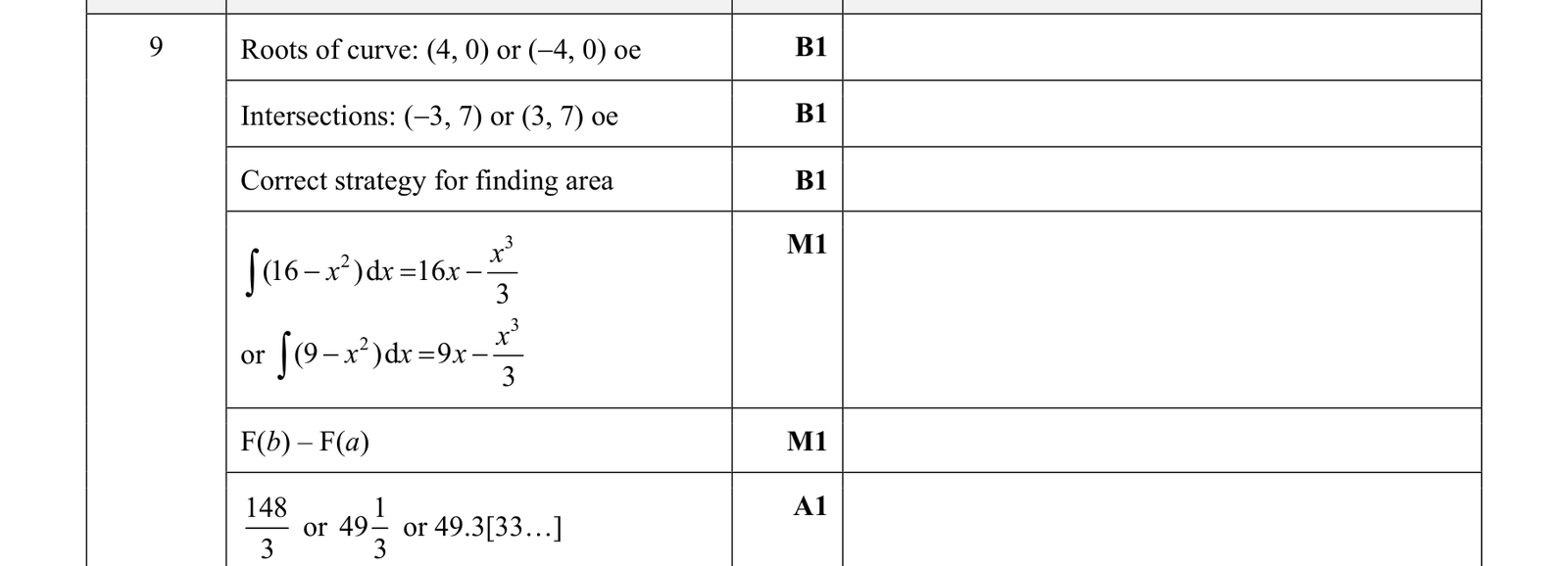
The diagram shows the curve \(y=16-x^2\) and the straight line \(y=7\). Find the area of the shaded region. You must show all your working.
0606 P23 - Nov 2019 - Q7 - 10 marks
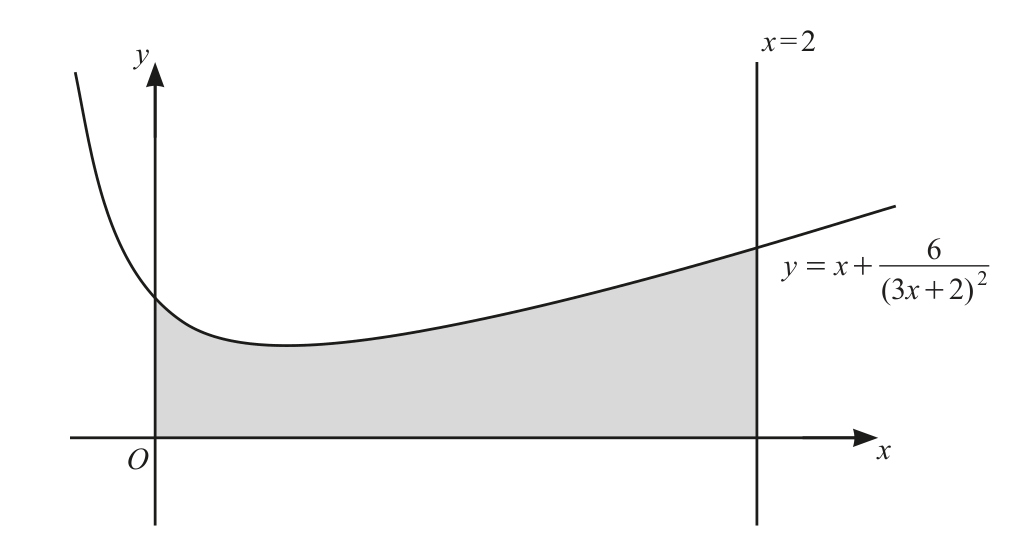
The diagram shows part of the curve
\(y=x+\frac{6}{(3x+2)^2}\)
and the line \(x=2\).
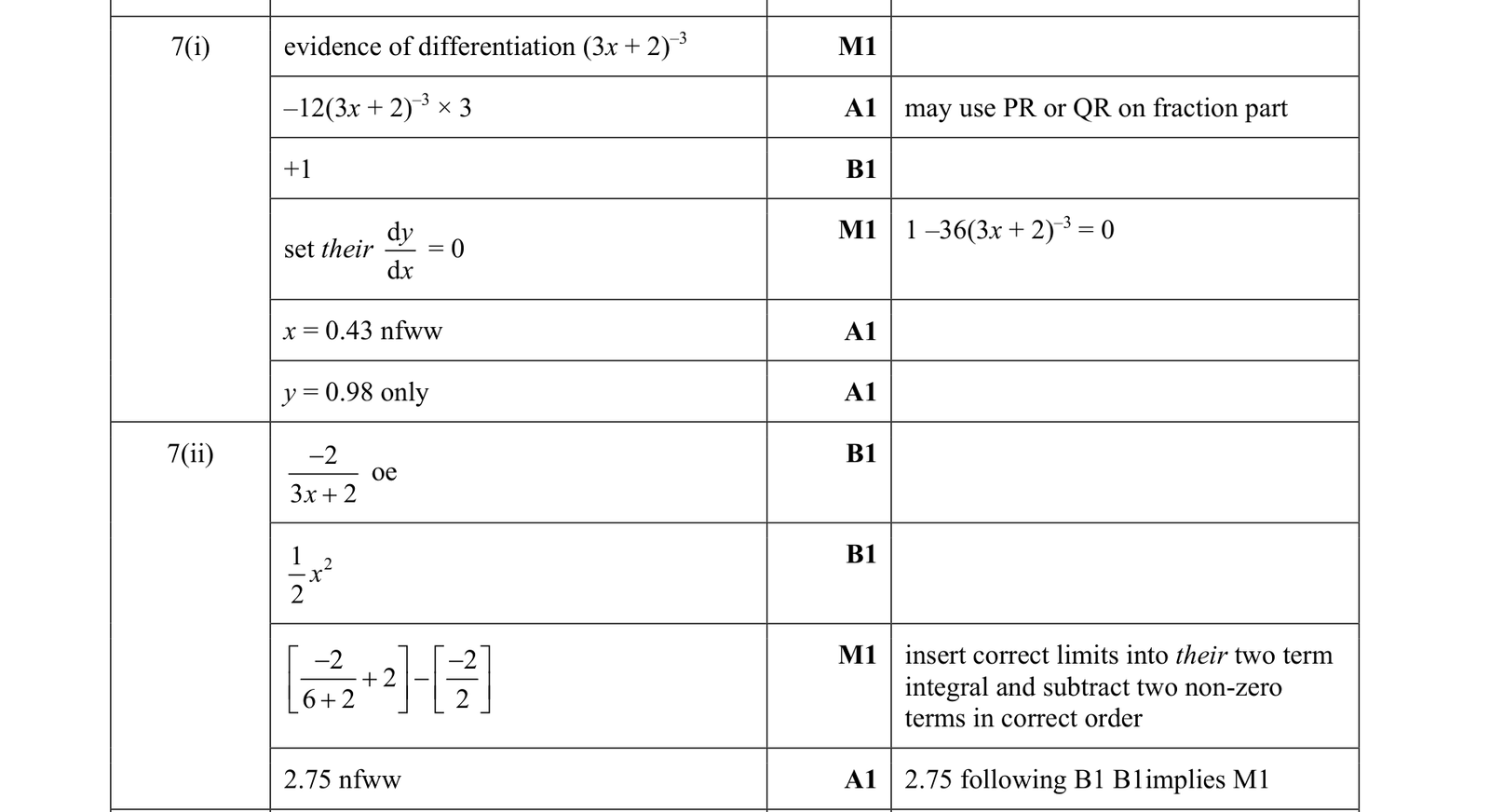
(i) Find, correct to 2 decimal places, the coordinates of the stationary point.
(ii) Find the area of the shaded region, showing all your working.
0606 P11 - Jun 2017 - Q9 - 7 marks
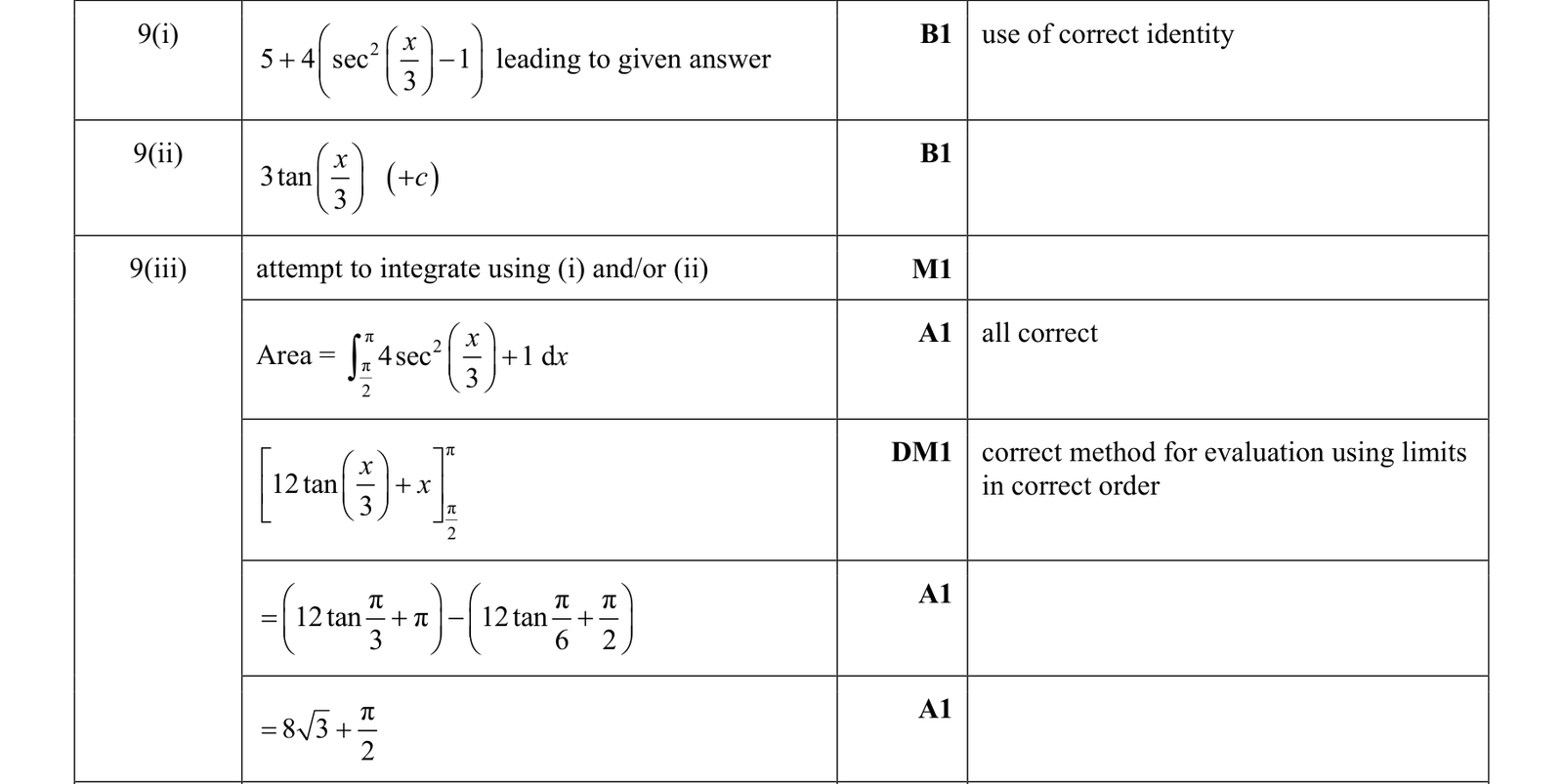
(i) Show that \(5+4\tan^2\left(\dfrac{x}{3}\right)=4\operatorname{sec}^2\left(\dfrac{x}{3}\right)+1\).
(ii) Given that \(\dfrac{d}{dx}\left(\tan\left(\dfrac{x}{3}\right)\right)=\dfrac13\operatorname{sec}^2\left(\dfrac{x}{3}\right)\), find \(\displaystyle\int \operatorname{sec}^2\left(\dfrac{x}{3}\right)\,dx\).
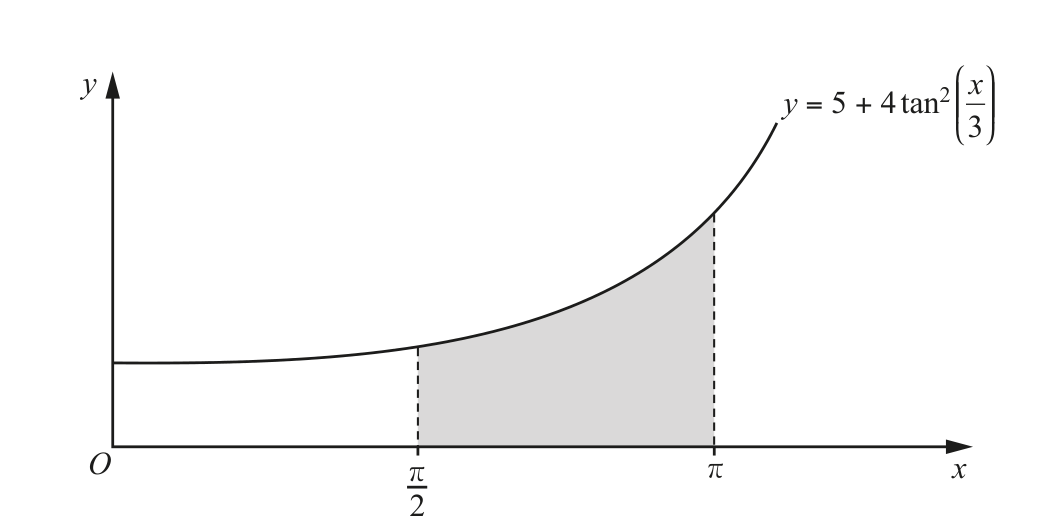
(iii) The diagram shows part of the curve \(y=5+4\tan^2\left(\dfrac{x}{3}\right)\). Using the results from parts (i) and (ii), find the exact area of the shaded region enclosed by the curve, the \(x\)-axis and the lines \(x=\dfrac{\pi}{2}\) and \(x=\pi\).
0606 P11 - Nov 2017 - Q5 - 8 marks
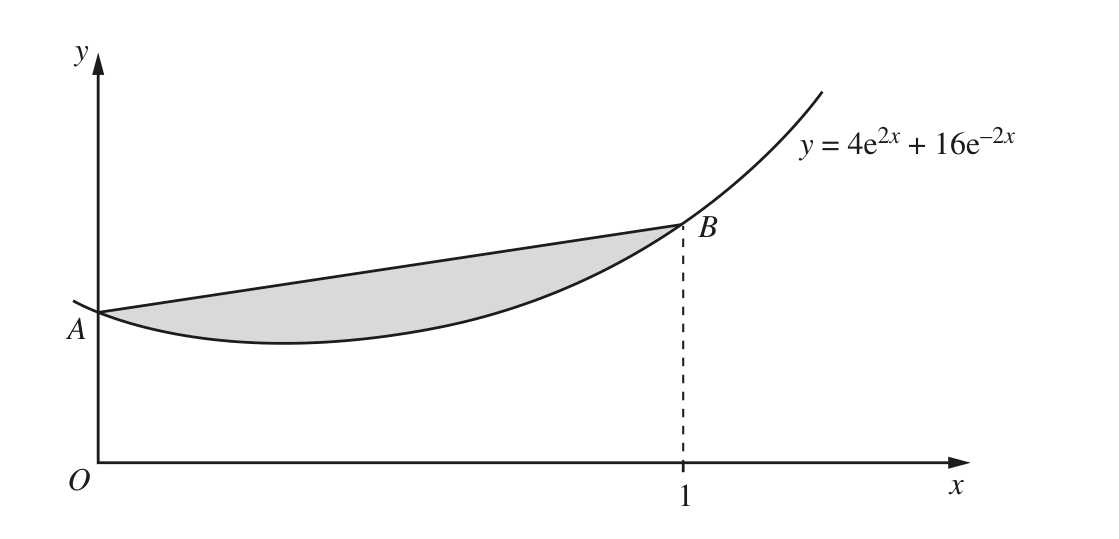
The diagram shows part of the graph of \(y=4e^{2x}+16e^{-2x}\), meeting the \(y\)-axis at the point \(A\) and the line \(x=1\) at the point \(B\).
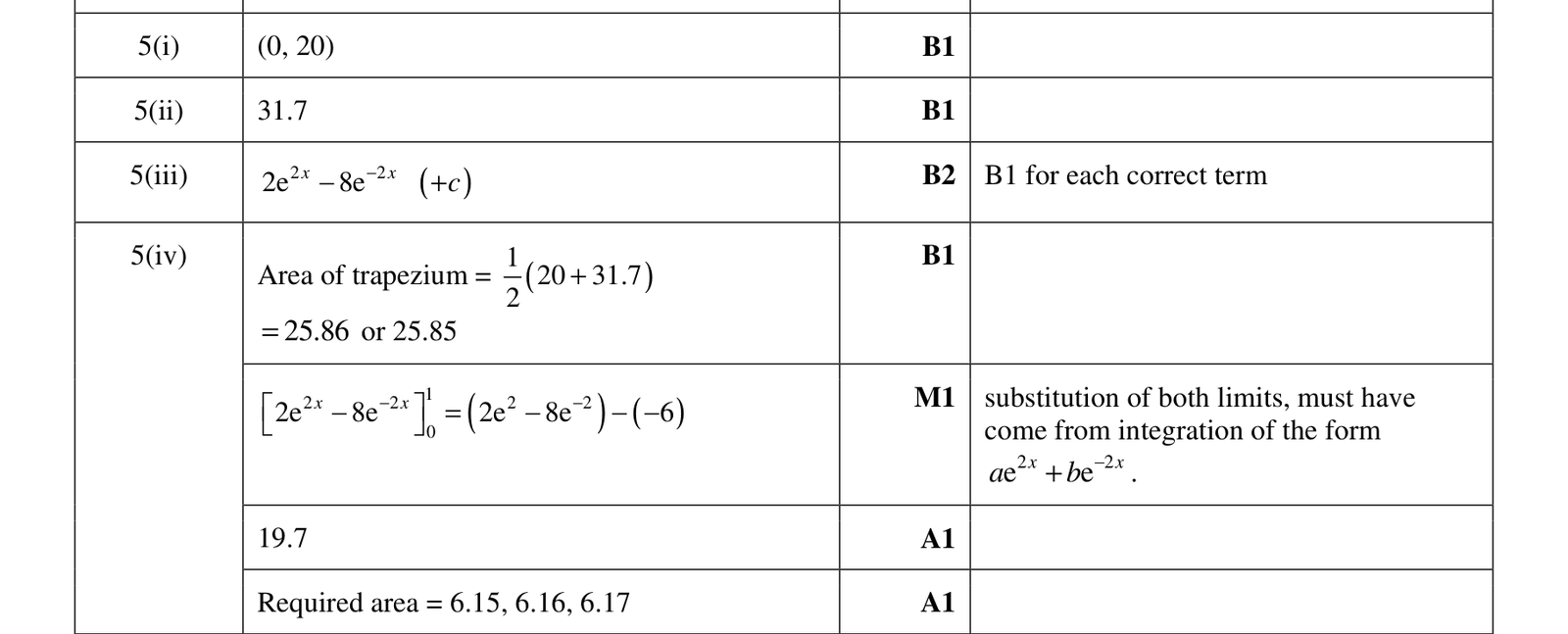
(i) Find the coordinates of \(A\).
(ii) Find the \(y\)-coordinate of \(B\).
(iii) Find \(\displaystyle\int(4e^{2x}+16e^{-2x})\,dx\).
(iv) Hence find the area of the shaded region enclosed by the curve and the line \(AB\). You must show all your working.