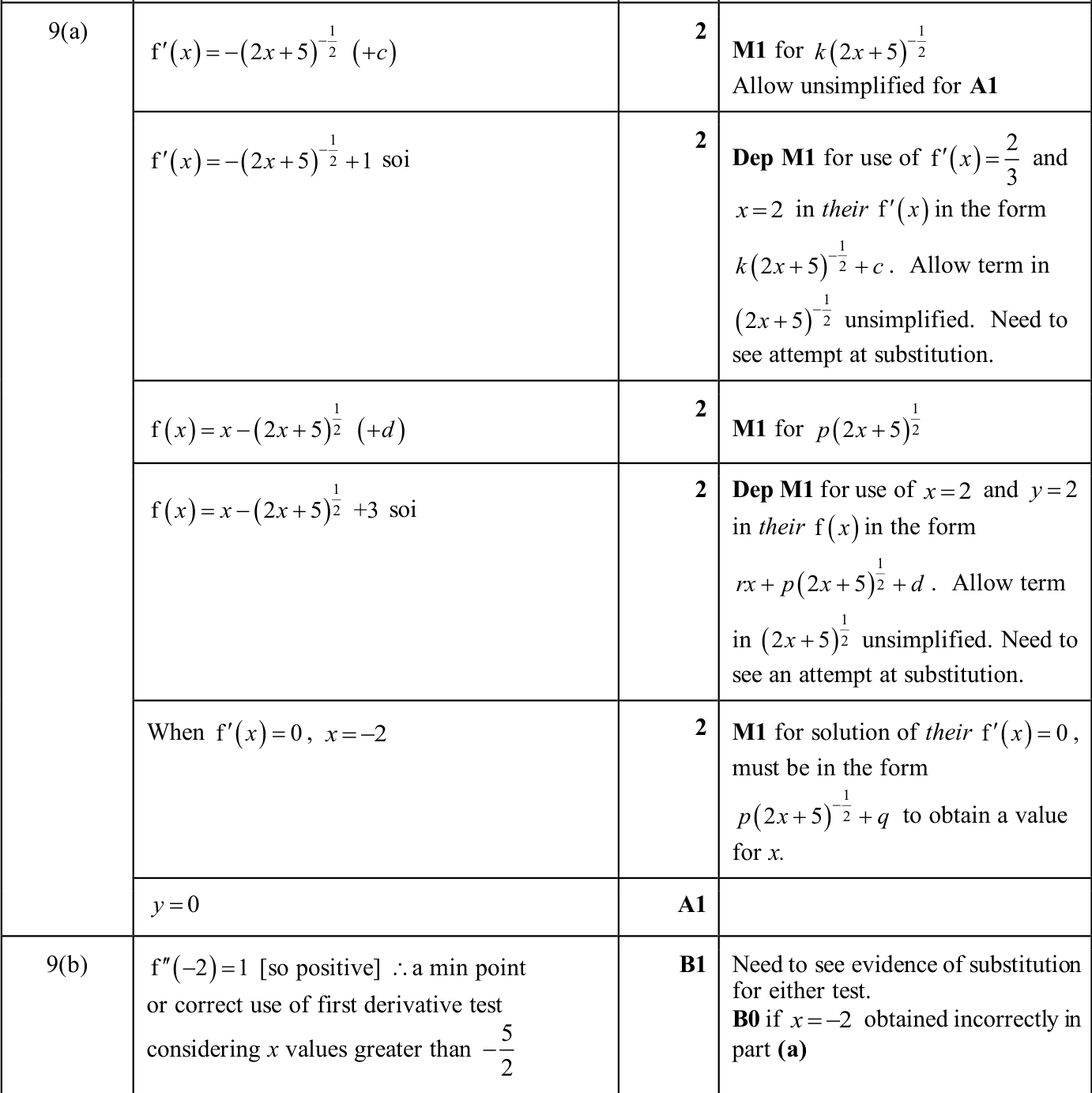
0606 P12 - Nov 2025 - Q9 - 12 marks
A curve \(y=\mathrm{f}(x)\) is such that \(\mathrm{f}''(x)=(2x+5)^{-\frac32}\). The curve has gradient \(\frac23\) at the point \((2,2)\).
(a) Find the coordinates of the stationary point on the curve.
(b) Determine the nature of this stationary point.
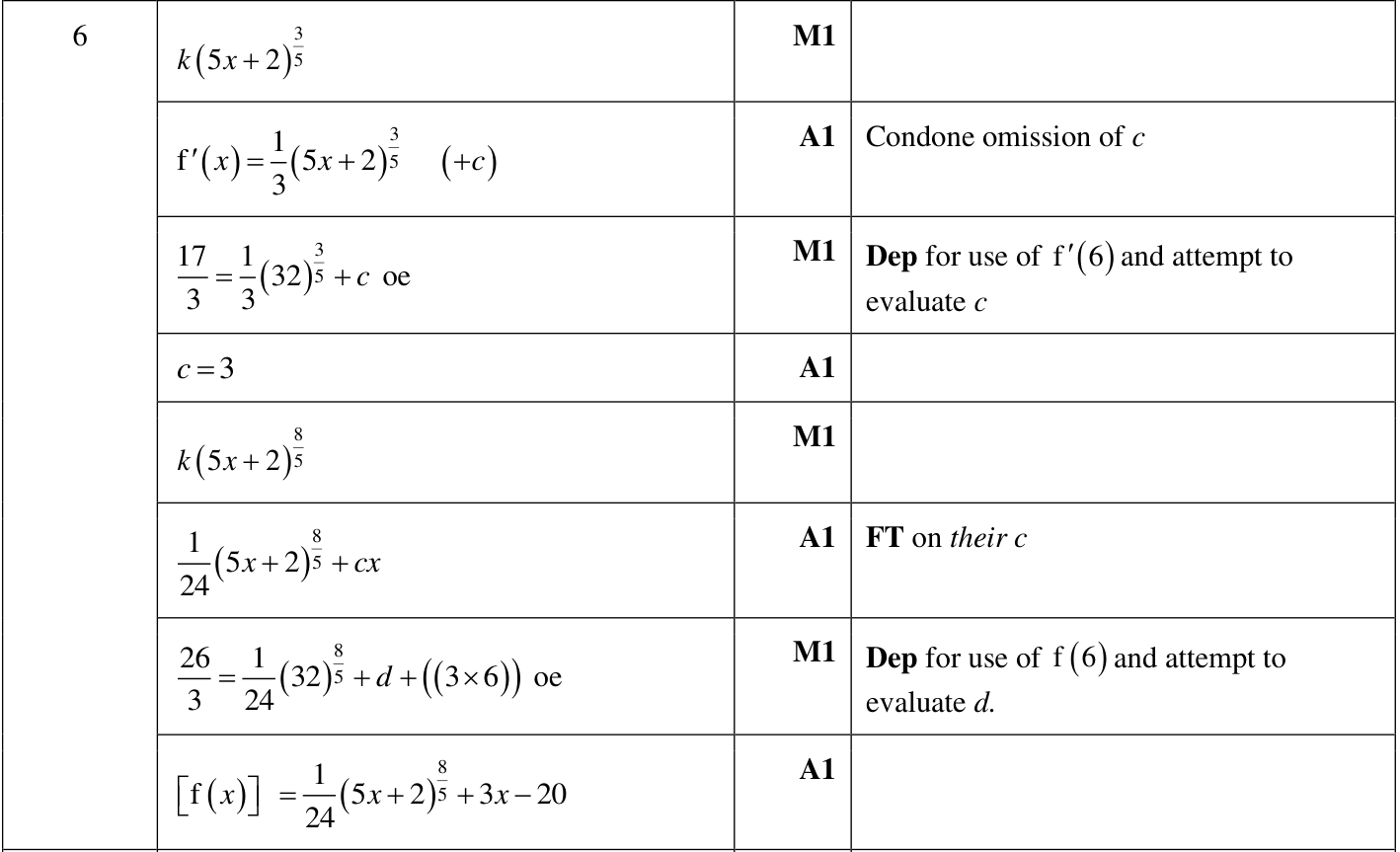
0606 P12 - Mar 2023 - Q6 - 8 marks
Given that
\(f''(x)=(5x+2)^{-2/5},\qquad f'(6)=\frac{17}{3}\)
and
\(f(6)=\frac{26}{3},\)
find an expression for \(f(x)\).
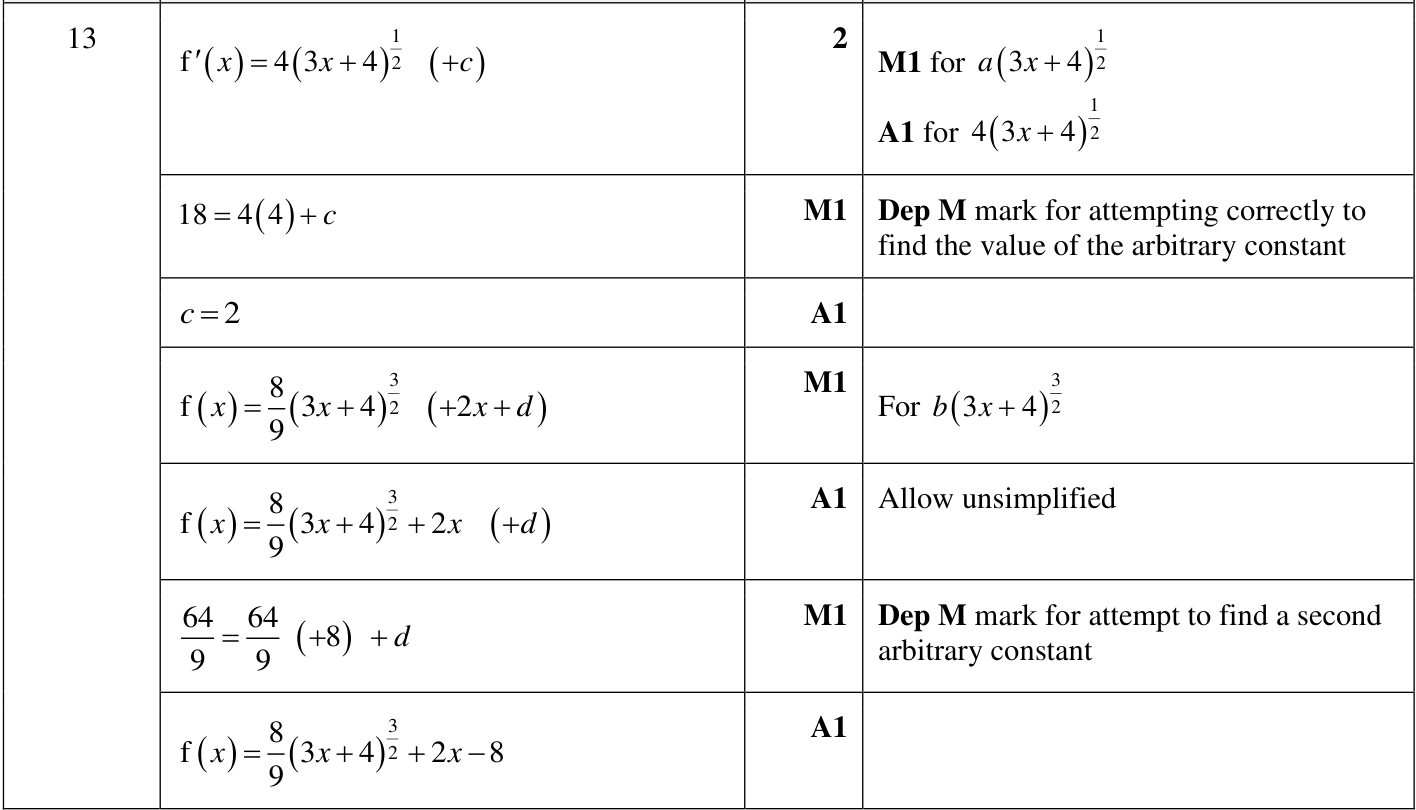
0606 P11 - Nov 2022 - Q13 - 8 marks
Given that
\(f''(x)=6(3x+4)^{-\frac12},\)
\(f'(4)=18\)
and
\(f(4)=\frac{512}{9},\)
find \(f(x)\).
0606 P13 - Nov 2021 - Q10 - 9 marks
A curve with equation \(y=\mathrm f(x)\) is such that
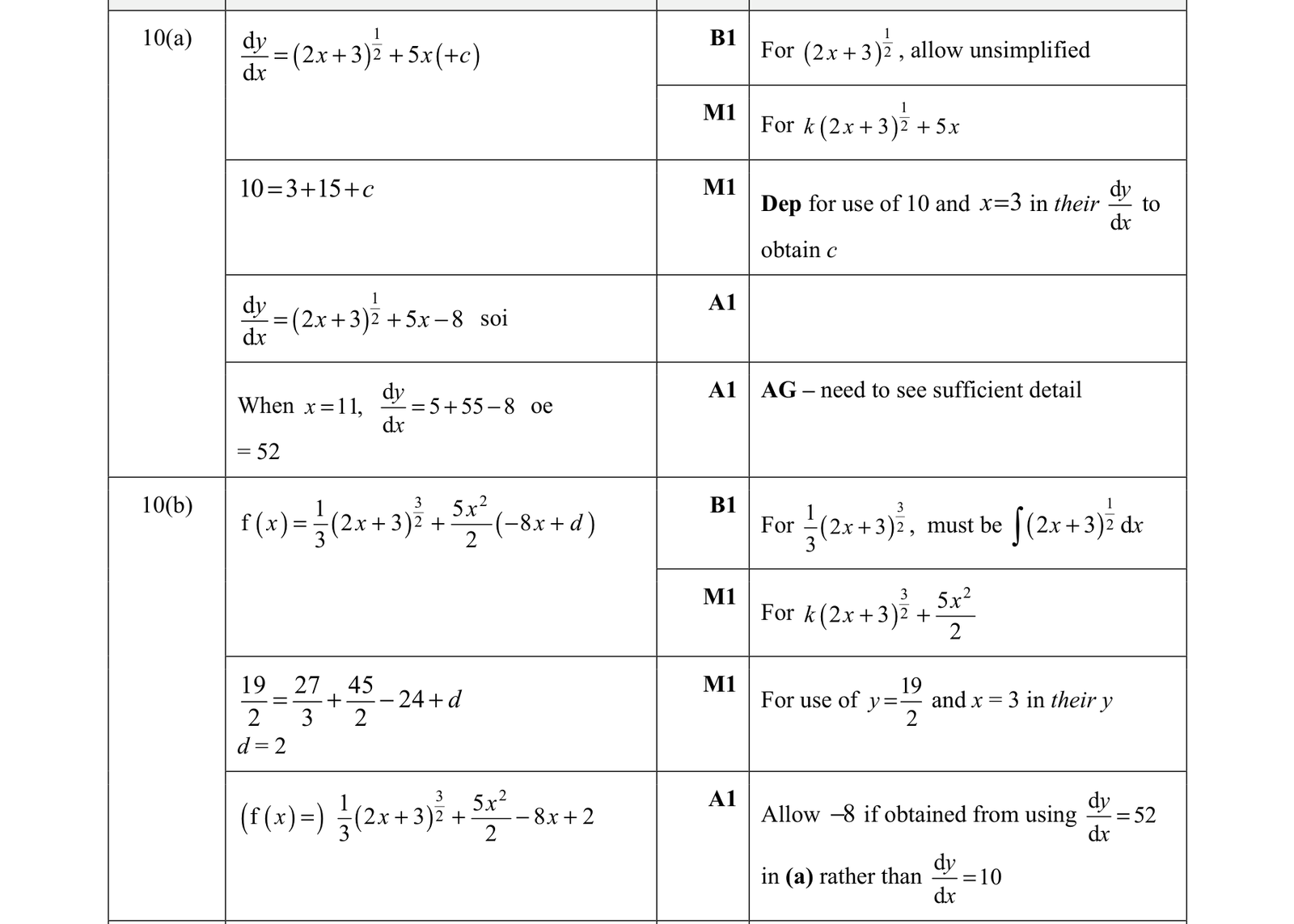
\(\frac{d^2y}{dx^2}=(2x+3)^{-\frac12}+5\)
for \(x\gt 0\). The curve has gradient \(10\) at the point \(\left(3,\frac{19}{2}\right)\).
(a) Show that, when \(x=11\), \(\frac{dy}{dx}=52\).
(b) Find \(\mathrm f(x)\).
0606 P22 - Nov 2021 - Q7 - 6 marks
It is given that
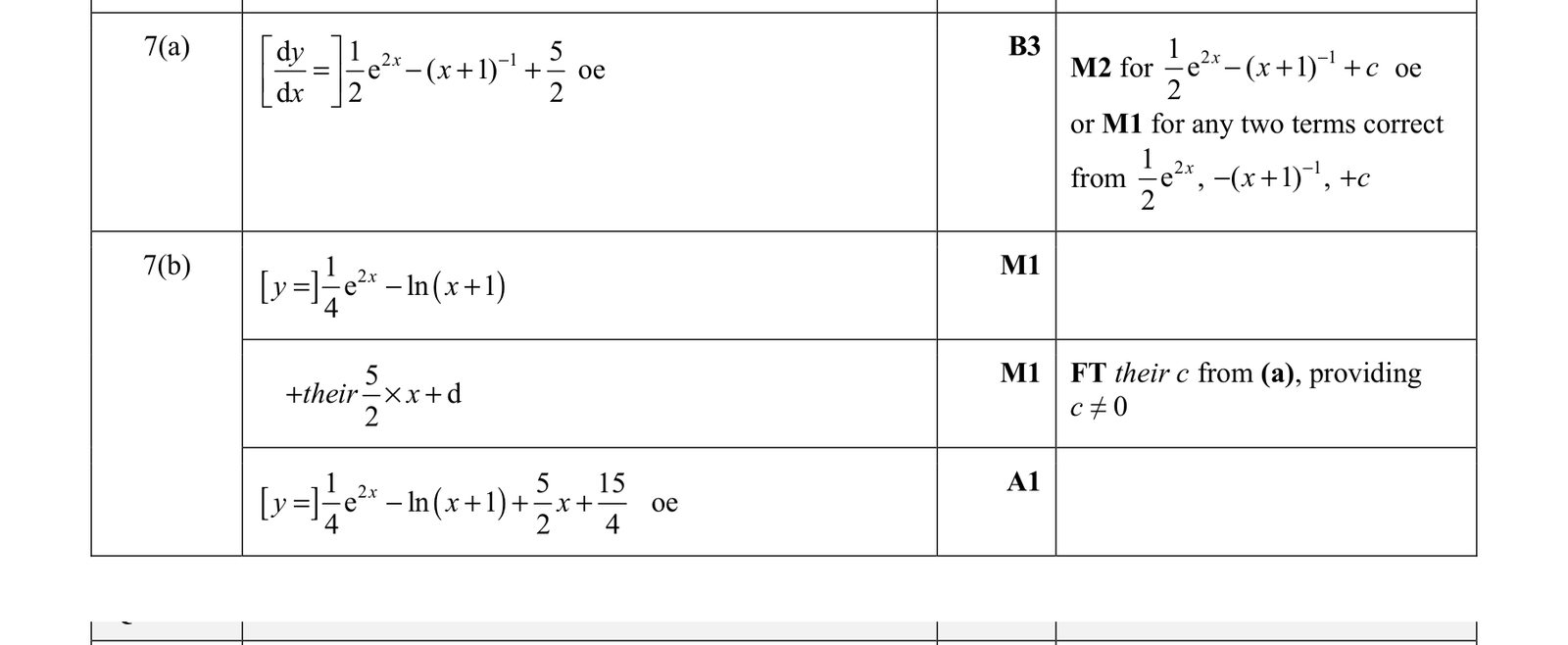
\(\frac{d^2y}{dx^2}=e^{2x}+\frac1{(x+1)^2}\)
for \(x\gt -1\).
(a) Find an expression for \(\frac{dy}{dx}\), given that \(\frac{dy}{dx}=2\) when \(x=0\).
(b) Find an expression for \(y\), given that \(y=4\) when \(x=0\).
0606 P11 - Jun 2020 - Q11 - 8 marks
A curve is such that
\(\frac{d^2y}{dx^2}=5\cos2x.\)
This curve has a gradient of \(\frac34\) at the point \(\left(-\frac{\pi}{12},\frac{5\pi}{4}\right)\). Find the equation of this curve.

0606 P11 - Nov 2019 - Q12 - 8 marks
A curve is such that
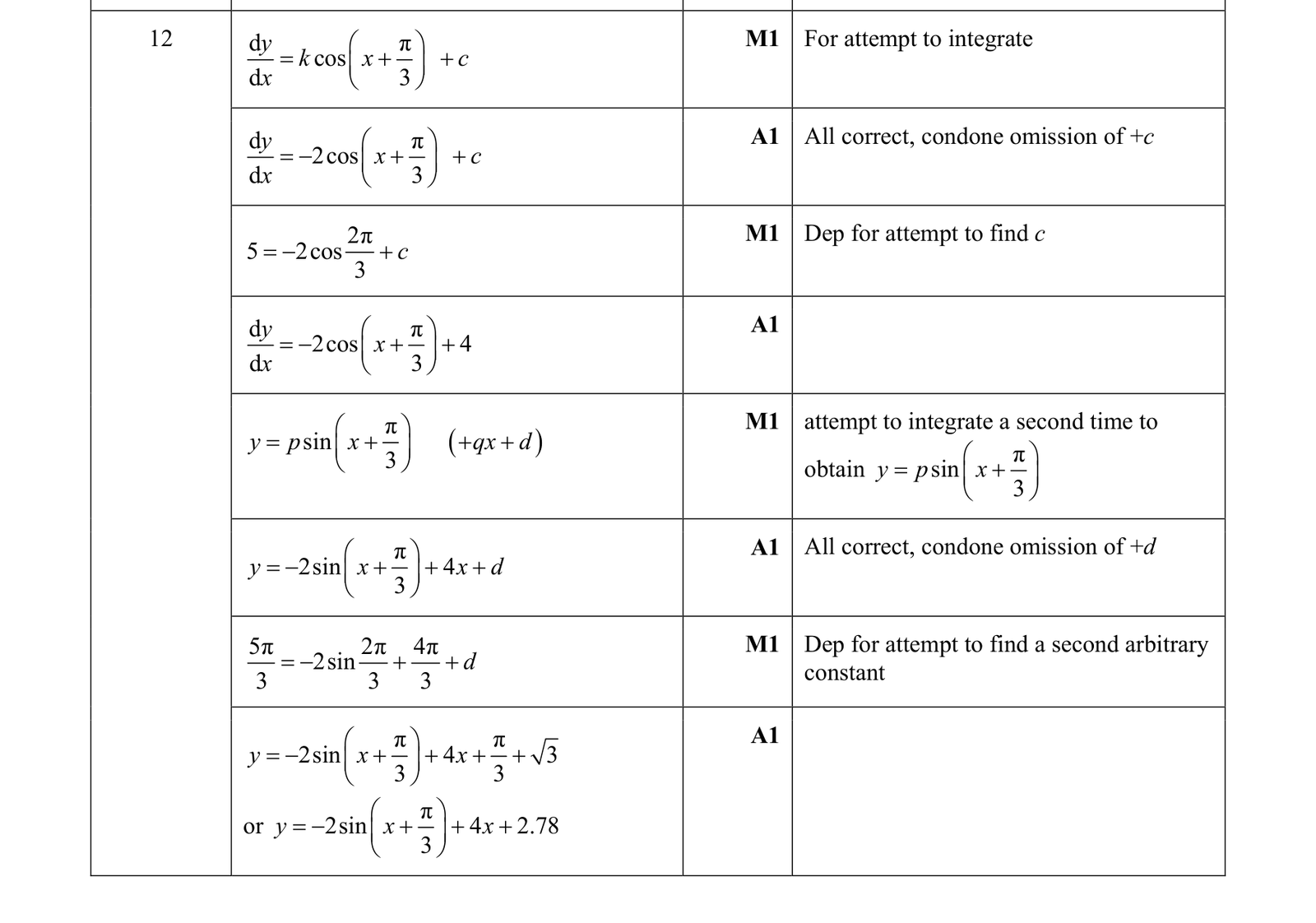
\(\frac{d^2y}{dx^2}=2\sin\left(x+\frac{\pi}{3}\right).\)
Given that the curve has a gradient of \(5\) at the point \(\left(\frac{\pi}{3},\frac{5\pi}{3}\right)\), find the equation of the curve.
0606 P12 - Nov 2019 - Q11 - 8 marks
A curve is such that
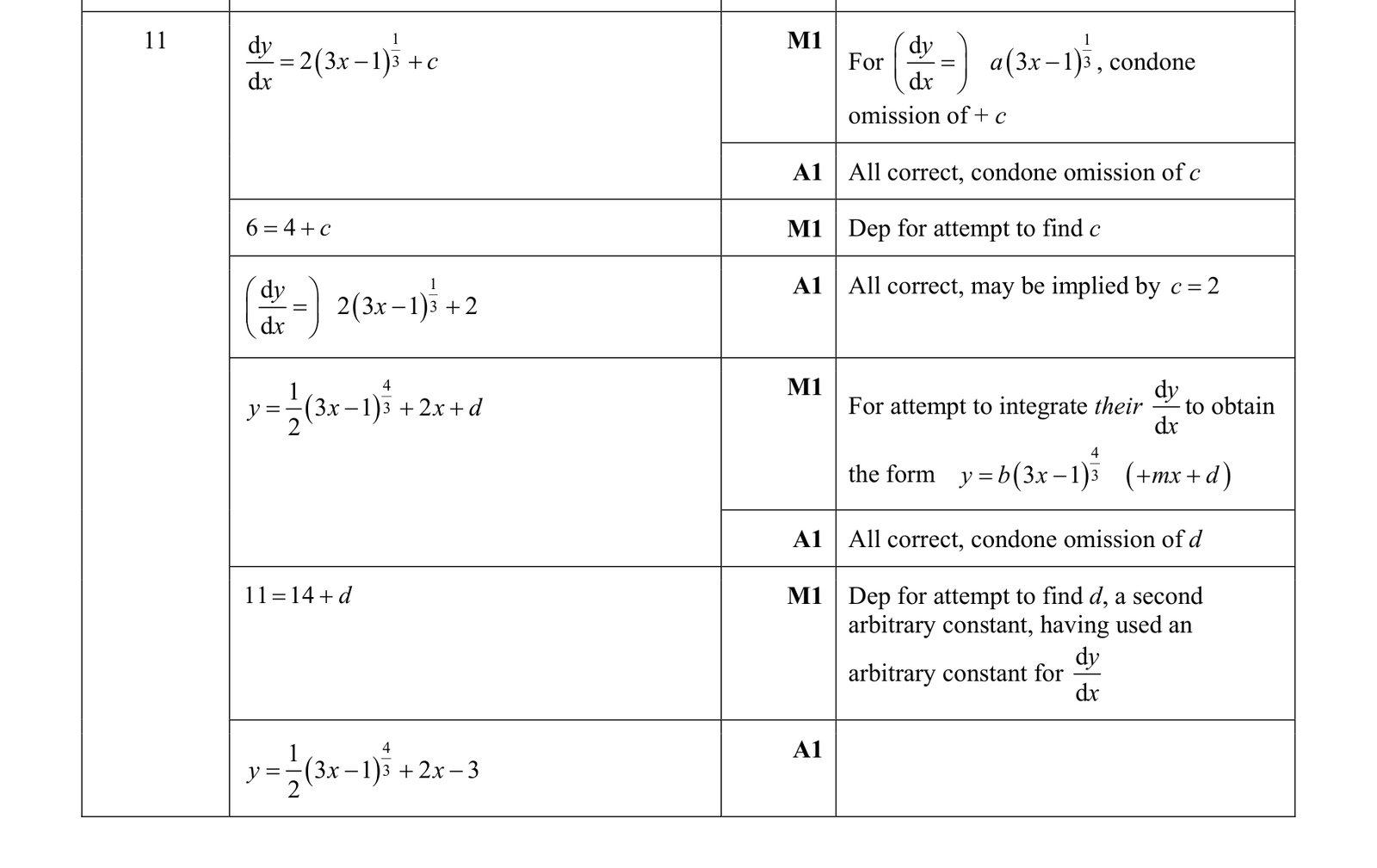
\(\frac{d^2y}{dx^2}=2(3x-1)^{-\frac23}.\)
Given that the curve has a gradient of \(6\) at the point \((3,11)\), find the equation of the curve.
0606 P11 - Jun 2018 - Q12 - 8 marks
A curve is such that
\(\frac{d^2y}{dx^2}=(2x-5)^{-1/2}.\)
Given that the curve has a gradient of \(6\) at the point \(\left(\dfrac92,\dfrac23\right)\), find the equation of the curve.
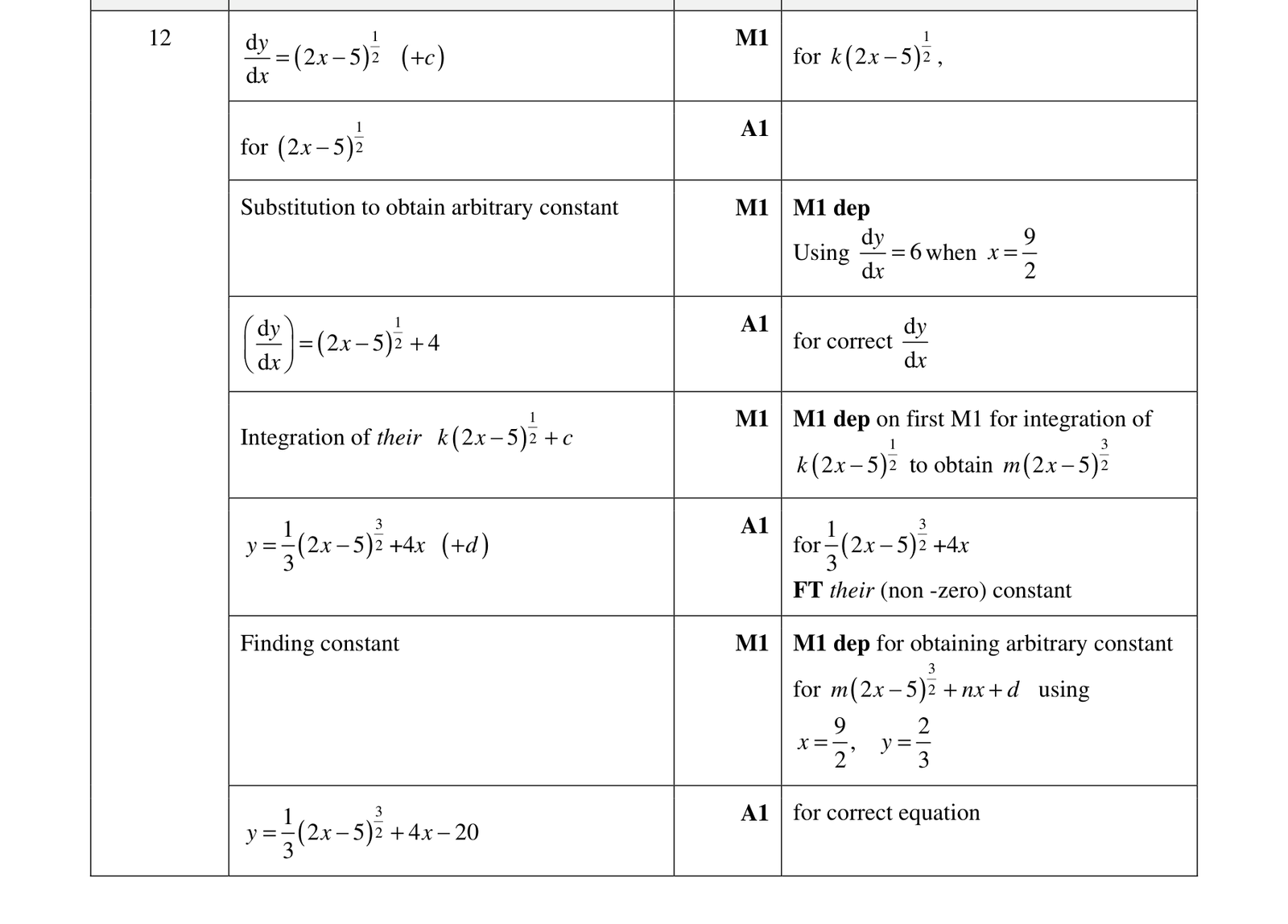
0606 P13 - Jun 2018 - Q12 - 8 marks
A curve is such that
\(\frac{d^2y}{dx^2}=(2x-5)^{-1/2}.\)
Given that the curve has a gradient of \(6\) at the point \(\left(\dfrac92,\dfrac23\right)\), find the equation of the curve.
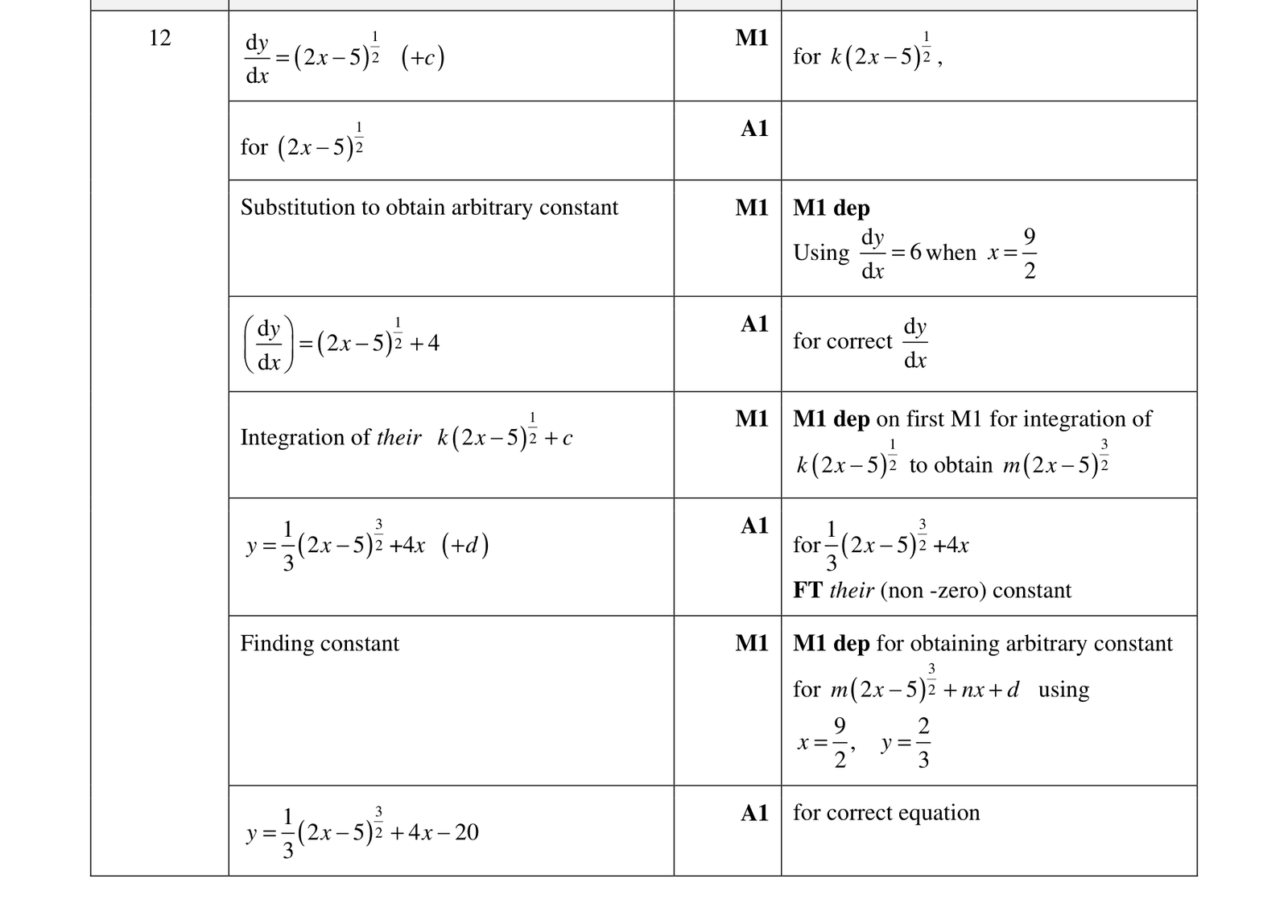
0606 P12 - Nov 2018 - Q2 - 5 marks
Find the equation of the curve which has a gradient of \(4\) at the point \((0,-3)\) and is such that
\(\frac{d^2y}{dx^2}=5+e^{2x}.\)
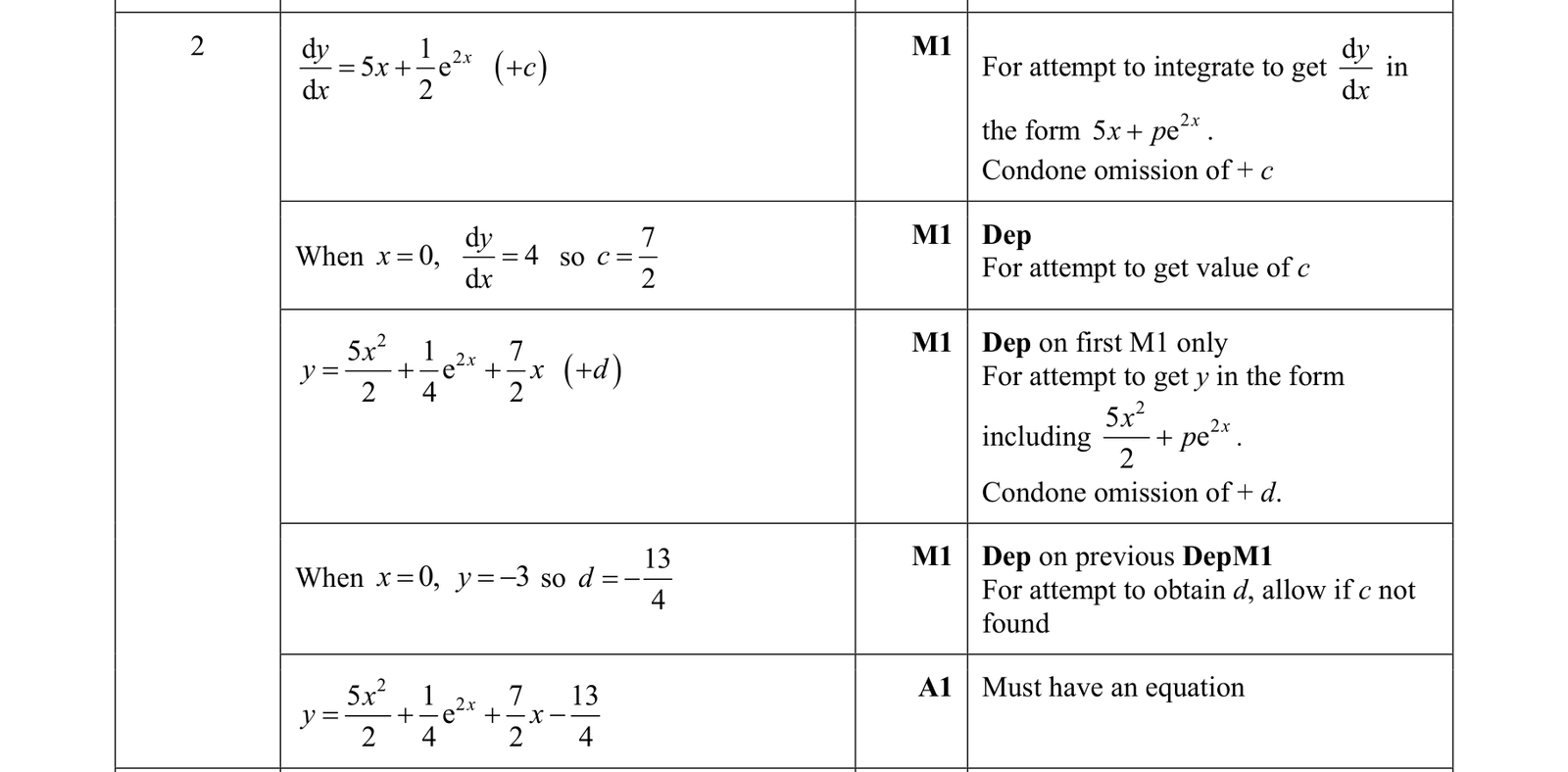
0606 P23 - Nov 2018 - Q4 - 6 marks
\(\frac{d^2y}{dx^2}=2x+\frac{3}{(x+1)^4}.\)
(i) Find \(\dfrac{dy}{dx}\), given that \(\dfrac{dy}{dx}=1\) when \(x=1\).
(ii) Find \(y\) in terms of \(x\), given that \(y=3\) when \(x=1\).
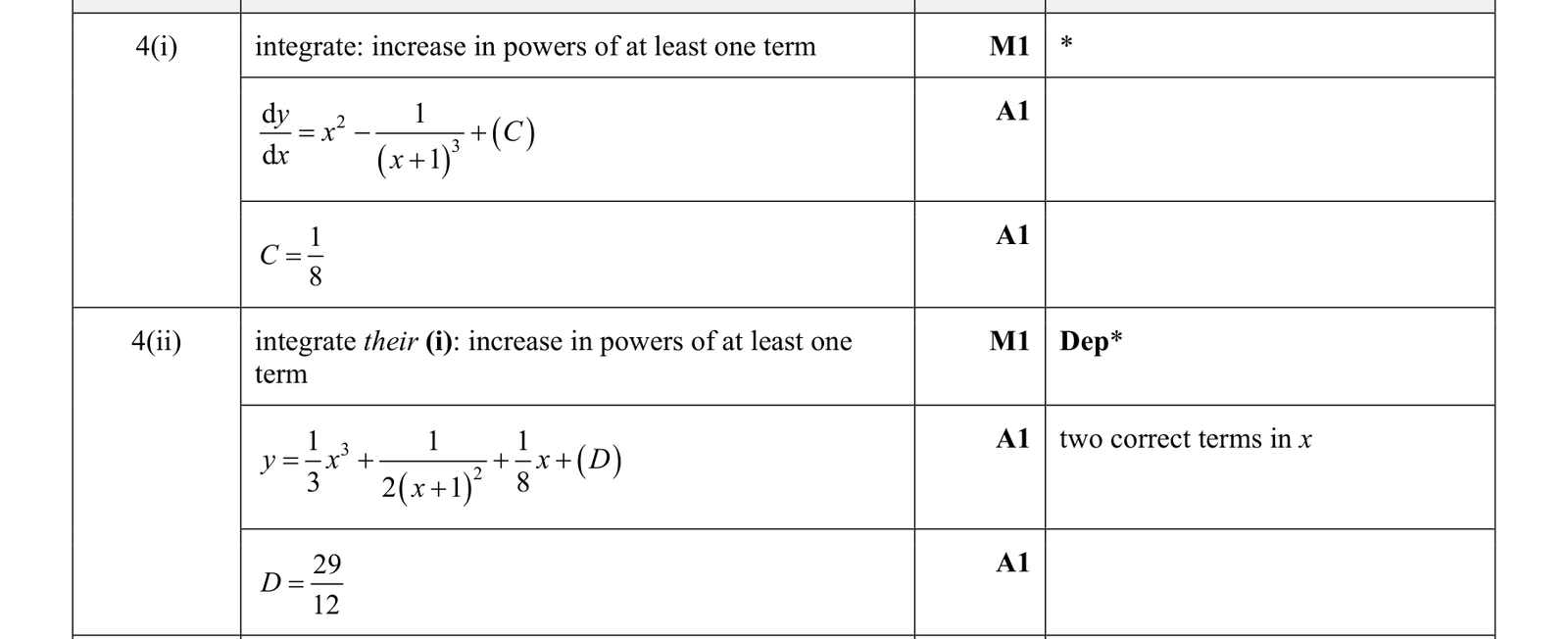
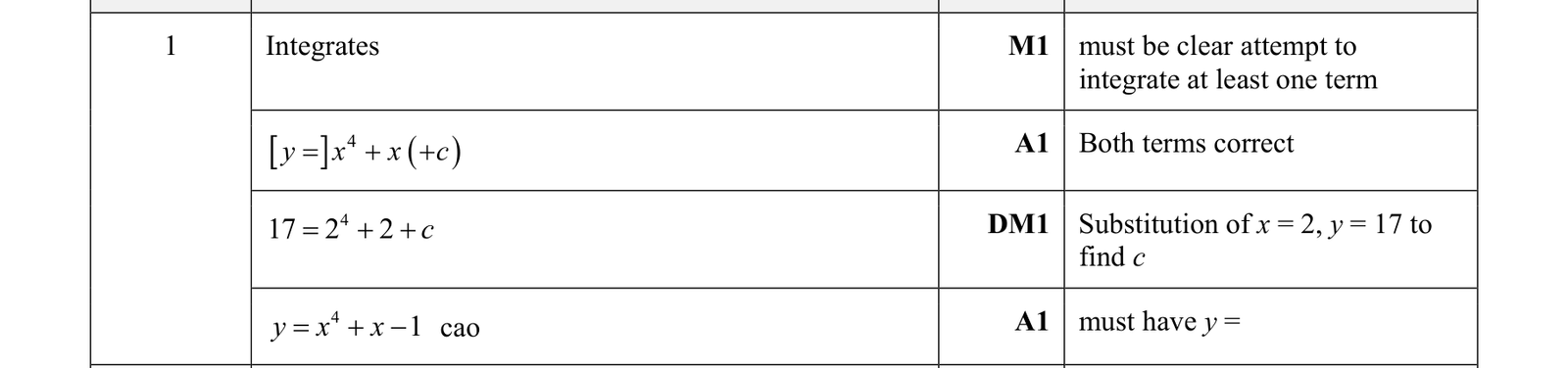
0606 P21 - Jun 2017 - Q1 - 4 marks
Find the equation of the curve which passes through the point \((2,17)\) and for which
\(\frac{dy}{dx}=4x^3+1.\)
0606 P13 - Nov 2017 - Q2 - 4 marks
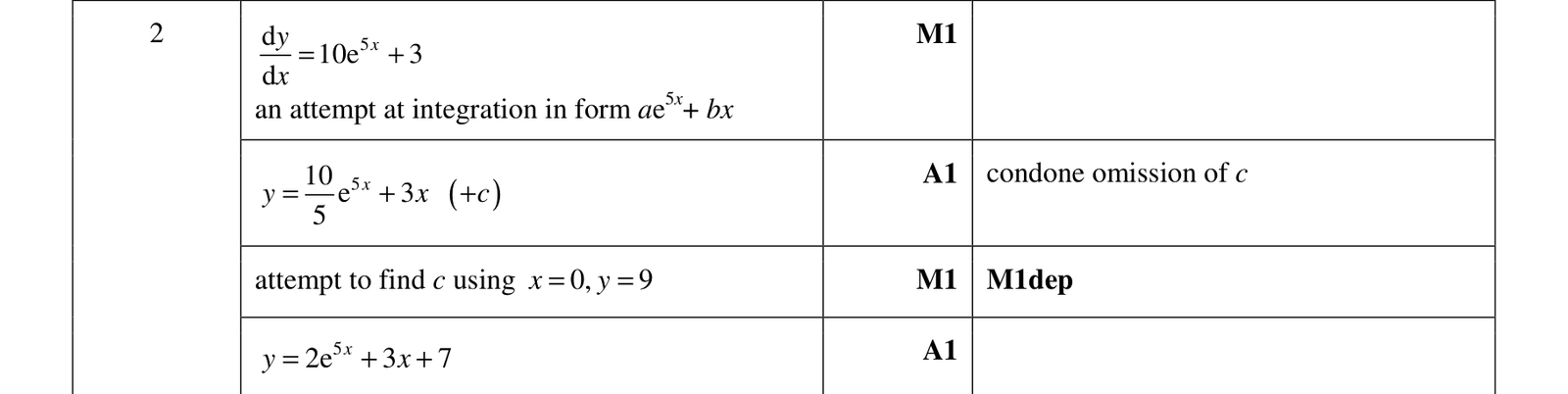
A curve is such that \(\dfrac{dy}{dx}=10e^{5x}+3\). It is given that the curve passes through the point \((0,9)\). Find the equation of the curve.
0606 P21 - Nov 2017 - Q7 - 6 marks
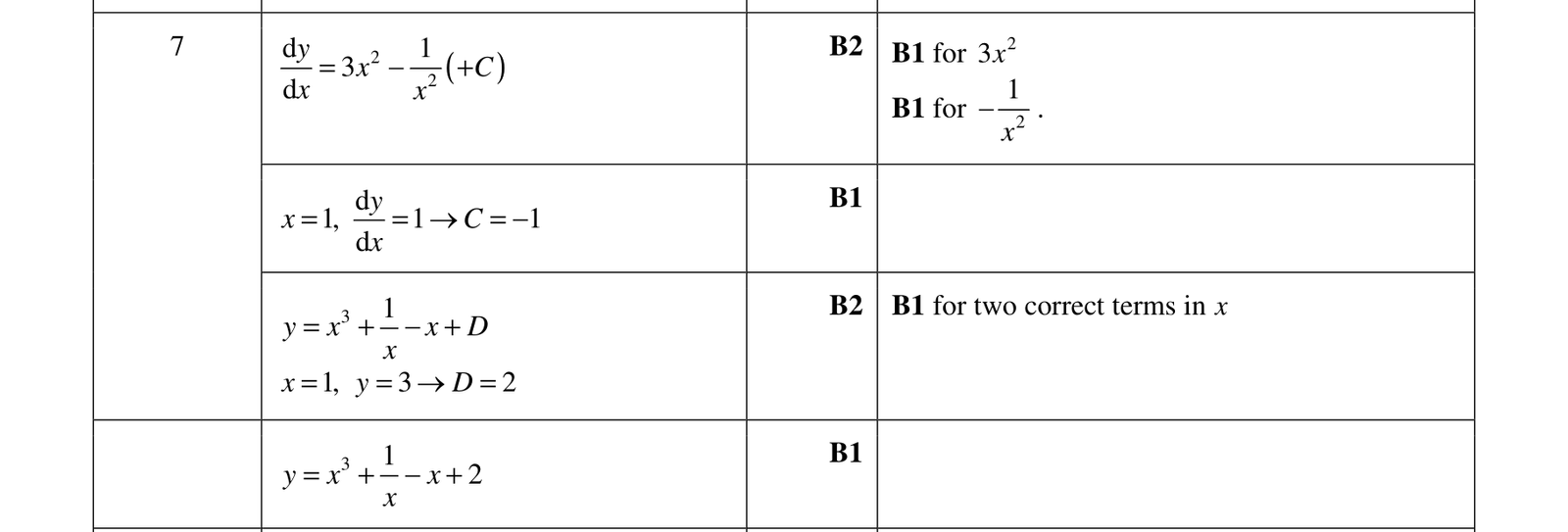
Find \(y\) in terms of \(x\), given that \(\dfrac{d^2y}{dx^2}=6x+\dfrac2{x^3}\) and that when \(x=1\), \(y=3\) and \(\dfrac{dy}{dx}=1\).
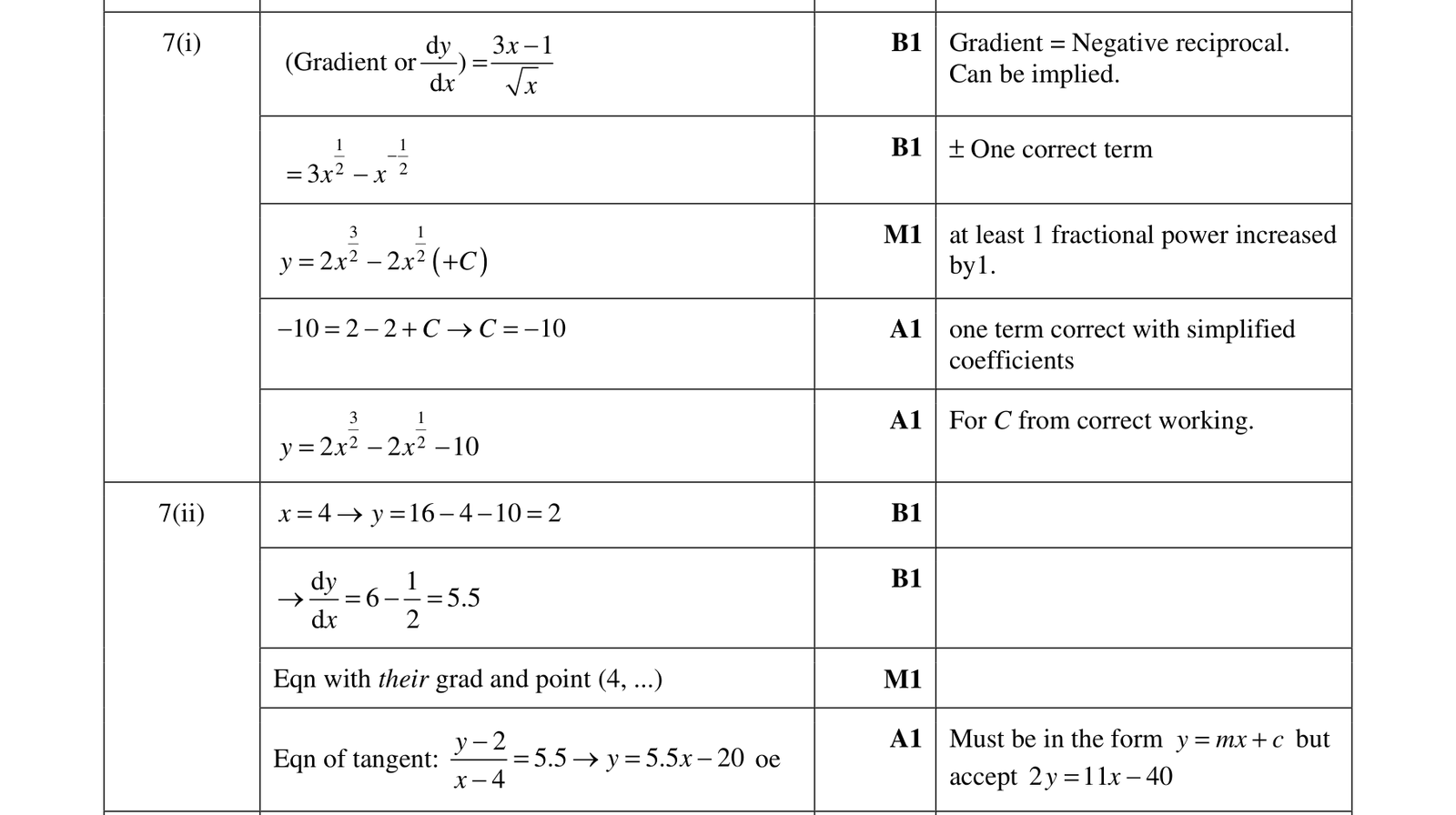
0606 P22 - Nov 2017 - Q7 - 9 marks
The gradient of the normal to a curve at the point with coordinates \((x,y)\) is given by \(\dfrac{\sqrt x}{1-3x}\).
(i) Find the equation of the curve, given that the curve passes through the point \((1,-10)\).
(ii) Find, in the form \(y=mx+c\), the equation of the tangent to the curve at the point where \(x=4\).