9709 P12 - Nov 2018 - Q6
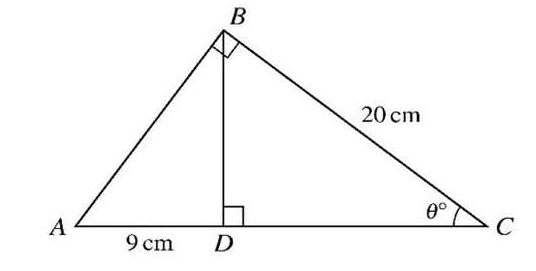
The diagram shows a triangle ABC in which BC = 20 cm and angle ABC is \(90^\circ\). The perpendicular from B to AC meets AC at D and AD = 9 cm. Angle BCA is \(\theta^\circ\).
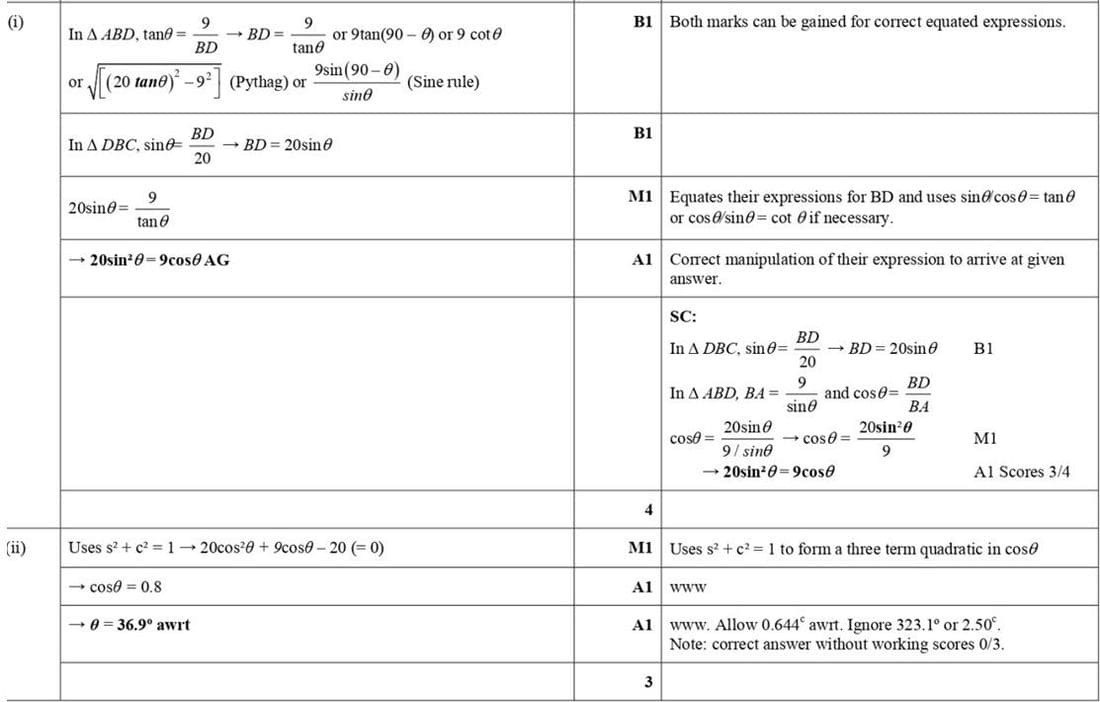
- By expressing the length of BD in terms of \(\theta\) in each of the triangles ABD and DBC, show that \(20\sin^2\theta = 9\cos\theta.\)
- Hence, showing all necessary working, calculate \(\theta\).
9709 P12 - Jun 2016 - Q5
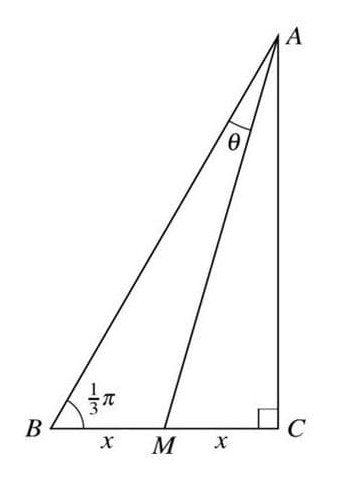
In the diagram, triangle ABC is right-angled at C and M is the mid-point of BC. It is given that angle ABC = \(\frac{1}{3} \pi\) radians and angle BAM = \(\theta\) radians. Denoting the lengths of BM and MC by x,
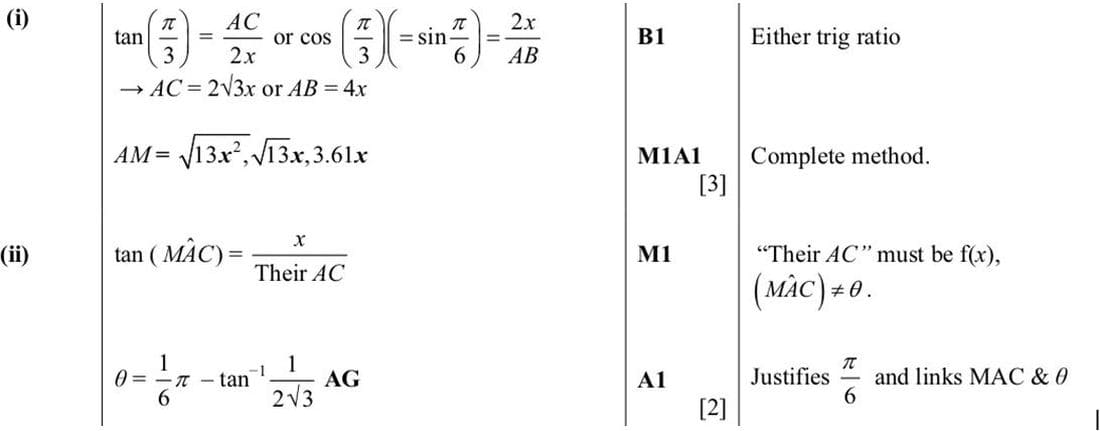
- find AM in terms of x,
- show that \(\theta = \frac{1}{6} \pi - \tan^{-1} \left( \frac{1}{2 \sqrt{3}} \right)\).
9709 P1 - Jun 2008 - Q1
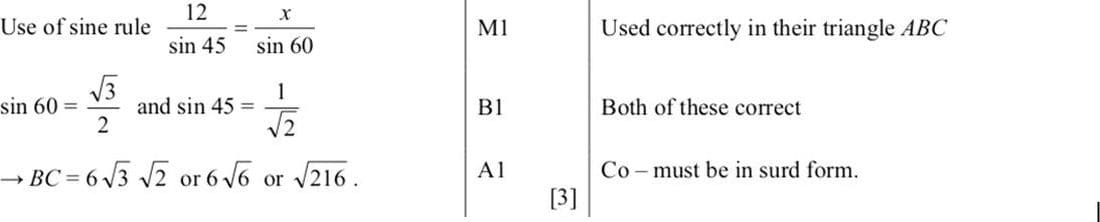
In the triangle ABC, AB = 12 cm, angle BAC = 60° and angle ACB = 45°. Find the exact length of BC.
9709 P1 - Jun 2006 - Q6
In the diagram, \(\triangle ABC\) is a triangle in which \(AB = 4 \text{ cm}\), \(BC = 6 \text{ cm}\) and angle \(\angle ABC = 150^\circ\). The line \(CX\) is perpendicular to the line \(ABX\).
(i) Find the exact length of \(BX\) and show that angle \(CAB = \tan^{-1} \left( \frac{3}{4 + 3\sqrt{3}} \right)\).
(ii) Show that the exact length of \(AC\) is \(\sqrt{52 + 24\sqrt{3}} \text{ cm}\).


9709 P1 - Nov 2005 - Q3
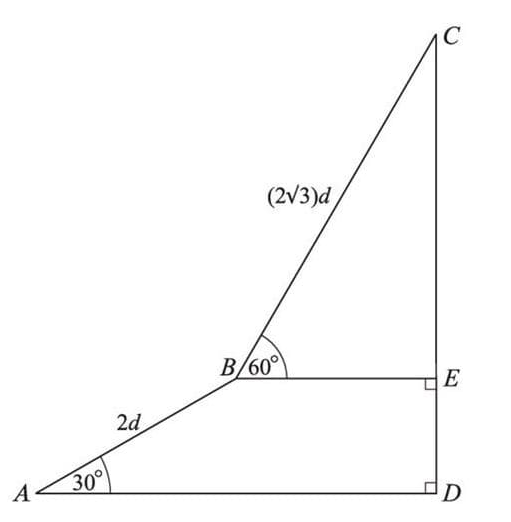
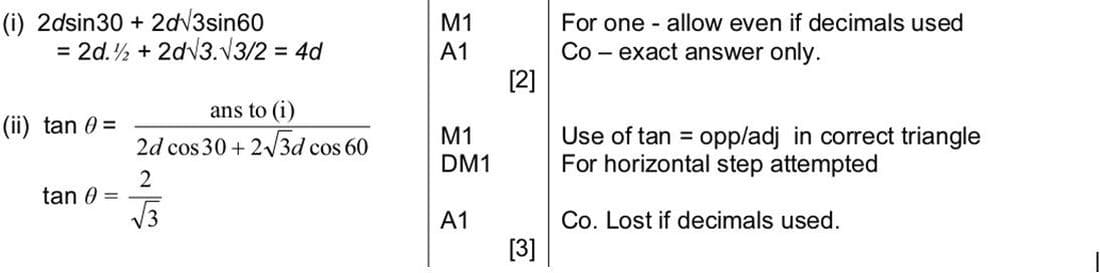
In the diagram, ABED is a trapezium with right angles at E and D, and CED is a straight line. The lengths of AB and BC are \(2d\) and \(2\sqrt{3}\,d\) respectively, and angles BAD and CBE are \(30^\circ\) and \(60^\circ\) respectively.
- Find the length of CD in terms of d.
- Show that angle CAD = \(\tan^{-1}\!\left(\frac{2}{\sqrt{3}}\right)\).
9709 P1 - Nov 2002 - Q6
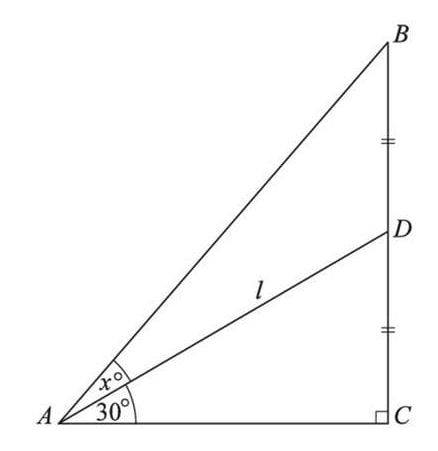
In the diagram, triangle ABC is right-angled and D is the mid-point of BC. Angle DAC is \(30^\circ\) and angle BAD is \(x^\circ\). Denoting the length of AD by l,
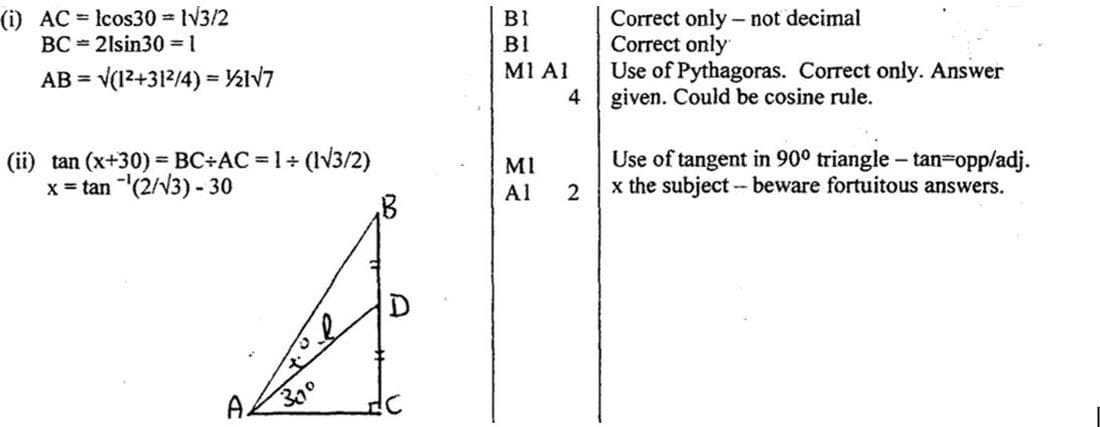
- express each of AC and BC exactly in terms of l, and show that \(AB = \tfrac{1}{2}l\sqrt{7}\),
- show that \(x = \tan^{-1}\!\left(\frac{2}{\sqrt{3}}\right) - 30^\circ\).