0606 P12 - Nov 2025 - Q12 - 6 marks
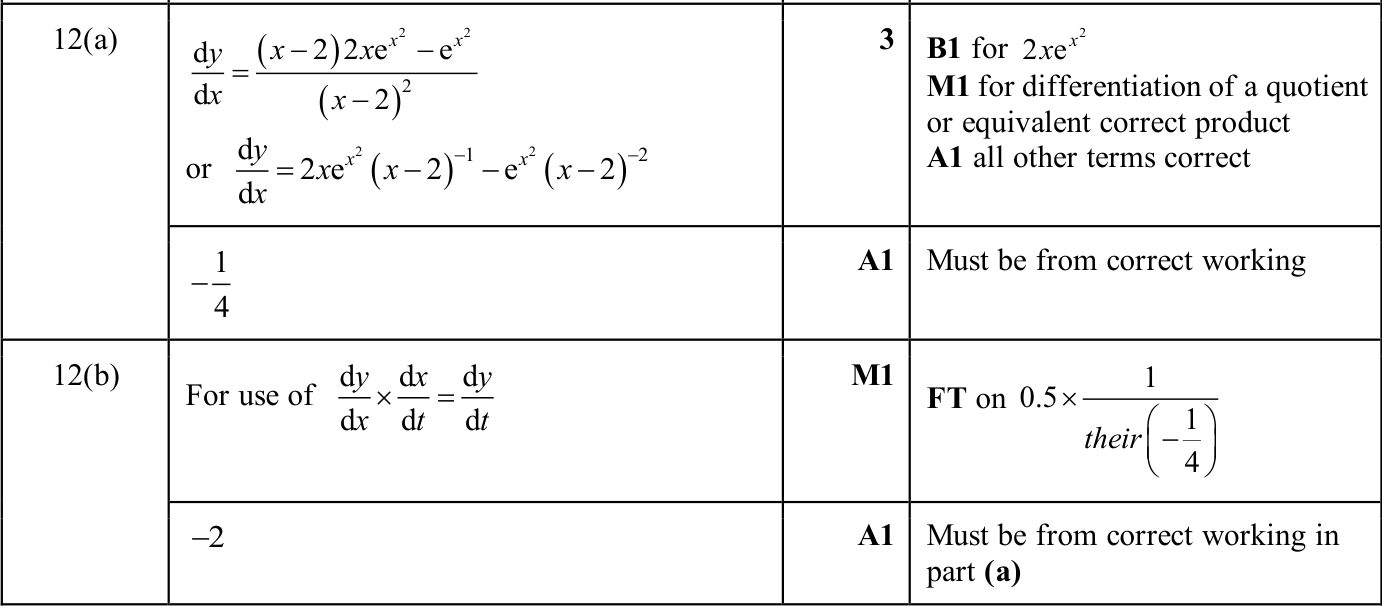
A curve has equation \(y=\dfrac{\mathrm{e}^{x^2}}{x-2}\) for \(x\lt 2\).
(a) Find the value of \(\dfrac{\mathrm{d}y}{\mathrm{d}x}\) when \(x=0\).
When \(x=0\), \(y\) is increasing at the rate of \(0.5\) units per second.
(b) Find the corresponding rate of change of \(x\).
0606 P22 - Mar 2025 - Q6 - 8 marks
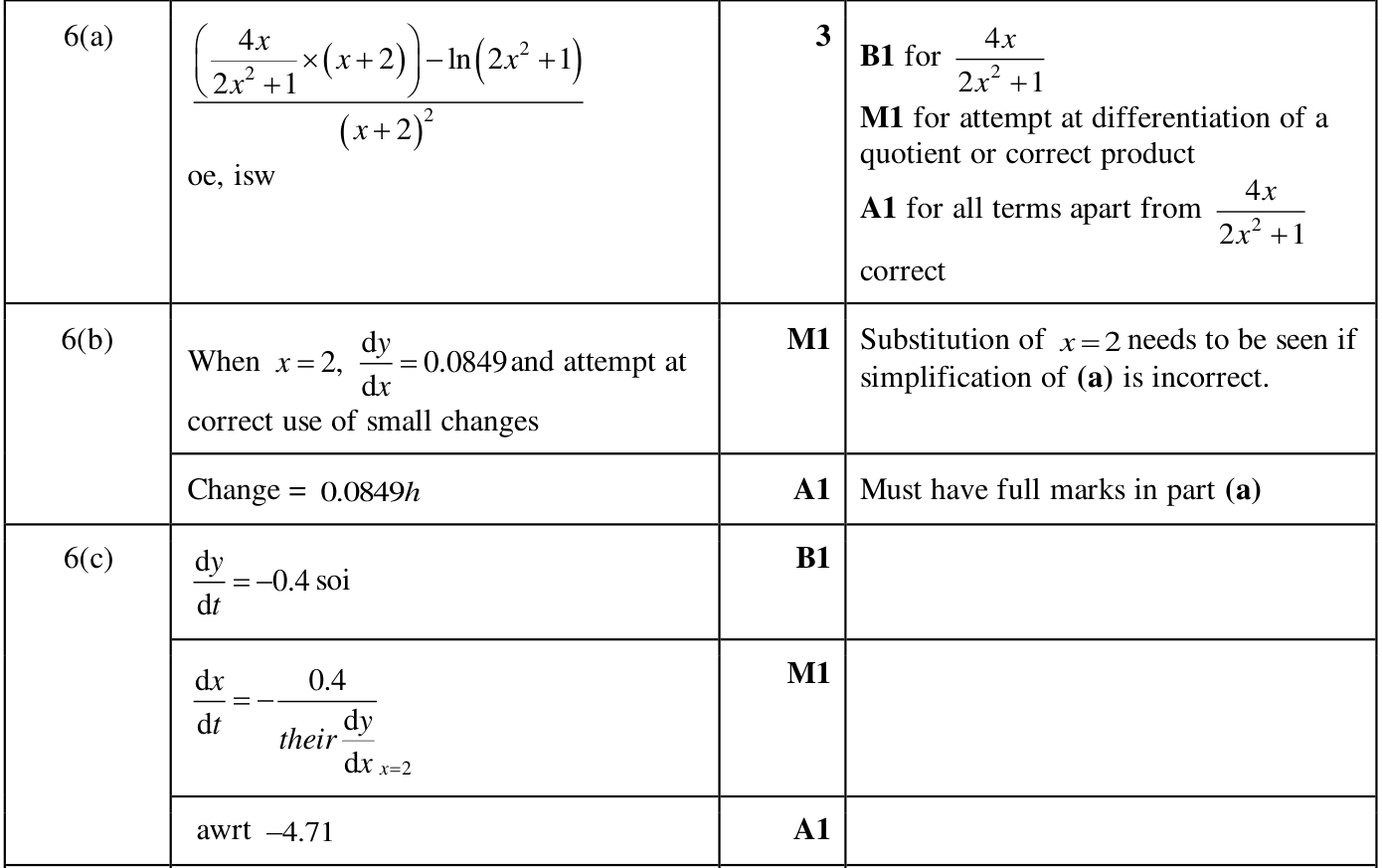
It is given that \(y=\frac{\ln(2x^2+1)}{x+2}\).
(a) Find \(\frac{\mathrm dy}{\mathrm dx}\).
(b) Given that \(x\) increases from \(2\) to \(2+h\), where \(h\) is small, find the approximate change in \(y\).
(c) Given that \(y\) is decreasing by \(0.4\) units per second, find the corresponding rate of change in \(x\) when \(x=2\).
0606 P11 - Nov 2024 - Q9 - 8 marks
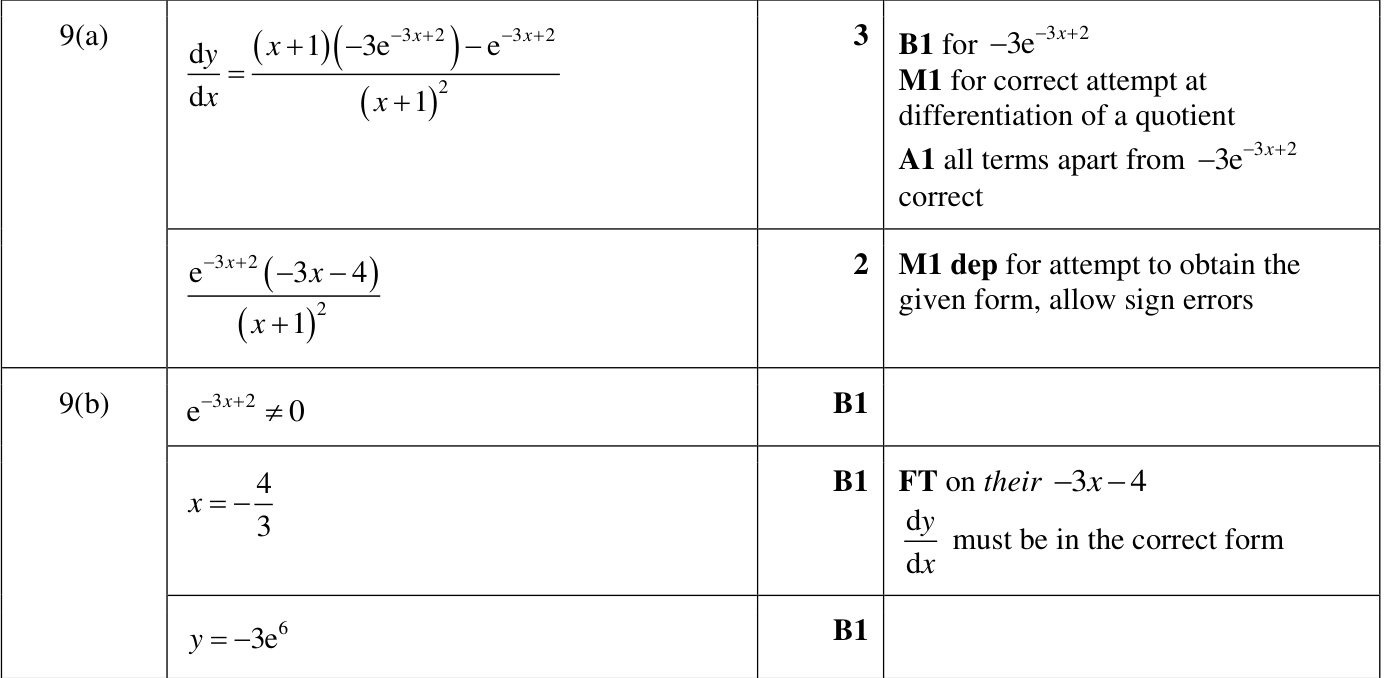
The equation of a curve is \(y=\frac{\mathrm{e}^{-3 x+2}}{x+1}\) where \(x\lt -1\). (a) Show that \(\frac{\mathrm{d} y}{\mathrm{~d} x}=\frac{\mathrm{e}^{-3 x+2}}{(x+1)^{2}}(A x+B) \quad\) where \(A\) and \(B\) are integers to be found. (b) Hence show that there is only one stationary point on the curve and find its exact coordinates.
0606 P12 - Nov 2024 - Q7 - 6 marks
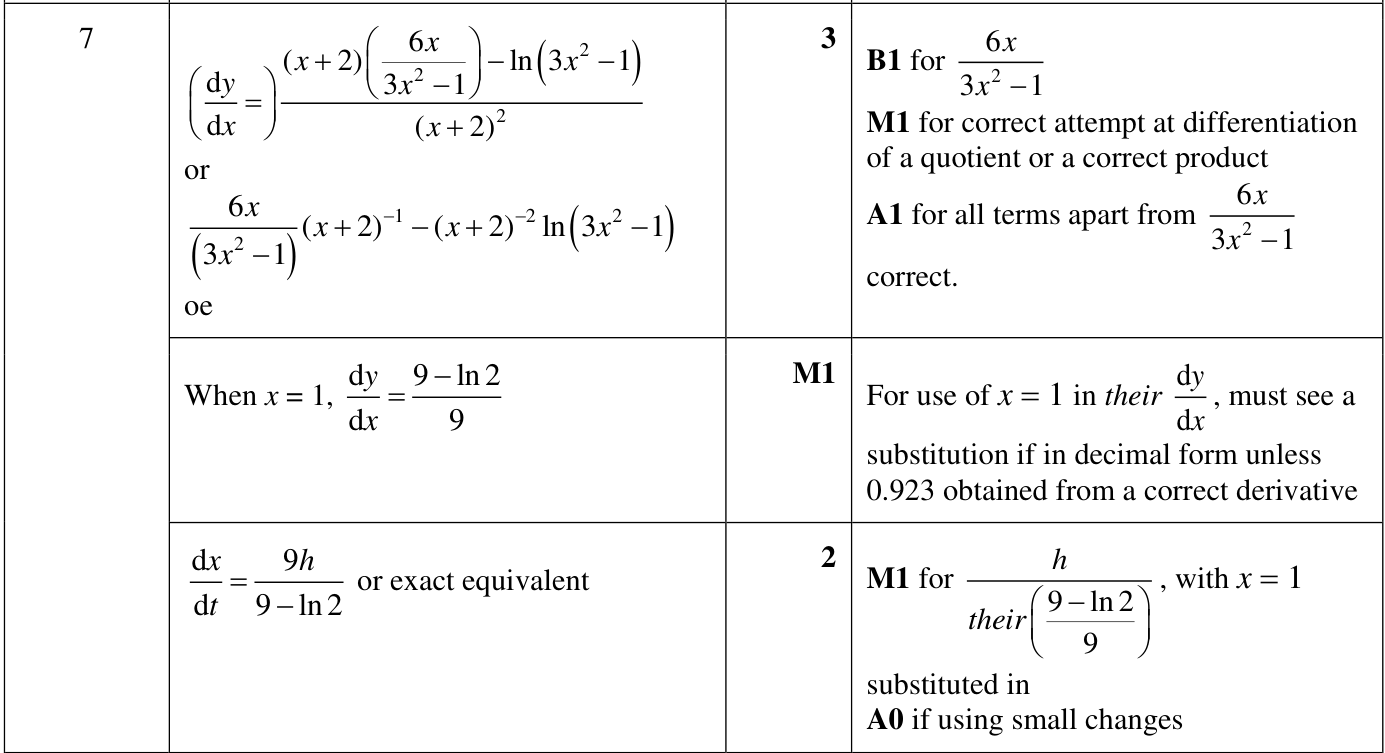
It is given that \(y=\frac{\ln \left(3 x^{2}-1\right)}{x+2}\), for \(x\gt \frac{1}{\sqrt{3}}\). When \(x=1, y\) is increasing at the rate of \(h\) units per second. Find, in terms of \(h\), the corresponding rate of change in \(x\), giving your answer in exact form.
0606 P22 - Nov 2024 - Q10 - 11 marks
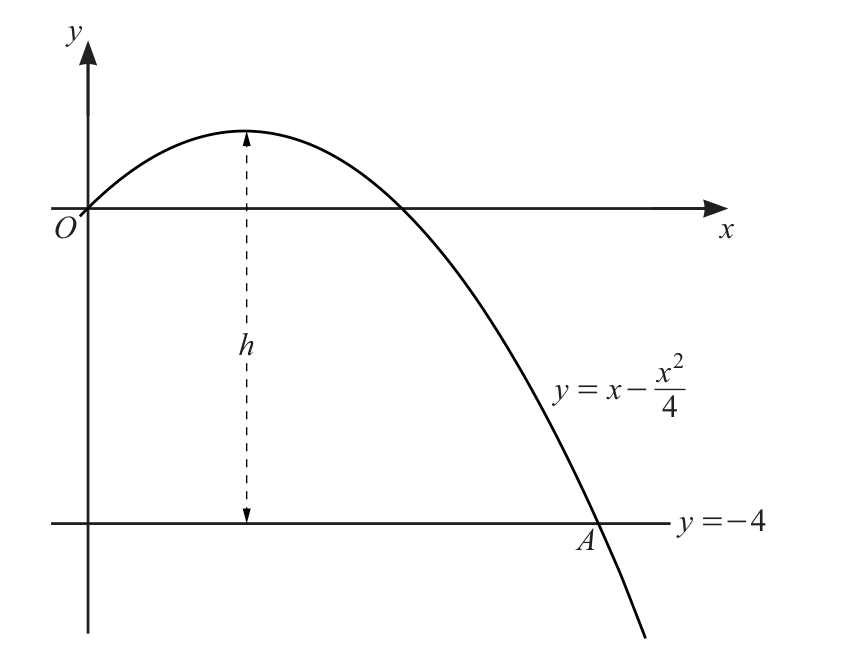
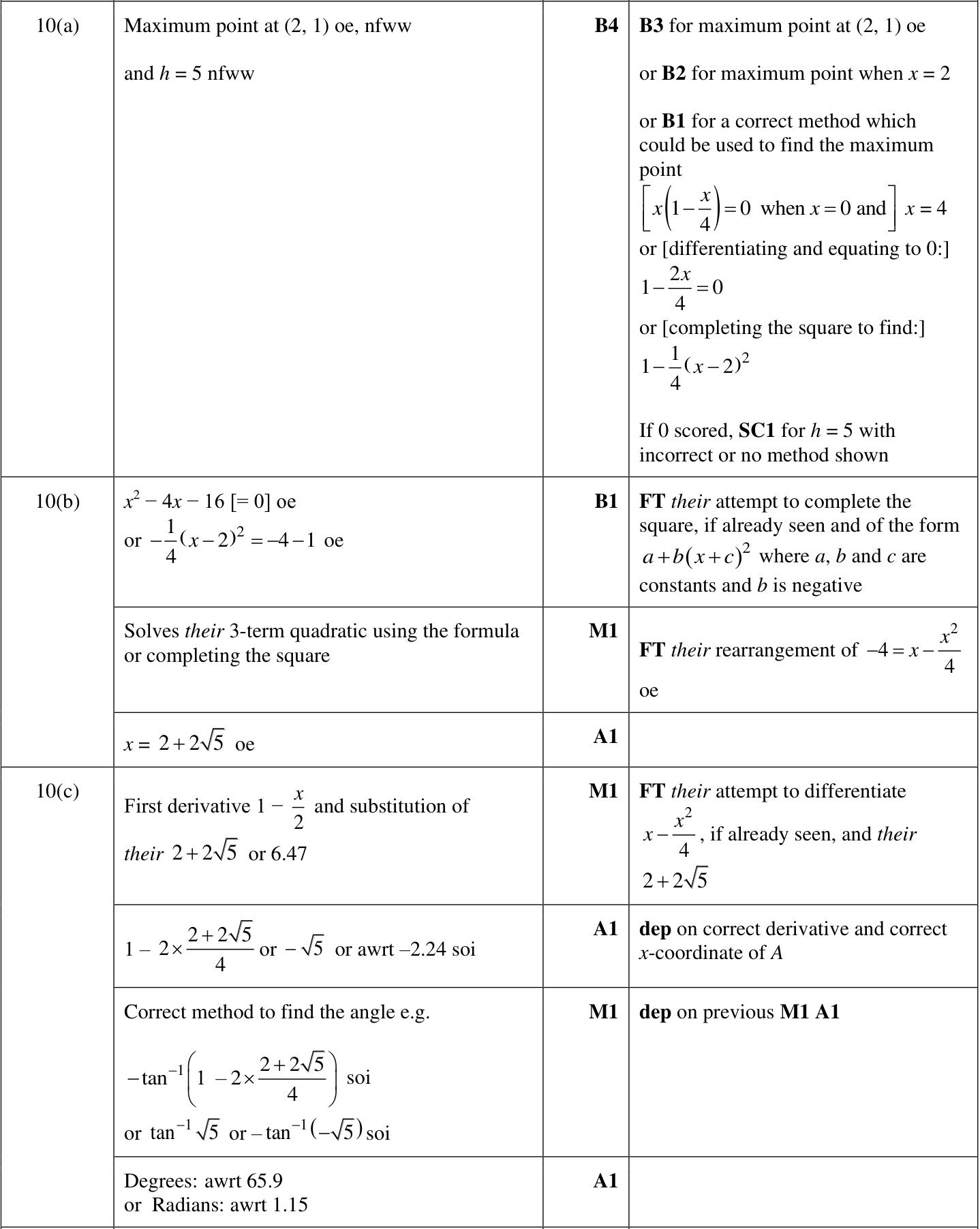
The diagram shows part of the curve \(y=x-\frac{x^{2}}{4}\) and the line \(y=-4\). The curve and the line intersect at the point \(A\). (a) The maximum point on the curve is at a perpendicular distance \(h\) from the line \(y=-4\). Find the value of \(h\).
(b) Find the exact \(x\)-coordinate of \(A\).
(c) Find the acute angle between the tangent to the curve at \(A\) and the line \(y=-4\).
0606 P12 - Jun 2024 - Q8 - 8 marks
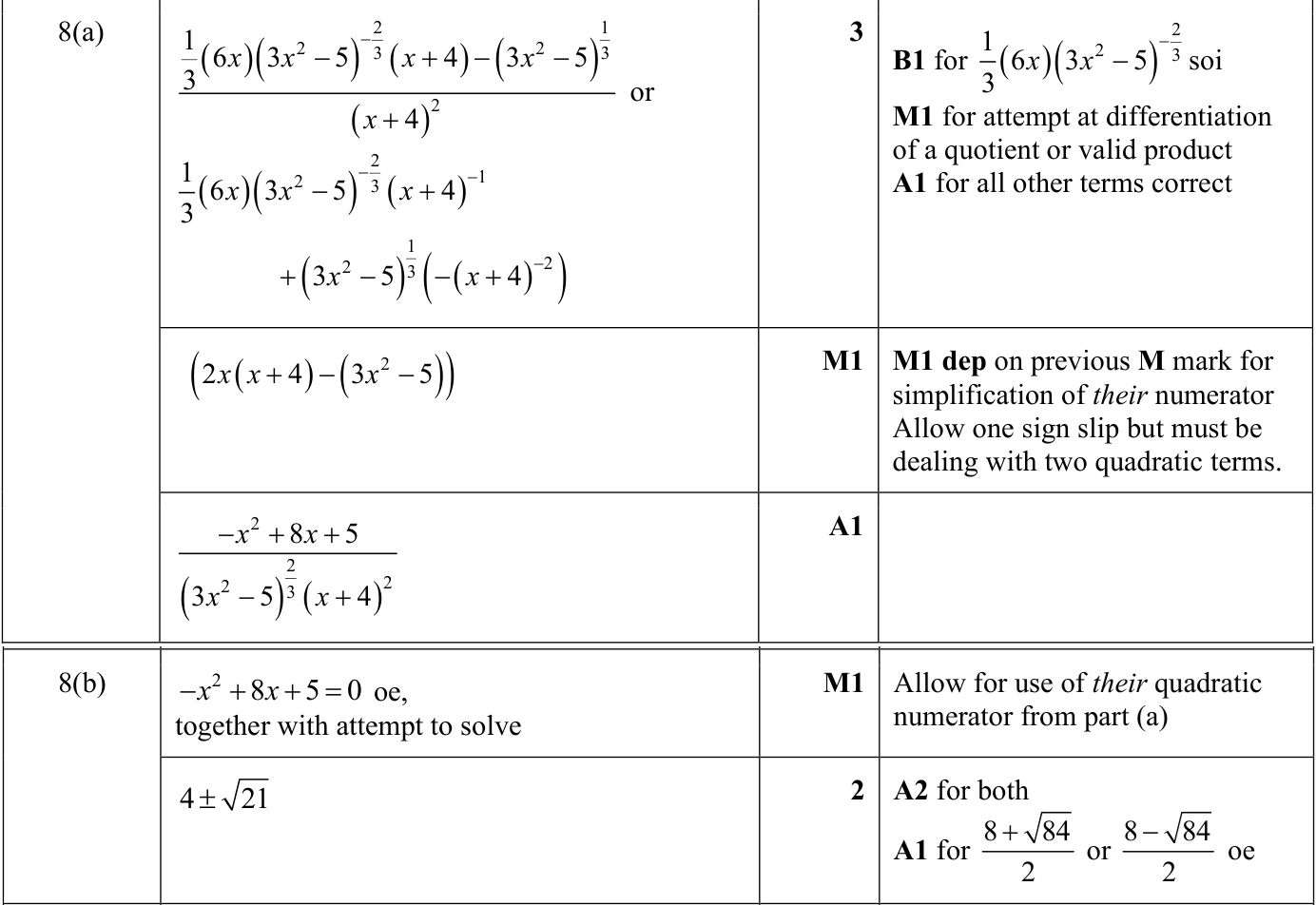
A curve has equation \(y=\frac{\left(3 x^{2}-5\right)^{\frac{1}{3}}}{x+4}\). (a) Show that \(\frac{\mathrm{d} y}{\mathrm{~d} x}\) can be written in the form \(\frac{A x^{2}+B x+C}{\left(3 x^{2}-5\right)^{\frac{2}{3}}(x+4)^{2}}\), where \(A, B\) and \(C\) are integers. (b) Hence find the \(x\)-coordinates of the stationary points on the curve. Give your answers in their simplest exact form.
0606 P22 - Jun 2023 - Q7 - 12 marks
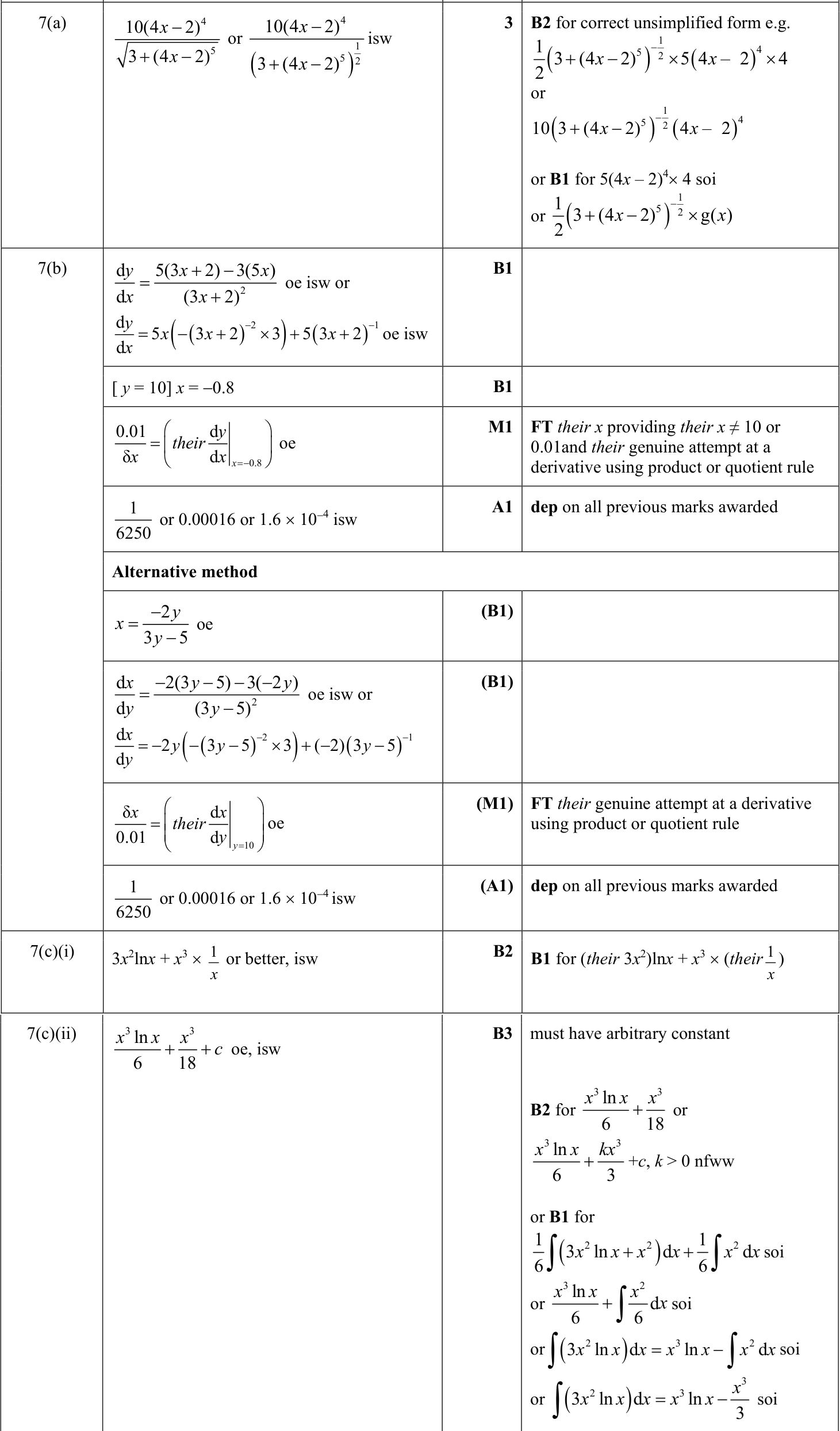
(a) \(f(x)=\sqrt{3+(4x-2)^5}\), where \(x\gt 1\). Find an expression for \(f'(x)\), giving your answer as a simplified algebraic fraction.
(b) Variables \(x\) and \(y\) are related by the equation
\(y=\frac{5x}{3x+2}.\)
Using differentiation, find the approximate change in \(x\) when \(y\) increases from \(10\) by the small amount \(0.01\).
(c)(i) Differentiate \(y=x^3\ln x\) with respect to \(x\).
(c)(ii) Hence find
\(\int\frac{x^2}{6}(2+3\ln x)\,dx.\)
0606 P21 - Jun 2020 - Q12 - 13 marks
(a) Find the \(x\)-coordinates of the stationary points of the curve
\(y=e^{3x}(2x+3)^6.\)
(b) A curve has equation \(y=f(x)\) and has exactly two stationary points. Given that
\(f''(x)=4x-7,\qquad f'(0.5)=0,\qquad f'(3)=0,\)
use the second derivative test to determine the nature of each of the stationary points of this curve.
(c) A solid cuboid has height \(h\) and a rectangular base measuring \(4x\) by \(x\). The volume of the cuboid is \(40\text{ cm}^3\). Given that \(x\) and \(h\) can vary and that the surface area of the cuboid has a minimum value, find this value.


0606 P23 - Jun 2020 - Q11 - 7 marks
In this question all lengths are in centimetres.
The volume, \(V\), of a cone of height \(h\) and base radius \(r\) is given by
\(V=\frac13\pi r^2h.\)
The diagram shows a large hollow cone from which a smaller cone of height \(180\) and base radius \(90\) has been removed. The remainder has been fitted with a circular base of radius \(90\) to form a container for water. The depth of water in the container is \(w\) and the surface of the water is a circle of radius \(R\).
(a) Find an expression for \(R\) in terms of \(w\) and show that the volume \(V\) of the water in the container is given by
\(V=\frac{\pi}{12}(w+180)^3-486000\pi.\)
(b) Water is poured into the container at a rate of \(10000\text{ cm}^3\text{ s}^{-1}\). Find the rate at which the depth of the water is increasing when \(w=10\).


0606 P11 - Jun 2017 - Q10 - 8 marks
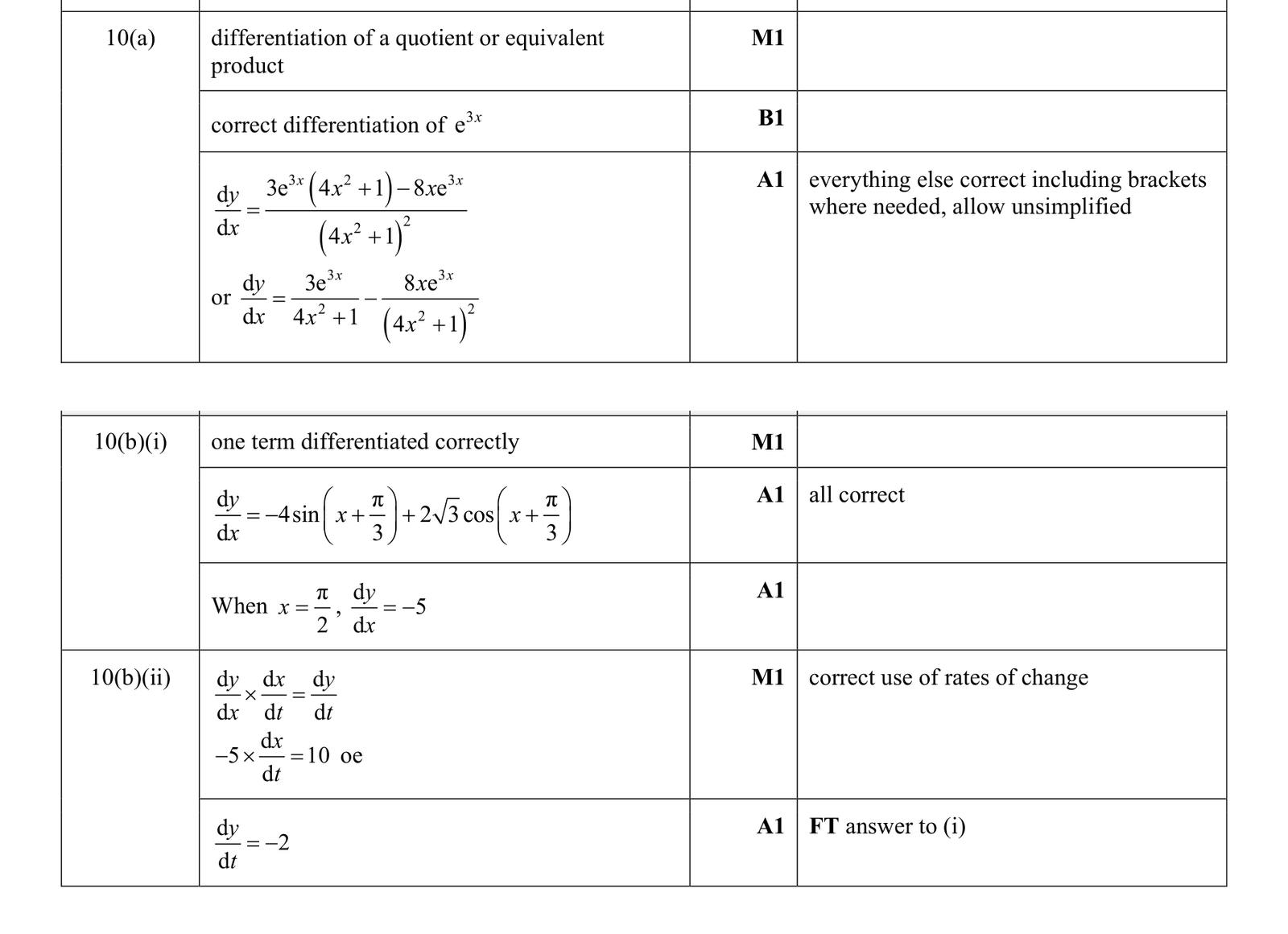
(a) Given that \(y=\dfrac{e^{3x}}{4x^2+1}\), find \(\dfrac{dy}{dx}\).
(b) Variables \(x\), \(y\), and \(t\) are such that
\(y=4\cos\left(x+\frac{\pi}{3}\right)+2\sqrt3\sin\left(x+\frac{\pi}{3}\right)\)
and \(\dfrac{dy}{dt}=10\).
(i) Find \(\dfrac{dy}{dx}\) when \(x=\dfrac{\pi}{2}\).
(ii) Find \(\dfrac{dx}{dt}\) when \(x=\dfrac{\pi}{2}\).
0606 P13 - Nov 2017 - Q8 - 8 marks
It is given that \(y=(x-4)(3x-1)^{\frac53}\).
(i) Show that \(\dfrac{dy}{dx}=(3x-1)^{\frac23}(Ax+B)\), where \(A\) and \(B\) are constants to be found.
(ii) Hence find, in terms of \(h\), the approximate change in \(y\) when \(x\) increases from \(3\) to \(3+h\), where \(h\) is small.
