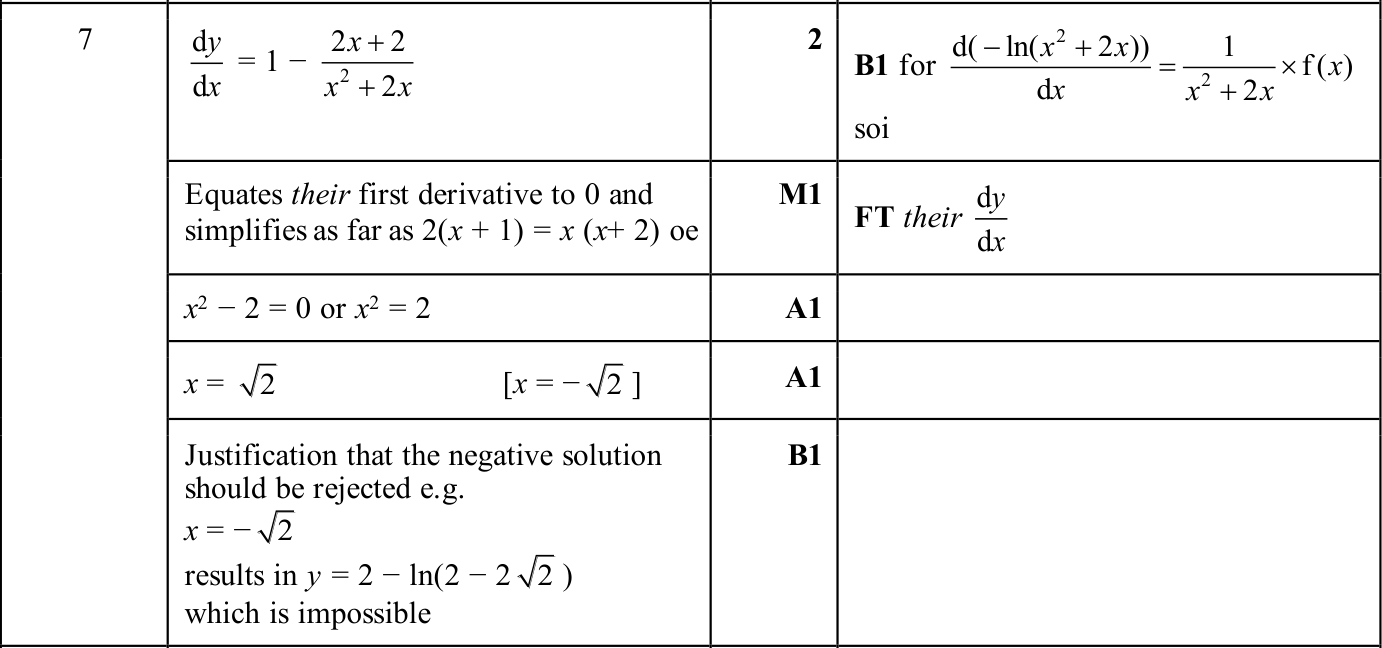
0606 P21 - Nov 2025 - Q7 - 6 marks
Show that the curve \(y=x-\ln(x^2+2x)\) has exactly one stationary point.
Find the \(x\)-coordinate of this point.
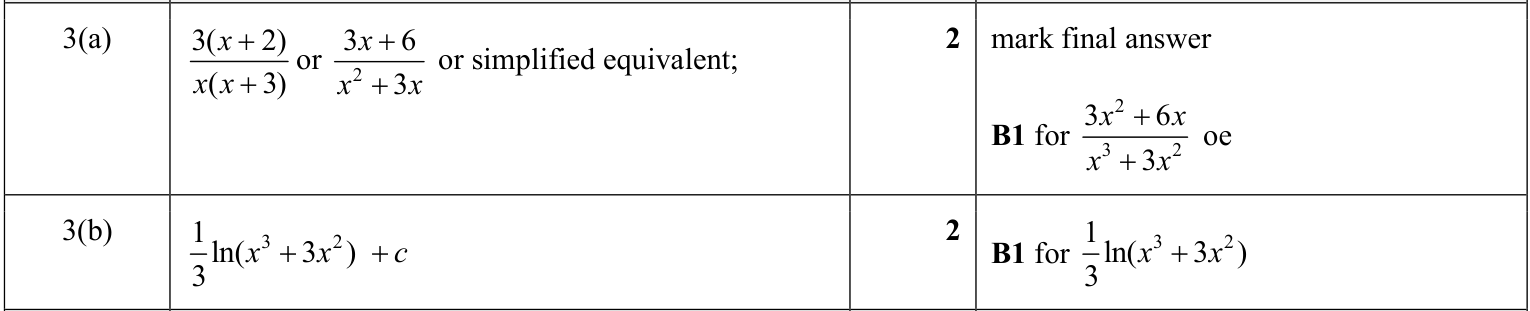
0606 P23 - Jun 2023 - Q3 - 4 marks
(a) Differentiate
\(\ln(x^3+3x^2)\)
with respect to \(x\), simplifying your answer.
(b) Hence find
\(\int \frac{x+2}{x(x+3)}\,dx.\)
0606 P12 - Nov 2020 - Q7 - 7 marks
It is given that
\(y=\frac{\ln(3x^2-5)}{2x+1},\qquad 3x^2\gt 5.\)
(a) Find the equation of the normal to the curve at the point where \(x=\sqrt2\).
(b) Hence find the approximate change in \(y\) as \(x\) increases from \(\sqrt2\) to \(\sqrt2+h\), where \(h\) is small.

0606 P21 - Nov 2020 - Q4 - 6 marks
Given that
\(y=\ln(\sin x+3\cos x),\qquad 0\lt x\lt \frac{\pi}{2},\)
(a) find \(\dfrac{dy}{dx}\),
(b) solve the equation \(\dfrac{dy}{dx}=-\frac12\).

0606 P23 - Nov 2020 - Q4 - 9 marks
Given that
\(y=\ln(1+\sin x),\qquad 0\lt x\lt\pi,\)
(a) find \(\dfrac{dy}{dx}\),
(b) find the exact value of \(\dfrac{dy}{dx}\) when \(x=\dfrac{\pi}{6}\), giving your answer in the form \(\dfrac1{\sqrt a}\), where \(a\) is an integer,
(c) solve the equation \(\dfrac{dy}{dx}=\tan x\).

0606 P13 - Nov 2019 - Q5 - 5 marks
(i) Differentiate
\((x^2+3)\ln(x^2+3)\)
with respect to \(x\).
(ii) Hence find
\(\int x\ln(x^2+3)\,dx.\)

0606 P12 - Mar 2018 - Q4 - 7 marks
The function \(y\) is defined by \(y=\dfrac{\ln(4x^2-1)}{x+2}\).
(i) State the values of \(x\) for which \(y\) is not defined.
(ii) Find \(\dfrac{dy}{dx}\).
(iii) Hence find the approximate increase in \(y\) as \(x\) increases from \(2\) to \(2+h\), where \(h\) is small.

0606 P11 - Nov 2017 - Q7 - 9 marks
(i) Write \(\ln\left(\dfrac{2x+1}{2x-1}\right)\) as the difference of two logarithms.
A curve has equation \(y=\ln\left(\dfrac{2x+1}{2x-1}\right)+4x\), for \(x\gt \dfrac12\).
(ii) Using your answer to part (i), show that \(\dfrac{dy}{dx}=\dfrac{ax^2+b}{4x^2-1}\), where \(a\) and \(b\) are integers.
(iii) Hence find the \(x\)-coordinate of the stationary point on the curve.
(iv) Determine the nature of this stationary point.

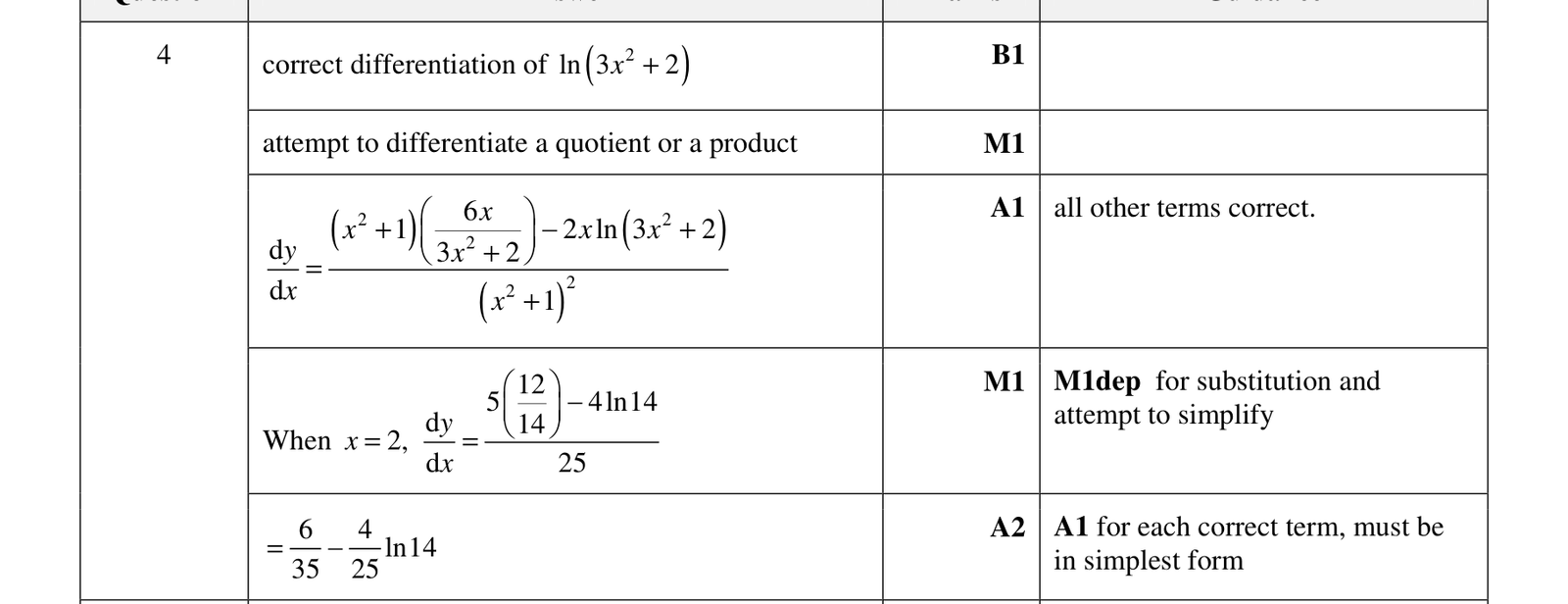
0606 P12 - Nov 2017 - Q4 - 6 marks
Given that \(y=\dfrac{\ln(3x^2+2)}{x^2+1}\), find the value of \(\dfrac{dy}{dx}\) when \(x=2\), giving your answer as \(a+b\ln14\), where \(a\) and \(b\) are fractions in their simplest form.