0606 P22 - Nov 2025 - Q6 - 8 marks
A particle \(P\) is moving in a straight line with speed \(26\) in the direction of the vector \(\begin{pmatrix}5\\-12\end{pmatrix}\).
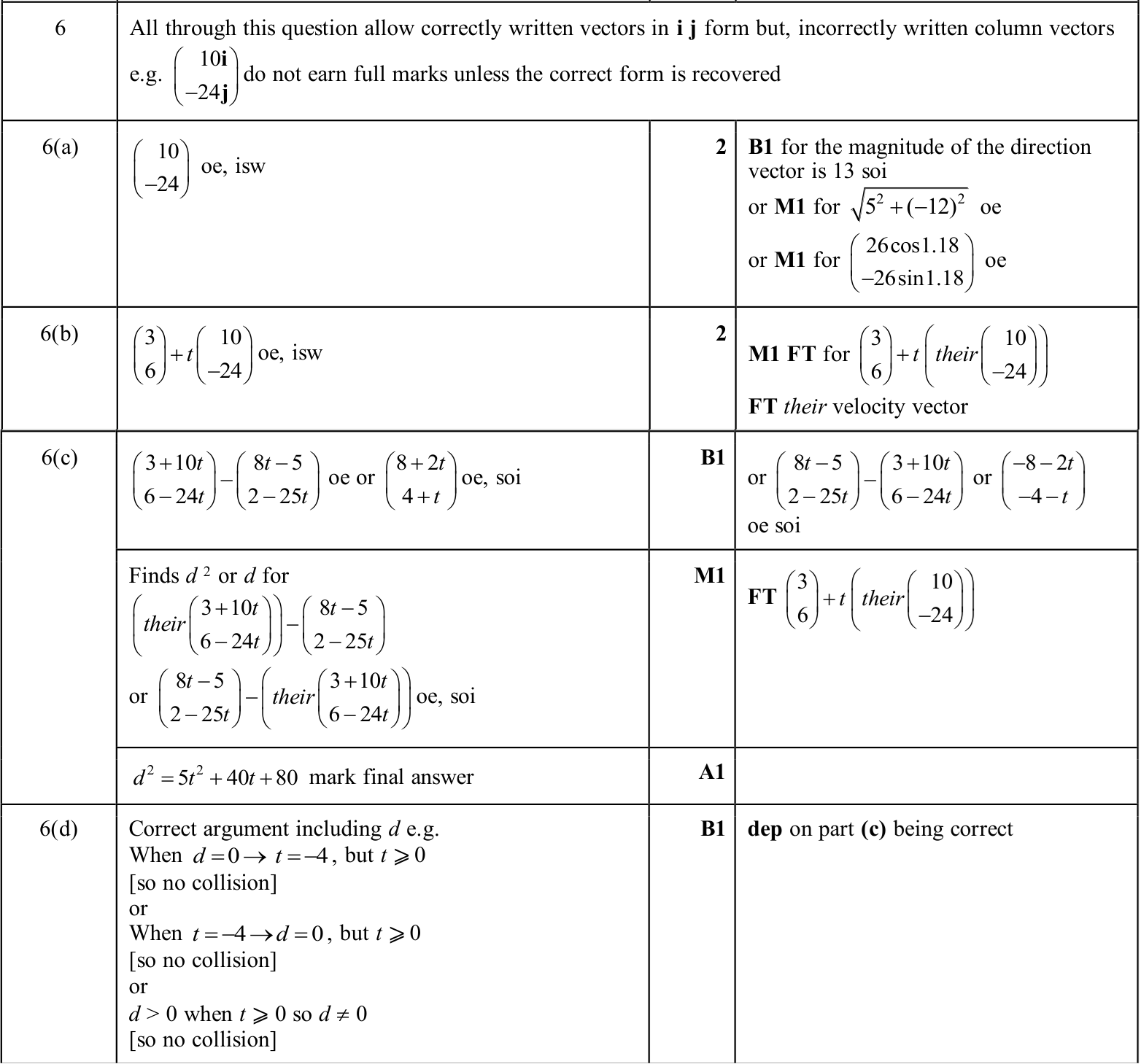
(a) Find the velocity vector of \(P\).
When \(t=0\), \(P\) passes through a point \(A\) with position vector \(\begin{pmatrix}3\\6\end{pmatrix}\).
(b) Write down the position vector of \(P\) at time \(t\).
At the same time, a particle \(Q\) passes through a point \(B\). The position vector of \(Q\) at time \(t\) is \(\begin{pmatrix}8t-5\\2-25t\end{pmatrix}\). The distance between \(P\) and \(Q\) at time \(t\) is \(d\).
(c) Show that \(d^2=mt^2+nt+r\), where \(m,n,r\) are integers to be found.
(d) Hence show that \(P\) and \(Q\) do not collide.
0606 P21 - Nov 2025 - Q12 - 7 marks
In this question, the \(x\)- and \(y\)-directions are east and north respectively. The units are metres and seconds.
Boat \(A\) starts from the origin \(O\) and moves with constant speed \(5\sqrt3\text{ m s}^{-1}\) on a bearing of \(030^\circ\).
After \(100\) seconds boat \(B\) starts from point \(P\), which has position vector \(\binom{0}{1000}\). Boat \(B\) moves with constant speed \(10\text{ m s}^{-1}\) on a bearing of \(060^\circ\).
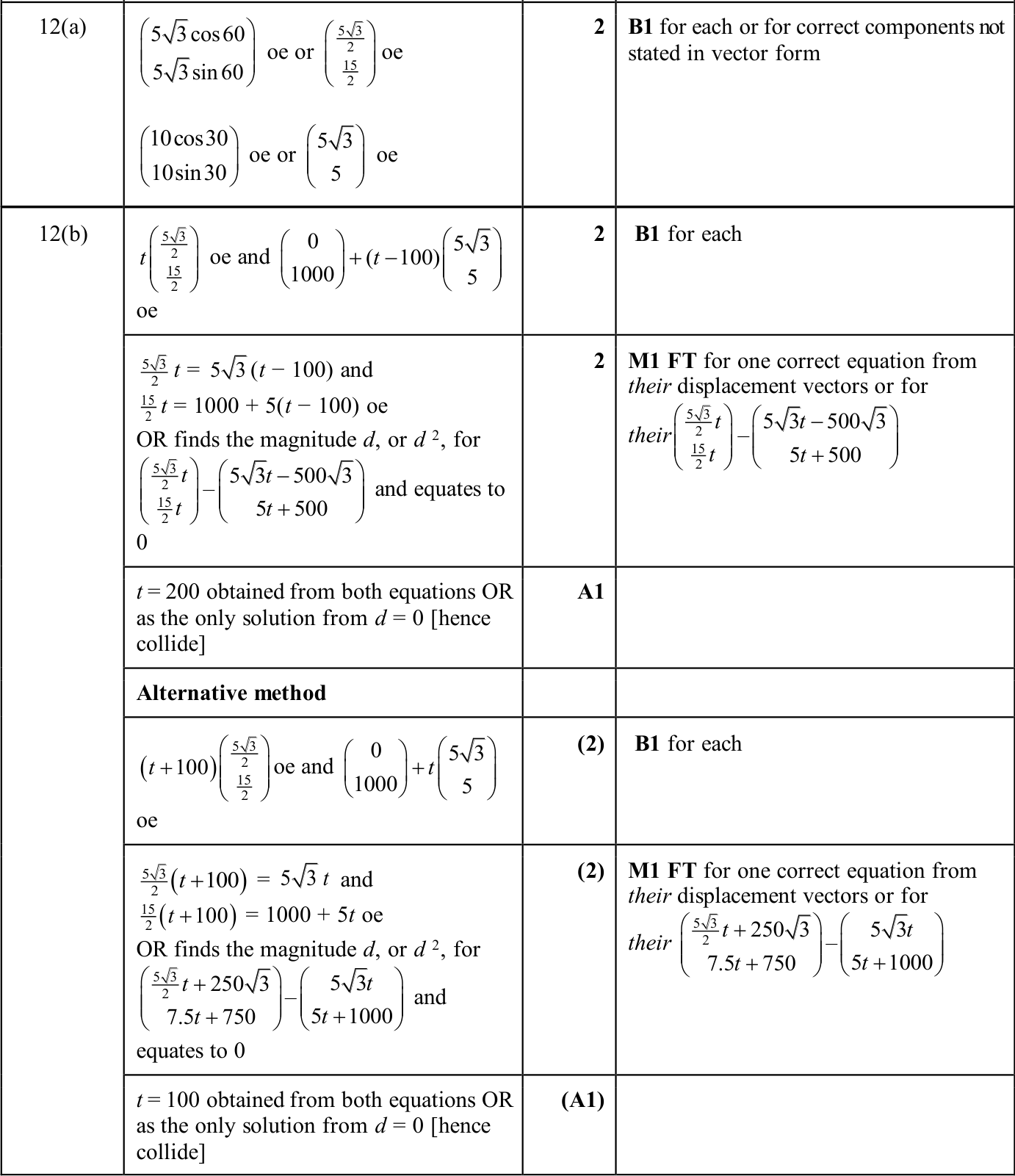
(a) Find the velocity of each boat in vector form.
(b) Show that the two boats will collide.
0606 P23 - Jun 2025 - Q10 - 9 marks
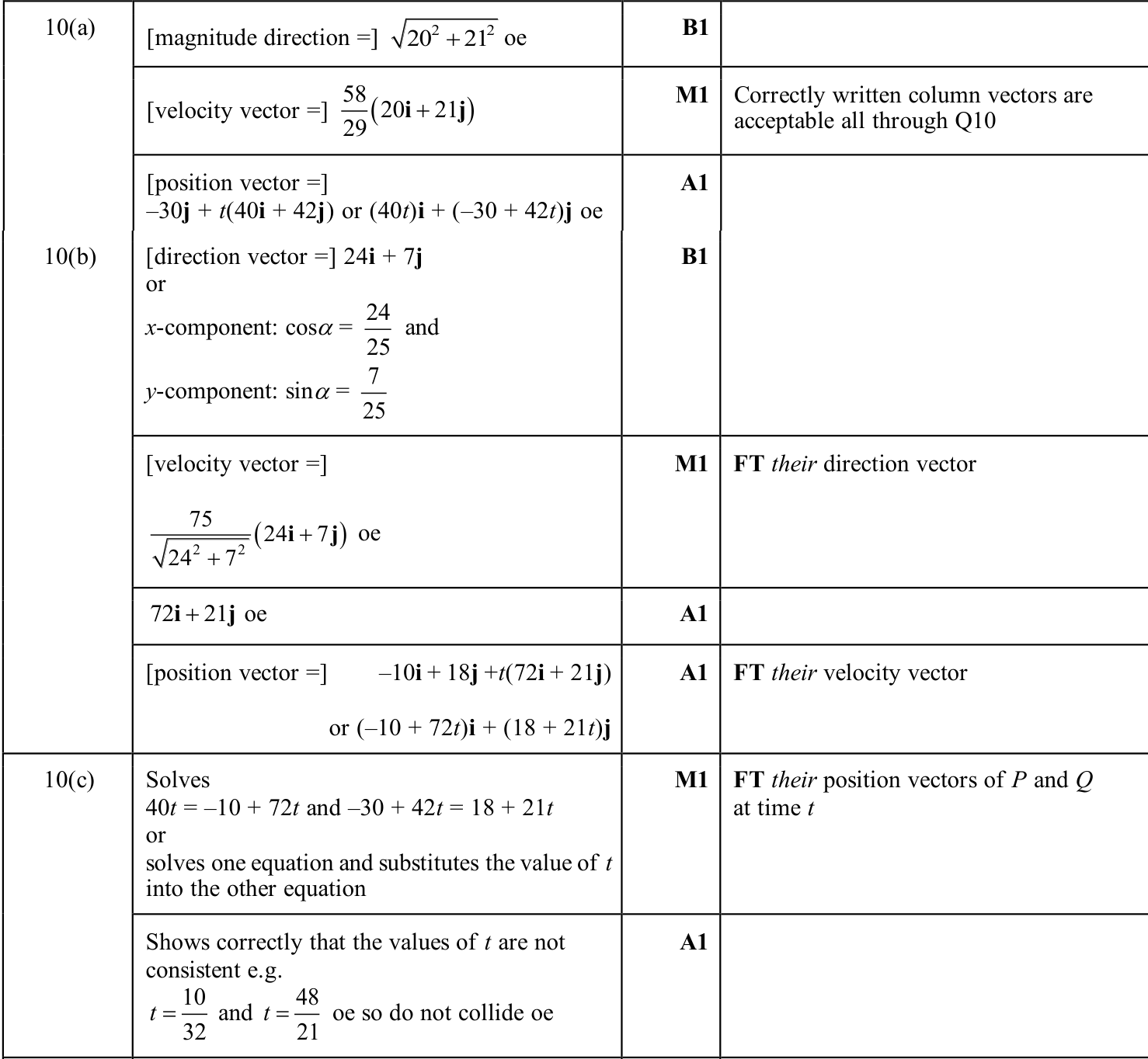
In this question, time is in seconds. (a) At time \(t=0\), particle \(P\) starts from the point with position vector \(-30 \mathbf{j}\). \(P\) travels with speed \(58 \mathrm{~ms}^{-1}\) in the direction \(20 \mathbf{i}+21 \mathbf{j}\). Find the position vector of \(P\) at time \(t\).
(b) Also at time \(t=0\), particle \(Q\) starts from the point with position vector \(-10 \mathbf{i}+18 \mathbf{j}\). \(Q\) travels with speed \(75 \mathrm{~ms}^{-1}\) at an angle \(\alpha\) above the positive \(x\)-axis, where \(\tan \alpha=\frac{7}{24}\). Find the position vector of \(Q\) at time \(t\).
(c) Determine whether \(P\) and \(Q\) collide.
0606 P22 - Nov 2024 - Q11 - 9 marks
In this question \(\mathbf{i}\) is a unit vector in the positive \(x\)-direction and \(\mathbf{j}\) is a unit vector in the positive \(y\)-direction. Time is in seconds and distances are in metres.
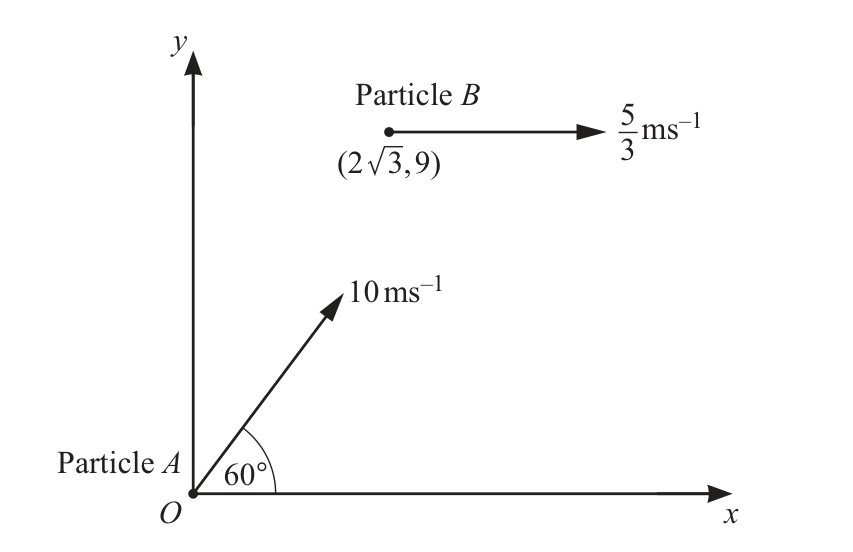
The diagram shows the initial positions and velocities of two particles, \(A\) and \(B\), that move in the \(x-y\) plane.
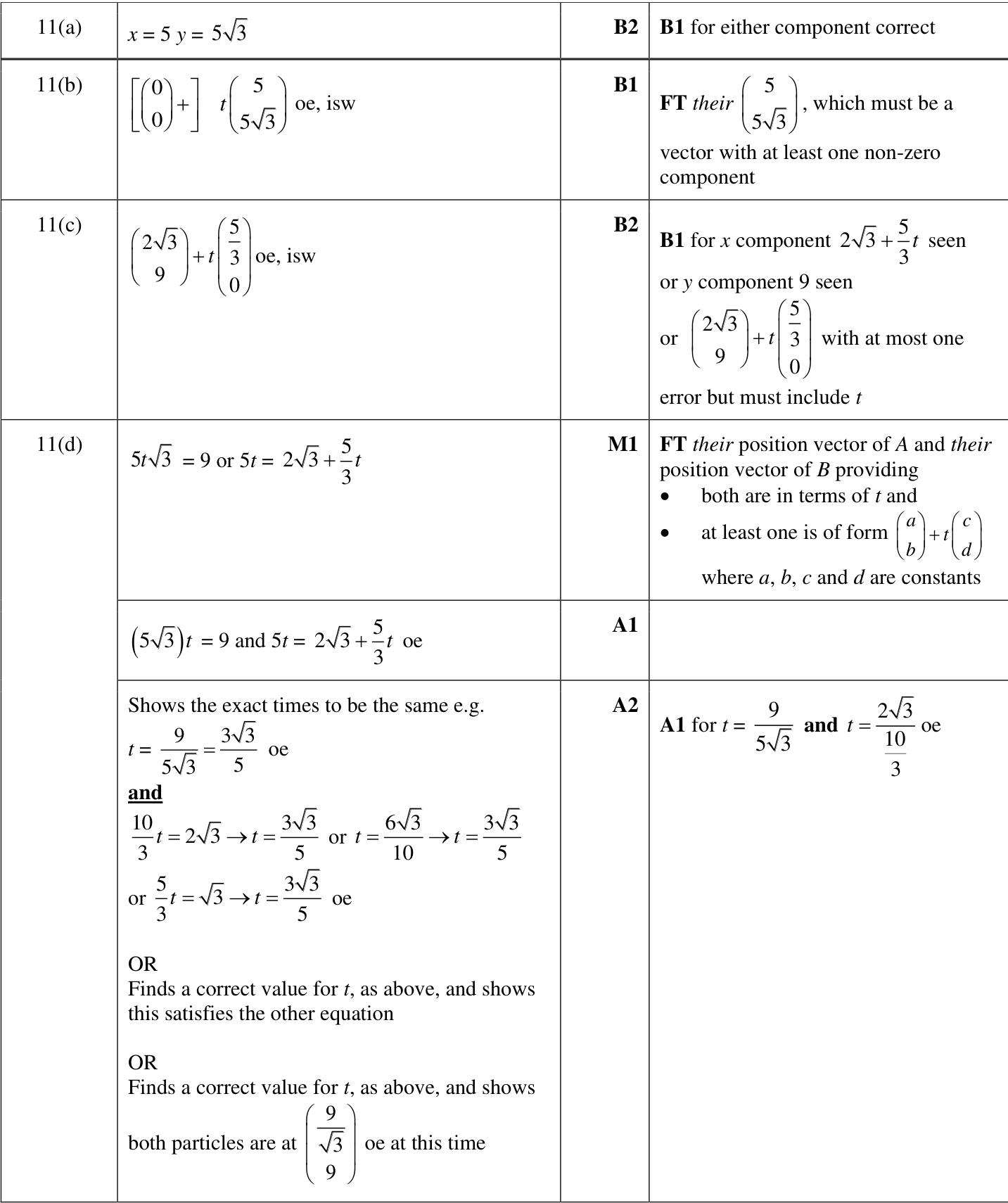
Particle \(A\) starts from the origin \(O\) at time \(t=0\). It moves with constant speed \(10 \mathrm{~ms}^{-1}\) in the direction \(60^{\circ}\) above the \(x\)-axis. (a) Find the exact values of the components of the velocity of particle \(A\) in the \(x\)-direction and the \(y\)-direction.
(b) Find, in terms of \(t\), the position vector of particle \(A\) at time \(t\).
Particle \(B\) starts from the point \((2 \sqrt{3}, 9)\) at time \(t=0\). It moves with constant speed \(\frac{5}{3} \mathrm{~ms}^{-1}\) parallel to the positive \(x\)-axis. (c) Find, in terms of \(t\), the position vector of particle \(B\) at time \(t\).
(d) Hence show that the particles collide.
0606 P12 - Jun 2024 - Q9 - 10 marks
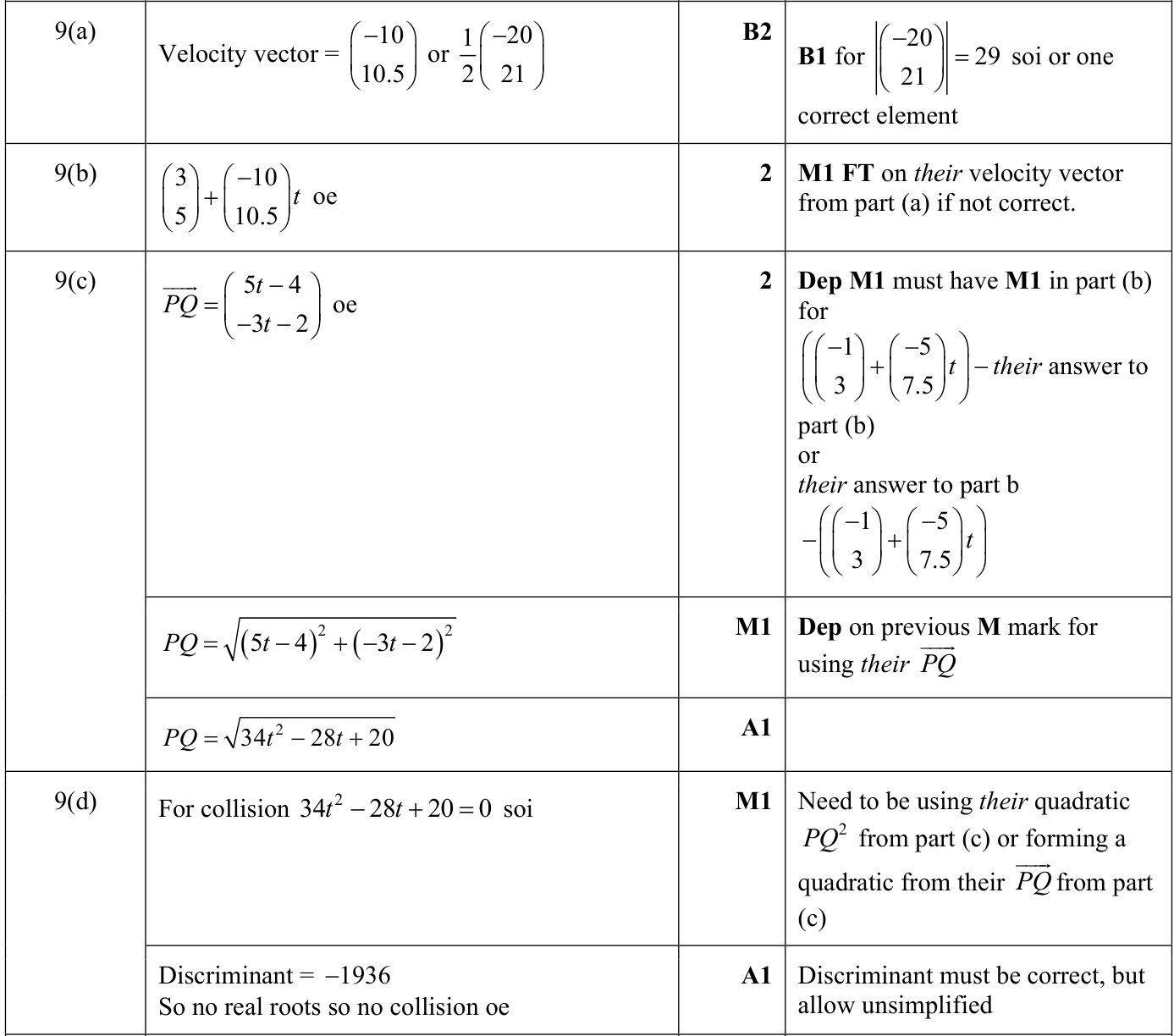
In this question, all distances are in metres and time, \(t\), is in seconds. A particle \(P\) moves with a speed of 14.5 parallel to the vector \(\binom{-20}{21}\). (a) Find the velocity vector of \(P\).
Initially, \(P\) has position vector \(\binom{3}{5}\). (b) Write down the position vector of \(P\) at time \(t\).
A second particle \(Q\) has position vector \(\binom{-1}{3}+\binom{-5}{7.5} t\) at time \(t\). (c) Find, in terms of \(t\), the distance between \(P\) and \(Q\) at time \(t\). Simplify your answer.
(d) Hence show that \(P\) and \(Q\) never collide.
0606 P12 - Mar 2023 - Q9 - 8 marks
In this question, all lengths are in metres.
(a) A particle \(P\) has position vector
\(\begin{pmatrix}2+12t\\5-5t\end{pmatrix}\)
at a time \(t\) seconds, \(t\geq0\).
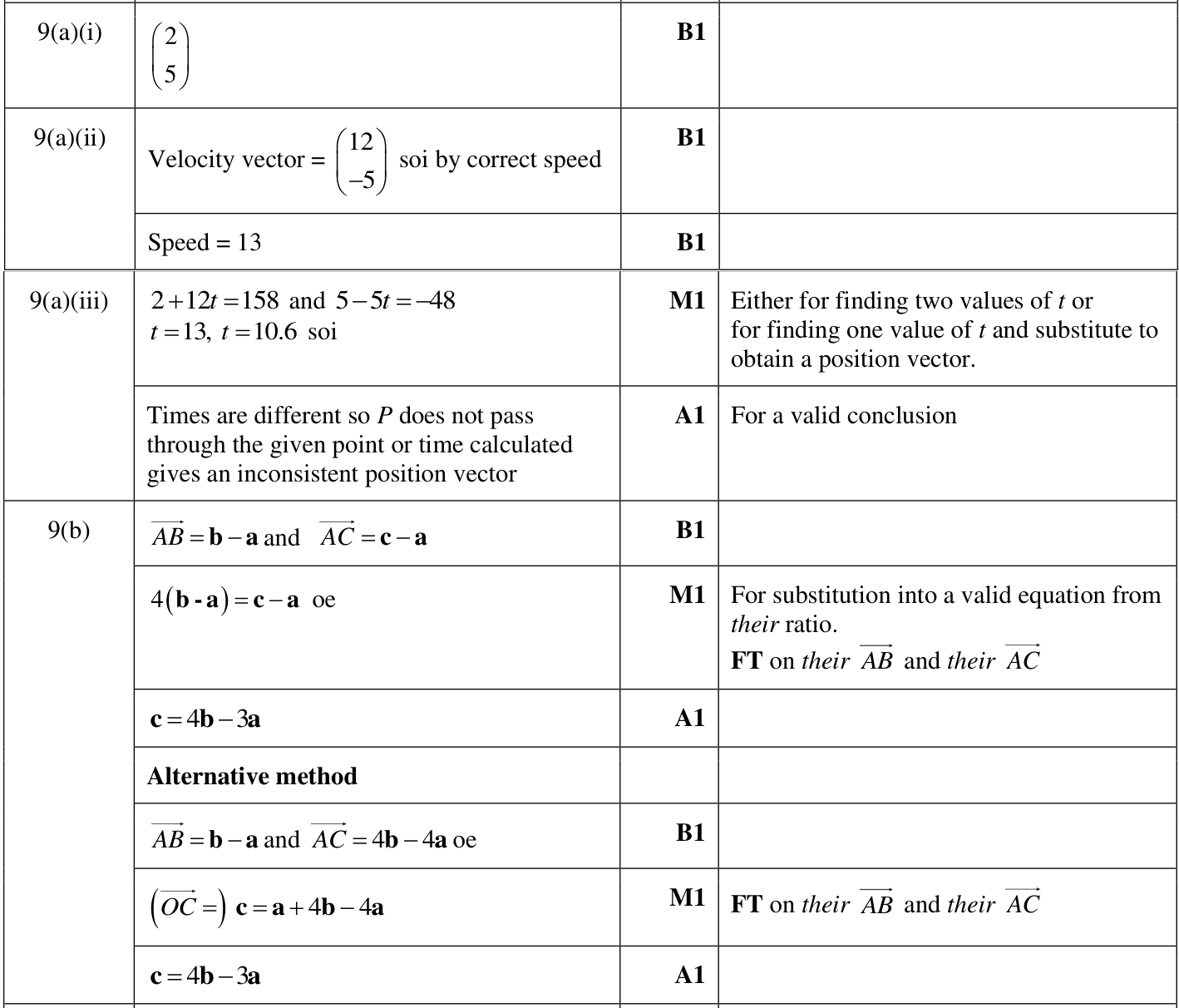
(i) Write down the initial position vector of \(P\).
(ii) Find the speed of \(P\).
(iii) Determine whether \(P\) passes through the point with position vector
\(\begin{pmatrix}158\\-48\end{pmatrix}.\)
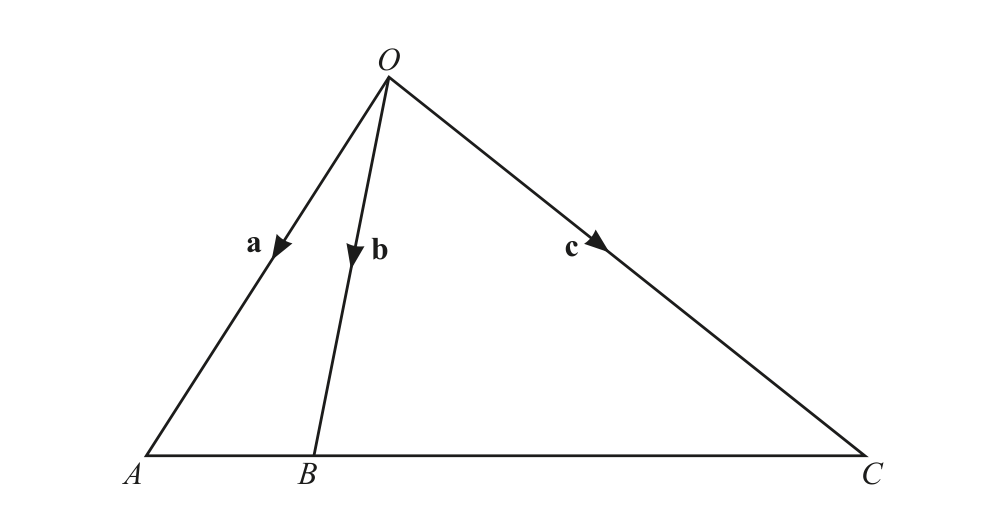
(b) The diagram shows the triangle \(OAC\). The point \(B\) lies on \(AC\) such that \(AB:AC=1:4\). Given that
\(\overrightarrow{OA}=\mathbf a,\qquad \overrightarrow{OB}=\mathbf b,\qquad \overrightarrow{OC}=\mathbf c,\)
find \(\mathbf c\) in terms of \(\mathbf a\) and \(\mathbf b\).
0606 P12 - Mar 2022 - Q8 - 8 marks
In this question, all lengths are in metres and all times are in seconds.
A particle \(A\) is moving in the direction \(\begin{pmatrix}-20\\21\end{pmatrix}\) with a speed of 58.
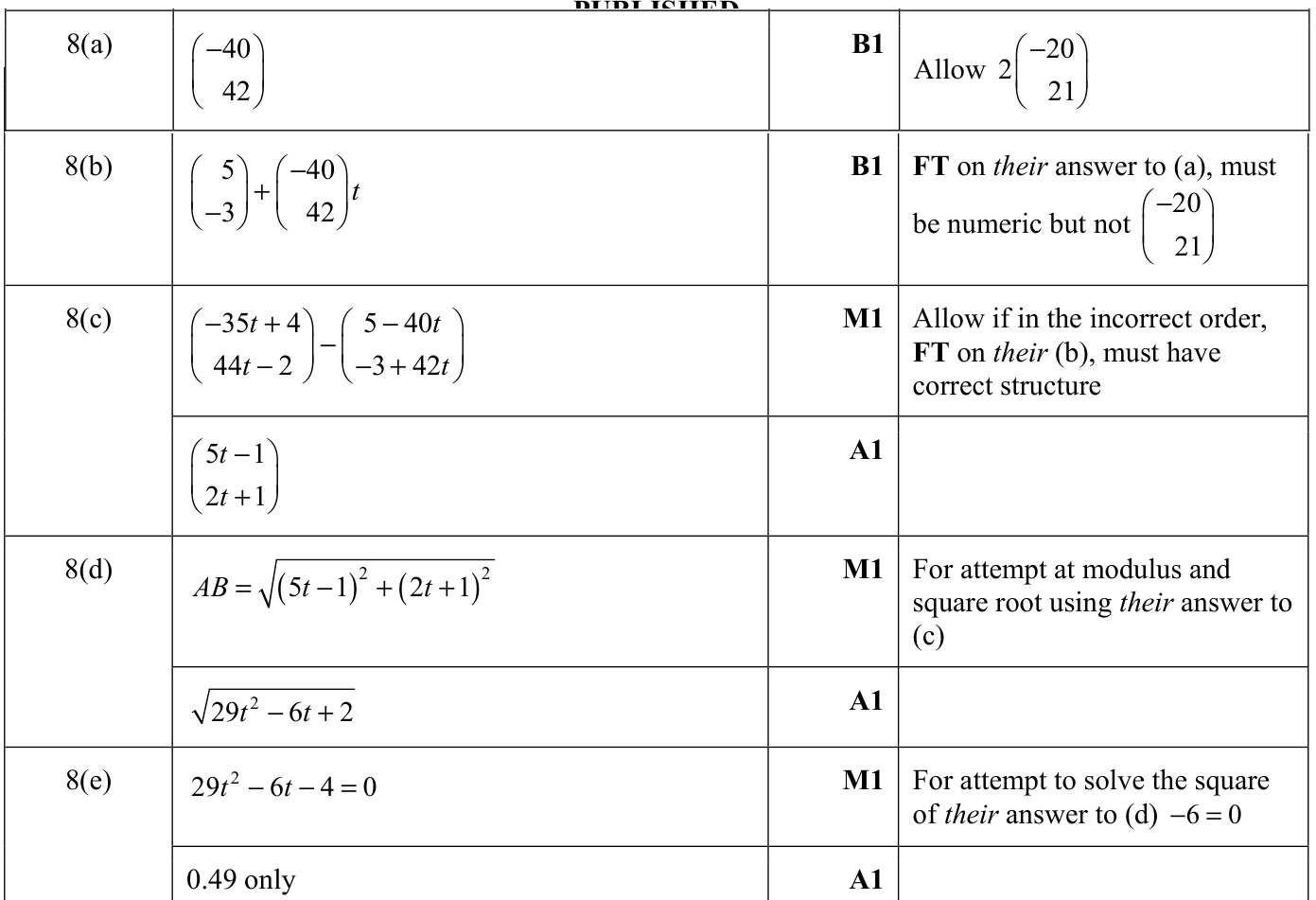
(a) Find the velocity vector of \(A\).
(b) Given that \(A\) is initially at the point with position vector \(\begin{pmatrix}5\\-3\end{pmatrix}\), write down the position vector of \(A\) at time \(t\).
A particle \(B\) starts to move such that its position vector at time \(t\) is \(\begin{pmatrix}-35t+4\\44t-2\end{pmatrix}\).
(c) Find the displacement vector \(\overrightarrow{AB}\) at time \(t\).
(d) Hence find the distance \(AB\), at time \(t\), in the form \(\sqrt{pt^2+qt+r}\), where \(p\), \(q\) and \(r\) are constants.
(e) Find the value of \(t\) when the distance \(AB\) is \(\sqrt6\), giving your answer correct to 2 decimal places.
0606 P21 - Jun 2022 - Q8 - 7 marks
Unit vectors \(\mathbf{i}\) and \(\mathbf{j}\) point east and north respectively.
At 09:00, ship A leaves the point \(P\), whose position vector is \(5\mathbf{i}+16\mathbf{j}\). Ship A travels with speed \(6\sqrt3\) km h\(^{-1}\) on a bearing of \(120^{\circ}\).
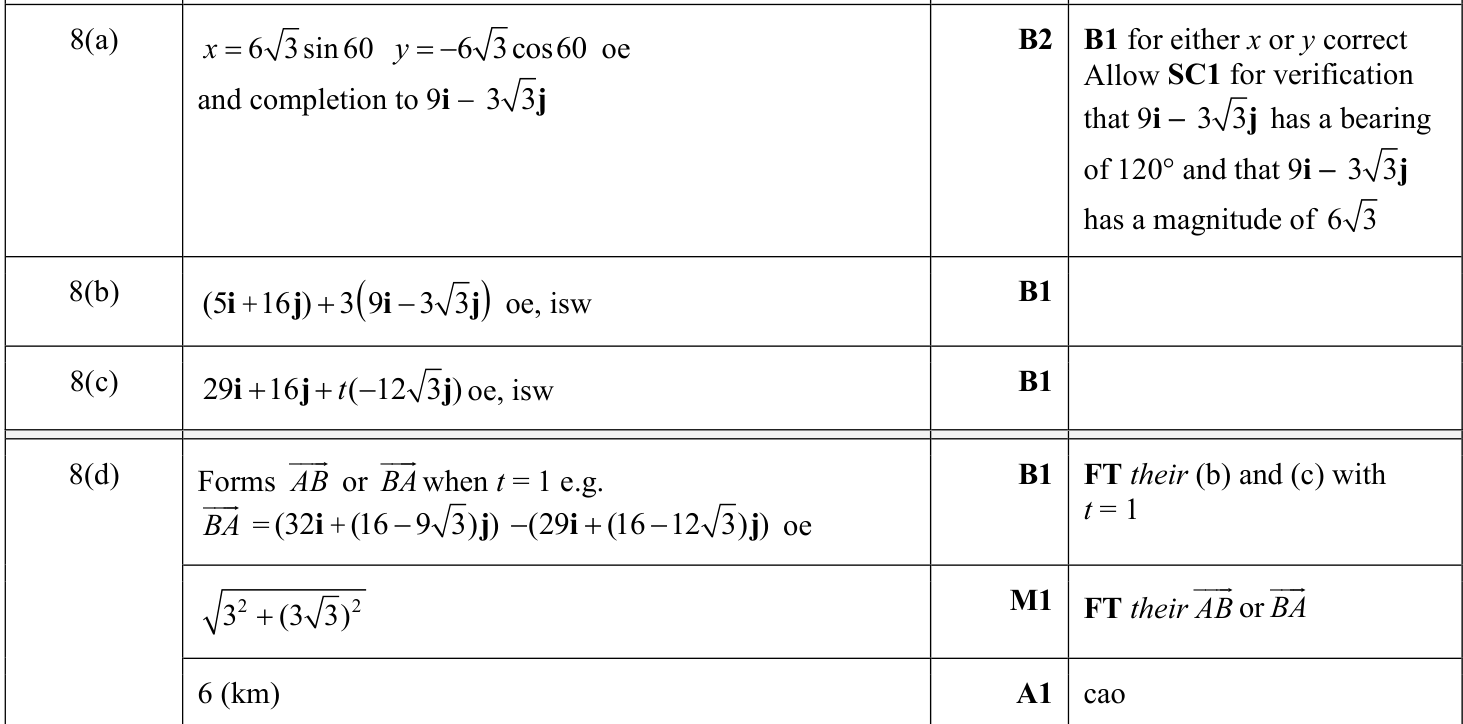
(a) Show that the velocity vector of ship A is \(9\mathbf{i}-3\sqrt3\mathbf{j}\).
(b) Find the position vector of ship A at 12:00.
At 11:00, ship B leaves the point \(Q\), whose position vector is \(29\mathbf{i}+16\mathbf{j}\). Ship B travels with velocity vector \(-12\sqrt3\mathbf{j}\) km h\(^{-1}\).
(c) Write down the position vector of ship B at time \(t\) hours after 11:00.
(d) Find the distance between ships A and B at 12:00.
0606 P23 - Nov 2022 - Q8 - 10 marks
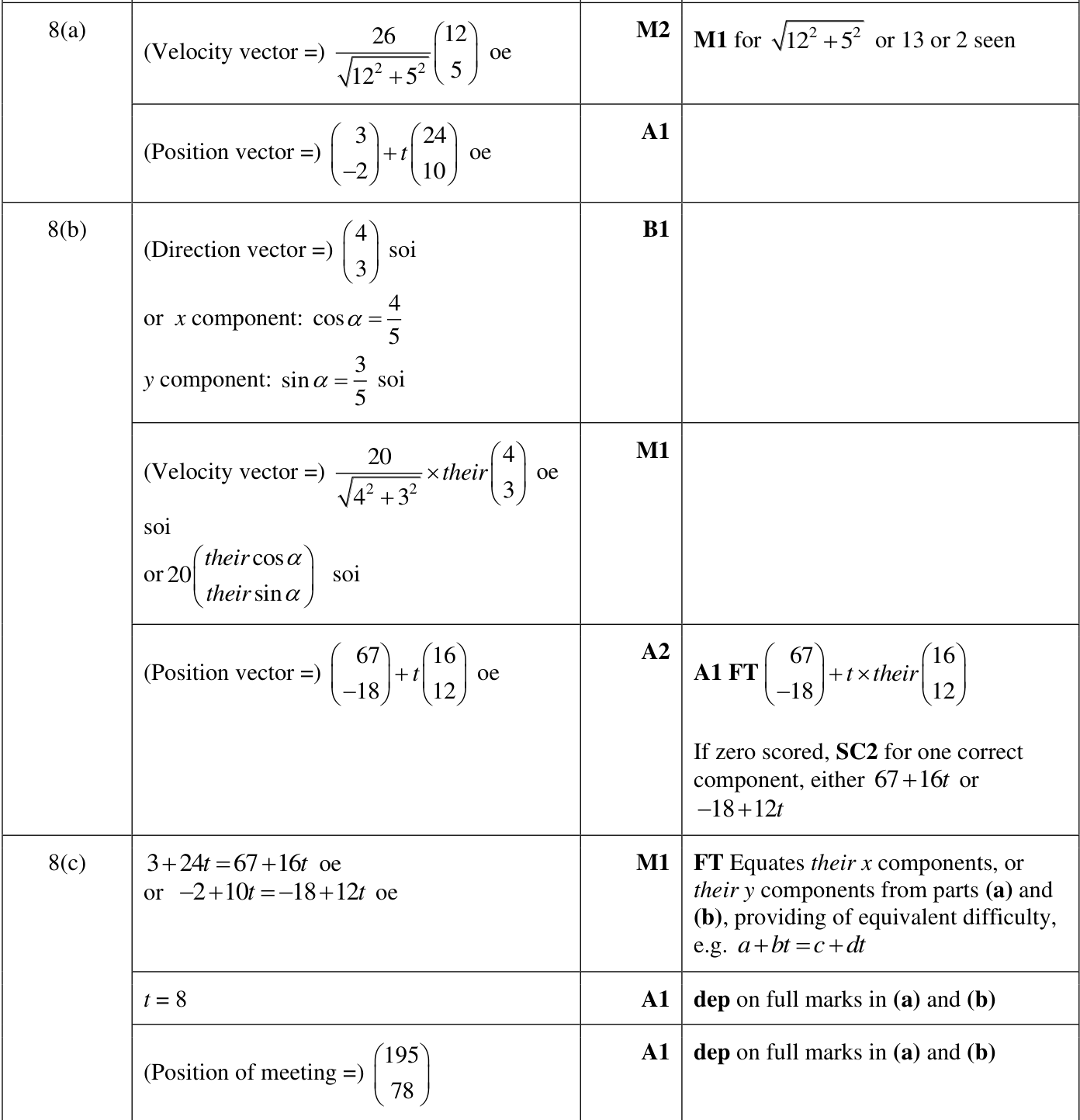
Particle \(A\) starts from the point with position vector \(3\mathbf{i}-2\mathbf{j}\). It moves with speed \(26\,\text{m s}^{-1}\) in the direction of the vector \(12\mathbf{i}+5\mathbf{j}\).
Particle \(B\) starts from the point with position vector \(67\mathbf{i}-18\mathbf{j}\). It moves with speed \(20\,\text{m s}^{-1}\) at an angle \(\alpha\) above the positive \(x\)-axis, where \(\tan\alpha=\frac34\).
The particles meet after \(t\) seconds. Find the value of \(t\) and the position vector of the point where they meet.
0606 P12 - Mar 2021 - Q5 - 7 marks
In this question all lengths are in kilometres and time is in hours.
Boat \(A\) sails, with constant velocity, from a point \(O\) with position vector \(\begin{pmatrix}0\\0\end{pmatrix}\). After 3 hours \(A\) is at the point with position vector \(\begin{pmatrix}-12\\9\end{pmatrix}\).
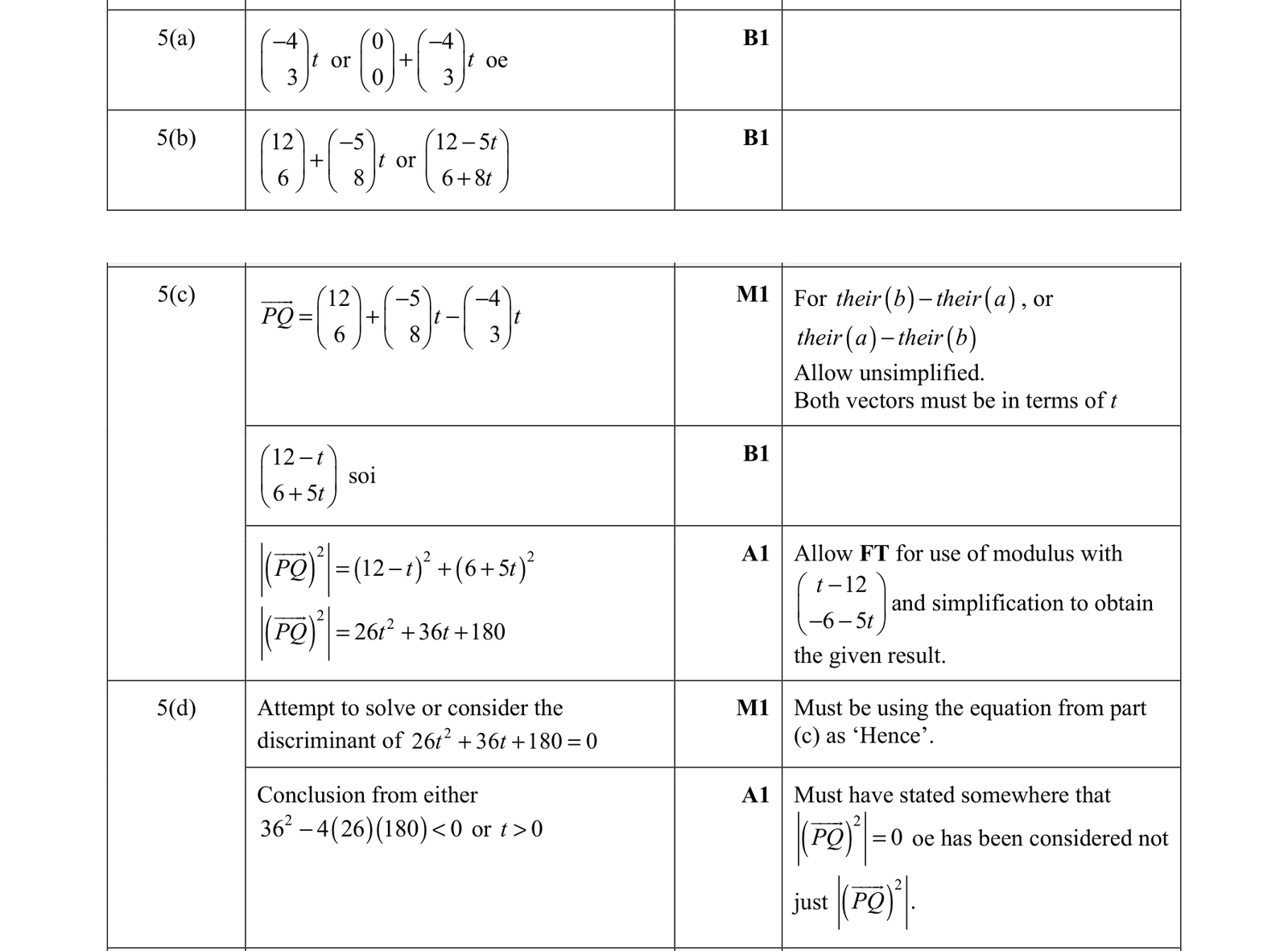
(a) Find the position vector, \(\overrightarrow{OP}\), of \(A\) at time \(t\).
At the same time as \(A\) sails from \(O\), boat \(B\) sails from a point with position vector \(\begin{pmatrix}12\\6\end{pmatrix}\), with constant velocity \(\begin{pmatrix}-5\\8\end{pmatrix}\).
(b) Find the position vector, \(\overrightarrow{OQ}\), of \(B\) at time \(t\).
(c) Show that at time \(t\), \(|\overrightarrow{PQ}|^2=26t^2+36t+180\).
(d) Hence show that \(A\) and \(B\) do not collide.
0606 P12 - Mar 2020 - Q8 - 8 marks
In this question all distances are in km.
A ship \(P\) sails from a point \(A\), which has position vector
\(\begin{pmatrix}0\\0\end{pmatrix},\)
with a speed of \(52\text{ km h}^{-1}\) in the direction of
\(\begin{pmatrix}-5\\12\end{pmatrix}.\)
(a) Find the velocity vector of the ship.
(b) Write down the position vector of \(P\) at a time \(t\) hours after leaving \(A\).
At the same time that ship \(P\) sails from \(A\), a ship \(Q\) sails from a point \(B\), which has position vector
\(\begin{pmatrix}12\\8\end{pmatrix},\)
with velocity vector
\(\begin{pmatrix}-25\\45\end{pmatrix}\text{ km h}^{-1}.\)
(c) Write down the position vector of \(Q\) at a time \(t\) hours after leaving \(B\).
(d) Using your answers to parts (b) and (c), find the displacement vector \(\overrightarrow{PQ}\) at time \(t\) hours.
(e) Hence show that
\(PQ=\sqrt{34t^2-168t+208}.\)
(f) Find the value of \(t\) when \(P\) and \(Q\) are first \(2\) km apart.

0606 P11 - Nov 2020 - Q6 - 7 marks
A particle \(P\) is initially at the point with position vector \(\begin{pmatrix}30\\10\end{pmatrix}\) and moves with a constant speed of \(10\text{ m s}^{-1}\) in the same direction as \(\begin{pmatrix}-4\\3\end{pmatrix}\).
(a) Find the position vector of \(P\) after \(t\) s.
As \(P\) starts moving, a particle \(Q\) starts to move such that its position vector after \(t\) s is given by
\(\begin{pmatrix}-80\\90\end{pmatrix} +t\begin{pmatrix}5\\12\end{pmatrix}.\)
(b) Write down the speed of \(Q\).
(c) Find the exact distance between \(P\) and \(Q\) when \(t=10\), giving your answer in its simplest surd form.

0606 P11 - Jun 2019 - Q5 - 7 marks
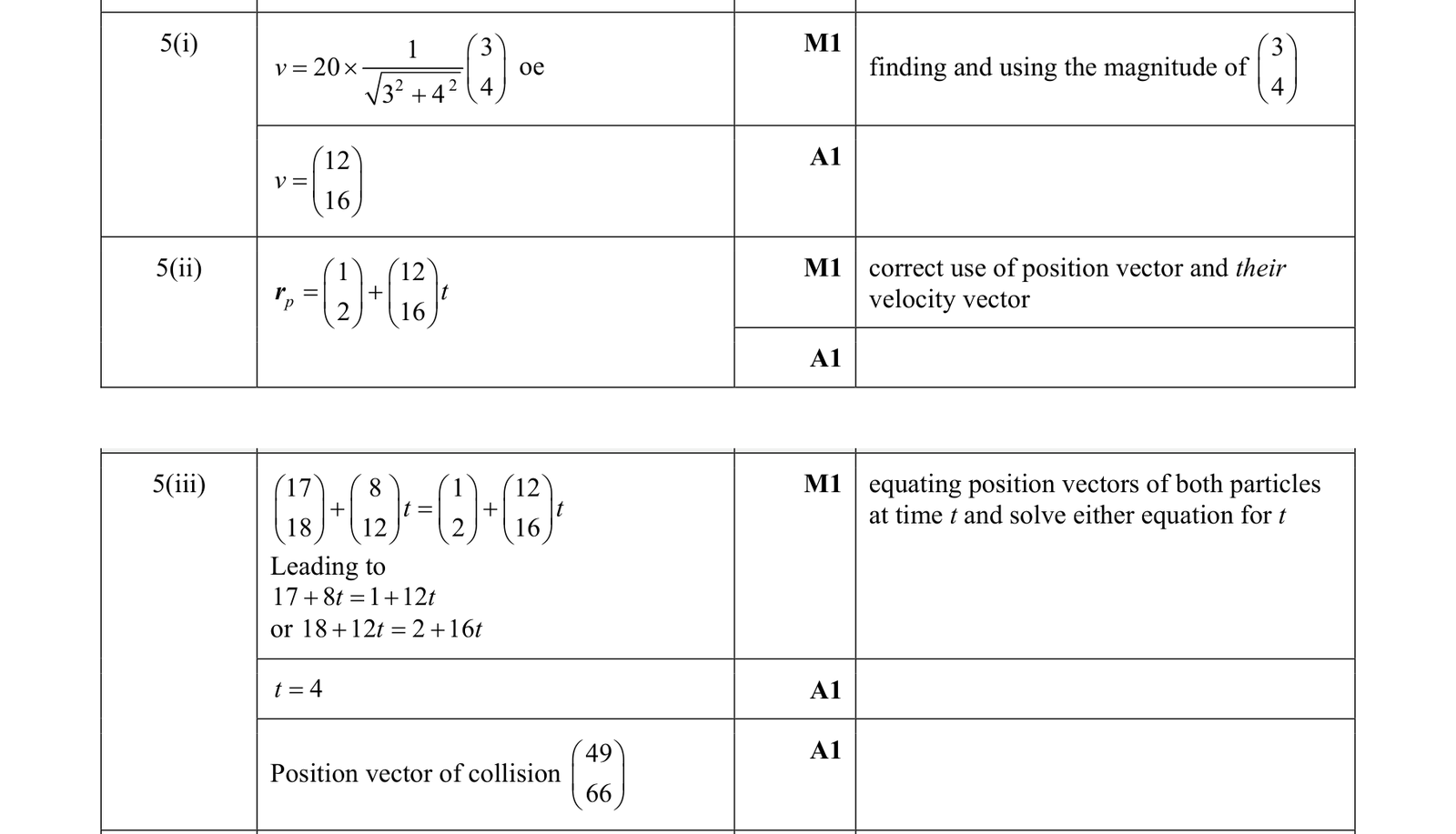
A particle \(P\) is moving with a velocity of \(20\text{ m s}^{-1}\) in the same direction as \(\binom34\).
(i) Find the velocity vector of \(P\).
At time \(t=0\), \(P\) has position vector \(\binom12\) relative to a fixed point \(O\).
(ii) Write down the position vector of \(P\) after \(t\) seconds.
A particle \(Q\) has position vector \(\binom{17}{18}\) relative to \(O\) at time \(t=0\), and has velocity vector \(\binom8{12}\text{ m s}^{-1}\).
(iii) Given that \(P\) and \(Q\) collide, find the value of \(t\) and the position vector of the point of collision.
0606 P12 - Jun 2019 - Q7 - 8 marks
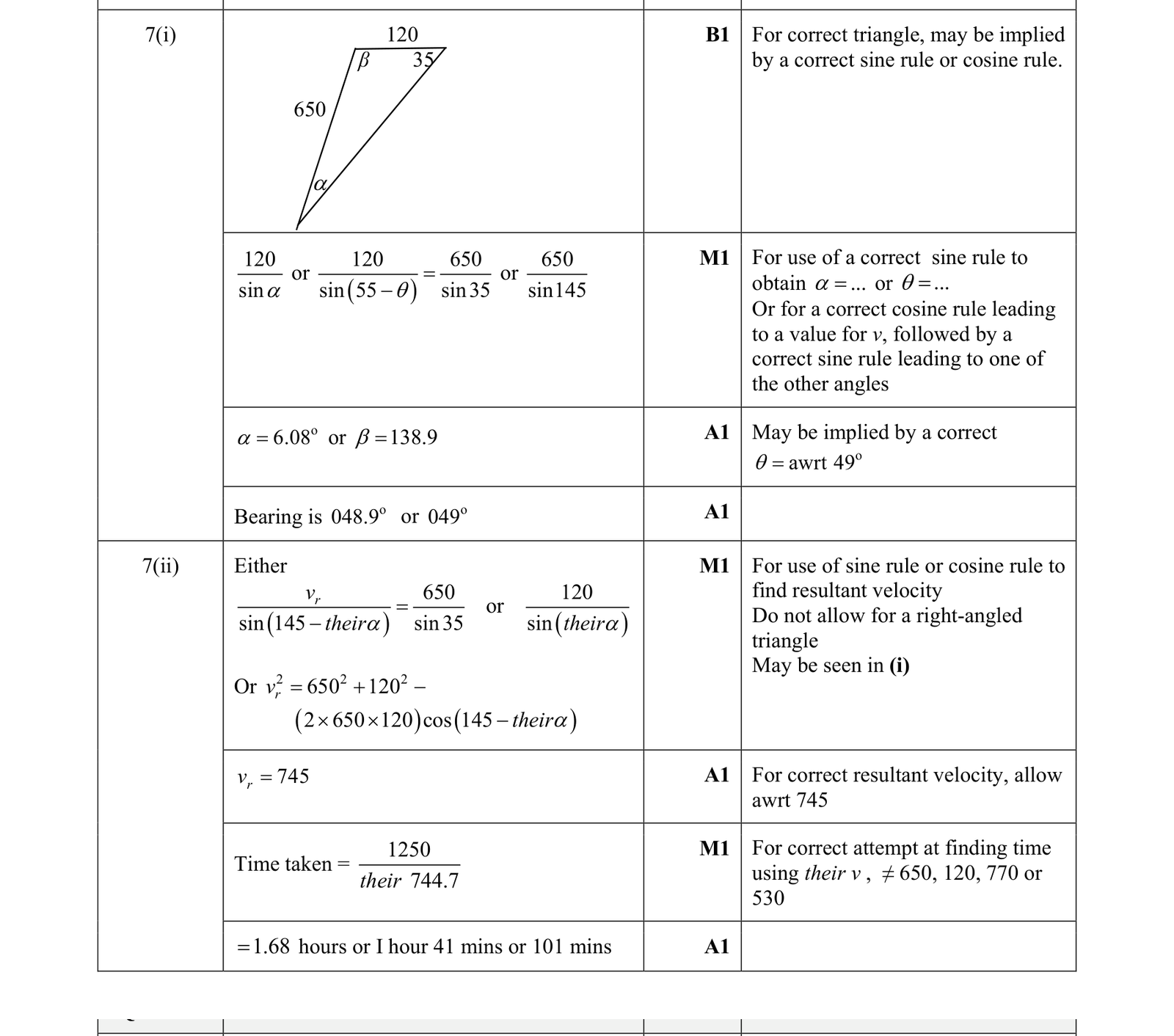
A pilot wishes to fly his plane from a point \(A\) to a point \(B\) on a bearing of \(055^\circ\). There is a wind blowing at \(120\text{ km h}^{-1}\) from the west. The plane can fly at \(650\text{ km h}^{-1}\) in still air.
(i) Find the direction in which the pilot must fly his plane in order to reach \(B\).
(ii) Given that the distance between \(A\) and \(B\) is \(1250\) km, find the time it will take the pilot to fly from \(A\) to \(B\).
0606 P13 - Jun 2019 - Q11 - 8 marks
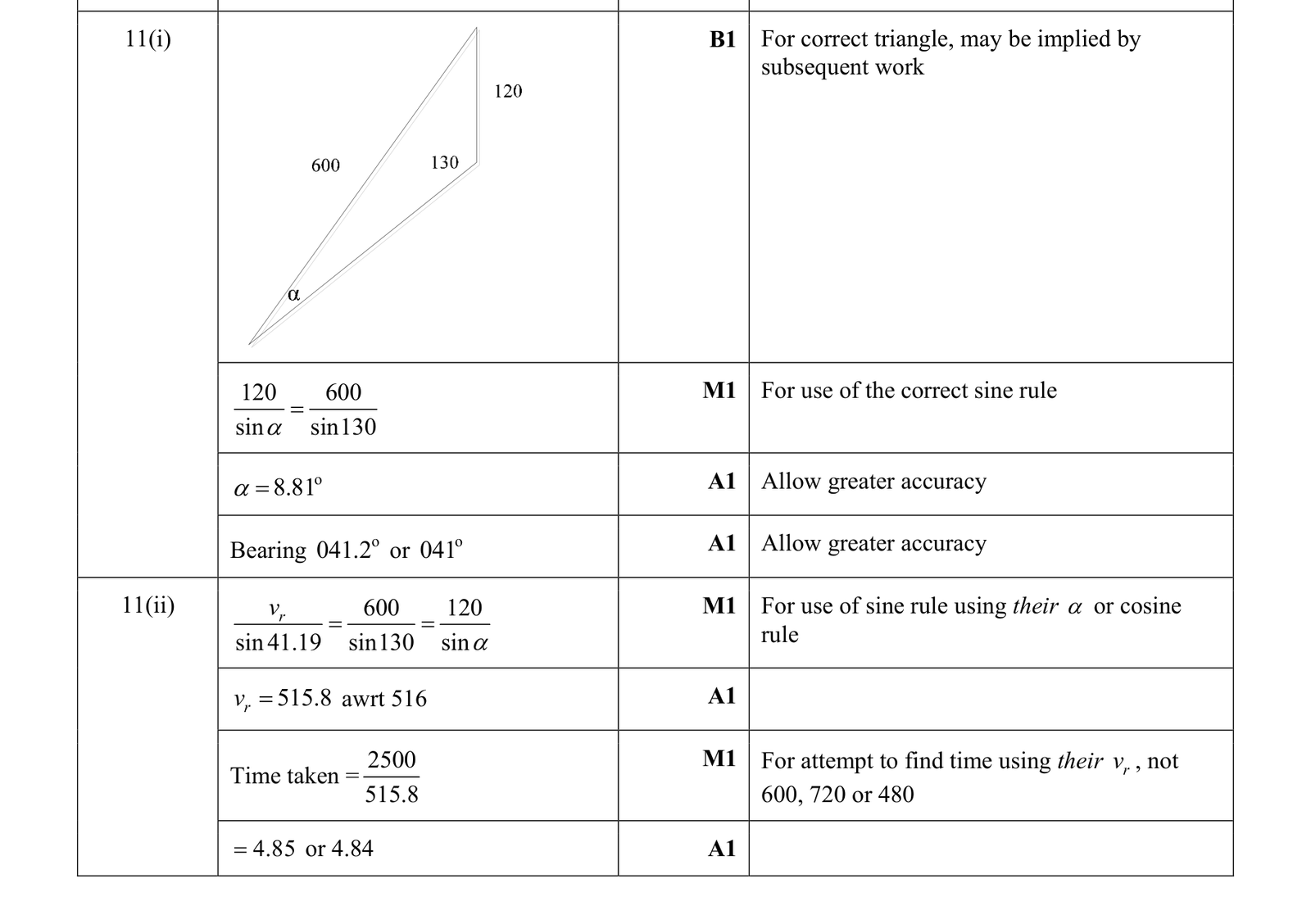
A pilot wishes to fly his plane from a point \(A\) to a point \(B\). The bearing of \(B\) from \(A\) is \(050^\circ\). A wind is blowing from the north at \(120\text{ km h}^{-1}\). The plane can fly at \(600\text{ km h}^{-1}\) in still air.
(i) Find the bearing on which the pilot must fly his plane in order to reach \(B\).
(ii) Given that the distance from \(A\) to \(B\) is \(2500\) km, find the time taken to fly from \(A\) to \(B\).
0606 P21 - Nov 2019 - Q11 - 6 marks
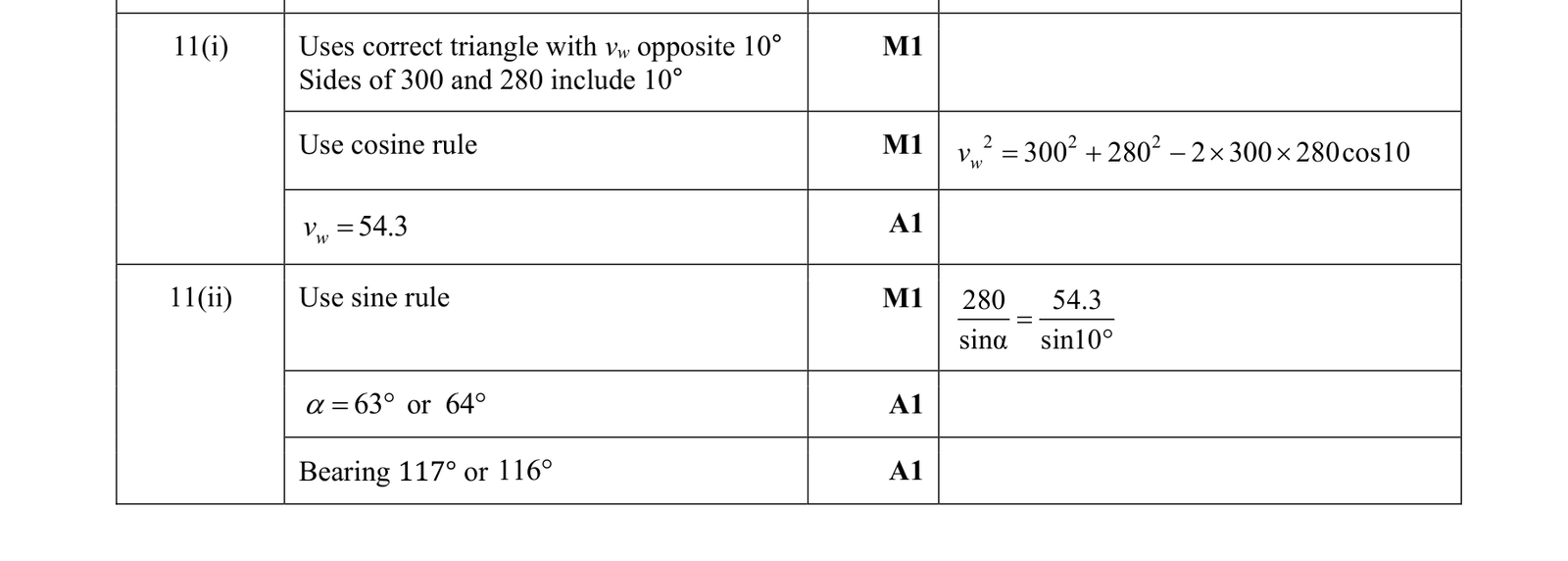
A plane, which can travel at a speed of \(300\text{ km h}^{-1}\) in still air, heads due north. The plane is blown off course by a wind so that it travels on a bearing of \(010^\circ\) at a speed of \(280\text{ km h}^{-1}\).
(i) Find the speed of the wind.
(ii) Find the direction of the wind as a bearing correct to the nearest degree.
0606 P22 - Nov 2019 - Q8 - 9 marks
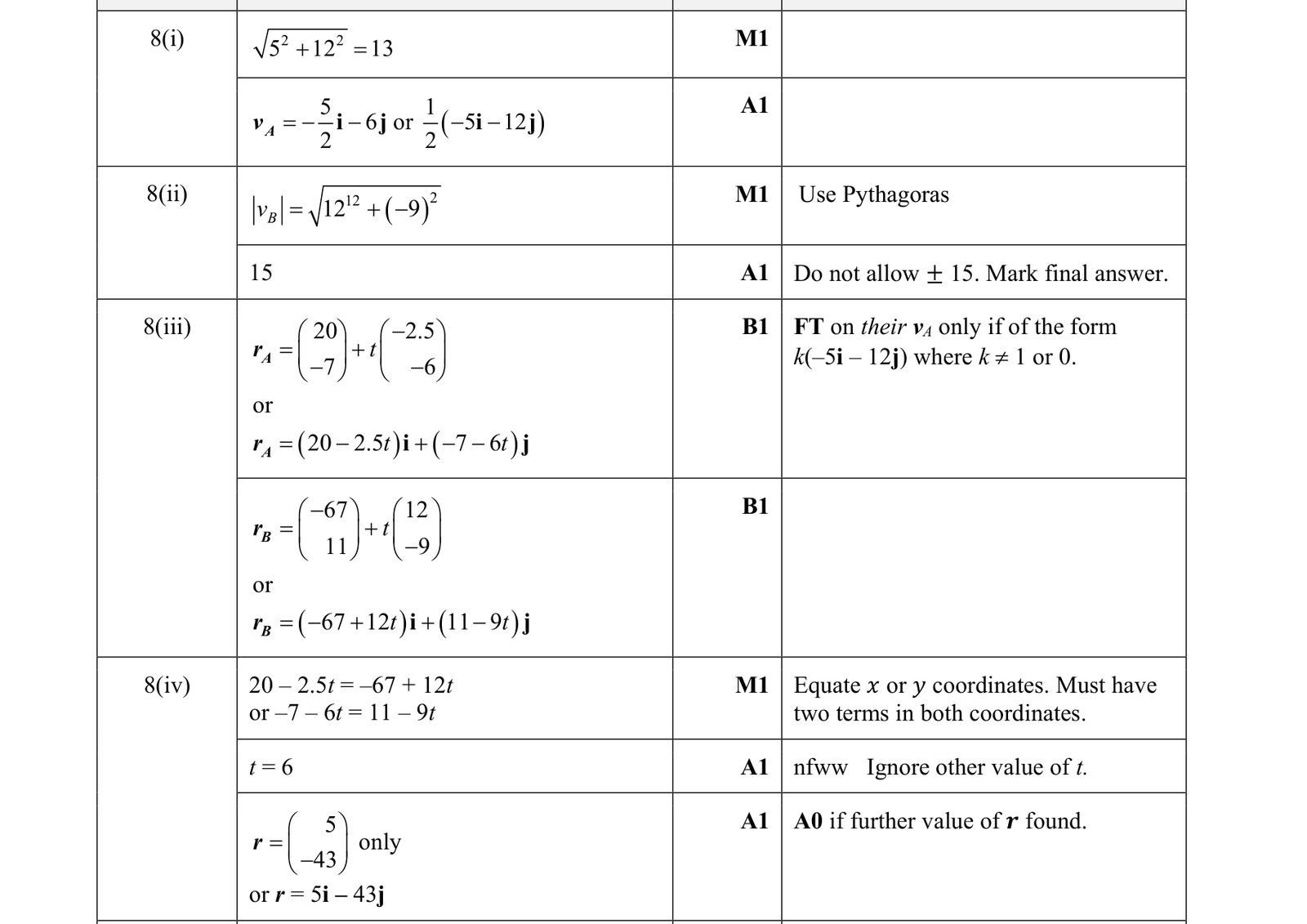
(i) A particle \(A\) travels with a speed of \(6.5\text{ m s}^{-1}\) in the direction \(-5\mathbf{i}-12\mathbf{j}\). Find the velocity \(\mathbf{v}_A\) of \(A\).
(ii) A particle \(B\) travels with velocity \(\mathbf{v}_B=12\mathbf{i}-9\mathbf{j}\). Find the speed of \(B\).
Particle \(A\) starts from the point with position vector \(20\mathbf{i}-7\mathbf{j}\). At the same time particle \(B\) starts from the point with position vector \(-67\mathbf{i}+11\mathbf{j}\).
(iii) Find the position vectors \(\mathbf{r}_A\) and \(\mathbf{r}_B\) after \(t\) seconds.
(iv) Find the time when the particles collide and the position vector of the point of collision.
0606 P22 - Mar 2018 - Q5 - 4 marks
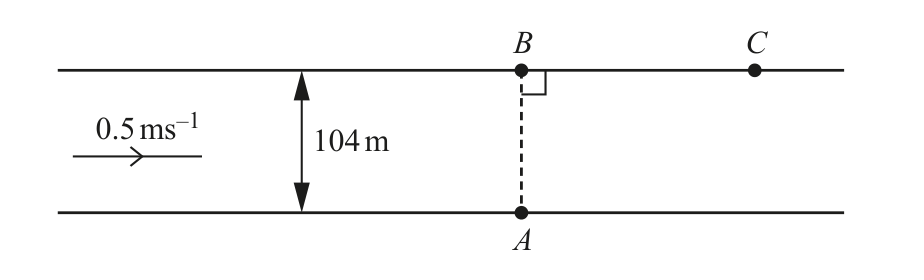
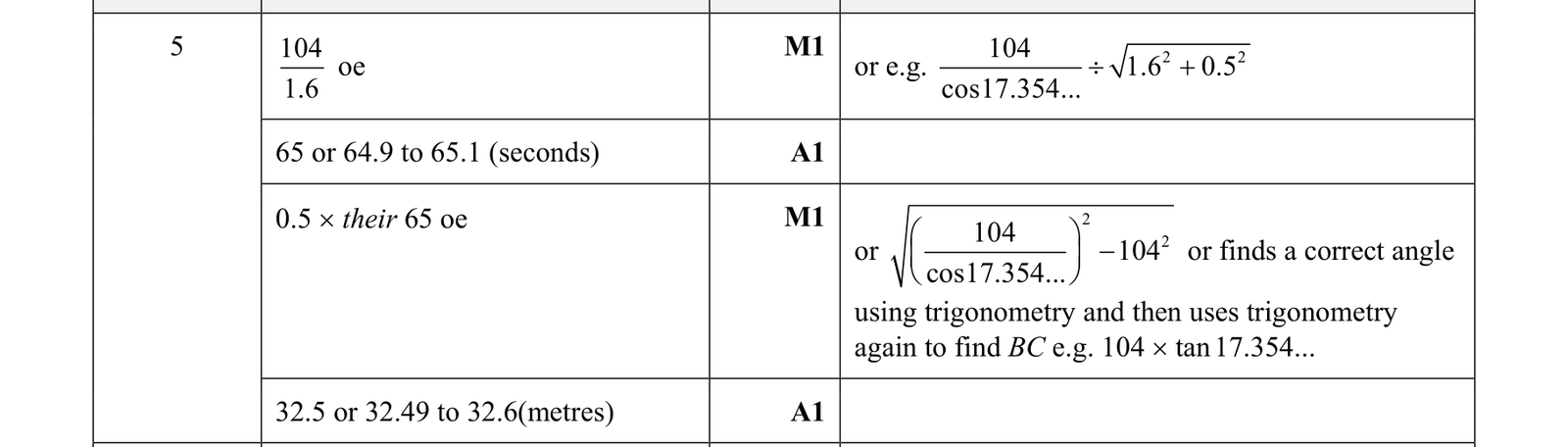
A river is \(104\) metres wide and the current flows at \(0.5\text{ m s}^{-1}\) parallel to its banks. A woman can swim at \(1.6\text{ m s}^{-1}\) in still water. She swims from point \(A\) and aims for point \(B\), which is directly opposite, but she is carried downstream to point \(C\). Calculate the time it takes the woman to swim across the river and the distance downstream, \(BC\), that she travels.
0606 P11 - Jun 2018 - Q8 - 8 marks
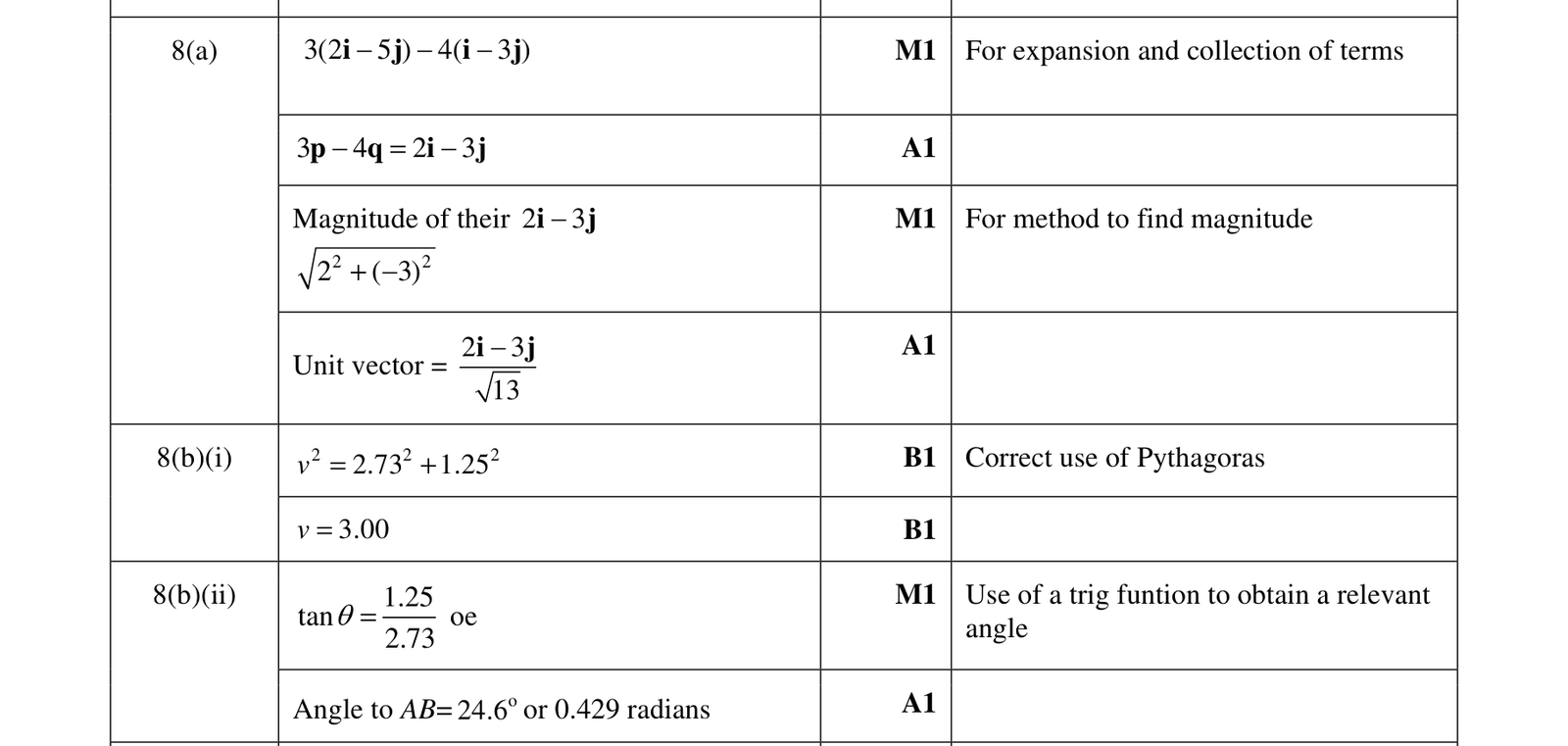
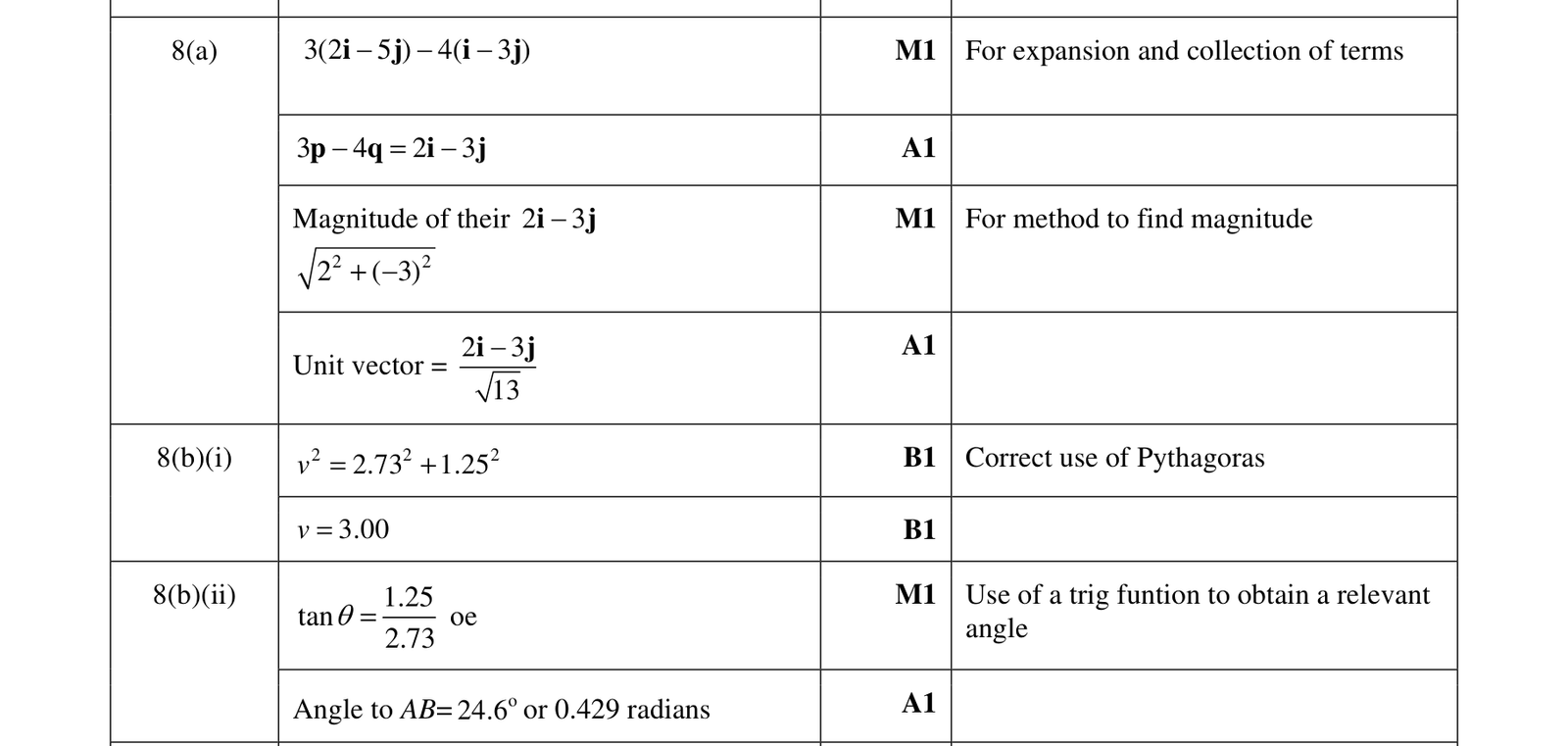
(a) Given that \(\mathbf p=2\mathbf i-5\mathbf j\) and \(\mathbf q=\mathbf i-3\mathbf j\), find the unit vector in the direction of \(3\mathbf p-4\mathbf q\).
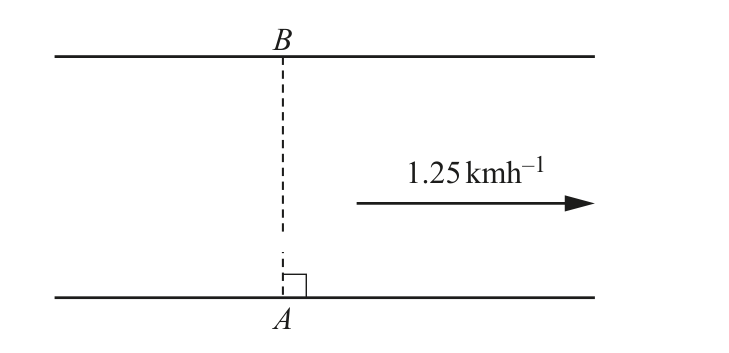
(b) A river flows between parallel banks at a speed of \(1.25\text{ km h}^{-1}\). A boy standing at point \(A\) on one bank sends a toy boat across the river to his father standing directly opposite at point \(B\). The toy boat, which can travel at \(v\text{ km h}^{-1}\) in still water, crosses the river with resultant speed \(2.73\text{ km h}^{-1}\) along the line \(AB\).
(i) Calculate the value of \(v\).
(ii) The direction in which the boy points the boat makes an angle \(\theta\) with the line \(AB\). Find the value of \(\theta\).
0606 P13 - Jun 2018 - Q8 - 8 marks
(a) Given that \(\mathbf p=2\mathbf i-5\mathbf j\) and \(\mathbf q=\mathbf i-3\mathbf j\), find the unit vector in the direction of \(3\mathbf p-4\mathbf q\).
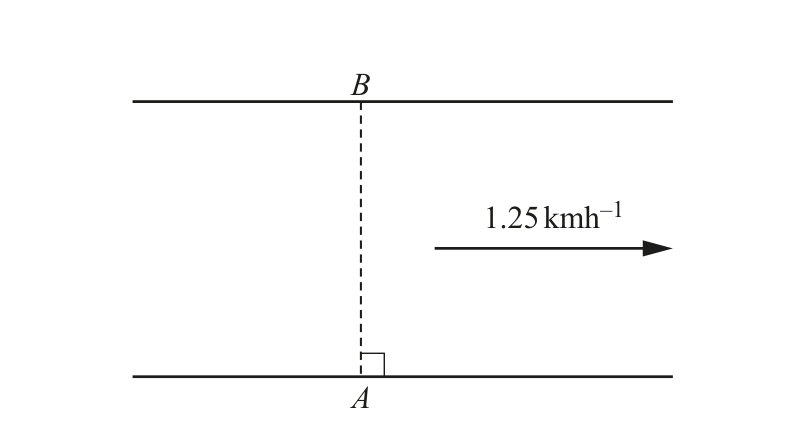
(b) A river flows between parallel banks at a speed of \(1.25\text{ km h}^{-1}\). A boy standing at point \(A\) on one bank sends a toy boat across the river to his father standing directly opposite at point \(B\). The toy boat, which can travel at \(v\text{ km h}^{-1}\) in still water, crosses the river with resultant speed \(2.73\text{ km h}^{-1}\) along the line \(AB\).
(i) Calculate the value of \(v\).
(ii) The direction in which the boy points the boat makes an angle \(\theta\) with the line \(AB\). Find the value of \(\theta\).
0606 P11 - Nov 2018 - Q10 - 9 marks
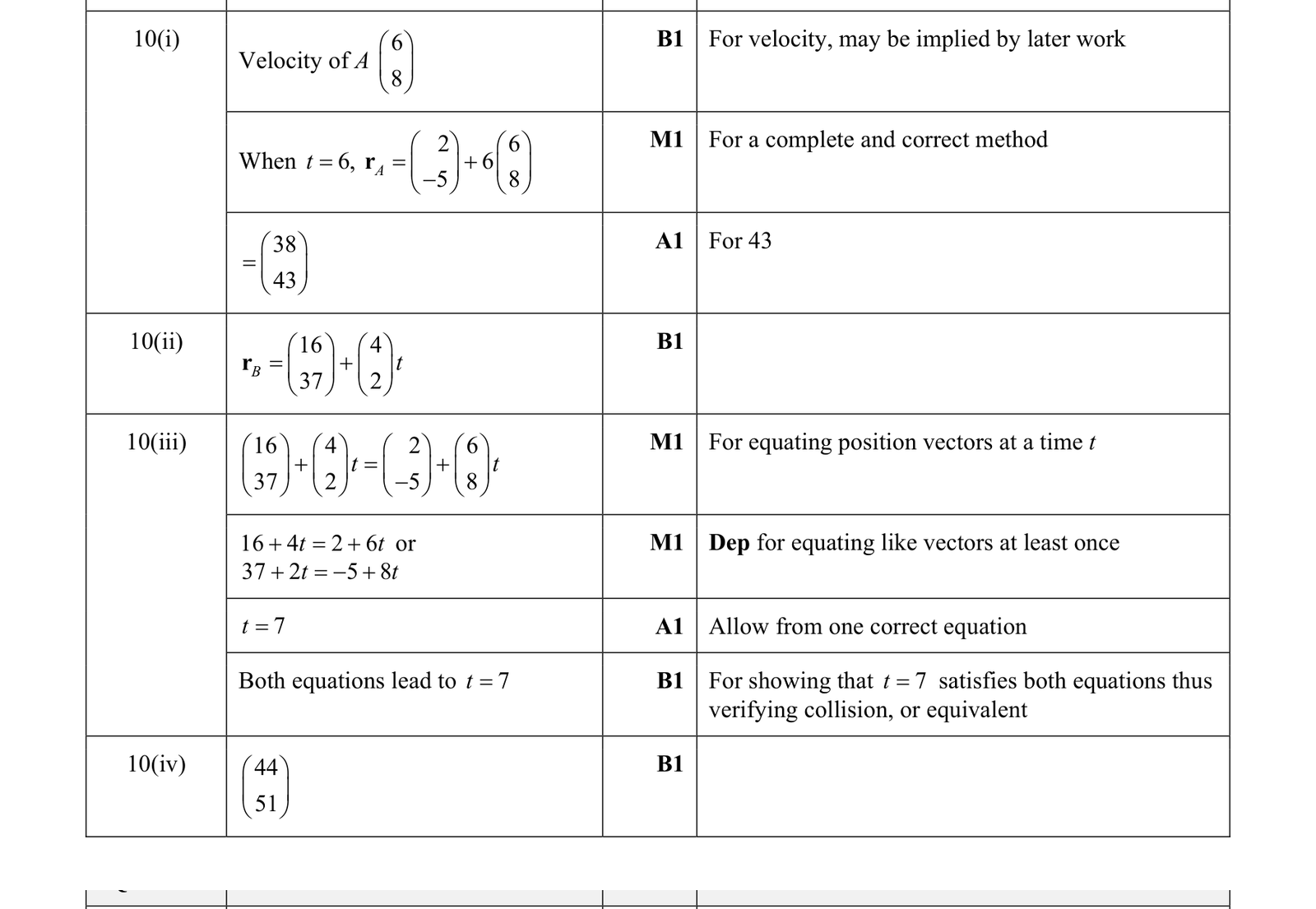
Particle \(A\) is at the point with position vector \(\begin{pmatrix}2\\-5\end{pmatrix}\) at time \(t=0\) and moves with a speed of \(10\text{ m s}^{-1}\) in the same direction as \(\begin{pmatrix}3\\4\end{pmatrix}\).
(i) Given that \(A\) is at the point with position vector \(\begin{pmatrix}38\\a\end{pmatrix}\) when \(t=6\) s, find the value of \(a\).
Particle \(B\) is at the point with position vector \(\begin{pmatrix}16\\37\end{pmatrix}\) at time \(t=0\) and moves with velocity \(\begin{pmatrix}4\\2\end{pmatrix}\text{ m s}^{-1}\).
(ii) Write down, in terms of \(t\), the position vector of \(B\) at time \(t\) seconds.
(iii) Verify that particles \(A\) and \(B\) collide.
(iv) Write down the position vector of the point of collision.
0606 P22 - Nov 2018 - Q12 - 6 marks
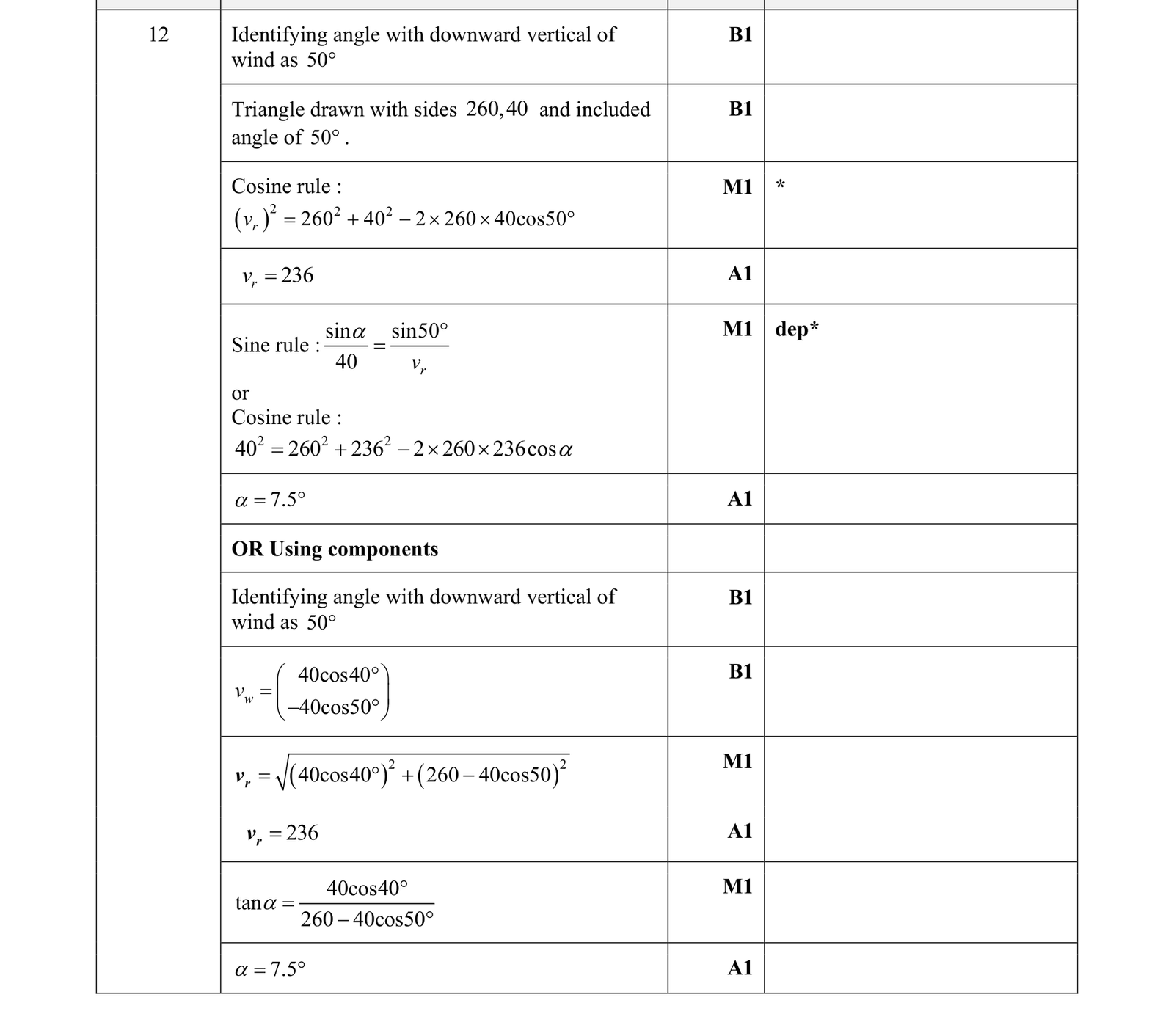
A plane that can travel at \(260\text{ km/h}\) in still air heads due North. A wind with speed \(40\text{ km/h}\) from a bearing of \(310^\circ\) blows the plane off course.
Find the resultant speed of the plane and its direction as a bearing correct to \(1\) decimal place.
0606 P12 - Nov 2017 - Q8 - 10 marks
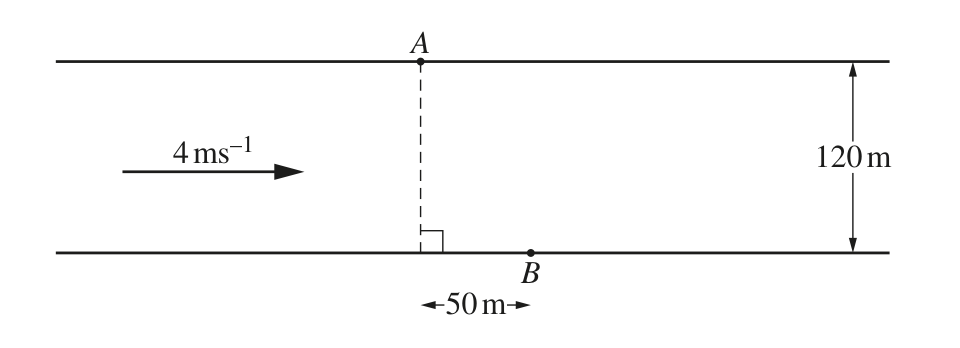
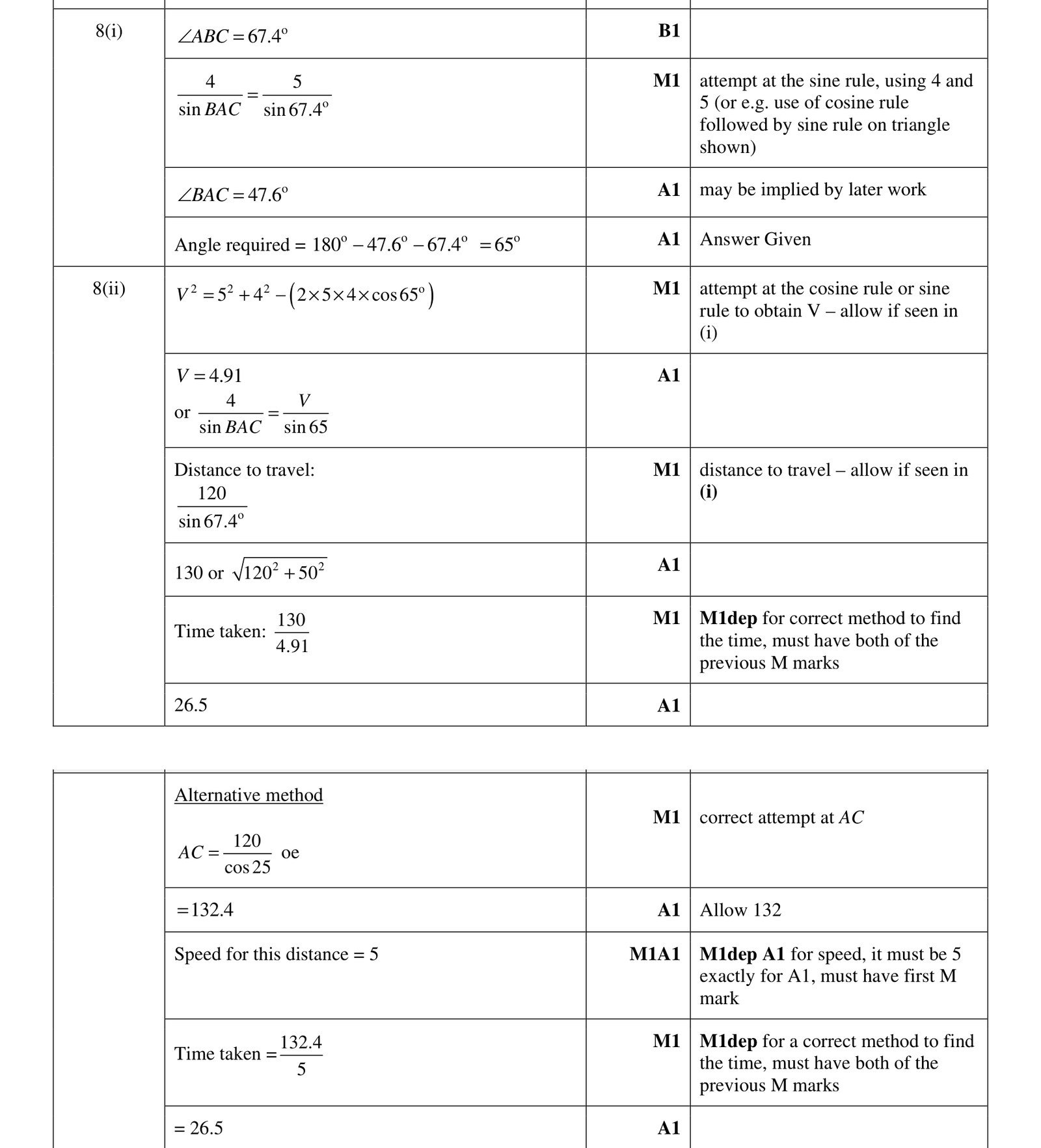
The diagram shows a river which is \(120\) m wide and is flowing at \(4\text{ m s}^{-1}\). Points \(A\) and \(B\) are on opposite sides of the river such that \(B\) is \(50\) m downstream from \(A\). A man needs to cross the river from \(A\) to \(B\) in a boat which can travel at \(5\text{ m s}^{-1}\) in still water.
(i) Show that the man must point his boat upstream at an angle of approximately \(65^\circ\) to the bank.
(ii) Find the time the man takes to cross the river from \(A\) to \(B\).
0606 P21 - Nov 2017 - Q10 - 9 marks
In this question \(\mathbf i\) is a unit vector due east and \(\mathbf j\) is a unit vector due north. Units of length and velocity are metres and metres per second respectively.
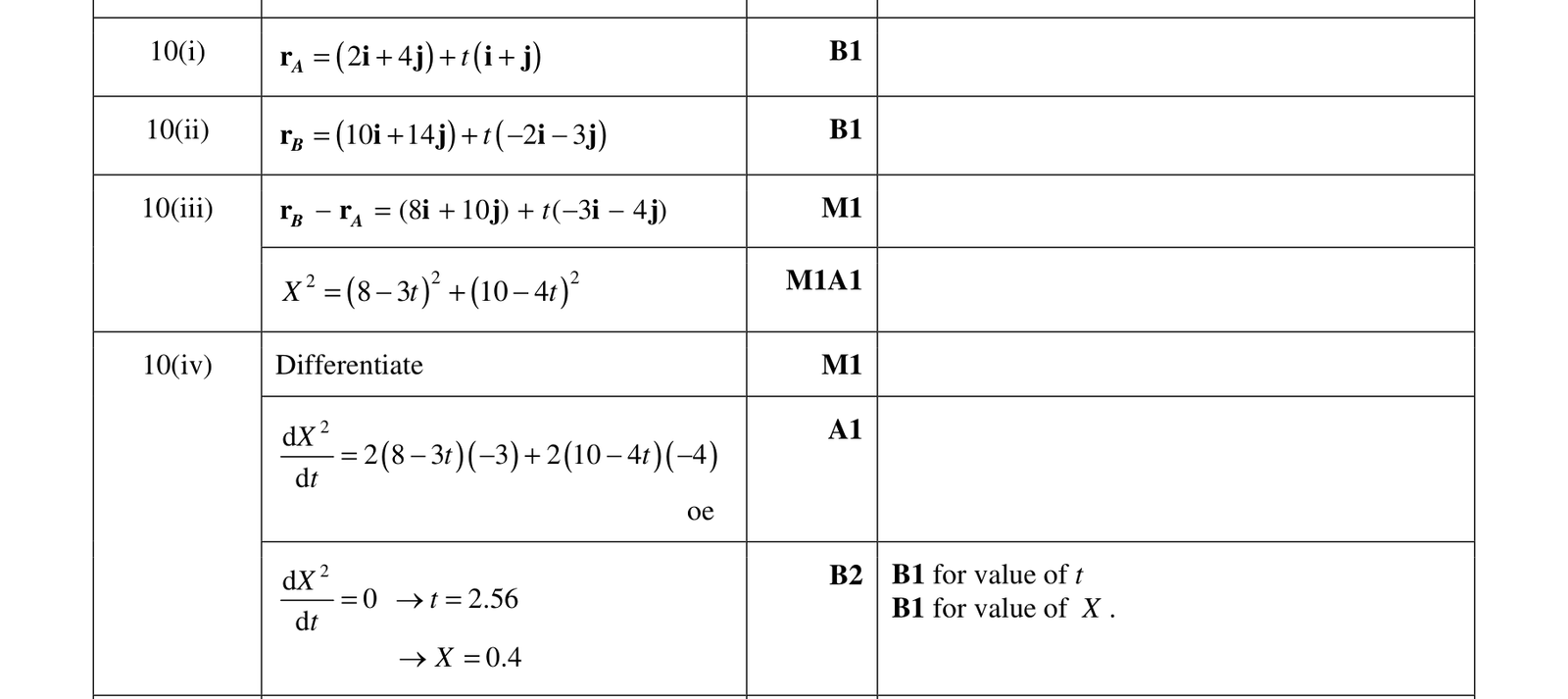
The initial position vectors of particles \(A\) and \(B\), relative to a fixed point \(O\), are \(2\mathbf i+4\mathbf j\) and \(10\mathbf i+14\mathbf j\) respectively. Particles \(A\) and \(B\) start moving at the same time. \(A\) moves with constant velocity \(\mathbf i+\mathbf j\) and \(B\) moves with constant velocity \(-2\mathbf i-3\mathbf j\). Find
(i) the position vector of \(A\) after \(t\) seconds,
(ii) the position vector of \(B\) after \(t\) seconds.
It is given that \(X\) is the distance between \(A\) and \(B\) after \(t\) seconds.
(iii) Show that \(X^2=(8-3t)^2+(10-4t)^2\).
(iv) Find the value of \(t\) for which \((8-3t)^2+(10-4t)^2\) has a stationary value and the corresponding value of \(X\).
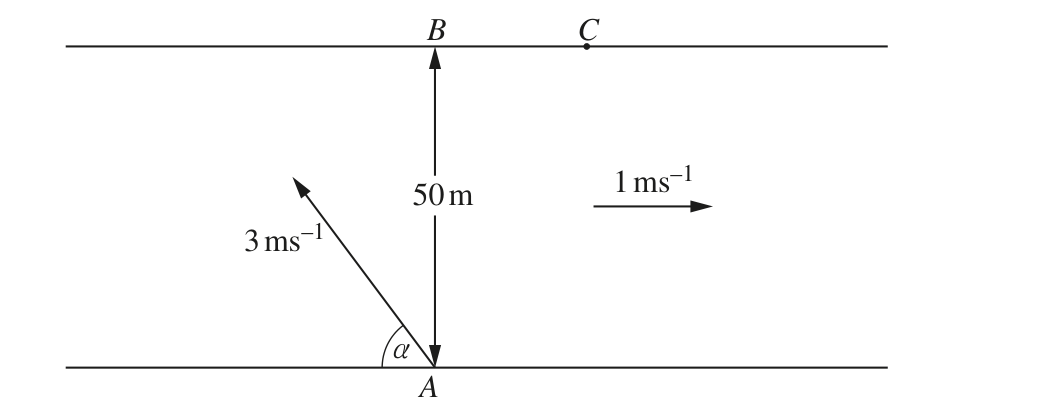
0606 P23 - Nov 2017 - Q8 - 8 marks
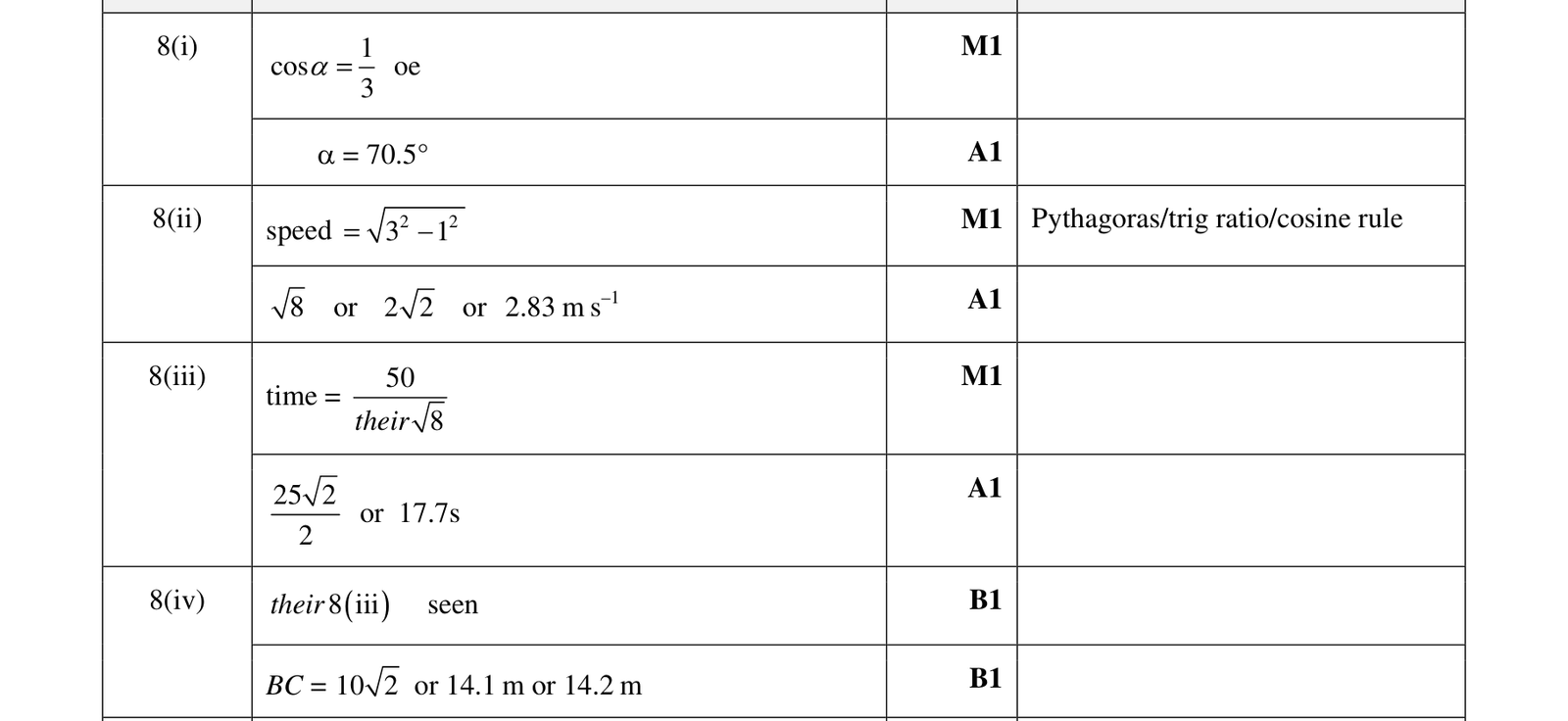
A man can row a boat at \(3\text{ m s}^{-1}\) in still water. He wants to cross a river from \(A\) to \(B\), where \(AB\) is perpendicular to both banks. The river is \(50\text{ m}\) wide and flows at \(1\text{ m s}^{-1}\). The man points his boat at an angle \(\alpha^\circ\) to the bank.
(i) Find \(\alpha\).
(ii) Find the resultant speed of the boat from \(A\) to \(B\).
(iii) Find the time taken to travel from \(A\) to \(B\).
On another occasion the man points the boat in the same direction, but the river speed is \(1.8\text{ m s}^{-1}\), so he lands at \(C\).
(iv) State the time taken to travel from \(A\) to \(C\), and hence find \(BC\).