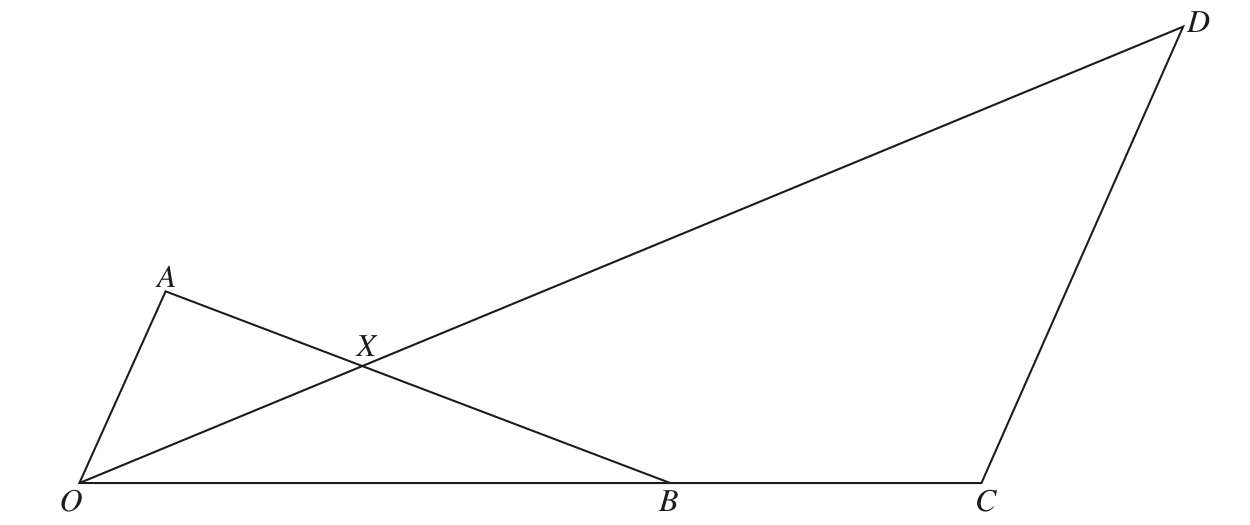
0606 P13 - Nov 2025 - Q7 - 7 marks
The point \(O\) is the origin. Two points \(P\) and \(Q\) are such that \(\overrightarrow{PQ}\) is in the same direction as \(-\mathbf{i}+5\mathbf{j}\).
(a) The point \(R\) is such that \(\overrightarrow{OR}\) is in the same direction as \(\overrightarrow{PQ}\) and the magnitude of \(\overrightarrow{OR}\) is \(3\sqrt{26}\). Find \(\overrightarrow{OR}\).
(b) \(\overrightarrow{OP}\) is in the same direction as \(2\mathbf{i}-3\mathbf{j}\), and \(\overrightarrow{OQ}=10\mathbf{i}+6\mathbf{j}\). Find \(\overrightarrow{OP}\).
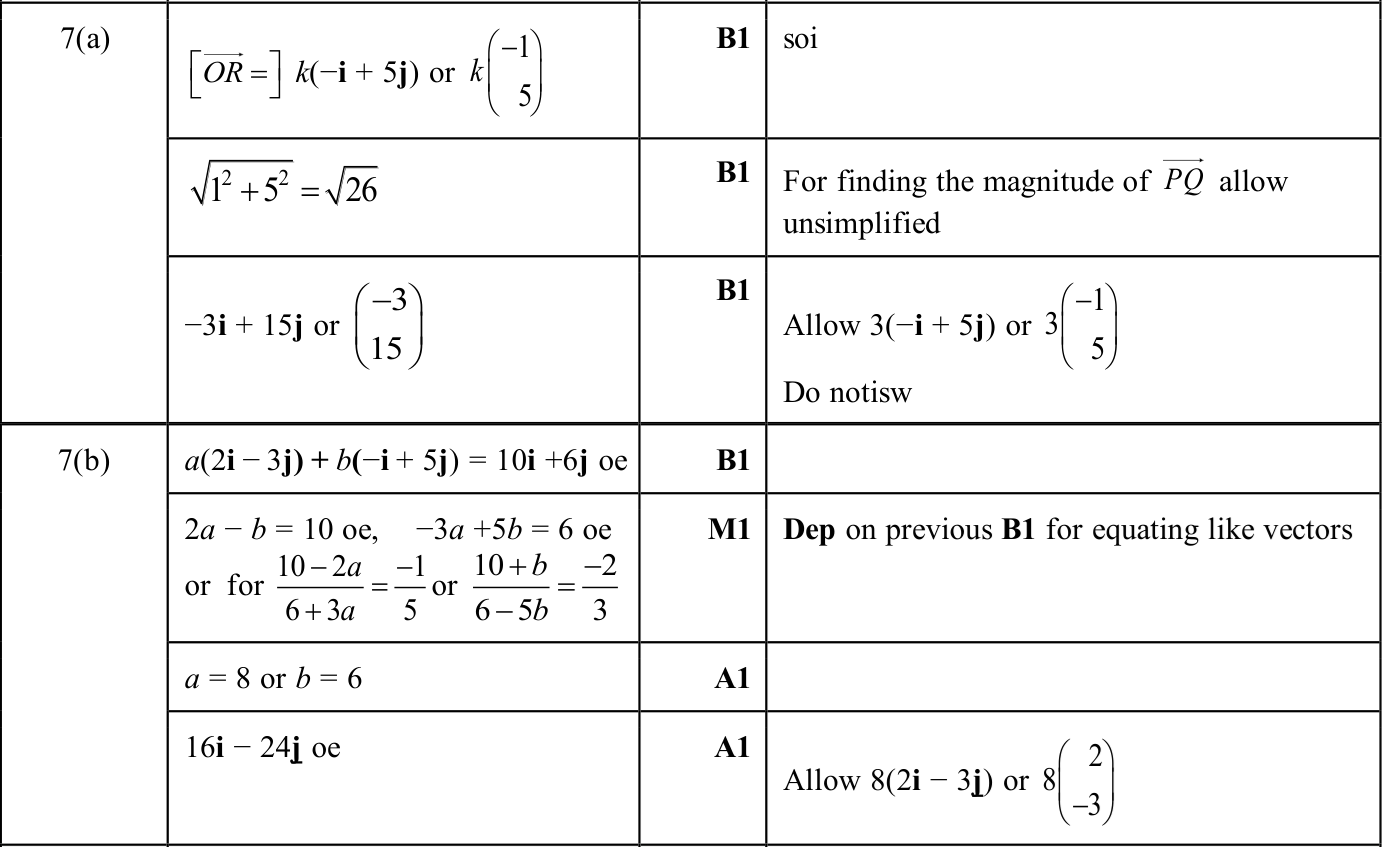
0606 P11 - Nov 2025 - Q12 - 6 marks
The points \(A\), \(B\) and \(C\) have position vectors \(\overrightarrow{OA}=\binom{1}{7}\), \(\overrightarrow{OB}=\binom{7}{4}\), and \(\overrightarrow{OC}=k\binom{1}{2}\). Given that \(C\) lies on the line segment \(AB\), find \(AC:AB\).
0606 P12 - Jun 2025 - Q11 - 9 marks
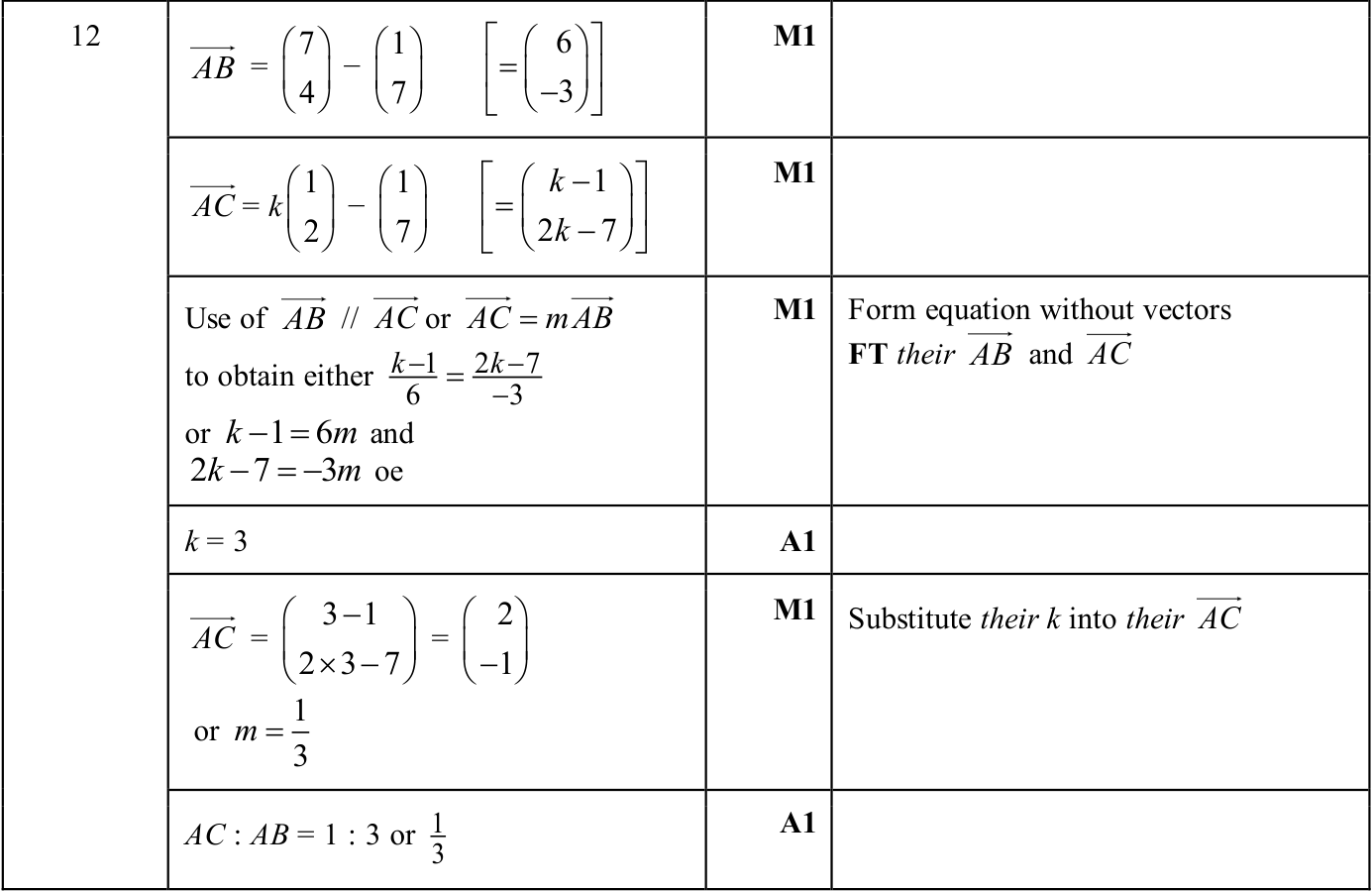
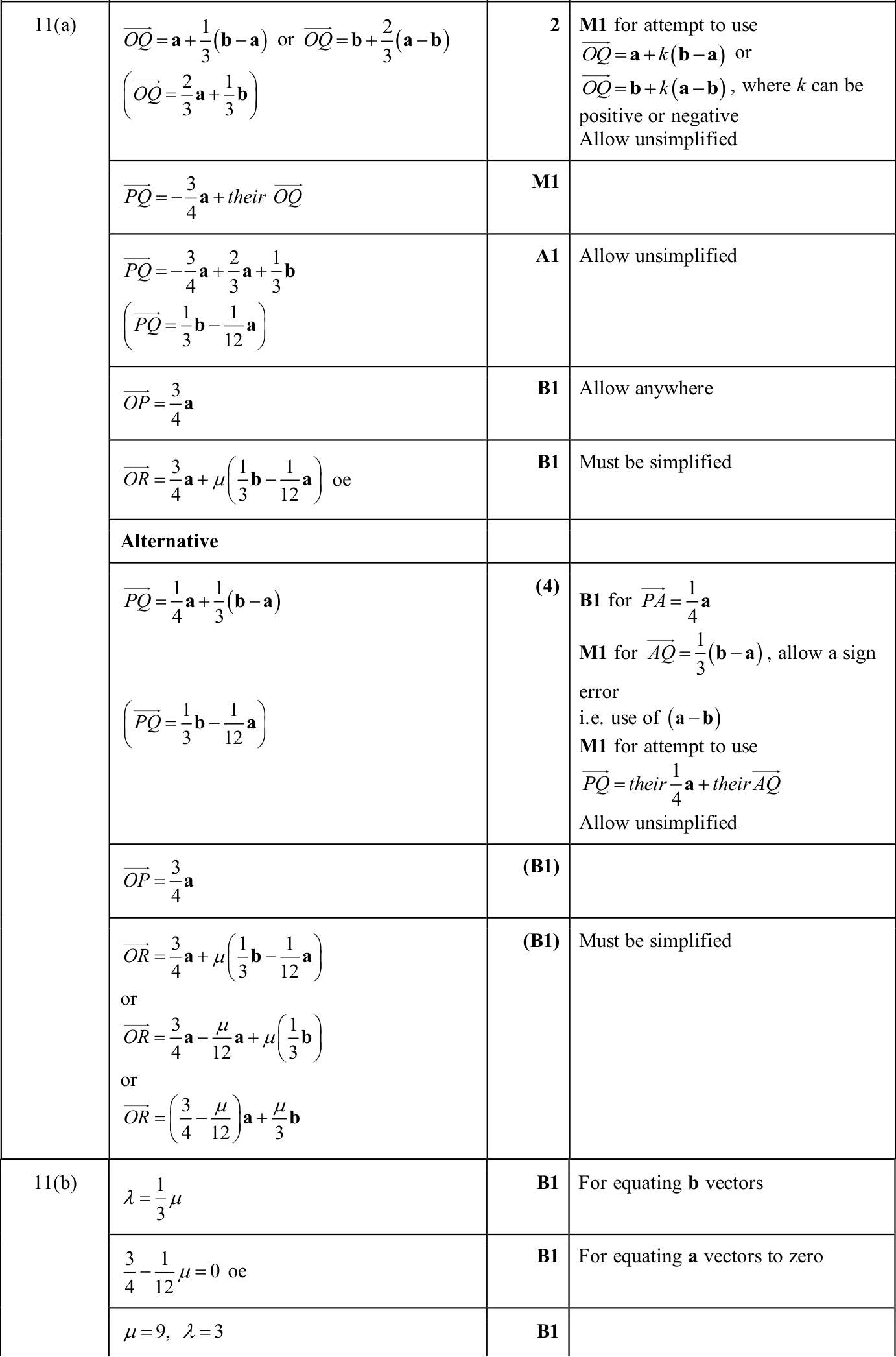
The diagram shows the triangle \(OAB\), where \(\overrightarrow{OA}=\mathbf{a}\) and \(\overrightarrow{OB}=\mathbf{b}\).
The point \(P\) lies on \(OA\) such that \(\overrightarrow{OP}=\frac34\overrightarrow{OA}\).
The point \(Q\) lies on \(AB\) such that \(\overrightarrow{AQ}=\frac13\overrightarrow{AB}\).
The straight line through \(P\) and \(Q\) meets the straight line through \(O\) and \(B\) at the point \(R\). It is given that \(\overrightarrow{OR}=\lambda\mathbf{b}\) and \(\overrightarrow{PR}=\mu\overrightarrow{PQ}\), where \(\lambda\) and \(\mu\) are constants.
(a) Find \(\overrightarrow{OR}\) in terms of \(\mathbf{a}\), \(\mathbf{b}\) and \(\mu\).
(b) Hence find the values of \(\lambda\) and \(\mu\).
0606 P13 - Jun 2025 - Q10 - 8 marks
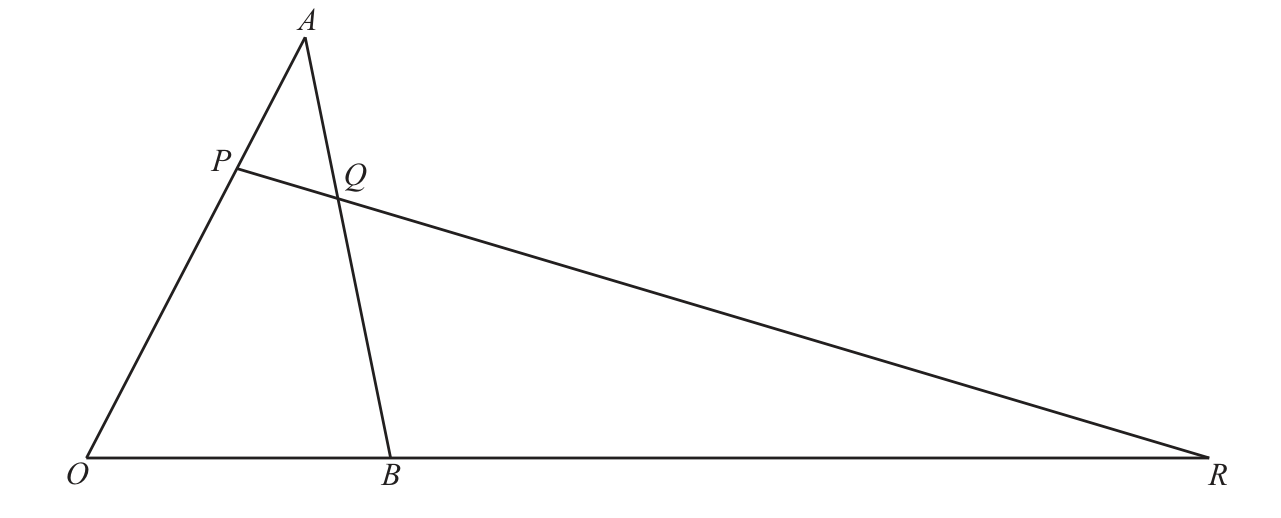
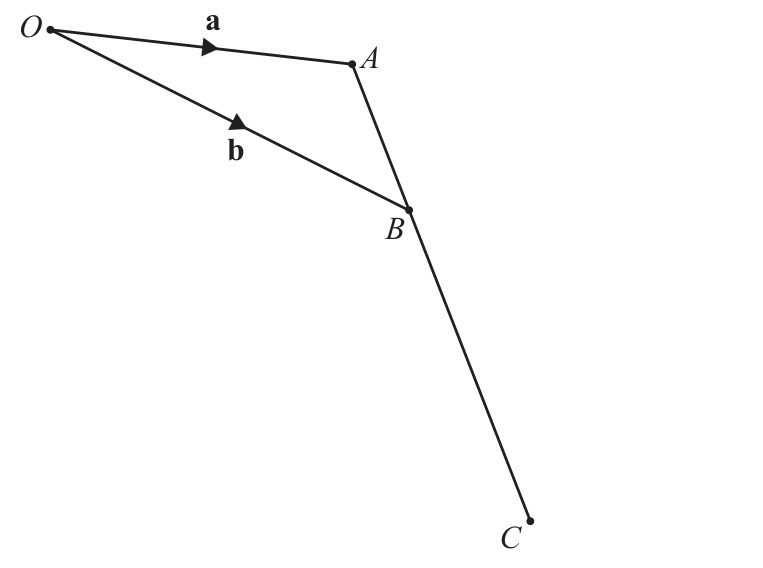
The diagram shows four points, \(O,A,B\) and \(C\).
\(A,B\) and \(C\) lie in a straight line and are such that \(\frac{AB}{AC}=\frac13\).
\(\overrightarrow{OA}=\mathbf{a}\) and \(\overrightarrow{OB}=\mathbf{b}\).
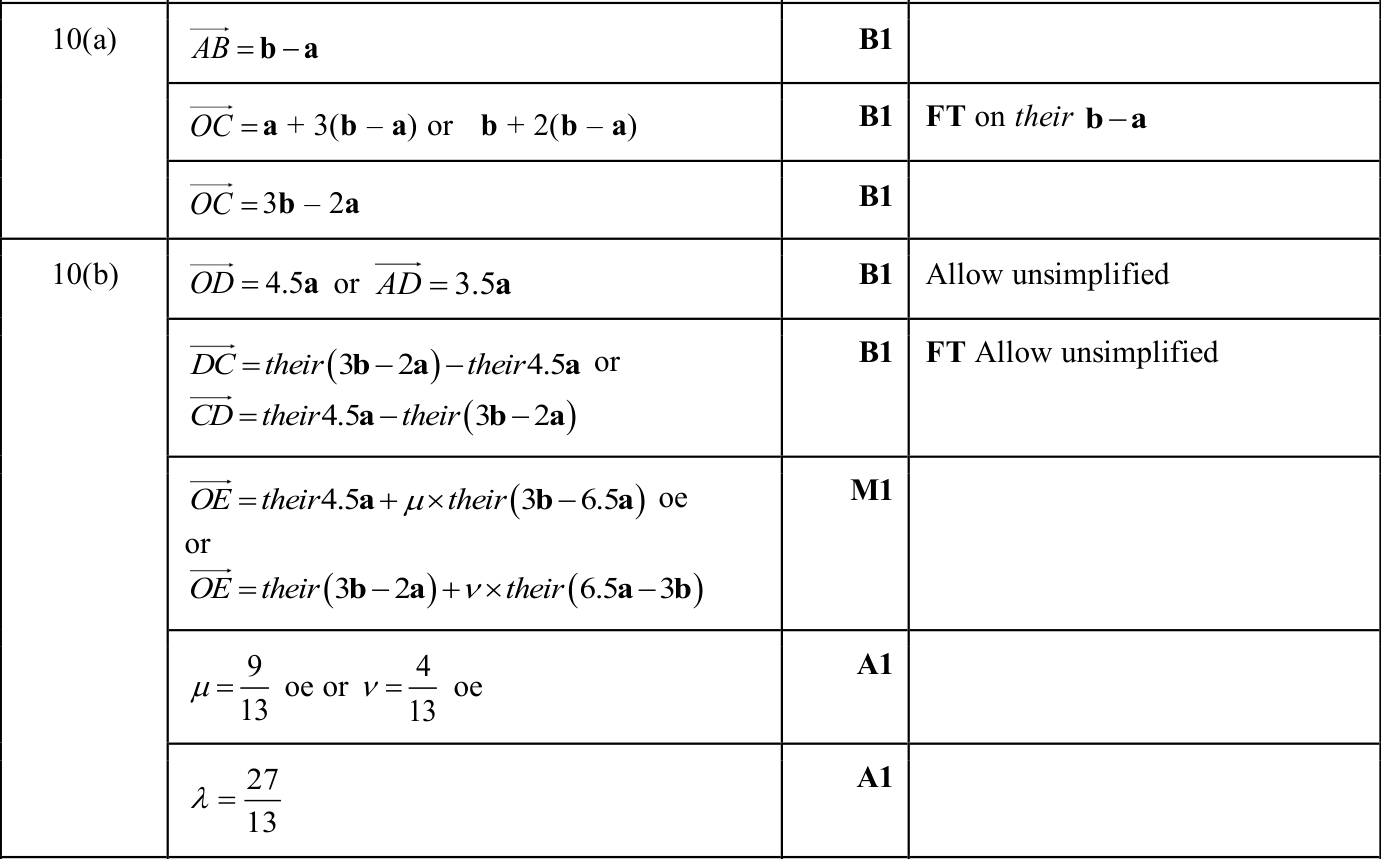
(a) Find \(\overrightarrow{OC}\) in terms of \(\mathbf{a}\) and \(\mathbf{b}\). Simplify your answer.
(b) The line \(OA\) is extended to the point \(D\) such that \(OA:AD=2:7\). Point \(E\) lies on \(CD\) such that \(\overrightarrow{OE}=\lambda\mathbf{b}\). Find the value of \(\lambda\).
0606 P12 - Mar 2025 - Q11 - 9 marks
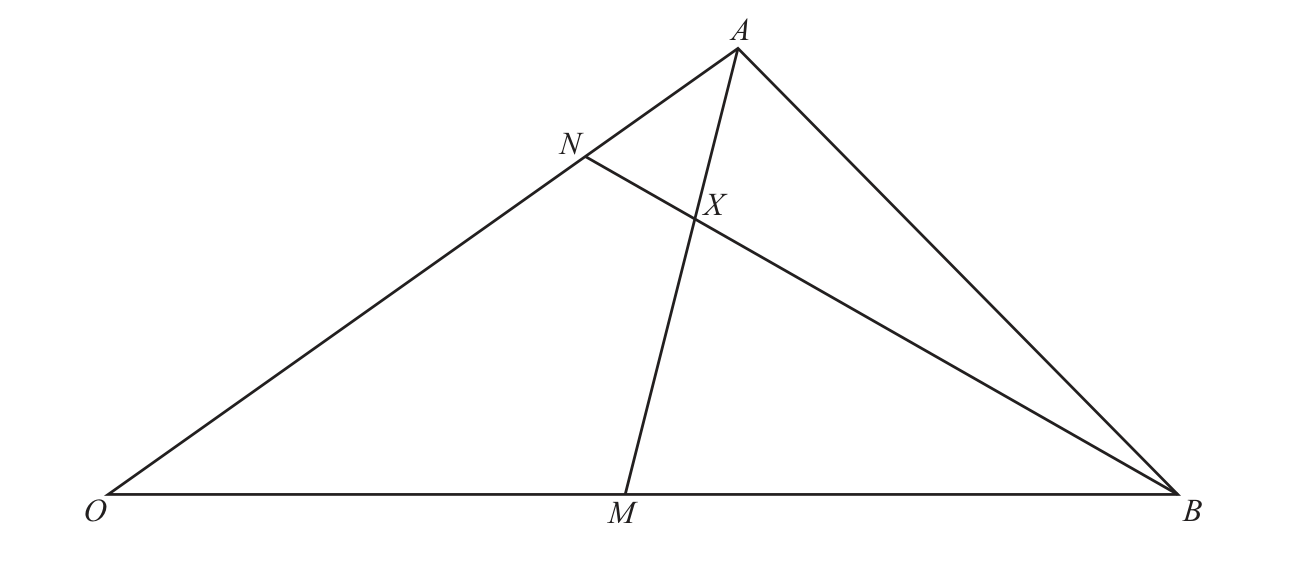
In the diagram, \(\overrightarrow{OA}=\mathbf a\) and \(\overrightarrow{OB}=\mathbf b\).
The point \(M\) is the midpoint of \(OB\).
The point \(N\) is such that \(\overrightarrow{ON}=3\overrightarrow{NA}\).
The lines \(BN\) and \(AM\) intersect at the point \(X\).
\(\overrightarrow{BX}=\lambda\overrightarrow{BN}\), where \(\lambda\) is a constant.
\(\overrightarrow{MX}=\mu\overrightarrow{MA}\), where \(\mu\) is a constant.
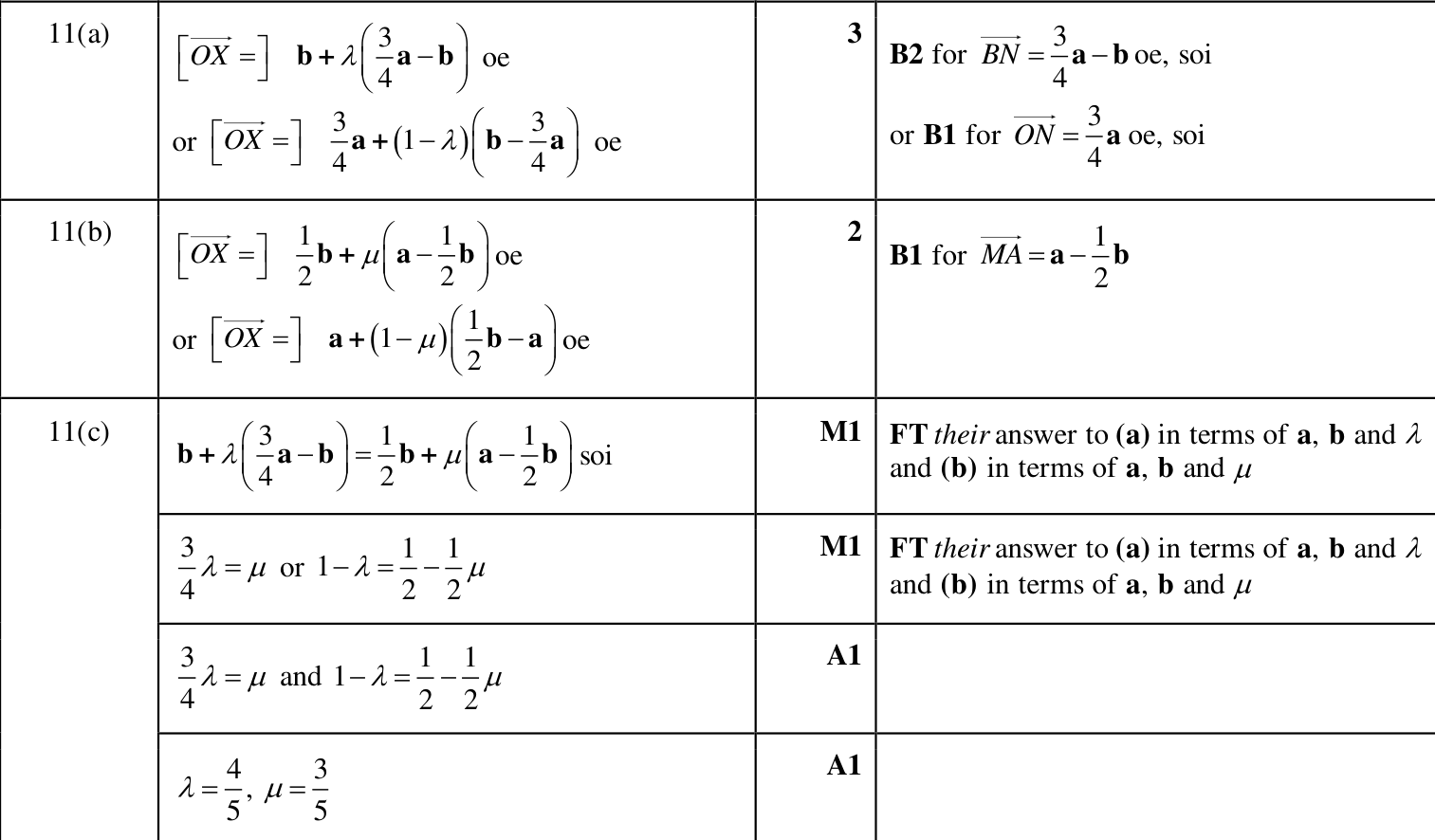
(a) Find \(\overrightarrow{OX}\) in terms of \(\mathbf a\), \(\mathbf b\) and \(\lambda\).
(b) Find \(\overrightarrow{OX}\) in terms of \(\mathbf a\), \(\mathbf b\) and \(\mu\).
(c) Hence find the values of \(\lambda\) and \(\mu\).
0606 P13 - Nov 2024 - Q9 - 10 marks
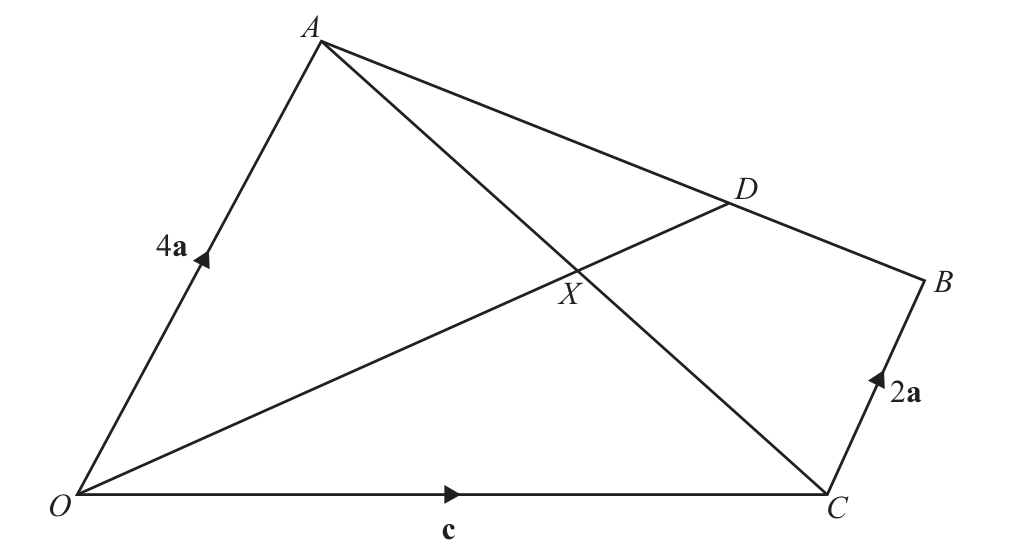
The diagram shows the trapezium \(O A B C\), where \(\overrightarrow{O A}=4 \mathbf{a}, \overrightarrow{O C}=\mathbf{c}\), and \(\overrightarrow{C B}=2 \mathbf{a}\). The point \(D\) lies on \(A B\) such that \(A D: D B=2: 1\). The point \(X\) is the point of intersection of the lines \(O D\) and \(A C\). It is given that \(\overrightarrow{A X}=\lambda \overrightarrow{A C}\) and \(\overrightarrow{O X}=\mu \overrightarrow{O D}\).
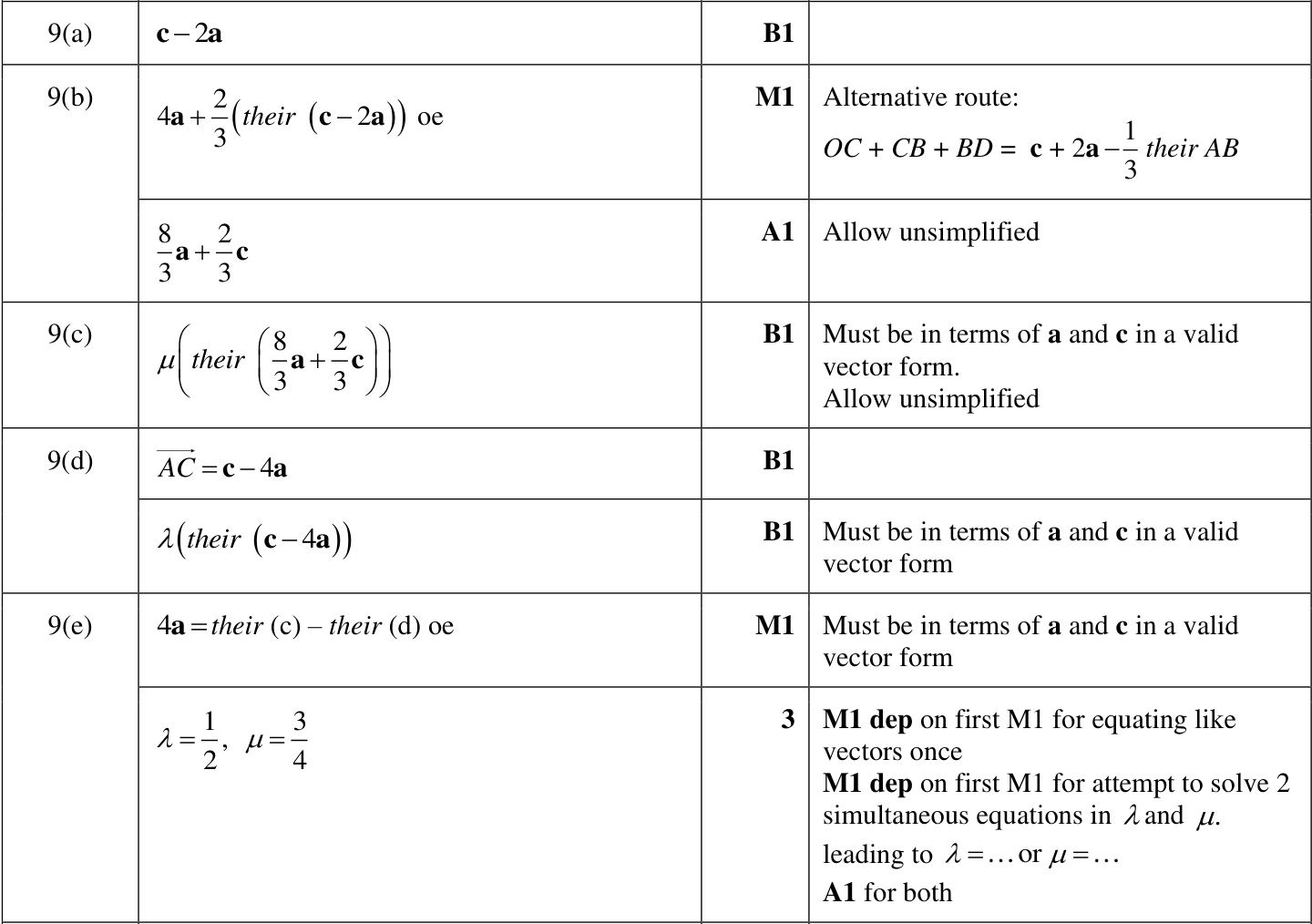
Find in terms of \(\mathbf{a}\) and \(\mathbf{c}\) (a) \(\overrightarrow{A B}\)
(b) \(\overrightarrow{O D}\).
(c) Find \(\overrightarrow{O X}\) in terms of \(\mathbf{a}, \mathbf{c}\) and \(\mu\).
(d) Find \(\overrightarrow{A X}\) in terms of \(\mathbf{a}, \mathbf{c}\) and \(\lambda\).
(e) Hence find the values of \(\lambda\) and \(\mu\).
0606 P21 - Nov 2024 - Q4 - 5 marks
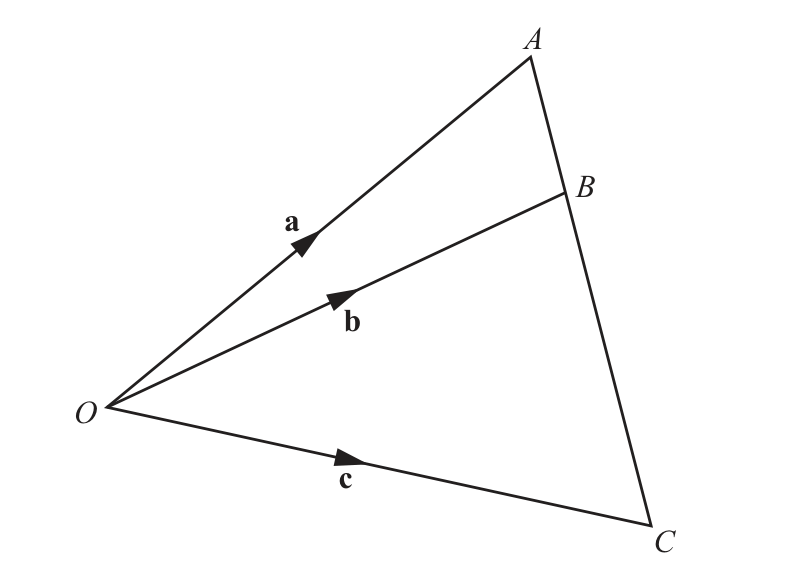
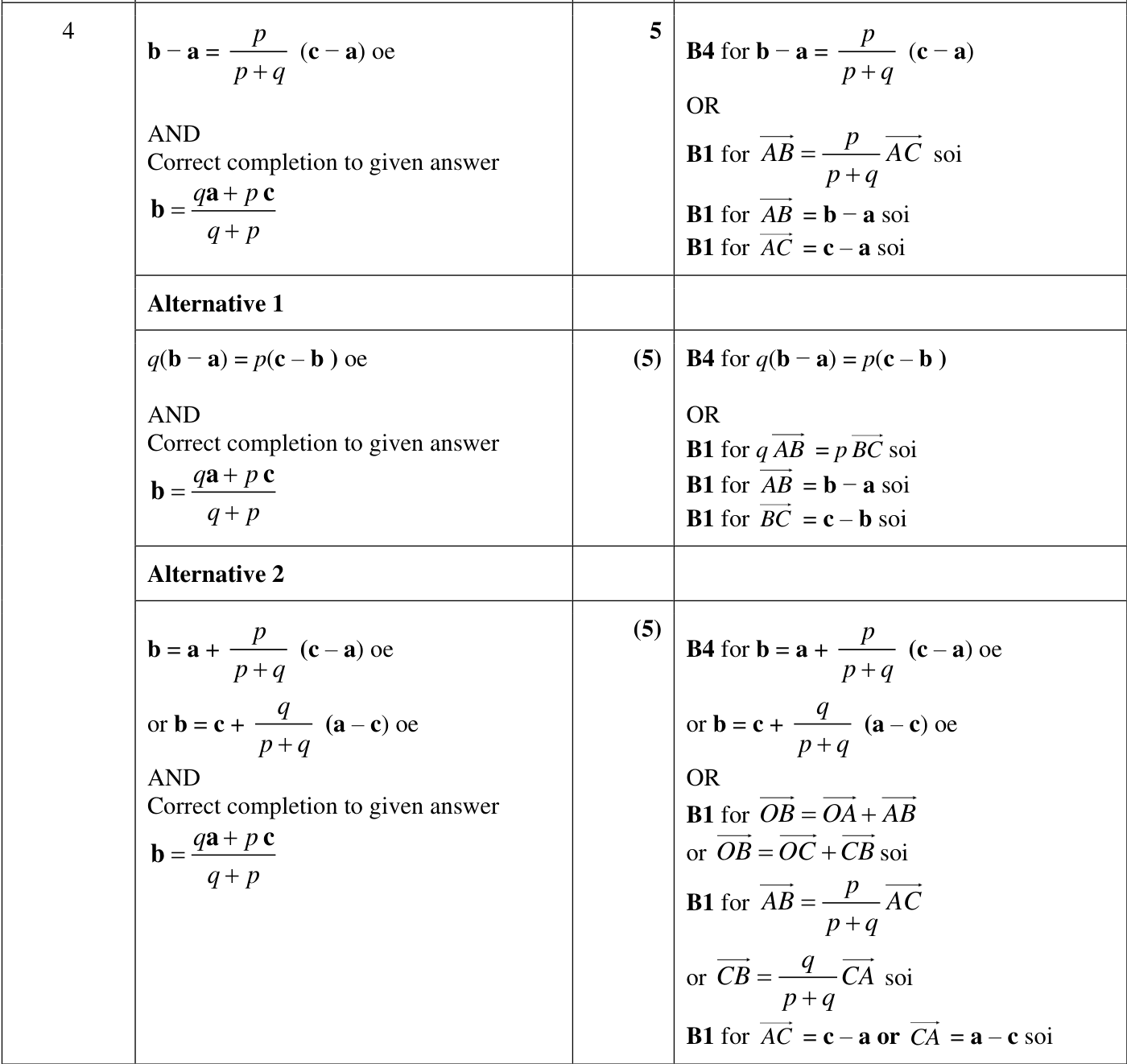
The diagram shows the triangle \(O A C\). The point \(B\) lies on \(A C\) such that \(A B: B C=p: q\), where \(p\) and \(q\) are constants ( \(p \neq-q\) ). \(\overrightarrow{O A}=\mathbf{a}, \overrightarrow{O B}=\mathbf{b} \text { and } \overrightarrow{O C}=\mathbf{c} .\)
Show that \(\mathbf{b}=\frac{q \mathbf{a}+p \mathbf{c}}{q+p}\).
0606 P22 - Mar 2024 - Q3 - 8 marks
(a)
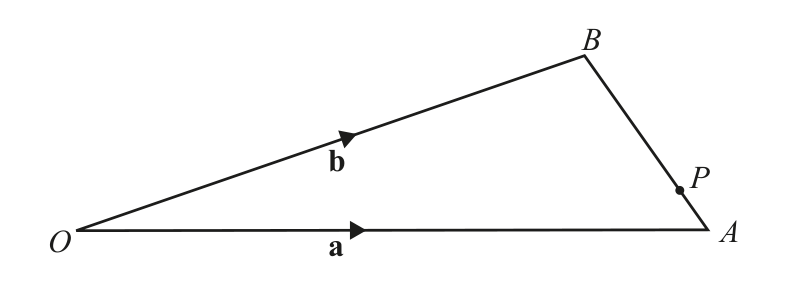
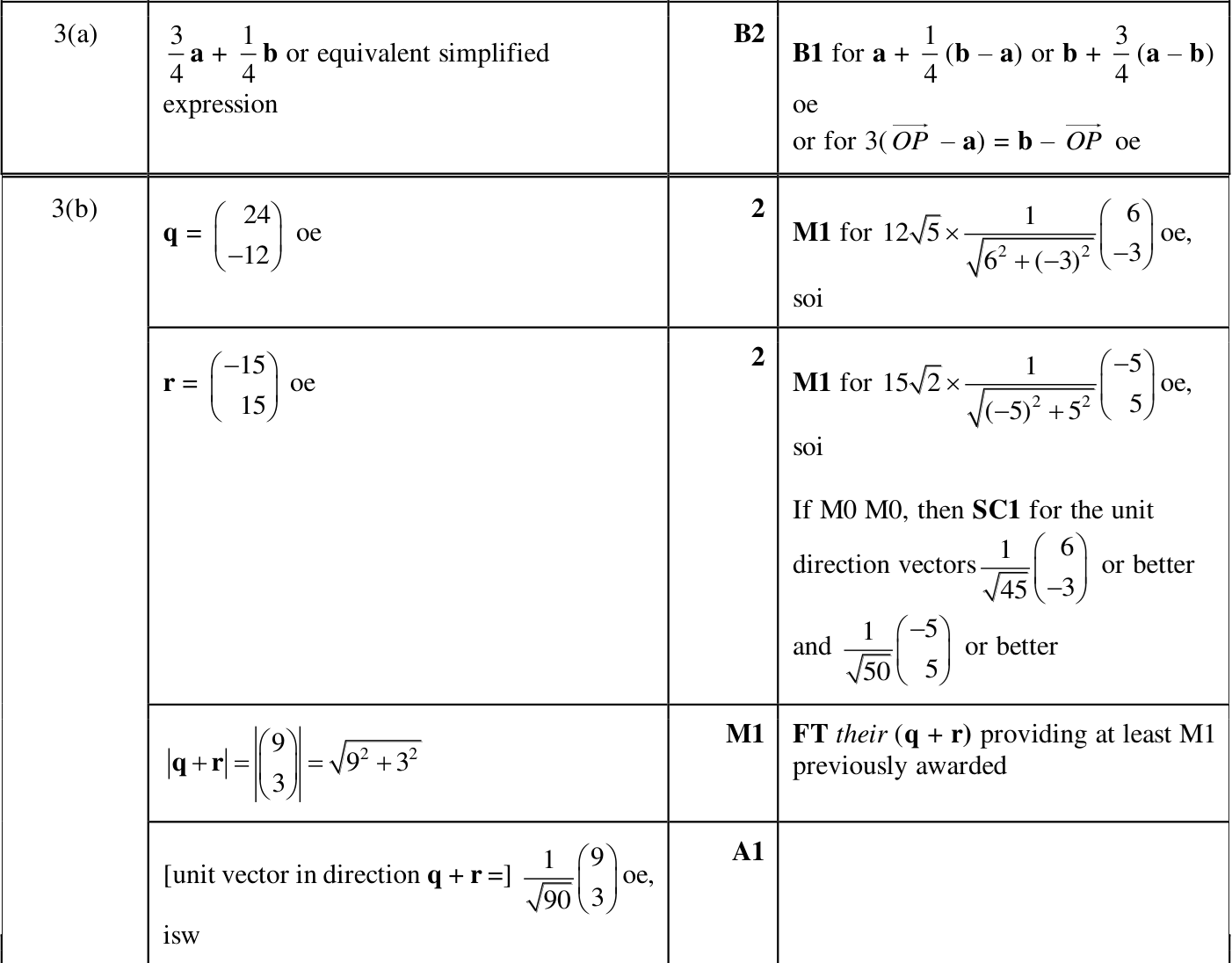
The diagram shows a triangle \(O A B\). The point \(P\) lies on \(A B\). The ratio \(A P: P B\) is \(1: 3\). Given that \(\overrightarrow{O A}=\mathbf{a}\) and \(\overrightarrow{O B}=\mathbf{b}\), find an expression for \(\overrightarrow{O P}\) in terms of \(\mathbf{a}\) and \(\mathbf{b}\). Simplify your answer.
(b) Vector \(\mathbf{q}\) has magnitude \(12 \sqrt{5}\) and direction \(\binom{6}{-3}\).
Vector \(\mathbf{r}\) has magnitude \(15 \sqrt{2}\) and direction \(\binom{-5}{5}\). Find the unit vector in the direction of \(\mathbf{q}+\mathbf{r}\).
0606 P21 - Jun 2024 - Q12 - 9 marks
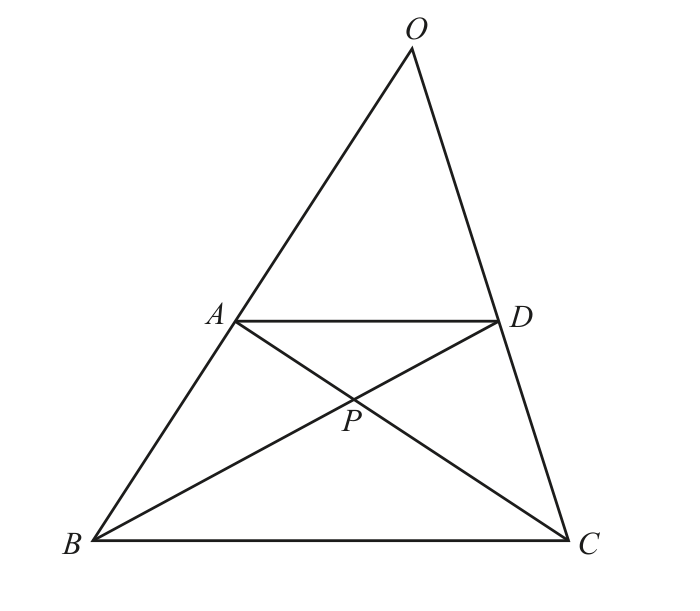
The diagram shows a triangle \(O B C\). \(O A: O B=4: 7\) and \(O D: O C=4: 7\). \(\overrightarrow{O B}=\mathbf{b} \text { and } \overrightarrow{O C}=\mathbf{c}\)
The point \(P\) is the point of intersection of \(A C\) and \(B D\) such that \(\overrightarrow{A P}=\lambda \overrightarrow{A C}\) and \(\overrightarrow{B P}=\mu \overrightarrow{B D}\) where \(\lambda\) and \(\mu\) are scalars. (a) Find two expressions for \(\overrightarrow{O P}\), each in terms of \(\mathbf{b}, \mathbf{c}\) and a scalar, and hence show that \(P\) divides both \(A C\) and \(D B\) in the ratio \(4: 7\).
(b) The point \(Q\) is such that \(\overrightarrow{O Q}=\frac{2}{7} \mathbf{b}+\frac{2}{7} \mathbf{c}\).
Use a vector method to show that \(O, Q\) and \(P\) are collinear. Justify your answer.
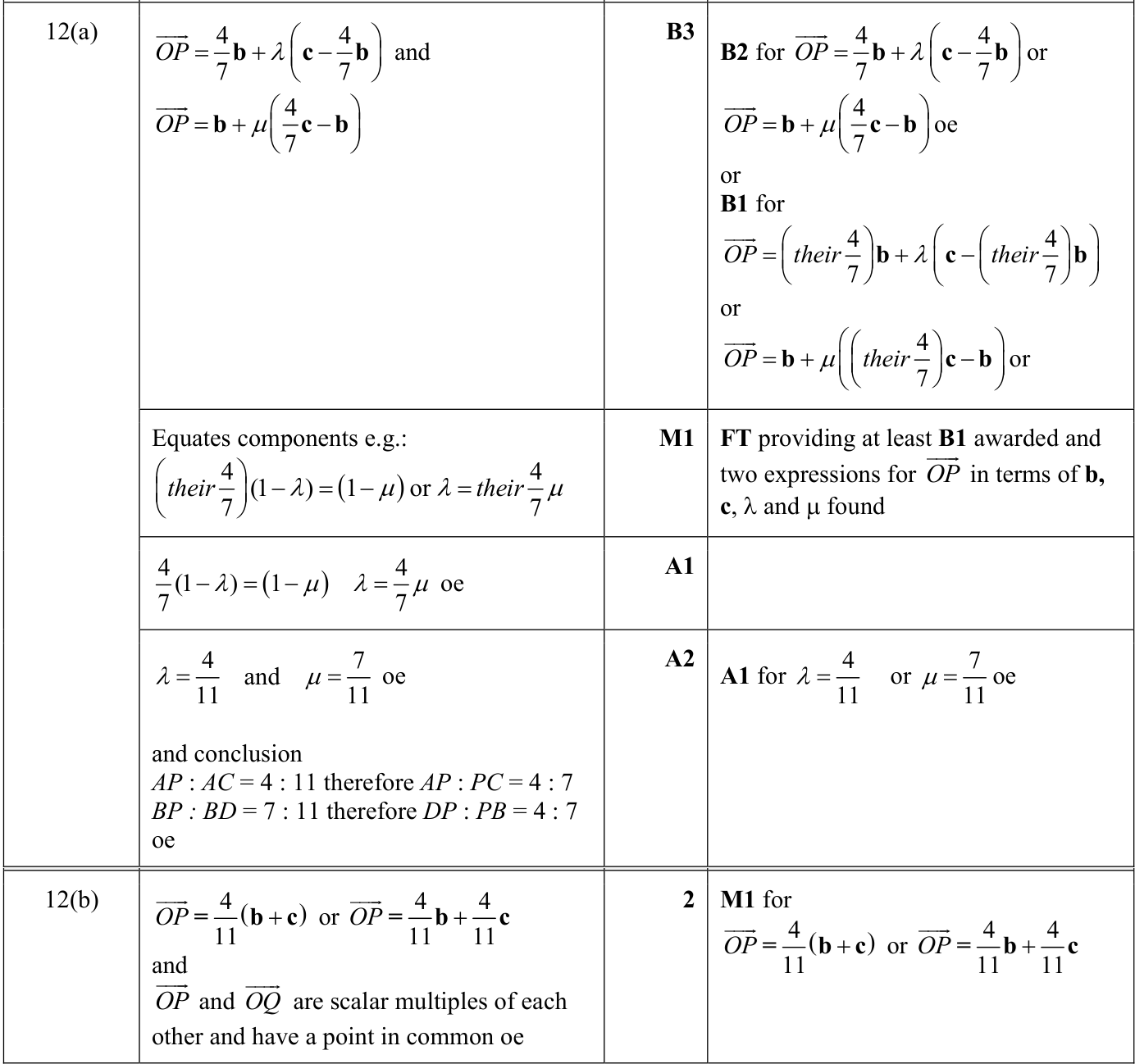
0606 P23 - Jun 2024 - Q10 - 7 marks
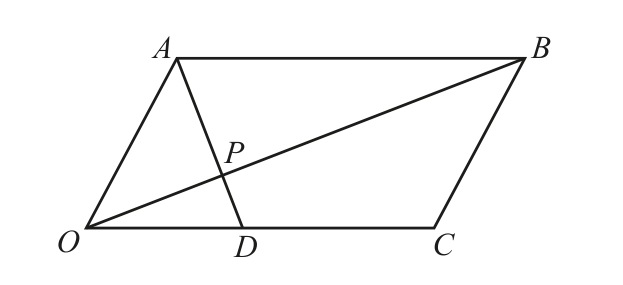
The diagram shows a parallelogram \(O A B C\). The point \(D\) divides the line \(O C\) in the ratio \(2: 3\). \(\overrightarrow{O A}=\mathbf{a} \text { and } \overrightarrow{O C}=\mathbf{c}\)
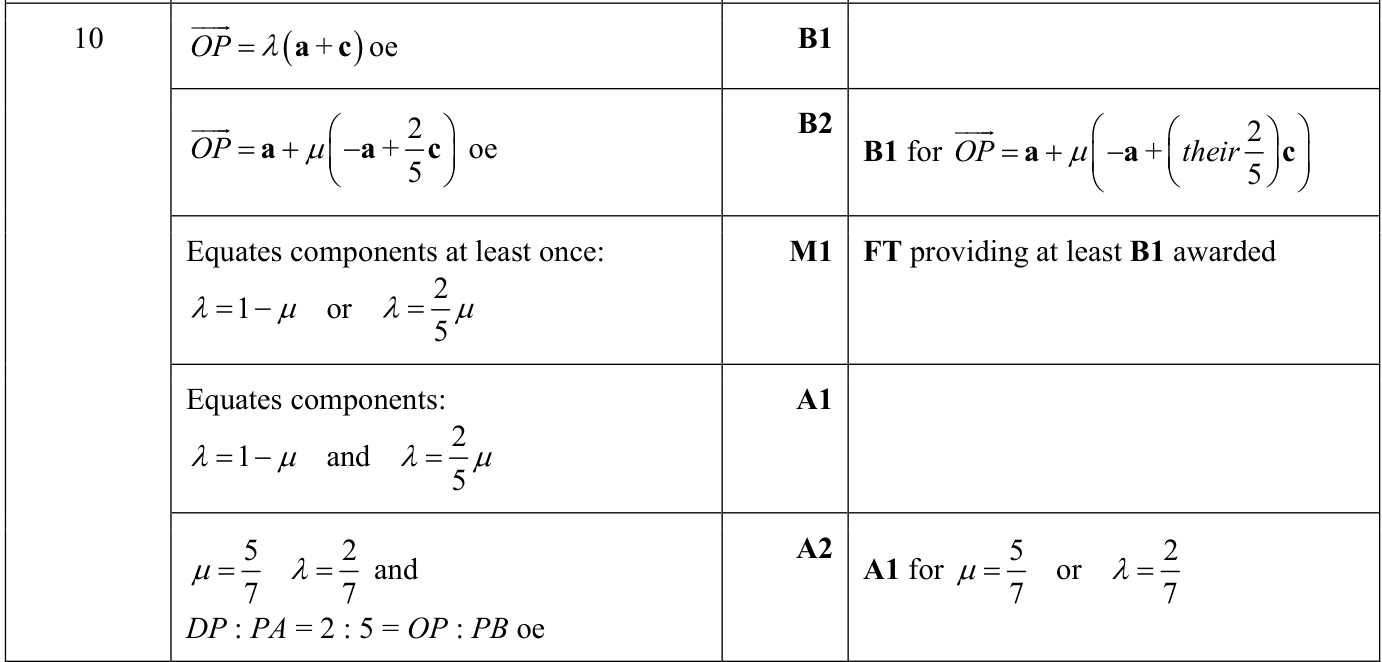
The point \(P\) lies on \(A D\) such that \(\overrightarrow{O P}=\lambda \overrightarrow{O B}\) and \(\overrightarrow{A P}=\mu \overrightarrow{A D}\), where \(\lambda\) and \(\mu\) are scalars. Find two expressions for \(\overrightarrow{O P}\), each in terms of \(\mathbf{a}\), \(\mathbf{c}\) and a scalar, and hence show that \(P\) divides both \(D A\) and \(O B\) in the ratio \(m: n\), where \(m\) and \(n\) are integers to be found.
0606 P13 - Jun 2023 - Q8 - 10 marks
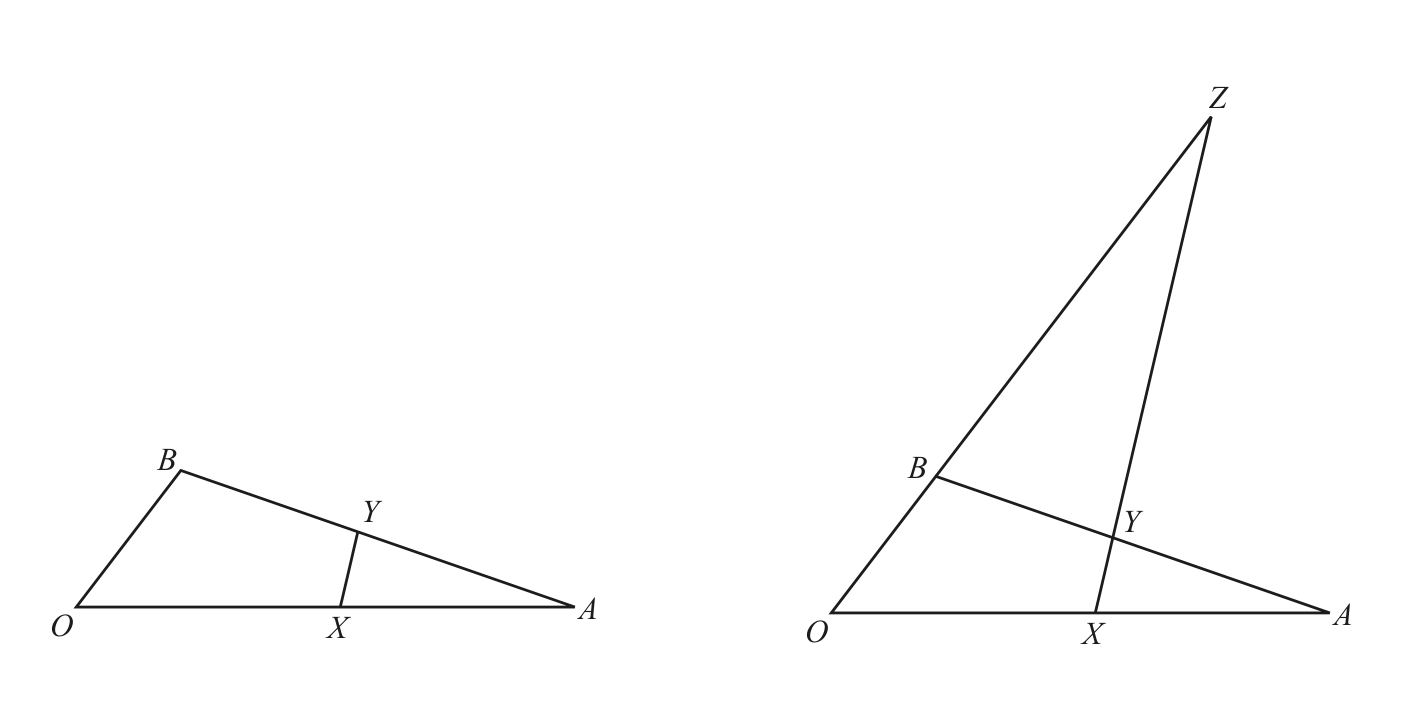
The diagram shows the triangle \(OAB\) with \(\overrightarrow{OA}=\mathbf a\) and \(\overrightarrow{OB}=\mathbf b\). The point \(X\) lies on the line \(OA\) such that \(\overrightarrow{OX}=\frac35\mathbf a\). The point \(Y\) is the midpoint of the line \(AB\). Find, in terms of \(\mathbf a\) and \(\mathbf b\),
(a) \(\overrightarrow{AB}\),
(b) \(\overrightarrow{XY}\).
The lines \(OB\) and \(XY\) are extended to meet at the point \(Z\). It is given that \(\overrightarrow{YZ}=\lambda\overrightarrow{XY}\) and \(\overrightarrow{BZ}=\mu\mathbf b\).
(c) Find \(\overrightarrow{XZ}\) in terms of \(\lambda\), \(\mathbf a\) and \(\mathbf b\).
(d) Find \(\overrightarrow{XZ}\) in terms of \(\mu\), \(\mathbf a\) and \(\mathbf b\).
(e) Hence find the values of \(\lambda\) and \(\mu\).
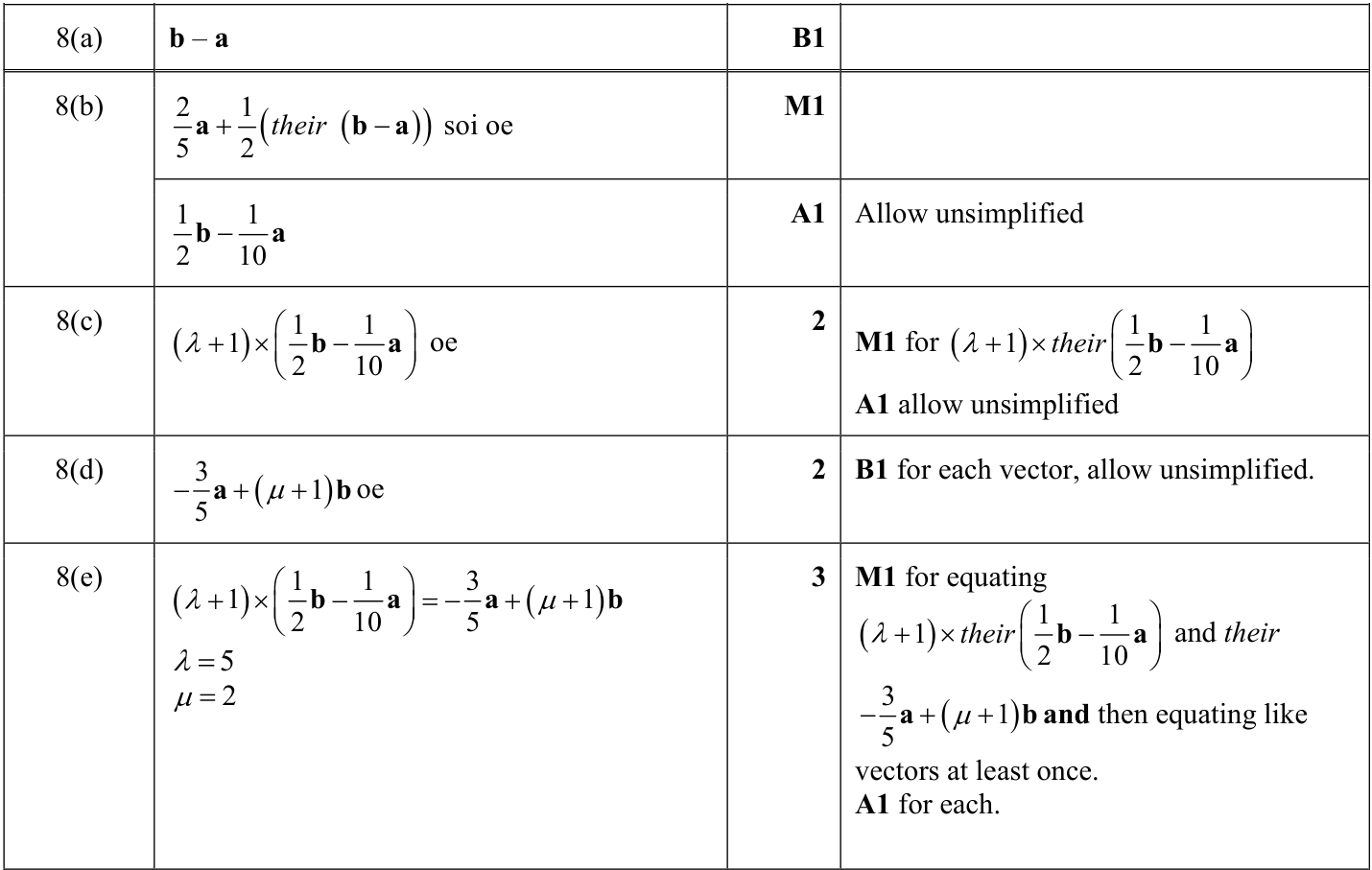
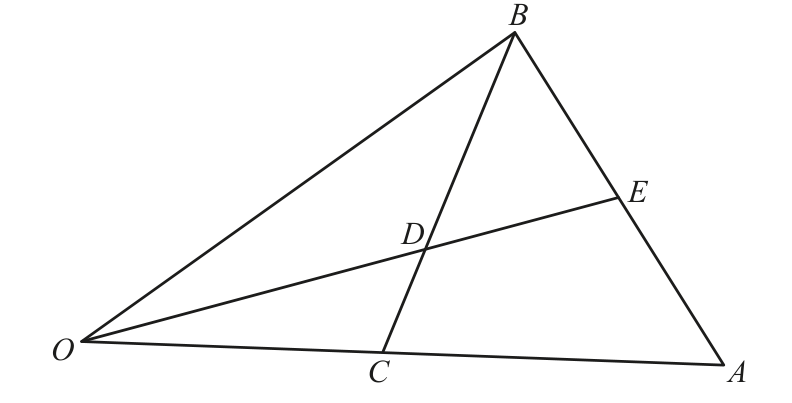
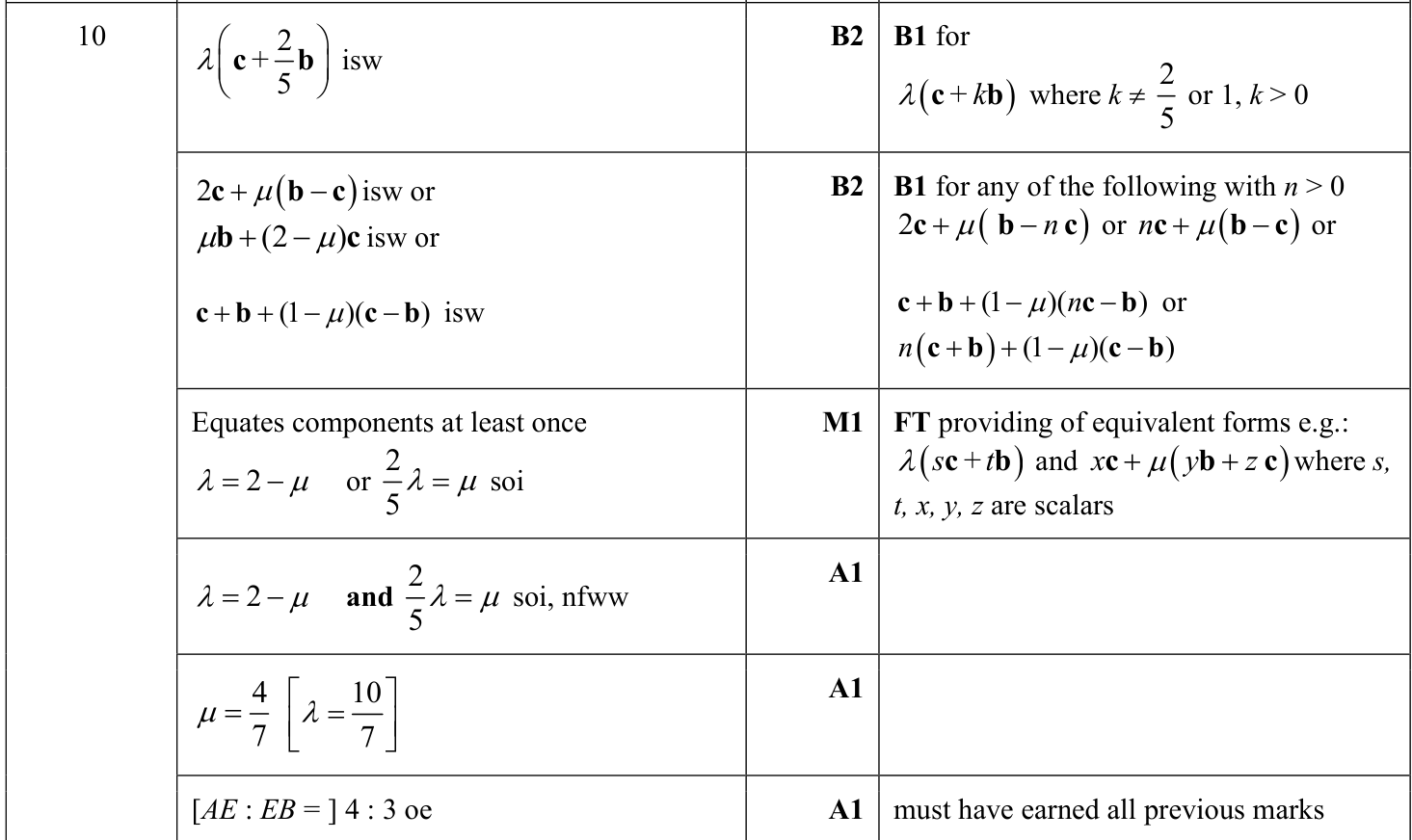
0606 P22 - Jun 2023 - Q10 - 8 marks
The diagram shows a triangle \(OAB\). The point \(C\) is the midpoint of \(OA\). The point \(D\) lies on \(CB\) such that \(CD:DB=2:3\).
\(\overrightarrow{OC}=\mathbf c,\qquad \overrightarrow{CB}=\mathbf b.\)
The point \(E\) lies on \(AB\) such that \(\overrightarrow{OE}=\lambda\overrightarrow{OD}\) and \(\overrightarrow{AE}=\mu\overrightarrow{AB}\), where \(\lambda\) and \(\mu\) are scalars. Find two expressions for \(\overrightarrow{OE}\), each in terms of \(\mathbf b\), \(\mathbf c\) and a scalar, and hence find \(AE:EB\).
0606 P12 - Nov 2023 - Q11 - 9 marks
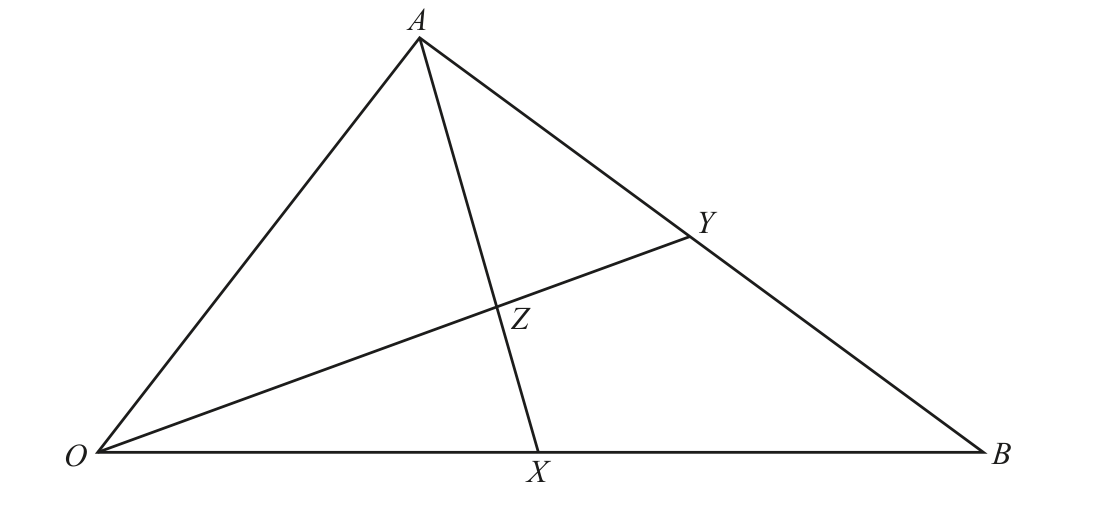
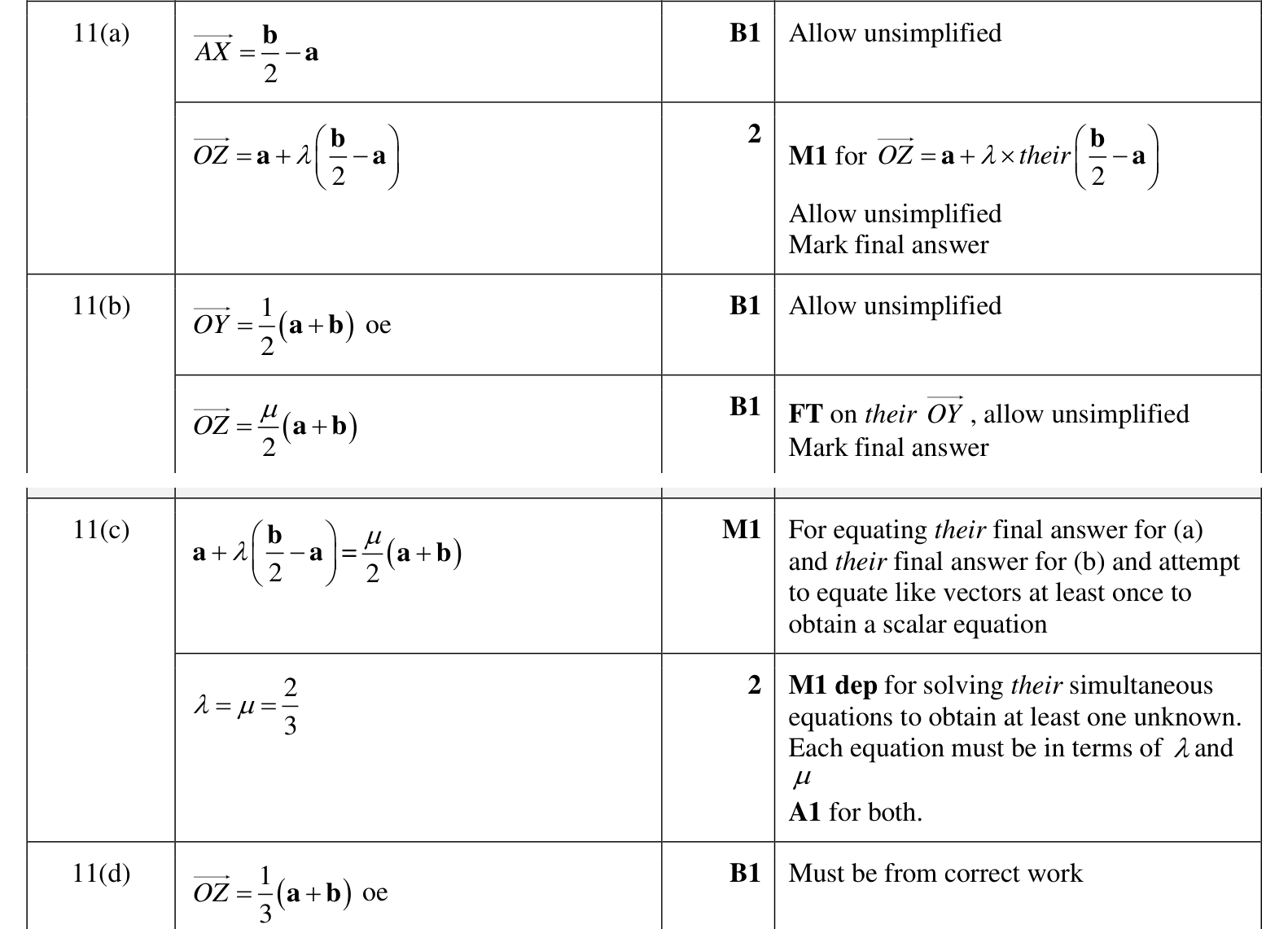
In the triangle \(OAB\), \(\overrightarrow{OA}=\mathbf a\) and \(\overrightarrow{OB}=\mathbf b\). The mid-point of the line \(OB\) is \(X\), and the mid-point of the line \(AB\) is \(Y\). The lines \(OY\) and \(AX\) intersect at the point \(Z\). It is given that \(\overrightarrow{AZ}=\lambda\overrightarrow{AX}\) and \(\overrightarrow{OZ}=\mu\overrightarrow{OY}\), where \(\lambda\) and \(\mu\) are rational numbers.
(a) Find \(\overrightarrow{OZ}\) in terms of \(\mathbf a\), \(\mathbf b\) and \(\lambda\).
(b) Find \(\overrightarrow{OZ}\) in terms of \(\mathbf a\), \(\mathbf b\) and \(\mu\).
(c) Find the values of \(\lambda\) and \(\mu\).
(d) Hence find \(\overrightarrow{OZ}\) in terms of \(\mathbf a\) and \(\mathbf b\) only.
0606 P13 - Nov 2023 - Q11 - 9 marks
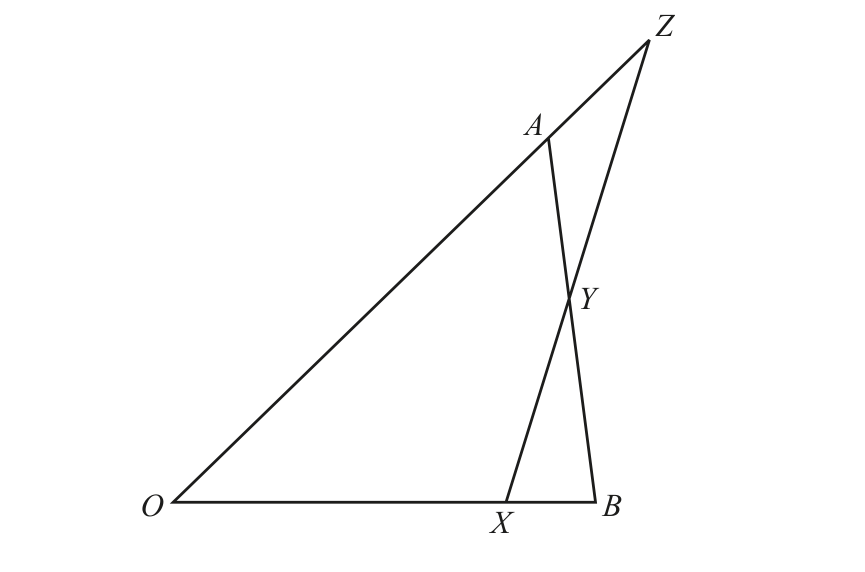
In the triangle \(OAB\), \(\overrightarrow{OA}=\mathbf a\) and \(\overrightarrow{OB}=\mathbf b\).
The straight line \(XYZ\) is such that:
\(\overrightarrow{OX}=\frac45\mathbf b\)
\(\overrightarrow{AY}=\frac13\overrightarrow{AB}\)
\(\overrightarrow{AZ}=\mu\mathbf a\), where \(\mu\) is a constant
\(\overrightarrow{YZ}=\lambda\overrightarrow{XY}\), where \(\lambda\) is a constant.
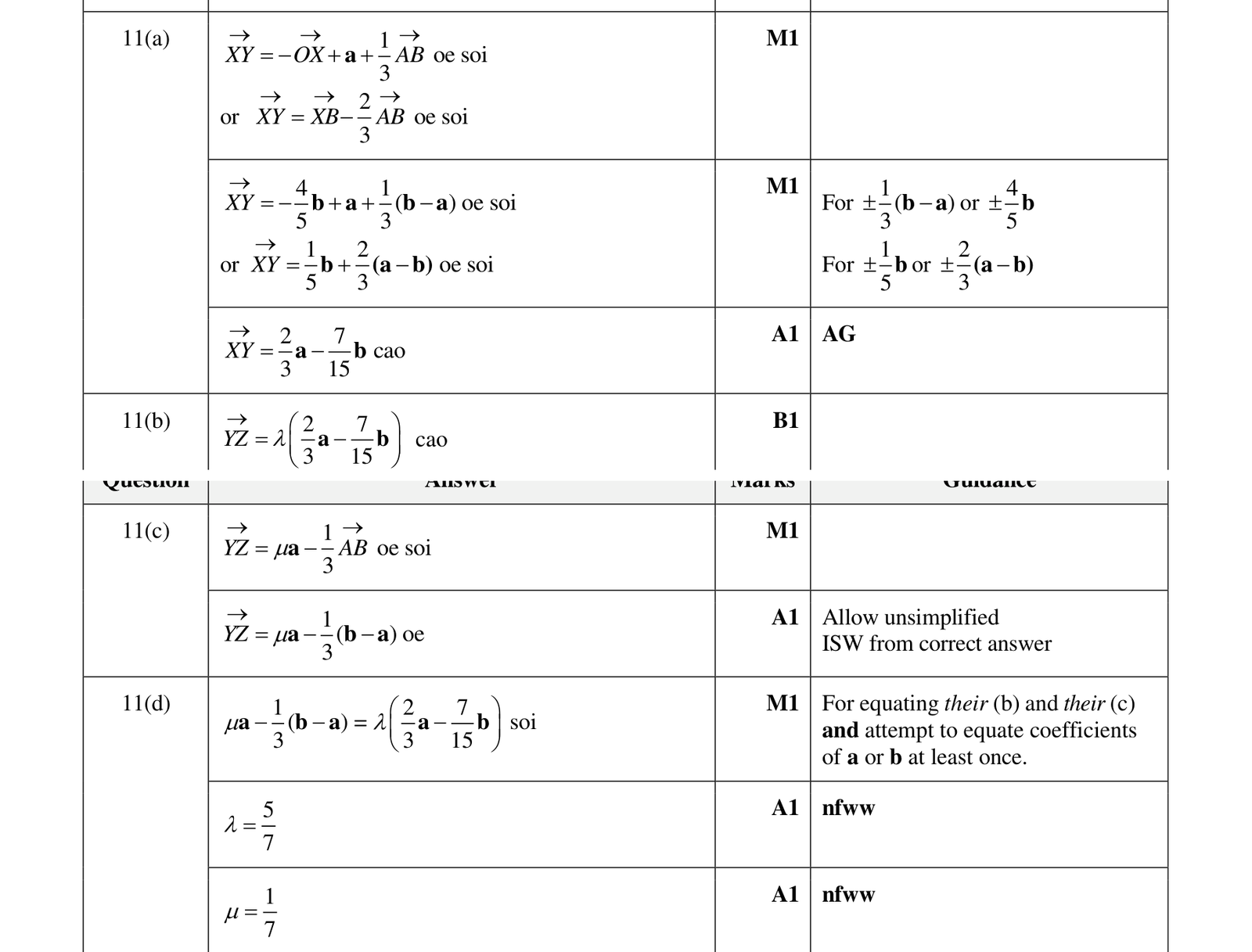
(a) Show that \(\overrightarrow{XY}=\frac23\mathbf a-\frac7{15}\mathbf b\).
(b) Find \(\overrightarrow{YZ}\) in terms of \(\lambda\), \(\mathbf a\) and \(\mathbf b\).
(c) Find \(\overrightarrow{YZ}\) in terms of \(\mu\), \(\mathbf a\) and \(\mathbf b\).
(d) Hence find the values of \(\lambda\) and \(\mu\).
0606 P11 - Nov 2022 - Q11 - 10 marks
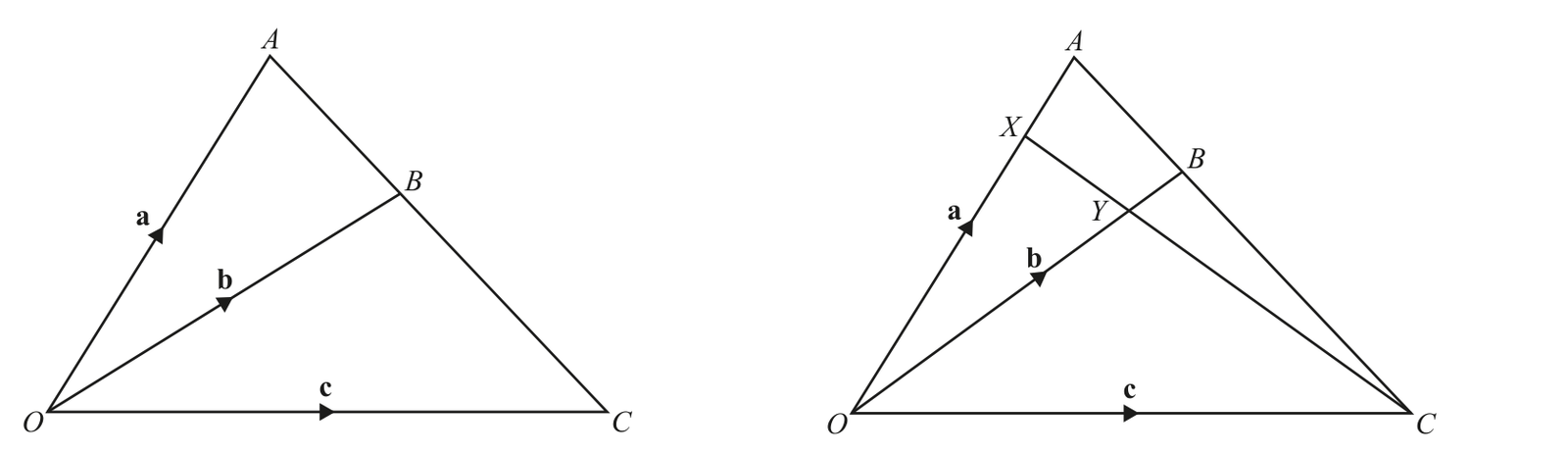
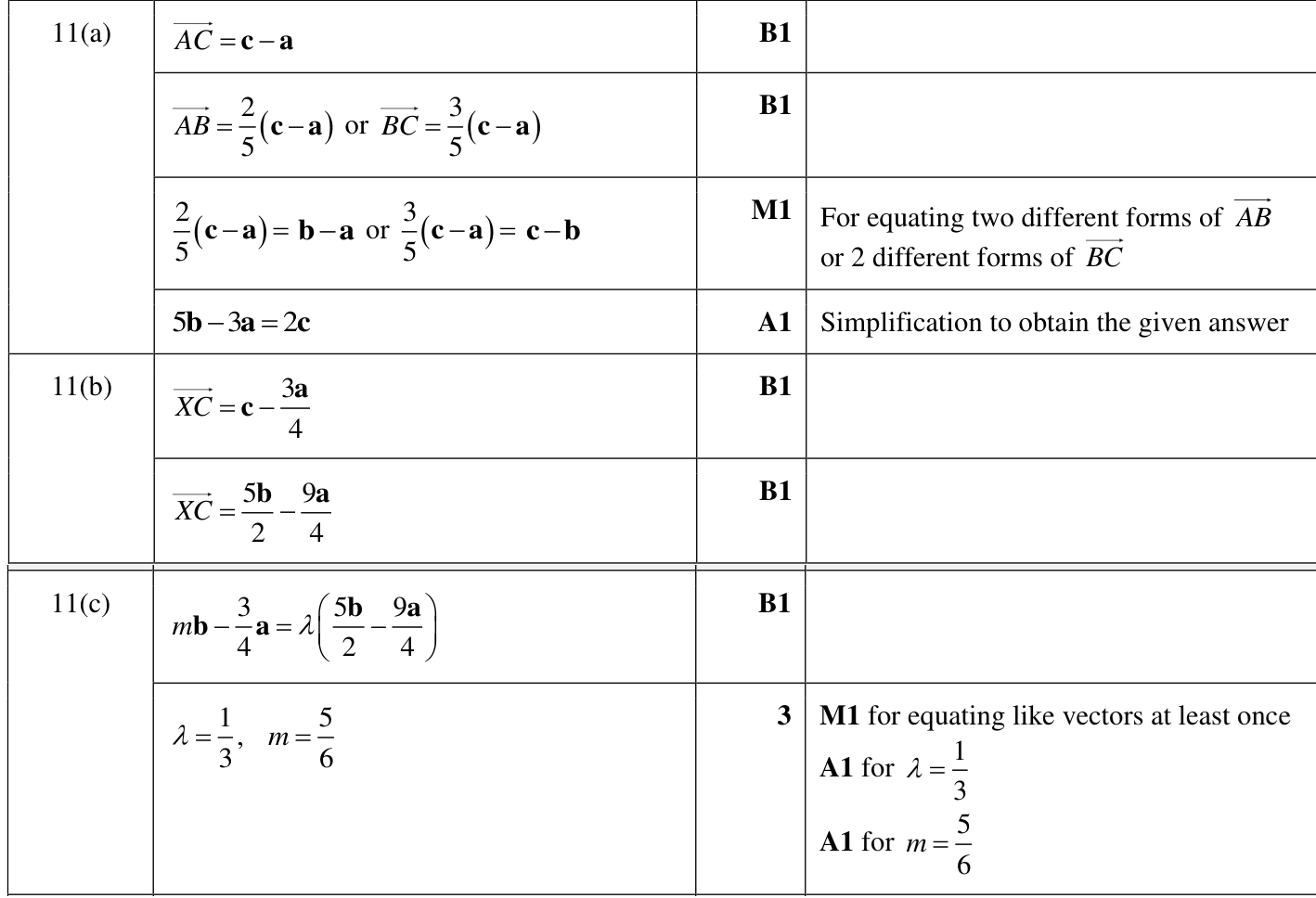
The diagram shows a triangle \(OAC\). The point \(B\) lies on \(AC\) such that \(AB:AC=2:5\). It is given that
\(\overrightarrow{OA}=\mathbf a,\qquad \overrightarrow{OB}=\mathbf b,\qquad \overrightarrow{OC}=\mathbf c.\)
(a) Show that
\(5\mathbf b-3\mathbf a=2\mathbf c.\)
The diagram now includes points \(X\) and \(Y\), such that
\(\overrightarrow{OX}=\frac34\overrightarrow{OA}\)
and
\(\overrightarrow{OY}=m\overrightarrow{OB},\)
where \(m\) is a constant. It is also given that \(XY:XC=\lambda:1\), where \(\lambda\) is a constant.
(b) Using part (a), find \(\overrightarrow{XC}\) in terms of \(\mathbf a\) and \(\mathbf b\).
(c) Hence find the values of \(m\) and \(\lambda\).
0606 P12 - Nov 2022 - Q5 - 8 marks
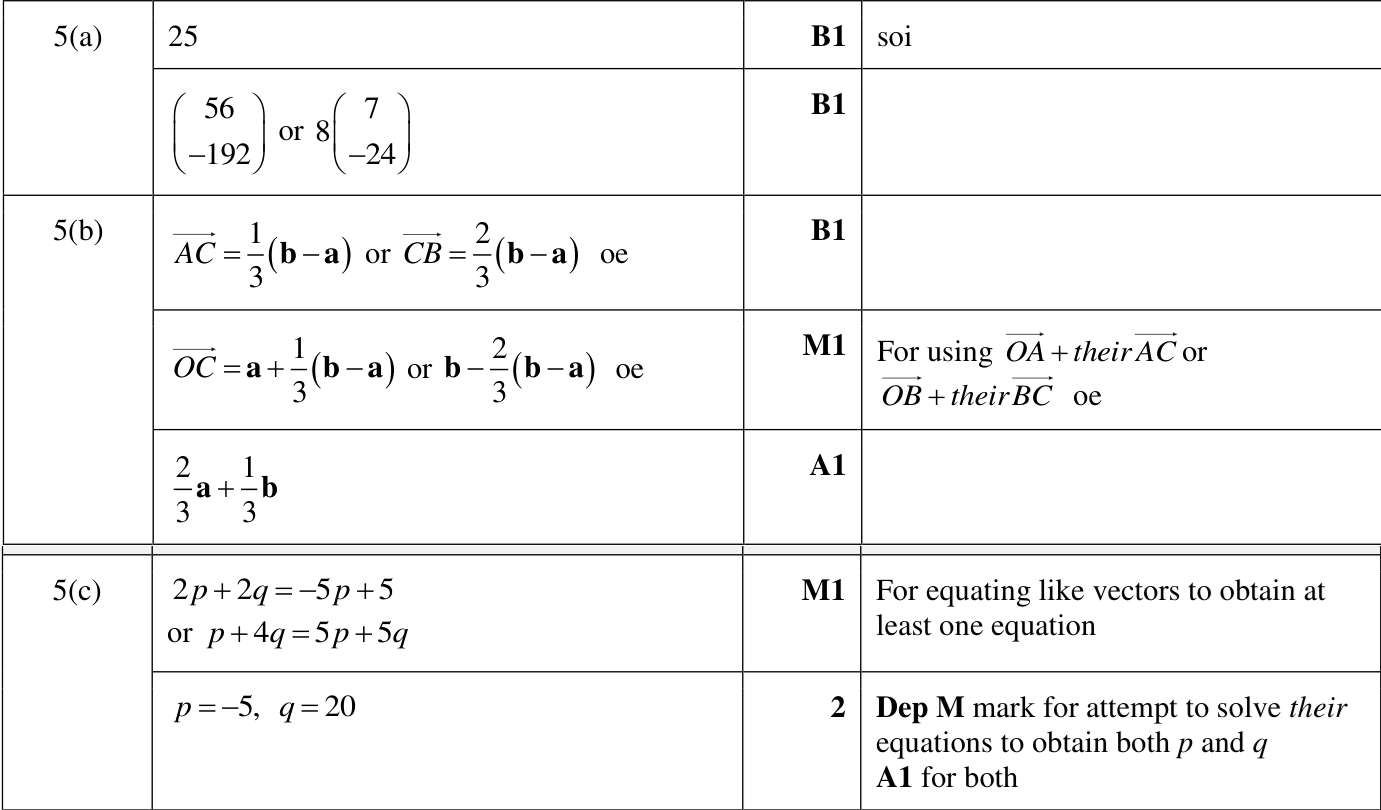
(a) Find the vector with magnitude \(200\) in the direction of
\(\begin{pmatrix}7\\-24\end{pmatrix}.\)
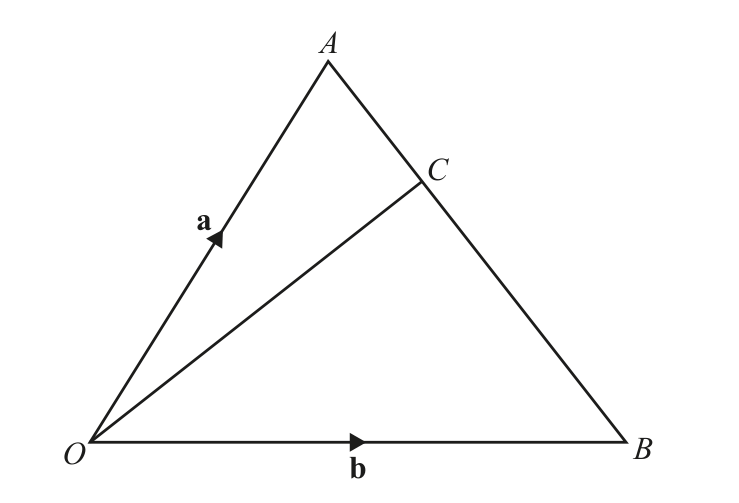
(b) The diagram shows triangle \(AOB\) such that \(\overrightarrow{OA}=\mathbf a\), and \(\overrightarrow{OB}=\mathbf b\). The point \(C\) lies on the line \(AB\) such that \(AC:AB=1:3\). Find the vector \(\overrightarrow{OC}\) in terms of \(\mathbf a\) and \(\mathbf b\), giving your answer in its simplest form.
(c) Given the vector equation
\(p\begin{pmatrix}2\\1\end{pmatrix}+q\begin{pmatrix}2\\4\end{pmatrix} =5\begin{pmatrix}-p+1\\p+q\end{pmatrix},\)
find the values of \(p\) and \(q\).
0606 P23 - Nov 2022 - Q11 - 11 marks
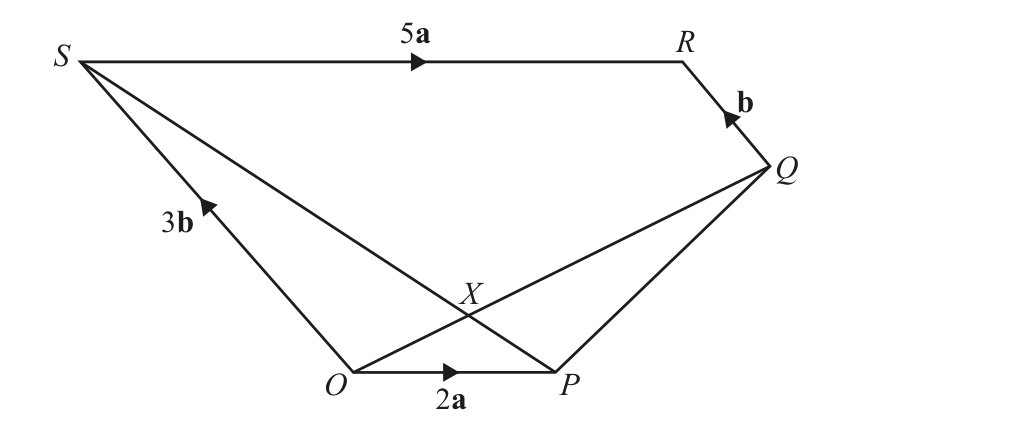
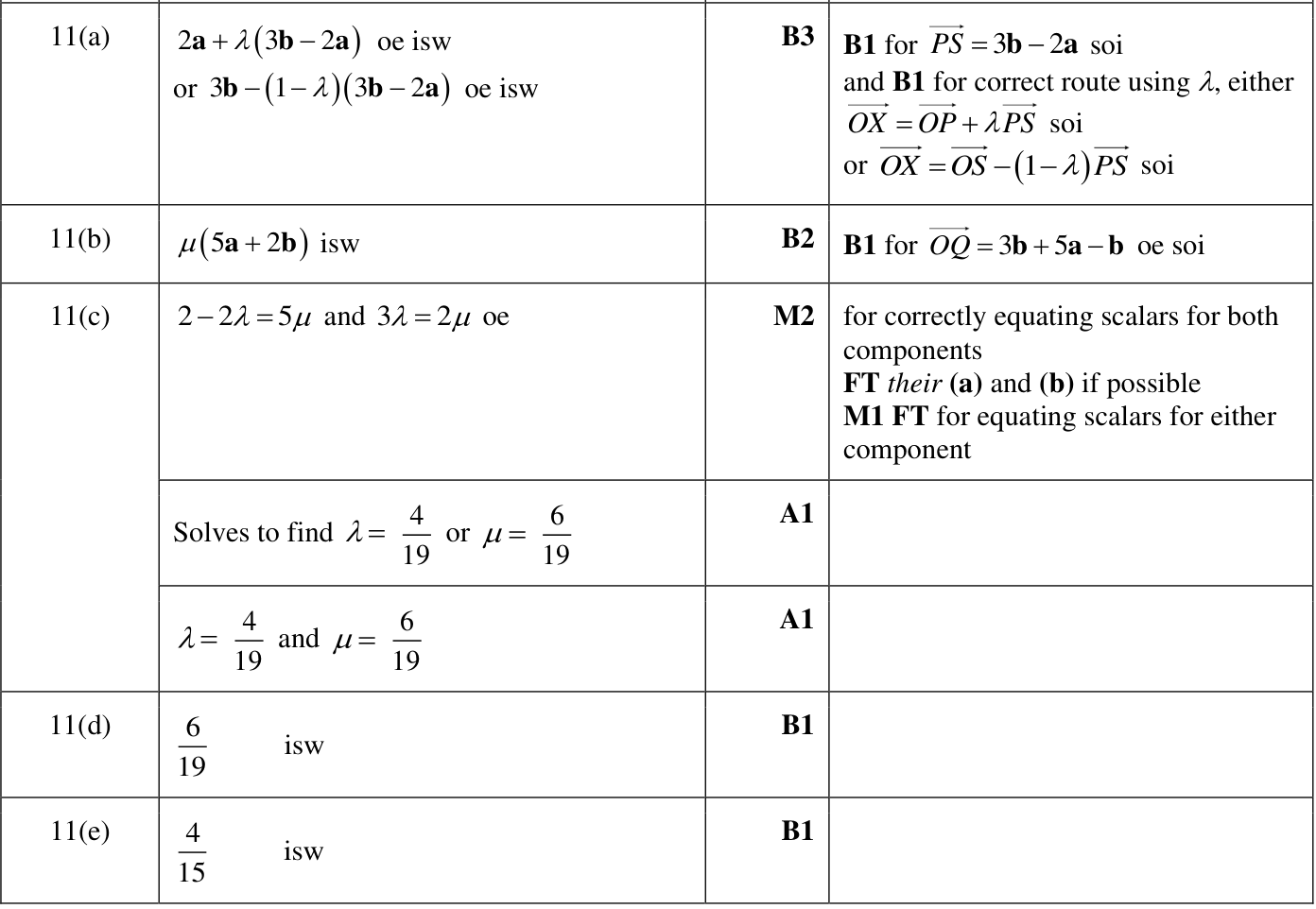
In the diagram, \(OP=2\mathbf a\), \(SR=5\mathbf a\), \(OS=3\mathbf b\) and \(QR=\mathbf b\).
The point \(X\) lies on \(PS\) and on \(OQ\). It is given that \(PX=\lambda PS\) and \(OX=\mu OQ\).
(a) Express \(\overrightarrow{OX}\) in terms of \(\lambda\), \(\mathbf a\) and \(\mathbf b\).
(b) Express \(\overrightarrow{OQ}\) in terms of \(\mathbf a\) and \(\mathbf b\).
(c) Find the values of \(\lambda\) and \(\mu\).
(d) Find \(OX:OQ\).
(e) Find \(PX:XS\).
0606 P12 - Jun 2021 - Q3 - 5 marks
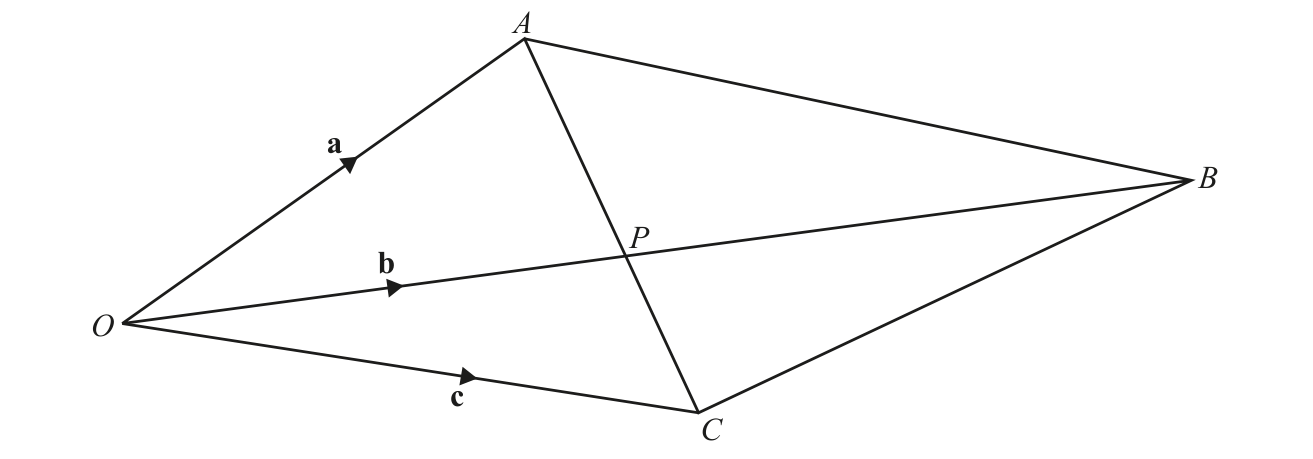
The diagram shows a quadrilateral \(OABC\), where
\(\overrightarrow{OA}=\mathbf a,\qquad \overrightarrow{OB}=\mathbf b,\qquad \overrightarrow{OC}=\mathbf c.\)
The line \(AC\) intersects \(OB\) at \(P\), and \(AP:PC=3:2\).
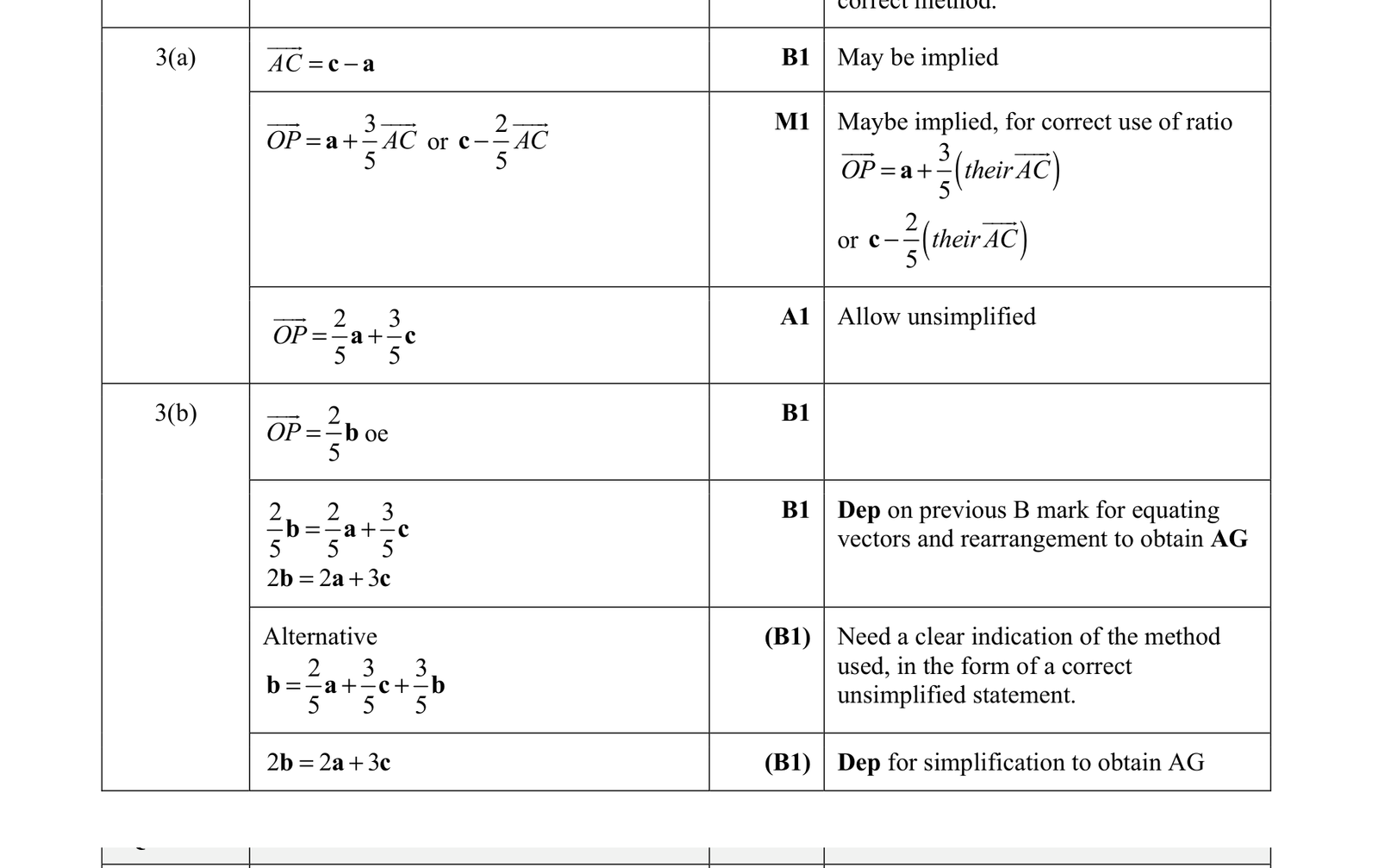
(a) Find \(\overrightarrow{OP}\) in terms of \(\mathbf a\) and \(\mathbf c\).
(b) Given that \(OP:PB=2:3\), show that
\(2\mathbf b=3\mathbf c+2\mathbf a.\)
0606 P13 - Jun 2021 - Q10 - 9 marks
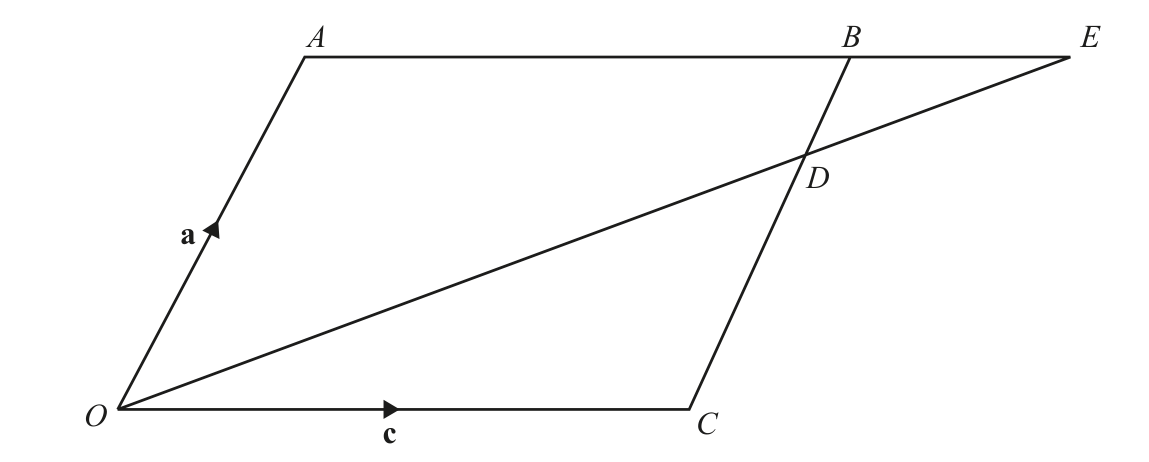
The diagram shows the parallelogram \(OABC\), such that \(\overrightarrow{OA}=\mathbf a\) and \(\overrightarrow{OC}=\mathbf c\). The point \(D\) lies on \(CB\) such that \(CD:DB=3:1\). When extended, the lines \(AB\) and \(OD\) meet at the point \(E\). It is given that
\(\overrightarrow{OE}=h\overrightarrow{OD} \quad\text{and}\quad \overrightarrow{BE}=k\overrightarrow{AB},\)
where \(h\) and \(k\) are constants.
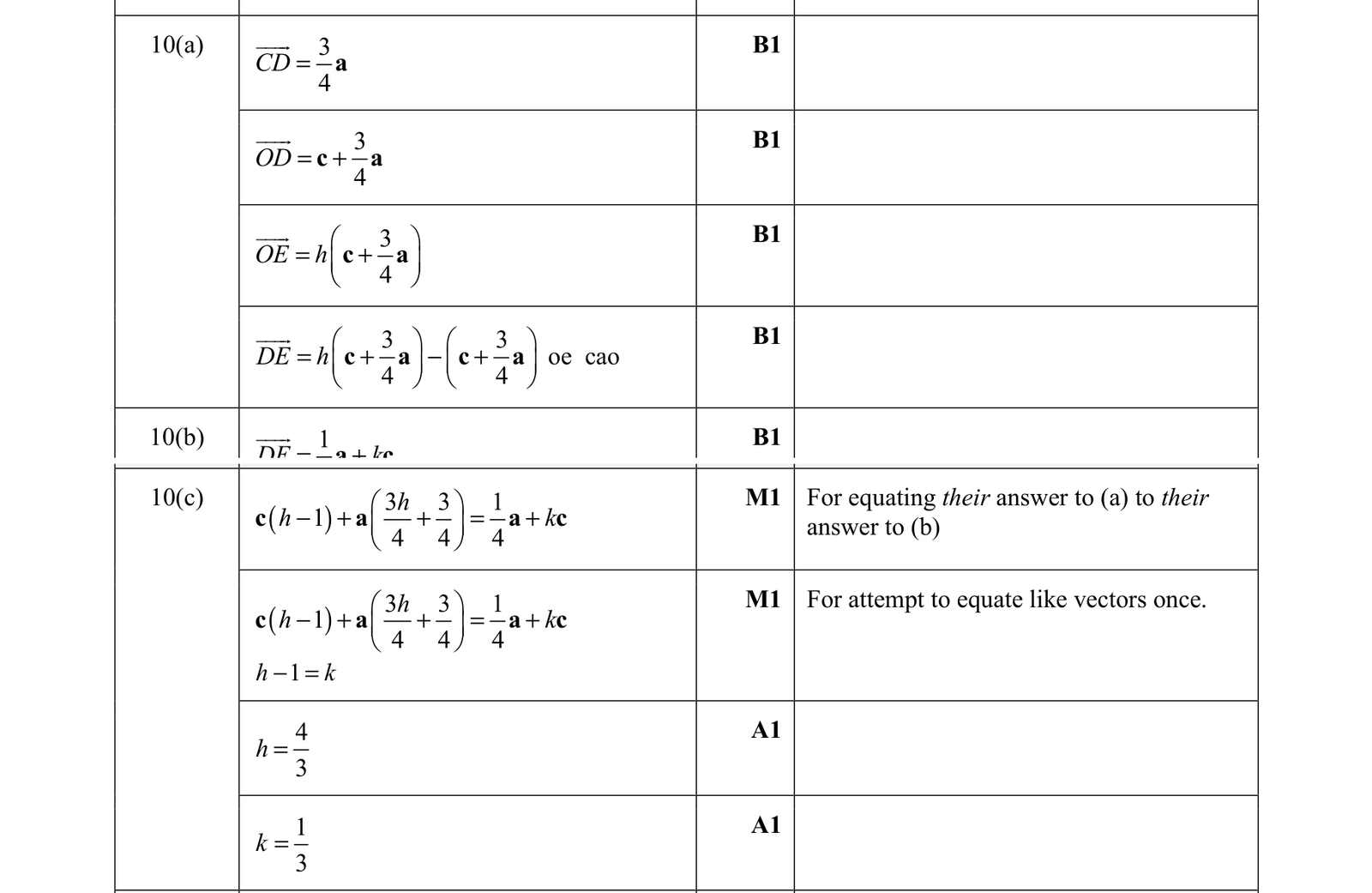
(a) Find \(\overrightarrow{DE}\) in terms of \(\mathbf a\), \(\mathbf c\) and \(h\).
(b) Find \(\overrightarrow{DE}\) in terms of \(\mathbf a\), \(\mathbf c\) and \(k\).
(c) Hence find the value of \(h\) and of \(k\).
0606 P12 - Nov 2021 - Q7 - 8 marks
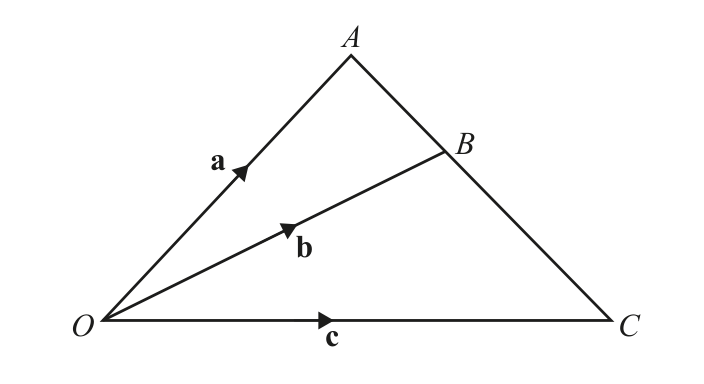
(a) The diagram shows triangle \(OAC\), where \(\overrightarrow{OA}=\mathbf a\), \(\overrightarrow{OB}=\mathbf b\) and \(\overrightarrow{OC}=\mathbf c\). The point \(B\) lies on the line \(AC\) such that \(AB:BC=m:n\), where \(m\) and \(n\) are constants.
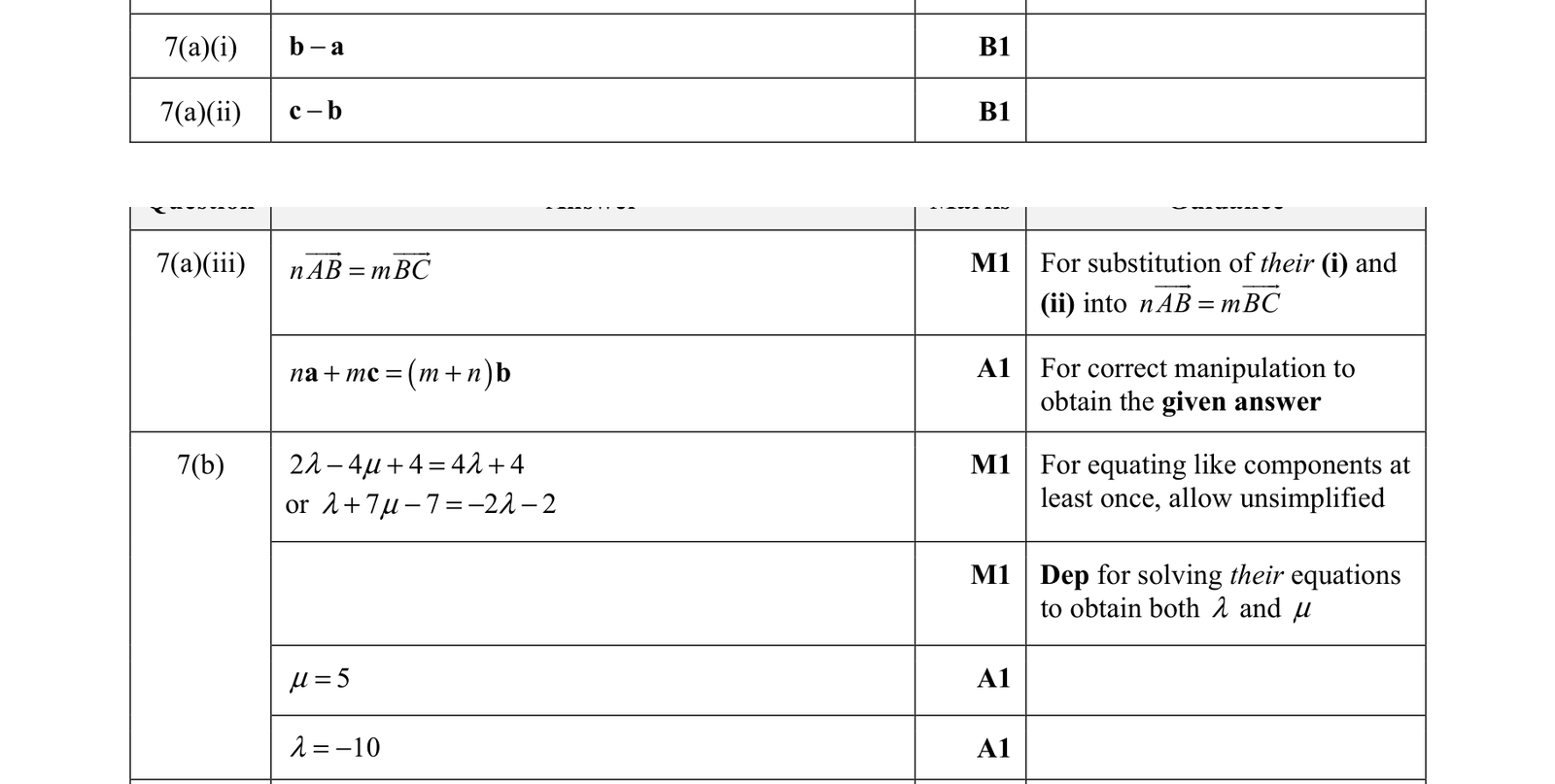
(i) Write down \(\overrightarrow{AB}\) in terms of \(\mathbf a\) and \(\mathbf b\).
(ii) Write down \(\overrightarrow{BC}\) in terms of \(\mathbf b\) and \(\mathbf c\).
(iii) Hence show that \(n\mathbf a+m\mathbf c=(m+n)\mathbf b\).
(b) Given that
\(\lambda\begin{pmatrix}2\\1\end{pmatrix}+(\mu-1)\begin{pmatrix}-4\\7\end{pmatrix} =(\lambda+1)\begin{pmatrix}4\\-2\end{pmatrix},\)
find the value of each of the constants \(\lambda\) and \(\mu\).
0606 P13 - Nov 2020 - Q9 - 9 marks
The diagram shows the triangle \(OAC\). The point \(B\) is the midpoint of \(OC\). The point \(Y\) lies on \(AC\) such that \(OY\) intersects \(AB\) at the point \(X\), where \(AX:XB=3:1\). It is given that \(\overrightarrow{OA}=\mathbf{a}\) and \(\overrightarrow{OB}=\mathbf{b}\).
(a) Find \(\overrightarrow{OX}\) in terms of \(\mathbf{a}\) and \(\mathbf{b}\), giving your answer in its simplest form.
(b) Find \(\overrightarrow{AC}\) in terms of \(\mathbf{a}\) and \(\mathbf{b}\).
(c) Given that \(\overrightarrow{OY}=h\overrightarrow{OX}\), find \(\overrightarrow{AY}\) in terms of \(\mathbf{a}\), \(\mathbf{b}\) and \(h\).
(d) Given that \(\overrightarrow{AY}=m\overrightarrow{AC}\), find the value of \(h\) and of \(m\).


0606 P22 - Nov 2020 - Q9 - 9 marks
In the diagram, \(\overrightarrow{OP}=2\mathbf{b}\), \(\overrightarrow{OS}=3\mathbf{a}\), \(\overrightarrow{SR}=\mathbf{b}\), and \(\overrightarrow{PQ}=\mathbf{a}\). The lines \(OR\) and \(QS\) intersect at \(X\).
(a) Find \(\overrightarrow{OQ}\) in terms of \(\mathbf{a}\) and \(\mathbf{b}\).
(b) Find \(\overrightarrow{QS}\) in terms of \(\mathbf{a}\) and \(\mathbf{b}\).
(c) Given that \(\overrightarrow{QX}=\mu\overrightarrow{QS}\), find \(\overrightarrow{OX}\) in terms of \(\mathbf{a}\), \(\mathbf{b}\), and \(\mu\).
(d) Given that \(\overrightarrow{OX}=\lambda\overrightarrow{OR}\), find \(\overrightarrow{OX}\) in terms of \(\mathbf{a}\), \(\mathbf{b}\), and \(\lambda\).
(e) Find the values of \(\lambda\) and \(\mu\).
(f) Find the value of \(\dfrac{QX}{XS}\).
(g) Find the value of \(\dfrac{OR}{OX}\).


0606 P22 - Jun 2019 - Q10 - 8 marks
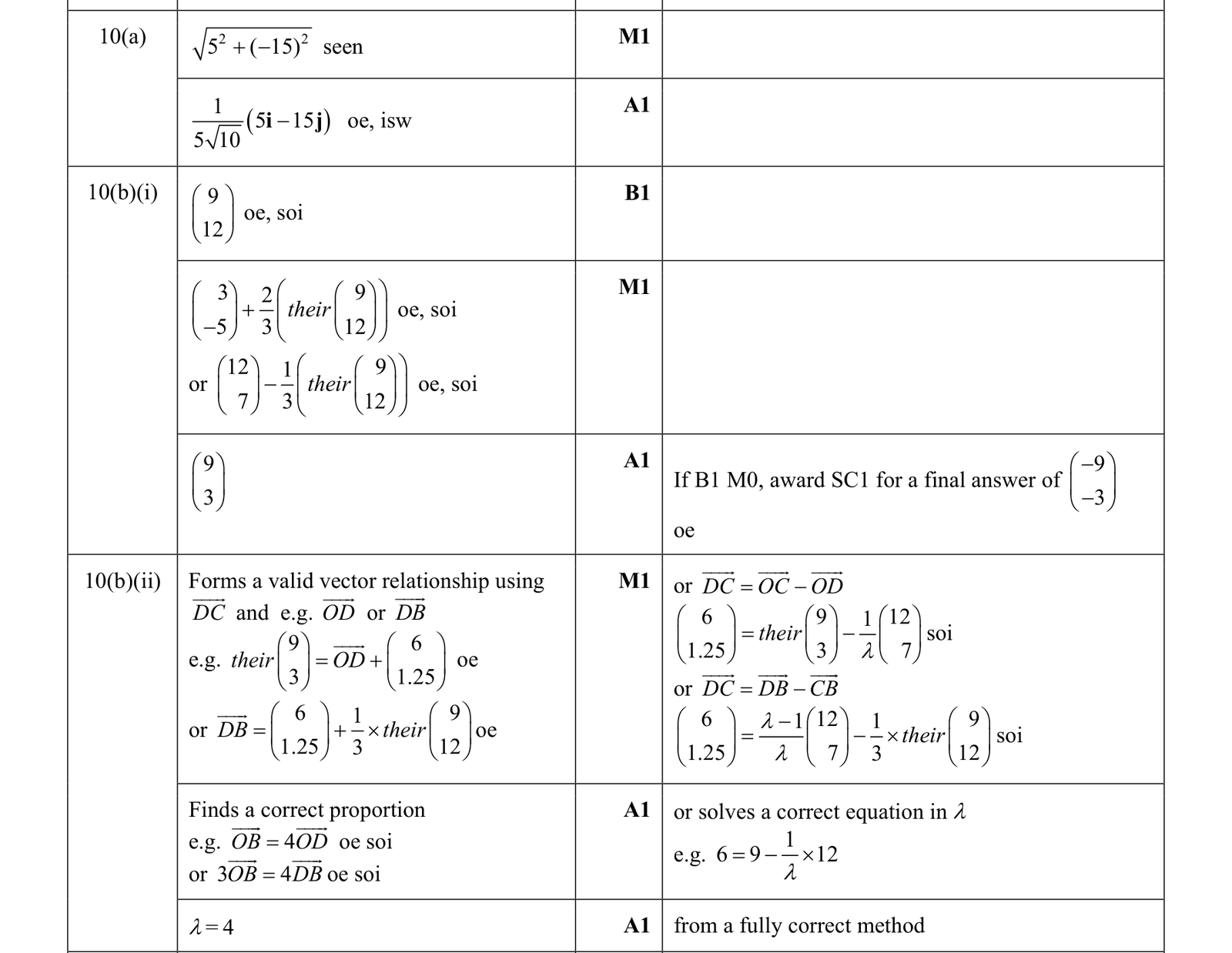
(a) Find the unit vector in the direction of \(5\mathbf{i}-15\mathbf{j}\).
(b) The position vectors of points \(A\) and \(B\) relative to an origin \(O\) are \(\begin{pmatrix}3\\-5\end{pmatrix}\) and \(\begin{pmatrix}12\\7\end{pmatrix}\) respectively. The point \(C\) lies on \(AB\) such that \(AC:CB=2:1\).
(i) Find the position vector of \(C\) relative to \(O\).
The point \(D\) lies on \(OB\) such that \(OD:OB=1:\lambda\) and \(\overrightarrow{DC}=\begin{pmatrix}6\\1.25\end{pmatrix}\).
(ii) Find the value of \(\lambda\).
0606 P23 - Jun 2019 - Q10 - 9 marks
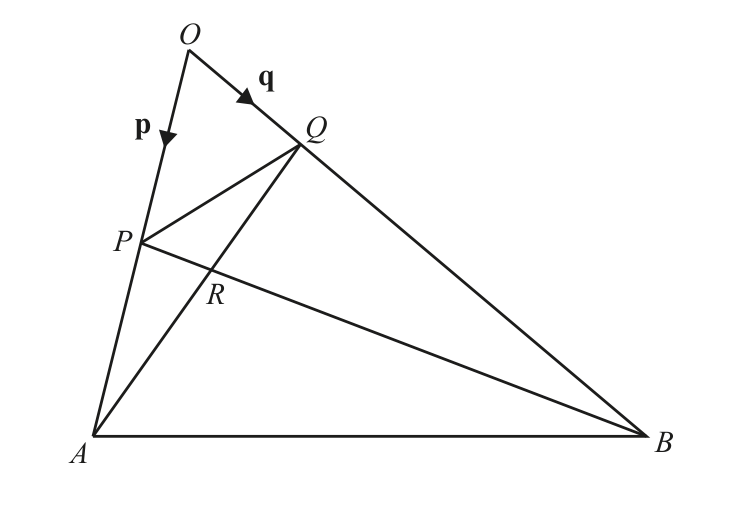
The diagram shows a triangle \(OAB\). The point \(P\) is the midpoint of \(OA\) and the point \(Q\) lies on \(OB\) such that \(\overrightarrow{OQ}=\dfrac14\overrightarrow{OB}\). The position vectors of \(P\) and \(Q\) relative to \(O\) are \(\mathbf{p}\) and \(\mathbf{q}\) respectively.
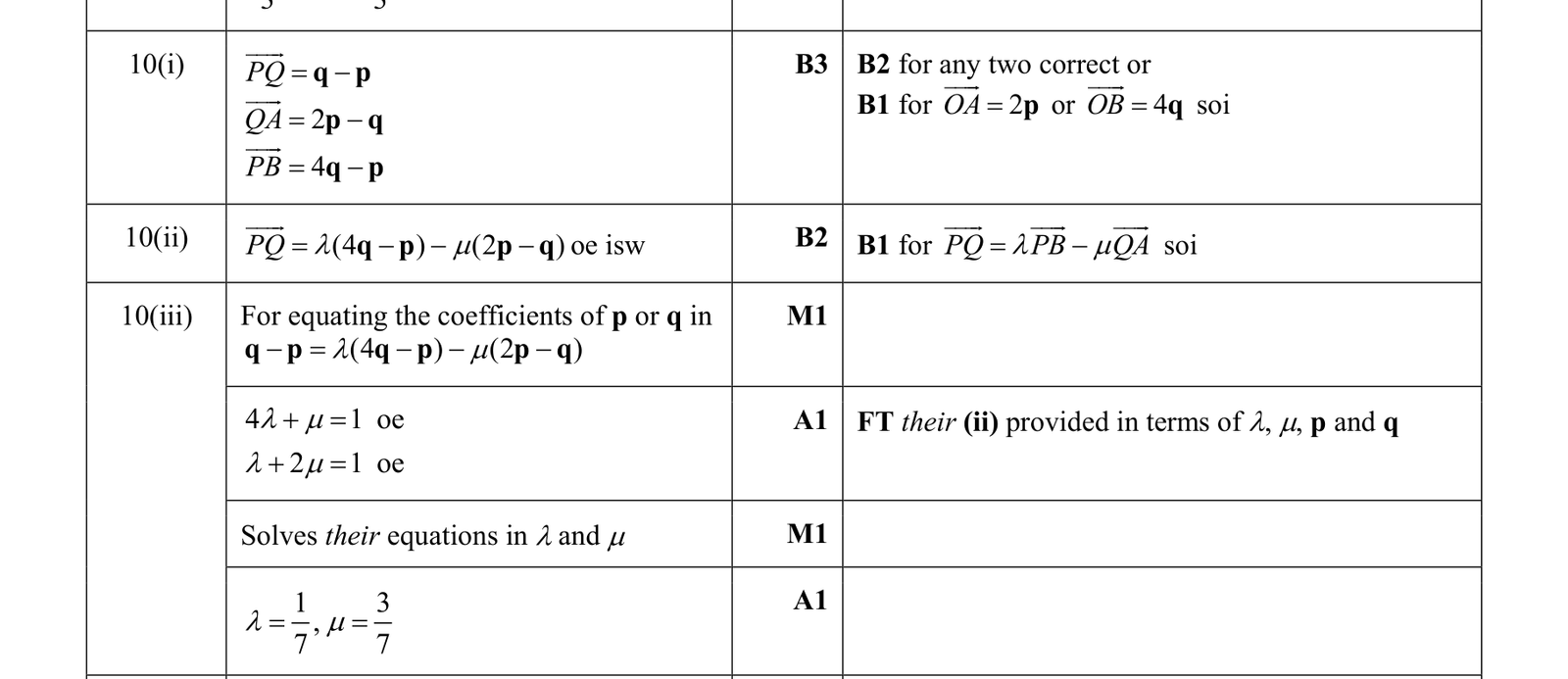
(i) Find, in terms of \(\mathbf{p}\) and \(\mathbf{q}\), an expression for each of the vectors \(\overrightarrow{PQ}\), \(\overrightarrow{QA}\) and \(\overrightarrow{PB}\).
(ii) Given that \(\overrightarrow{PR}=\lambda\overrightarrow{PB}\) and that \(\overrightarrow{QR}=\mu\overrightarrow{QA}\), find an expression for \(\overrightarrow{PQ}\) in terms of \(\lambda\), \(\mu\), \(\mathbf{p}\) and \(\mathbf{q}\).
(iii) Using your expressions for \(\overrightarrow{PQ}\), find the value of \(\lambda\) and of \(\mu\).
0606 P23 - Nov 2019 - Q9 - 9 marks
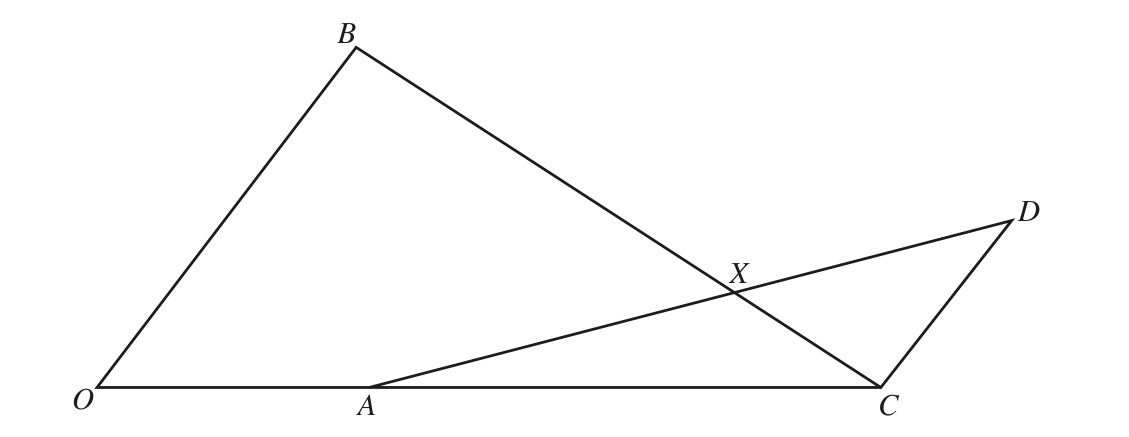
The diagram shows the points \(O\), \(A\), \(B\), \(C\), \(D\) and \(X\). The position vectors of \(A\), \(B\) and \(C\) relative to \(O\) are \(\overrightarrow{OA}=\mathbf{a}\), \(\overrightarrow{OB}=2\mathbf{b}\) and \(\overrightarrow{OC}=3\mathbf{a}\). The vector \(\overrightarrow{CD}=\mathbf{b}\).
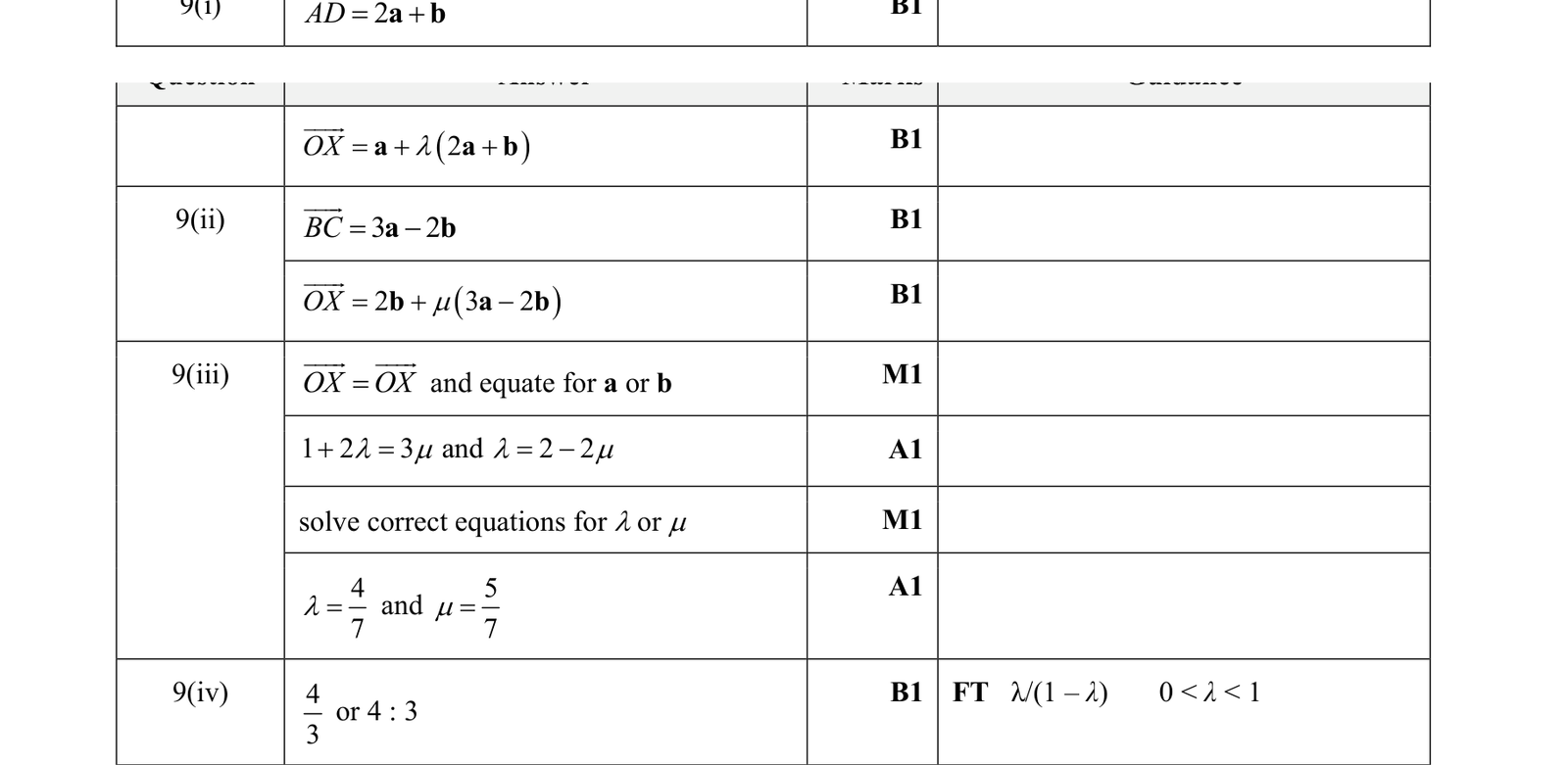
(i) Given that \(\overrightarrow{AX}=\lambda\overrightarrow{AD}\), find \(\overrightarrow{OX}\) in terms of \(\lambda\), \(\mathbf{a}\) and \(\mathbf{b}\).
(ii) Given that \(\overrightarrow{BX}=\mu\overrightarrow{BC}\), find \(\overrightarrow{OX}\) in terms of \(\mu\), \(\mathbf{a}\) and \(\mathbf{b}\).
(iii) Hence find the value of \(\lambda\) and of \(\mu\).
(iv) Find the ratio \(\displaystyle \frac{AX}{XD}\).
0606 P12 - Mar 2018 - Q6 - 8 marks
In the quadrilateral \(OABC\), \(\overrightarrow{OA}=\mathbf a\), \(\overrightarrow{OB}=\mathbf b\), and \(\overrightarrow{OC}=\mathbf c\). The point \(M\) lies on \(AC\) such that \(AM:MC=2:1\). The point \(M\) also lies on \(OB\) such that \(OM:MB=3:2\).
(i) Find \(\overrightarrow{AC}\) in terms of \(\mathbf a\) and \(\mathbf c\).
(ii) Find \(\overrightarrow{OM}\) in terms of \(\mathbf a\) and \(\mathbf c\).
(iii) Find \(\overrightarrow{OM}\) in terms of \(\mathbf b\).
(iv) Find \(5\mathbf a+10\mathbf c\) in terms of \(\mathbf b\).
(v) Find \(\overrightarrow{AB}\) in terms of \(\mathbf a\) and \(\mathbf c\), simplifying your answer.

0606 P13 - Nov 2018 - Q7 - 6 marks
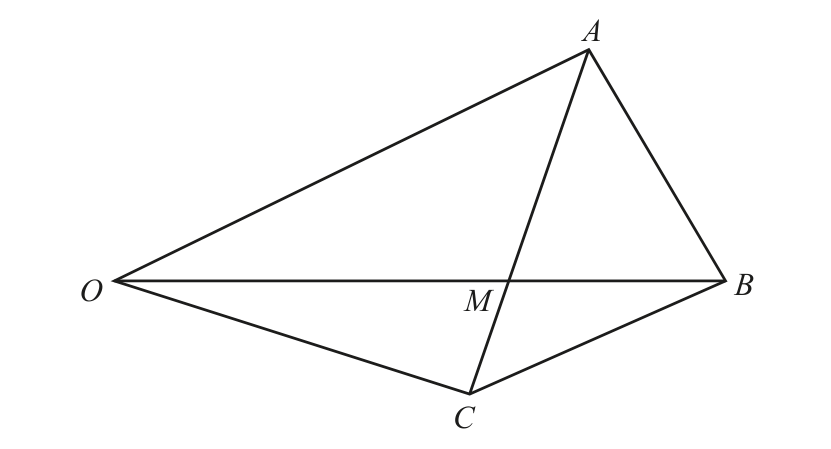
The diagram shows a quadrilateral \(OABC\). The point \(D\) lies on \(OB\) such that \(\overrightarrow{OD}=2\overrightarrow{DB}\) and \(\overrightarrow{AD}=m\overrightarrow{AC}\), where \(m\) is a scalar quantity.
\(\overrightarrow{OA}=\mathbf a,\qquad \overrightarrow{OB}=\mathbf b,\qquad \overrightarrow{OC}=\mathbf c.\)
(i) Find \(\overrightarrow{AD}\) in terms of \(m\), \(\mathbf a\) and \(\mathbf c\).
(ii) Find \(\overrightarrow{AD}\) in terms of \(\mathbf a\) and \(\mathbf b\).
(iii) Given that \(15\mathbf a=16\mathbf b-9\mathbf c\), find the value of \(m\).

0606 P11 - Jun 2017 - Q5 - 11 marks
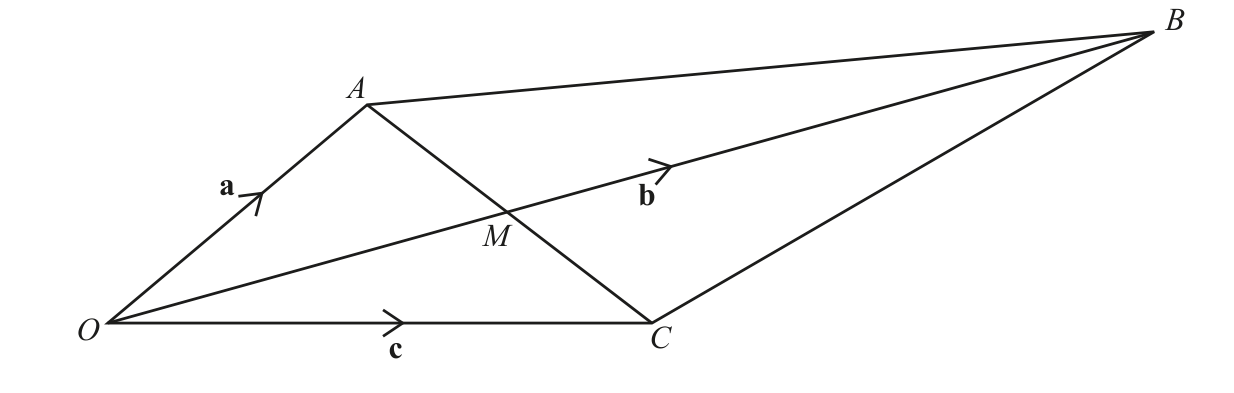
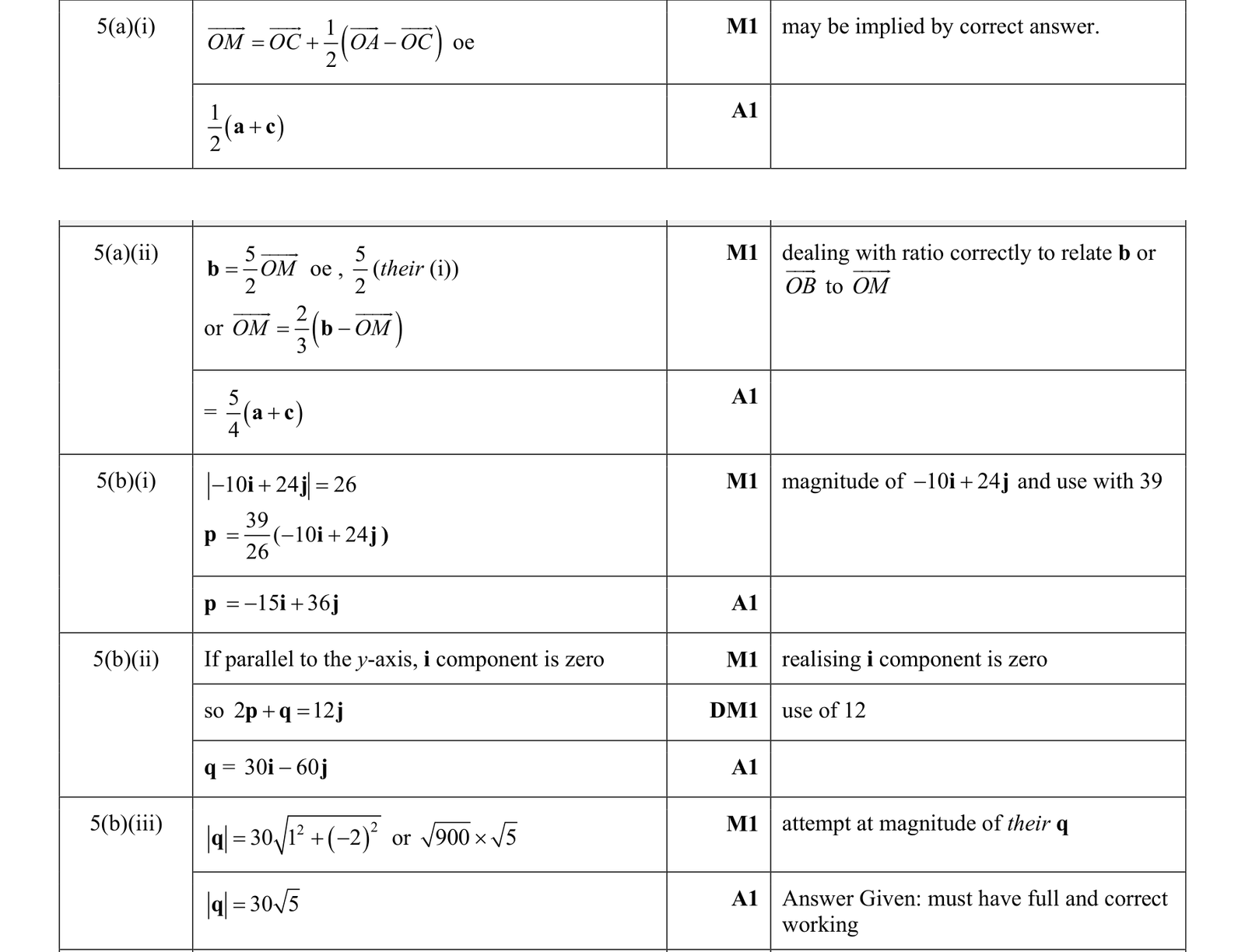
(a) The diagram shows a figure \(OABC\), where \(\overrightarrow{OA}=\mathbf a\), \(\overrightarrow{OB}=\mathbf b\), and \(\overrightarrow{OC}=\mathbf c\). The lines \(AC\) and \(OB\) intersect at \(M\), where \(M\) is the midpoint of \(AC\).
(i) Find \(\overrightarrow{OM}\) in terms of \(\mathbf a\) and \(\mathbf c\).
(ii) Given that \(OM:MB=2:3\), find \(\mathbf b\) in terms of \(\mathbf a\) and \(\mathbf c\).
(b) Vectors \(\mathbf i\) and \(\mathbf j\) are unit vectors parallel to the \(x\)-axis and \(y\)-axis respectively. The vector \(\mathbf p\) has magnitude \(39\) units and has the same direction as \(-10\mathbf i+24\mathbf j\).
(i) Find \(\mathbf p\) in terms of \(\mathbf i\) and \(\mathbf j\).
(ii) Find \(\mathbf q\) such that \(2\mathbf p+\mathbf q\) is parallel to the positive \(y\)-axis and has magnitude \(12\) units.
(iii) Hence show that \(|\mathbf q|=k\sqrt5\), where \(k\) is an integer to be found.
0606 P23 - Nov 2017 - Q5 - 8 marks
The diagram shows points \(O,A,B,C,D\) and \(X\). The position vectors of \(A\), \(B\), and \(C\) relative to \(O\) are
\(\overrightarrow{OA}=\mathbf a\), \(\overrightarrow{OB}=\mathbf b\), and \(\overrightarrow{OC}=\dfrac32\mathbf b\). The vector \(\overrightarrow{CD}=3\mathbf a\).
(i) If \(\overrightarrow{OX}=\lambda\overrightarrow{OD}\), express \(\overrightarrow{OX}\) in terms of \(\lambda\), \(\mathbf a\), and \(\mathbf b\).
(ii) If \(\overrightarrow{AX}=\mu\overrightarrow{AB}\), express \(\overrightarrow{OX}\) in terms of \(\mu\), \(\mathbf a\), and \(\mathbf b\).
(iii) Use your two expressions for \(\overrightarrow{OX}\) to find \(\lambda\) and \(\mu\).
(iv) Find \(\dfrac{AX}{XB}\).
(v) Find \(\dfrac{OX}{XD}\).