0606 P21 - Jun 2024 - Q7 - 4 marks
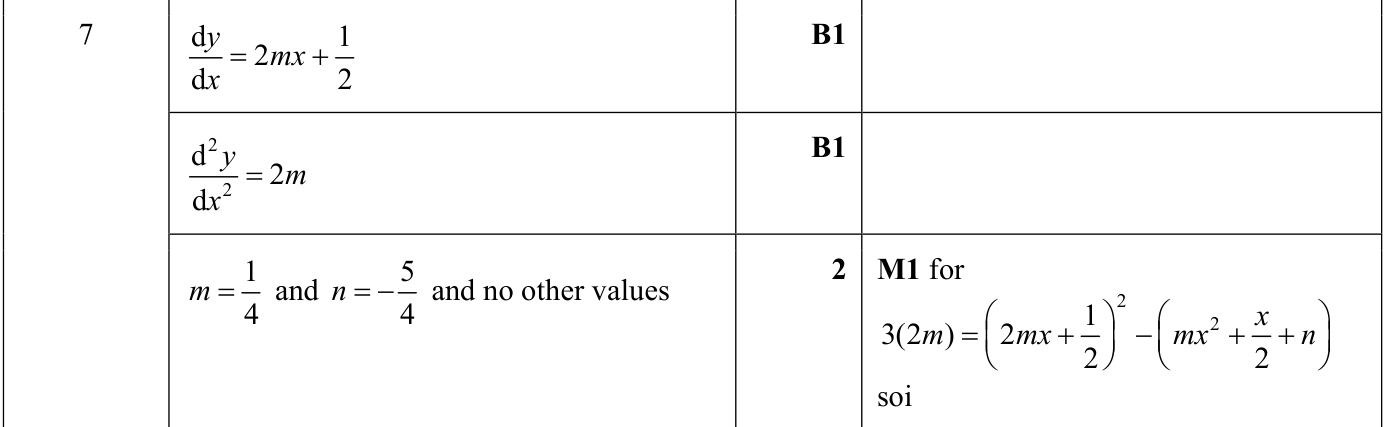
It is given that \(y=m x^{2}+\frac{x}{2}+n\), where \(m\) and \(n\) are non-zero constants. It is also given that \(3\left(\frac{\mathrm{~d}^{2} y}{\mathrm{~d} x^{2}}\right)=\left(\frac{\mathrm{d} y}{\mathrm{~d} x}\right)^{2}-y\) for all values of \(x\). Find the values of \(m\) and \(n\).
0606 P12 - Mar 2022 - Q7 - 8 marks
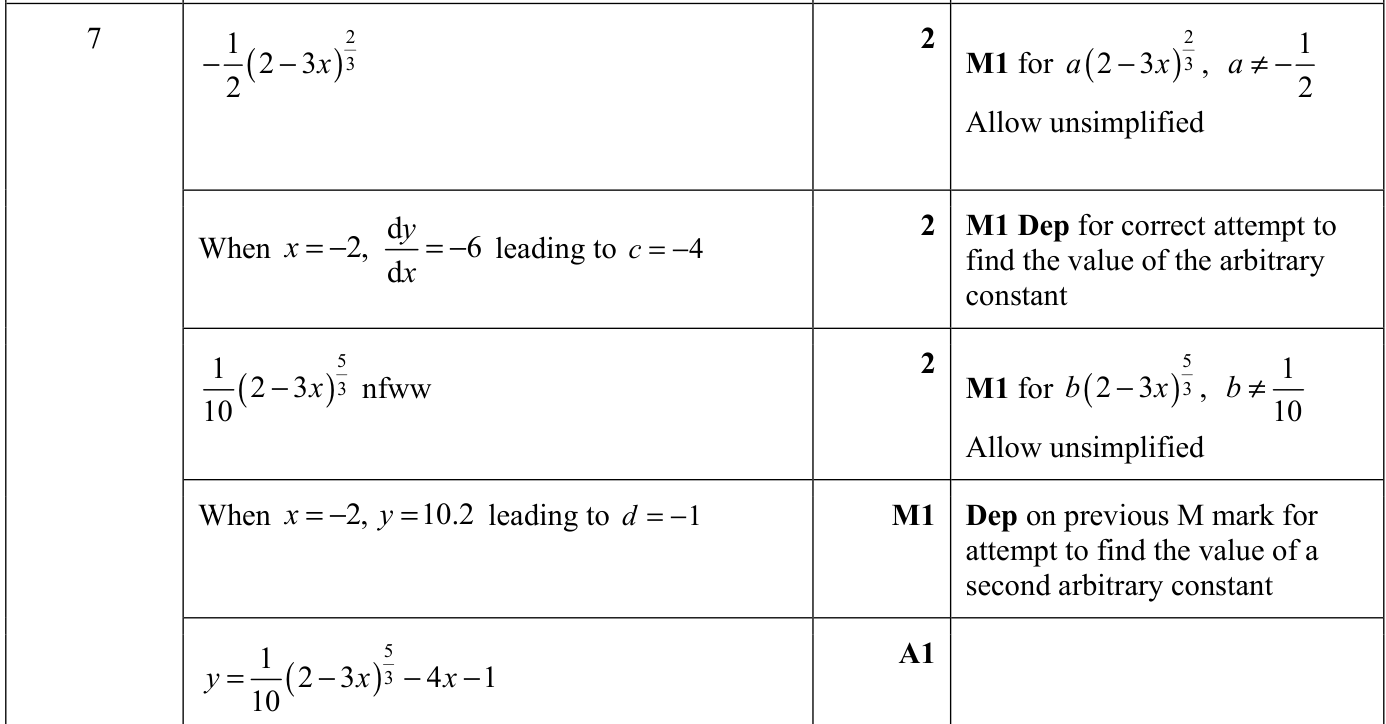
A curve \(y=f(x)\) is such that \(\displaystyle \frac{d^2y}{dx^2}=(2-3x)^{-1/3}\). The curve passes through the point \((-2,10.2)\). The gradient of the tangent to the curve at \((-2,10.2)\) is \(-6\). Find \(f(x)\).
0606 P23 - Jun 2019 - Q6 - 8 marks
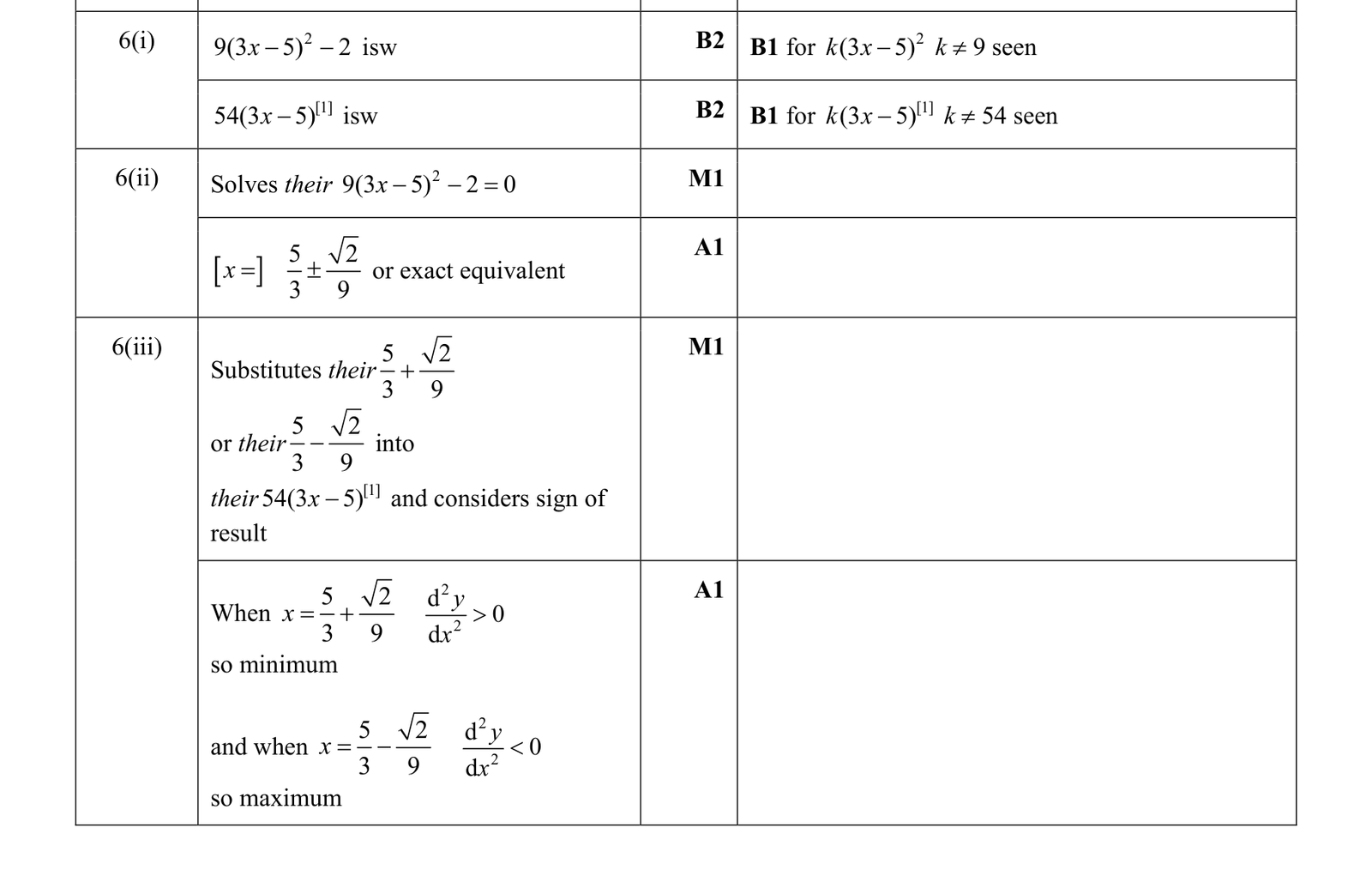
A curve has equation \(y=(3x-5)^3-2x\).
(i) Find \(\dfrac{dy}{dx}\) and \(\dfrac{d^2y}{dx^2}\).
(ii) Find the exact value of the \(x\)-coordinate of each of the stationary points of the curve.
(iii) Use the second derivative test to determine the nature of each of the stationary points.