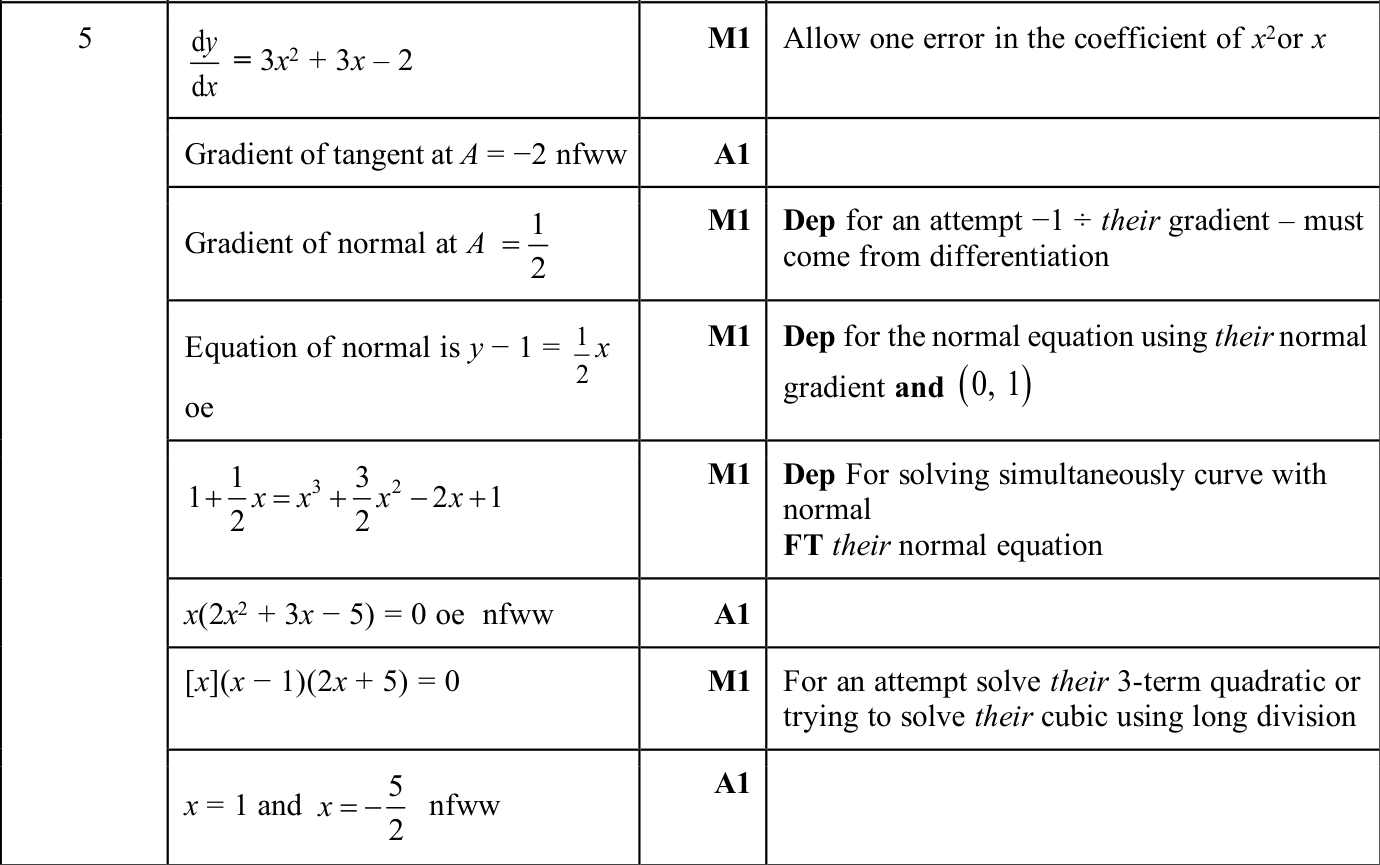
0606 P13 - Nov 2025 - Q5 - 8 marks
The normal to the curve \(y=x^3+\frac32x^2-2x+1\) at the point where \(x=0\) cuts the curve again at two other points.
Find the \(x\)-coordinates of these two points.
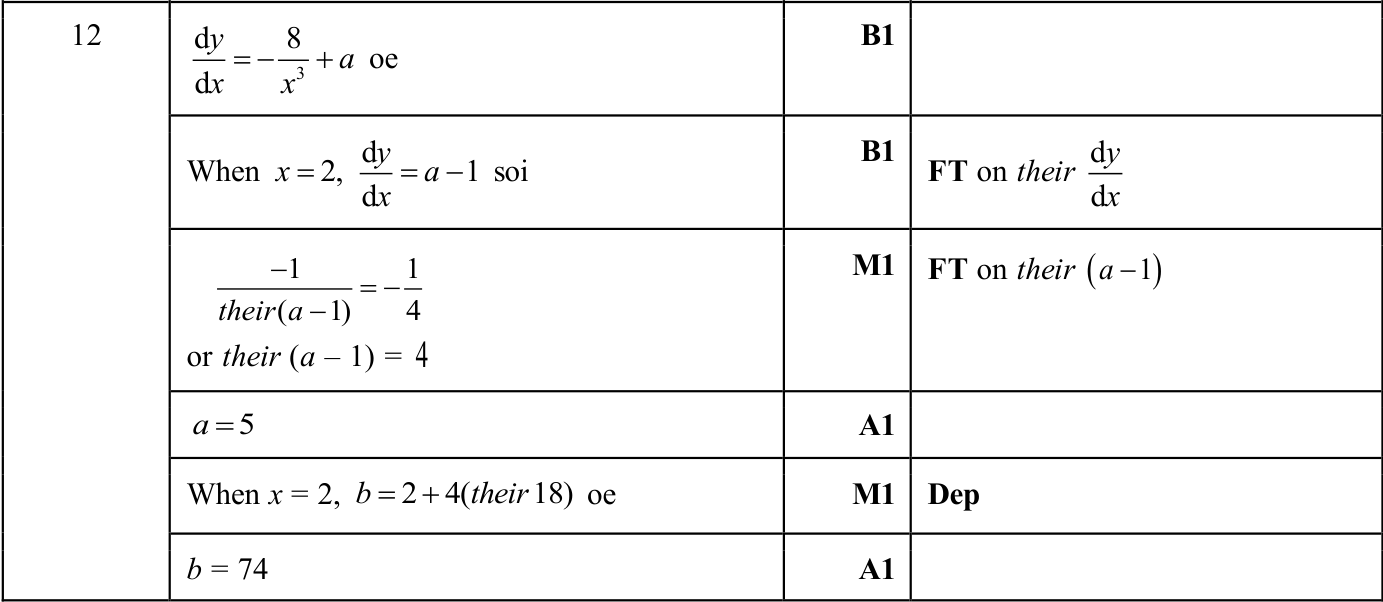
0606 P13 - Jun 2025 - Q12 - 6 marks
The normal to the curve \(y=\frac{4}{x^{2}}+a x+7\) at the point where \(x=2\) has equation \(x+4 y=b\). Find the values of \(a\) and \(b\).
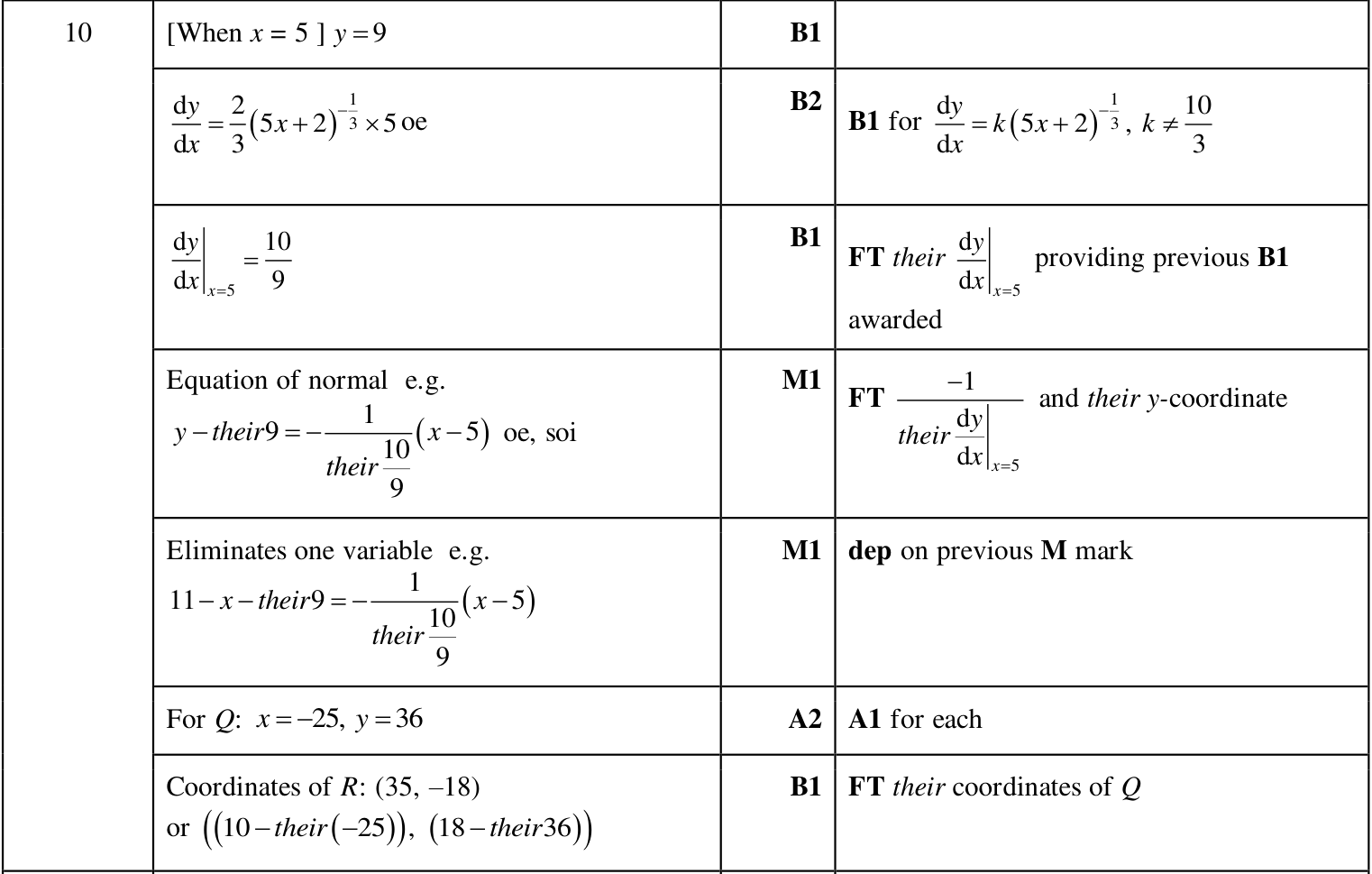
0606 P12 - Mar 2025 - Q10 - 9 marks
The point \(P\) lies on the curve \(y=(5x+2)^{\frac23}\).
The \(x\)-coordinate of \(P\) is \(5\).
The normal to the curve at \(P\) intersects the line \(x+y=11\) at the point \(Q\).
The point \(R\) is the reflection of \(Q\) in the tangent to the curve at \(P\).
Find the coordinates of \(R\).
0606 P21 - Nov 2024 - Q7 - 7 marks
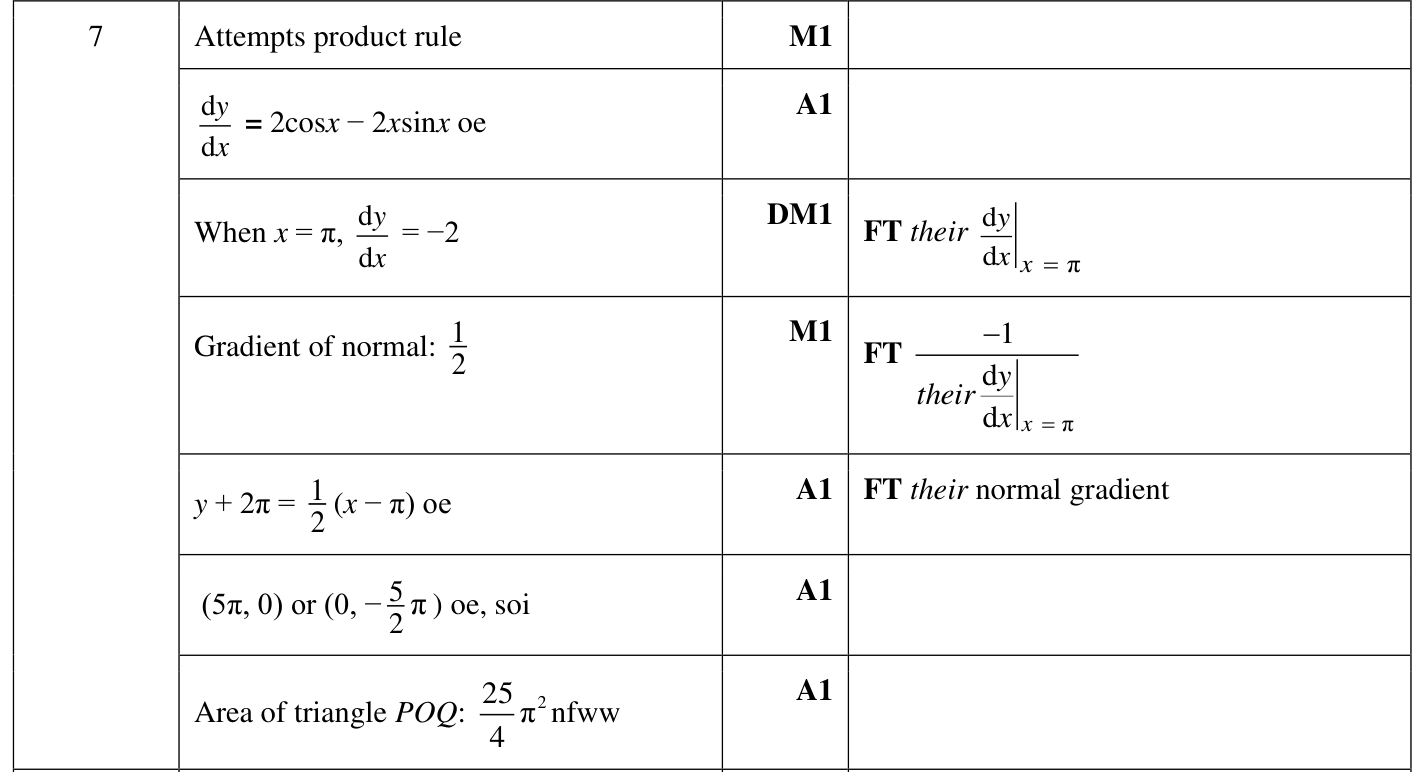
A curve has equation \(y=2 x \cos x\). The normal to the curve at ( \(\pi,-2 \pi\) ) meets the \(x\)-axis and \(y\)-axis at points \(P\) and \(Q\). Find the exact area of triangle \(P O Q\).
0606 P23 - Nov 2024 - Q5 - 8 marks
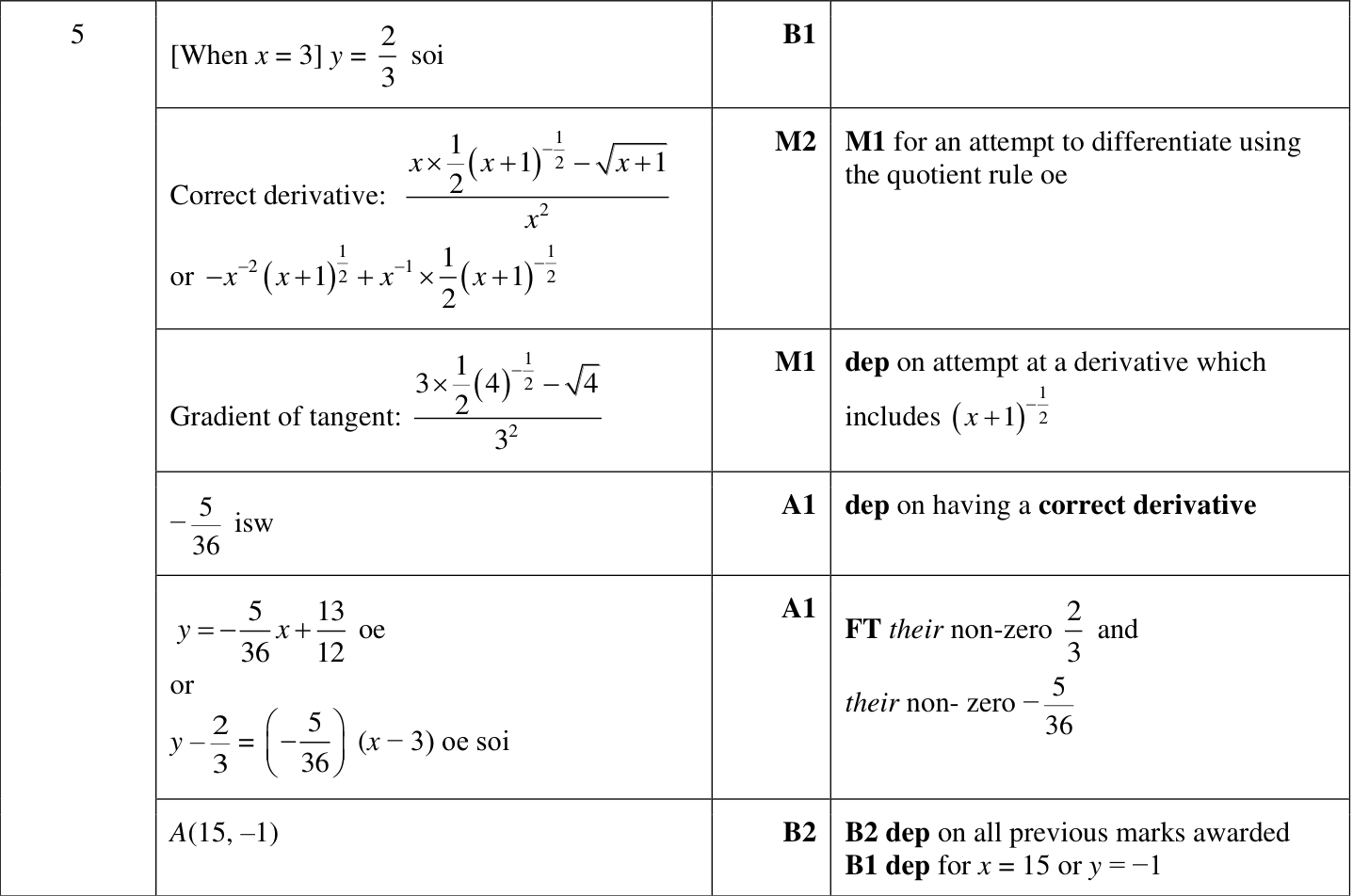
The tangent to the curve \(y=\frac{\sqrt{x+1}}{x}\) at the point where \(x=3\) meets the line \(y=x-16\) at the point \(A\). Find the coordinates of \(A\).
0606 P12 - Mar 2024 - Q3 - 7 marks
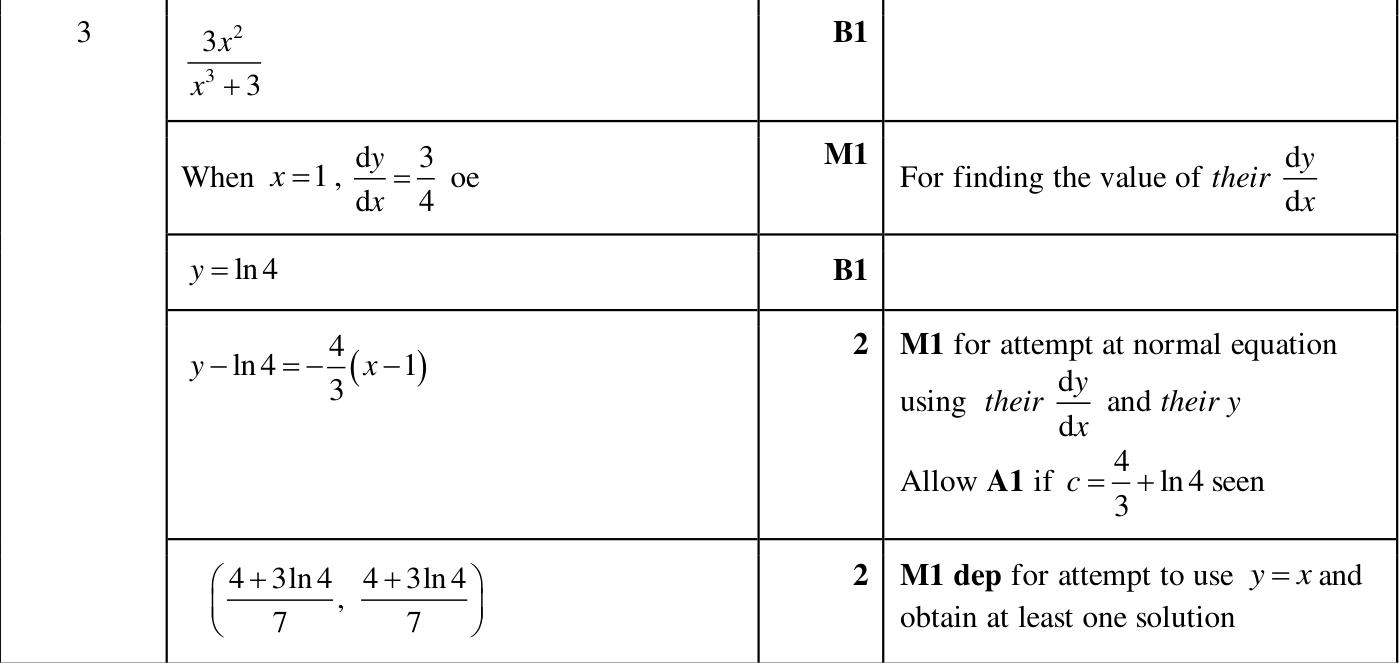
The curve \(C\) has equation \(y=\ln \left(x^{3}+3\right)\). The normal to \(C\) at the point where \(x=1\) meets the line \(y=x\) at the point \(P\). Find the exact coordinates of \(P\).
0606 P11 - Jun 2024 - Q11 - 10 marks
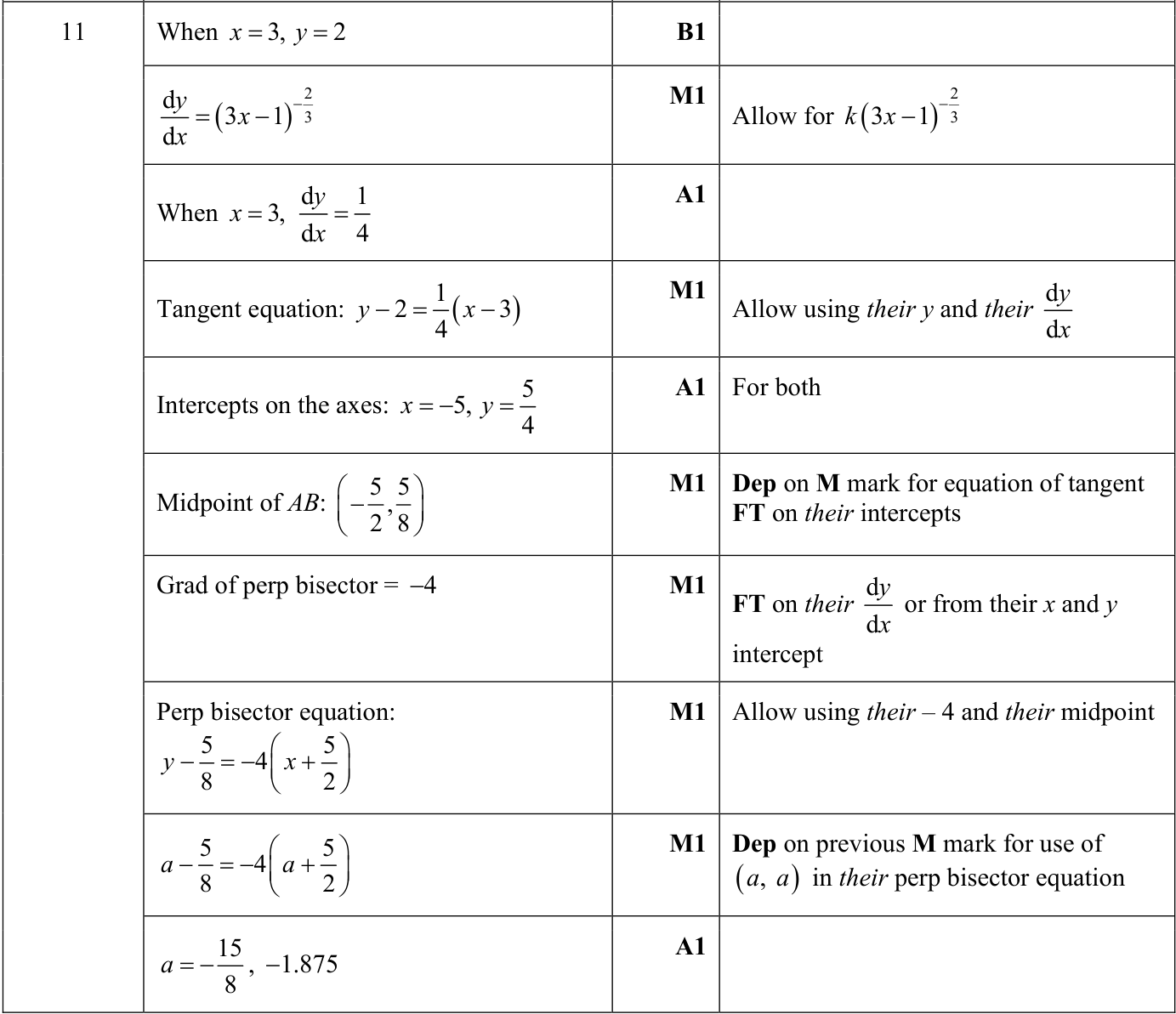
The tangent to the curve \(y=(3 x-1)^{\frac{1}{3}}\) at the point where \(x=3\) meets the coordinate axes at the points \(A\) and \(B\). The point with coordinates \((a, a)\) lies on the perpendicular bisector of the line \(A B\). Find the exact value of \(a\).
0606 P13 - Jun 2024 - Q8 - 7 marks
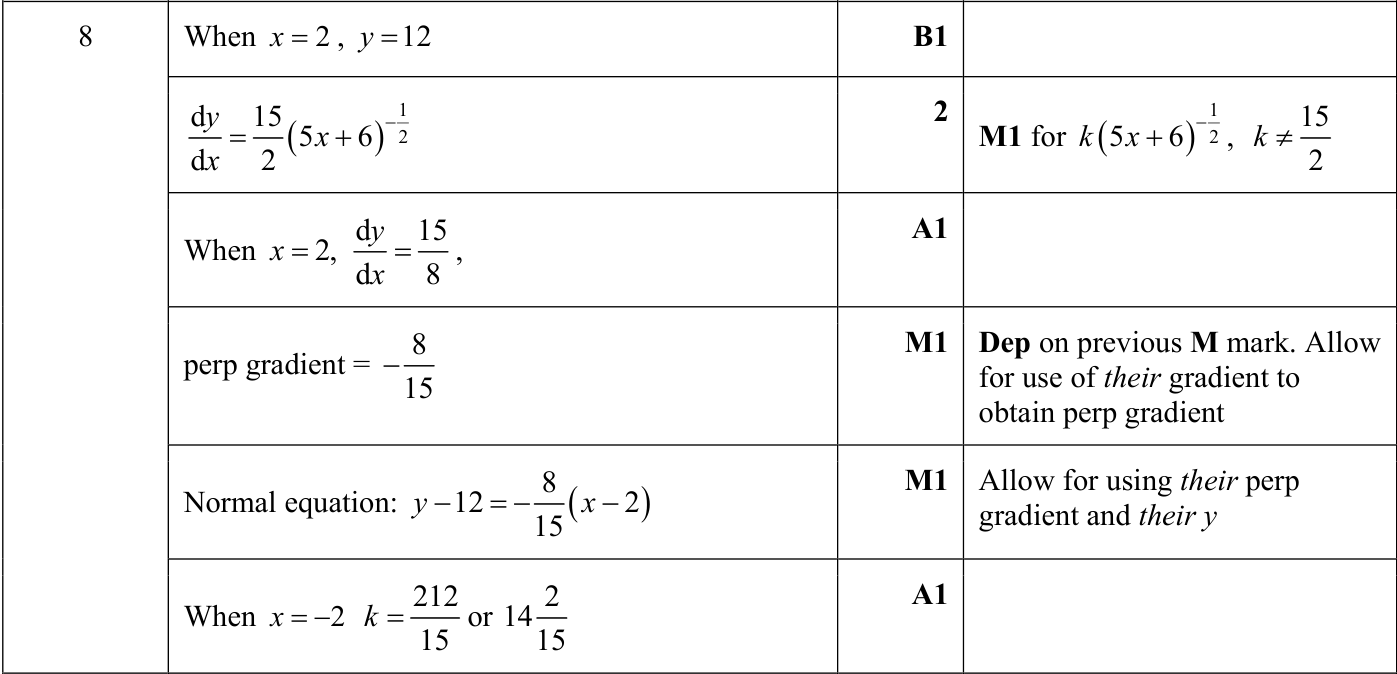
The line \(L\) is the normal to the curve \(y=3(5 x+6)^{\frac{1}{2}}\) at the point where \(x=2\). The point \((-2, k)\), where \(k\) is a constant, lies on \(L\). Find the exact value of \(k\).
0606 P21 - Nov 2023 - Q5 - 6 marks
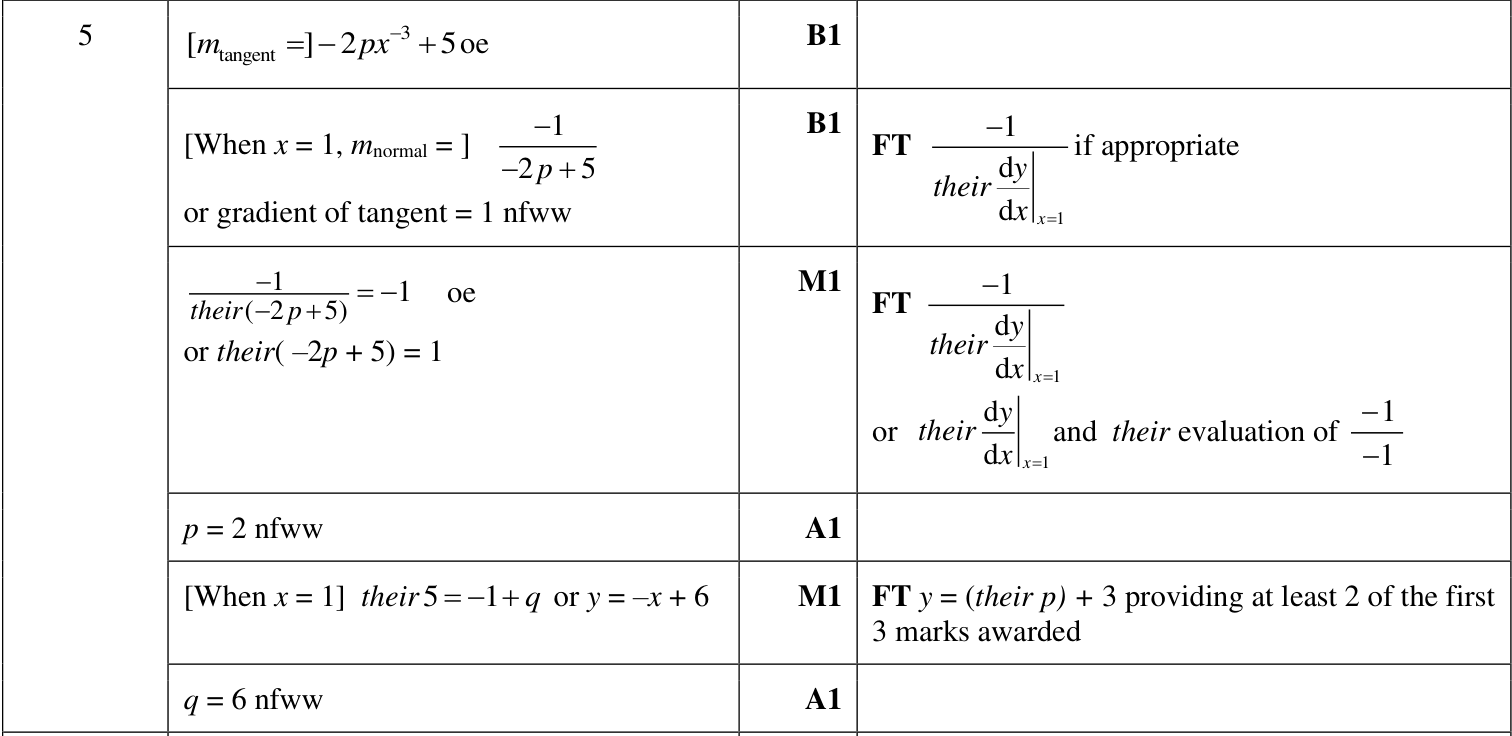
In this question \(p\) and \(q\) are constants.
The normal to the curve
\(\displaystyle y=\frac{p}{x^2}+5x-2\)
at the point where \(x=1\), has equation \(y=-x+q\).
Find the values of \(p\) and \(q\).
0606 P22 - Nov 2023 - Q5 - 10 marks
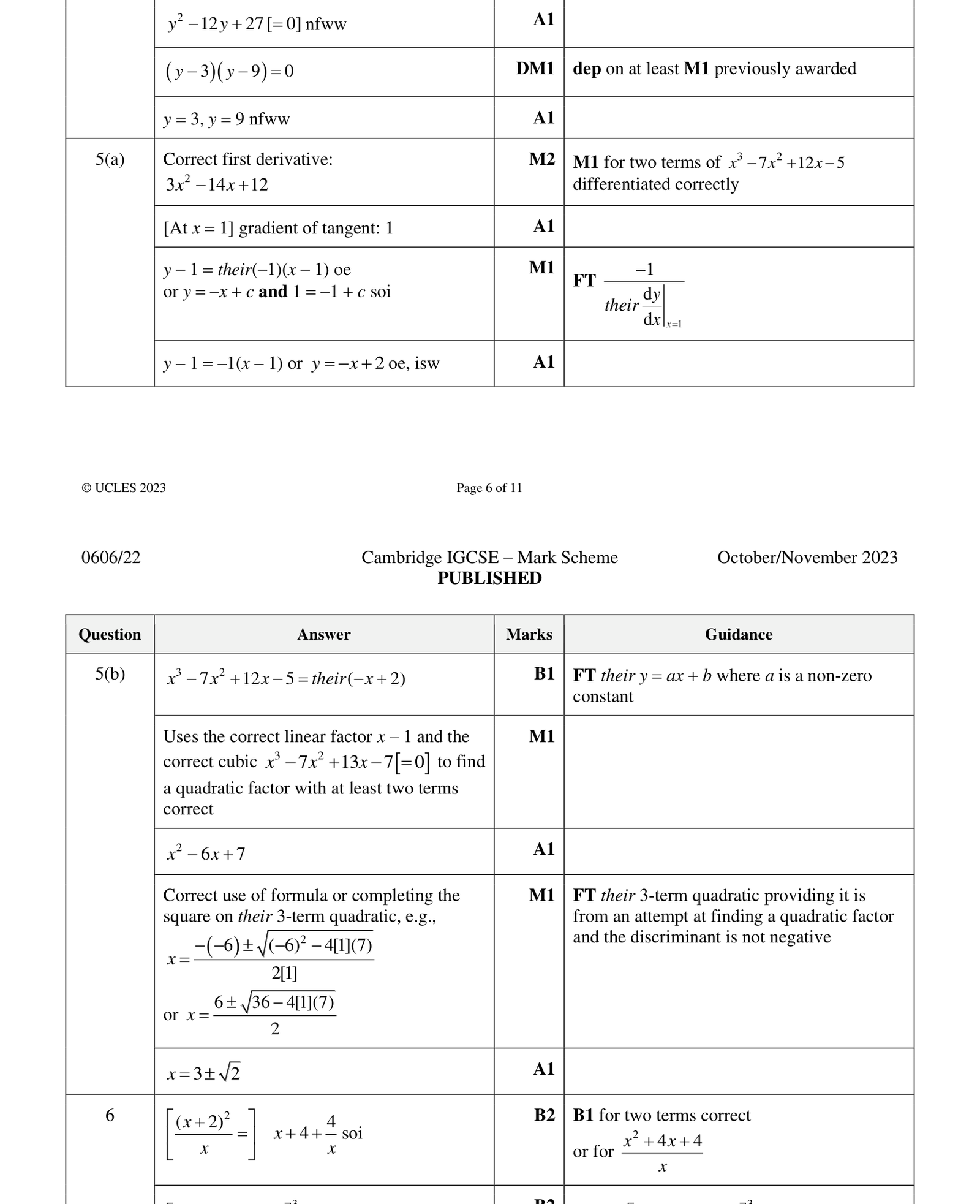
(a) Find the equation of the normal to the curve
\(y=x^3-7x^2+12x-5\)
at the point \((1,1)\).
(b) Find the \(x\)-coordinates of the two points where the normal cuts the curve again. Give your answers in the form \(x=a\pm\sqrt b\), where \(a\) and \(b\) are integers.
0606 P11 - Nov 2023 - Q8 - 10 marks
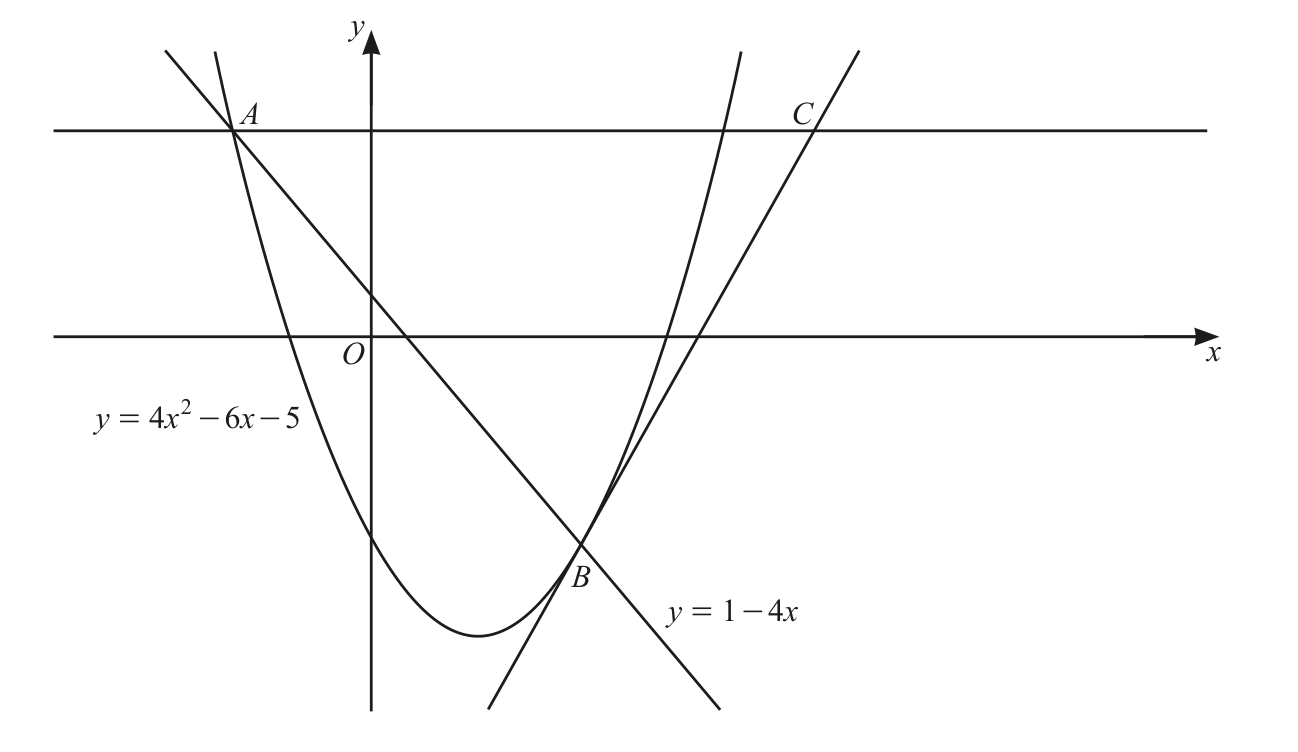
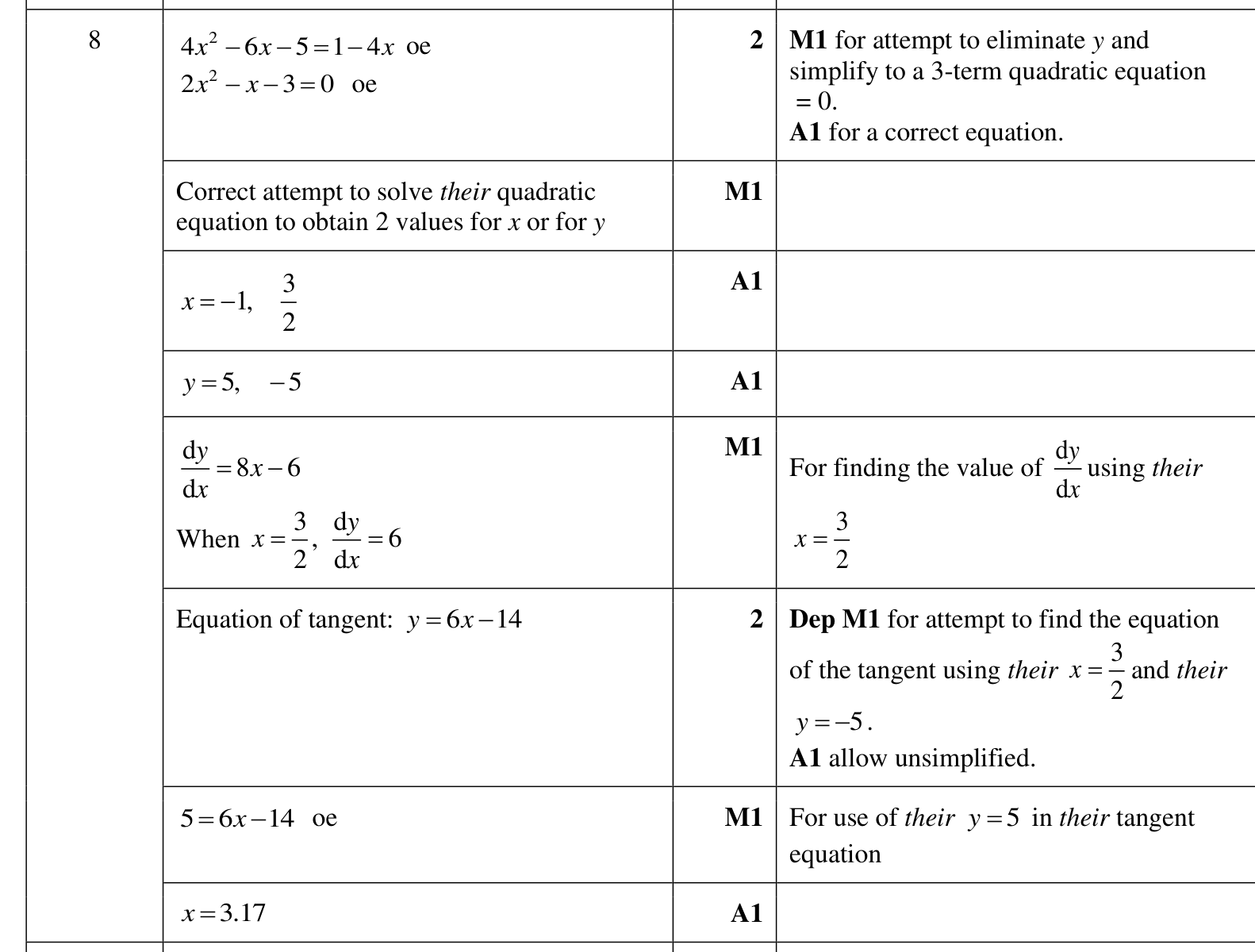
The diagram shows the line \(y=1-4x\) meeting the curve \(y=4x^2-6x-5\) at the points \(A\) and \(B\).
The tangent to the curve at \(B\) meets the horizontal line through \(A\) at the point \(C\).
Find the \(x\)-coordinate of \(C\), giving your answer correct to 2 decimal places.
0606 P12 - Mar 2022 - Q6 - 8 marks
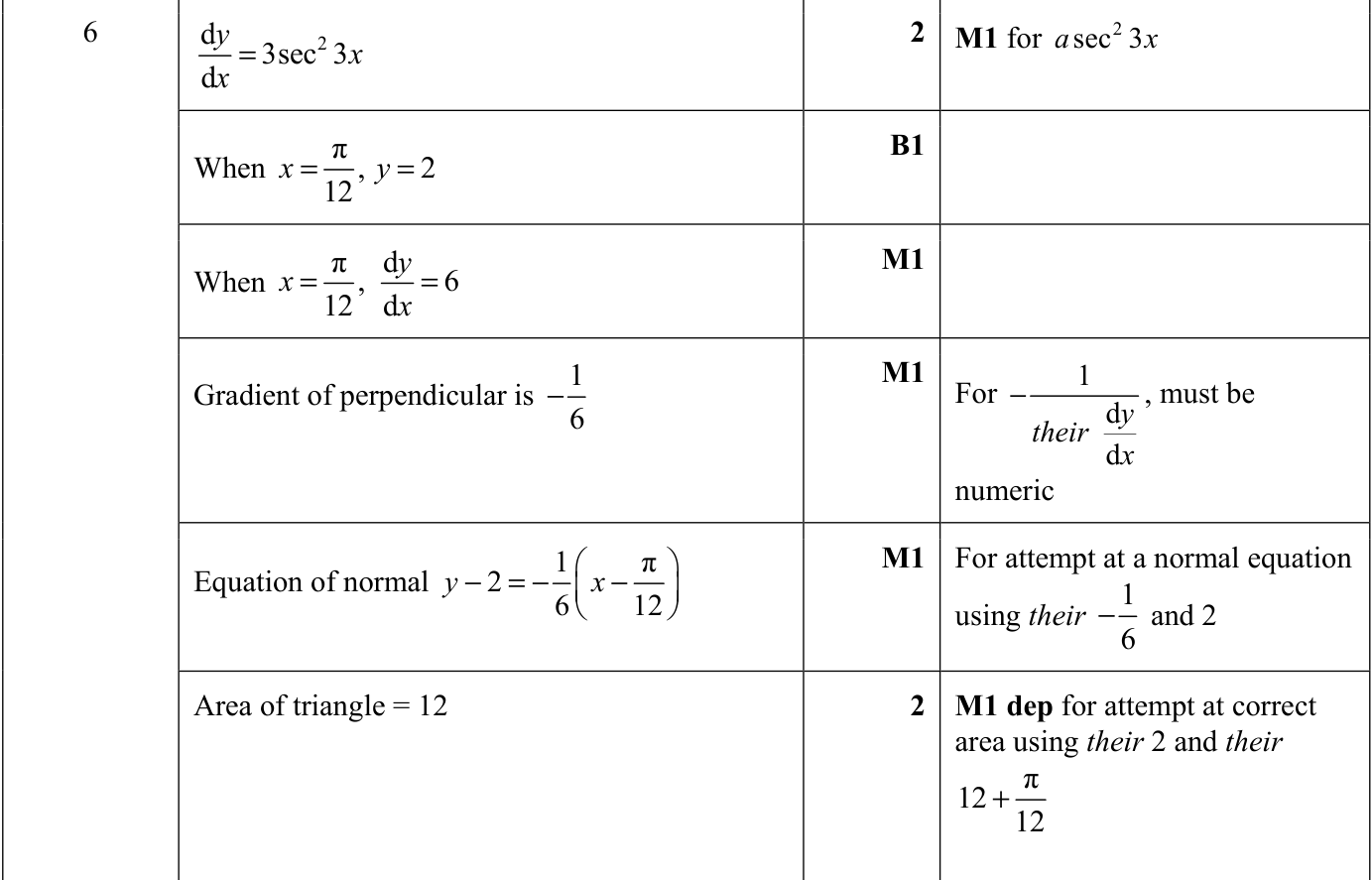
The normal to the curve \(y=1+\tan3x\) at the point \(P\) with \(x\)-coordinate \(\frac{\pi}{12}\) meets the \(x\)-axis at the point \(Q\).
The line \(x=\frac{\pi}{12}\) meets the \(x\)-axis at the point \(R\). Find the area of the triangle \(PQR\).
0606 P22 - Mar 2023 - Q11 - 9 marks
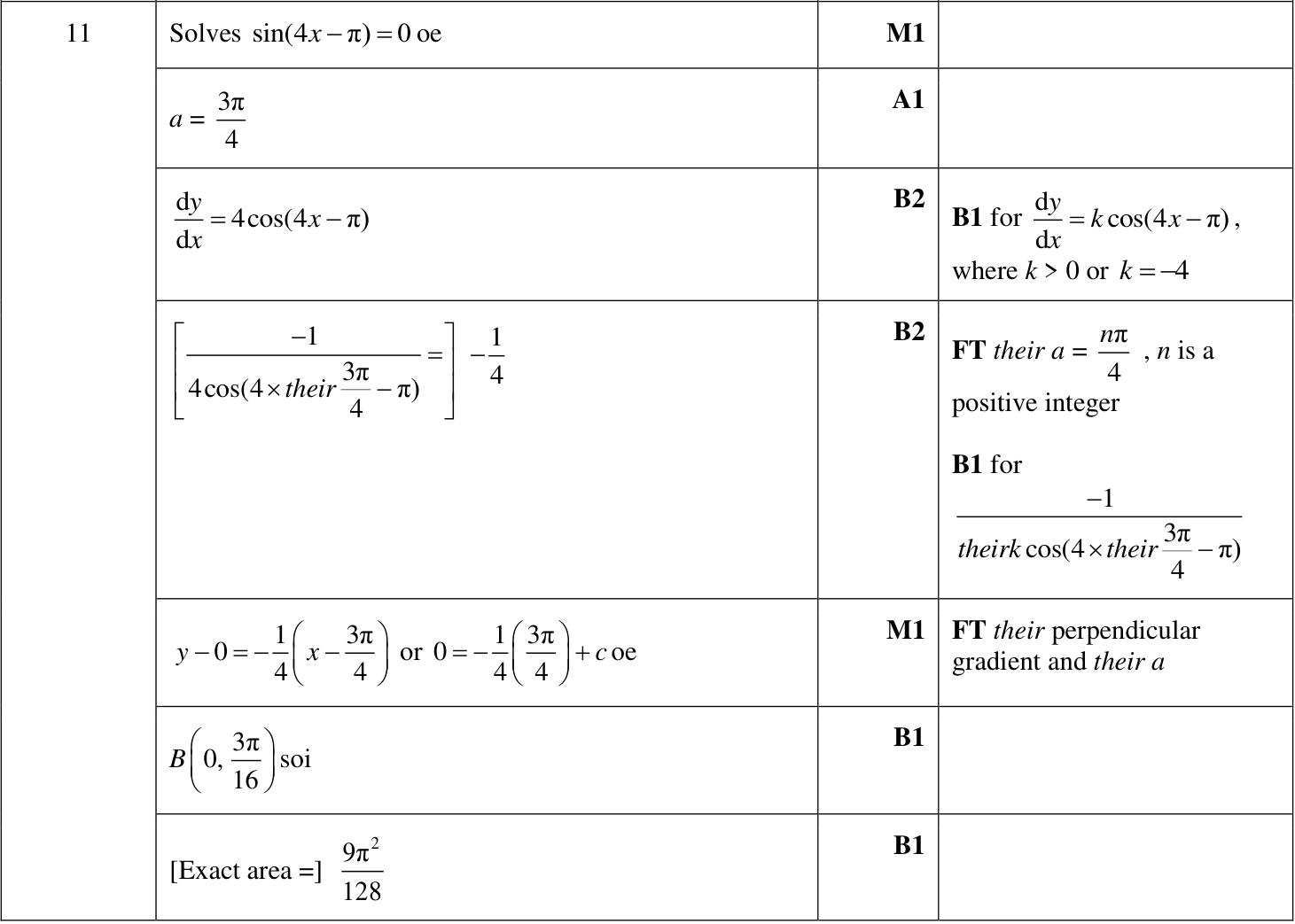
The normal to the curve
\(y=\sin(4x-\pi)\)
at the point \(A(a,0)\), where \(\frac{\pi}{2}\lt a\lt \pi\), meets the \(y\)-axis at the point \(B\).
Find the exact area of triangle \(OAB\), where \(O\) is the origin.
0606 P11 - Jun 2022 - Q10 - 10 marks
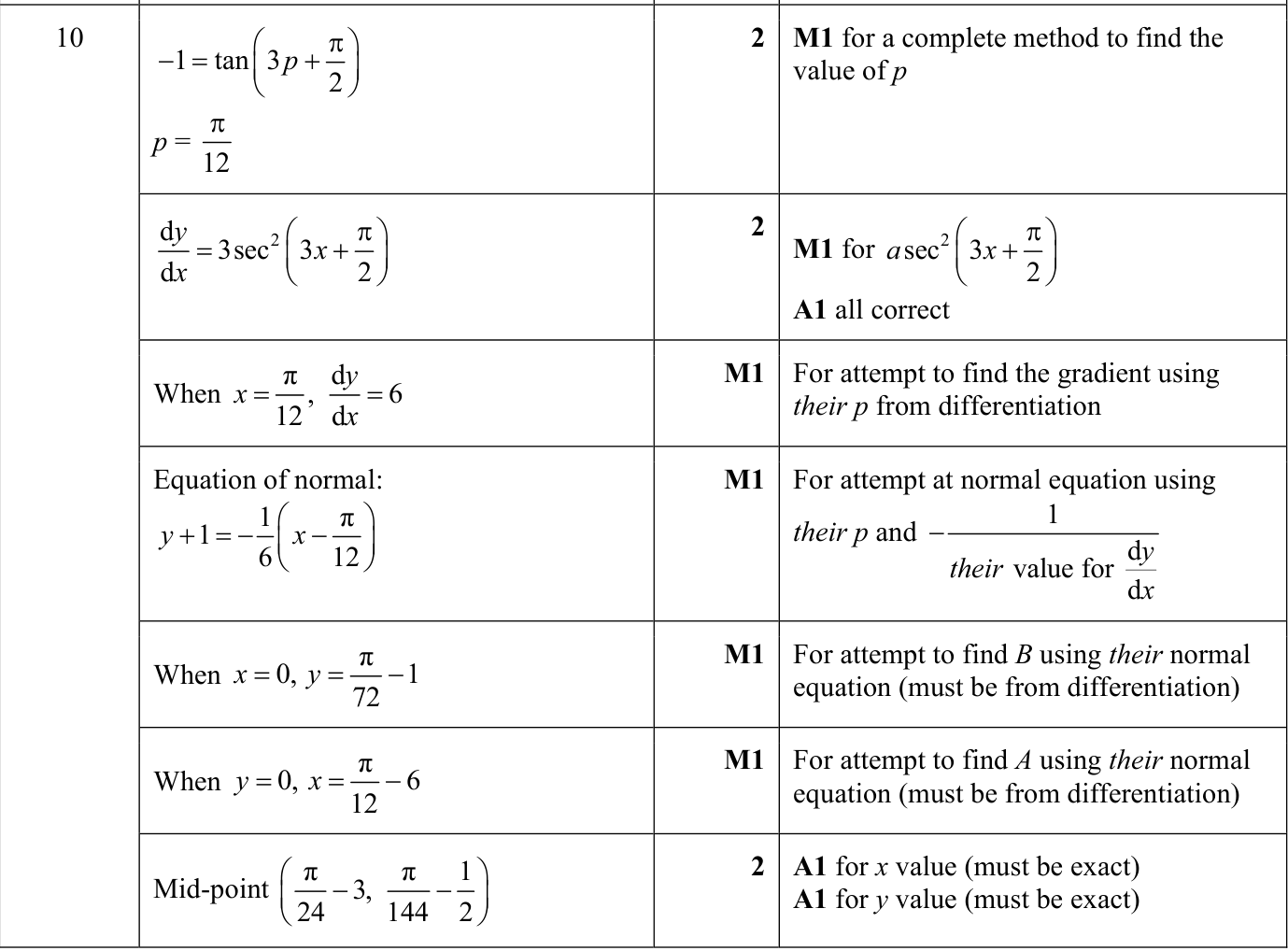
The normal to the curve \(y=\tan\left(3x+\frac\pi2\right)\) at \(P(p,-1)\), where \(0\lt p\le\frac\pi6\), meets the \(x\)-axis at \(A\) and the \(y\)-axis at \(B\). Find the exact coordinates of the midpoint of \(AB\).
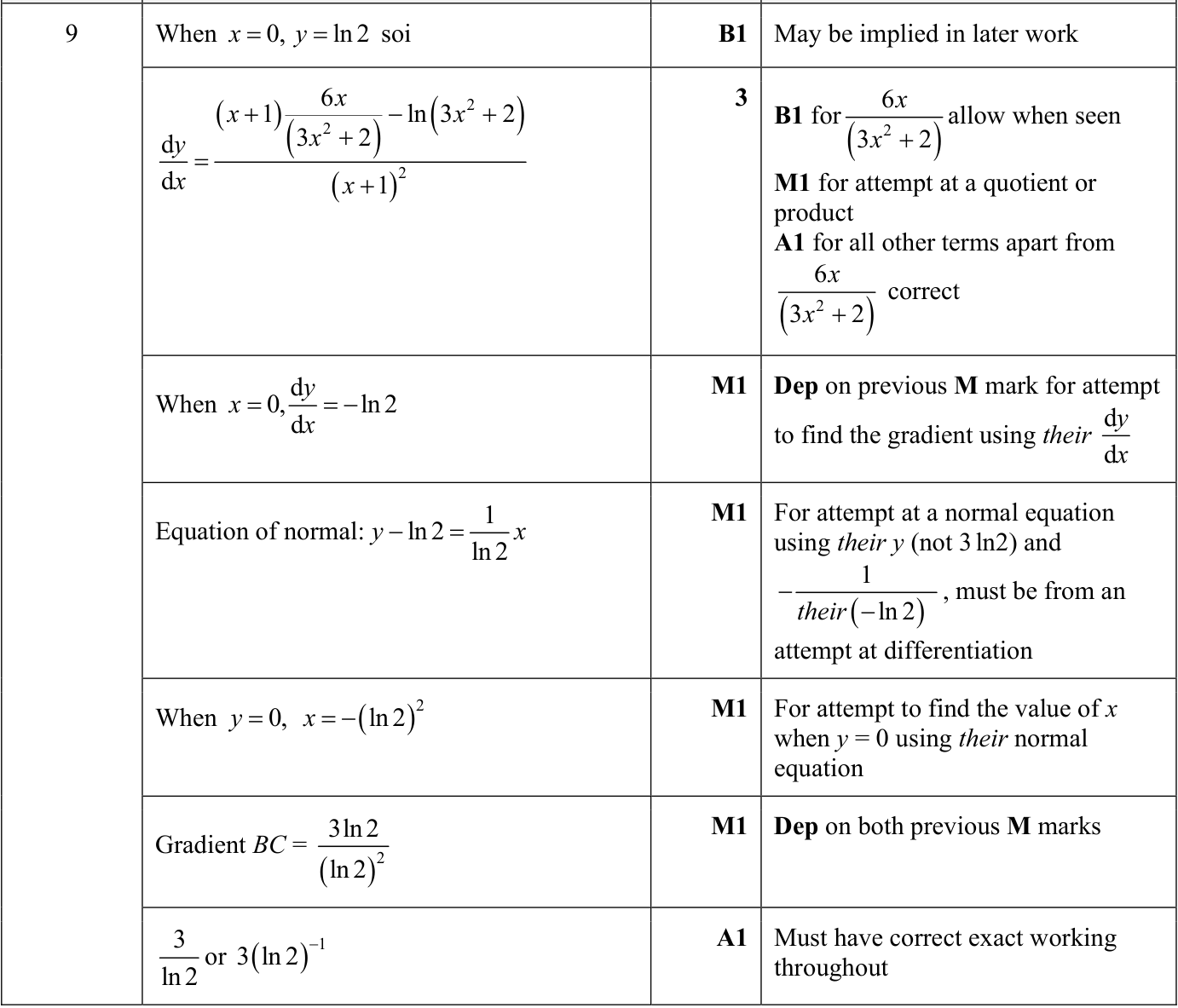
0606 P12 - Jun 2022 - Q9 - 9 marks
The normal to the curve
\(y=\frac{\ln(3x^2+2)}{x+1}\)
at the point \(A\) on the curve where \(x=0\), meets the \(x\)-axis at point \(B\). Point \(C\) has coordinates \((0,3\ln2)\). Find the gradient of the line \(BC\) in terms of \(\ln2\).
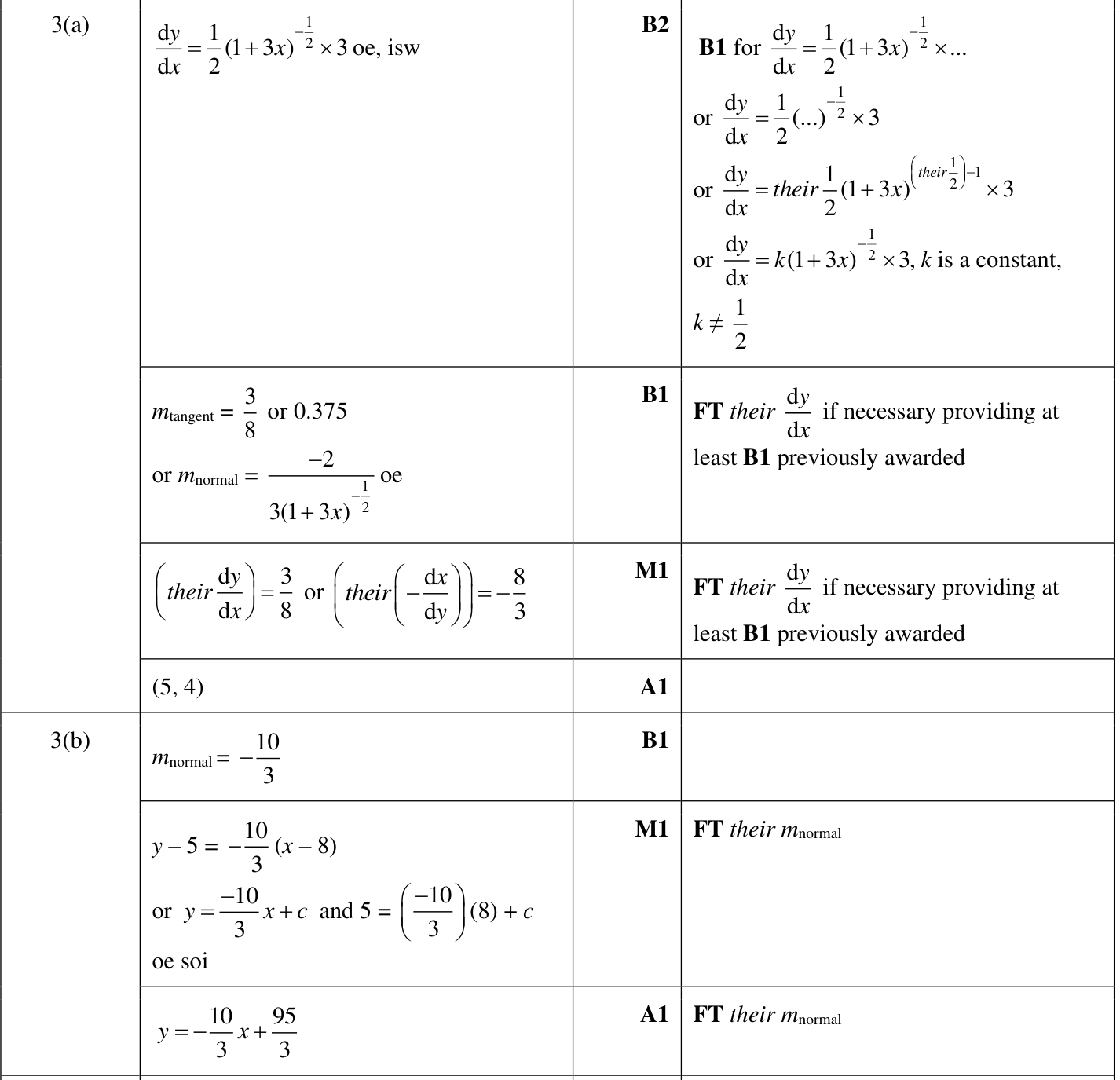
0606 P21 - Nov 2022 - Q3 - 8 marks
(a) Find the coordinates of the point on the curve
\(y=\sqrt{1+3x}\)
where the gradient of the normal is \(-\frac83\).
(b) Find the equation of the normal to the curve
\(y=\sqrt{1+3x}\)
at the point \((8,5)\), in the form \(y=mx+c\).
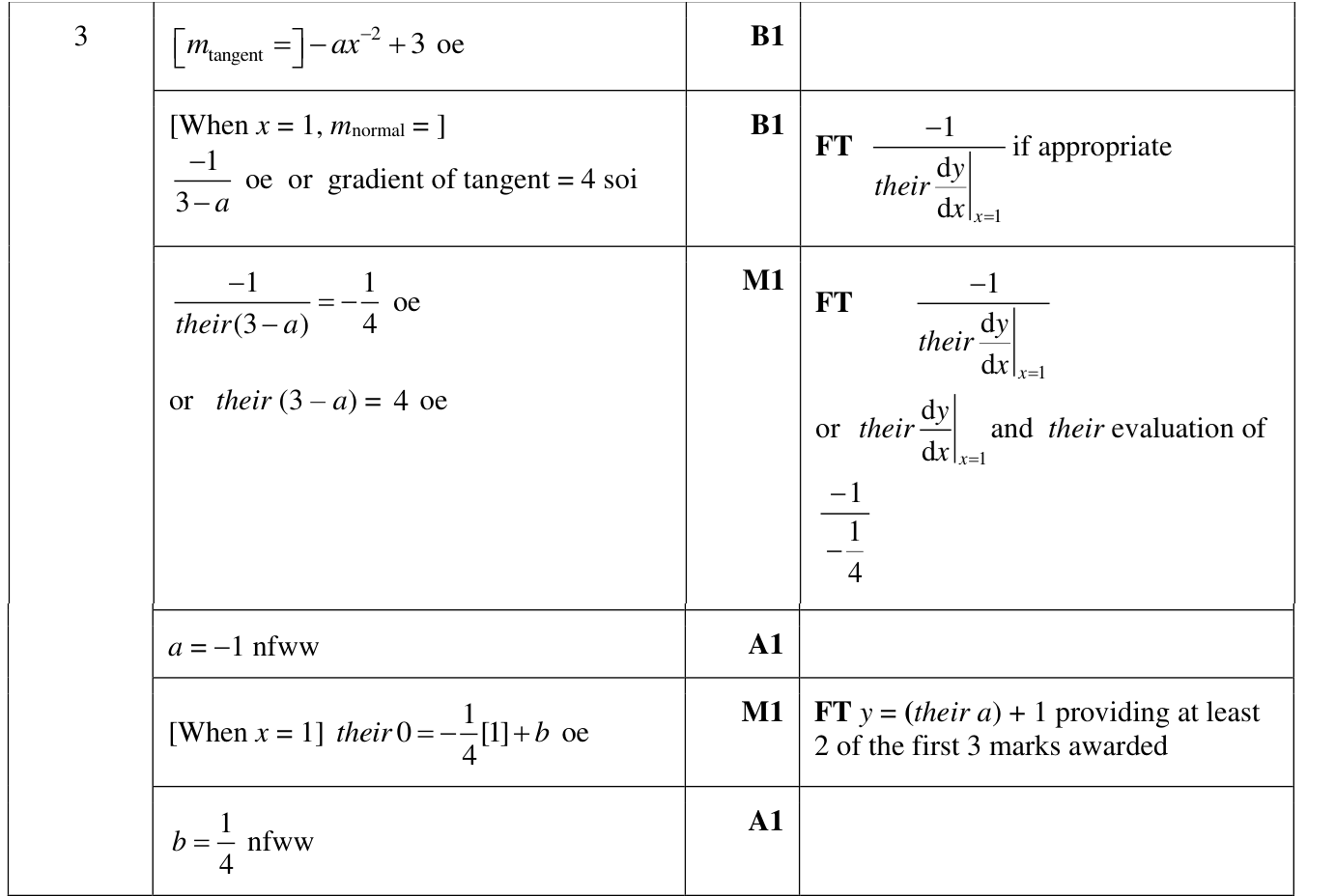
0606 P22 - Nov 2022 - Q3 - 6 marks
In this question \(a\) and \(b\) are constants.
The normal to the curve
\(y=\frac{a}{x}+3x-2\)
at the point where \(x=1\) has equation
\(y=-\frac14x+b.\)
Find the values of \(a\) and \(b\).
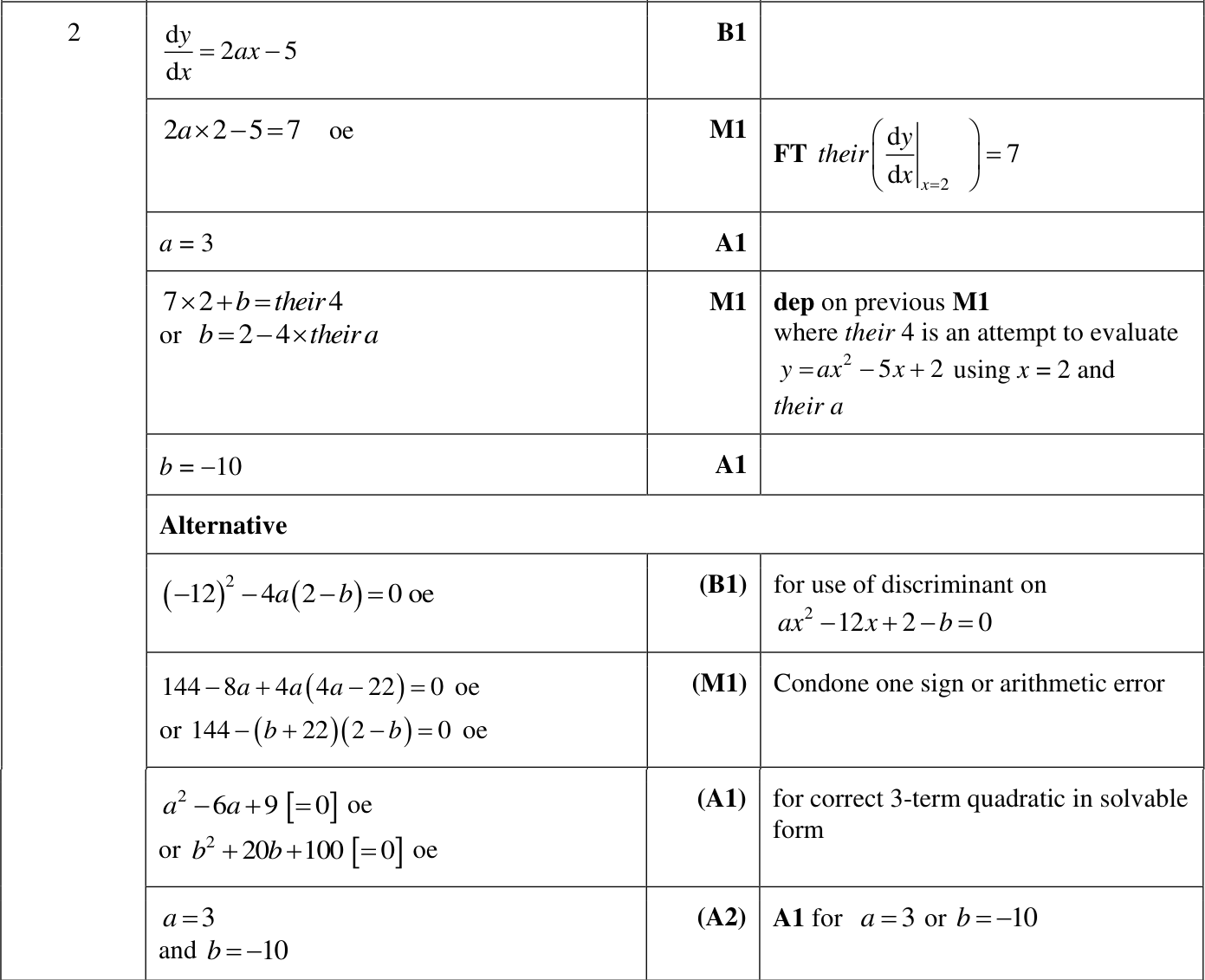
0606 P23 - Nov 2022 - Q2 - 5 marks
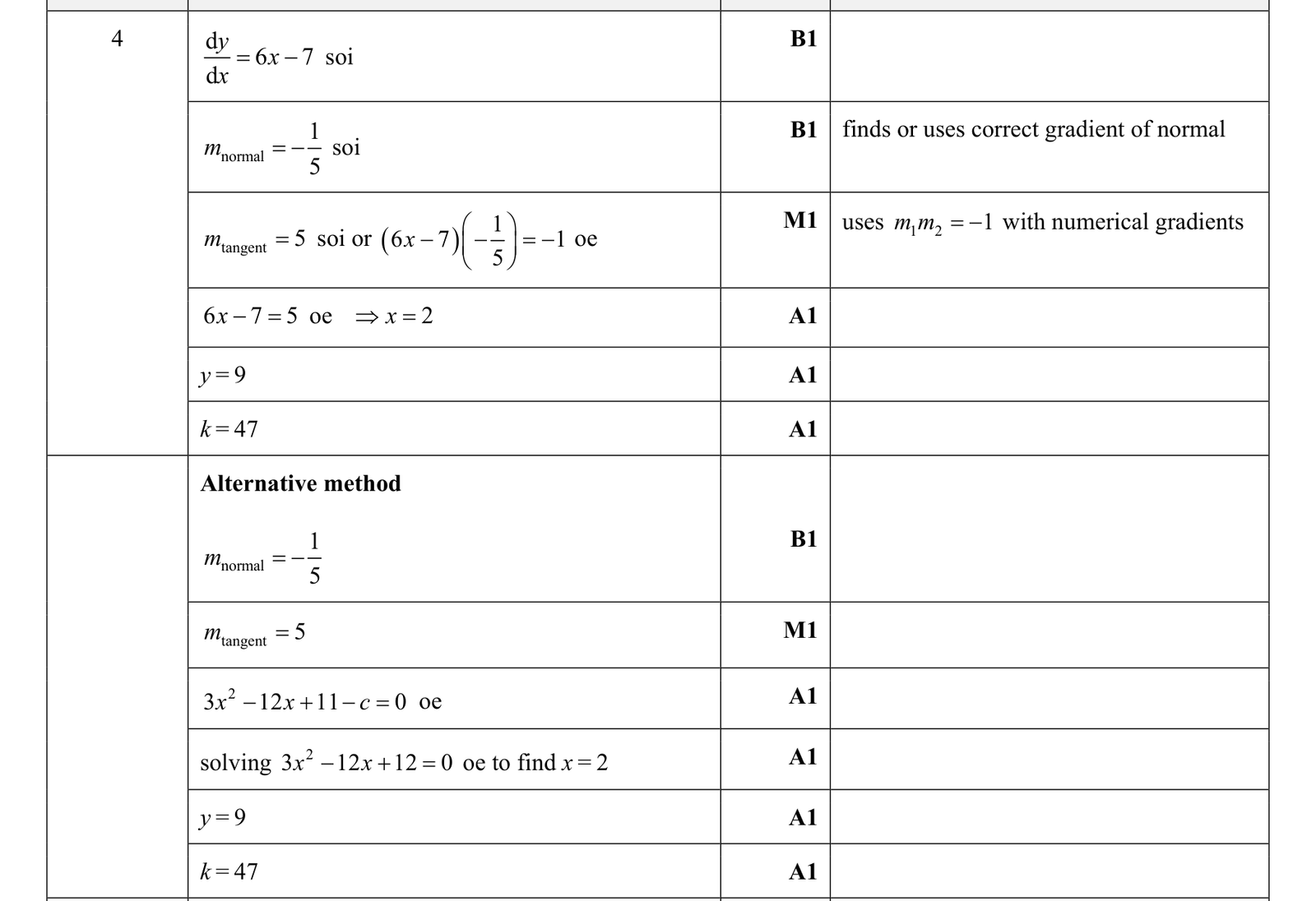
The tangent to the curve \(y=ax^2-5x+2\) at the point where \(x=2\) has equation \(y=7x+b\).
Find the value of \(a\) and the value of \(b\).
0606 P22 - Mar 2021 - Q7 - 8 marks
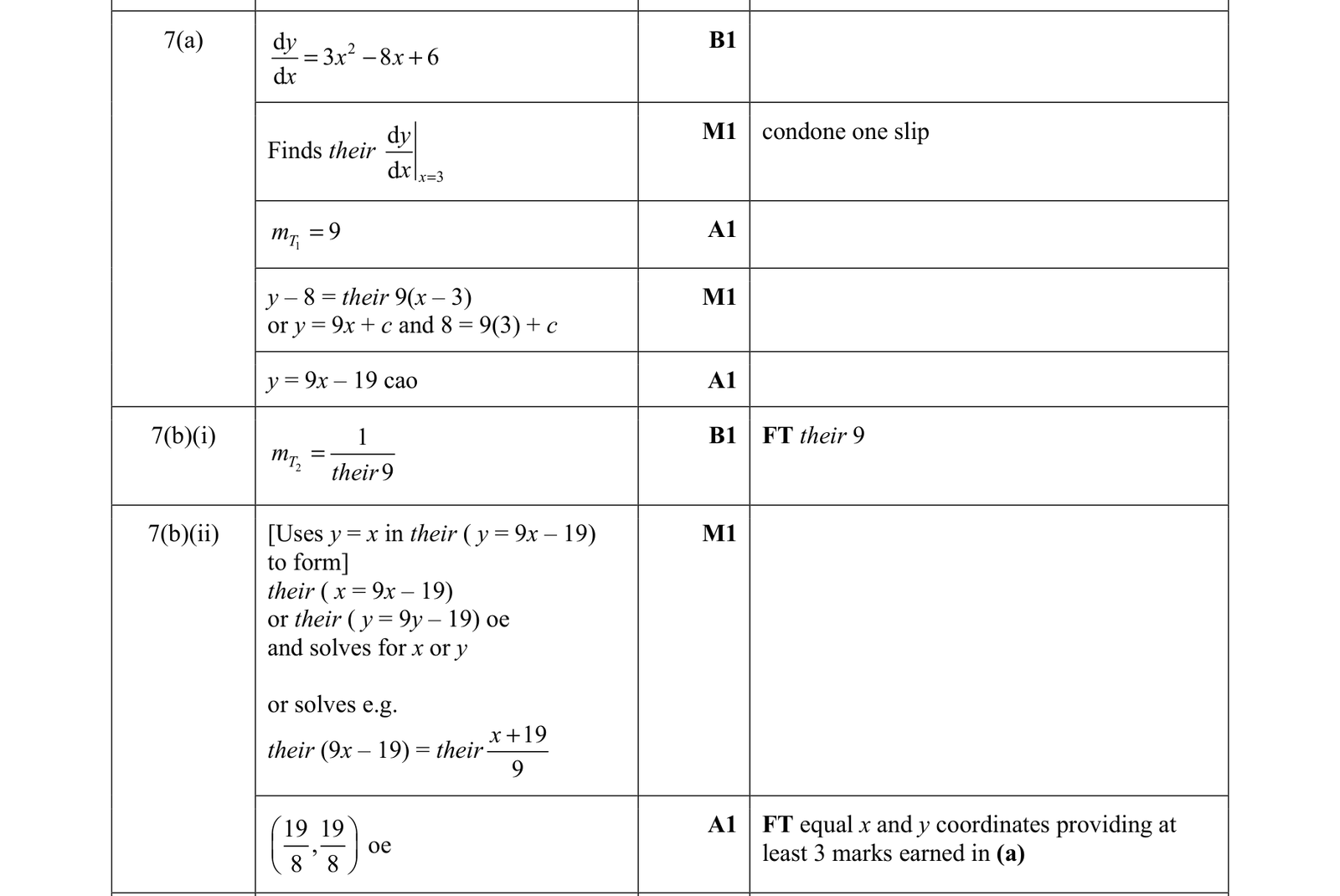
A curve has equation \(y=p(x)\), where
\(p(x)=x^3-4x^2+6x-1.\)
(a) Find the equation of the tangent to the curve at the point \((3,8)\). Give your answer in the form \(y=mx+c\).
(b)
(i) Given that \(p^{-1}\) exists, write down the gradient of the tangent to the curve \(y=p^{-1}(x)\) at the point \((8,3)\).
(ii) Find the coordinates of the point of intersection of these two tangents.
0606 P12 - Jun 2021 - Q11 - 7 marks
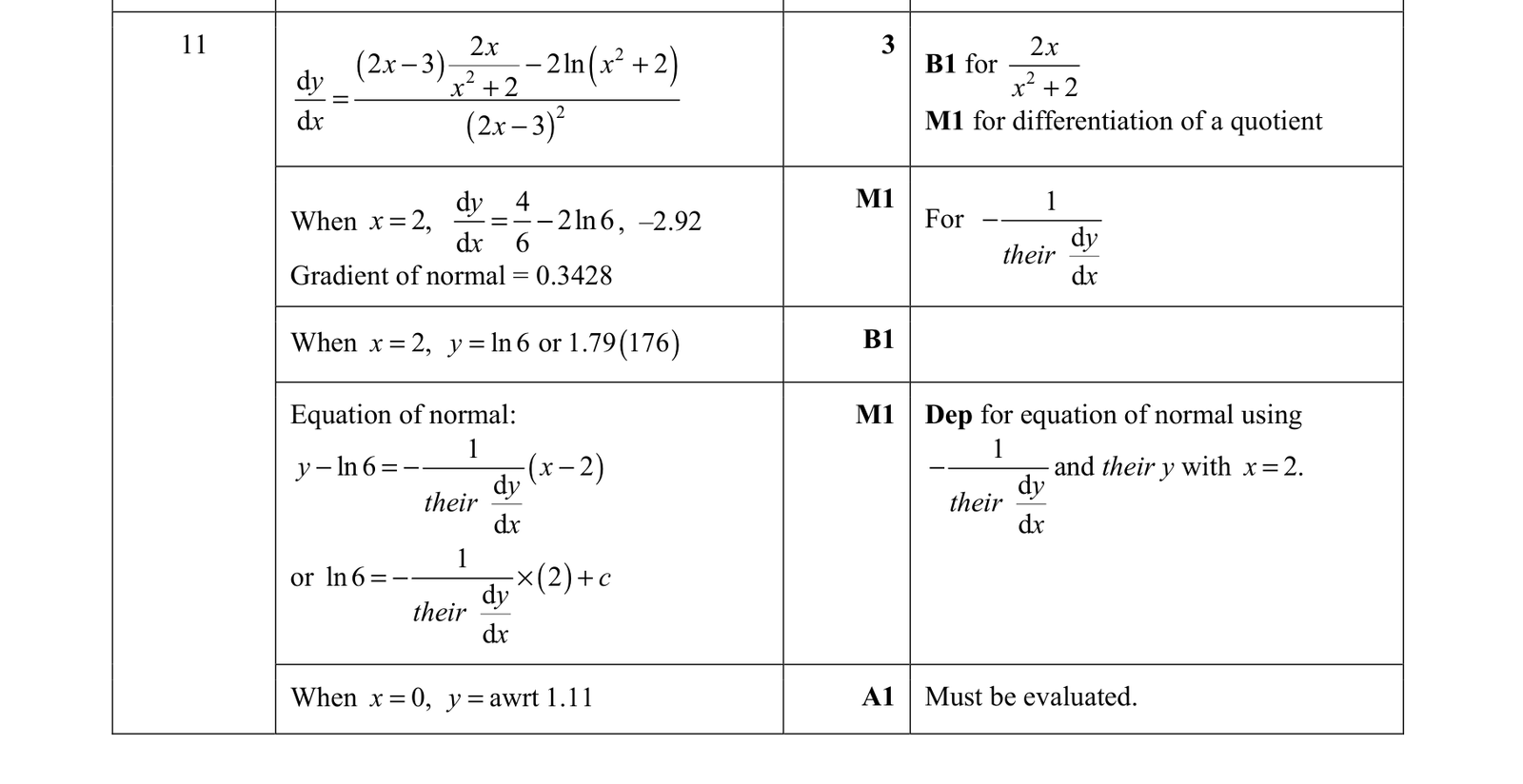
The curve
\(y=\frac{\ln(x^2+2)}{2x-3}\)
has a normal at the point where \(x=2\). This normal meets the \(y\)-axis at \(P\).
Find the coordinates of \(P\).
0606 P21 - Nov 2021 - Q3 - 9 marks
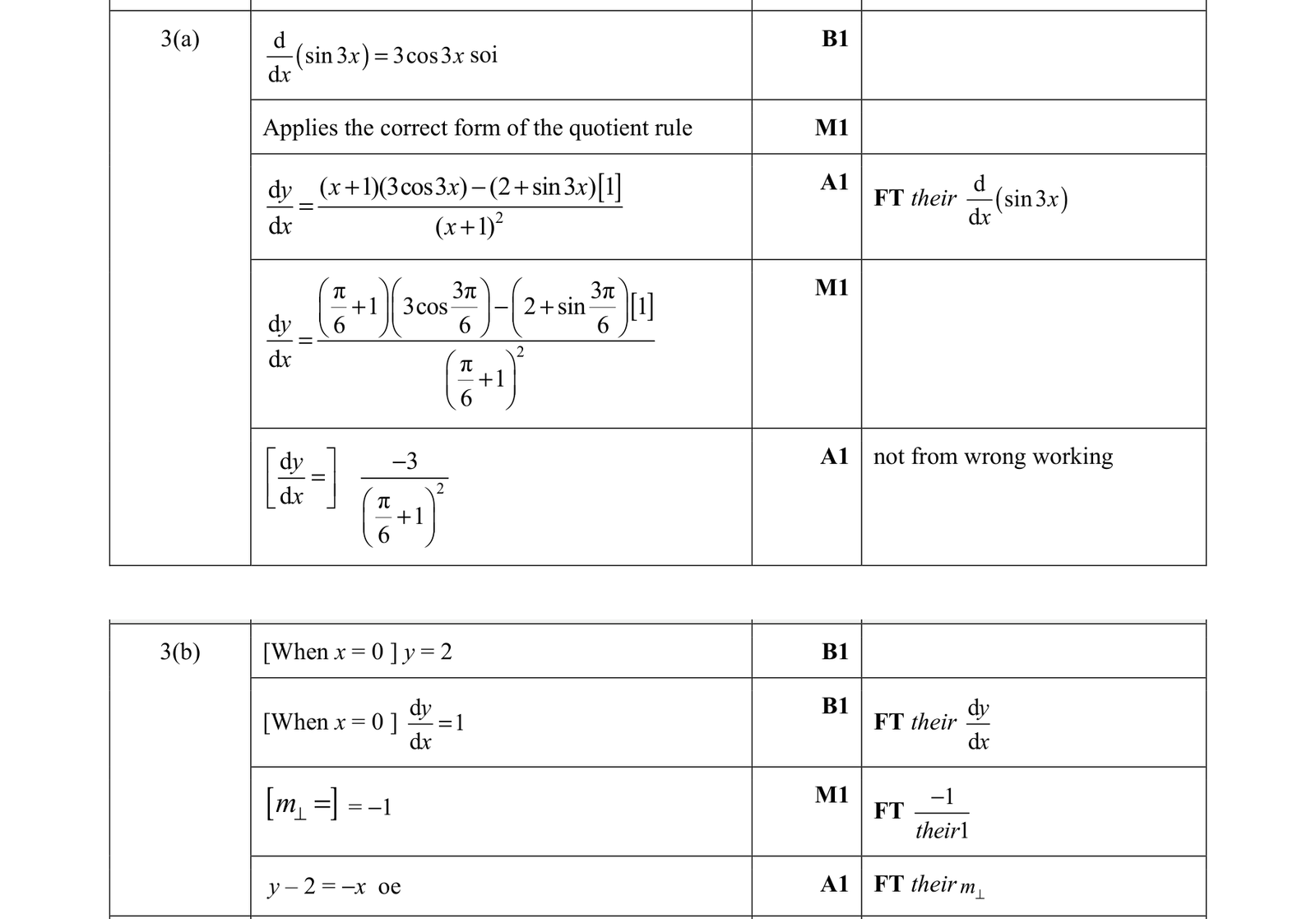
A curve has equation
\(y=\frac{2+\sin 3x}{x+1}.\)
(a) Show that the exact value of \(\frac{dy}{dx}\) when \(x=\frac{\pi}{6}\) can be written in the form
\(\frac{k}{\left(\frac{\pi}{6}+1\right)^2},\)
where \(k\) is an integer to be found.
(b) Find the equation of the normal to the curve at the point where \(x=0\).
0606 P22 - Nov 2021 - Q9 - 10 marks
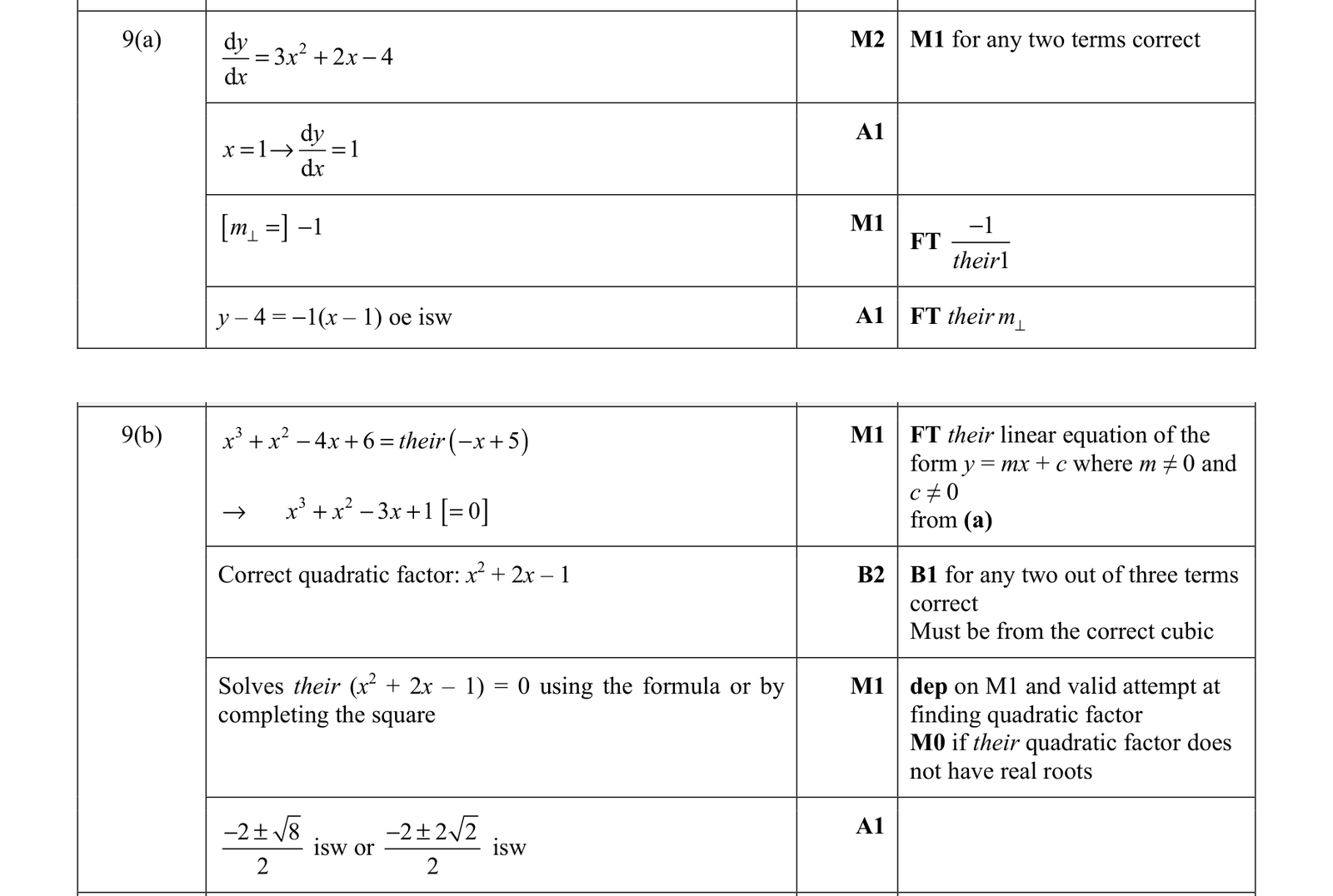
(a) Find the equation of the normal to the curve
\(y=x^3+x^2-4x+6\)
at the point \((1,4)\).
(b) Without using a calculator, find the exact \(x\)-coordinate of each of the two points where the normal cuts the curve again.
0606 P23 - Nov 2021 - Q6 - 7 marks
It is given that
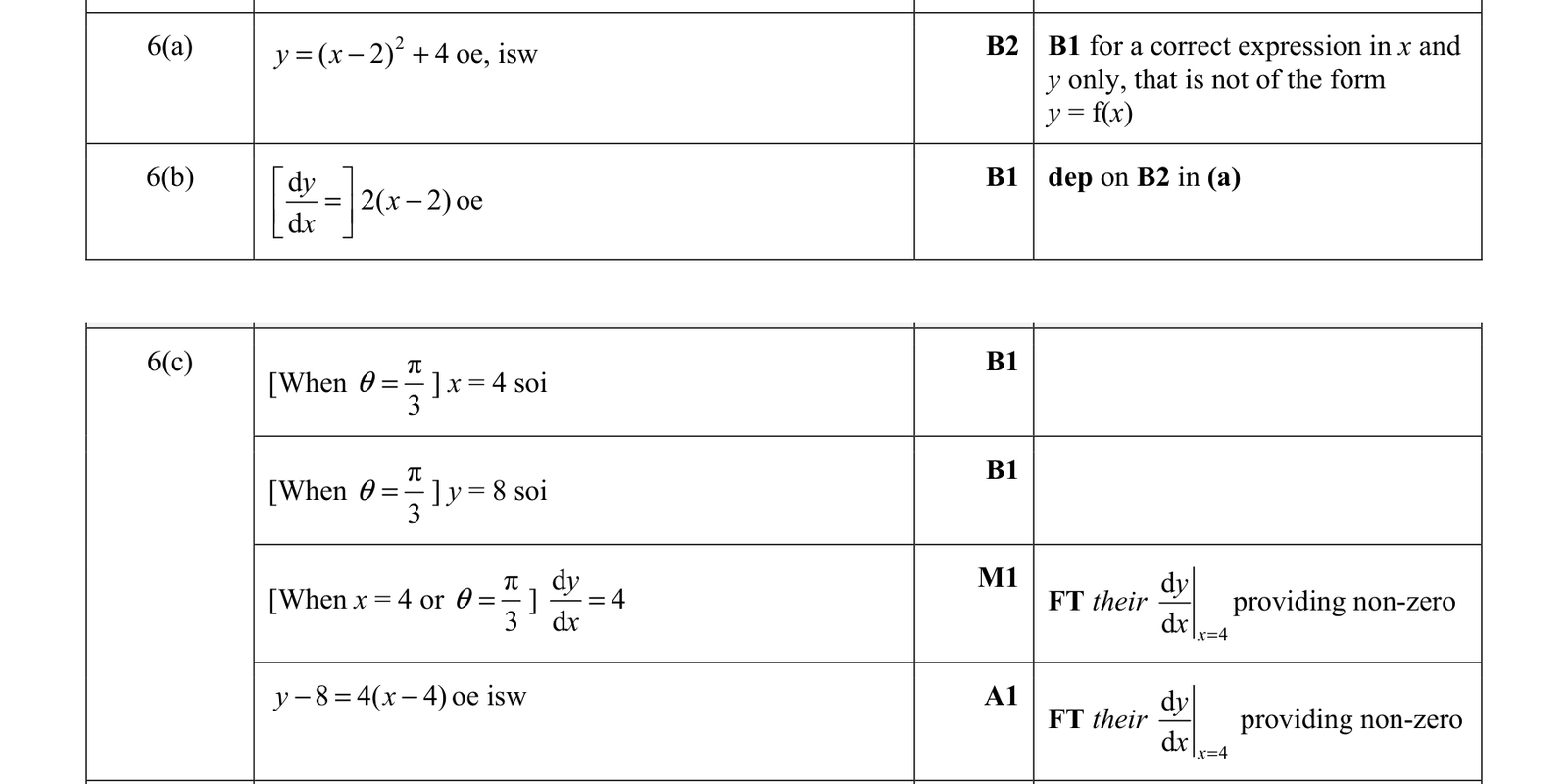
\(x=2+\operatorname{sec}\theta,\qquad y=5+\tan^2\theta.\)
(a) Express \(y\) in terms of \(x\).
(b) Find \(\frac{dy}{dx}\) in terms of \(x\).
(c) A curve has the equation found in part (a). Find the equation of the tangent to the curve when \(\theta=\frac{\pi}{3}\).
0606 P12 - Mar 2020 - Q4 - 6 marks
The tangent to the curve
\(y=\ln(3x^2-4)-\frac{x^3}{6}\)
at the point where \(x=2\), meets the \(y\)-axis at the point \(P\). Find the exact coordinates of \(P\).

0606 P11 - Jun 2020 - Q5 - 6 marks
Find the equation of the tangent to the curve
\(y=\frac{\ln(3x^2-1)}{x+2}\)
at the point where \(x=1\). Give your answer in the form \(y=mx+c\), where \(m\) and \(c\) are constants correct to 3 decimal places.

0606 P22 - Jun 2020 - Q6 - 7 marks
(a) Find the equation of the tangent to the curve
\(2y=\tan 2x+7\)
at the point where \(x=\frac{\pi}{8}\). Give your answer in the form \(ax-y=\frac{\pi}{b}+c\), where \(a\), \(b\) and \(c\) are integers.
(b) This tangent intersects the \(x\)-axis at \(P\) and the \(y\)-axis at \(Q\). Find the length of \(PQ\).

0606 P22 - Nov 2020 - Q5 - 9 marks
Do not use a calculator in this question.
(a) Find the equation of the tangent to the curve
\(y=x^3-6x^2+3x+10\)
at the point where \(x=1\).
(b) Find the coordinates of the point where this tangent meets the curve again.

0606 P23 - Nov 2020 - Q7 - 11 marks
A curve has equation
\(y=x\cos x.\)
(a) Find \(\dfrac{dy}{dx}\).
(b) Find the equation of the normal to the curve at the point where \(x=\pi\).
(c) Find the exact value of
\(\int_0^{\frac{\pi}{6}} x\sin x\,dx.\)

0606 P11 - Jun 2019 - Q11 - 9 marks
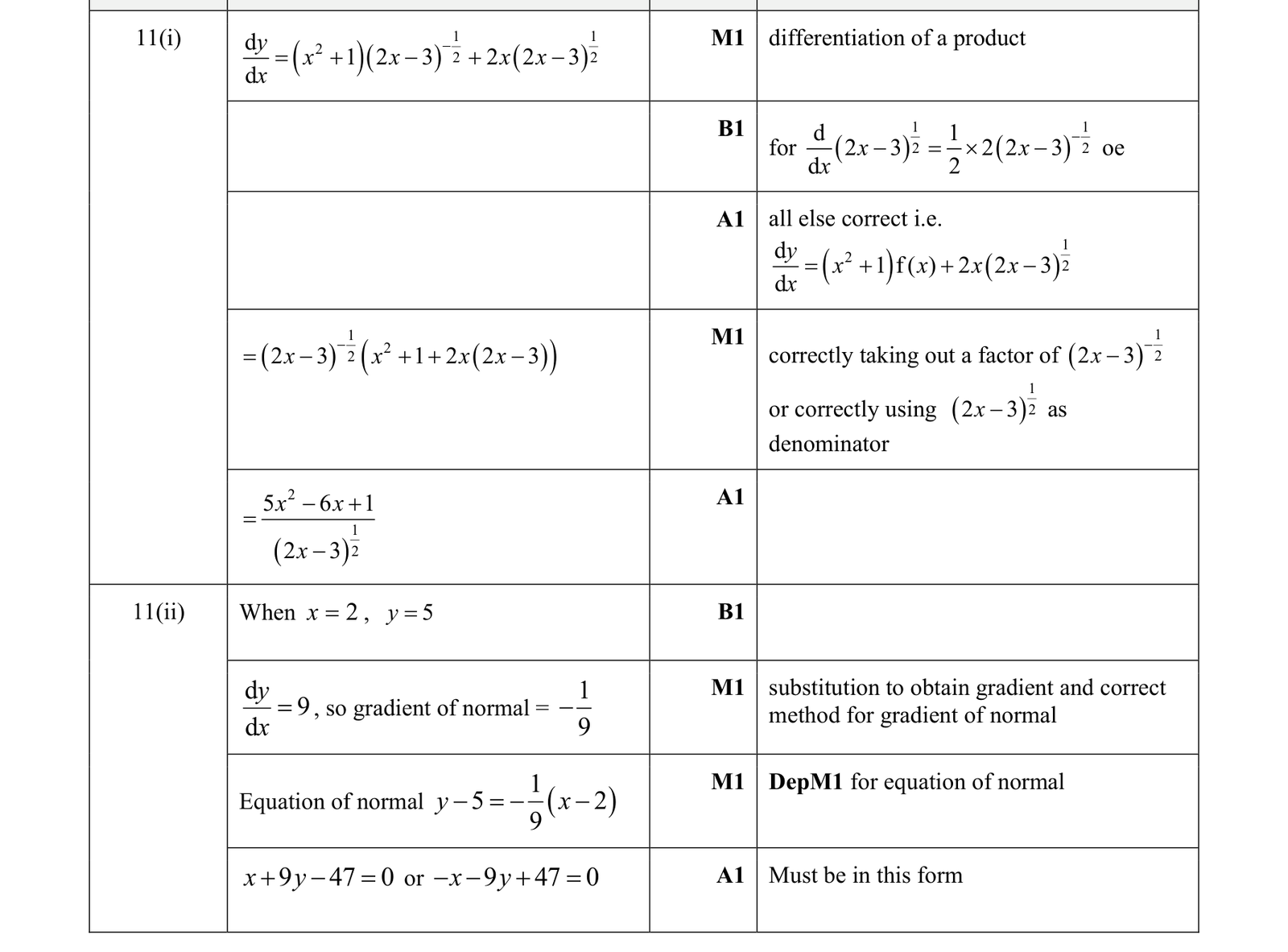
It is given that \(y=(x^2+1)(2x-3)^{1/2}\).
(i) Show that
\(\frac{dy}{dx}=\frac{Px^2+Qx+1}{(2x-3)^{1/2}},\)
where \(P\) and \(Q\) are integers.
(ii) Hence find the equation of the normal to the curve at the point where \(x=2\), giving your answer in the form \(ax+by+c=0\), where \(a\), \(b\) and \(c\) are integers.
0606 P12 - Jun 2019 - Q11 - 7 marks
The normal to the curve \(y=(x-2)(3x+1)^{2/3}\) at the point where \(x=\frac73\), meets the \(y\)-axis at the point \(P\). Find the exact coordinates of \(P\).

0606 P11 - Nov 2019 - Q6 - 5 marks
Find the equation of the normal to the curve
\(y=\sqrt{8x+5}\)
at the point where \(x=\frac12\), giving your answer in the form \(ax+by+c=0\), where \(a\), \(b\) and \(c\) are integers.

0606 P22 - Nov 2019 - Q5 - 7 marks
At the point where \(x=1\) on the curve \(\displaystyle y=\frac{k}{(x+1)^2}\), the normal has a gradient of \(\frac13\).
(i) Find the value of the constant \(k\).
(ii) Using your value of \(k\), find the equation of the tangent to the curve at \(x=2\).

0606 P13 - Nov 2018 - Q9 - 8 marks
Find the equation of the normal to the curve
\(y=\frac{\ln(3x^2+1)}{x^2}\)
at the point where \(x=2\), giving your answer in the form \(y=mx+c\), where \(m\) and \(c\) are correct to 2 decimal places. You must show all your working.

0606 P11 - Jun 2017 - Q1 - 5 marks
The line \(y=kx-5\), where \(k\) is a positive constant, is a tangent to the curve \(y=x^2+4x\) at the point \(A\).
(i) Find the exact value of \(k\).
(ii) Find the gradient of the normal to the curve at \(A\), giving your answer in the form \(a+b\sqrt5\), where \(a\) and \(b\) are constants.

0606 P13 - Jun 2017 - Q5 - 7 marks
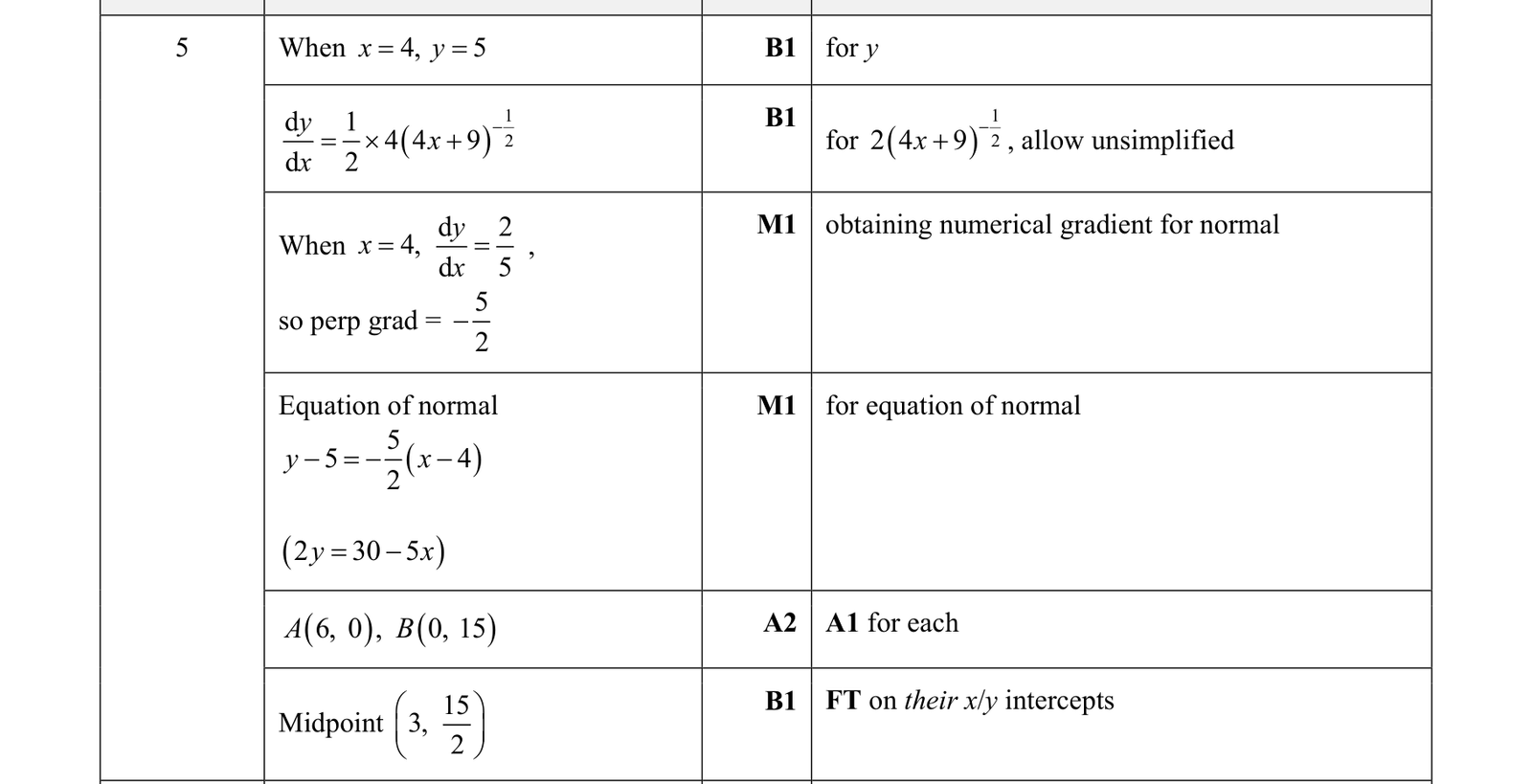
The normal to the curve
\(y=\sqrt{4x+9},\)
at the point where \(x=4\), meets the \(x\)- and \(y\)-axes at the points \(A\) and \(B\). Find the coordinates of the midpoint of the line \(AB\).
0606 P22 - Jun 2017 - Q4 - 6 marks
The point \(P\) lies on the curve \(y=3x^2-7x+11\).
The normal to the curve at \(P\) has equation \(5y+x=k\).
Find the coordinates of \(P\) and the value of \(k\).