0606 P11 - Jun 2025 - Q6 - 8 marks
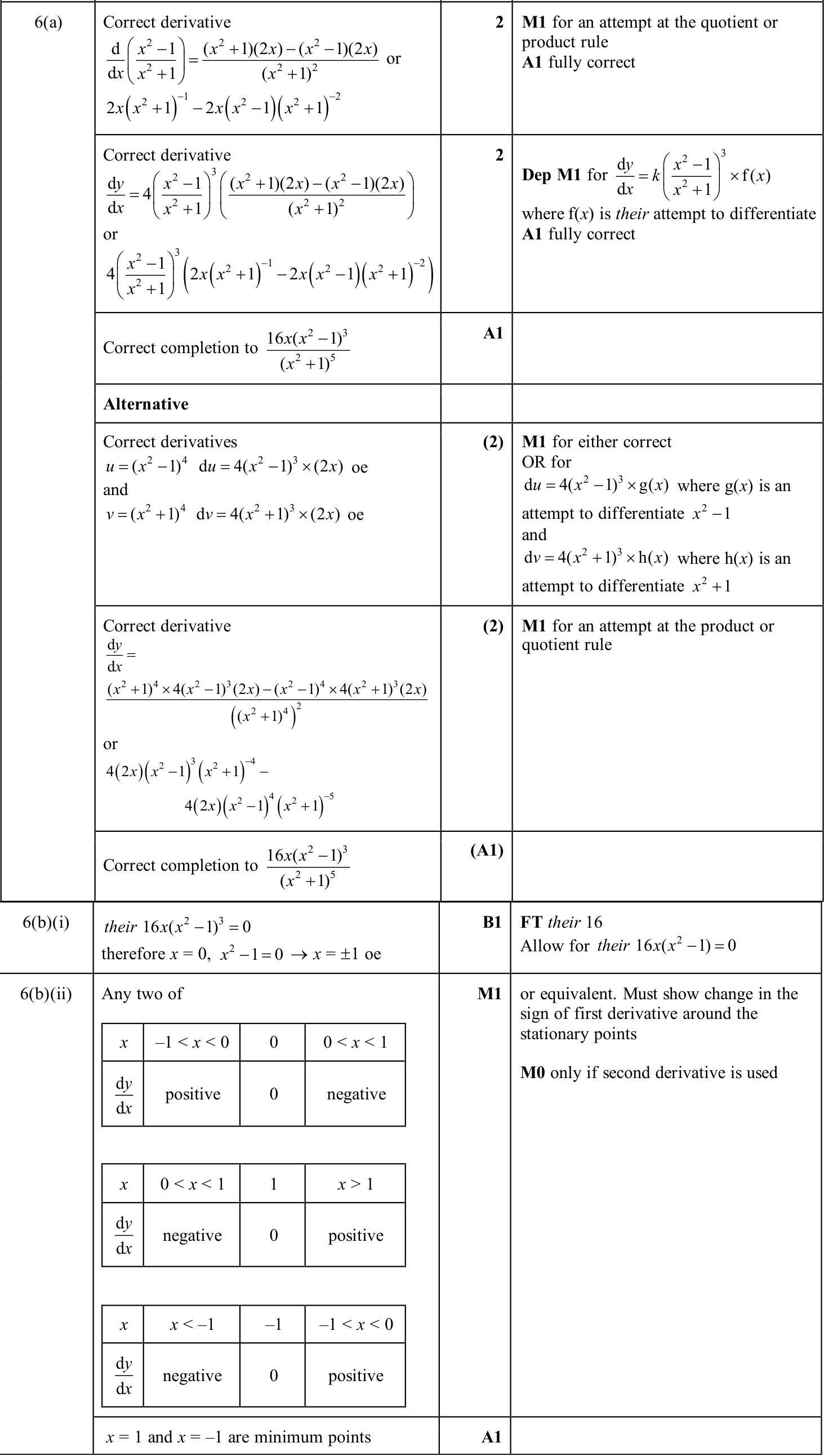
A curve has equation \(y=\left(\frac{x^2-1}{x^2+1}\right)^4\).
(a) Show that \(\frac{\mathrm{d}y}{\mathrm{d}x}\) can be written as \(\frac{Ax(x^2-1)^3}{(x^2+1)^5}\), where \(A\) is a positive integer to be found.
(b)(i) Show that the curve has stationary points where \(x=-1\), \(x=0\) and \(x=1\).
(ii) Use the first derivative test to determine which two stationary points have the same nature and state whether they are maximum or minimum points.
0606 P12 - Jun 2025 - Q8 - 6 marks
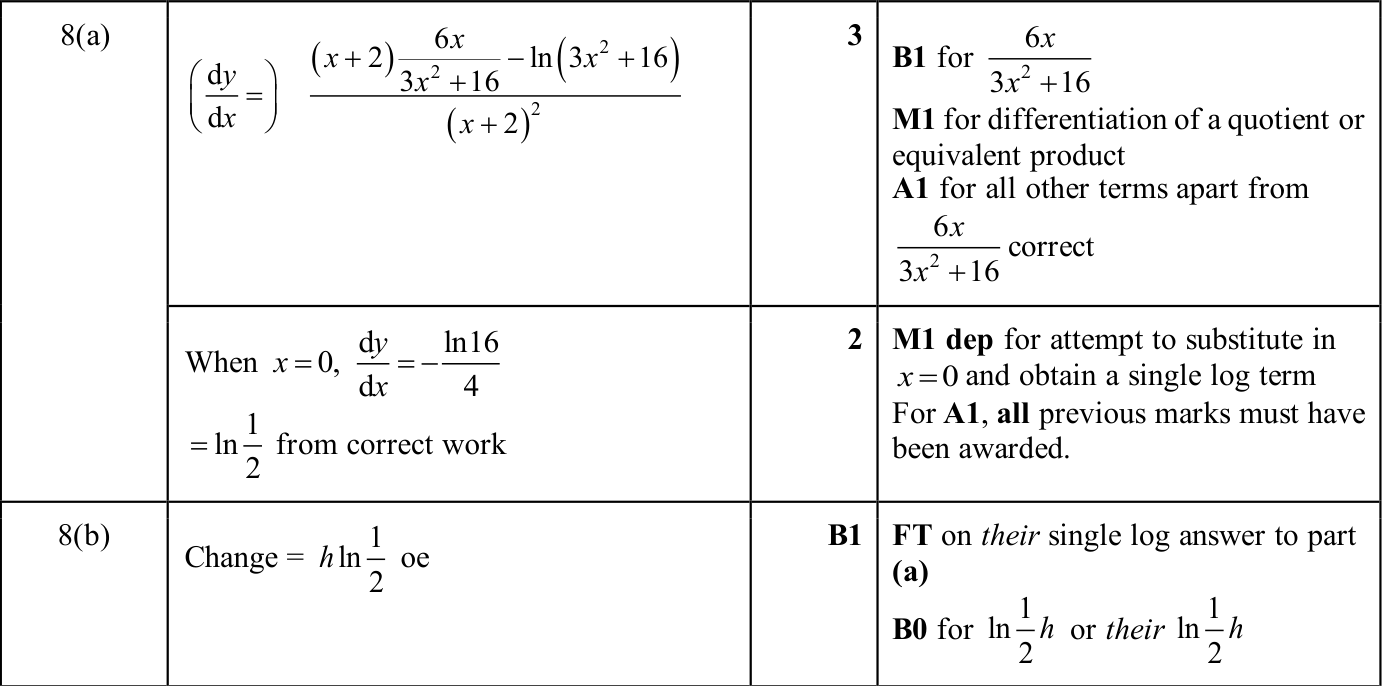
It is given that \(y=\frac{\ln(3x^2+16)}{x+2}\).
(a) Find \(\frac{\mathrm{d}y}{\mathrm{d}x}\) when \(x=0\). Give your answer in the form \(\ln p\), where \(p\) is a constant.
(b) Given that \(x\) increases from \(0\) to \(h\), where \(h\) is small, write down the approximate change in \(y\).
0606 P23 - Jun 2025 - Q2 - 3 marks
Given that \(y=\frac{4 x^{3}-5}{x^{2}}\), show that \(\frac{\mathrm{d} y}{\mathrm{~d} x}\) can be written as \(\frac{2\left(2 x^{3}+5\right)}{x^{3}}\).

0606 P11 - Jun 2023 - Q8 - 7 marks
Given that
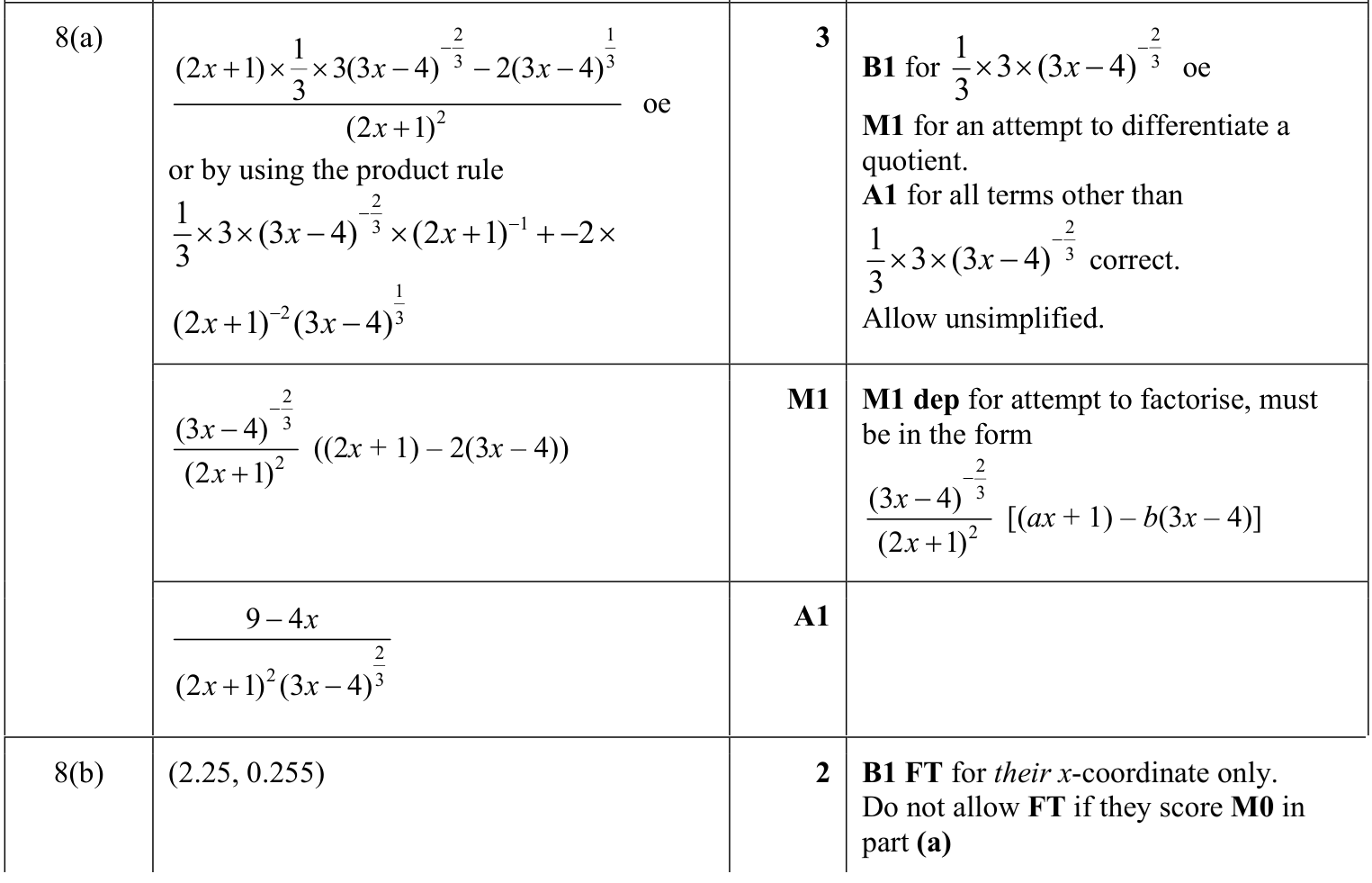
\(\displaystyle y=\frac{(3x-4)^{\frac13}}{2x+1},\)
show that \(\frac{\mathrm dy}{\mathrm dx}\) can be written in the form
\(\displaystyle \frac{Ax+B}{(2x+1)^2(3x-4)^{\frac23}},\)
where \(A\) and \(B\) are integers. Hence find the coordinates of the stationary point on the curve.
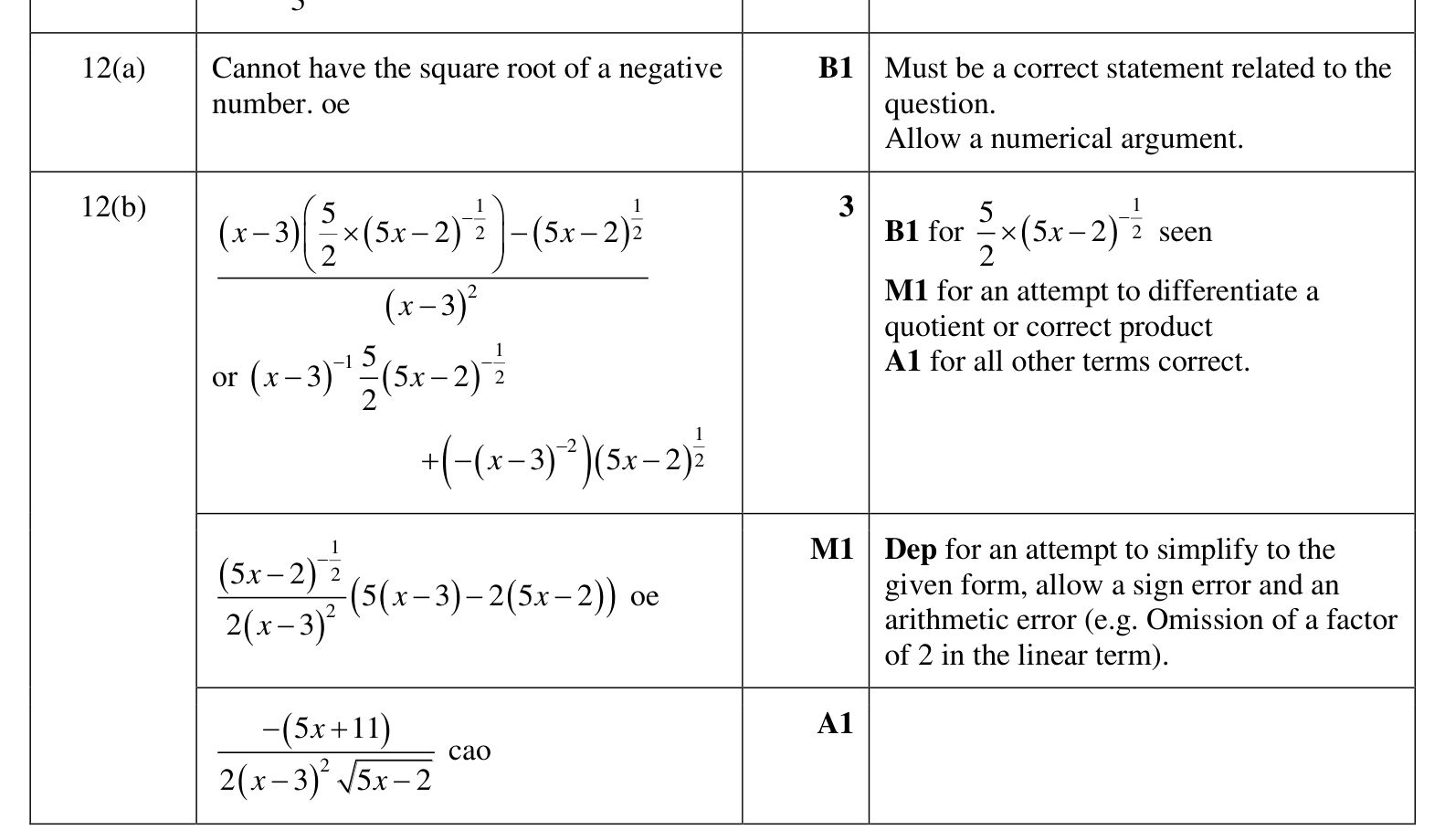
0606 P12 - Nov 2023 - Q12 - 6 marks
A curve has equation
\(y=\frac{\sqrt{5x-2}}{x-3}\).
(a) Explain why the curve does not exist when \(x\lt \frac25\).
(b) Show that \(\frac{dy}{dx}\) can be written in the form
\(-\frac{Ax+B}{2(x-3)^2\sqrt{5x-2}}\),
where \(A\) and \(B\) are positive integers.
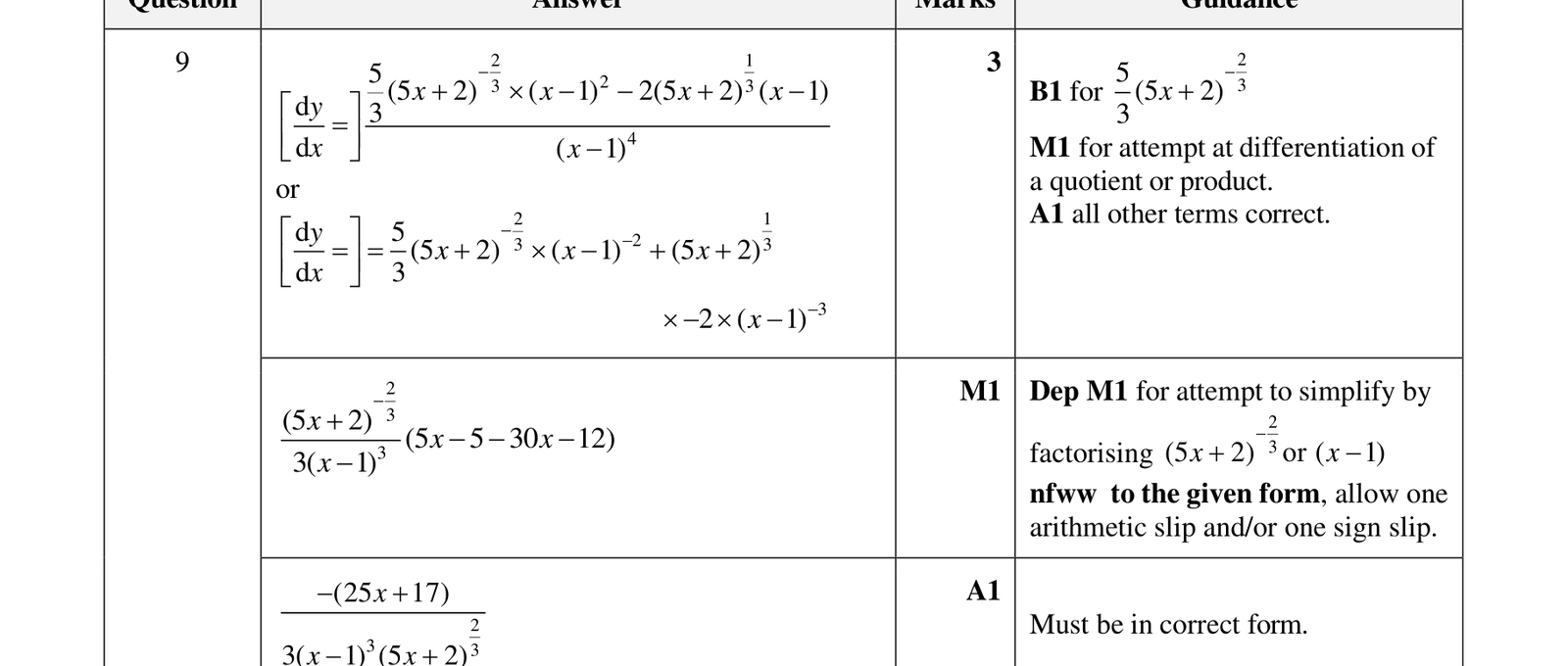
0606 P13 - Nov 2023 - Q9 - 5 marks
Given that
\(\displaystyle y=\frac{(5x+2)^{\frac13}}{(x-1)^2},\)
show that \(\frac{\mathrm dy}{\mathrm dx}\) can be written in the form
\(\displaystyle -\frac{Ax+B}{3(5x+2)^{\frac23}(x-1)^3},\)
where \(A\) and \(B\) are integers.
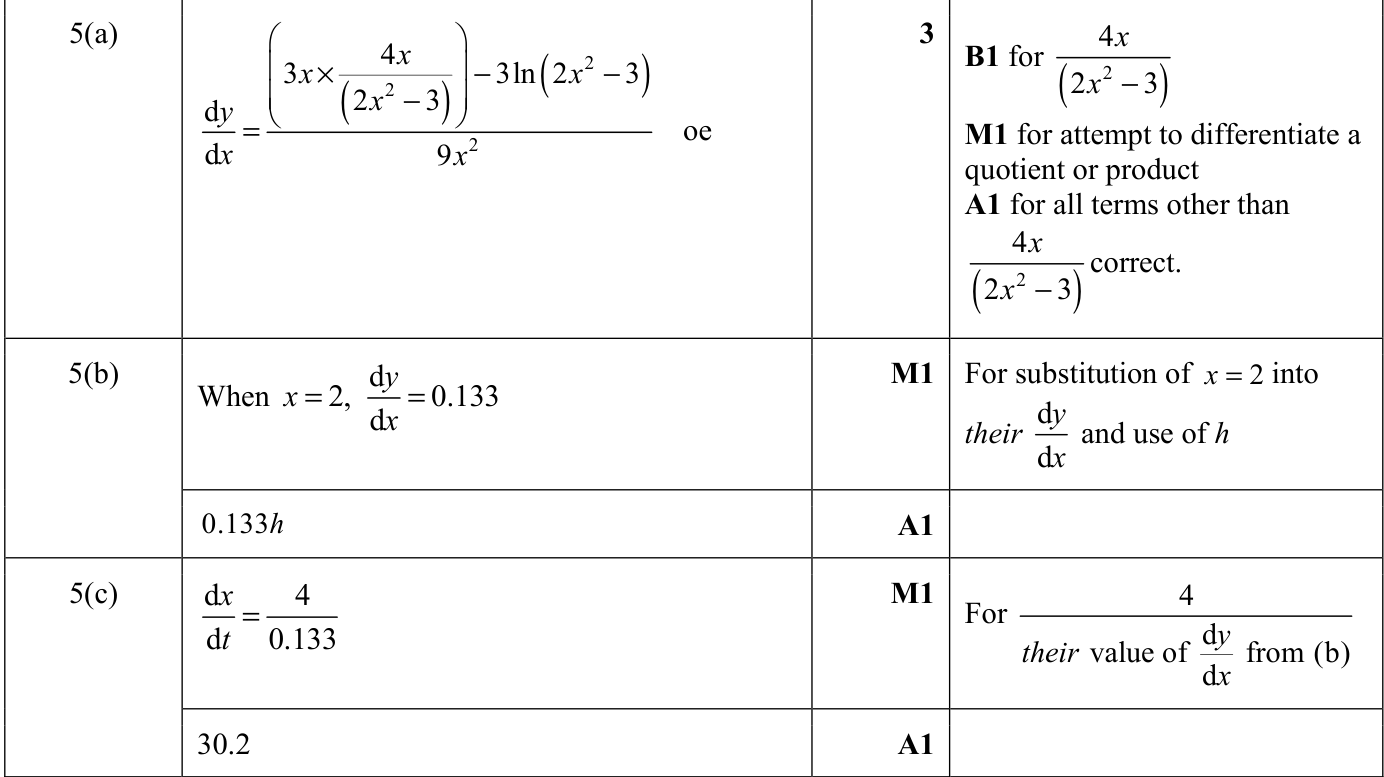
0606 P12 - Mar 2022 - Q5 - 7 marks
Variables \(x\) and \(y\) are such that \(\displaystyle y=\frac{\ln(2x^2-3)}{3x}\).
(a) Find \(\displaystyle \frac{dy}{dx}\).
(b) Hence find the approximate change in \(y\) when \(x\) increases from 2 to \(2+h\), where \(h\) is small.
(c) At the instant when \(x=2\), \(y\) is increasing at the rate of 4 units per second. Find the corresponding rate of increase in \(x\).
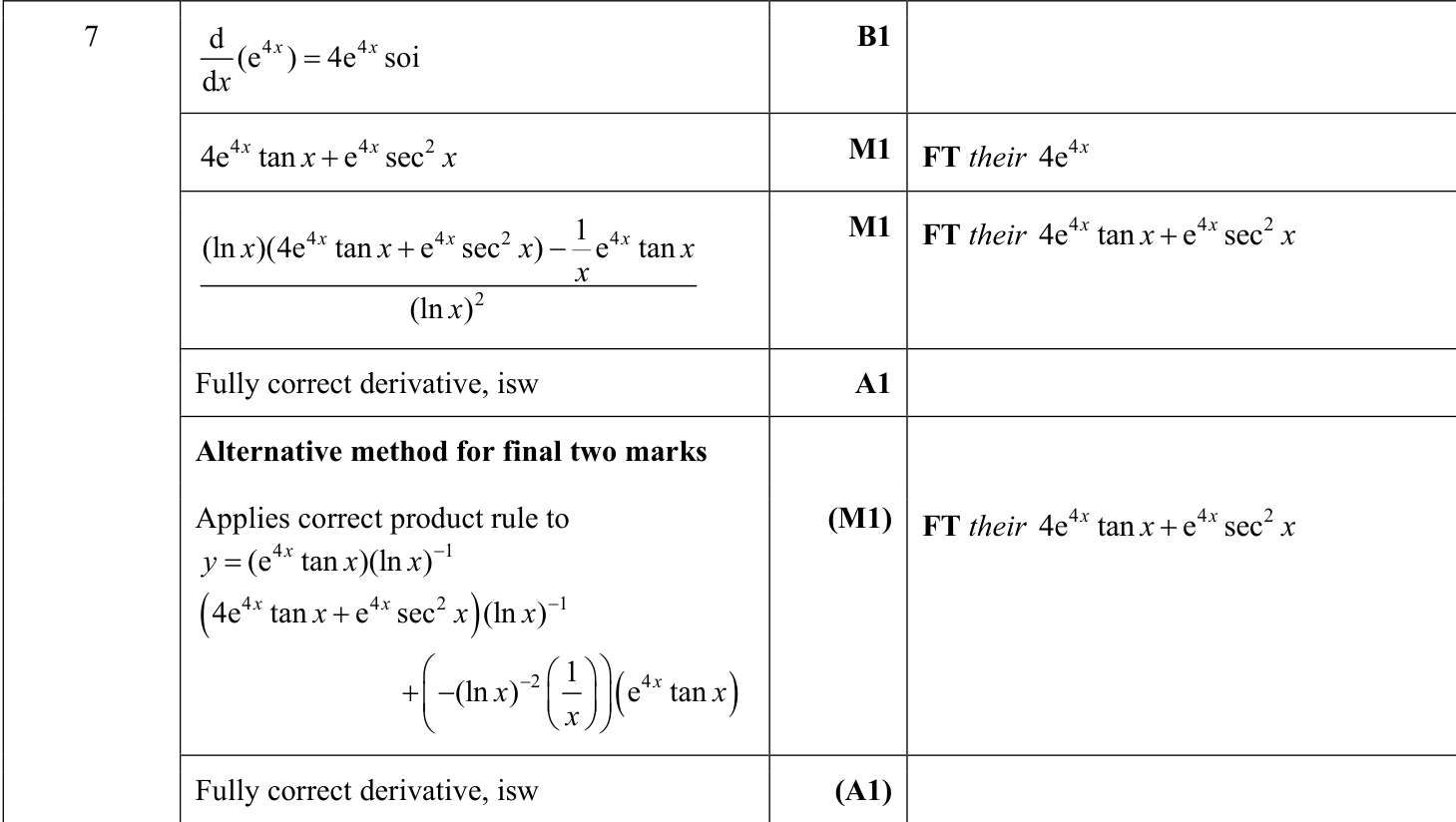
0606 P22 - Jun 2022 - Q7 - 4 marks
Differentiate \(\displaystyle y=\frac{\mathrm{e}^{4x}\tan x}{\ln x}\) with respect to \(x\).
0606 P12 - Mar 2021 - Q10 - 9 marks
A curve has equation
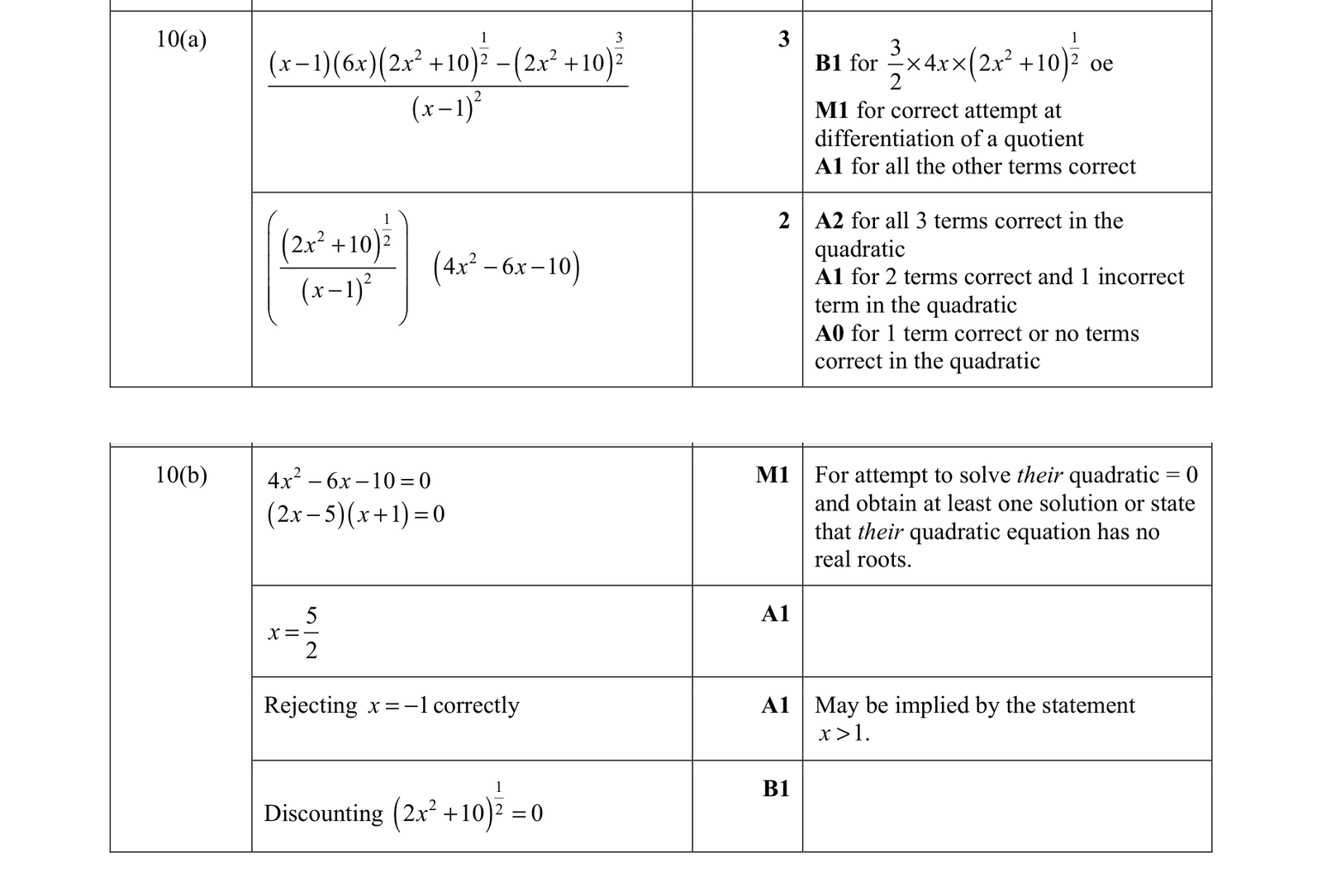
\(y=\frac{(2x^2+10)^{\frac32}}{x-1}\quad\text{for }x\gt 1.\)
(a) Show that \(\dfrac{dy}{dx}\) can be written in the form
\(\frac{(2x^2+10)^{\frac12}}{(x-1)^2}(Ax^2+Bx+C),\)
where \(A\), \(B\) and \(C\) are integers.
(b) Show that, for \(x\gt 1\), the curve has exactly one stationary point. Find the value of \(x\) at this stationary point.
0606 P13 - Nov 2021 - Q11 - 10 marks
A curve has equation
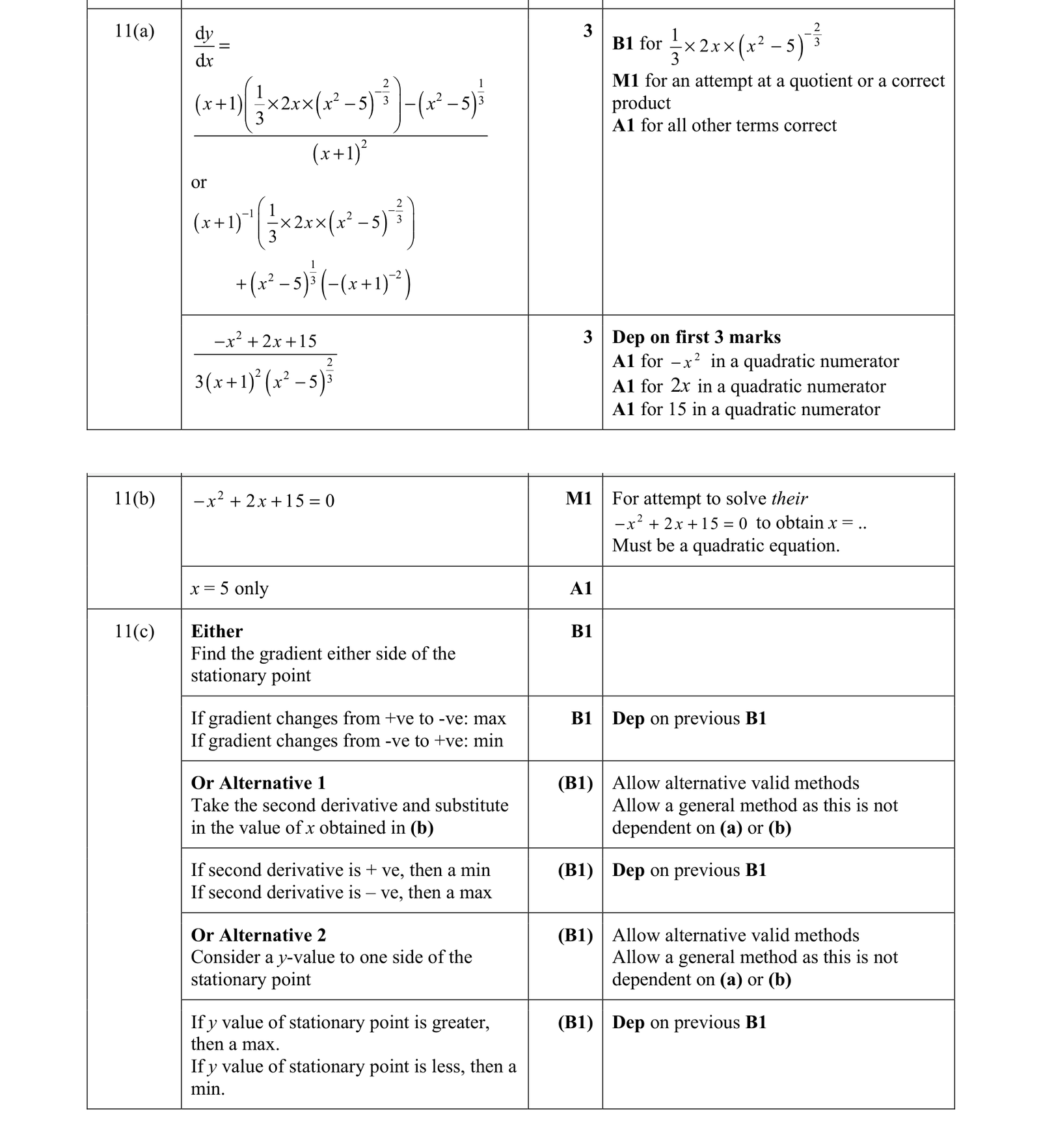
\(y=\frac{(x^2-5)^{\frac13}}{x+1}\)
for \(x\gt -1\).
(a) Show that
\(\frac{dy}{dx}=\frac{Ax^2+Bx+C}{3(x+1)^2(x^2-5)^{\frac23}},\)
where \(A\), \(B\) and \(C\) are integers.
(b) Find the \(x\)-coordinate of the stationary point on the curve.
(c) Explain how you could determine the nature of this stationary point. You are not required to find the nature of this stationary point.
0606 P13 - Jun 2019 - Q4 - 5 marks
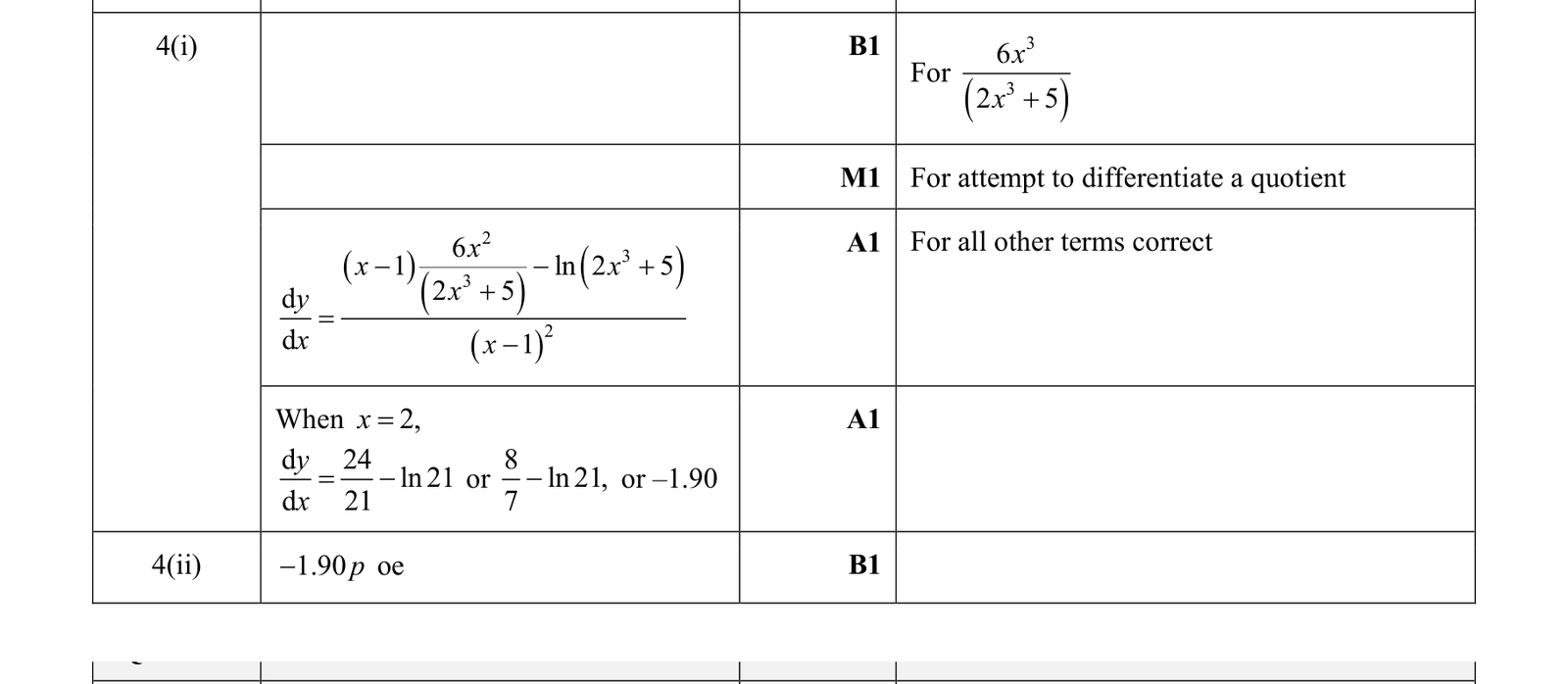
It is given that \(y=\dfrac{\ln(2x^3+5)}{x-1}\) for \(x\gt 1\).
(i) Find \(\frac{dy}{dx}\) when \(x=2\).
(ii) Find the approximate change in \(y\) as \(x\) increases from \(2\) to \(2+p\), where \(p\) is small.
0606 P21 - Jun 2019 - Q2 - 5 marks
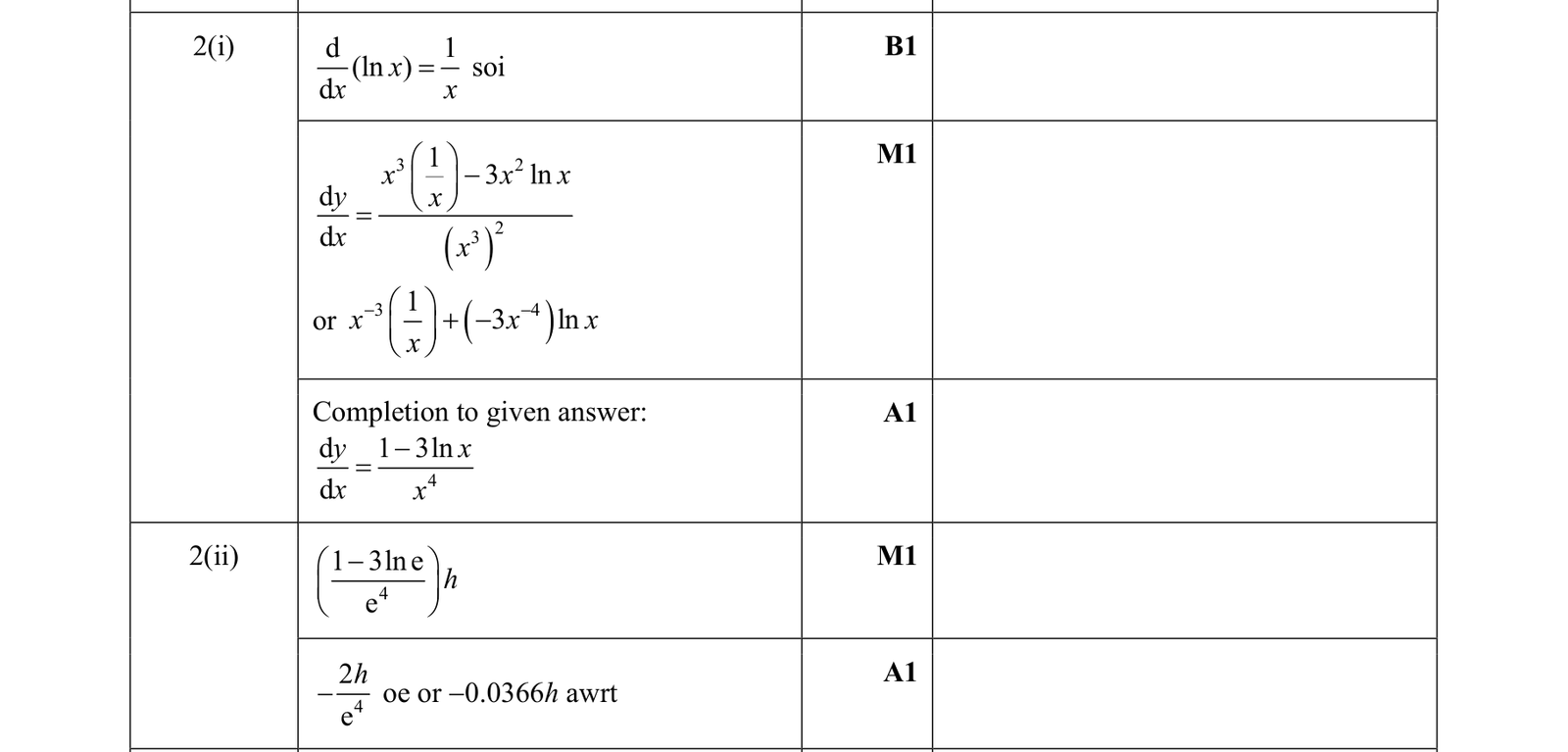
Two variables \(x\) and \(y\) are such that \(y=\dfrac{\ln x}{x^3}\), for \(x\gt 0\).
(i) Show that \(\dfrac{dy}{dx}=\dfrac{1-3\ln x}{x^4}\).
(ii) Hence find the approximate change in \(y\) as \(x\) increases from \(e\) to \(e+h\), where \(h\) is small.
0606 P22 - Jun 2019 - Q1 - 4 marks
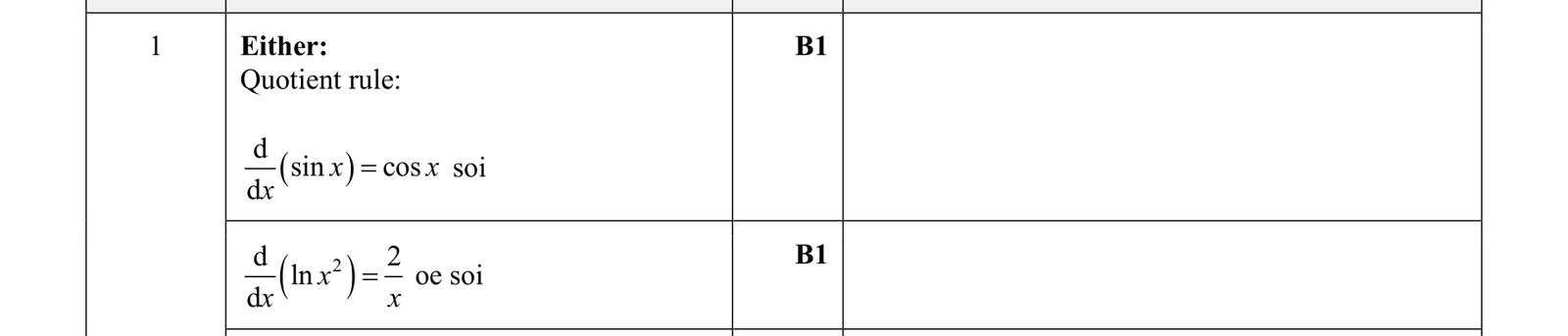
Find \(\dfrac{dy}{dx}\) when \(y=\dfrac{\sin x}{\ln x^2}\).
0606 P21 - Jun 2018 - Q7 - 5 marks
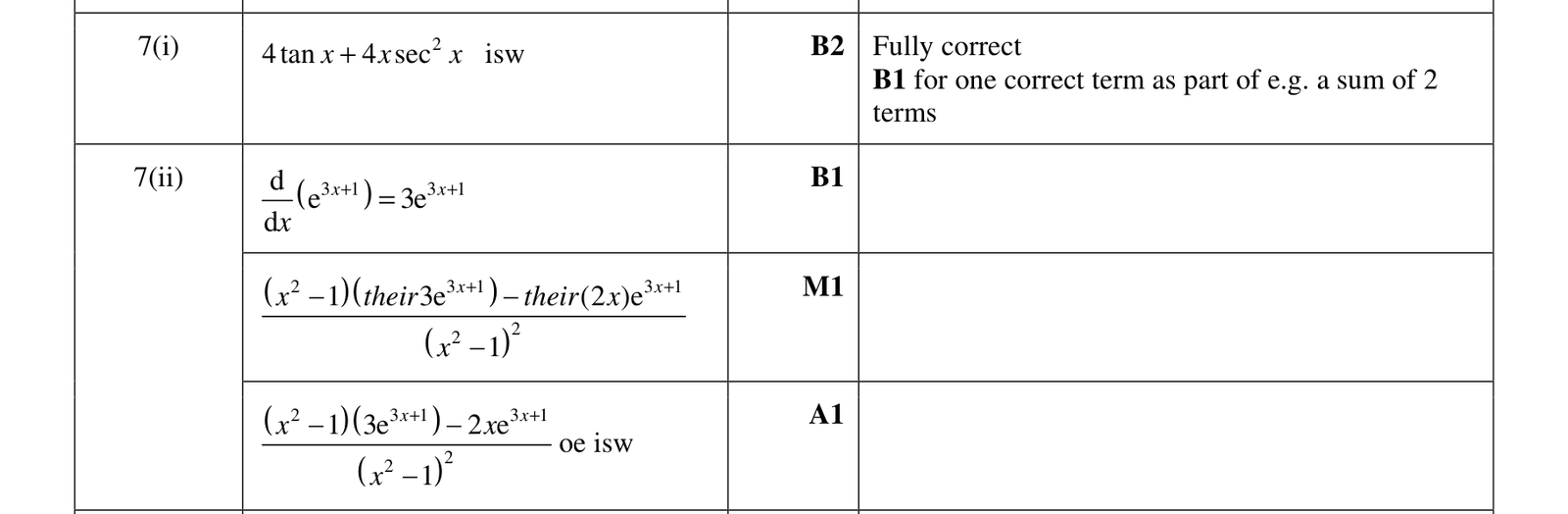
Differentiate with respect to \(x\)
(i) \(4x\tan x\),
(ii) \(\dfrac{e^{3x+1}}{x^2-1}\).
0606 P23 - Jun 2018 - Q7 - 5 marks
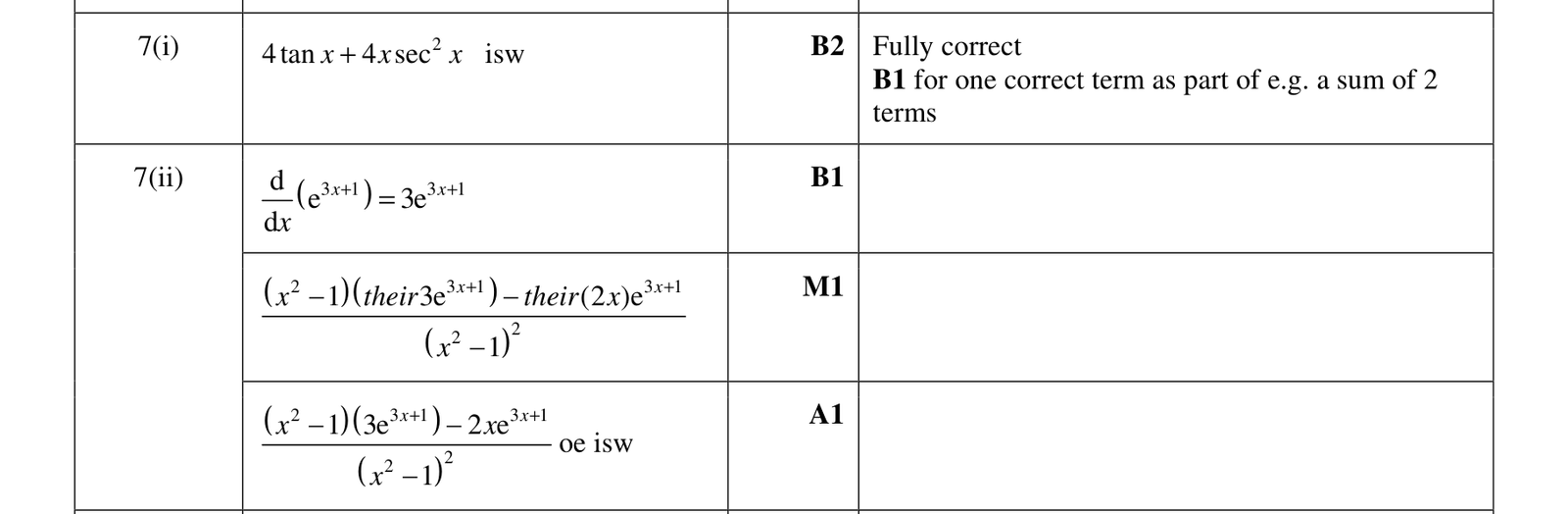
Differentiate with respect to \(x\)
(i) \(4x\tan x\),
(ii) \(\dfrac{e^{3x+1}}{x^2-1}\).
0606 P11 - Nov 2018 - Q6 - 6 marks
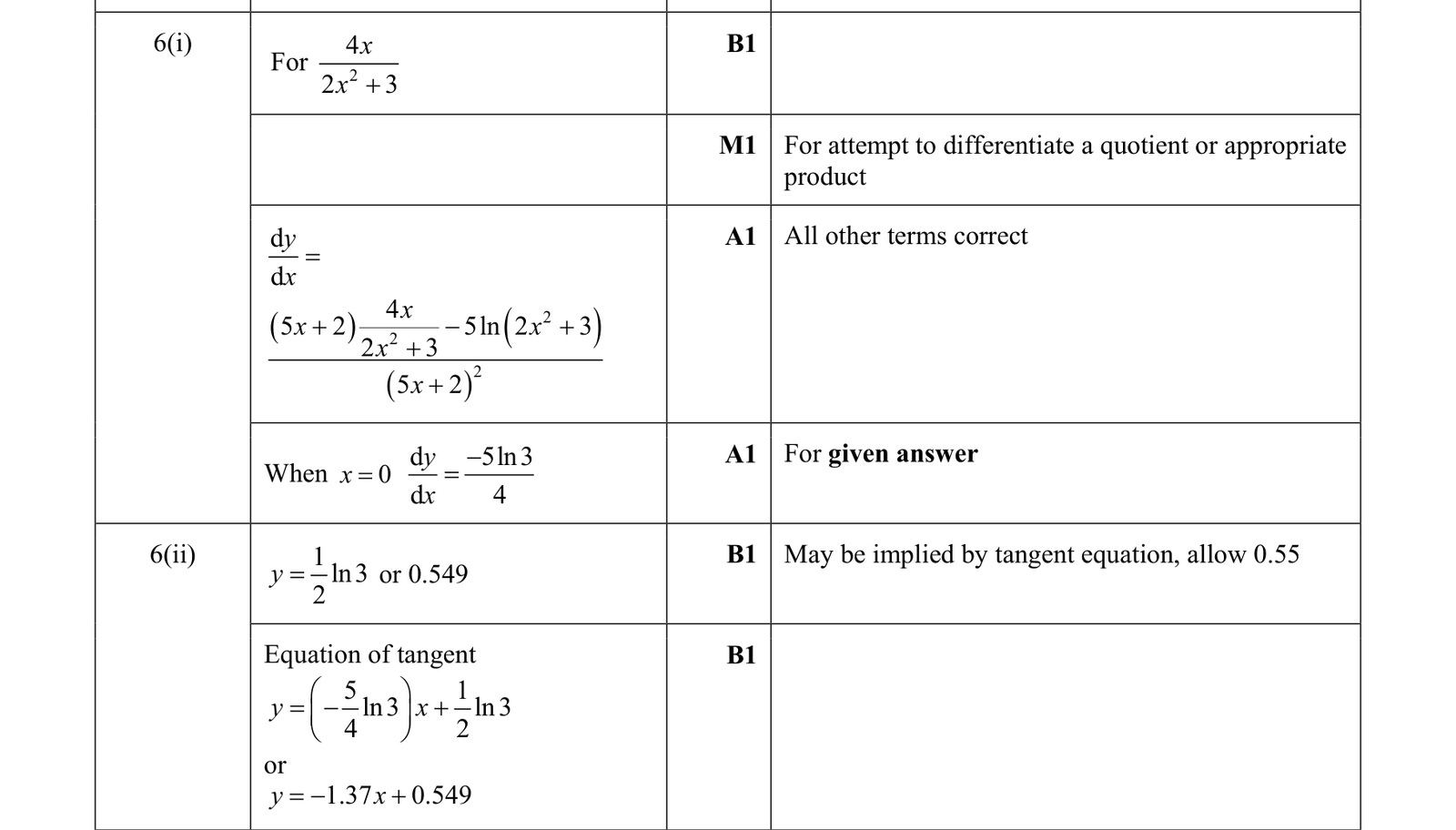
A curve has equation
\(y=\frac{\ln(2x^2+3)}{5x+2}.\)
(i) Show that \(\dfrac{dy}{dx}=-\dfrac54\ln3\) when \(x=0\).
(ii) Hence find the equation of the tangent to the curve at the point where \(x=0\).
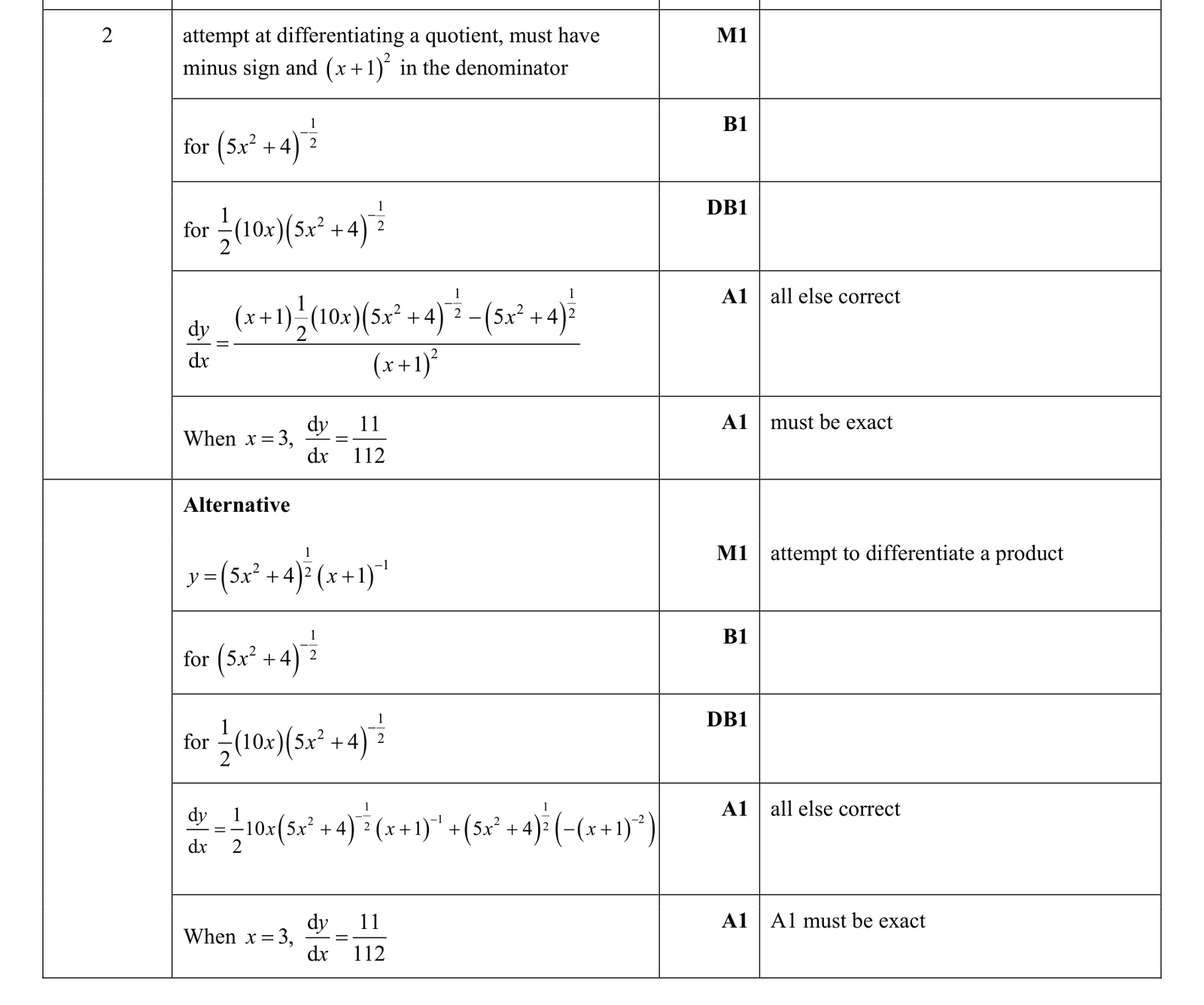
0606 P12 - Jun 2017 - Q2 - 5 marks
It is given that
\(y=\frac{(5x^2+4)^{1/2}}{x+1}.\)
Find the exact value of \(\dfrac{dy}{dx}\) when \(x=3\).
0606 P23 - Jun 2017 - Q7 - 8 marks
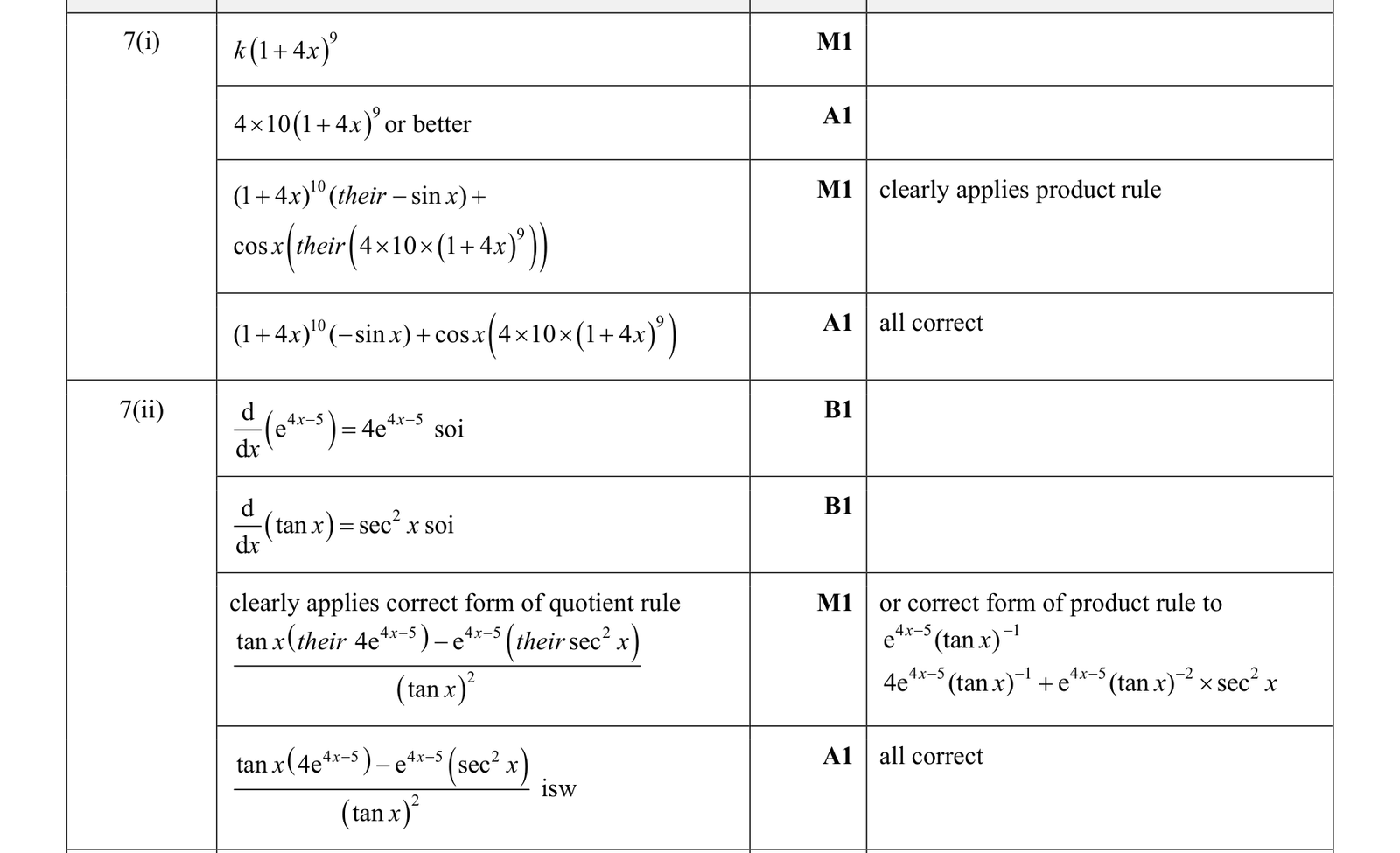
Differentiate with respect to \(x\),
(i) \((1+4x)^{10}\cos x\),
(ii) \(\dfrac{e^{4x-5}}{\tan x}\).