0606 P12 - Nov 2025 - Q3 - 6 marks
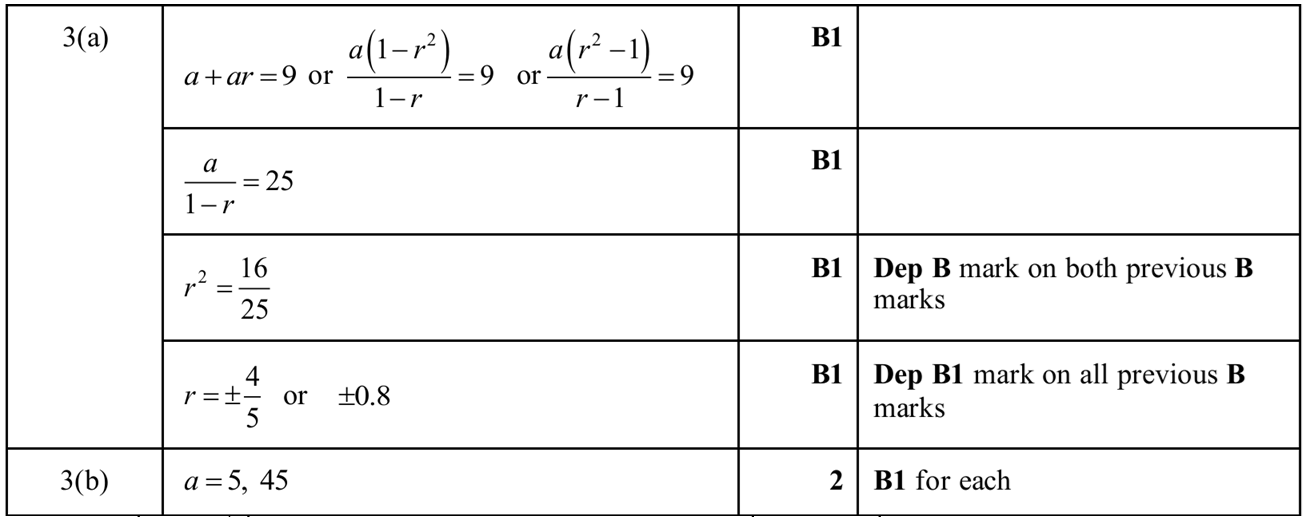
The sum of the first two terms of a geometric progression is \(9\). The sum to infinity of this geometric progression is \(25\).
(a) Find the possible values of the common ratio of this geometric progression.
(b) Find the first term of this geometric progression for each possible value of the common ratio.
0606 P12 - Jun 2025 - Q7 - 6 marks
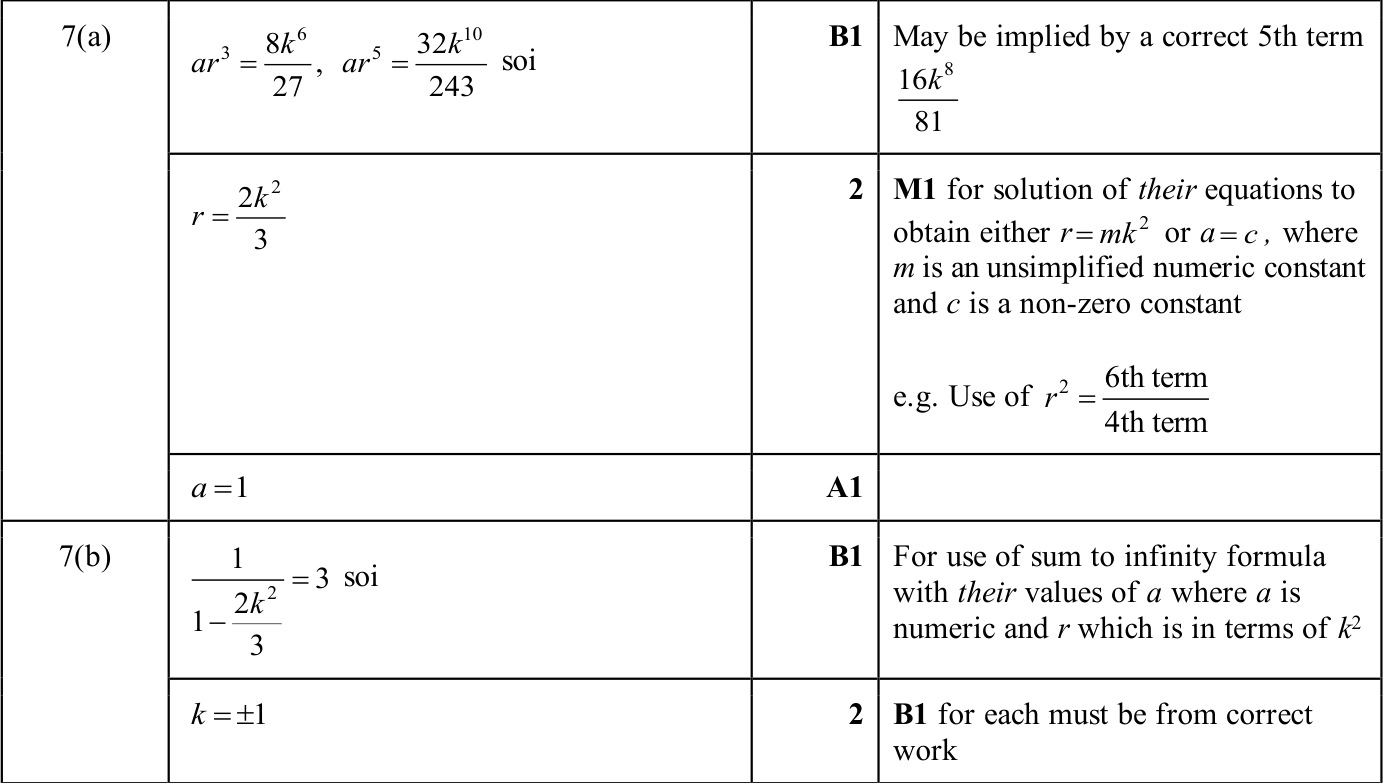
A geometric progression has a 4th term of \(\frac{8k^6}{27}\) and a 6th term of \(\frac{32k^{10}}{243}\), where \(k\) is a constant. The common ratio of this geometric progression is positive.
(a) Find the common ratio in terms of \(k\) and the value of the first term of this geometric progression.
(b) Given that this geometric progression has a sum to infinity of \(3\), find the possible values of \(k\).
0606 P21 - Jun 2025 - Q11 - 8 marks
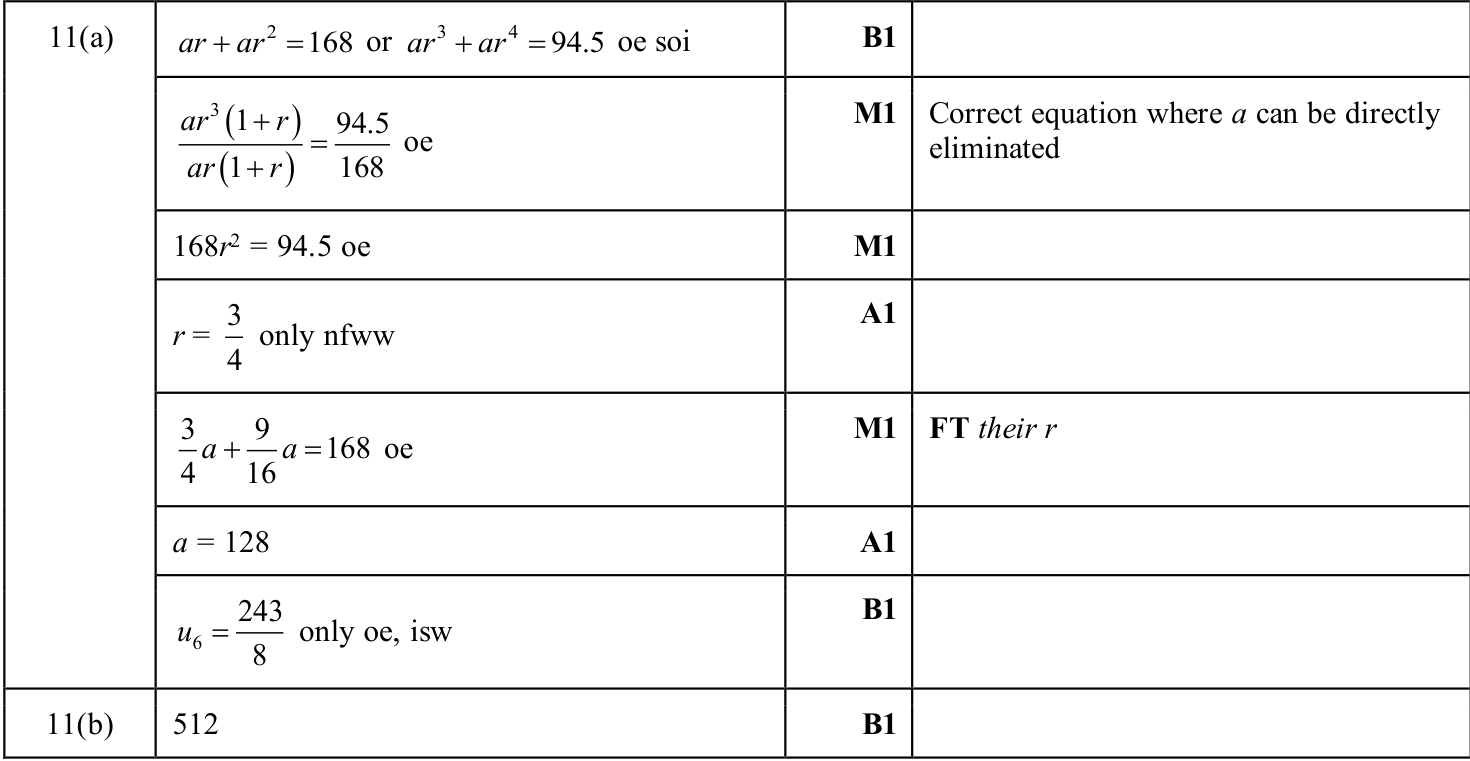
A geometric progression has first term \(a\) and common ratio \(r\), where \(r\gt 0\). The sum of the 2nd and 3rd terms of the progression is 168 . The sum of the 4th and 5th terms of the progression is 94.5. (a) Find the 6th term of the progression. (b) Find the sum to infinity of the progression.
0606 P11 - Nov 2024 - Q10 - 8 marks
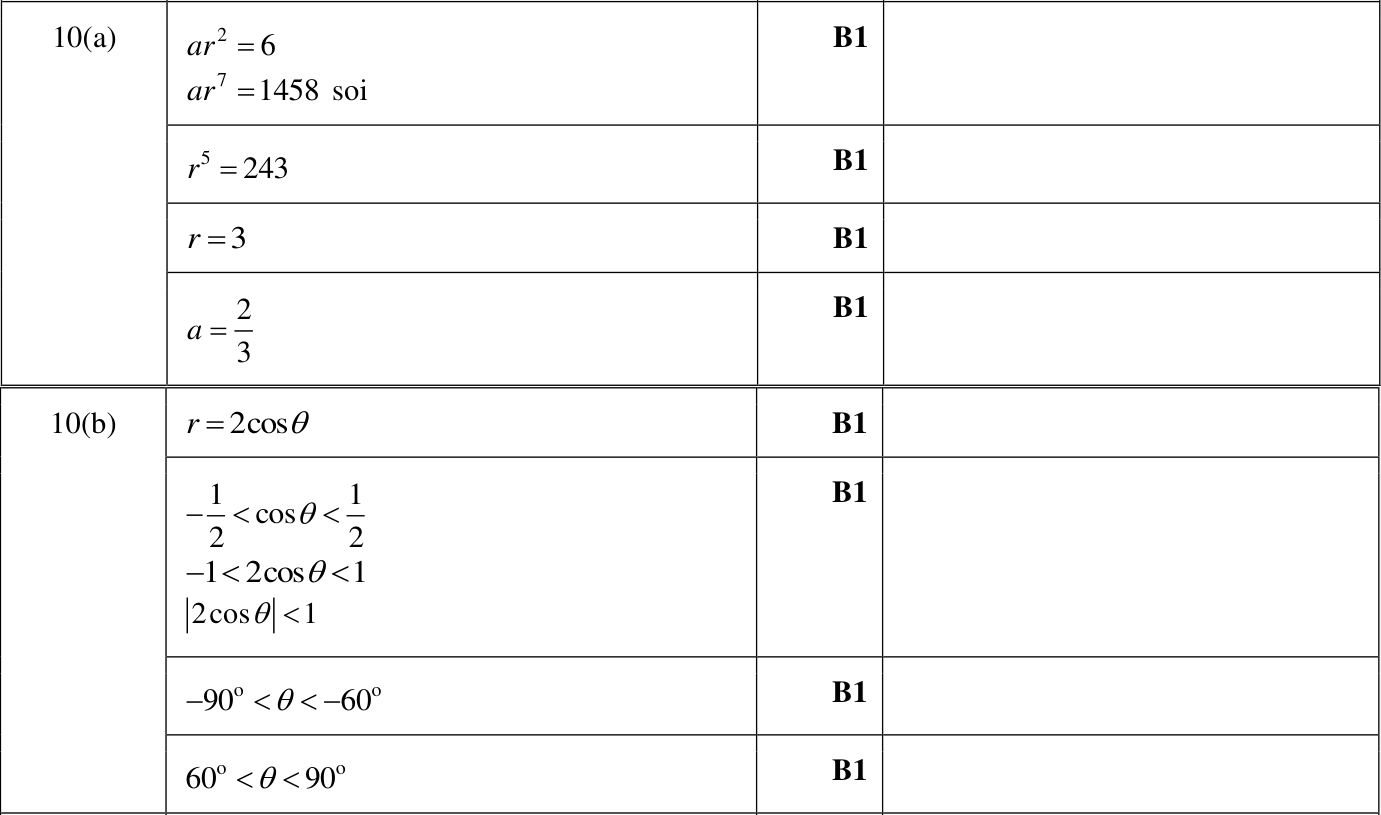
(a) The 3rd and 8th terms of a geometric progression are 6 and 1458 respectively. Find the common ratio and the first term of this progression.
(b) The first 3 terms of a second geometric progression are \(\cos \theta, \quad 2 \cos ^{2} \theta, \quad 4 \cos ^{3} \theta, \quad\) where \(-90^{\circ}\lt \theta\lt 90^{\circ}\). Find the values of \(\theta\) for which this geometric progression has a sum to infinity.
0606 P13 - Nov 2022 - Q5 - 7 marks
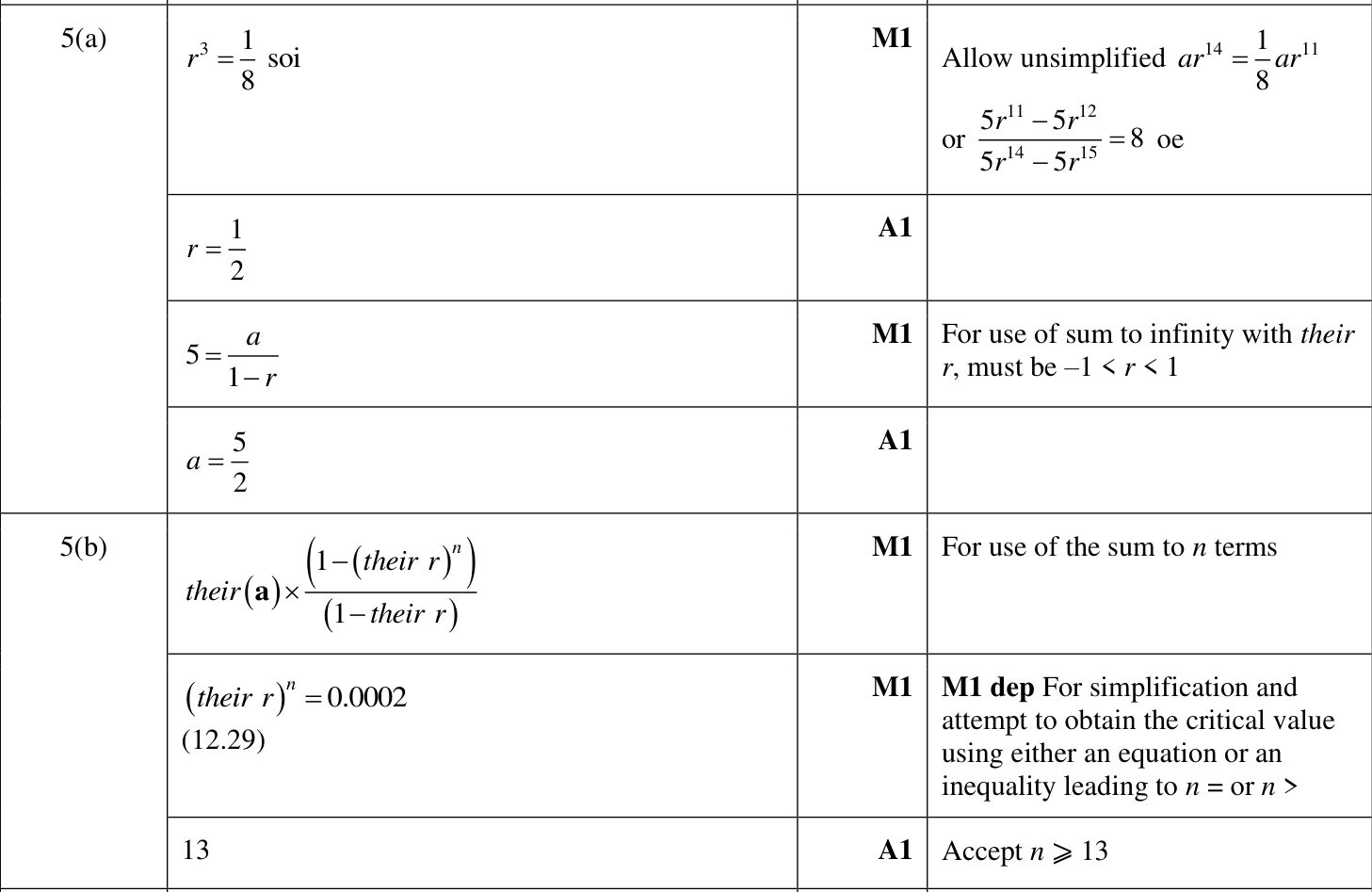
A geometric progression is such that the fifteenth term is equal to \(\frac18\) of the twelfth term. The sum to infinity is \(5\).
(a) Find the first term and the common ratio.
(b) Find the least number of terms needed for the sum of the geometric progression to be greater than \(4.999\).
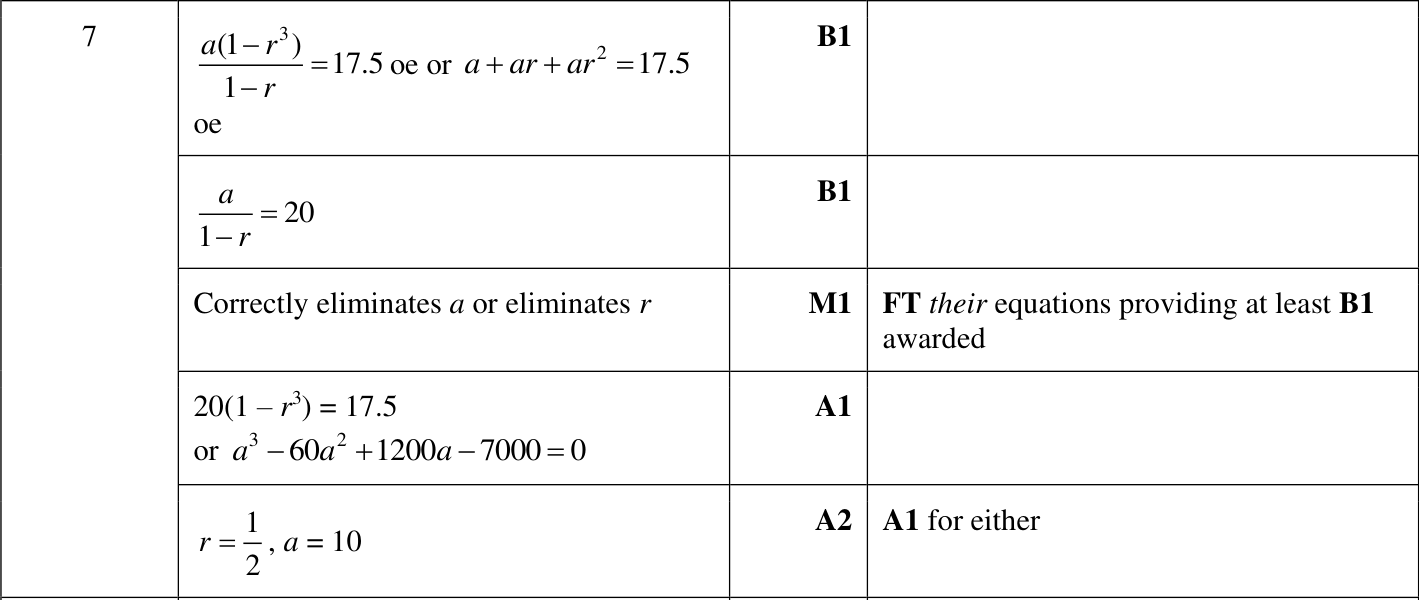
0606 P21 - Nov 2022 - Q7 - 6 marks
The sum of the first three terms of a geometric progression is \(17.5\) and the sum to infinity is \(20\).
Find the first term and the common ratio.