0606 P12 - Mar 2025 - Q8 - 7 marks
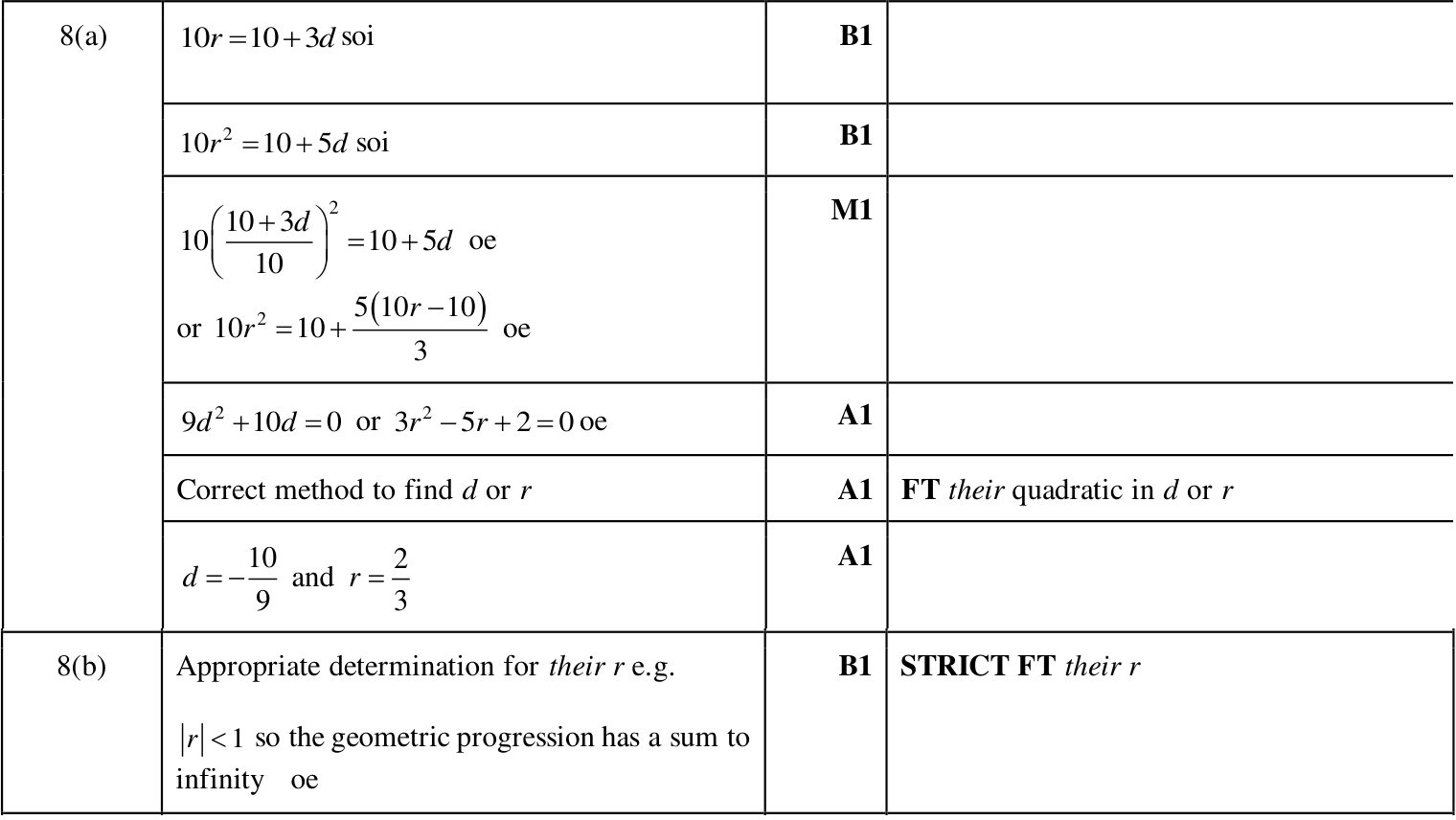
The first term of a geometric progression is \(10\). This geometric progression has a positive common ratio \(r\).
The first term of an arithmetic progression is also \(10\). This arithmetic progression has a negative common difference \(d\).
The second term of the geometric progression is the same as the fourth term of the arithmetic progression.
The third term of the geometric progression is the same as the sixth term of the arithmetic progression.
(a) Find the values of \(r\) and \(d\).
(b) Determine whether the geometric progression has a sum to infinity.
0606 P23 - Nov 2024 - Q10 - 8 marks
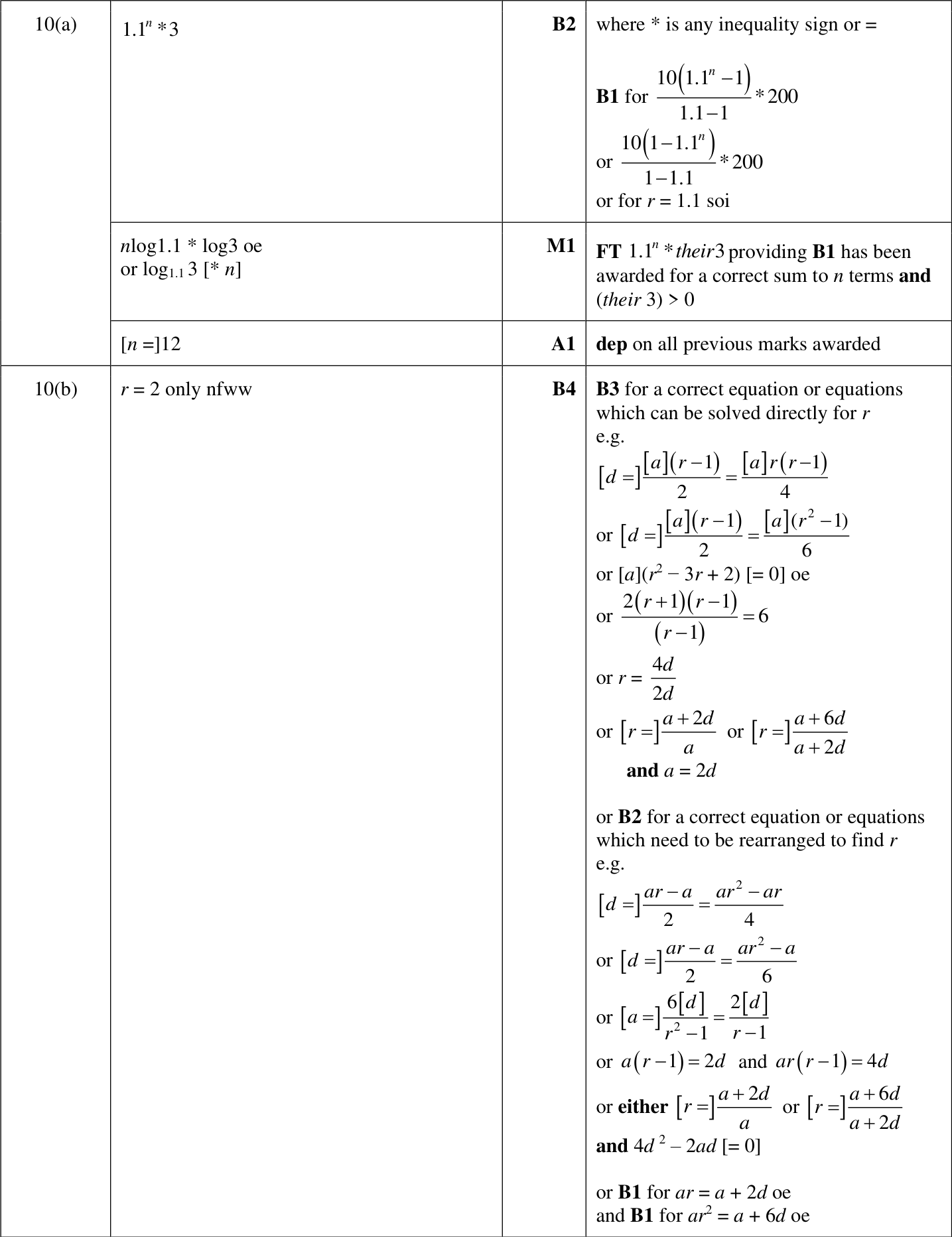
(a) Suzma is training for a marathon. In the first week she runs 10 km . Then each week she runs a distance that is \(10 \%\) greater than the week before.
The total distance that Suzma has run by the end of \(n\) whole weeks is more than 200 km . Find the smallest possible value of \(n\). (b) A geometric progression has 1st term \(a\) and common ratio \(r\), where \(a \neq 0\) and \(r \neq 1\). The 1st, 2nd and 3rd terms of the geometric progression are the 1st, 3rd and 7th terms of an arithmetic progression. Find the value of \(r\).
0606 P22 - Nov 2022 - Q10 - 8 marks
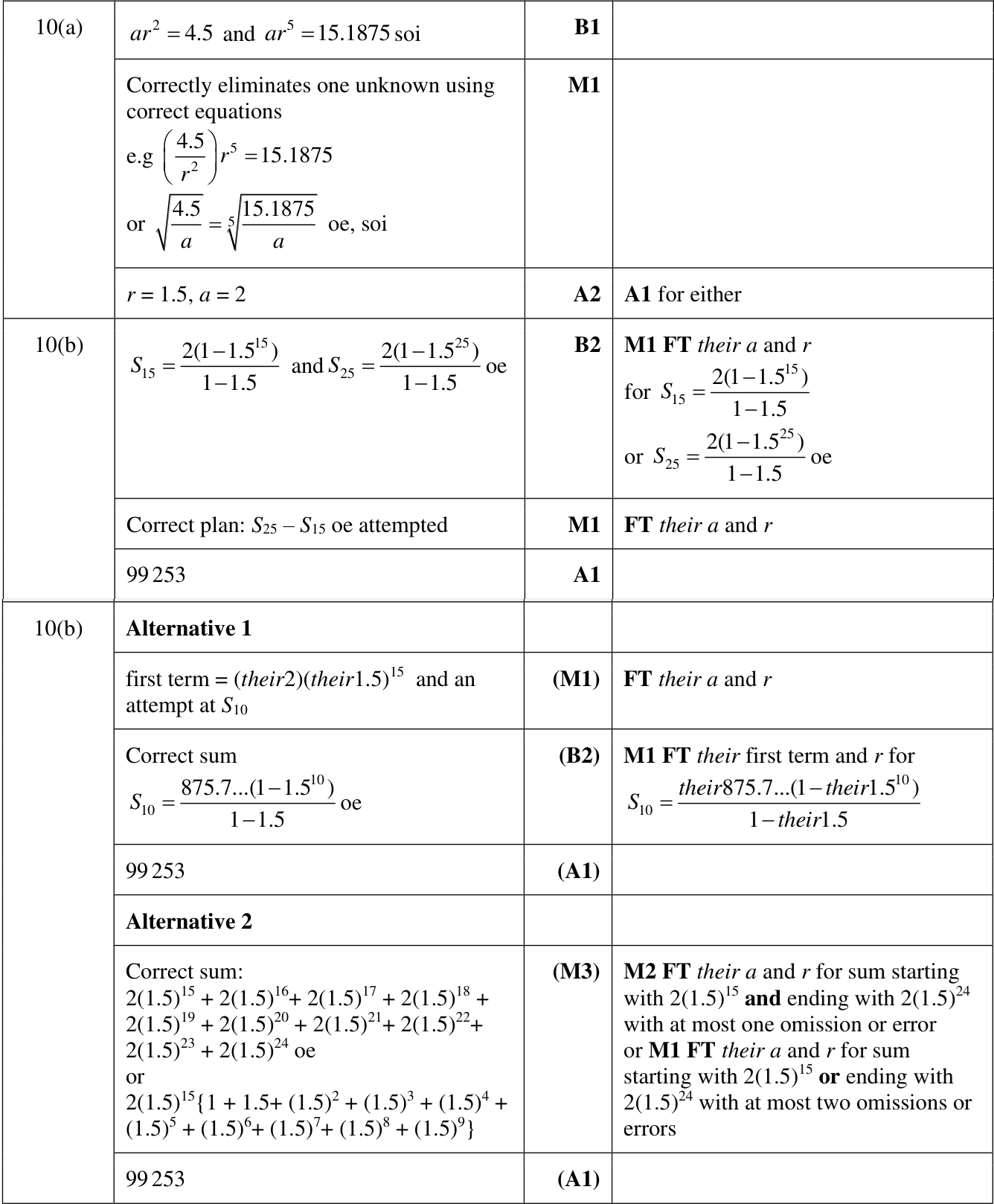
(a) A geometric progression has third term \(4.5\) and sixth term \(15.1875\). Find the first term and the common ratio.
(b) Find the sum of ten terms of the progression, starting with the sixteenth term. Give your answer to the nearest integer.
0606 P13 - Nov 2021 - Q5 - 6 marks
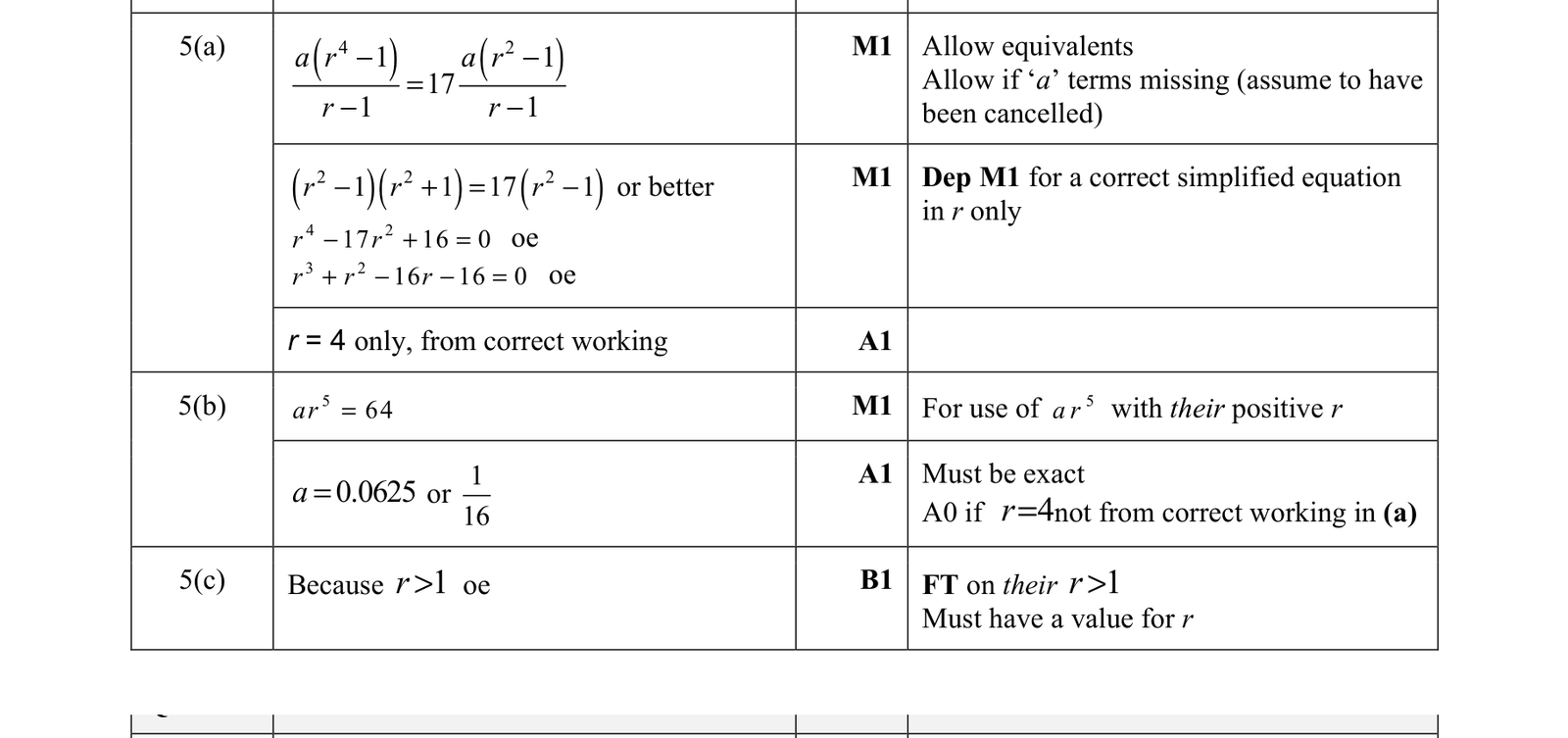
A geometric progression is such that its sum to \(4\) terms is \(17\) times its sum to \(2\) terms. It is given that the common ratio of this geometric progression is positive and not equal to \(1\).
(a) Find the common ratio of this geometric progression.
(b) Given that the \(6\)th term of the geometric progression is \(64\), find the first term.
(c) Explain why this geometric progression does not have a sum to infinity.
0606 P22 - Nov 2020 - Q7 - 8 marks
A geometric progression has a first term of \(3\) and a second term of \(2.4\). For this progression, find
(a) the sum of the first \(8\) terms,
(b) the sum to infinity,
(c) the least number of terms for which the sum is greater than \(95\%\) of the sum to infinity.
