0606 P11 - Jun 2025 - Q11 - 9 marks
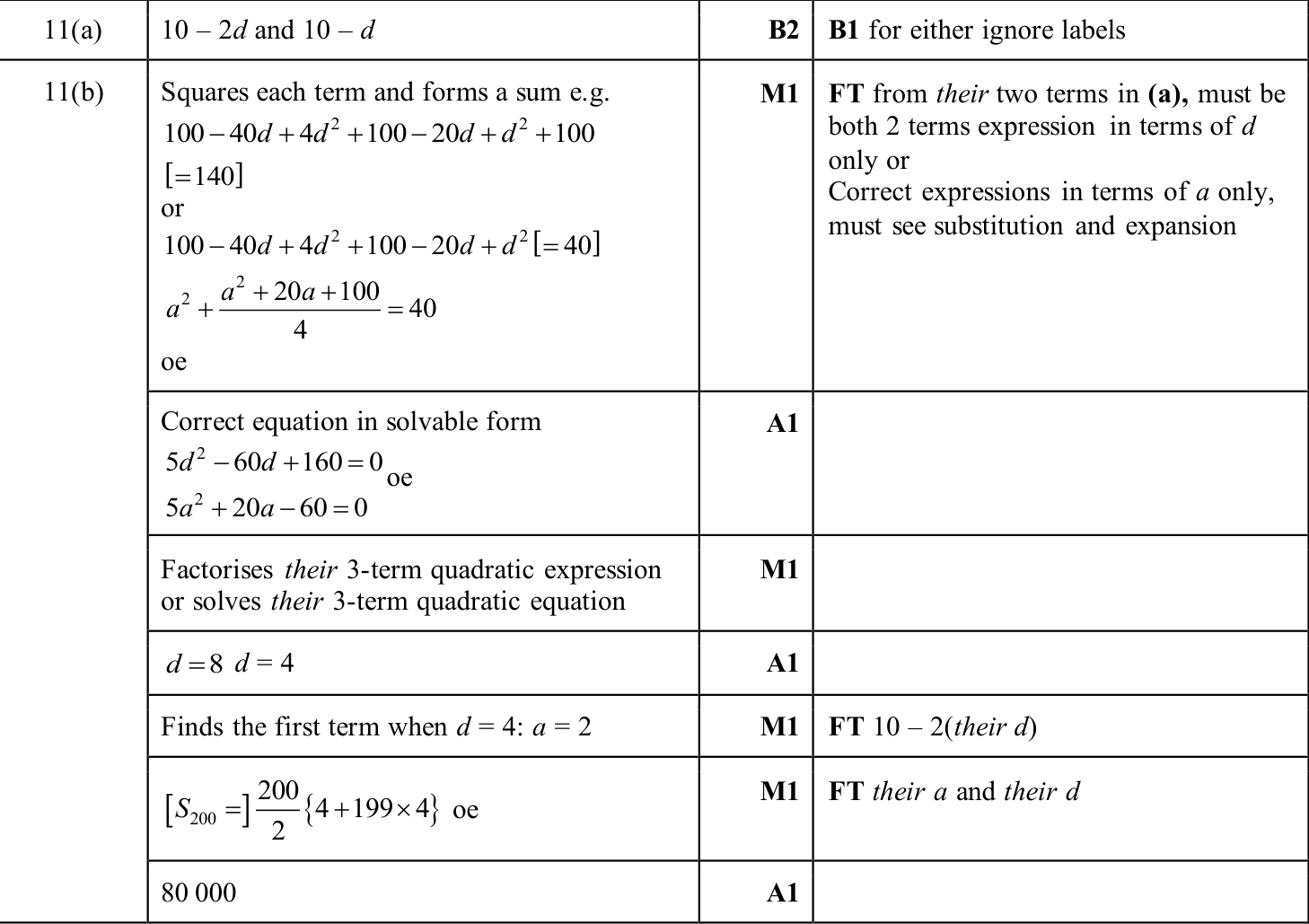
An arithmetic progression has common difference \(d\). The 3rd term of this progression is \(10\).
(a) Write down expressions for the 1st term and the 2nd term of this progression. Give your answers in terms of \(d\) only.
(b) When each of the first 3 terms is squared, the sum of these squares is \(140\). There are two possible values for \(d\).
Using your answer to part (a), find the sum of the first \(200\) terms of the progression with the smaller value of \(d\).
0606 P21 - Nov 2024 - Q12 - 9 marks
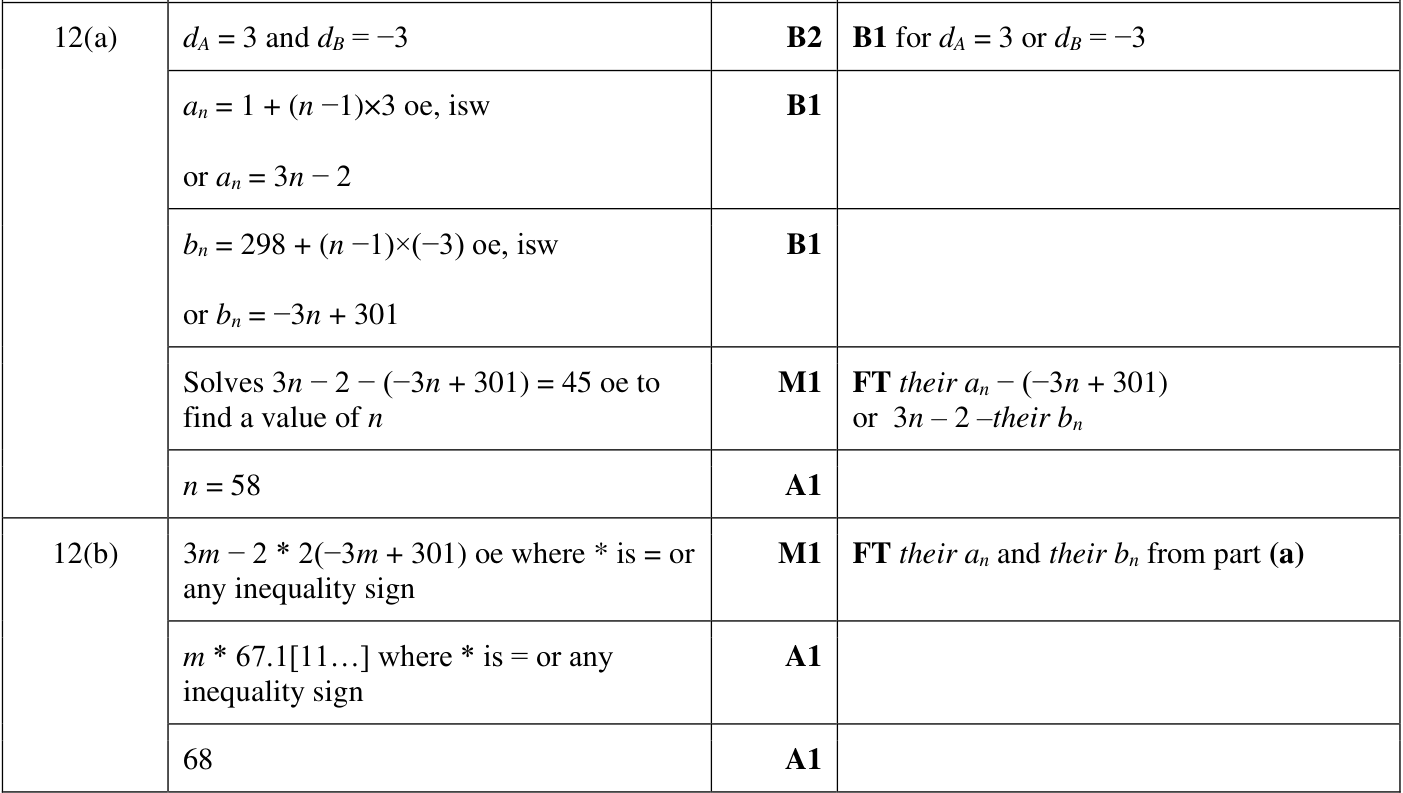
Two arithmetic progressions, \(A\) and \(B\), each have 100 terms. Their terms are denoted by \(a_{1}, a_{2}, a_{3}, a_{4}, \ldots a_{100}\) and \(b_{1}, b_{2}, b_{3}, b_{4}, \ldots b_{100}\) respectively.
It is given that \(a_{1}=b_{100}=1\) and \(a_{100}=b_{1}=298\). (a) Find \(n\) such that \(a_{n}-b_{n}=45\). (b) Find the smallest \(m\) such that \(a_{m}\gt 2 b_{m}\).
0606 P11 - Nov 2022 - Q5 - 6 marks
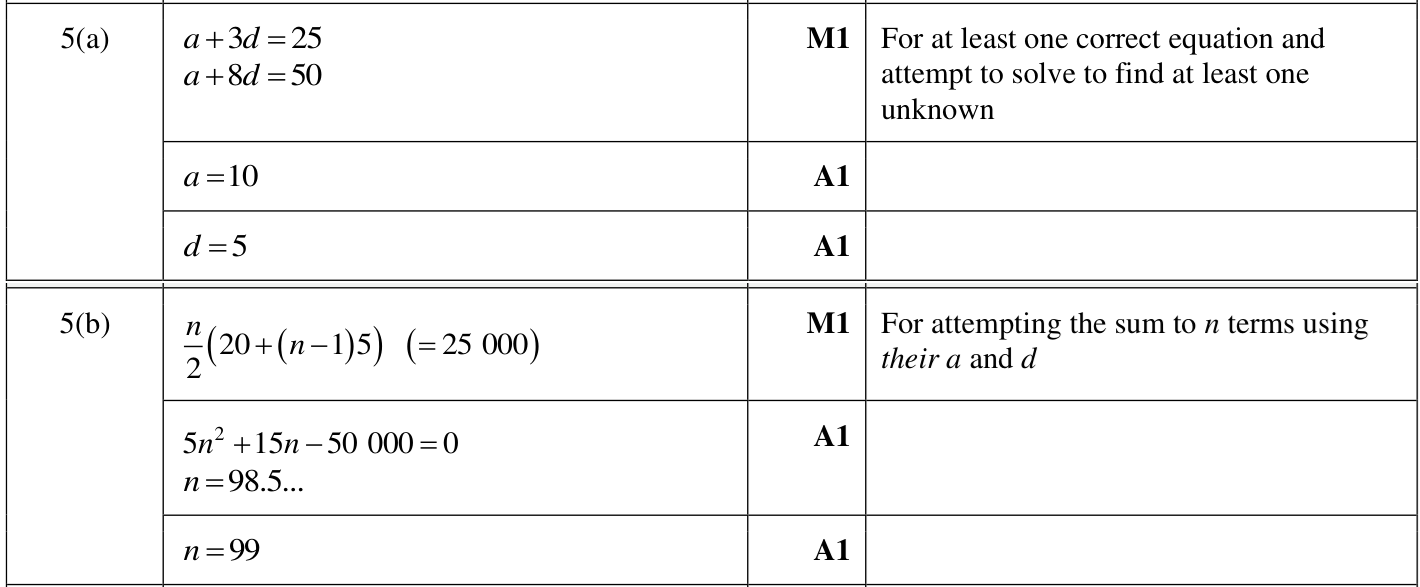
An arithmetic progression is such that the fourth term is \(25\) and the ninth term is \(50\).
(a) Find the first term and the common difference.
(b) Find the least number of terms for which the sum of the progression is greater than \(25000\).
0606 P12 - Nov 2022 - Q10 - 8 marks
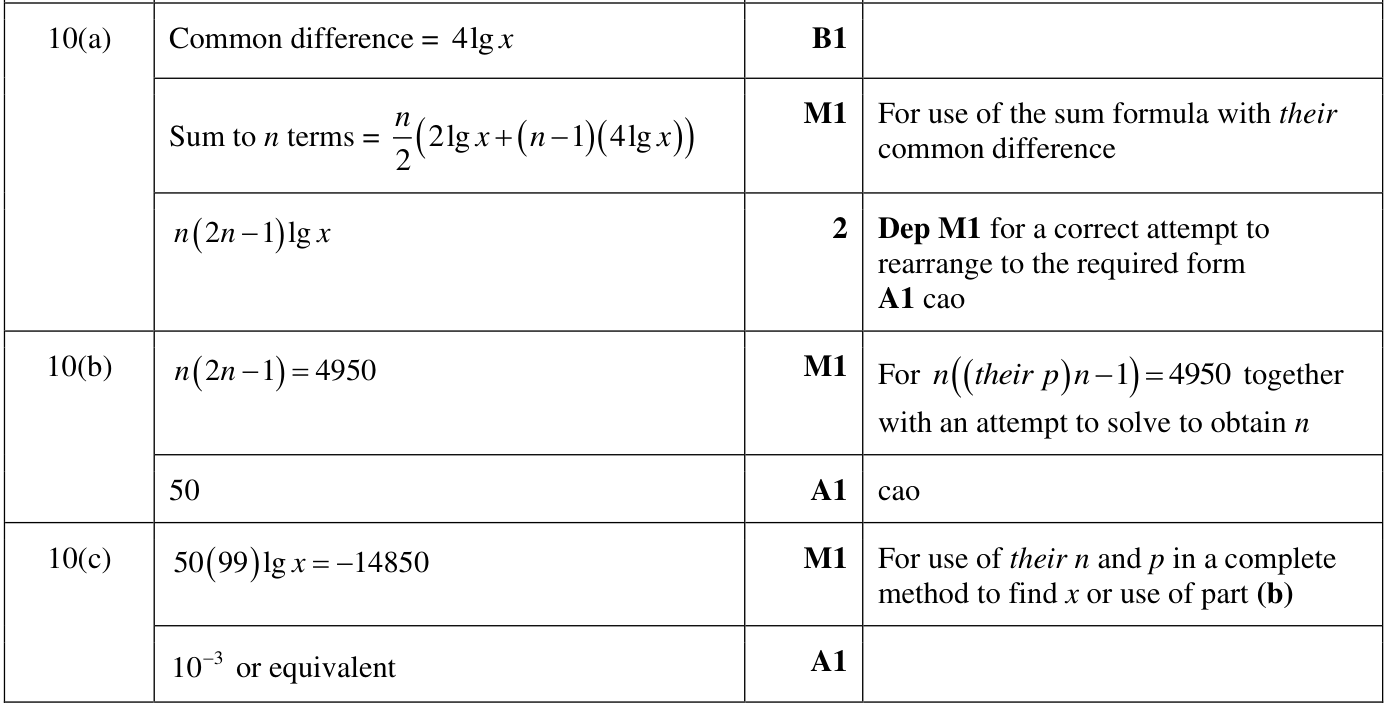
The first three terms of an arithmetic progression are \(\lg x\), \(\lg x^5\), \(\lg x^9\), where \(x\gt 0\).
(a) Show that the sum to \(n\) terms of this arithmetic progression can be written as
\(n(pn-1)\lg x,\)
where \(p\) is an integer.
(b) Hence find the value of \(n\) for which the sum to \(n\) terms is equal to \(4950\lg x\).
(c) Given that this sum to \(n\) terms is also equal to \(-14850\), find the exact value of \(x\).
0606 P23 - Nov 2022 - Q10 - 9 marks
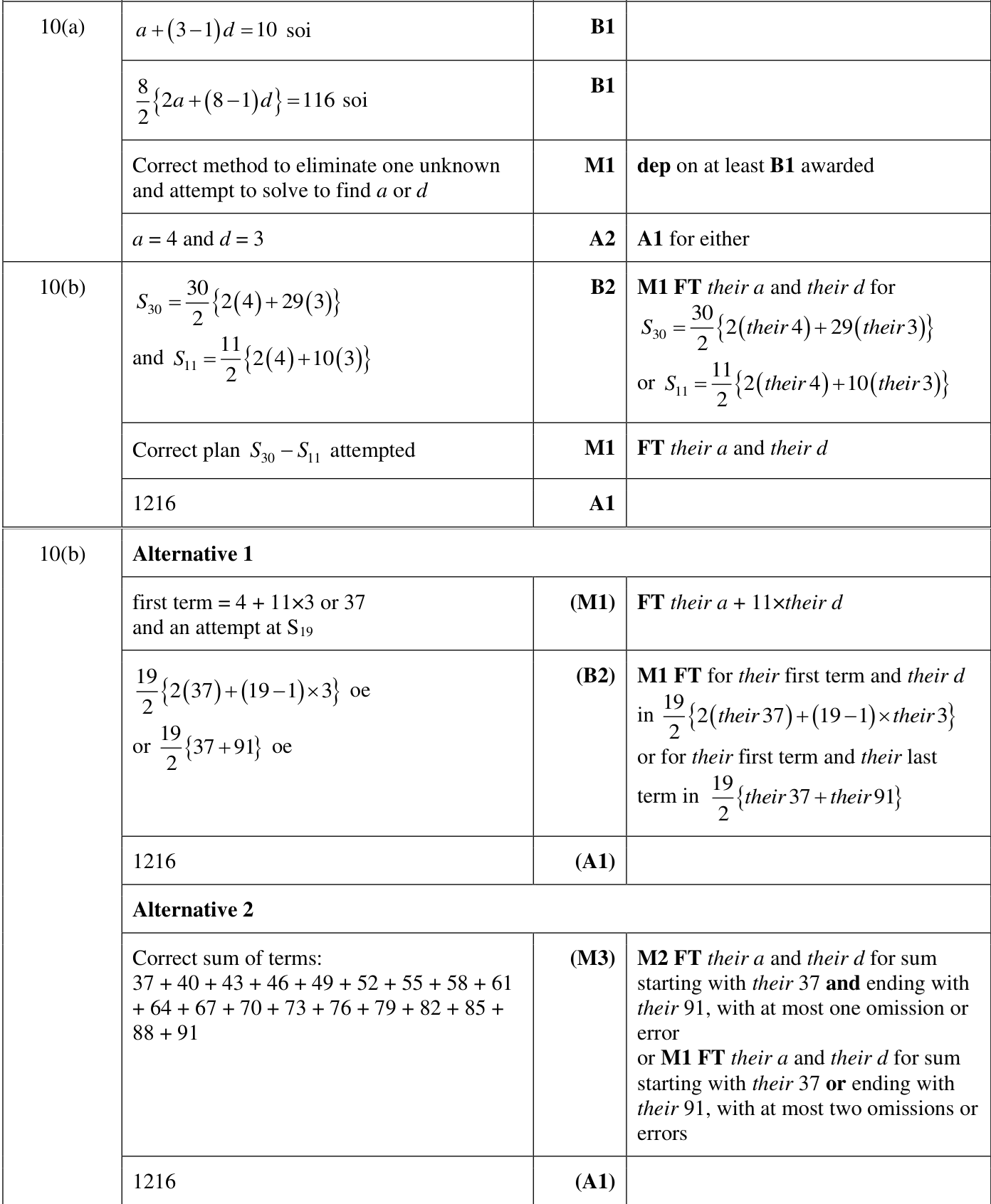
An arithmetic progression has third term \(10\), and the sum of the first \(8\) terms is \(116\).
(a) Find the first term and the common difference.
(b) Find the sum of \(19\) terms of the progression, starting with the twelfth term.
0606 P23 - Nov 2021 - Q9 - 12 marks
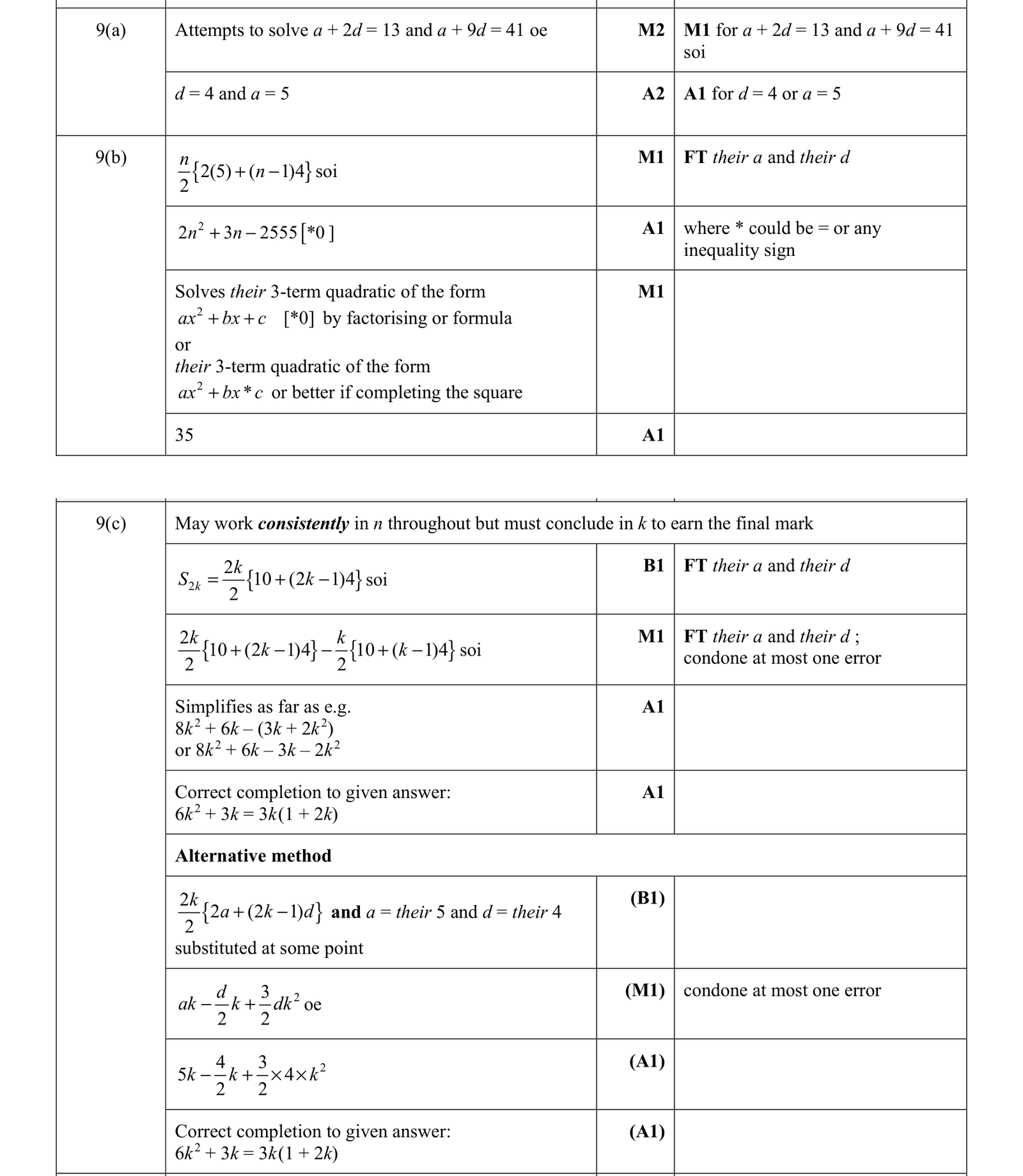
An arithmetic progression has first term \(a\) and common difference \(d\). The third term is \(13\) and the tenth term is \(41\).
(a) Find the value of \(a\) and of \(d\).
(b) Find the number of terms required to give a sum of \(2555\).
(c) Given that \(S_n\) is the sum to \(n\) terms, show that
\(S_{2k}-S_k=3k(1+2k).\)
0606 P12 - Nov 2020 - Q4 - 6 marks
The seventh term of an arithmetic progression is \(158\), and the tenth term is \(149\).
(a) Find the first term and the common difference of the progression.
(b) Find the least value of \(n\) for which the sum of the first \(n\) terms is negative.
