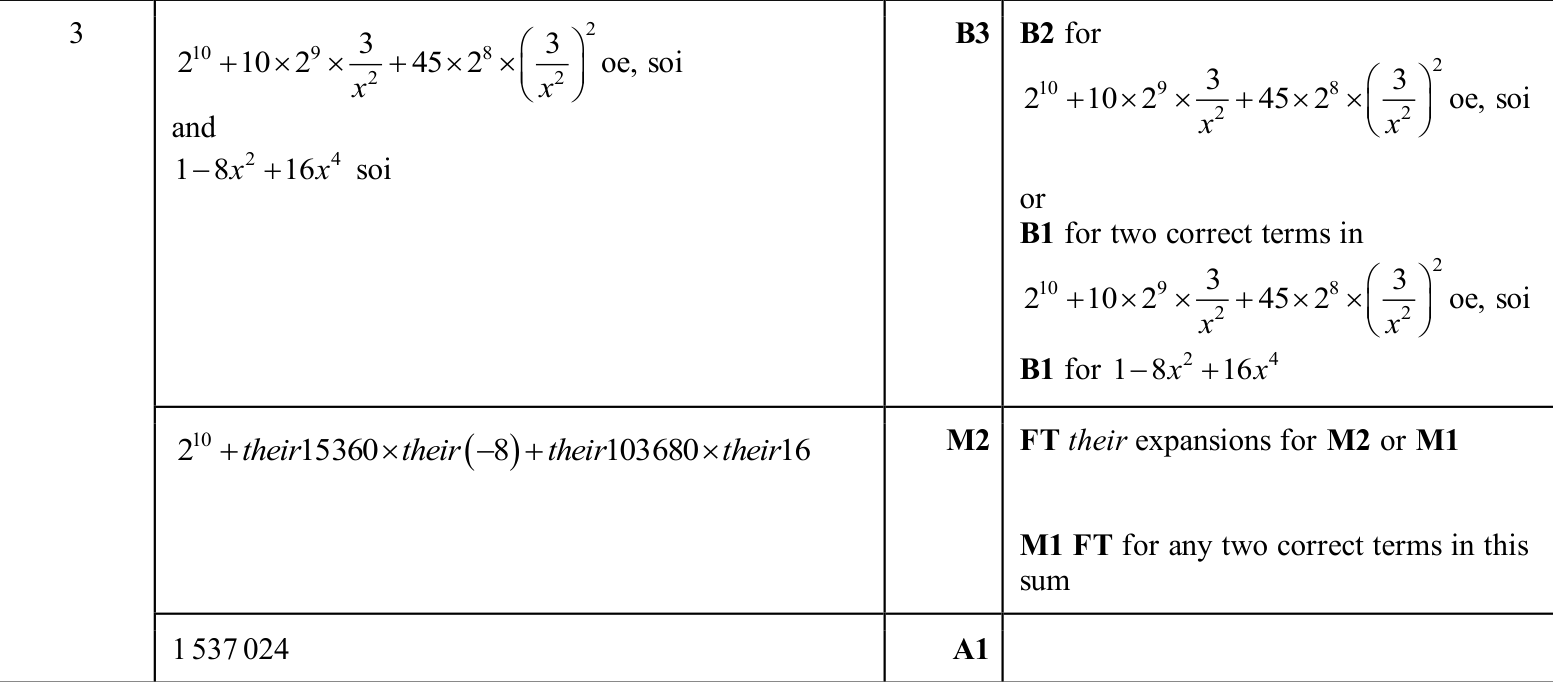
0606 P22 - Nov 2025 - Q3 - 6 marks
Find the exact value of the term independent of \(x\) in the expansion of
\(\left(2+\frac{3}{x^2}\right)^{10}(1-4x^2)^2.\)
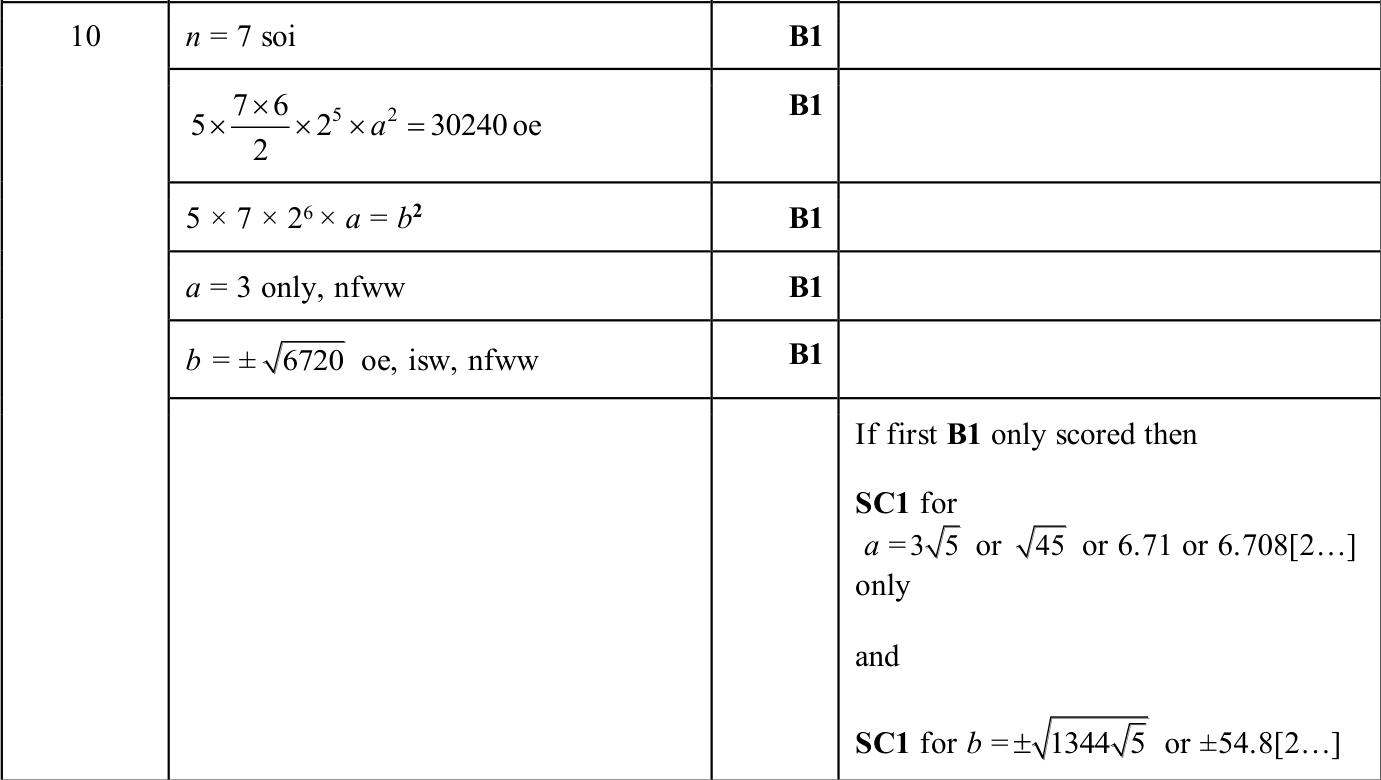
0606 P21 - Nov 2025 - Q10 - 5 marks
In this question \(a\), \(b\) and \(n\) are constants. When \(5(2+ax)^n\) is written in ascending powers of \(x\), the first three terms are \(640+b^2x+30240x^2\).
Find the value of \(a\) and the possible values of \(b\).
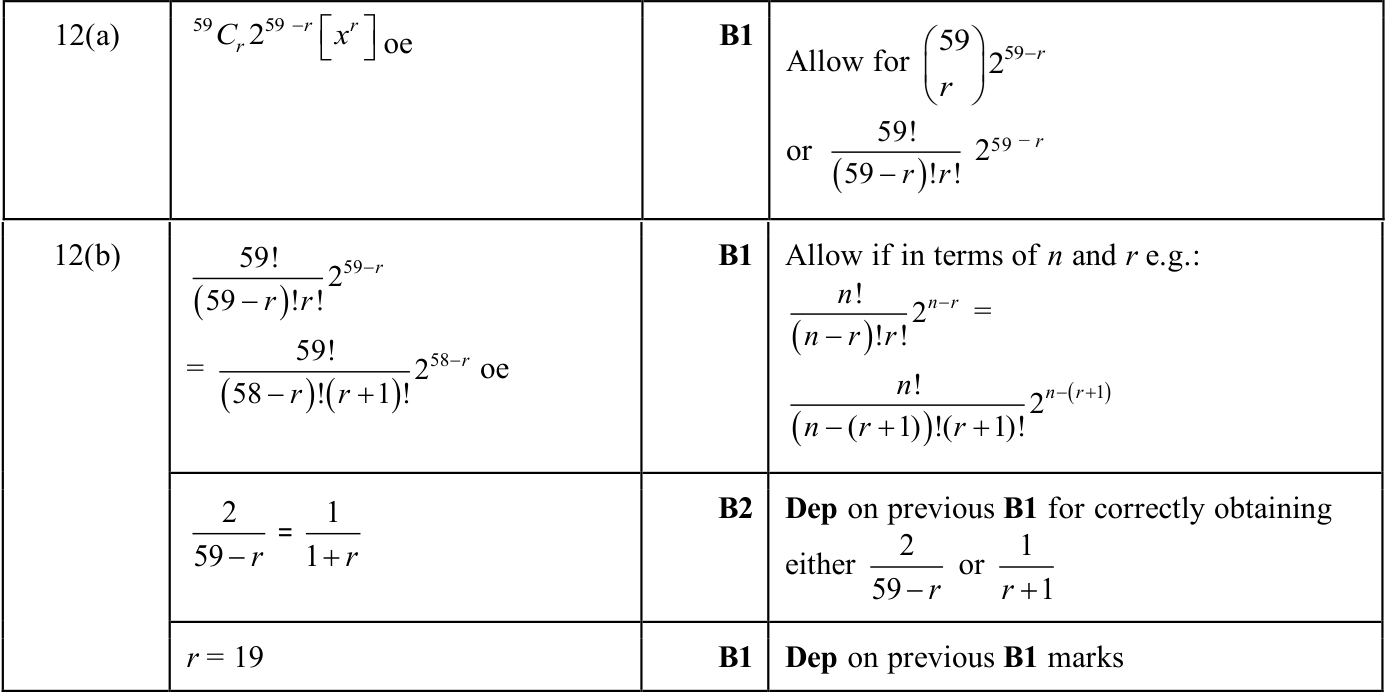
0606 P13 - Nov 2025 - Q12 - 5 marks
(a) Write down the coefficient of \(x^r\) in the binomial expansion of \((2+x)^{59}\).
(b) For this expansion, find the value of \(r\) for which the coefficient of \(x^r\) is equal to the coefficient of \(x^{r+1}\).
0606 P21 - Jun 2025 - Q6 - 6 marks
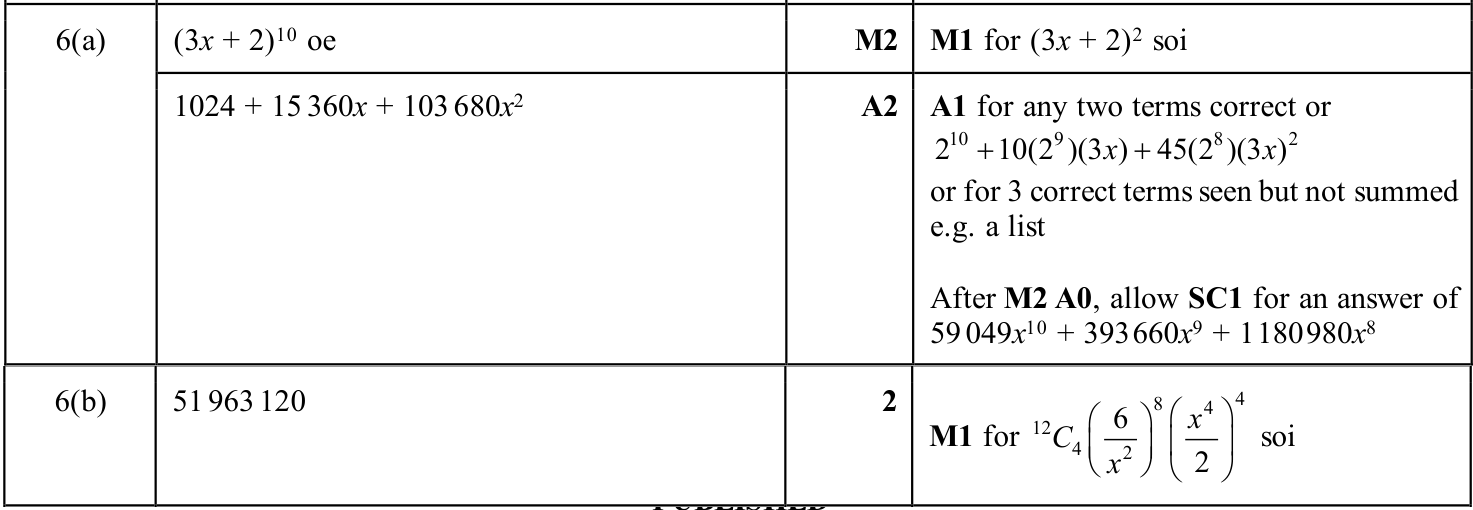
(a) Using an appropriate quadratic factorisation, find the first three terms in the binomial expansion of \(\left(9 x^{2}+12 x+4\right)^{5}, \quad\) in ascending powers of \(x\). You must simplify your coefficients.
(b) Find the term independent of \(x\) in the expansion of \(\left(\frac{6}{x^{2}}+\frac{x^{4}}{2}\right)^{12}\).
0606 P22 - Jun 2025 - Q10 - 9 marks
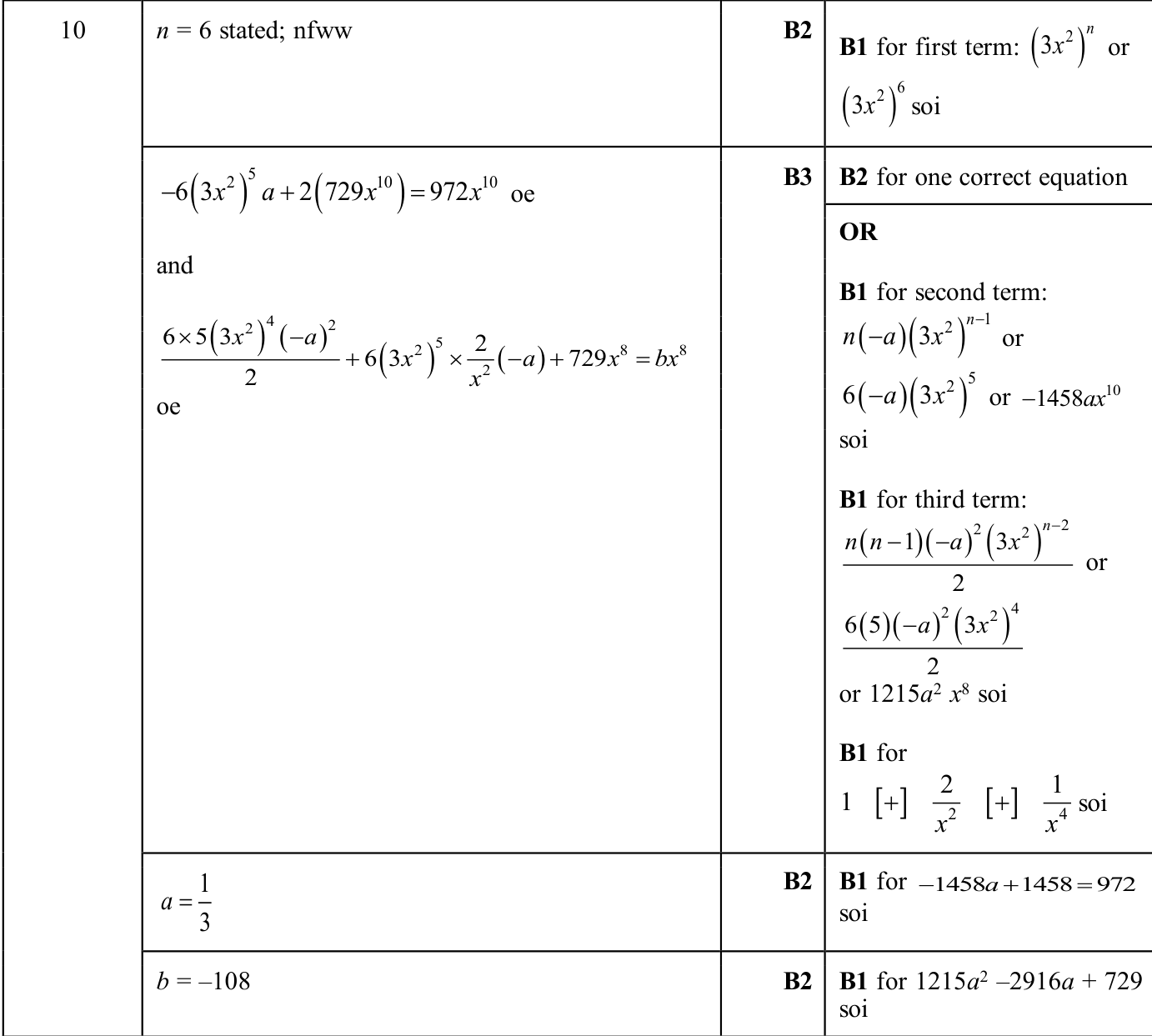
The first three terms, in descending powers of \(x\), in the expansion of \(\left(3 x^{2}-a\right)^{n}\left(1+\frac{1}{x^{2}}\right)^{2}\) can be written as \(\quad 729 x^{12}+972 x^{10}+b x^{8}, \quad\) where \(a, b\) and \(n\) are constants.
Find the values of \(a, b\) and \(n\).
0606 P23 - Jun 2025 - Q7 - 6 marks
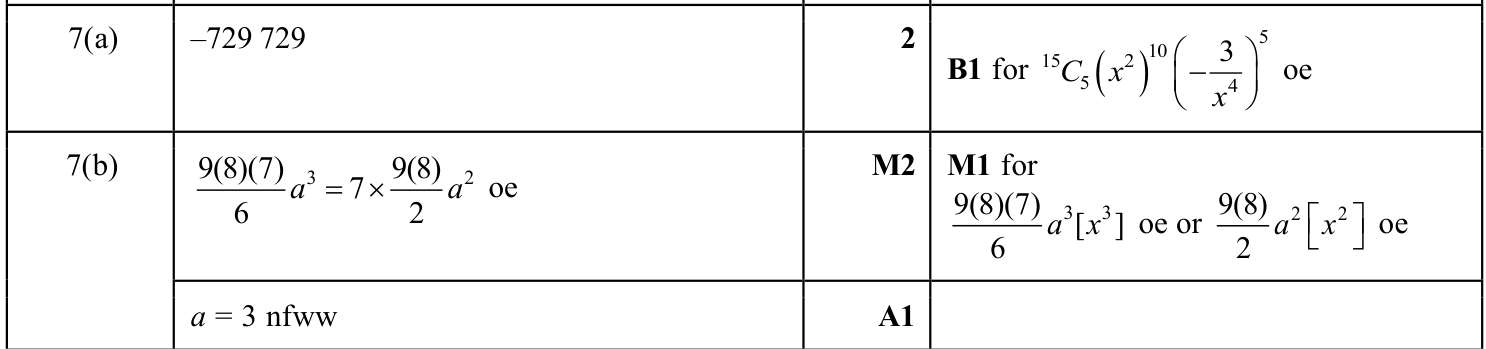
(a) Find the term independent of \(x\) in the expansion of \(\left(x^{2}-\frac{3}{x^{4}}\right)^{15}\). (b) In the expansion of \((1+a x)^{9}\) the coefficient of \(x^{3}\) is 7 times the coefficient of \(x^{2}\). Given that \(a\) is a positive constant, find the value of \(a\).
0606 P22 - Mar 2025 - Q10 - 10 marks
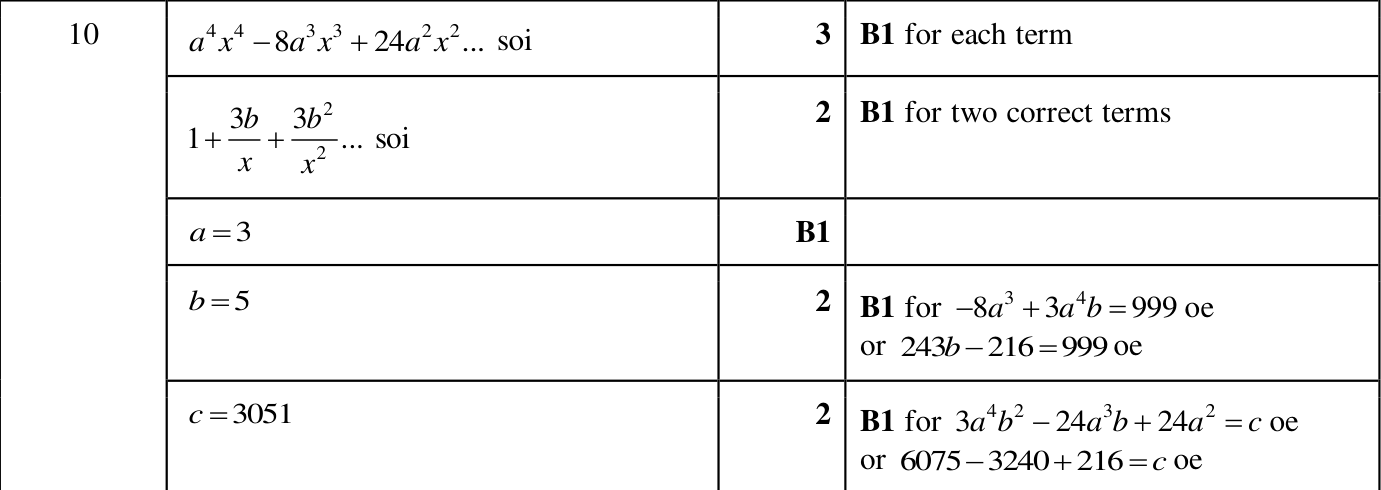
The expansion of \((ax-2)^4\left(1+\frac{b}{x}\right)^3\) is written in descending powers of \(x\).
The first 3 terms of this expansion are \(81x^4+999x^3+cx^2\).
It is given that \(a\), \(b\) and \(c\) are positive integers.
Find the values of \(a\), \(b\) and \(c\).
0606 P11 - Nov 2024 - Q5 - 4 marks
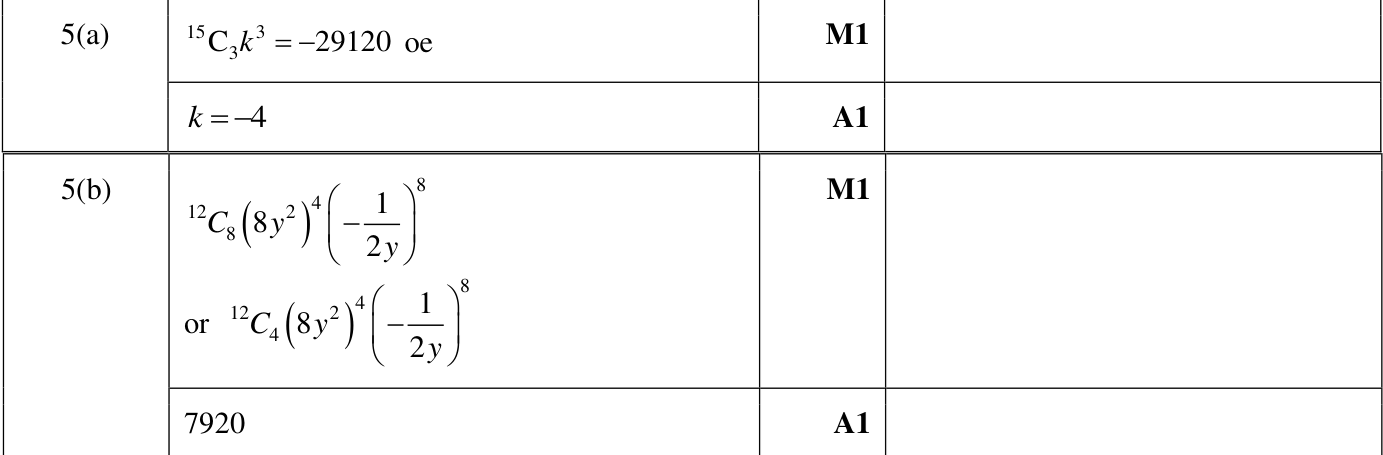
(a) In the expansion of \((1+k x)^{15}\), where \(k\) is a constant, the coefficient of \(x^{3}\) is -29120 . Find the value of \(k\). (b) Find the term independent of \(y\) in the expansion of \(\left(8 y^{2}-\frac{1}{2 y}\right)^{12}\).
0606 P12 - Nov 2024 - Q6 - 7 marks
(a) Find, in descending powers of \(x\), the first 3 terms in the expansion of \(\left(x+\frac{2}{x^{2}}\right)^{10}\). Simplify each term as far as possible. term as far as possible.
(b) Find the term independent of \(x\) in the expansion of \(\left(4 x^{2}+\frac{1}{2 x^{2}}\right)^{8}\).

0606 P23 - Nov 2024 - Q7 - 7 marks
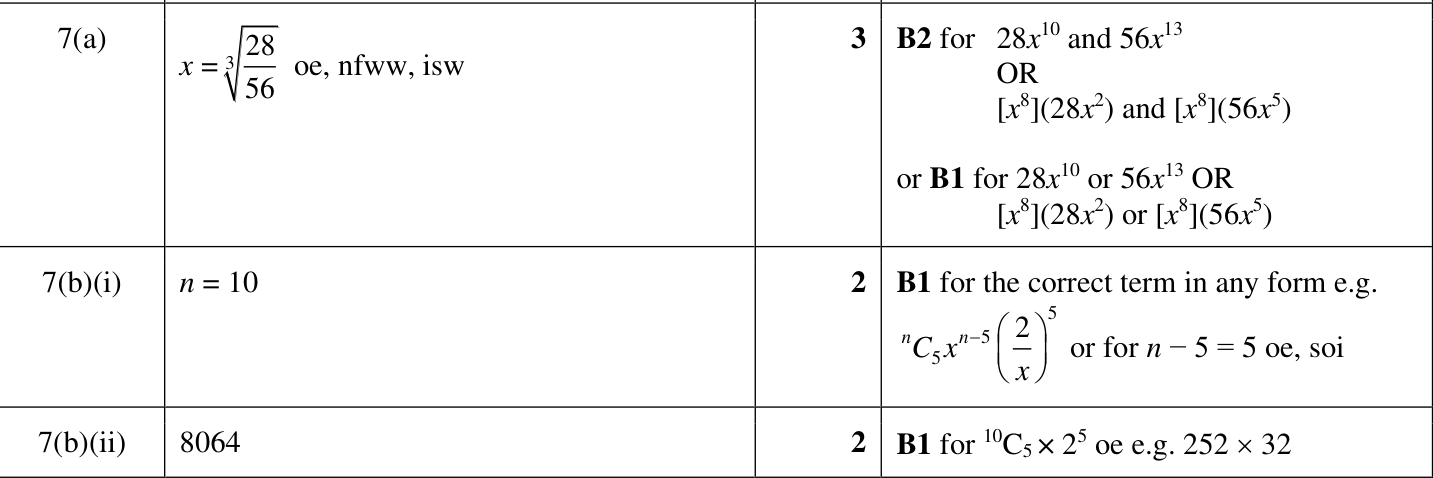
(a) In the expansion of \(\left(x+x^{2}\right)^{8}\) in ascending powers of \(x\), the 3rd and 6th terms are equal. Find the value of \(x\).
(b) In the expansion of \(\left(x+\frac{2}{x}\right)^{n}\) in decreasing powers of \(x\), the 6th term is a constant. (i) Find the value of the positive integer \(n\).
(ii) Find the value of the 6th term.
0606 P22 - Mar 2024 - Q10 - 10 marks
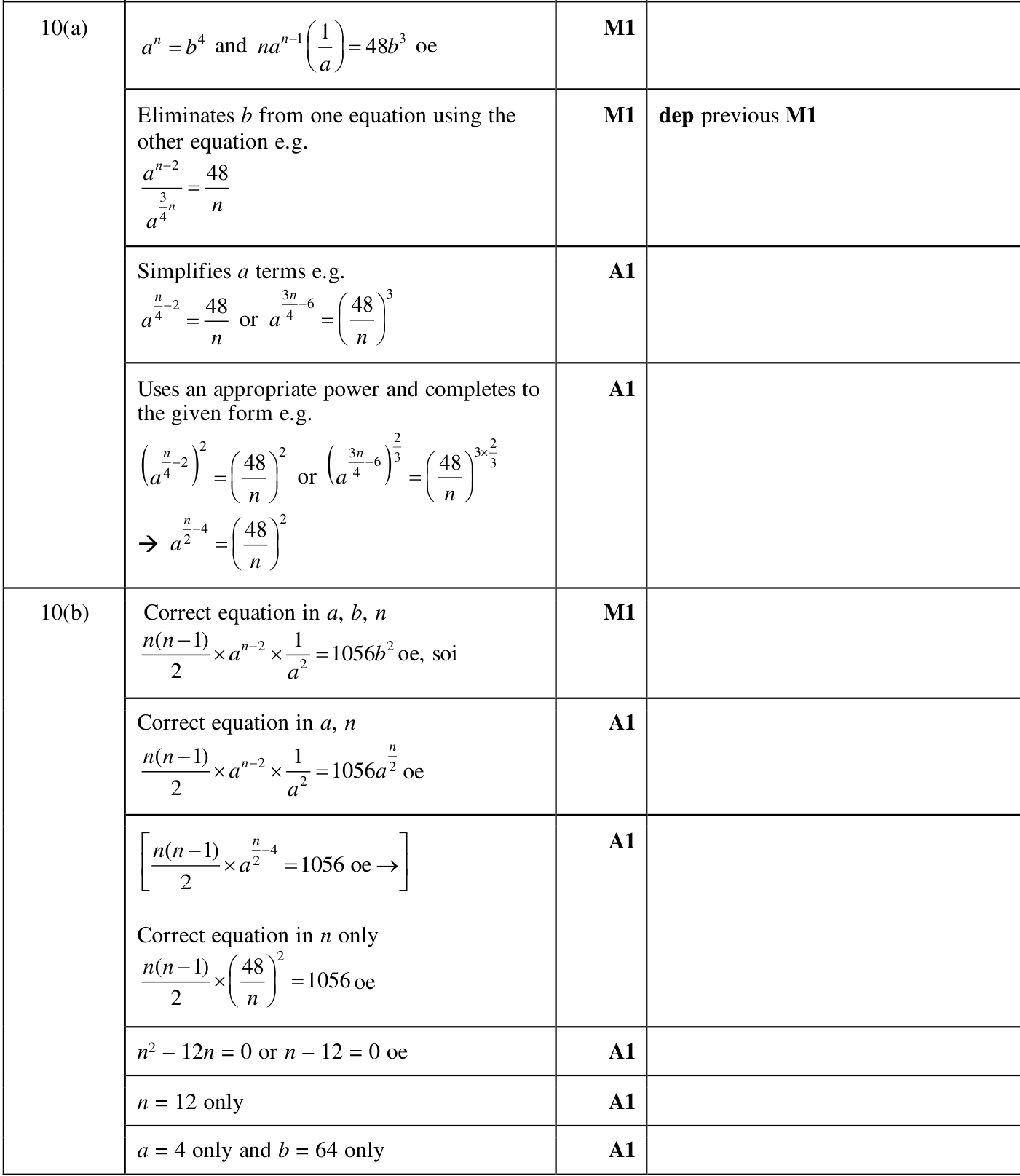
The expansion of \(\left(a+\frac{x}{a}\right)^{n}\) in ascending powers of \(x\) begins \(b^{4}+48 b^{3} x\), where \(n, a\) and \(b\) are positive integers. (a) Show that \(a^{\frac{n}{2}-4}=\left(\frac{48}{n}\right)^{2}\). (b) Given also that the third term is \(1056 b^{2} x^{2}\), find the values of \(n, a\) and \(b\).
0606 P11 - Jun 2024 - Q4 - 7 marks
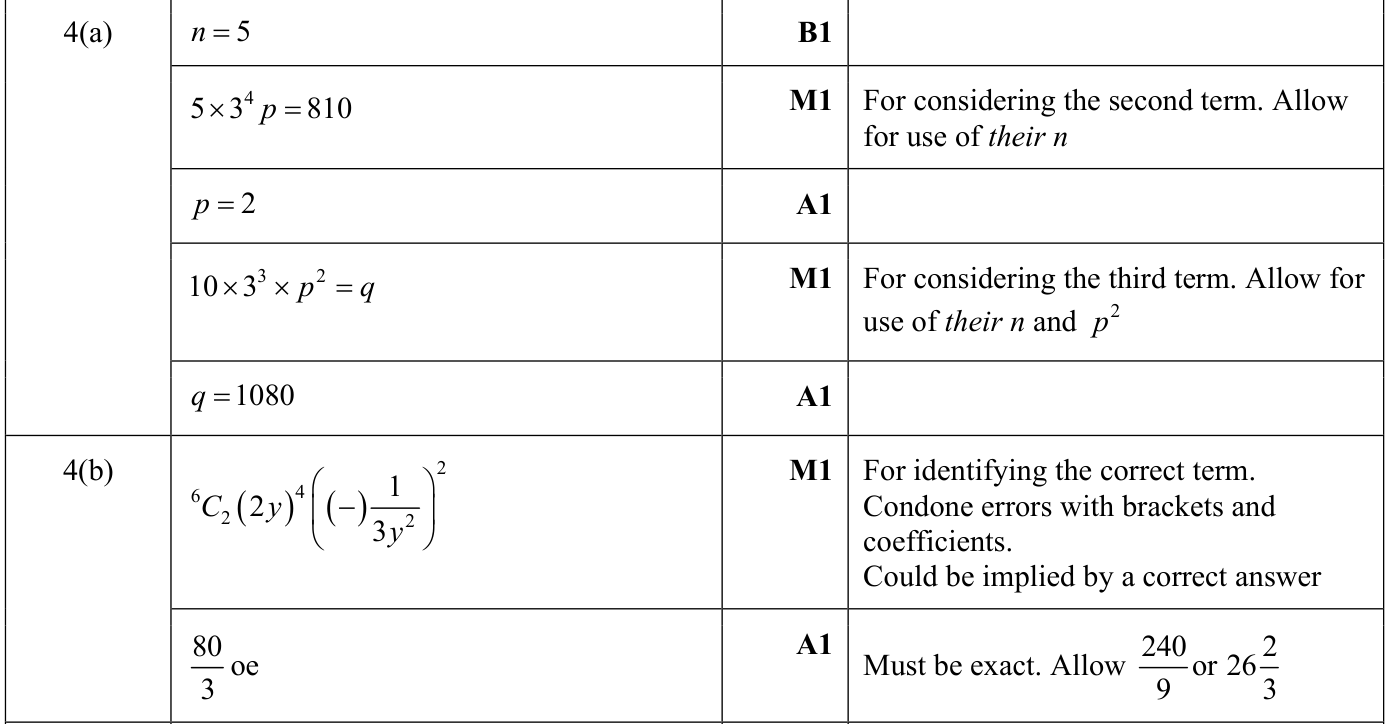
(a) The first three terms, in ascending powers of \(x\), in the expansion of \((3+p x)^{n}\) are \(243+810 x+q x^{2}, \quad\) where \(n, p\) and \(q\) are constants. Find the values of \(n, p\) and \(q\). (b) Find the term independent of \(y\) in the expansion of \(\left(2 y-\frac{1}{3 y^{2}}\right)^{6}\). Give your answer in exact form.
0606 P22 - Jun 2024 - Q11 - 8 marks
In the binomial expansion of \(\left(2+\frac{x}{2}\right)^{n}\), the first three terms in increasing powers of \(x\) are \(b+a b x+\frac{9}{8} a b x^{2}\). Find the values of the constants \(n, a\) and \(b\).
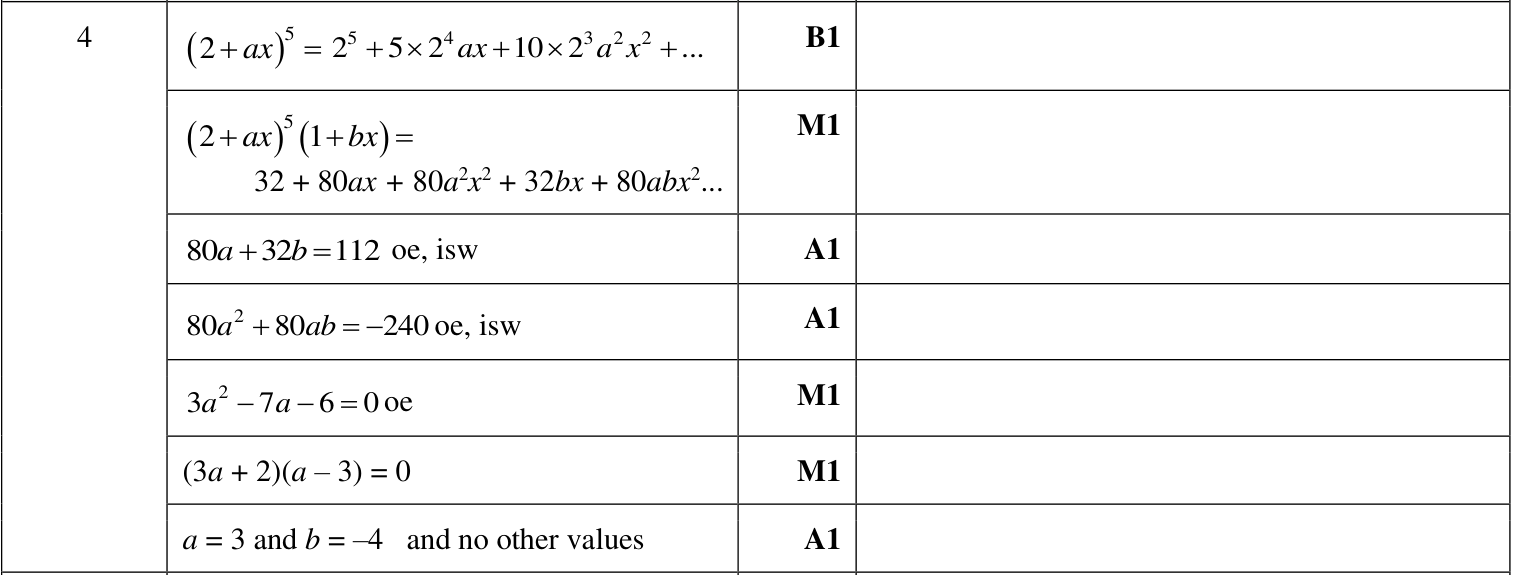
0606 P21 - Nov 2023 - Q4 - 7 marks
In this question \(a\) and \(b\) are integers.
Three terms in the expansion of \((2+ax)^5(1+bx)\) are
\(32+112x-240x^2.\)
Find the values of \(a\) and \(b\).
0606 P23 - Jun 2024 - Q4 - 8 marks
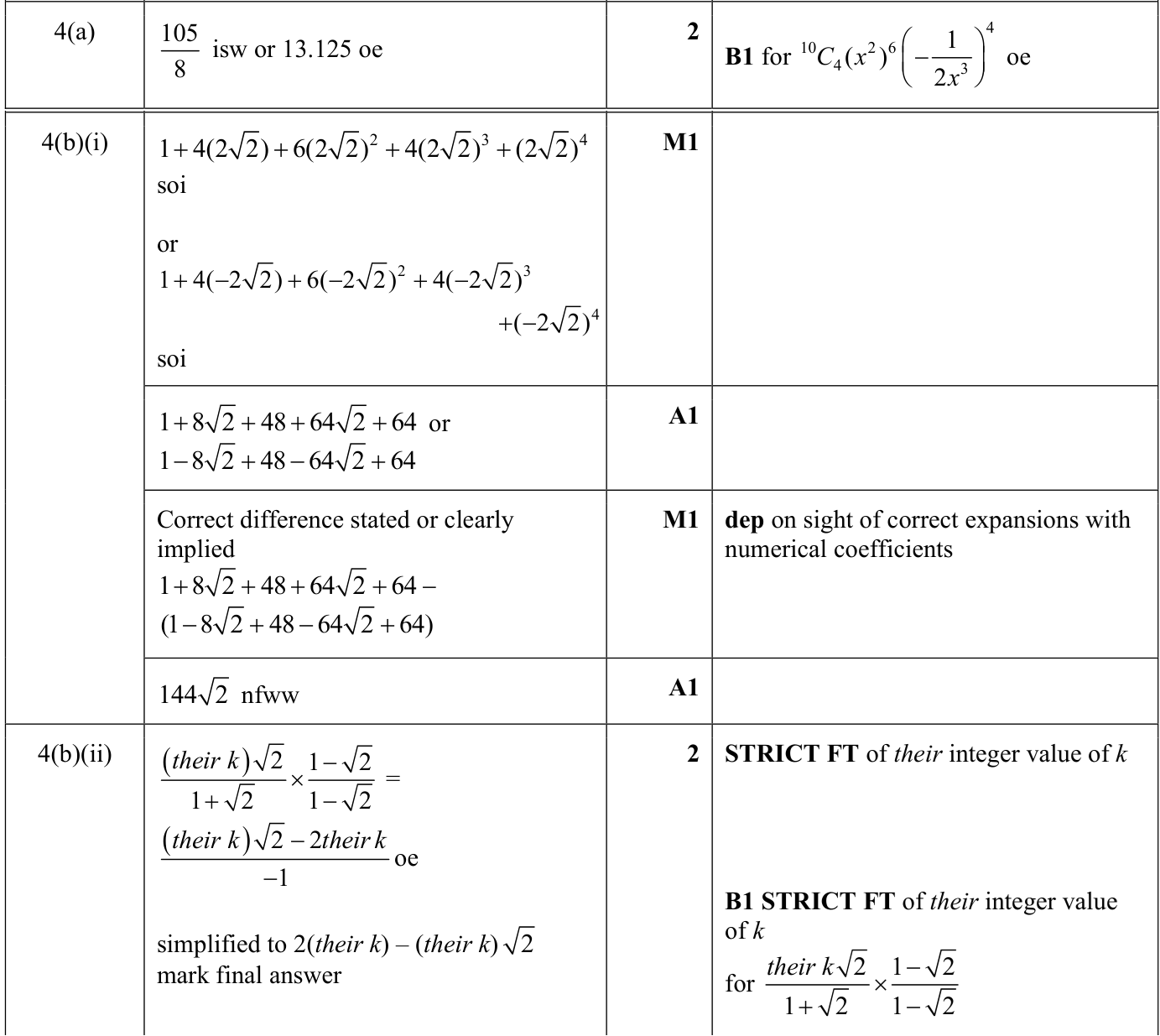
(a) Find and simplify the term independent of \(x\) in the expansion of \(\left(x^{2}-\frac{1}{2 x^{3}}\right)^{10}\). (b) DO NOT USE A CALCULATOR IN THIS PART OF THE QUESTION. (i) Use the binomial theorem to show that \((1+2 \sqrt{2})^{4}-(1-2 \sqrt{2})^{4}=k \sqrt{2}\), where \(k\) is an integer to be found. (ii) Hence write \(\frac{(1+2 \sqrt{2})^{4}-(1-2 \sqrt{2})^{4}}{1+\sqrt{2}}\) in the form \(a+b \sqrt{2}\), where \(a\) and \(b\) are integers.
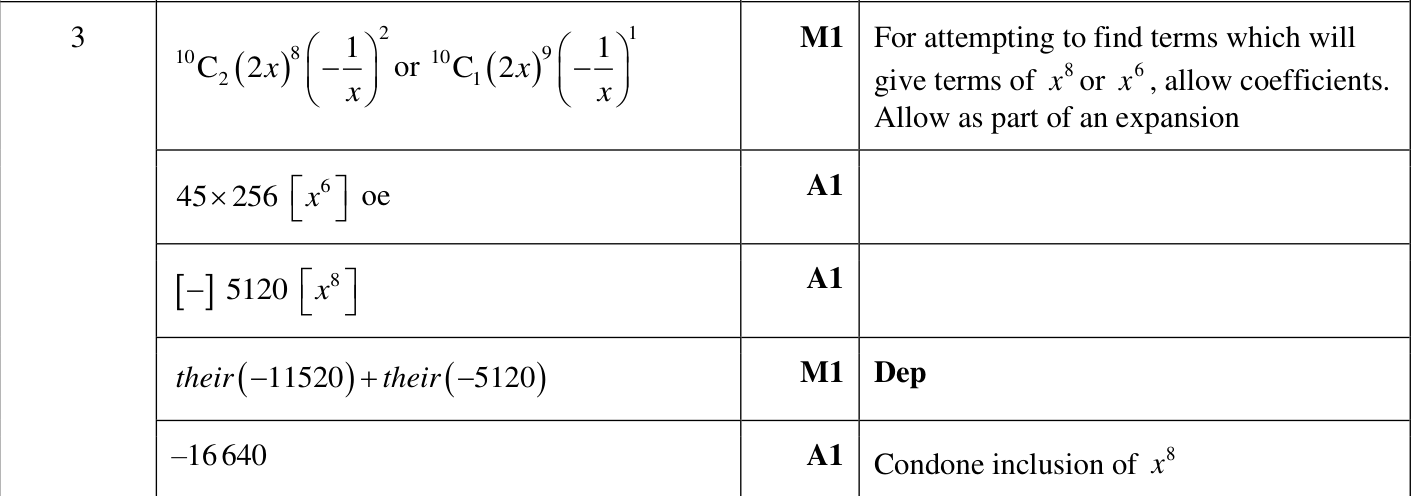
0606 P12 - Mar 2023 - Q3 - 5 marks
Find the coefficient of \(x^8\) in the expansion of
\((1-x^2)\left(2x-\frac1x\right)^{10}.\)
0606 P13 - Jun 2023 - Q5 - 6 marks
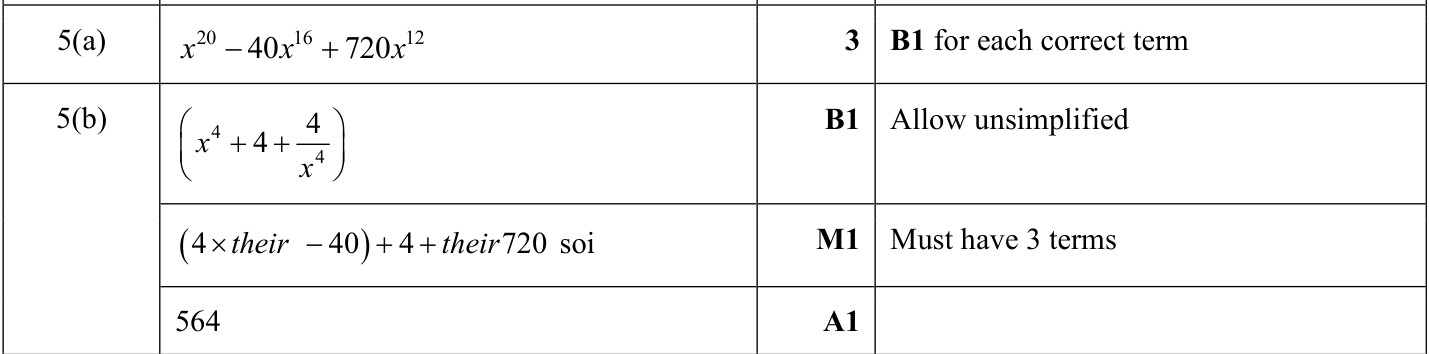
(a) Find the first three terms in the expansion of
\(\left(x^2-\frac4{x^2}\right)^{10}\)
in descending powers of \(x\). Give each term in its simplest form.
(b) Hence find the coefficient of \(x^{16}\) in the expansion of
\(\left(x^2-\frac4{x^2}\right)^{10}\left(x^2+\frac2{x^2}\right)^2.\)
0606 P21 - Jun 2023 - Q10 - 7 marks
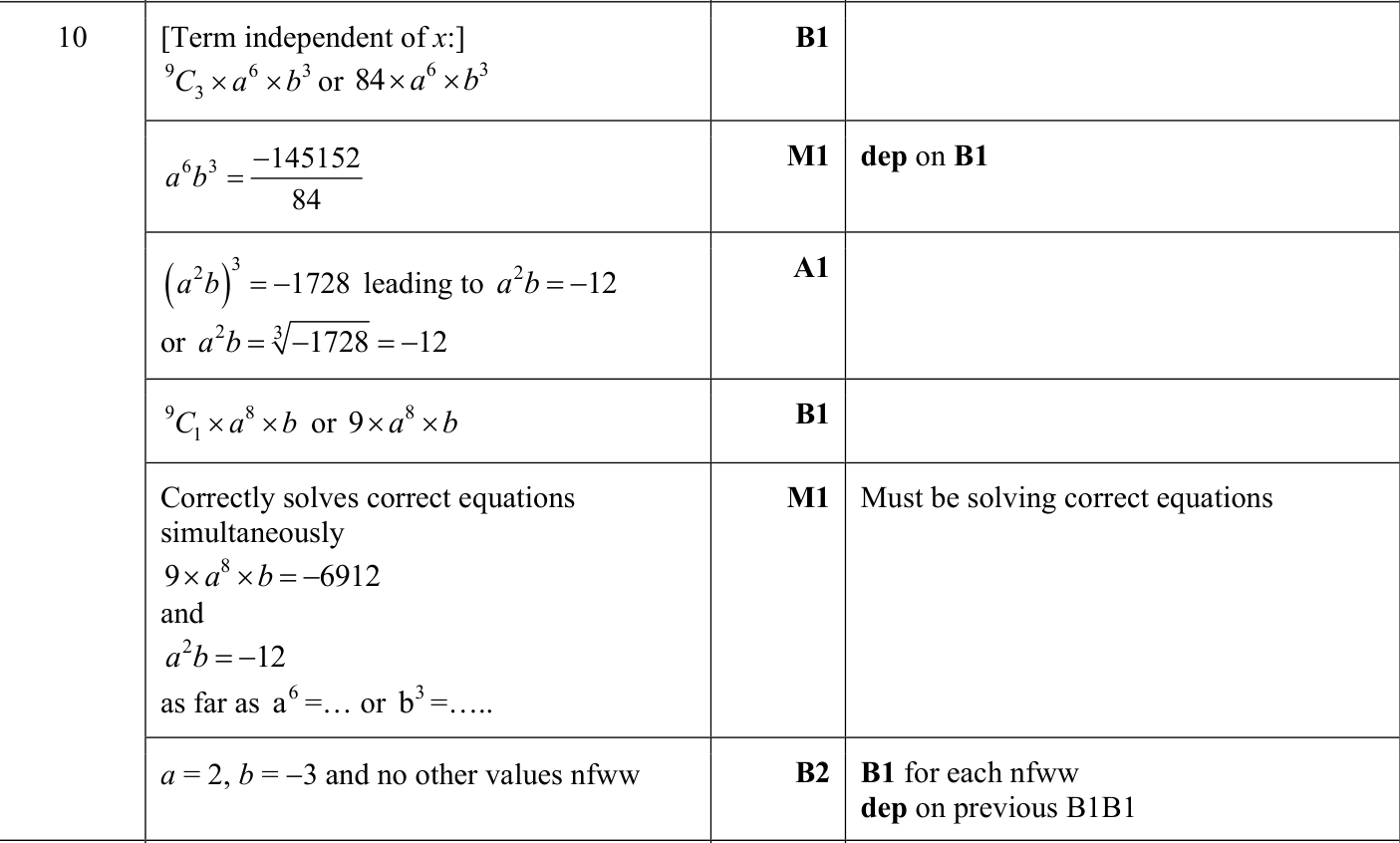
In the expansion of
\(\left(ax+\frac{b}{x^2}\right)^9,\)
where \(a\) and \(b\) are constants with \(a\gt 0\), the term independent of \(x\) is \(-145\,152\) and the coefficient of \(x^6\) is \(-6912\). Show that \(a^2b=-12\) and find the value of \(a\) and the value of \(b\).
0606 P22 - Jun 2023 - Q6 - 9 marks
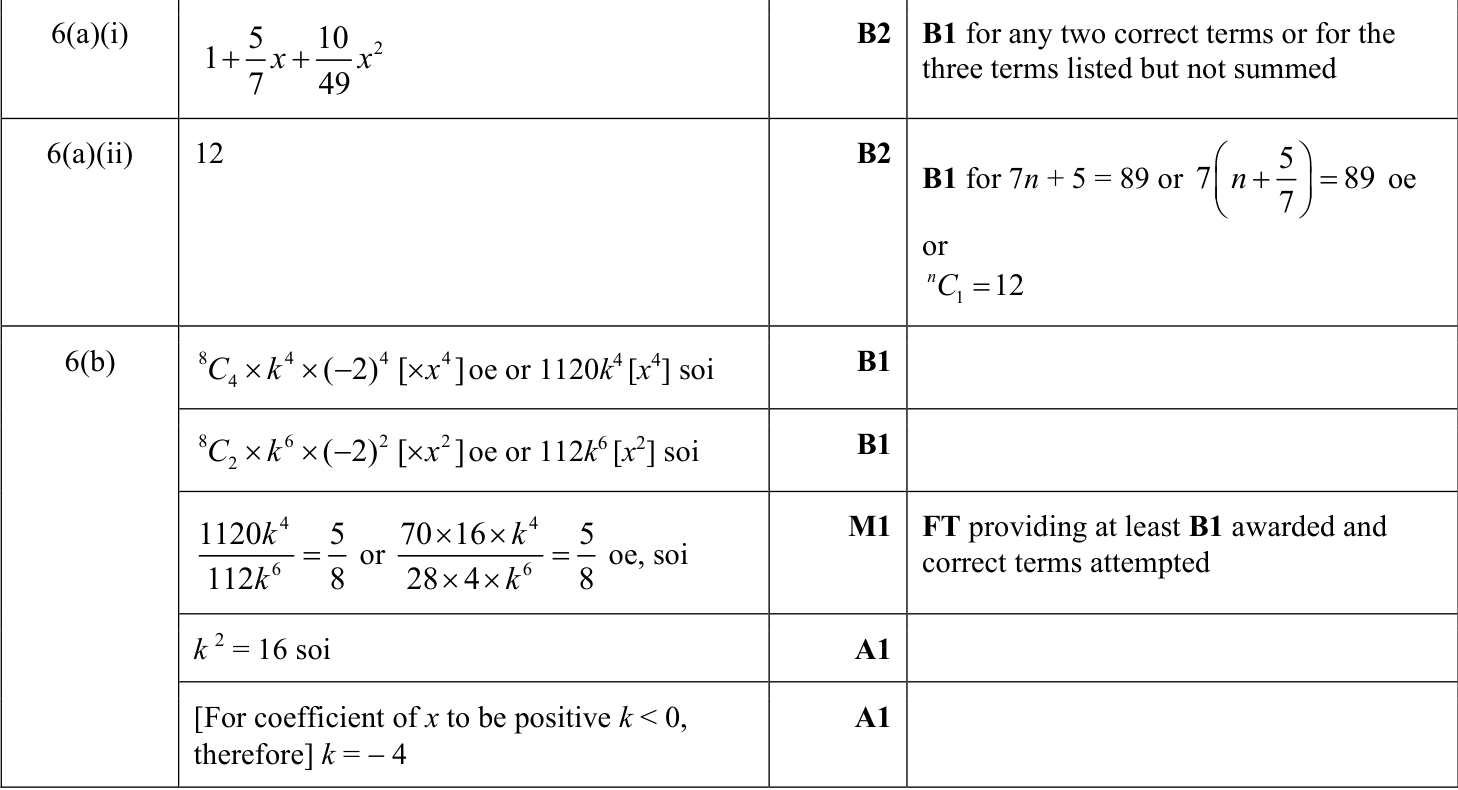
(a)(i) Find the first three terms in the expansion of
\(\left(1+\frac{x}{7}\right)^5\)
in ascending powers of \(x\). Simplify the coefficient of each term.
(a)(ii) The expansion of
\(7(1+x)^n\left(1+\frac{x}{7}\right)^5,\)
where \(n\) is a positive integer, is written in ascending powers of \(x\). The first two terms in the expansion are \(7+89x\). Find the value of \(n\).
(b) In the expansion of \((k-2x)^8\), where \(k\) is a constant, the coefficient of \(x^4\) divided by the coefficient of \(x^2\) is \(\frac58\). The coefficient of \(x\) is positive. Form an equation and hence find the value of \(k\).
0606 P12 - Nov 2023 - Q4 - 7 marks
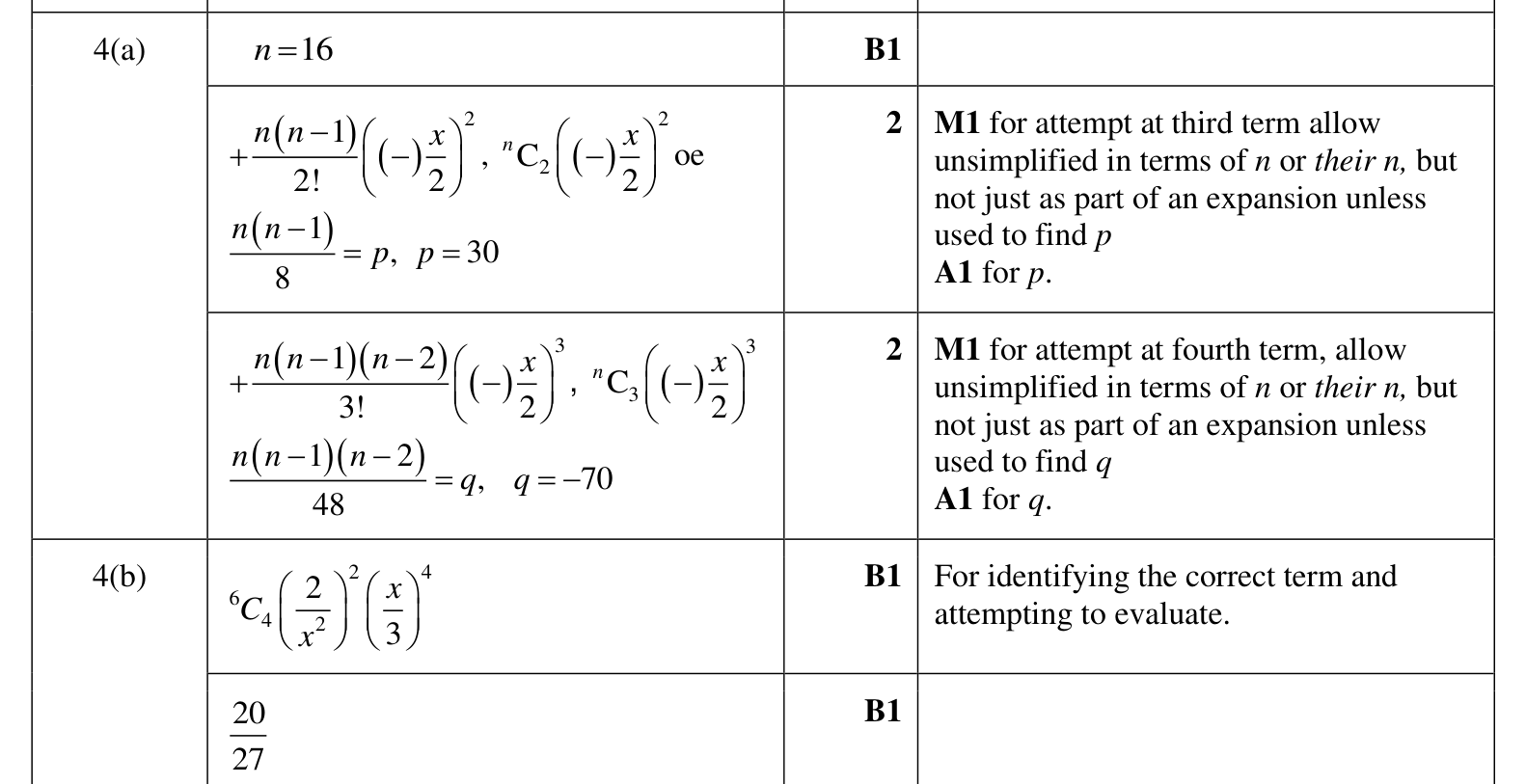
(a) It is given that the first four terms, in ascending powers of \(x\), in the expansion of \(\left(1-\frac{x}{2}\right)^n\) can be written in the form
\(1-8x+px^2+qx^3\),
where \(n\), \(p\) and \(q\) are integers. Find the values of \(n\), \(p\) and \(q\).
(b) Find the term independent of \(x\) in the expansion of \(\left(\frac{2}{x^2}+\frac{x}{3}\right)^6\), giving your answer as a rational number.
0606 P13 - Nov 2023 - Q8 - 6 marks
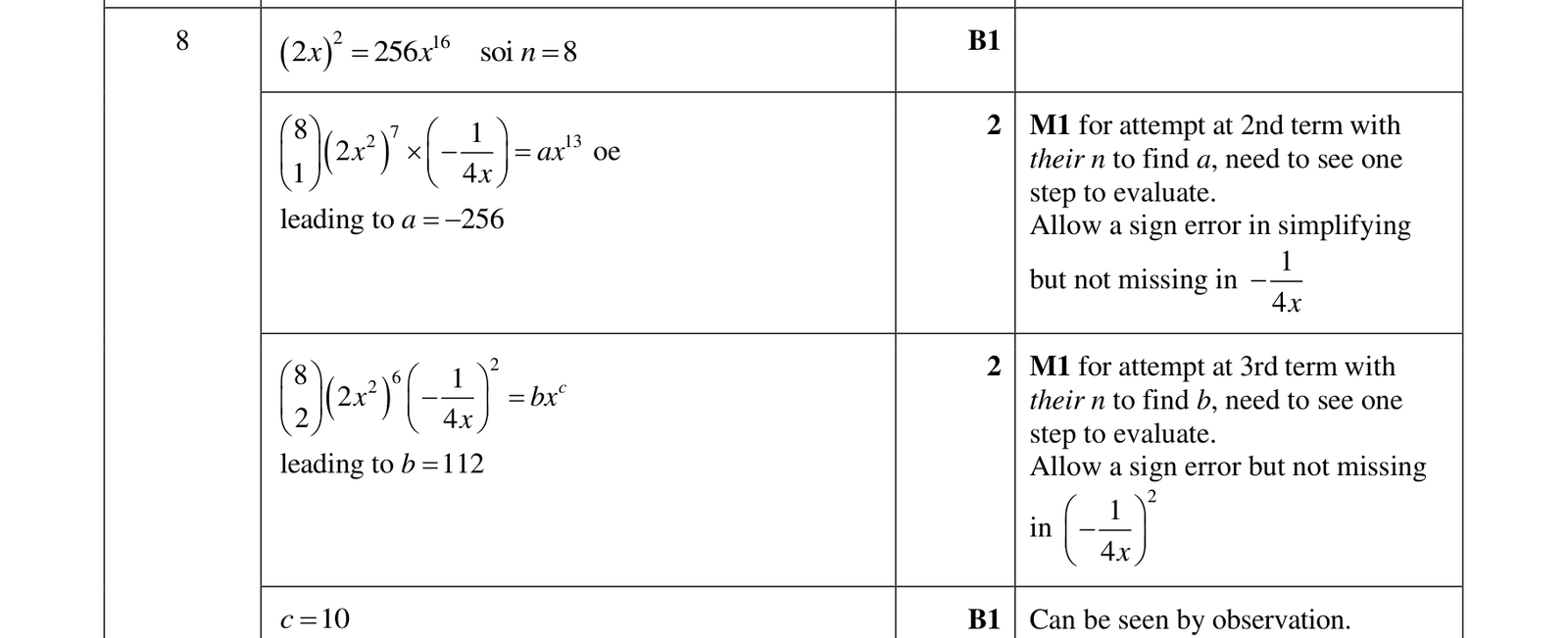
The first three terms, in descending powers of \(x\), in the expansion of
\(\displaystyle \left(2x^2-\frac1{4x}\right)^n\)
can be written in the form
\(256x^{16}+ax^{13}+bx^c\),
where \(n\), \(a\), \(b\) and \(c\) are integers. Find the values of \(n\), \(a\), \(b\) and \(c\).
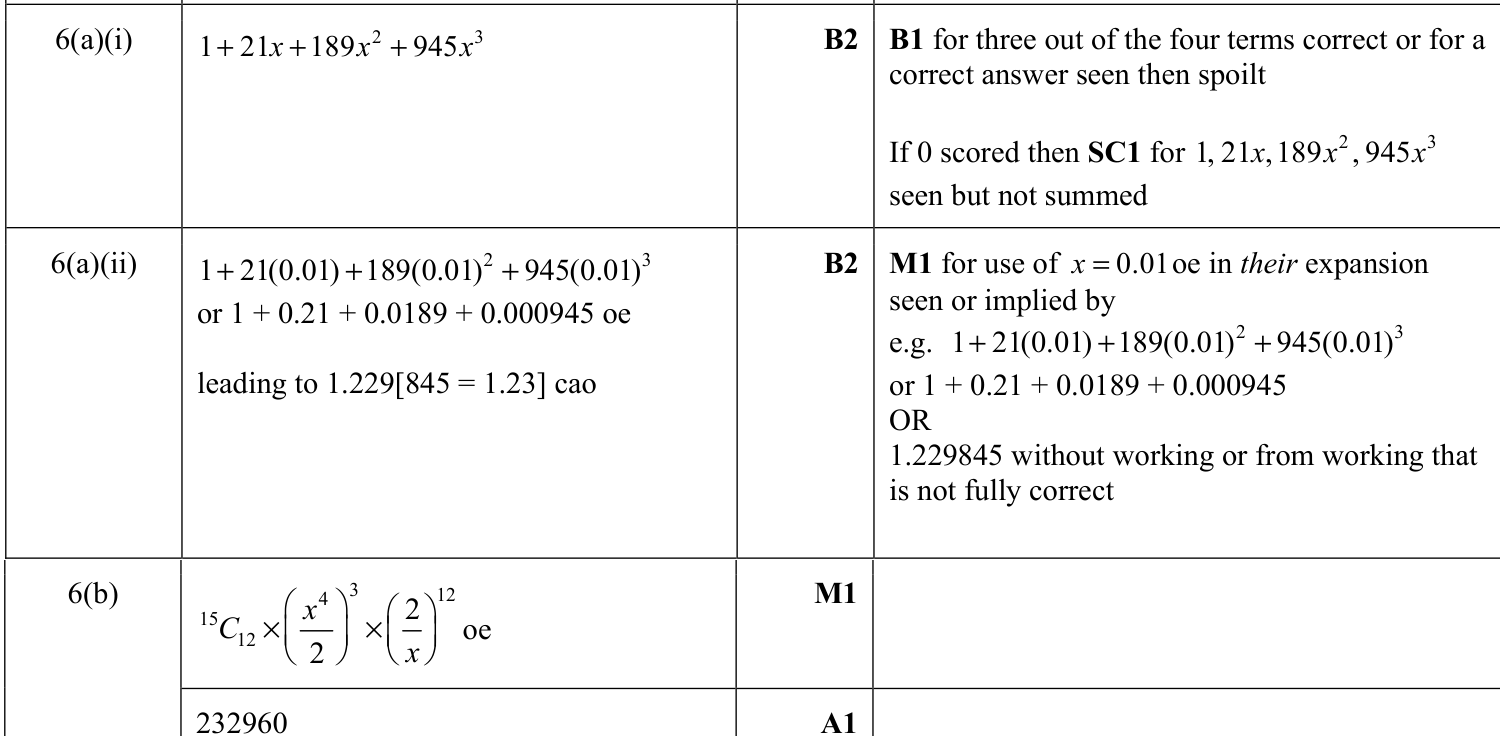
0606 P22 - Mar 2022 - Q6 - 6 marks
(a)(i) Use the binomial theorem to expand \((1+3x)^7\) in ascending powers of \(x\), as far as the term in \(x^3\). Simplify each term.
(a)(ii) Show that your expansion from part (a)(i) gives the value of \(1.03^7\) as \(1.23\) to \(2\) decimal places.
(b) Find the term independent of \(x\) in the expansion of
\(\left(\frac{x^4}{2}+\frac{2}{x}\right)^{15}.\)
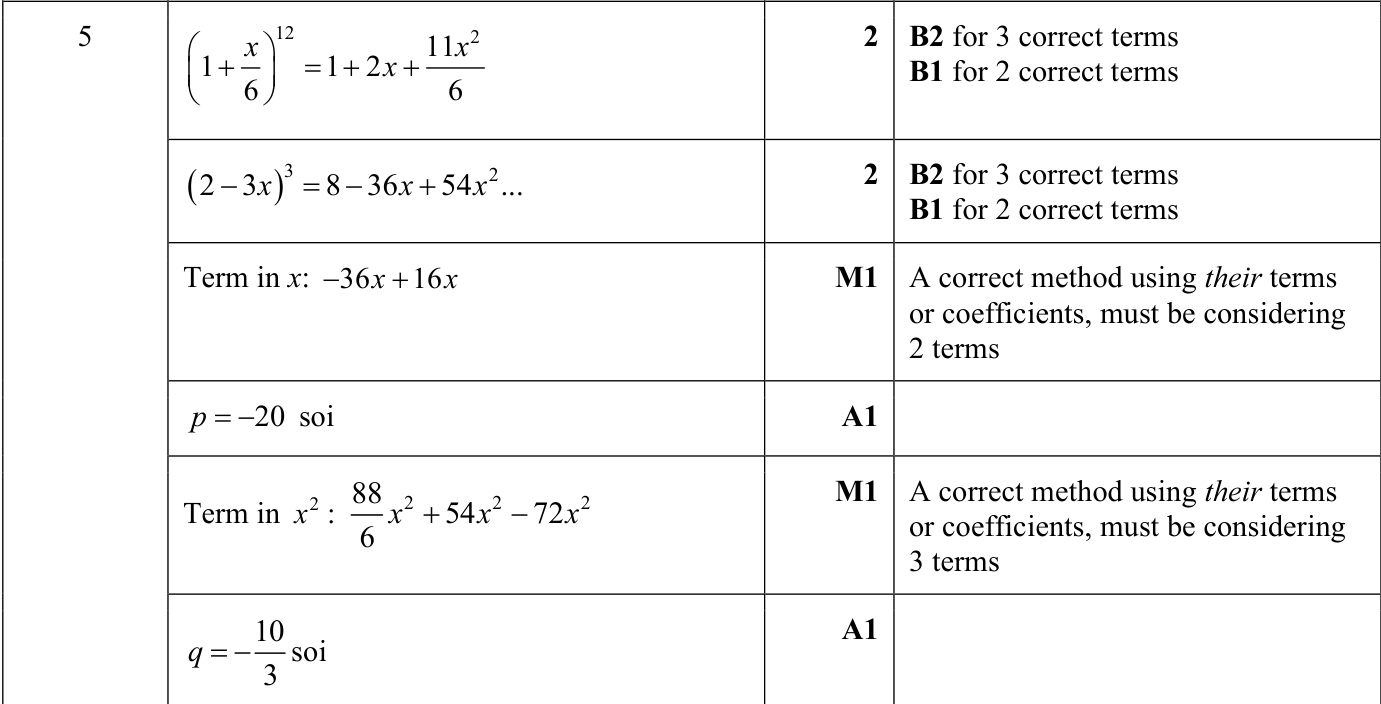
0606 P12 - Jun 2022 - Q5 - 8 marks
The first three terms, in ascending powers of \(x\), in the expansion of
\(\left(1+\frac{x}{6}\right)^{12}(2-3x)^3\)
can be written in the form \(8+px+qx^2\), where \(p\) and \(q\) are constants. Find the values of \(p\) and \(q\).
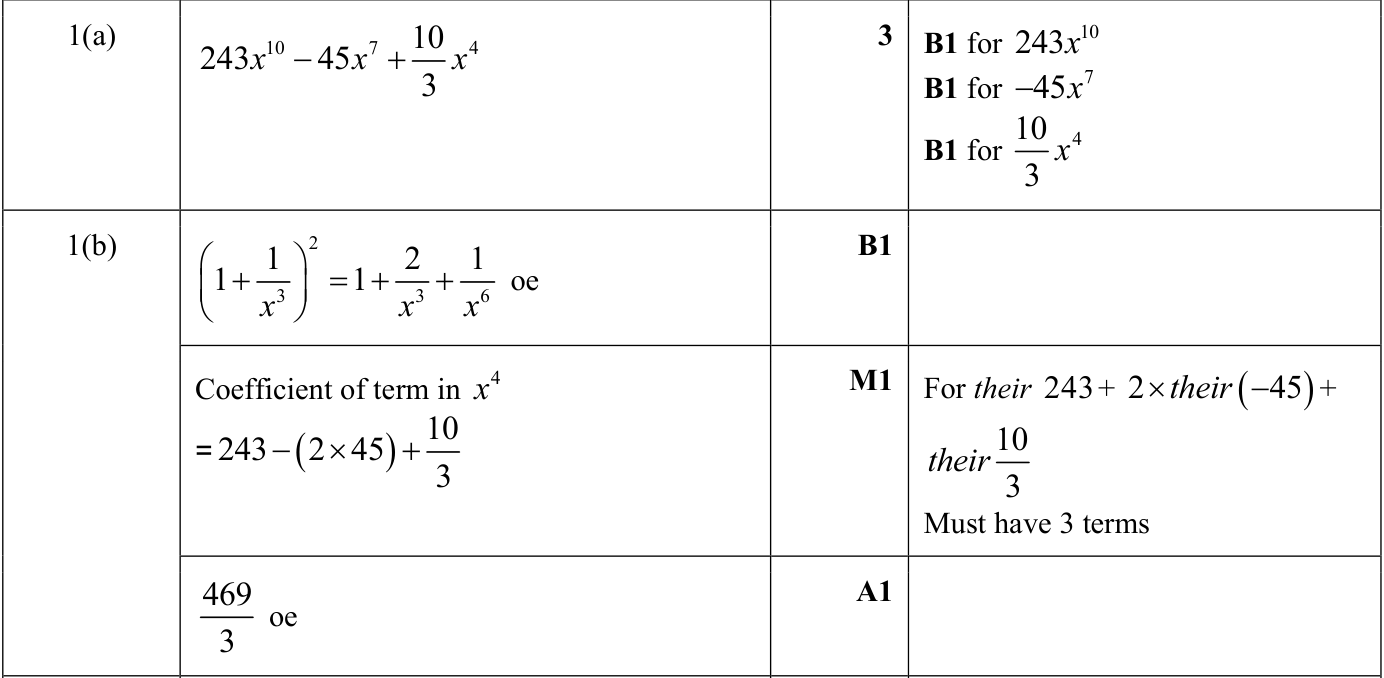
0606 P13 - Jun 2022 - Q1 - 6 marks
(a) Find the rational numbers \(a\), \(b\) and \(c\), such that the first three terms, in descending powers of \(x\), in the expansion of
\(\left(3x^2-\frac{1}{9x}\right)^5\)
can be written in the form \(ax^{10}+bx^7+cx^4\).
(b) Hence find the coefficient of \(x^4\) in the expansion of
\(\left(3x^2-\frac{1}{9x}\right)^5\left(1+\frac{1}{x^3}\right)^2.\)
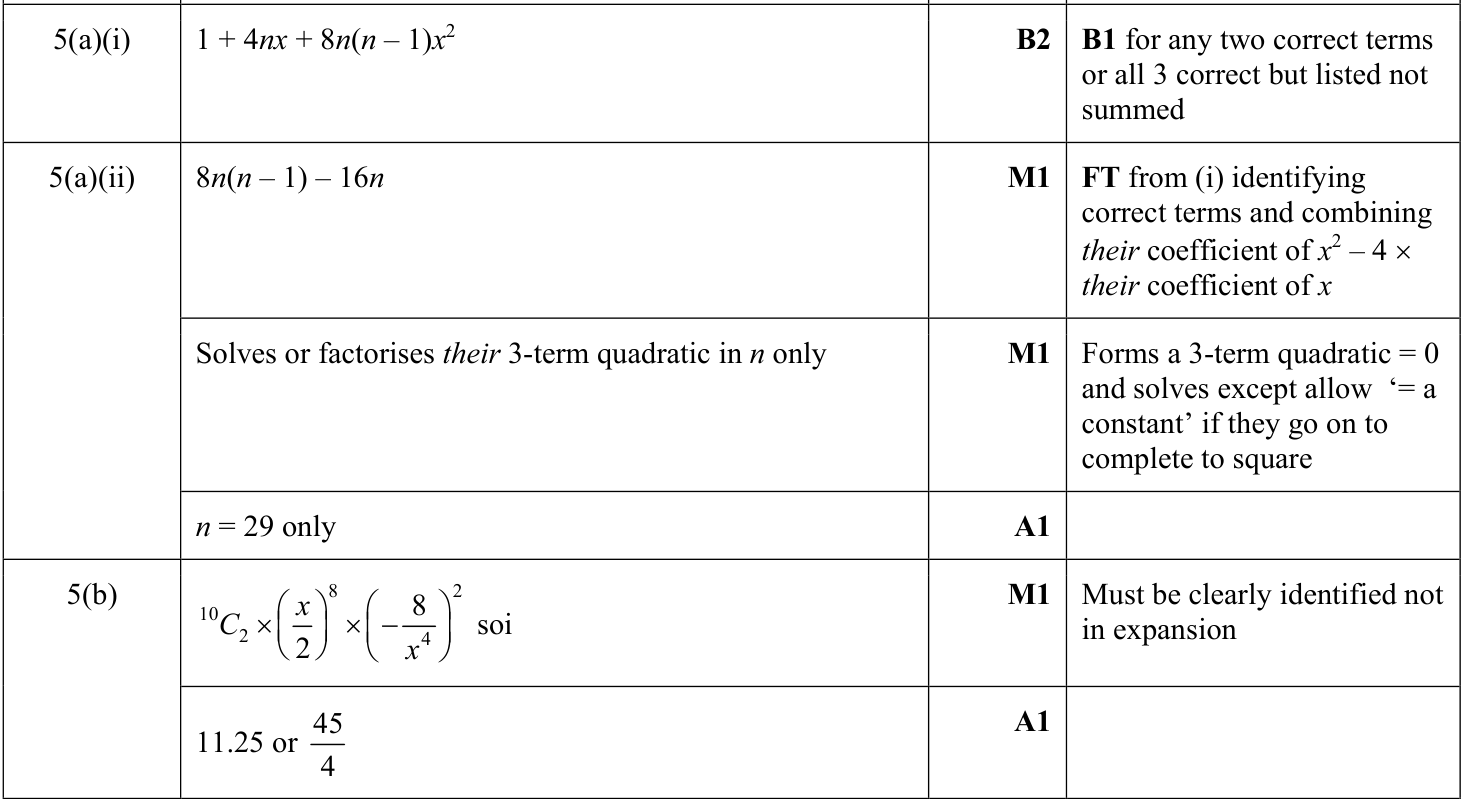
0606 P21 - Jun 2022 - Q5 - 7 marks
(a) (i) Write down the first three terms, in ascending powers of \(x\), in the expansion of \((1+4x)^n\), where \(n\) is a positive integer.
(ii) In the expansion of \((1+4x)^n(1-4x)\), the coefficient of \(x^2\) is 6032. Find the value of \(n\).
(b) Find the term independent of \(x\) in the expansion of \(\left(\frac{x}{2}-\frac{8}{x^4}\right)^{10}\).
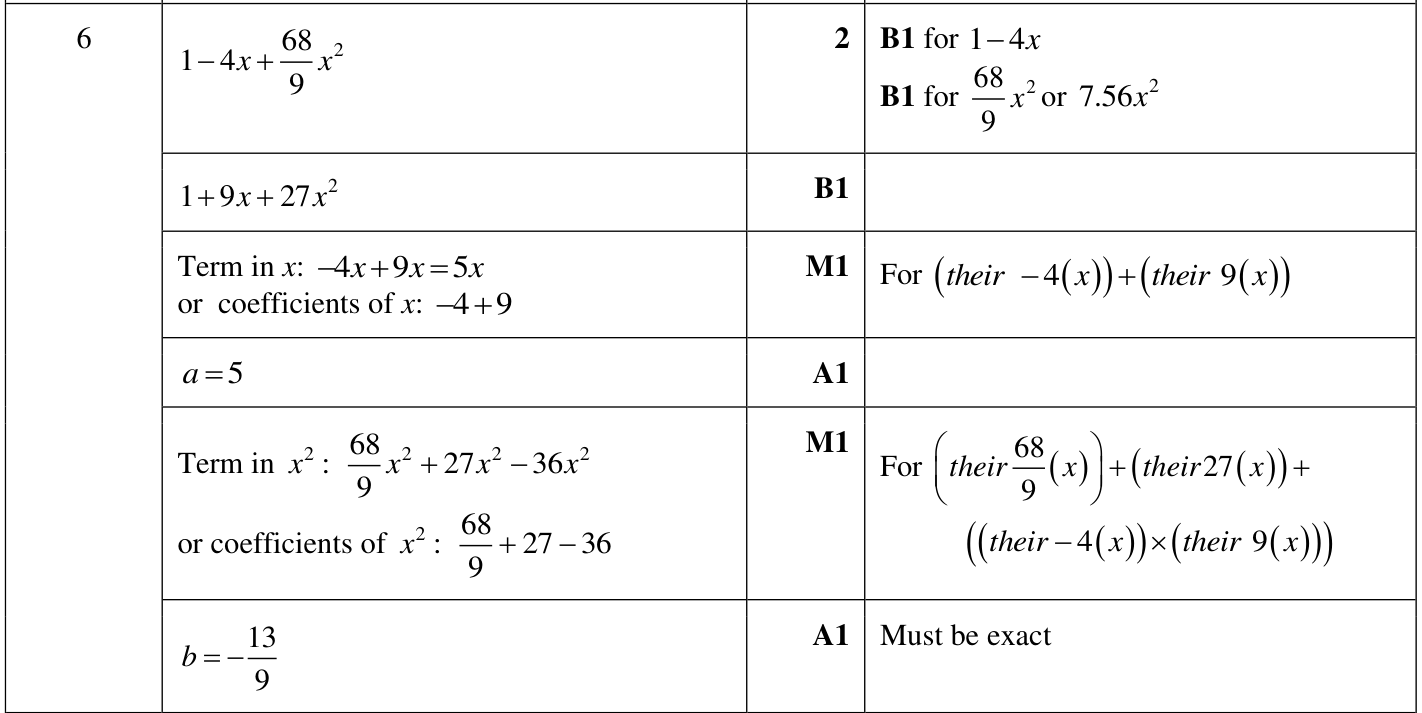
0606 P11 - Nov 2022 - Q6 - 7 marks
The first three terms, in ascending powers of \(x\), in the expansion of
\(\left(1-\frac{2x}{9}\right)^{18}(1+3x)^3\)
are written in the form
\(1+ax+bx^2,\)
where \(a\) and \(b\) are constants. Find the exact values of \(a\) and \(b\).
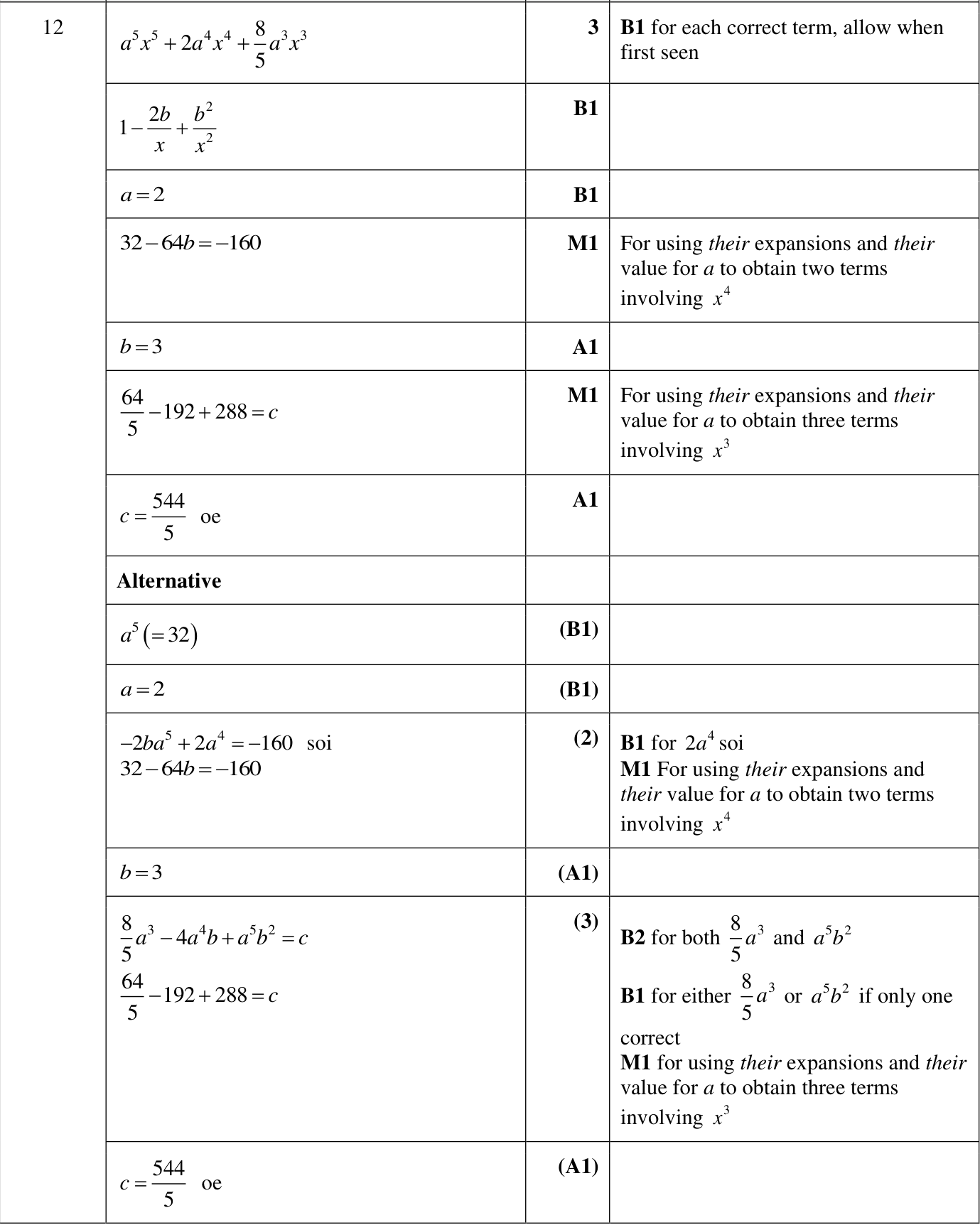
0606 P12 - Nov 2022 - Q12 - 9 marks
The first three terms, in descending powers of \(x\), of the expansion of
\(\left(ax+\frac25\right)^5\left(1-\frac{b}{x}\right)^2\)
can be written as
\(32x^5-160x^4+cx^3,\)
where \(a\), \(b\) and \(c\) are constants. Find the exact values of \(a\), \(b\) and \(c\).
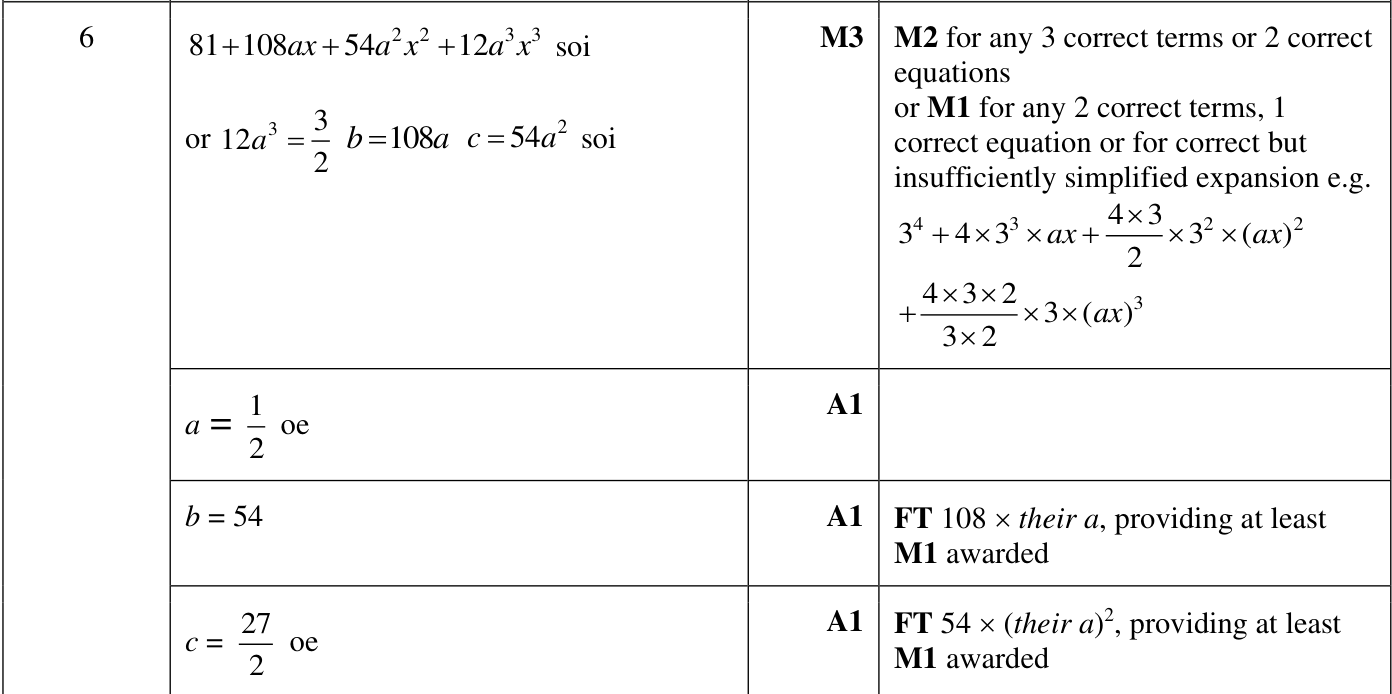
0606 P23 - Nov 2022 - Q6 - 6 marks
The first four terms in the expansion of \((3+ax)^4\), in ascending powers of \(x\), are
\(81+bx+cx^2+\frac32x^3.\)
Find the values of \(a\), \(b\) and \(c\).
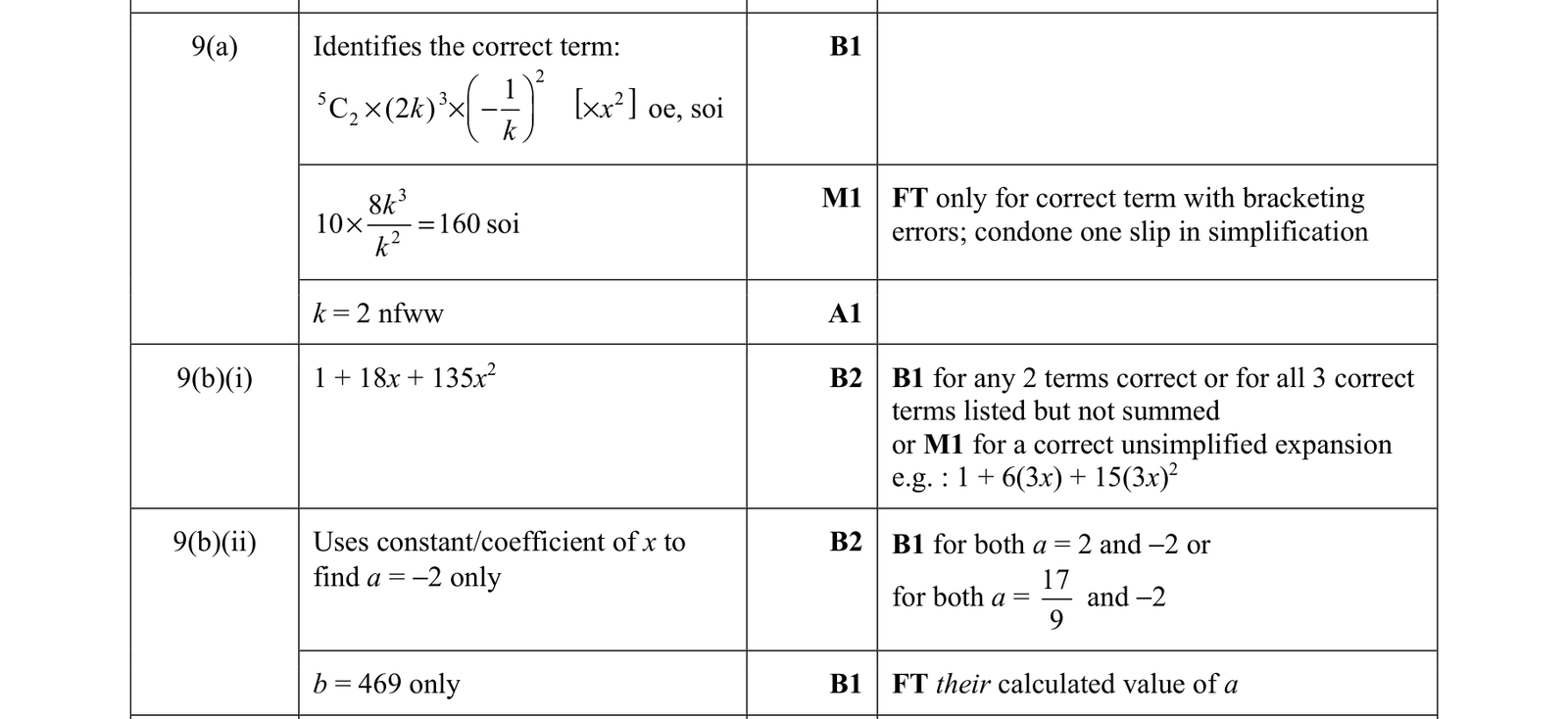
0606 P22 - Mar 2021 - Q9 - 8 marks
(a) In the expansion of
\(\left(2k-\frac{x}{k}\right)^5,\)
where \(k\) is a constant, the coefficient of \(x^2\) is \(160\). Find the value of \(k\).
(b)
(i) Find, in ascending powers of \(x\), the first 3 terms in the expansion of \((1+3x)^6\), simplifying the coefficient of each term.
(ii) When \((1+3x)^6(a+x)^2\) is written in ascending powers of \(x\), the first three terms are \(4+68x+bx^2\), where \(a\) and \(b\) are constants. Find the value of \(a\) and of \(b\).
0606 P11 - Jun 2021 - Q4 - 8 marks
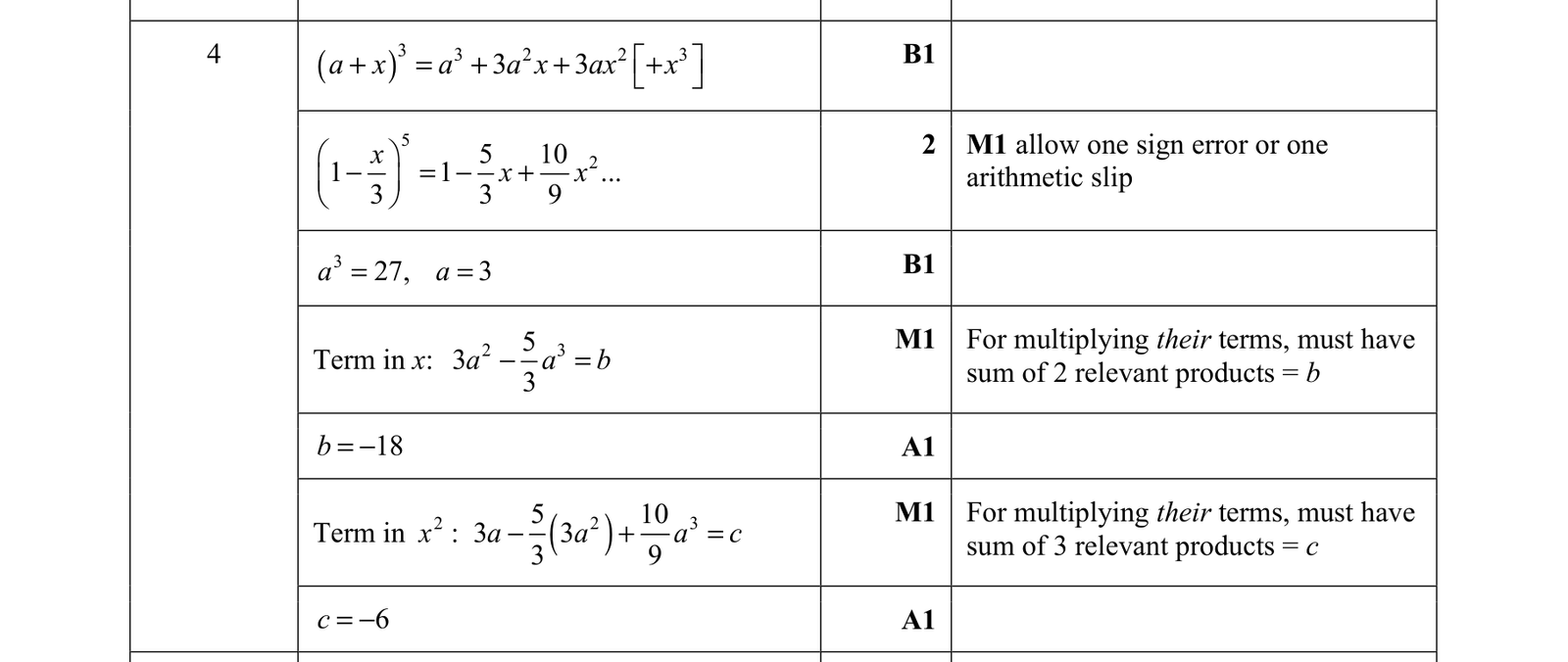
The first 3 terms in the expansion of
\((a+x)^3\left(1-\frac{x}{3}\right)^5\)
in ascending powers of \(x\), can be written in the form
\(27+bx+cx^2,\)
where \(a\), \(b\) and \(c\) are integers. Find the values of \(a\), \(b\) and \(c\).
0606 P13 - Jun 2021 - Q4 - 6 marks
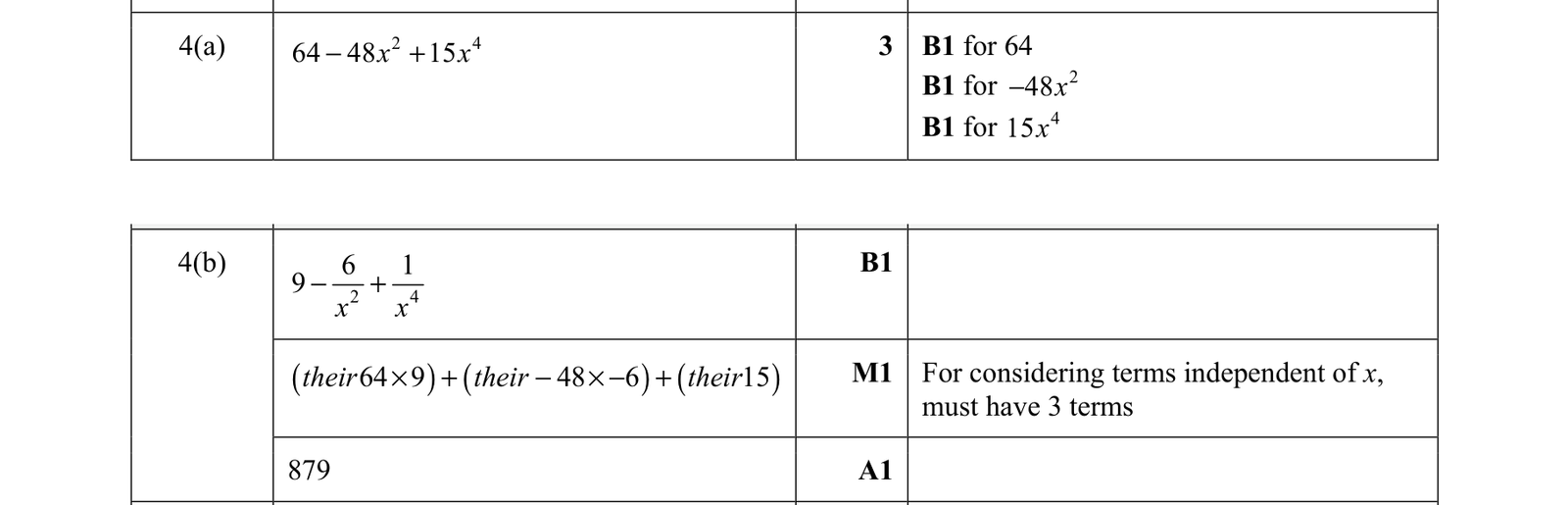
(a) Find the first three non-zero terms in the expansion of
\(\left(2-\frac{x^2}{4}\right)^6\)
in ascending powers of \(x\). Simplify each term.
(b) Hence find the term independent of \(x\) in the expansion of
\(\left(2-\frac{x^2}{4}\right)^6\left(3-\frac1{x^2}\right)^2.\)
0606 P22 - Jun 2021 - Q1 - 2 marks
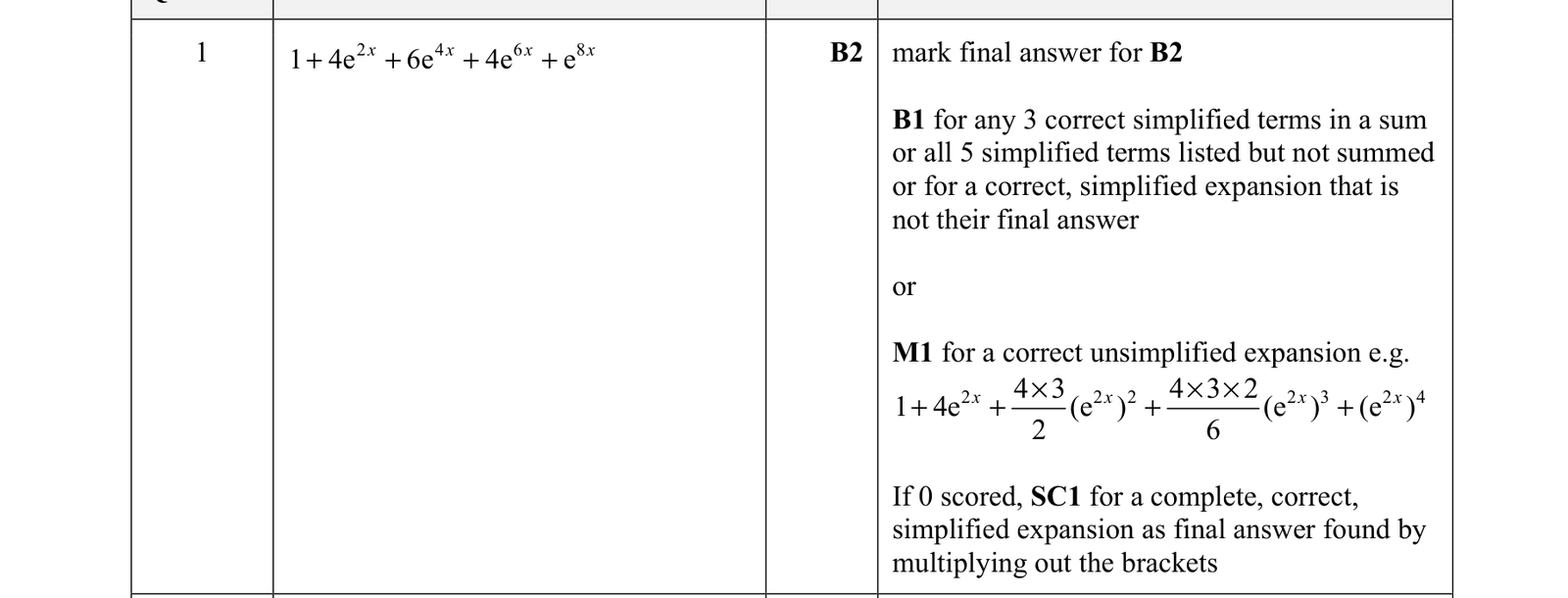
Using the binomial theorem, expand
\((1+e^{2x})^4,\)
simplifying each term.
0606 P11 - Nov 2021 - Q7 - 7 marks
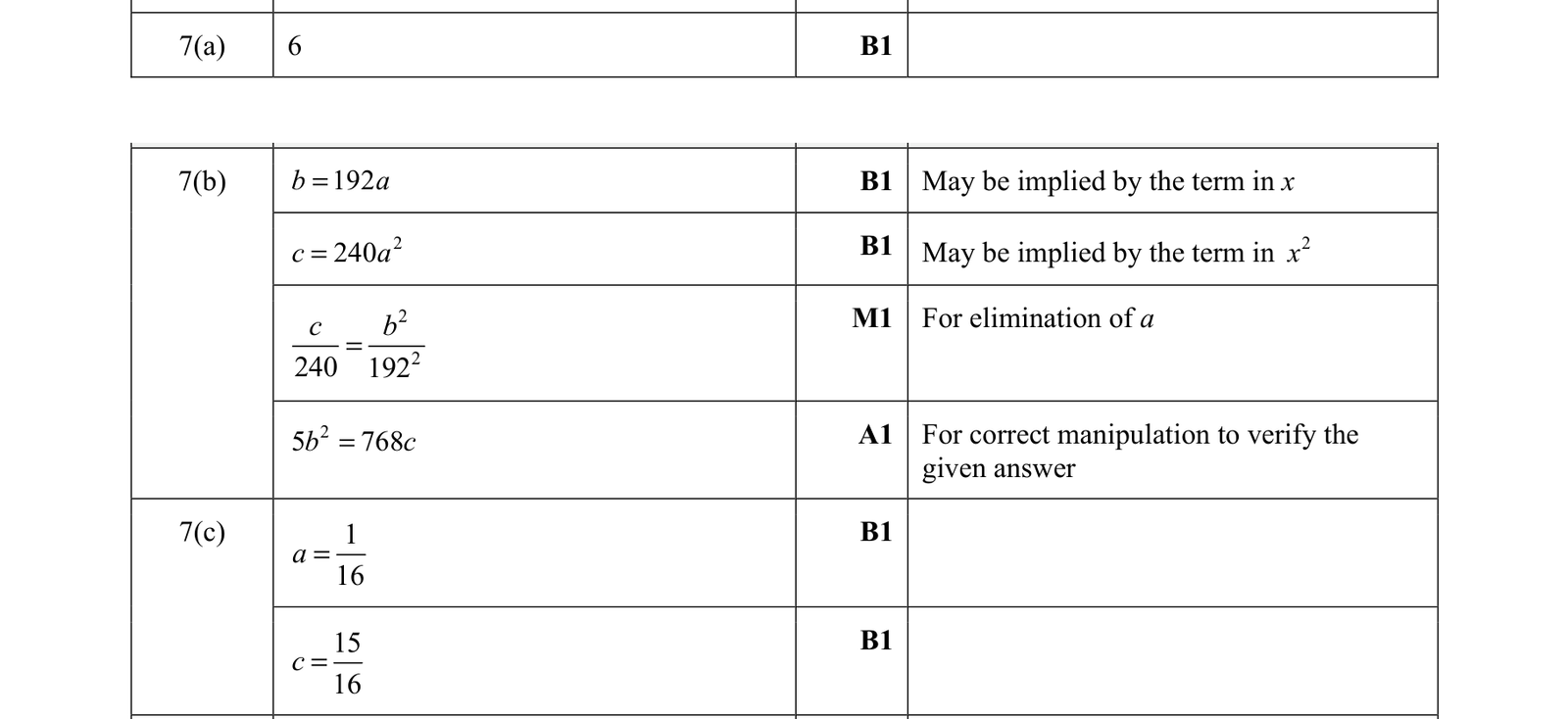
The first three terms, in ascending powers of \(x\), in the expansion of \((2+ax)^n\) can be written as \(64+bx+cx^2\), where \(n\), \(a\), \(b\) and \(c\) are constants.
(a) Find the value of \(n\).
(b) Show that \(5b^2=768c\).
(c) Given that \(b=12\), find the exact value of \(a\) and of \(c\).
0606 P13 - Nov 2021 - Q4 - 6 marks
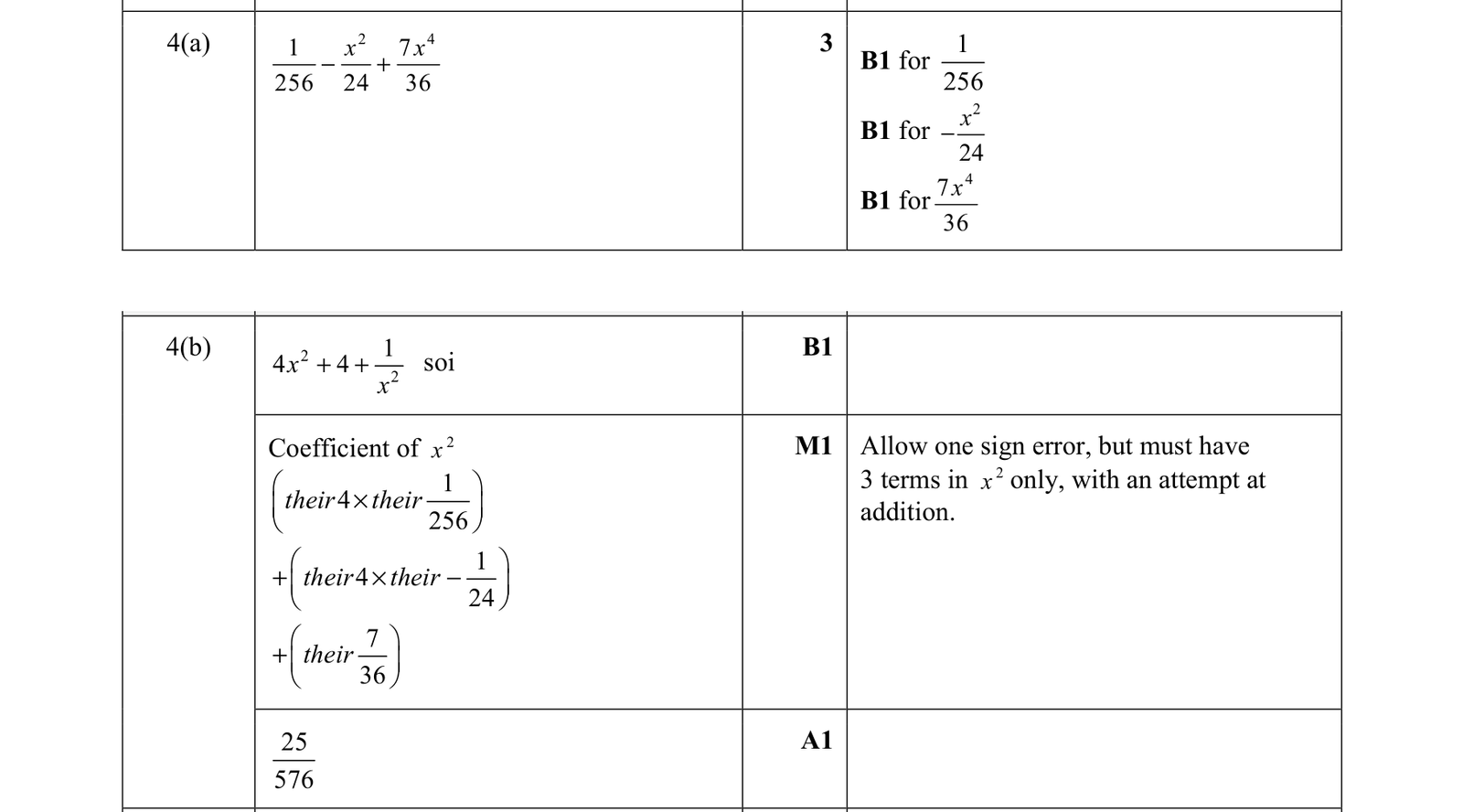
(a) Find the first three terms, in ascending powers of \(x^2\), in the expansion of
\(\left(\frac12-\frac23x^2\right)^8.\)
Write your coefficients as rational numbers.
(b) Find the coefficient of \(x^2\) in the expansion of
\(\left(\frac12-\frac23x^2\right)^8\left(2x+\frac1x\right)^2.\)
0606 P22 - Nov 2021 - Q2 - 8 marks
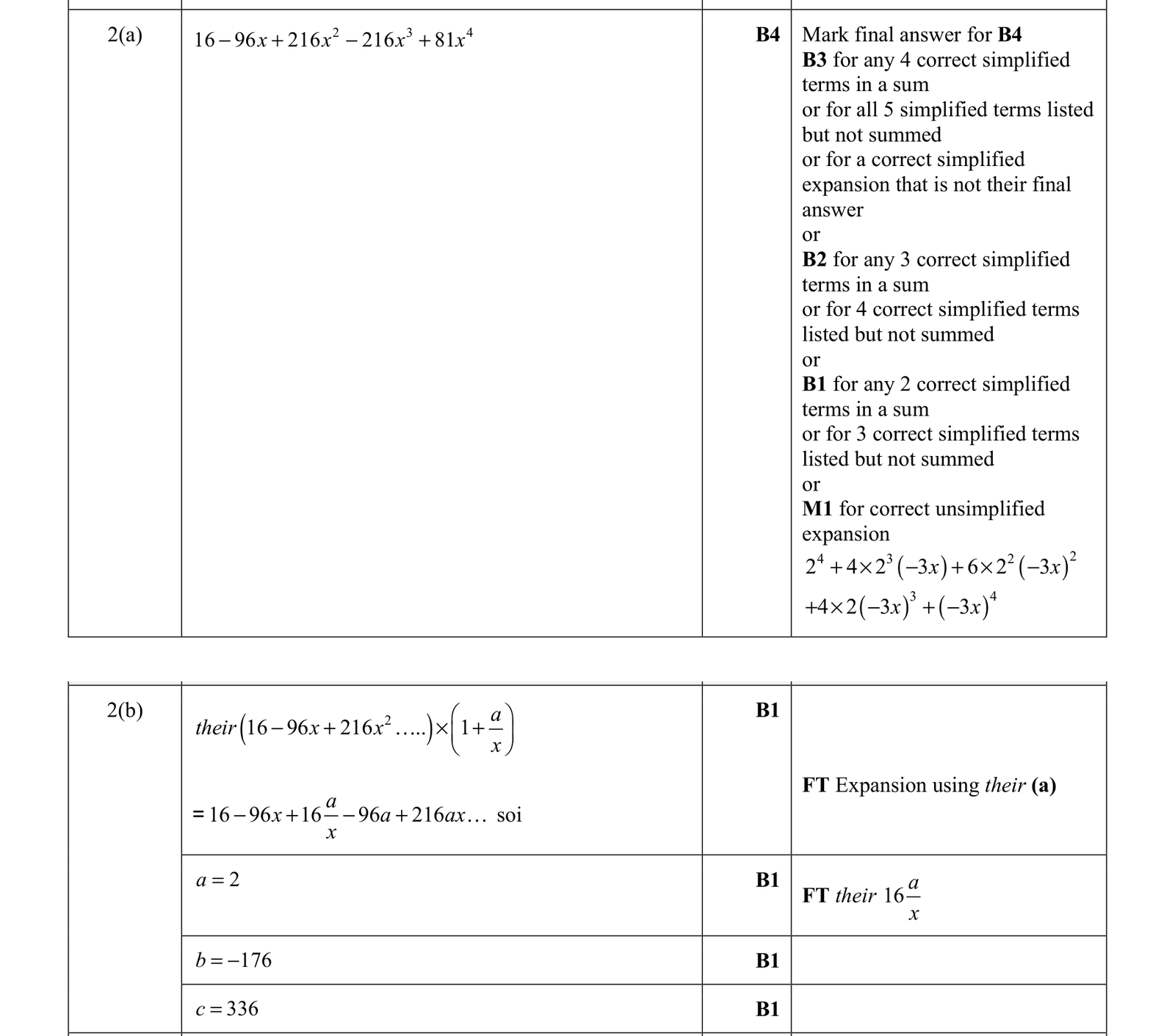
(a) Expand \((2-3x)^4\), evaluating all of the coefficients.
(b) The sum of the first three terms in ascending powers of \(x\) in the expansion of
\((2-3x)^4\left(1+\frac ax\right)\)
is
\(\frac{32}{x}+b+cx,\)
where \(a\), \(b\) and \(c\) are integers. Find the values of \(a\), \(b\) and \(c\).
0606 P12 - Mar 2020 - Q3 - 5 marks
The first 3 terms in the expansion of \((3-ax)^5\), in ascending powers of \(x\), can be written in the form
\(b-81x+cx^2.\)
Find the value of each of \(a\), \(b\) and \(c\).

0606 P12 - Jun 2020 - Q3 - 6 marks
(a) Find the first three terms in the expansion of
\(\left(4-\frac{x}{16}\right)^6\)
in ascending powers of \(x\), giving each term in its simplest form.
(b) Hence find the term independent of \(x\) in the expansion of
\(\left(4-\frac{x}{16}\right)^6\left(x-\frac1x\right)^2.\)

0606 P21 - Jun 2020 - Q8 - 7 marks
(a) Expand \((2-x)^5\), simplifying each coefficient.
(b) Hence solve
\(\frac{e^{(2-x)^5}\times e^{80x}}{e^{10x^4+32}}=e^{-x^5}.\)

0606 P23 - Jun 2020 - Q9 - 8 marks
Do not use a calculator in this question.
(a) Find the term independent of \(x\) in the binomial expansion of
\(\left(3x-\frac1x\right)^6.\)
(b) In the expansion of
\(\left(1+\frac{x}{2}\right)^n,\)
the coefficient of \(x^4\) is half the coefficient of \(x^6\). Find the value of the positive constant \(n\).

0606 P12 - Nov 2020 - Q5 - 5 marks
Find the coefficient of \(x^2\) in the expansion of
\(\left(x-\frac{3}{x}\right)\left(x+\frac{2}{x}\right)^5.\)

0606 P13 - Nov 2020 - Q5 - 5 marks
Given that the coefficient of \(x^2\) in the expansion of
\((1+x)\left(1-\frac{x}{2}\right)^n\)
is \(\dfrac{25}{4}\), find the value of the positive integer \(n\).

0606 P21 - Nov 2020 - Q5 - 7 marks
The first three terms in the expansion of
\((a+bx)^5(1+x)\)
are
\(32-208x+cx^2.\)
Find the value of each of the integers \(a\), \(b\) and \(c\).

0606 P12 - Mar 2019 - Q3 - 6 marks
(i) Find the first three terms, in ascending powers of \(x\), in the expansion of \(\left(3-\dfrac{x}{9}\right)^6\).
(ii) Hence find the term independent of \(x\) in the expansion of \(\left(3-\dfrac{x}{9}\right)^6\left(x-\dfrac2x\right)^2\).
0606 P11 - Jun 2019 - Q4 - 7 marks
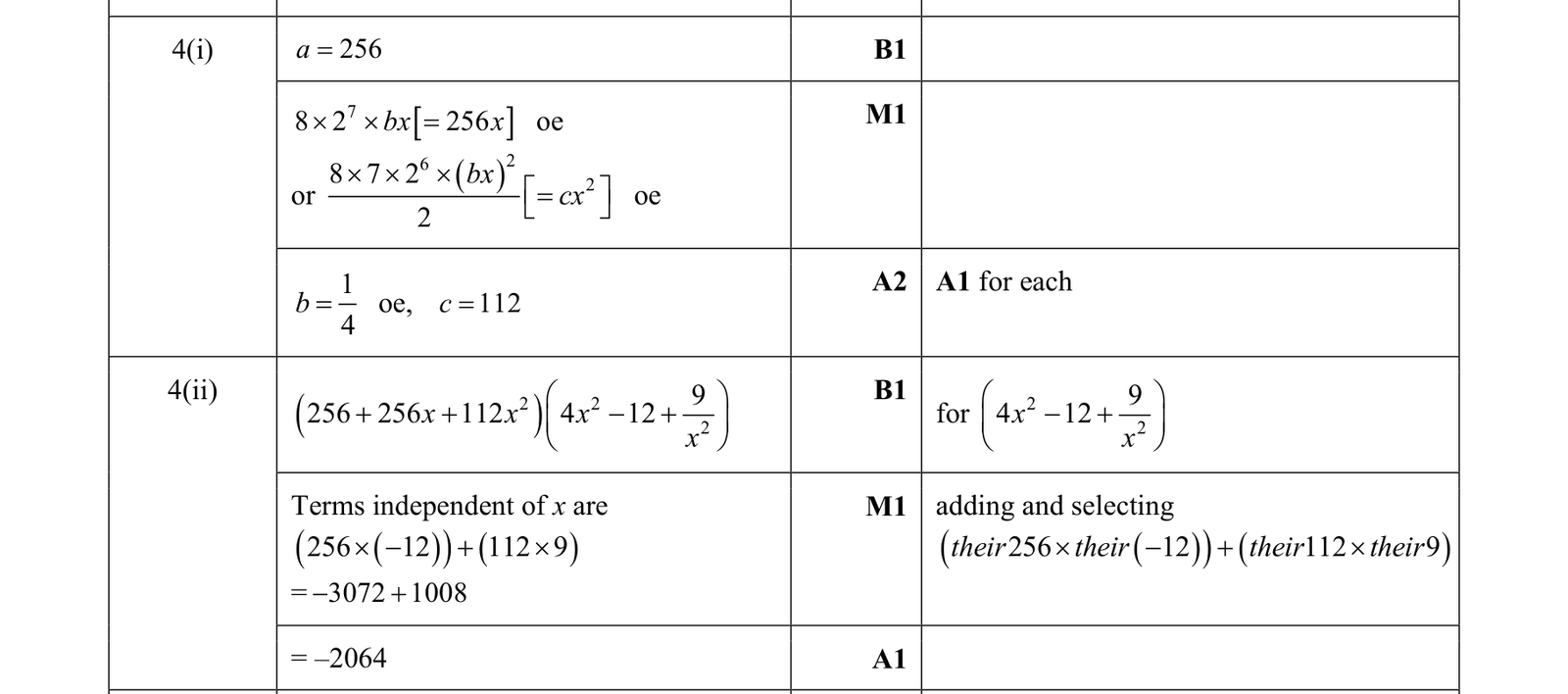
(i) The first 3 terms, in ascending powers of \(x\), in the expansion of \((2+bx)^8\) can be written as
\(a+256x+cx^2.\)
Find \(a\), \(b\) and \(c\).
(ii) Using the values found in part (i), find the term independent of \(x\) in the expansion of
\((2+bx)^8\left(2x-\frac3x\right)^2.\)
0606 P22 - Jun 2019 - Q8 - 8 marks
(a) In the binomial expansion of \(\left(a-\dfrac{x}{2}\right)^6\), the coefficient of \(x^3\) is 120 times the coefficient of \(x^5\). Find the possible values of the constant \(a\).
(b) (i) Expand \((1+2x)^{20}\) in ascending powers of \(x\), as far as the term in \(x^3\). Simplify each term.
(ii) Use your expansion to show that the value of \(0.98^{20}\) is \(0.67\) to 2 decimal places.
0606 P23 - Jun 2019 - Q8 - 8 marks
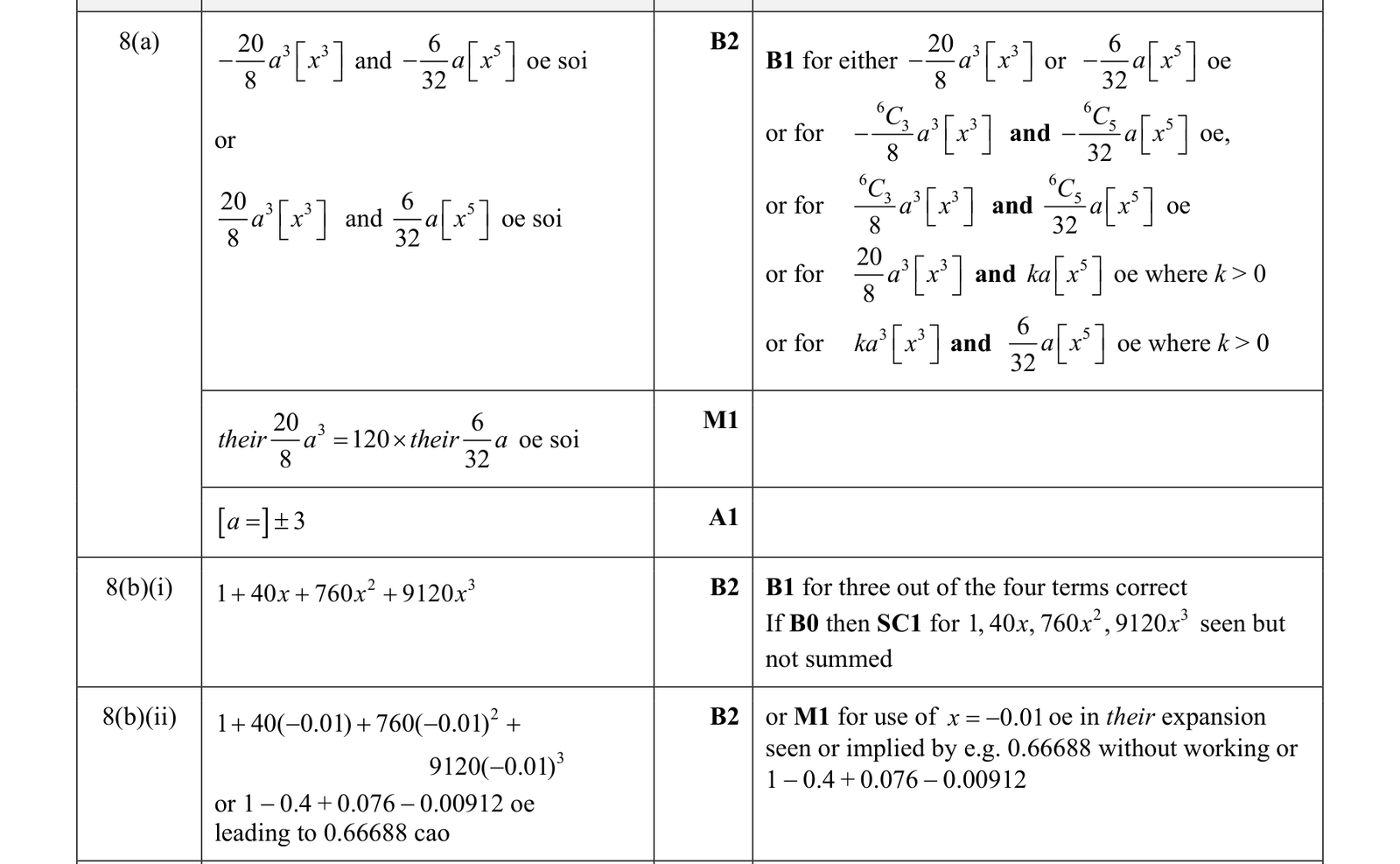
(a) (i) Given that \(\left(x^2-\dfrac1{px}\right)^8=x^{16}-4x^{13}+qx^{10}+rx^7+\cdots\), find the value of each of the constants \(p\), \(q\) and \(r\).
(ii) Explain why there is no term independent of \(x\) in the binomial expansion of \(\left(x^2-\dfrac1{px}\right)^8\).
(b) In the binomial expansion of \(\left(1-\dfrac{\sqrt{x}}2\right)^n\), where \(n\) is a positive integer, the coefficient of \(x\) is 30. Form an equation in \(n\) and hence find the value of \(n\).
0606 P12 - Nov 2019 - Q3 - 6 marks
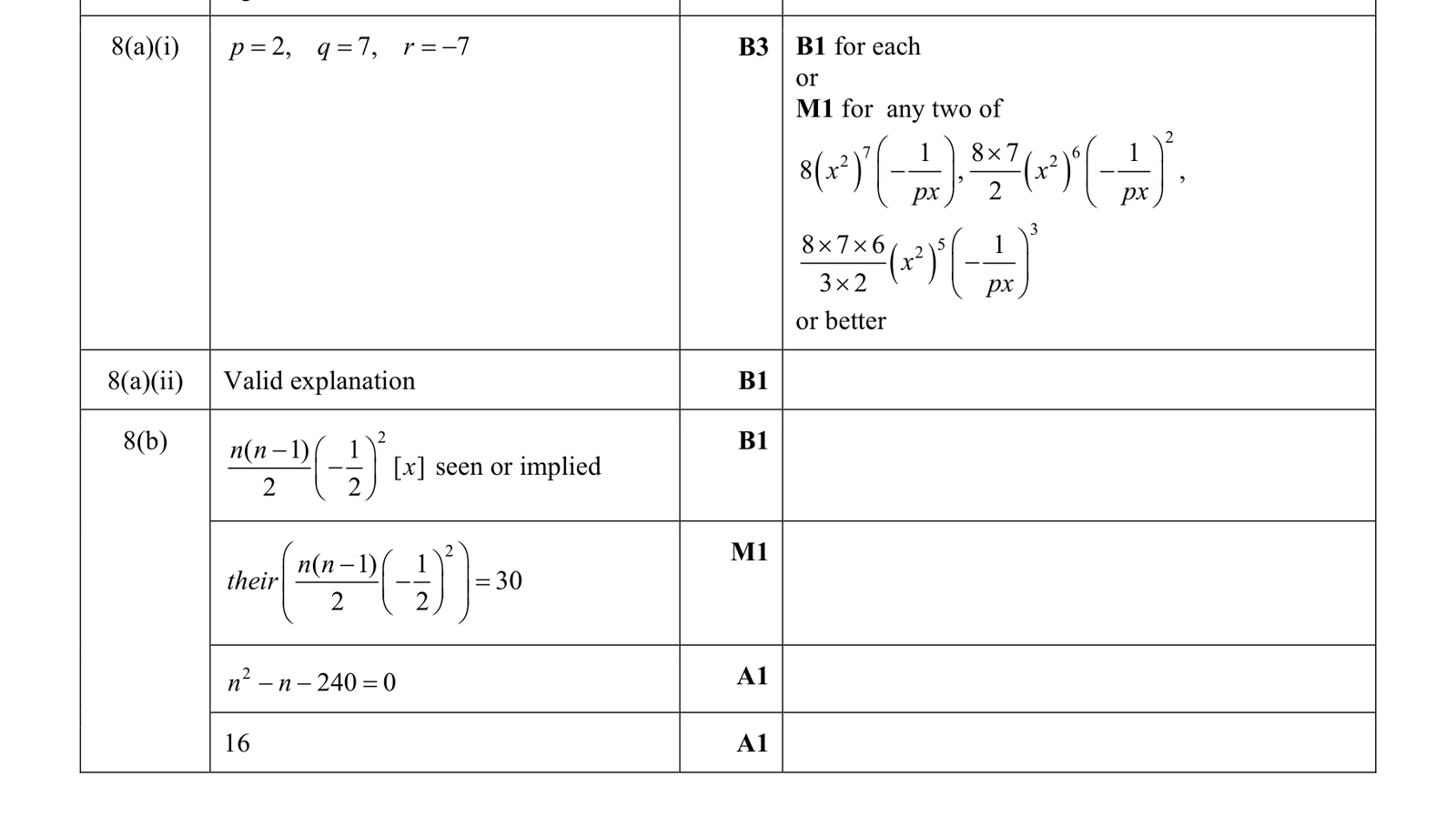
The first three terms in the expansion of
\(\left(1-\frac{x}{7}\right)^{14}(1-2x)^4\)
can be written as \(1+ax+bx^2\). Find the value of each of the constants \(a\) and \(b\).
0606 P21 - Nov 2019 - Q10 - 8 marks
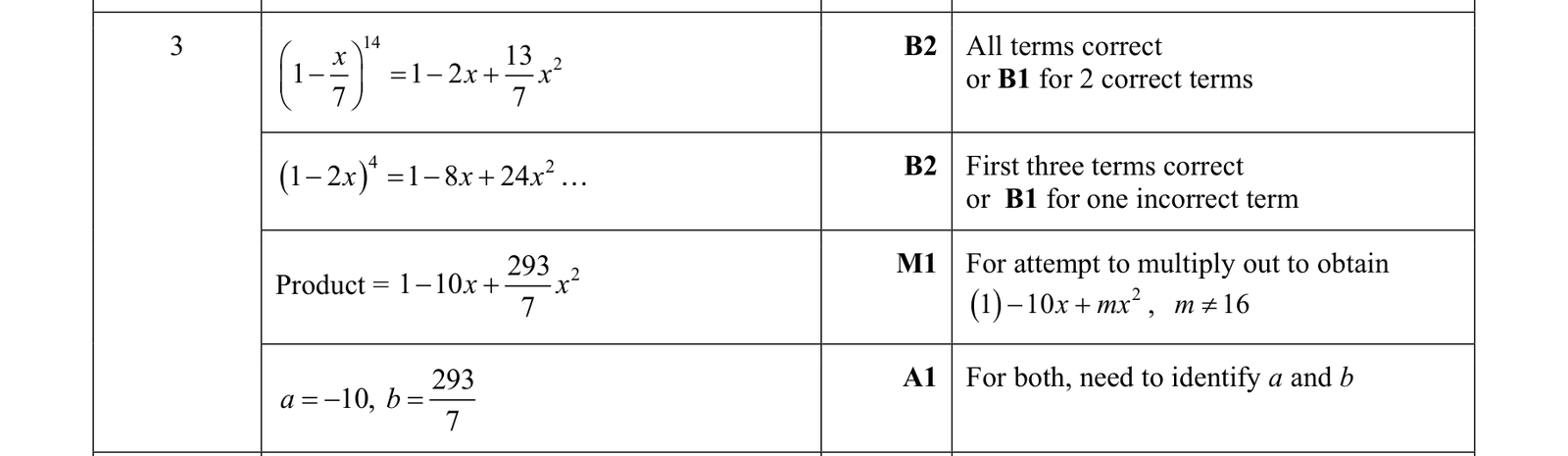
(i) Expand \((3+x)^4\), evaluating each coefficient.
In the expansion of
\(\left(x-\frac{p}{x}\right)(3+x)^4\)
the coefficient of \(x\) is zero.
(ii) Find the value of the constant \(p\).
(iii) Hence find the term independent of \(x\).
(iv) Show that the coefficient of \(x^2\) is \(90\).
0606 P23 - Nov 2019 - Q3 - 8 marks
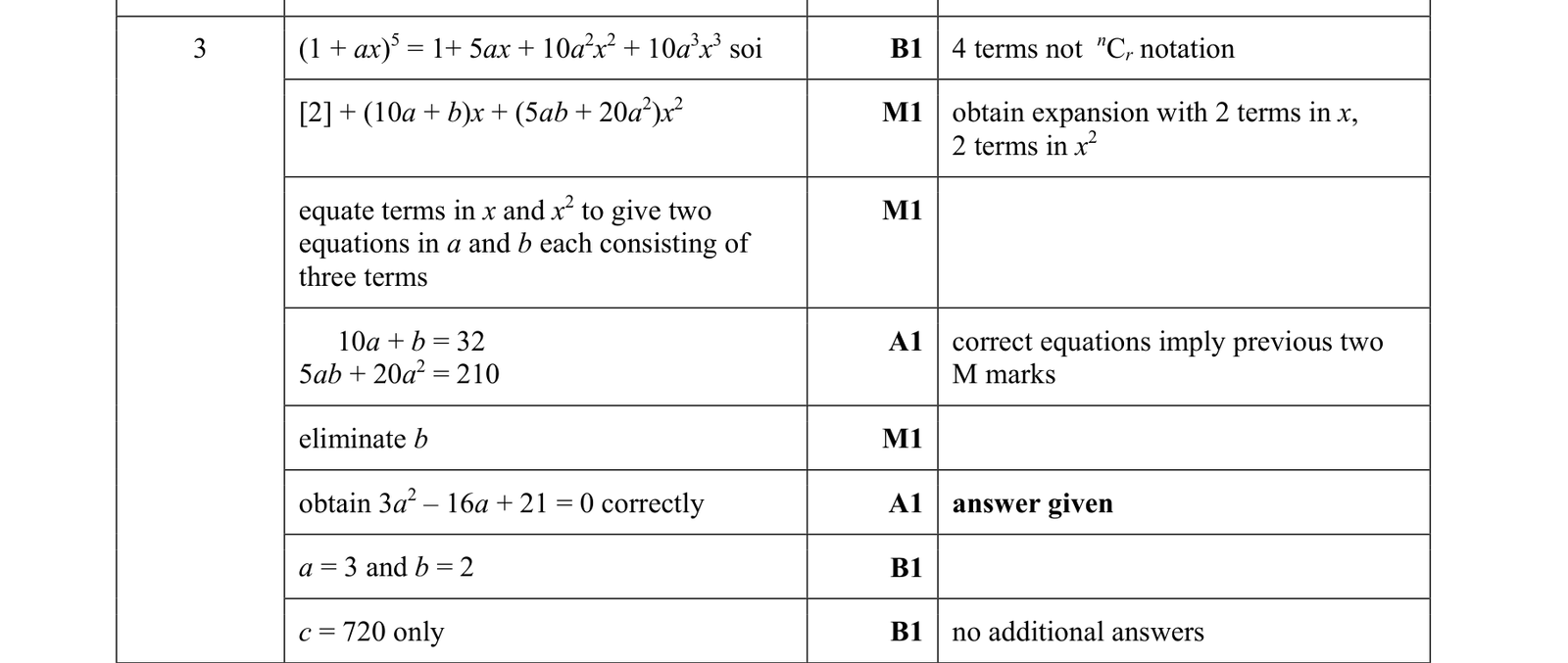
The first four terms in the expansion of \((1+ax)^5(2+bx)\) are
\(2+32x+210x^2+cx^3,\)
where \(a\), \(b\) and \(c\) are integers. Show that
\(3a^2-16a+21=0\)
and hence find the values of \(a\), \(b\) and \(c\).
0606 P12 - Mar 2018 - Q5 - 8 marks
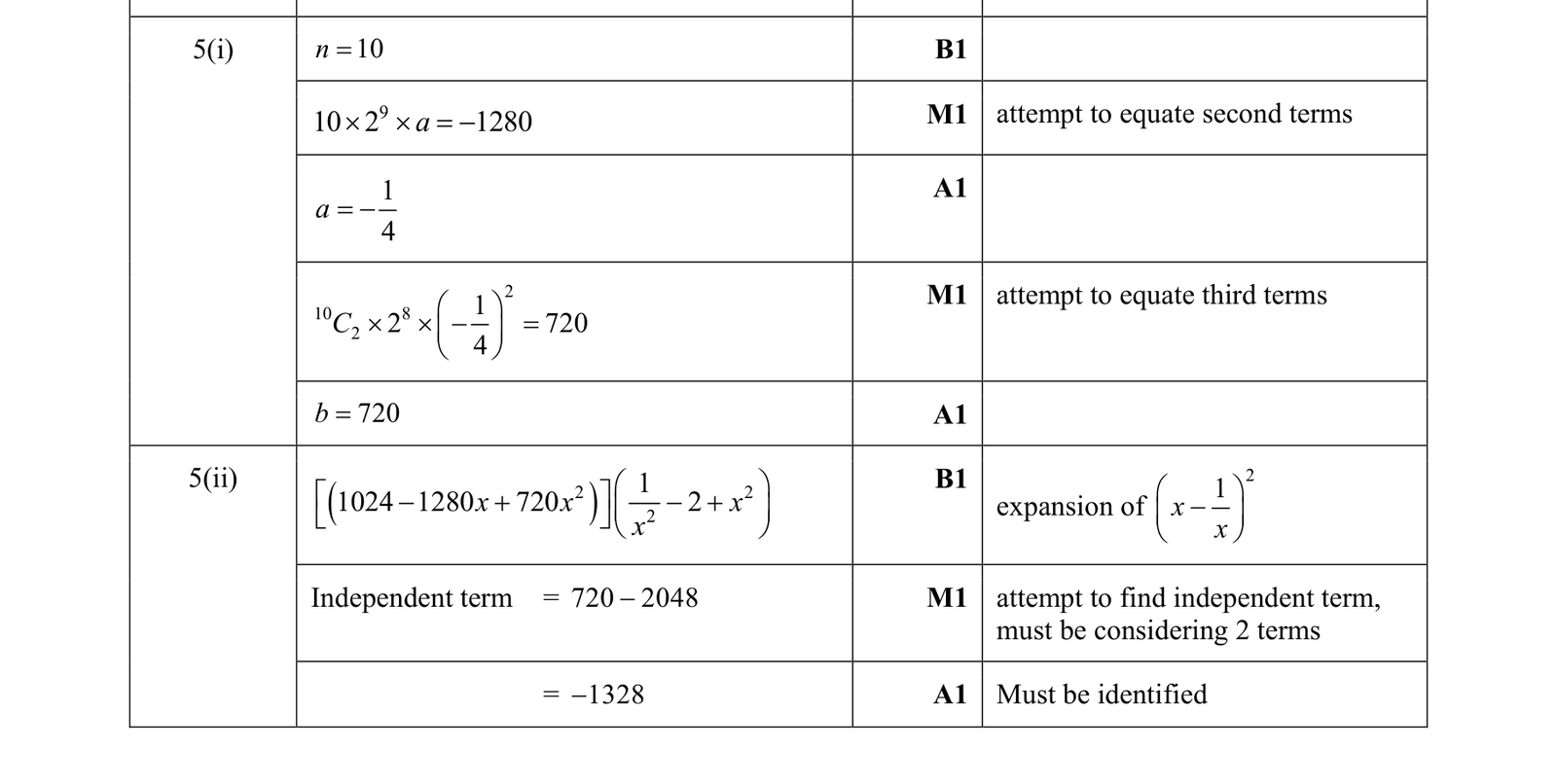
The first three terms, in ascending powers of \(x\), in the expansion of \((2+ax)^n\) are \(1024-1280x+bx^2\). Find the values of \(n\), \(a\), and \(b\).
Hence find the term independent of \(x\) in the expansion of \((2+ax)^n\left(x-\dfrac1x\right)^2\).
0606 P11 - Jun 2018 - Q9 - 6 marks
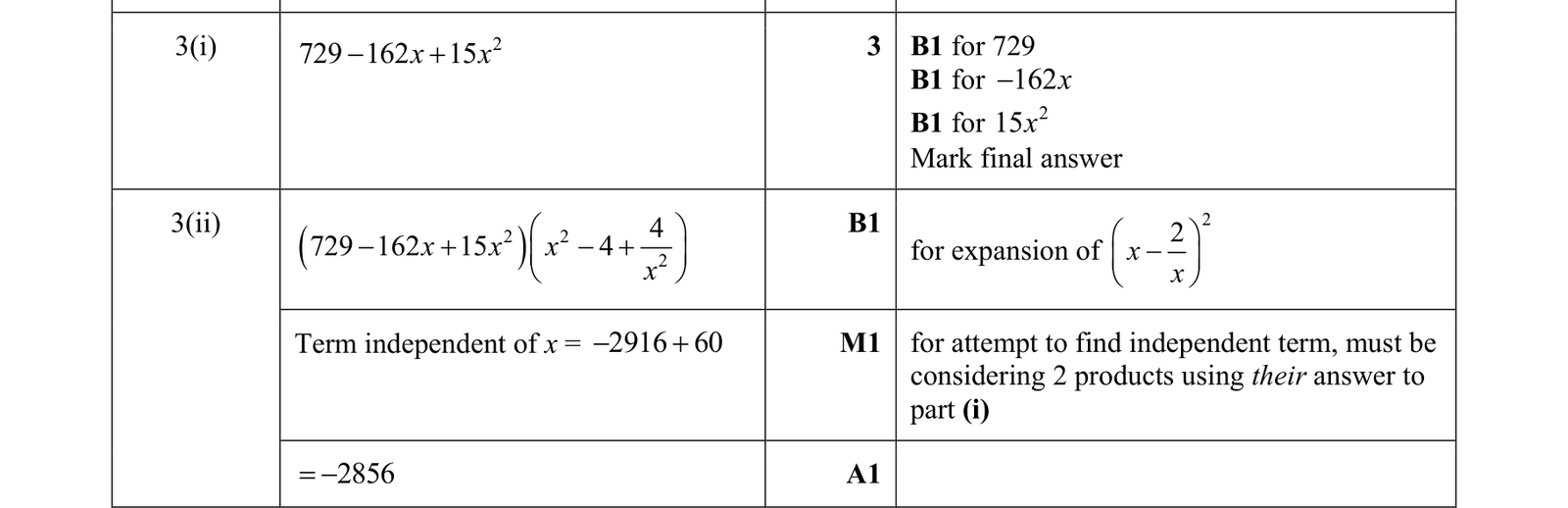
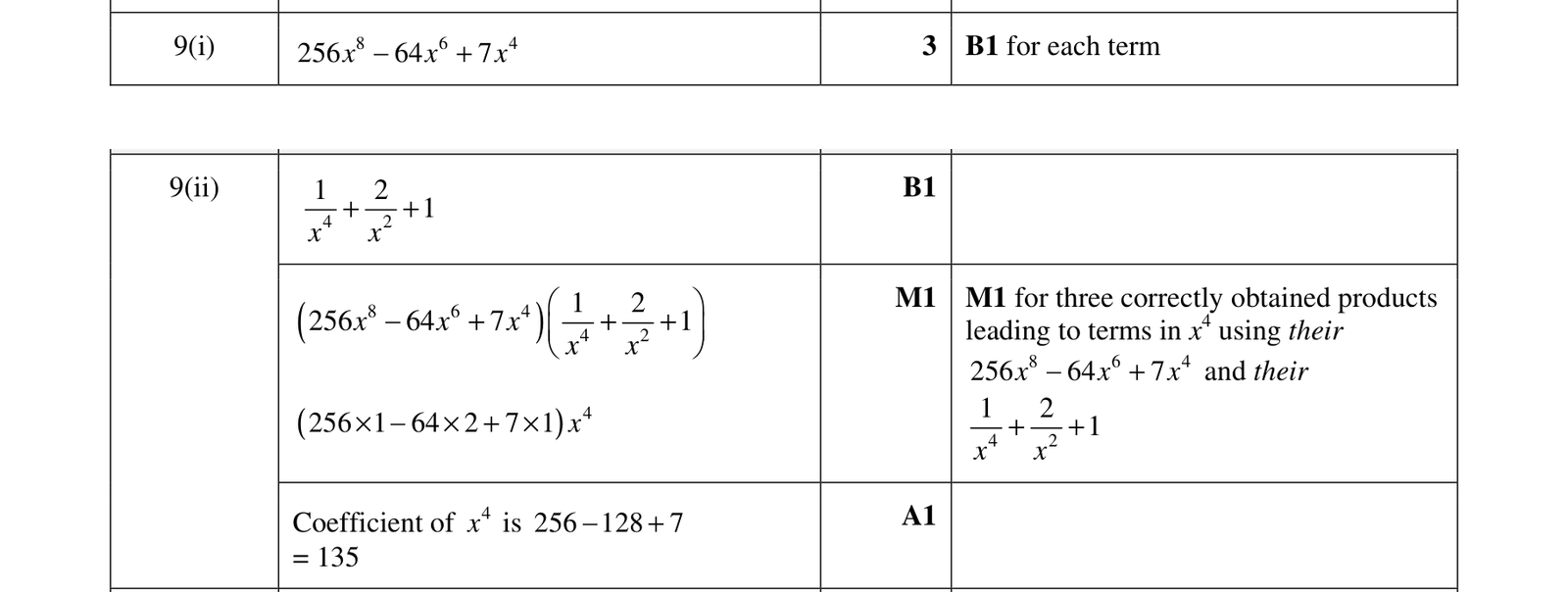
(i) Find the first \(3\) terms in the expansion of
\(\left(2x-\frac{1}{16x}\right)^8\)
in descending powers of \(x\).
(ii) Hence find the coefficient of \(x^4\) in the expansion of
\(\left(2x-\frac{1}{16x}\right)^8 \left(\frac{1}{x^2}+1\right)^2.\)
0606 P12 - Jun 2018 - Q5 - 6 marks
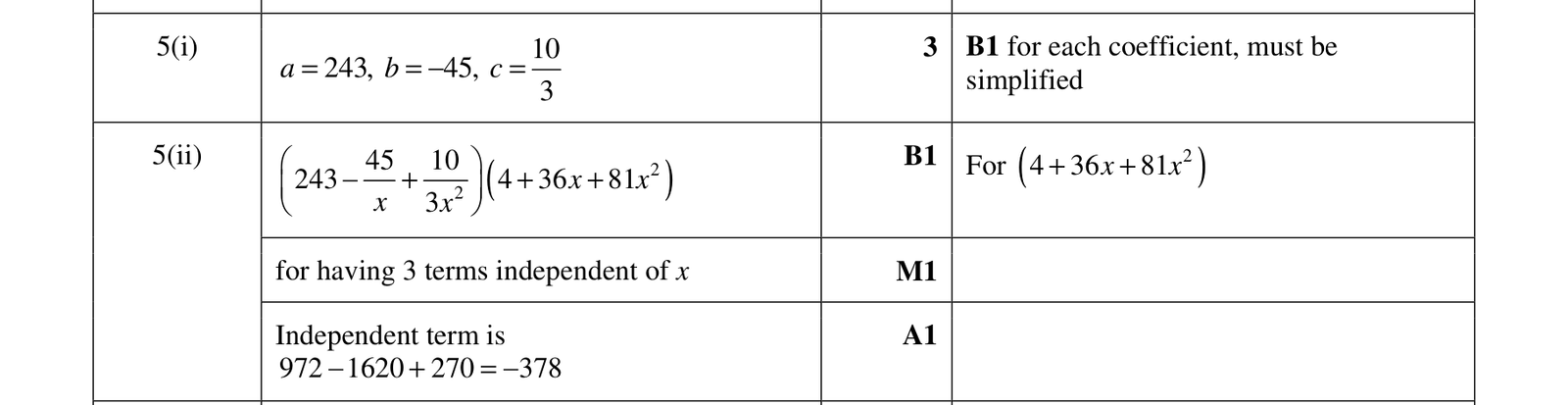
(i) The first three terms in the expansion of
\(\left(3-\frac1{9x}\right)^5\)
can be written as \(a+\dfrac bx+\dfrac c{x^2}\). Find the value of each of the constants \(a\), \(b\) and \(c\).
(ii) Use your values of \(a\), \(b\) and \(c\) to find the term independent of \(x\) in the expansion of
\(\left(3-\frac1{9x}\right)^5(2+9x)^2.\)
0606 P13 - Jun 2018 - Q9 - 6 marks
(i) Find the first \(3\) terms in the expansion of
\(\left(2x-\frac{1}{16x}\right)^8\)
in descending powers of \(x\).
(ii) Hence find the coefficient of \(x^4\) in the expansion of
\(\left(2x-\frac{1}{16x}\right)^8 \left(\frac{1}{x^2}+1\right)^2.\)
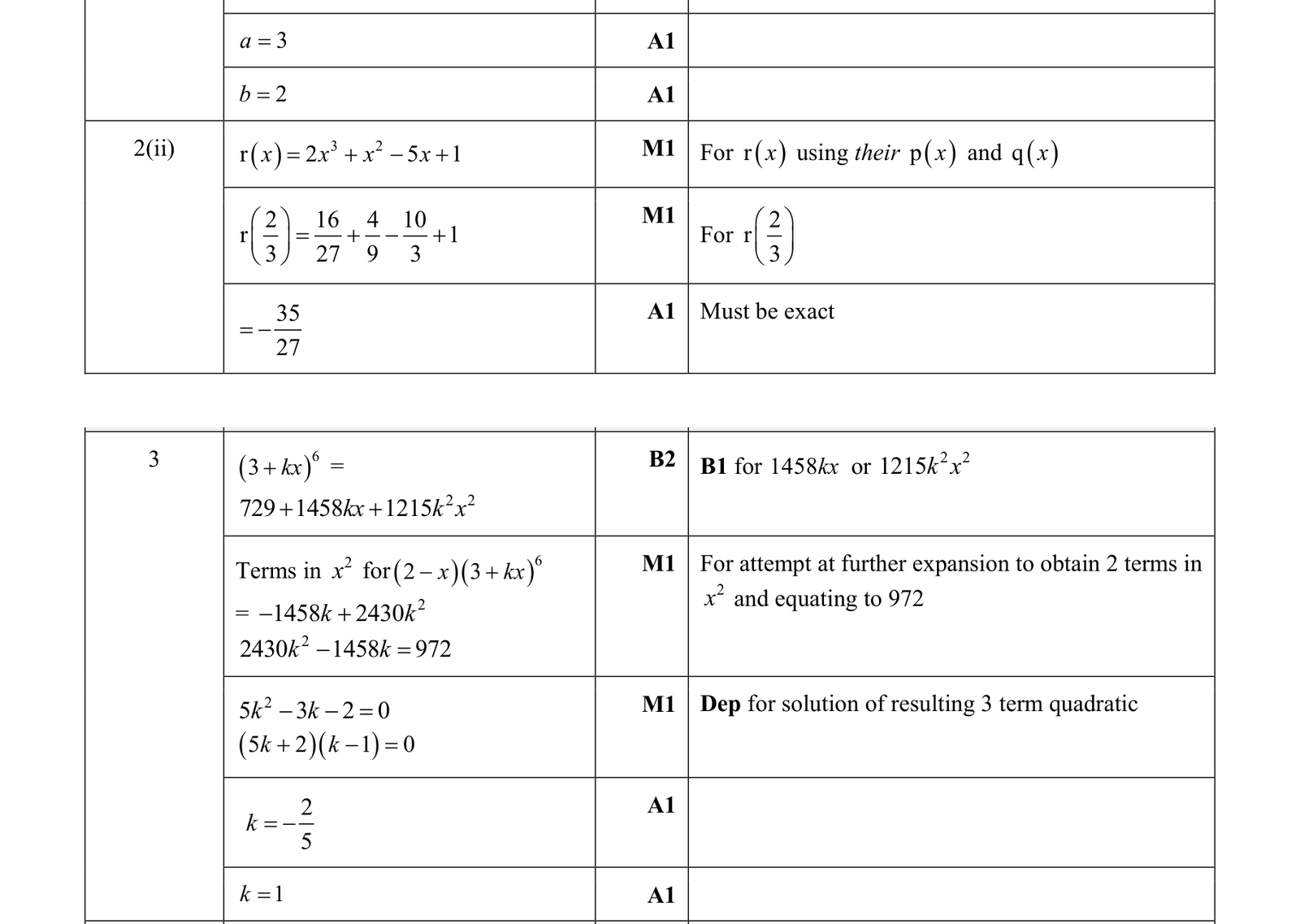
0606 P11 - Nov 2018 - Q3 - 6 marks
The coefficient of \(x^2\) in the expansion of \((2-x)(3+kx)^6\) is equal to \(972\). Find the possible values of the constant \(k\).
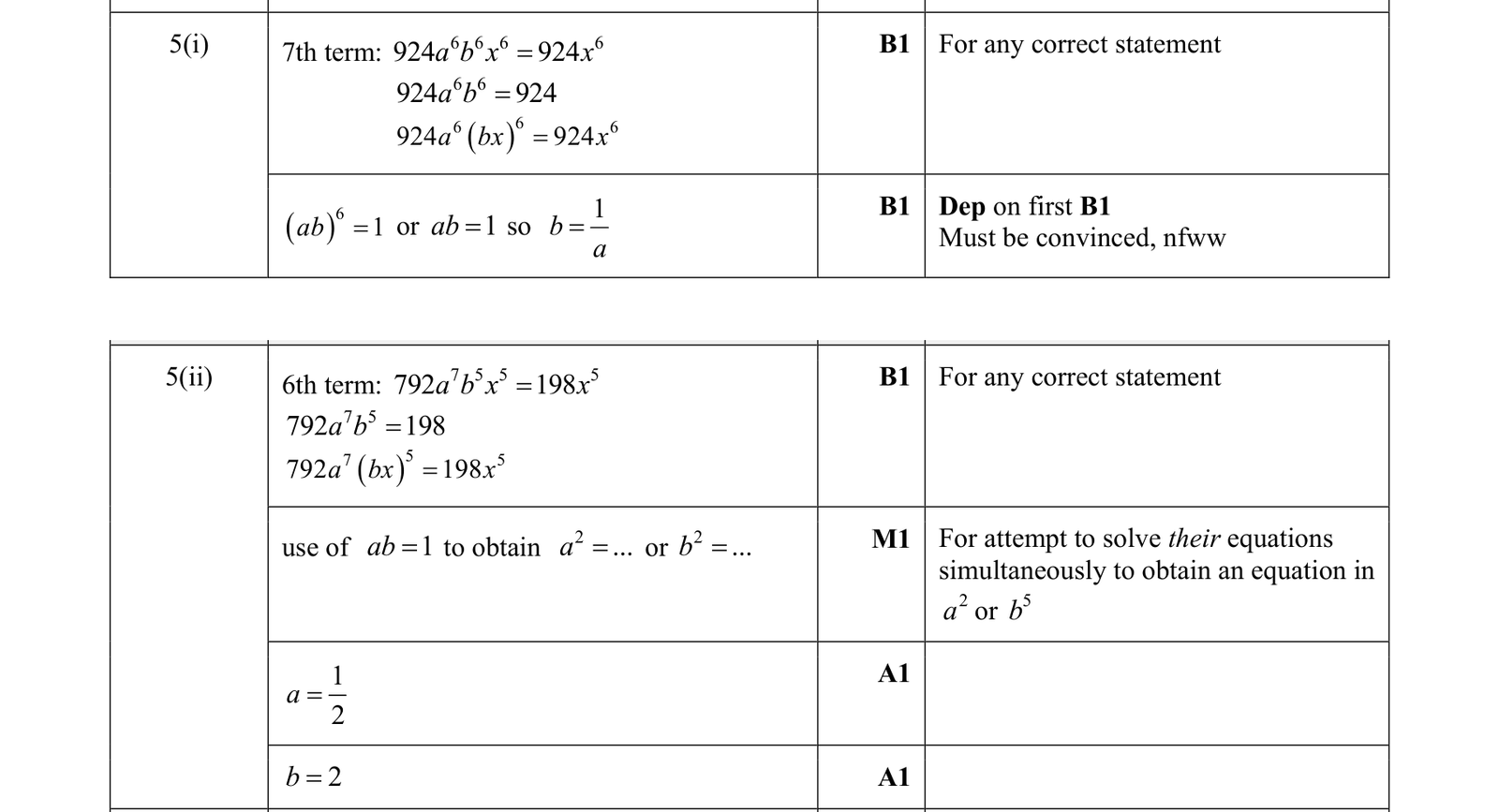
0606 P12 - Nov 2018 - Q5 - 6 marks
The 7th term in the expansion of \((a+bx)^{12}\) in ascending powers of \(x\) is \(924x^6\). It is given that \(a\) and \(b\) are positive constants.
(i) Show that \(b=\dfrac1a\).
The 6th term in the expansion of \((a+bx)^{12}\) in ascending powers of \(x\) is \(198x^5\).
(ii) Find the value of \(a\) and of \(b\).

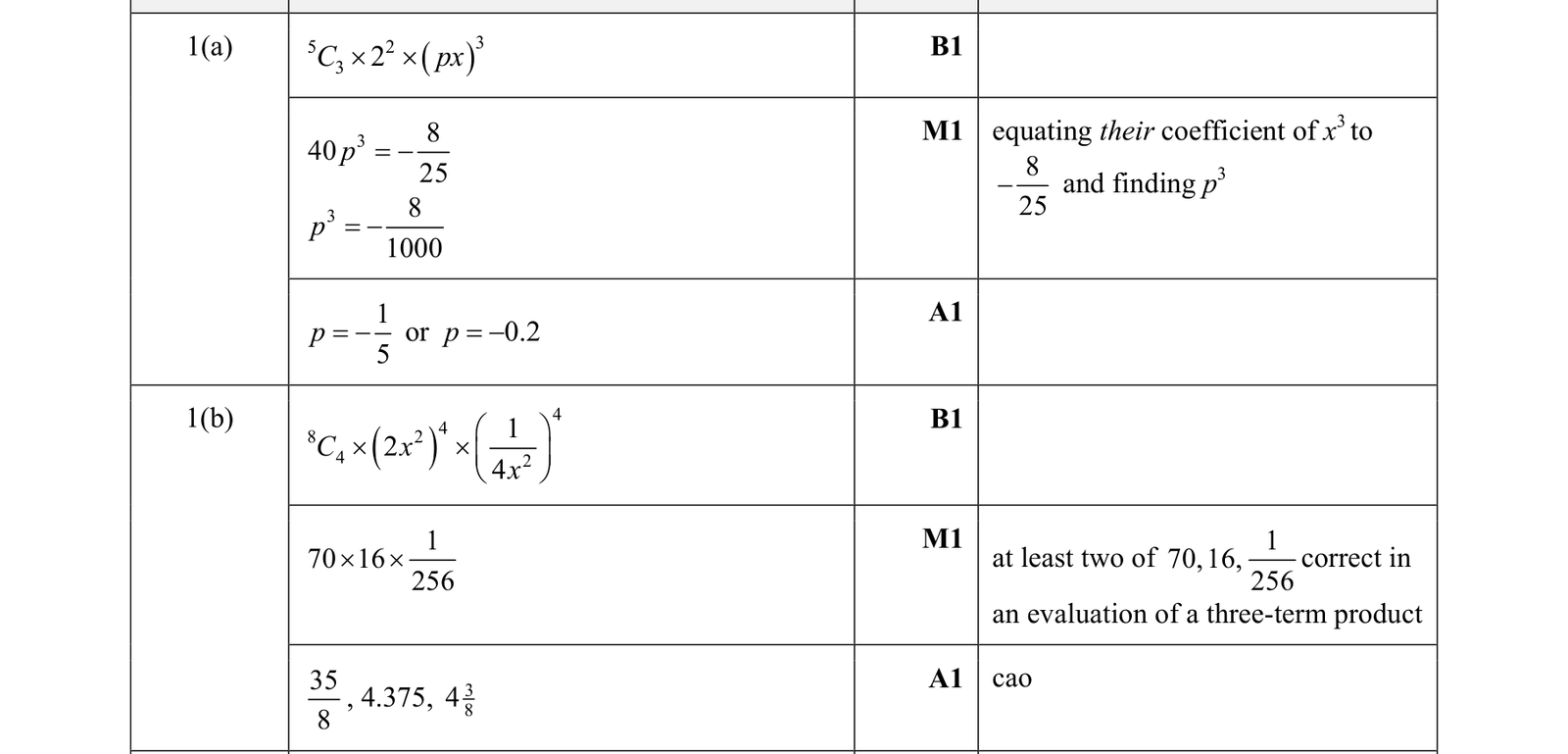
0606 P13 - Nov 2018 - Q1 - 6 marks
(a) In the expansion of \((2+px)^5\), the coefficient of \(x^3\) is equal to \(-\dfrac{8}{25}\). Find the value of the constant \(p\).
(b) Find the term independent of \(x\) in the expansion of \(\left(2x^2+\dfrac{1}{4x^2}\right)^8\).
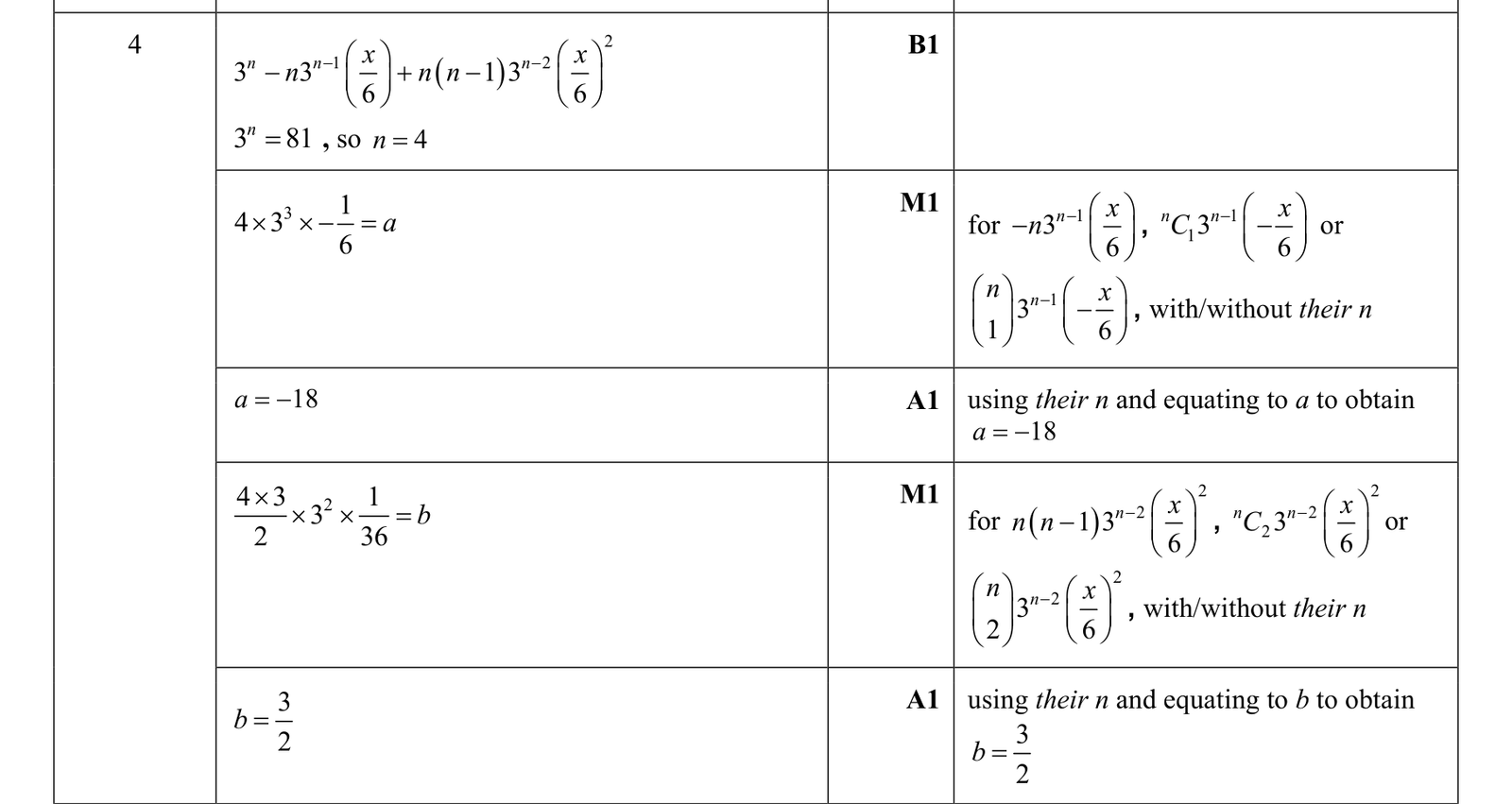
0606 P12 - Jun 2017 - Q4 - 5 marks
The first three terms in the expansion of
\(\left(3-\frac{x}{6}\right)^n\)
are \(81+ax+bx^2\). Find \(n\), \(a\), and \(b\).
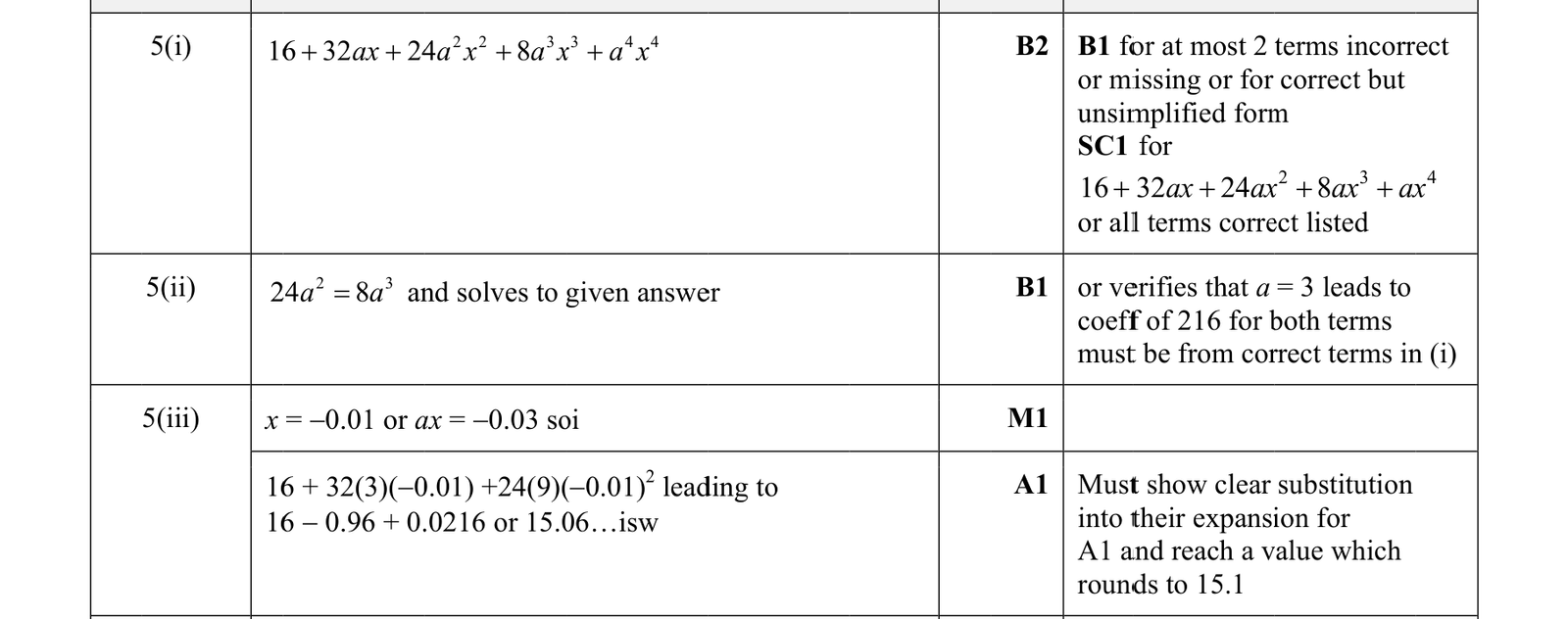
0606 P21 - Jun 2017 - Q5 - 5 marks
(i) Given that \(a\) is a constant, expand \((2+ax)^4\), in ascending powers of \(x\), simplifying each term of your expansion.
Given also that the coefficient of \(x^2\) is equal to the coefficient of \(x^3\),
(ii) show that \(a=3\),
(iii) use your expansion to show that the value of \(1.97^4\) is \(15.1\) to 1 decimal place.
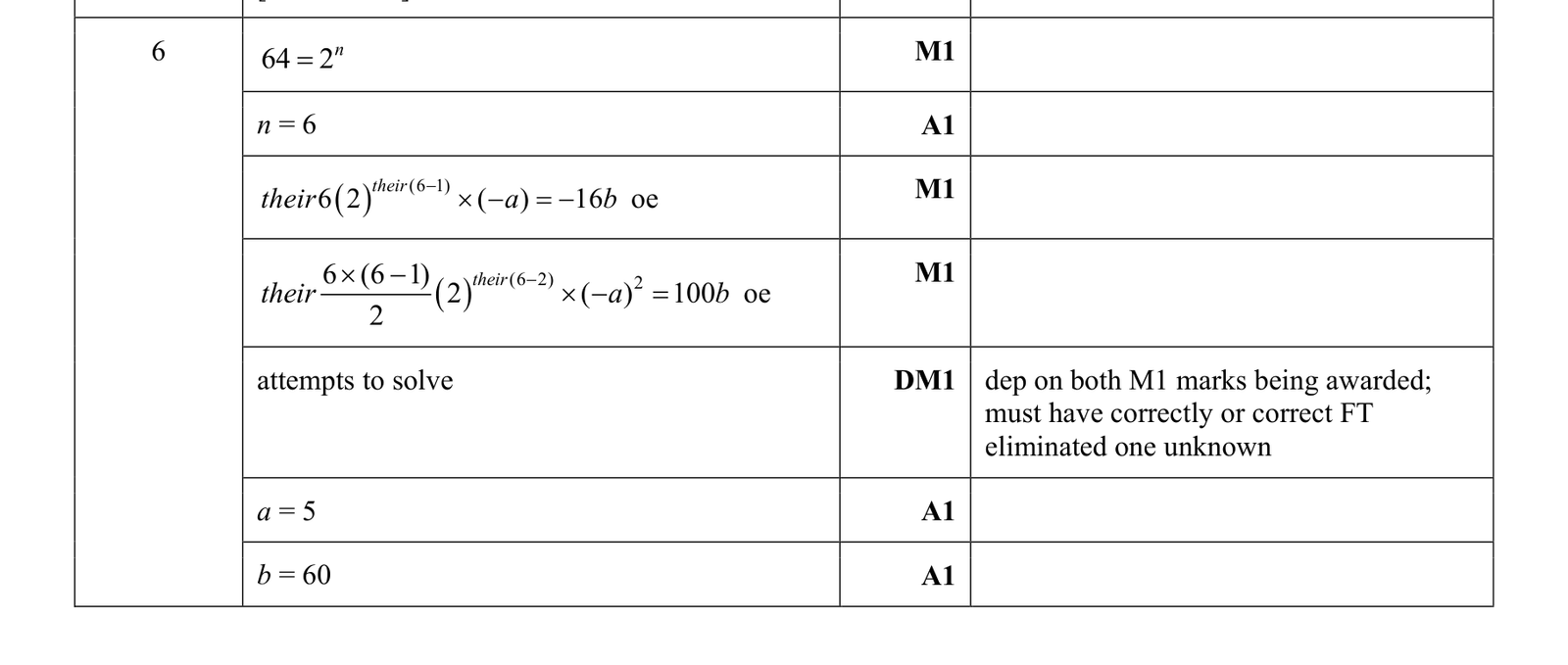
0606 P23 - Jun 2017 - Q6 - 7 marks
The first three terms of the binomial expansion of \((2-ax)^n\) are
\(64-16bx+100bx^2.\)
Find the value of each of the integers \(n\), \(a\) and \(b\).
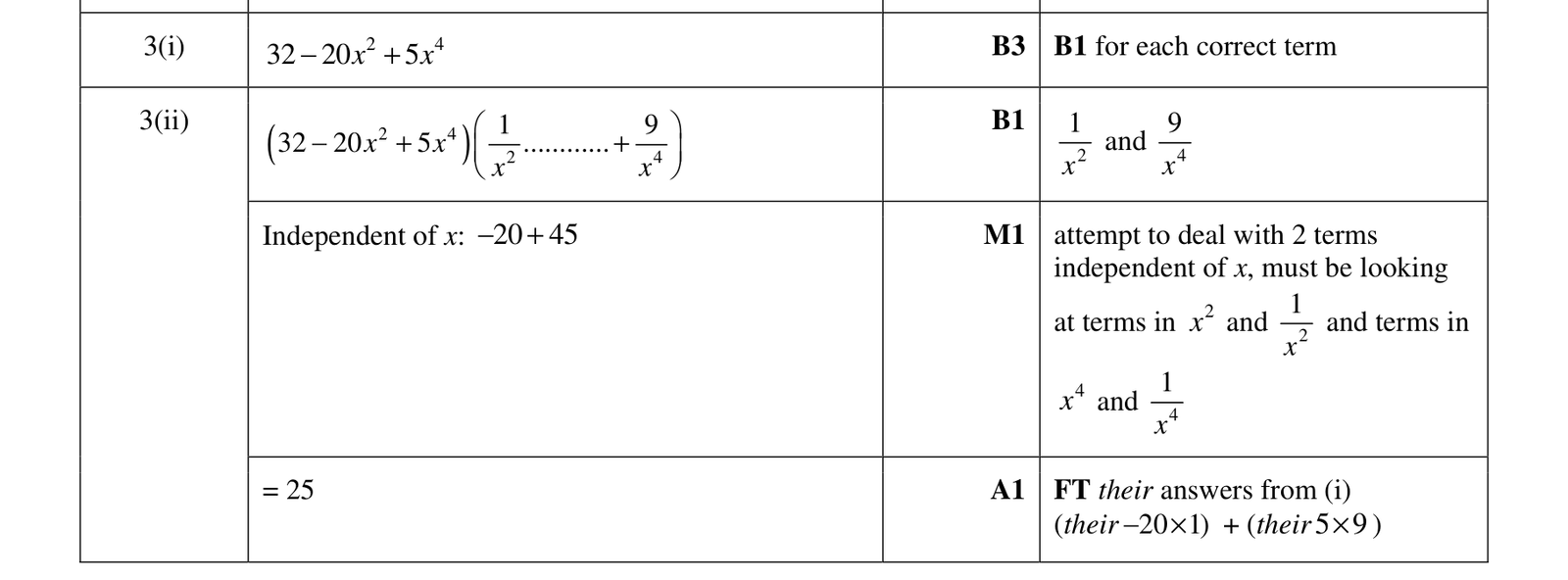
0606 P12 - Nov 2017 - Q3 - 6 marks
(i) Find, in ascending powers of \(x\), the first 3 terms in the expansion of \(\left(2-\dfrac{x^2}{4}\right)^5\).
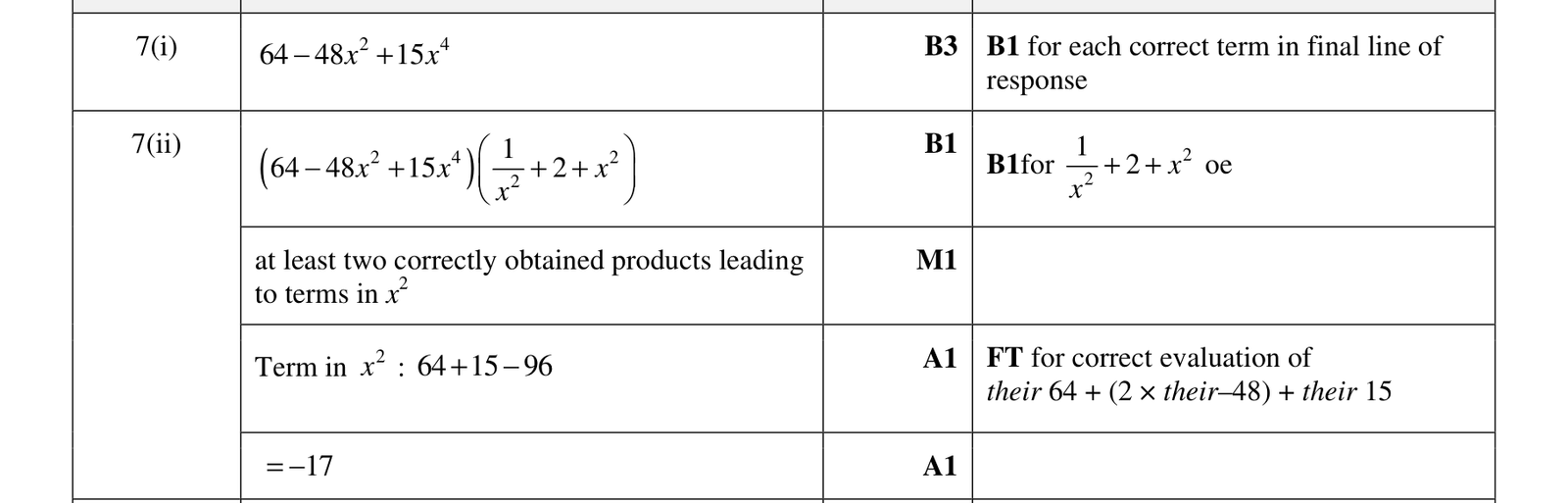
(ii) Hence find the term independent of \(x\) in the expansion of \(\left(2-\dfrac{x^2}{4}\right)^5\left(\dfrac1x-\dfrac3{x^2}\right)^2\).
0606 P13 - Nov 2017 - Q7 - 7 marks
(i) Find, in ascending powers of \(x\), the first 3 terms in the expansion of \(\left(2-\dfrac{x^2}{4}\right)^6\).
(ii) Hence find the coefficient of \(x^2\) in the expansion of \(\left(2-\dfrac{x^2}{4}\right)^6\left(\dfrac1x+x\right)^2\).
0606 P21 - Nov 2017 - Q9 - 10 marks
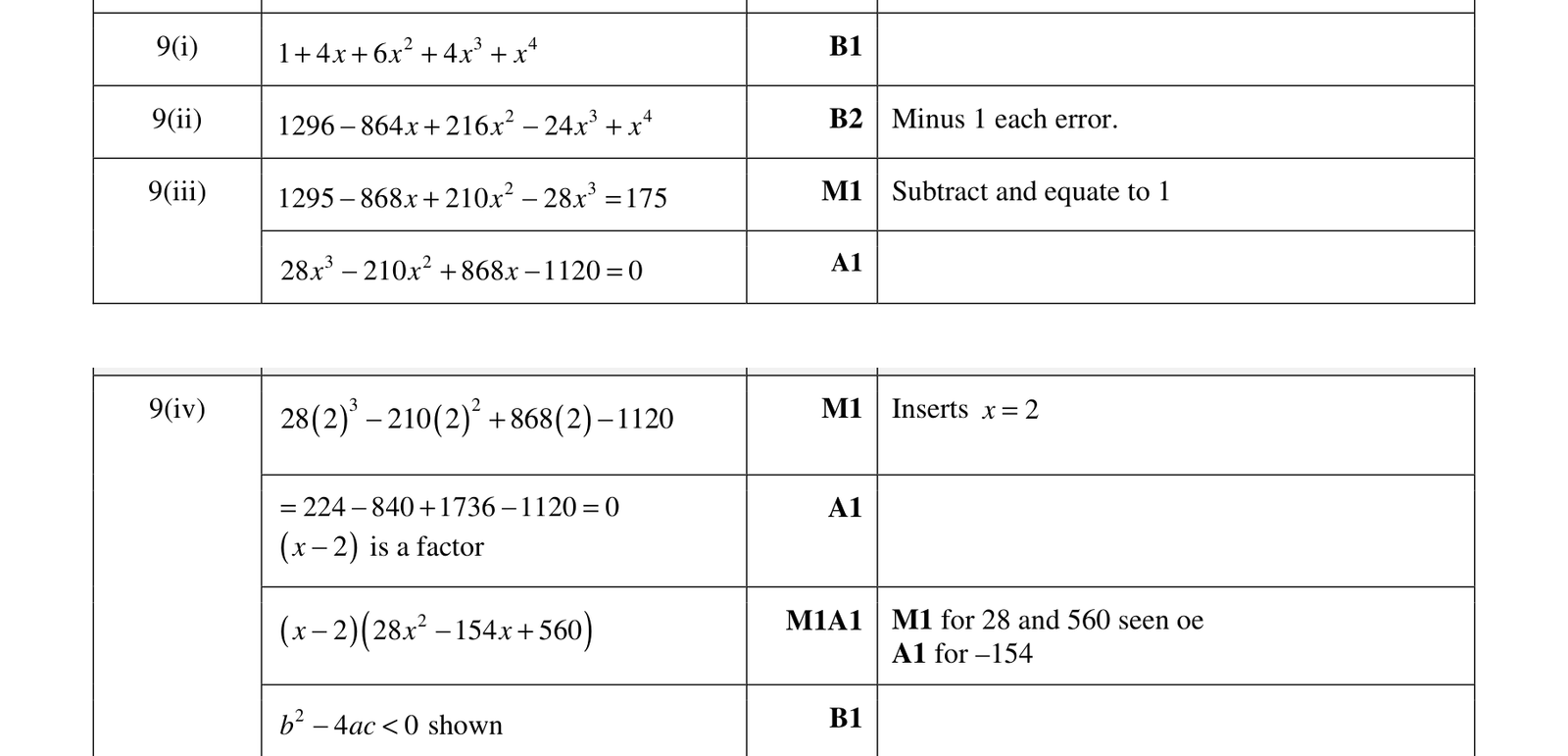
(i) Expand \((1+x)^4\), simplifying all coefficients.
(ii) Expand \((6-x)^4\), simplifying all coefficients.
(iii) Hence express \((6-x)^4-(1+x)^4=175\) in the form \(ax^3+bx^2+cx+d=0\), where \(a\), \(b\), \(c\), and \(d\) are integers.
(iv) Show that \(x=2\) is a solution of the equation in part (iii) and show that this equation has no other real roots.