0606 P12 - Mar 2025 - Q6 - 5 marks
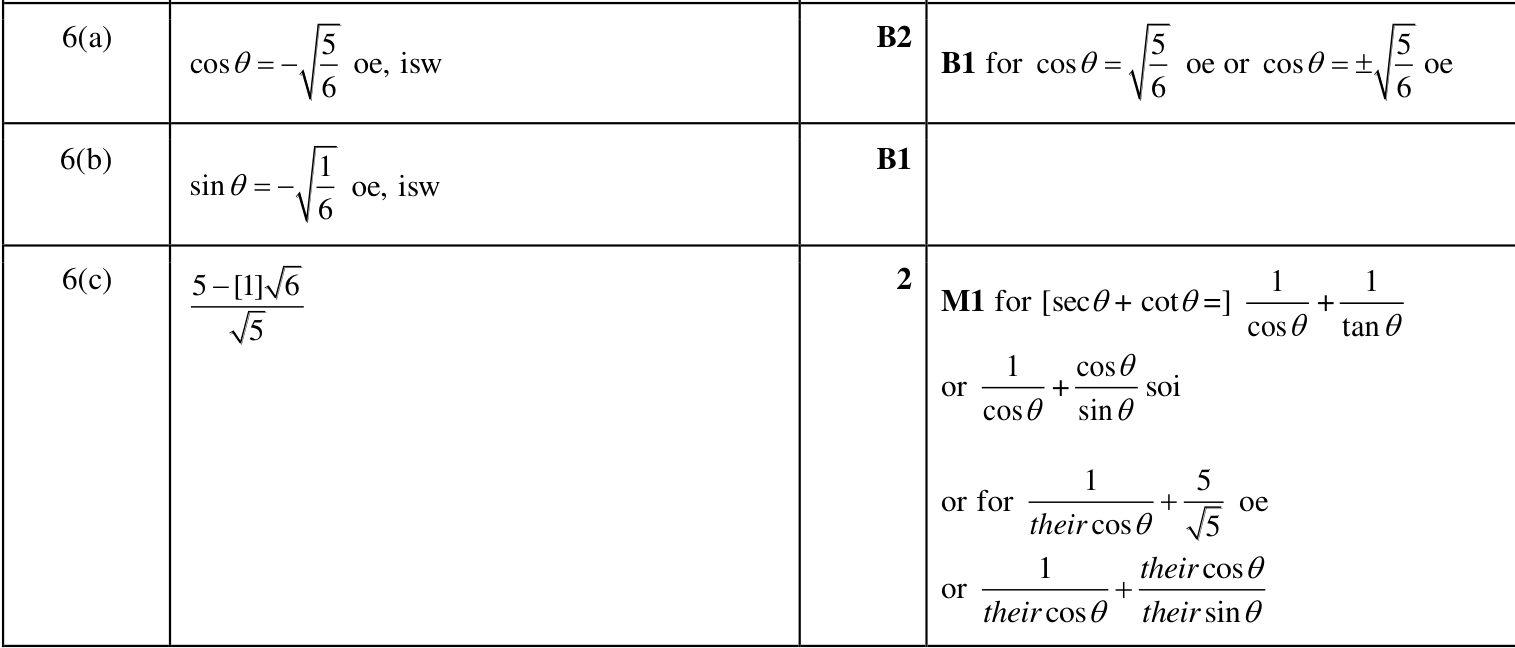
It is given that \(\tan\theta=\frac{\sqrt5}{5}\) and \(180^\circ\lt \theta\lt 360^\circ\).
(a) Find the value of \(\cos\theta\).
(b) Find the value of \(\sin\theta\).
(c) Find the value of \(\sec\theta+\cot\theta\). Give your answer in the form \(\frac{a+b\sqrt c}{\sqrt5}\), where \(a\), \(b\) and \(c\) are integers.
0606 P23 - Nov 2023 - Q7 - 7 marks
Do not use a calculator in this question.
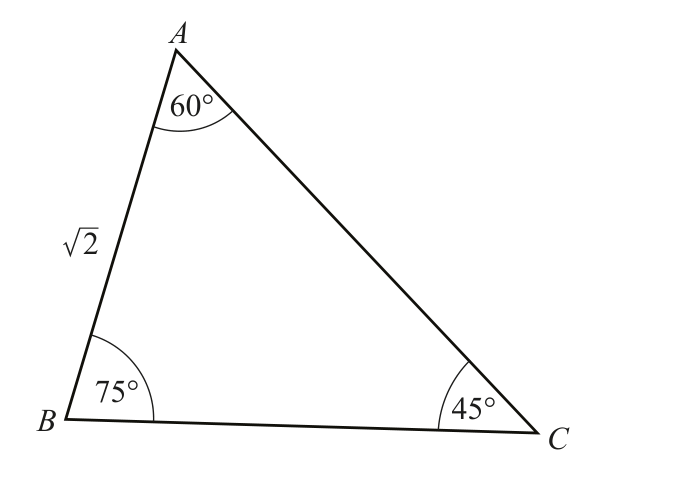
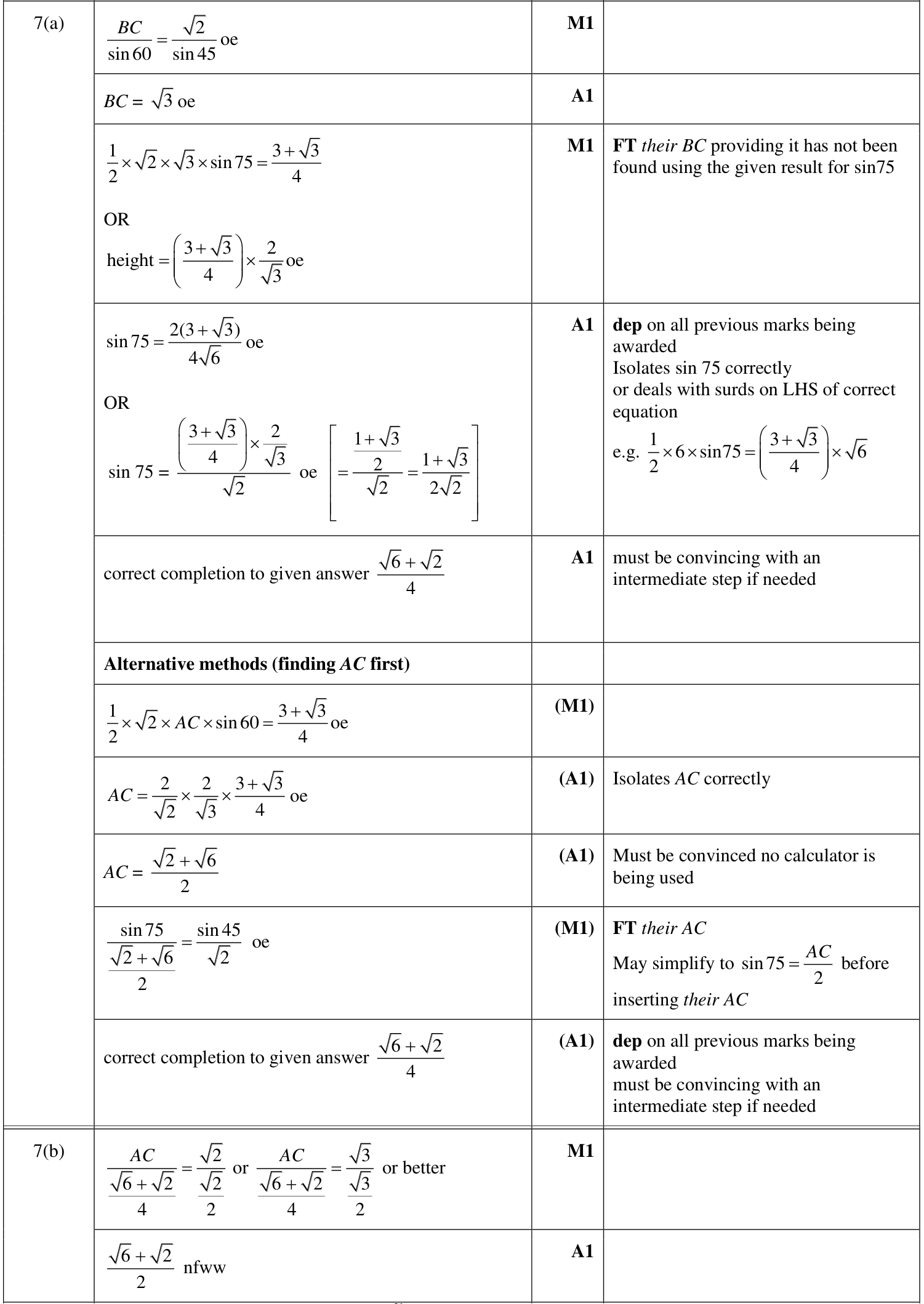
The diagram shows triangle \(ABC\), where \(AB=\sqrt2\), \(\angle A=60^\circ\), \(\angle B=75^\circ\) and \(\angle C=45^\circ\).
You may use \(\sin60^\circ=\frac{\sqrt3}{2}\), \(\sin45^\circ=\frac{\sqrt2}{2}\), \(\cos60^\circ=\frac12\), \(\cos45^\circ=\frac{\sqrt2}{2}\), \(\tan60^\circ=\sqrt3\) and \(\tan45^\circ=1\).
(a) Given that the area of triangle \(ABC\) is \(\frac{3+\sqrt3}{4}\), show that
\(\sin75^\circ=\frac{\sqrt6+\sqrt2}{4}.\)
(b) Hence find the exact length of \(AC\).
0606 P11 - Jun 2023 - Q5 - 8 marks
This question is to be answered without using a calculator.
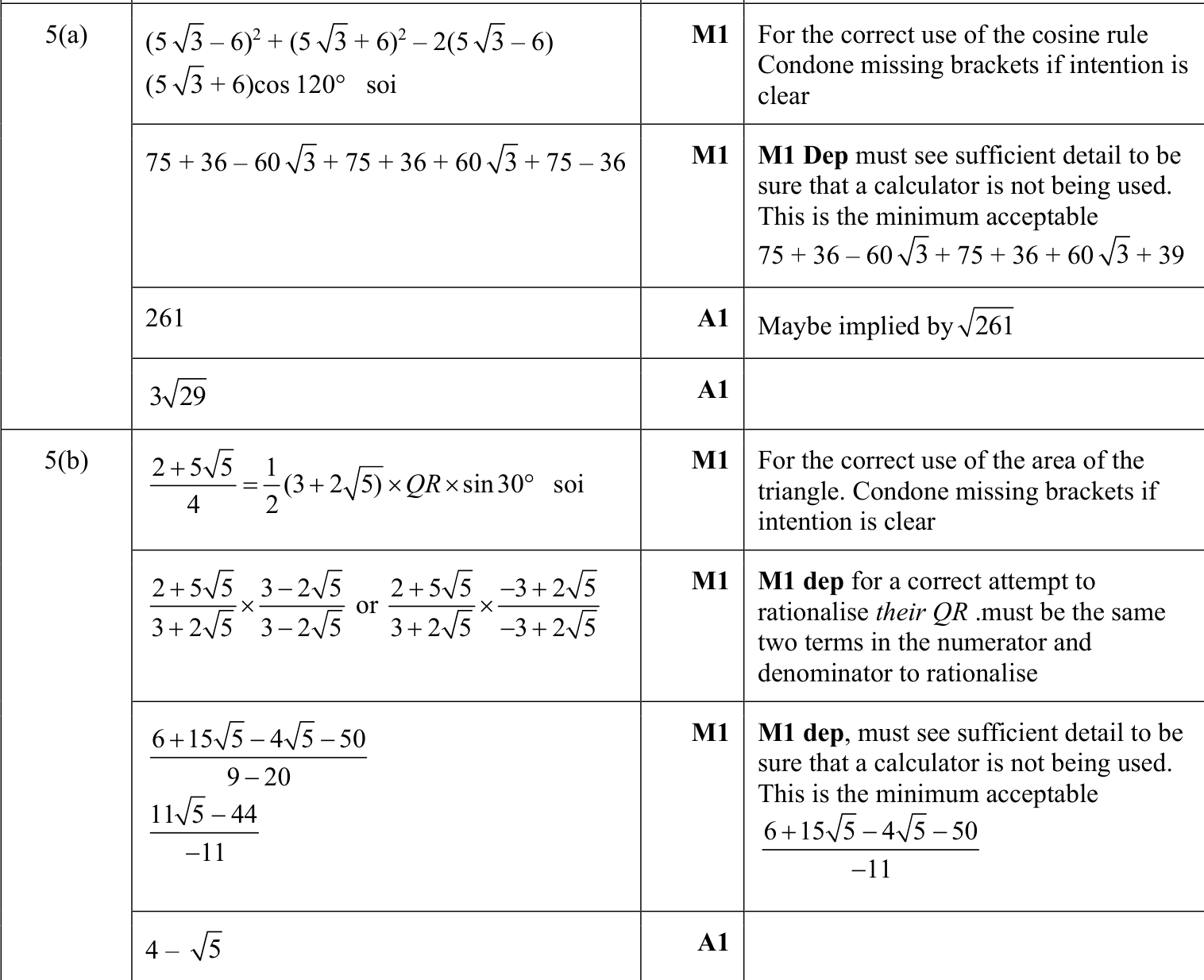
(a) In triangle \(ABC\), \(AB=5\sqrt3-6\), \(BC=5\sqrt3+6\) and angle \(ABC=120^\circ\). Find \(AC\) in the form \(a\sqrt b\), where \(a\) and \(b\) are integers.
(b) In triangle \(PQR\), \(PQ=3+2\sqrt5\), angle \(PQR=30^\circ\) and the area of triangle \(PQR\) is \(\frac14(2+5\sqrt5)\). Find \(QR\) in the form \(c+d\sqrt5\), where \(c\) and \(d\) are integers.
0606 P11 - Jun 2022 - Q8 - 9 marks
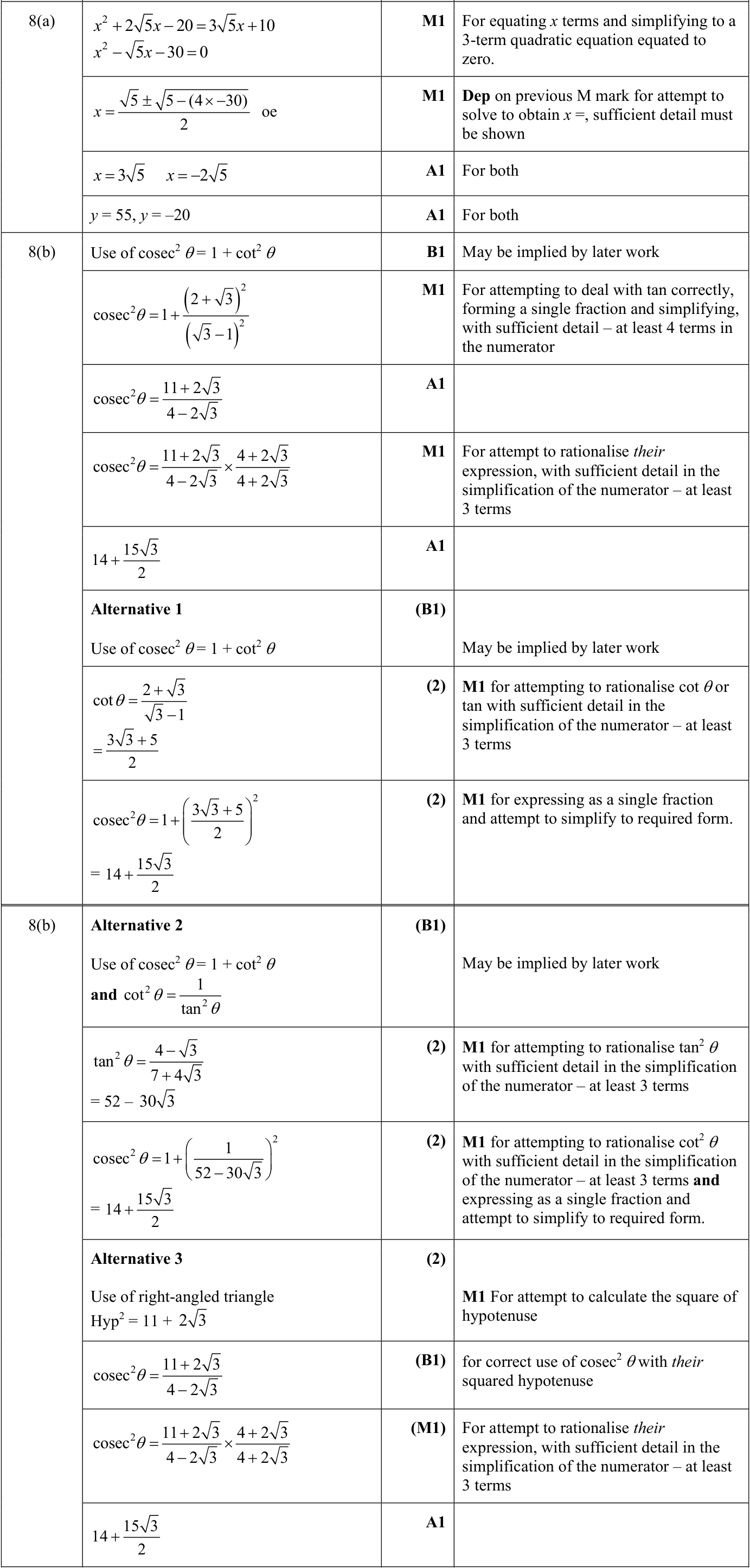
(a) Find the exact coordinates of the points of intersection of \(y=x^2+2\sqrt5x-20\) and \(y=3\sqrt5x+10\).
(b) Given \(\tan\theta=\frac{\sqrt3-1}{2+\sqrt3}\), for \(0\lt \theta\lt \frac\pi2\), find \(\operatorname{cosec}^2\theta\) in the form \(a+b\sqrt3\).
0606 P12 - Jun 2022 - Q2 - 4 marks
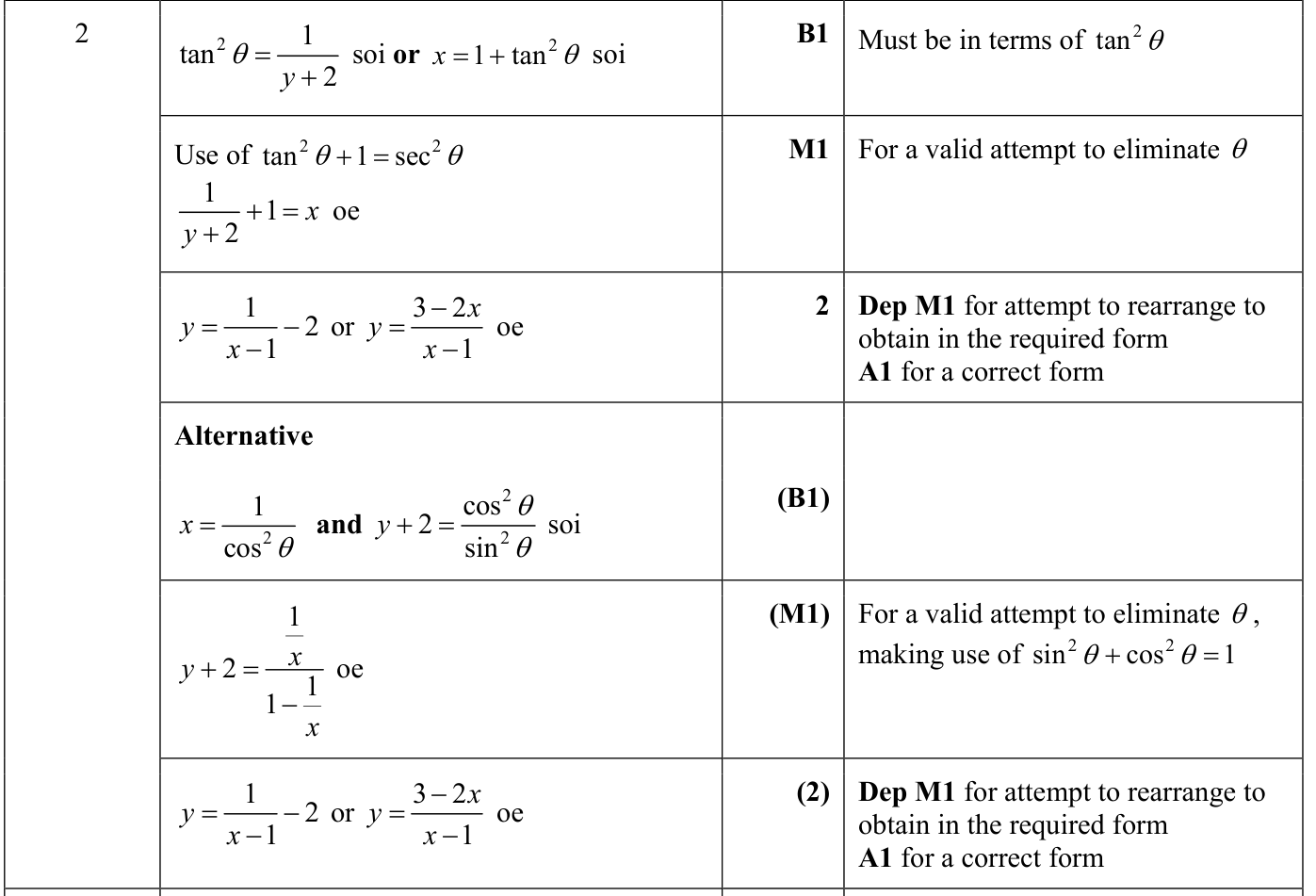
Given that \(x=\operatorname{sec}^{2}\theta\) and \(y+2=\operatorname{cot}^{2}\theta\), find \(y\) in terms of \(x\).
0606 P22 - Nov 2022 - Q9 - 11 marks
In this question all lengths are in centimetres.
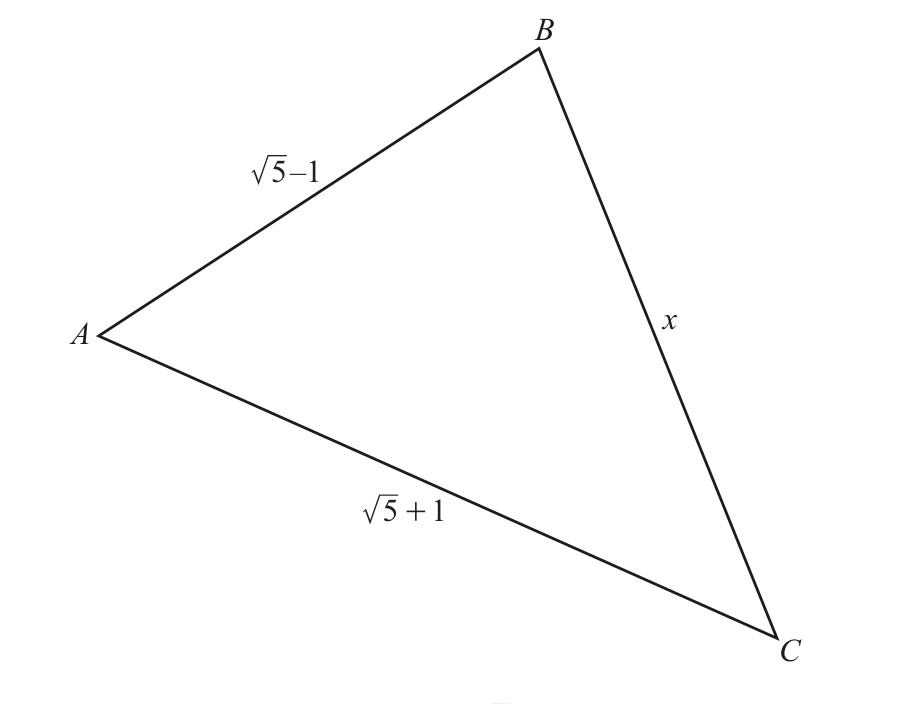
The diagram shows triangle \(ABC\) with \(AB=\sqrt5-1\), \(AC=\sqrt5+1\) and \(BC=x\). The area of triangle \(ABC\) is \(\frac{2\sqrt5}{3}\text{ cm}^2\). Angle \(A\) is acute.
(a) Find the exact value of \(\sin A\).
(b) Find the exact value of \(\cos A\) and hence find the exact value of \(x\).
(c) Find the exact value of \(\sin B\).

0606 P22 - Nov 2021 - Q6 - 7 marks
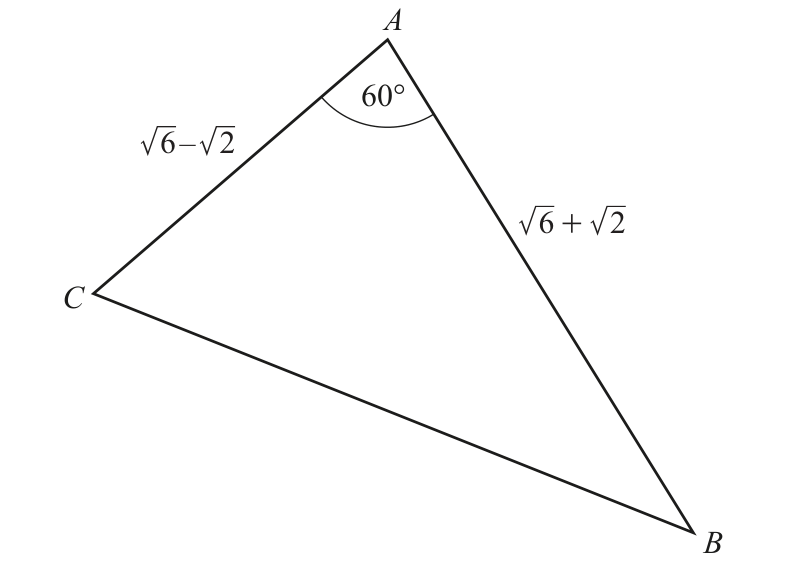
The diagram shows triangle \(ABC\) with
\(AC=\sqrt6-\sqrt2,\quad AB=\sqrt6+\sqrt2\)
and angle \(CAB=60^\circ\).
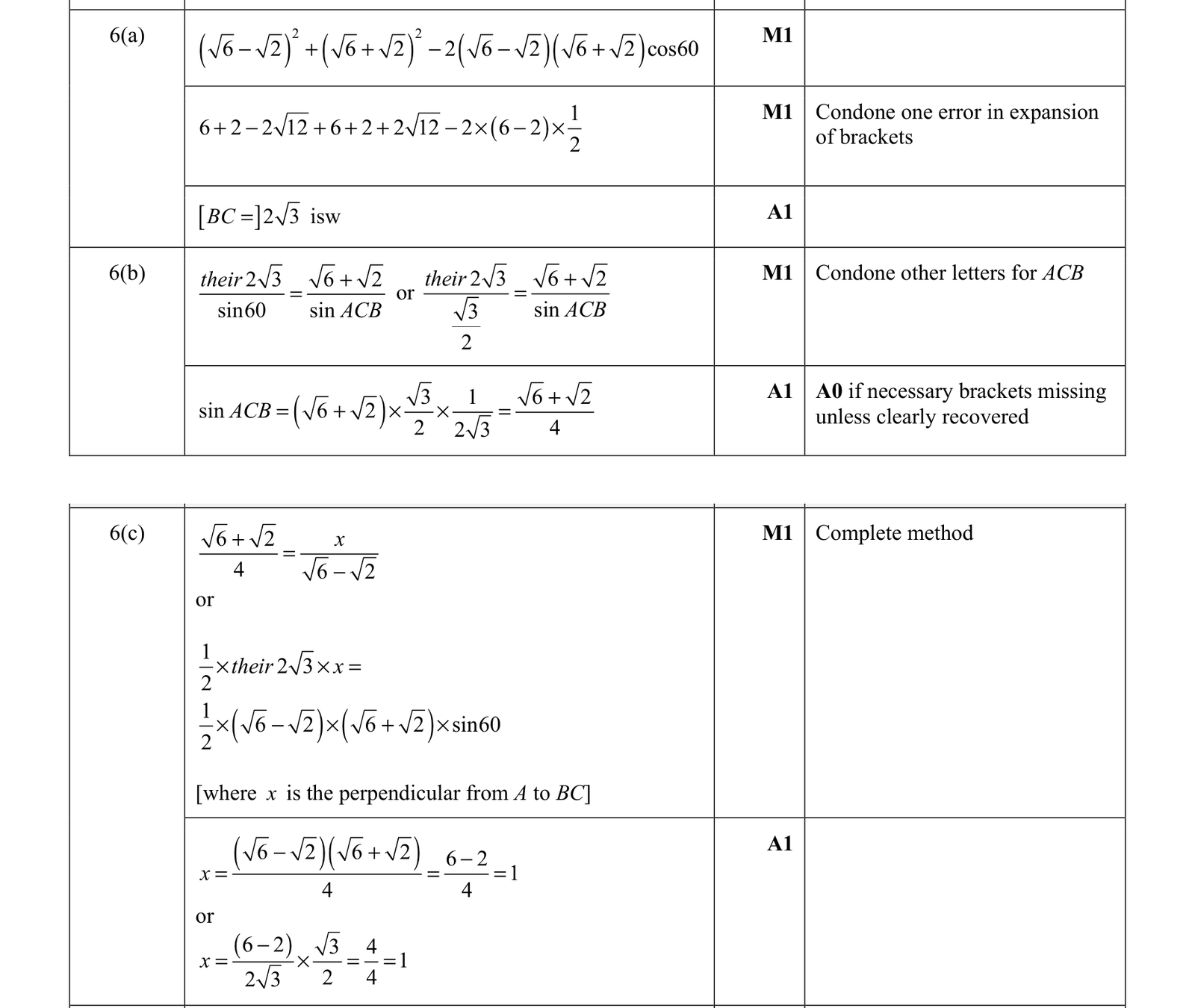
(a) Find the exact length of \(BC\).
(b) Show that
\(\sin ACB=\frac{\sqrt6+\sqrt2}{4}.\)
(c) Show that the perpendicular distance from \(A\) to the line \(BC\) is \(1\).
0606 P12 - Mar 2019 - Q7 - 6 marks
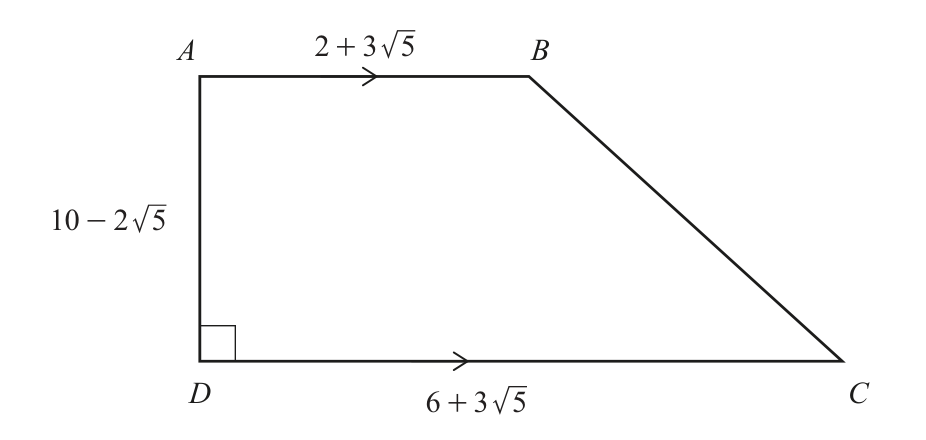
The diagram shows a trapezium \(ABCD\), where \(AB\) is parallel to \(DC\), \(AD\) is perpendicular to \(DC\),
\(AB=2+3\sqrt5,\qquad DC=6+3\sqrt5,\qquad AD=10-2\sqrt5.\)
(i) Find the area of the trapezium in the form \(a+b\sqrt5\), where \(a\) and \(b\) are integers.
(ii) Find \(\operatorname{cot} BCD\) in the form \(c+d\sqrt5\), where \(c\) and \(d\) are constants.

0606 P13 - Jun 2019 - Q7 - 8 marks
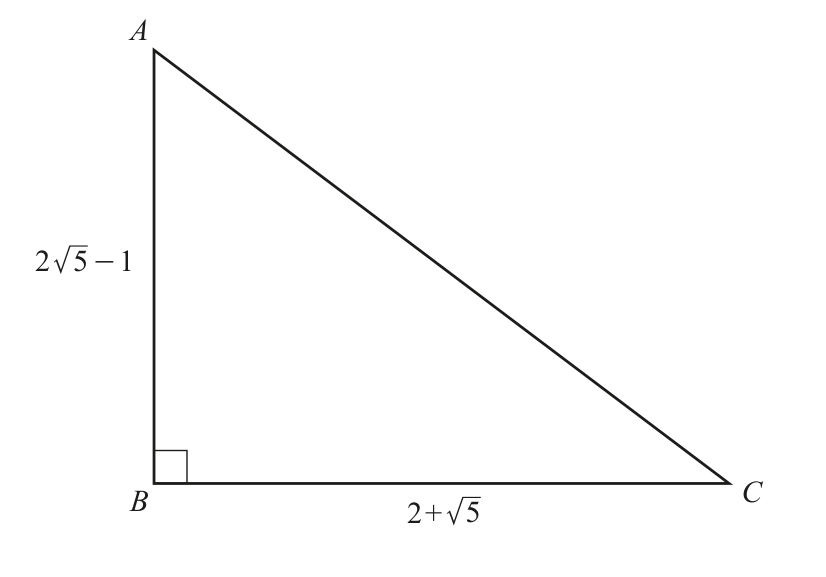
Do not use a calculator in this question. In triangle \(ABC\), \(AB=2\sqrt5-1\), \(BC=2+\sqrt5\), and angle \(ABC=90^\circ\).
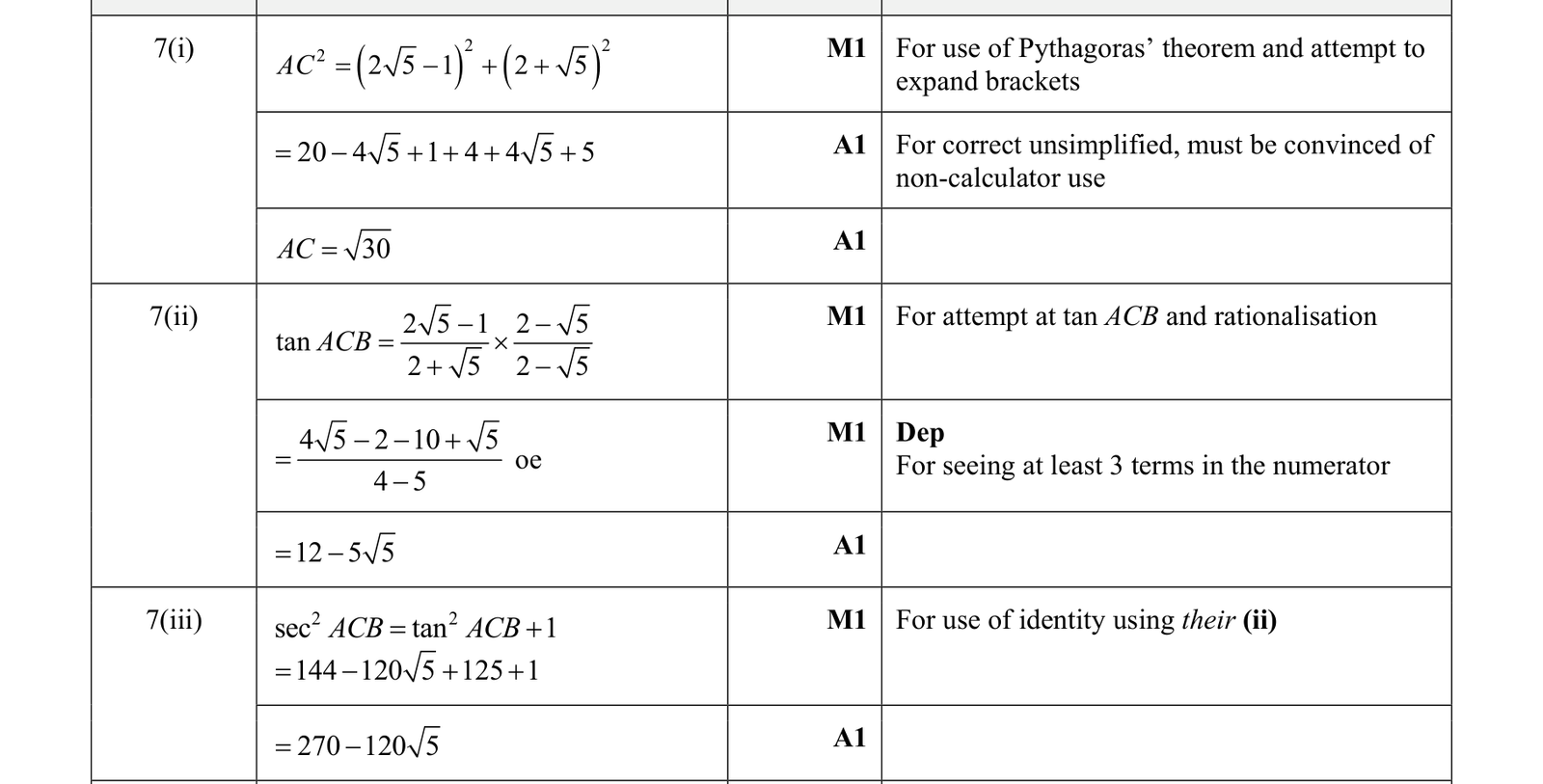
(i) Find the exact length of \(AC\).
(ii) Find \(\tan ACB\), giving your answer in the form \(p+q\sqrt r\), where \(p\), \(q\) and \(r\) are integers.
(iii) Hence find \(\operatorname{sec}^2ACB\), giving your answer in the form \(s+t\sqrt u\), where \(s\), \(t\) and \(u\) are integers.