0606 P22 - Nov 2023 - Q3 - 4 marks
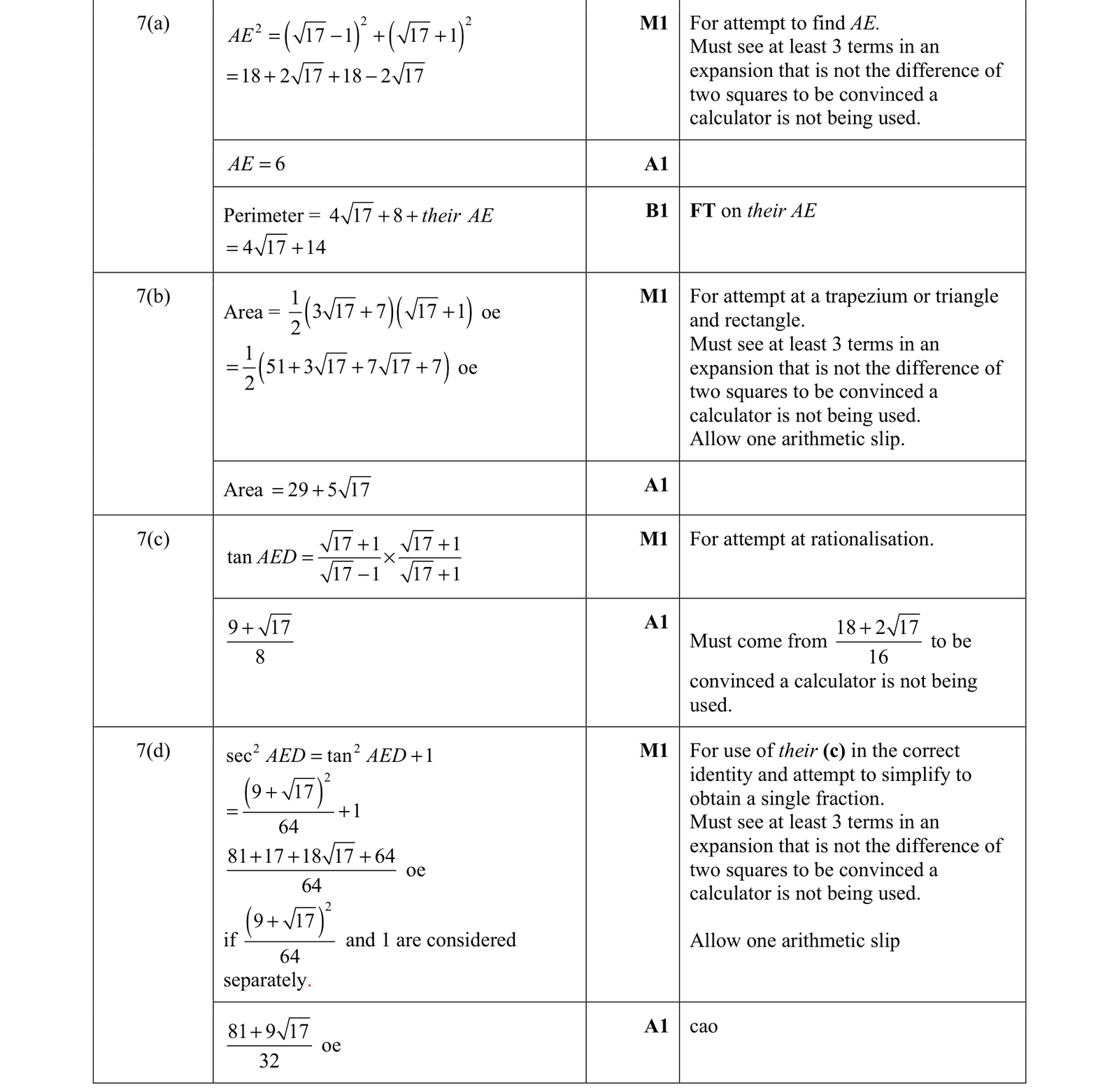
Do not use a calculator in this question.
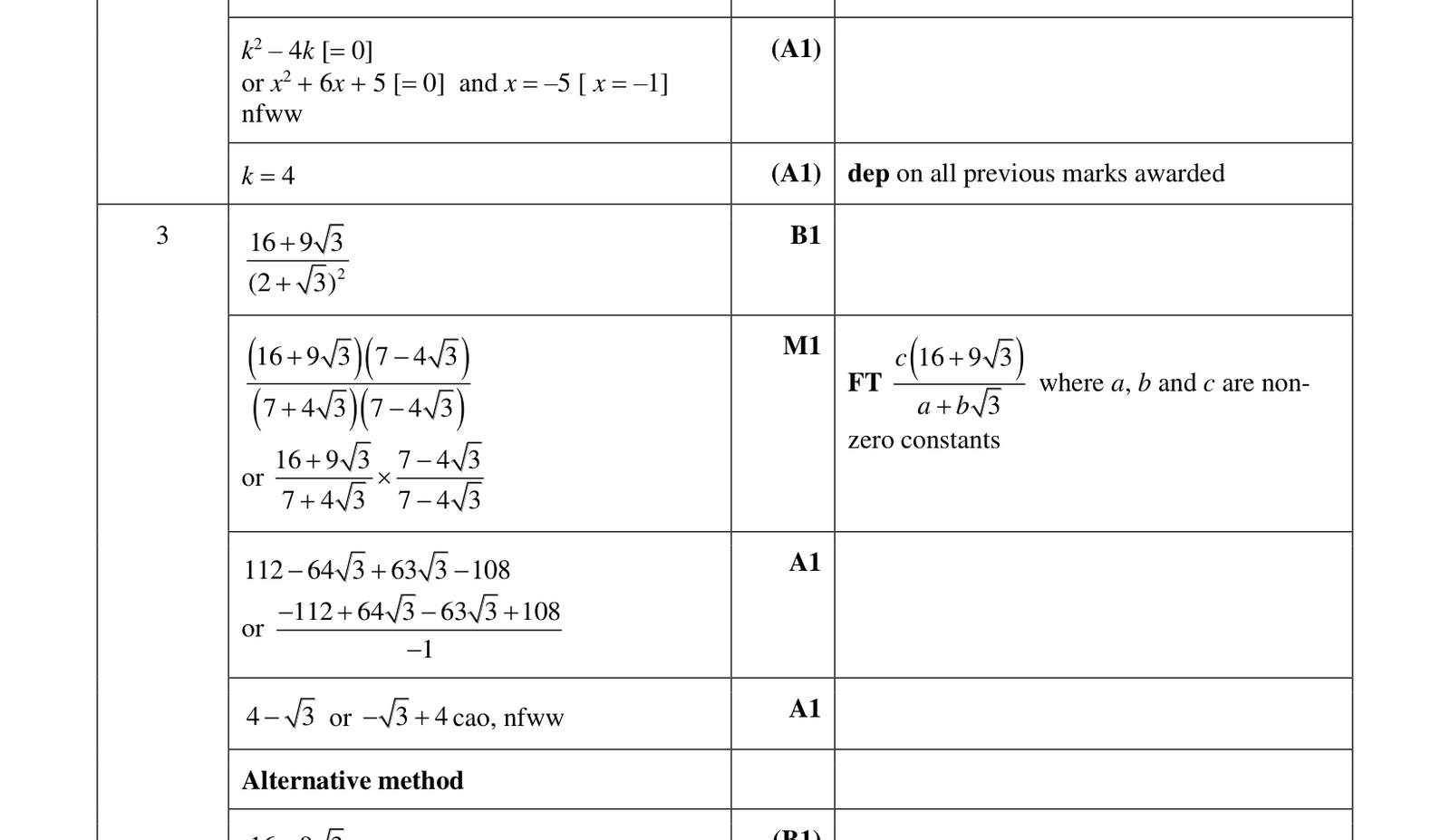
A cylinder has base radius \((2+\sqrt3)\text{ m}\) and volume \(\pi(16+9\sqrt3)\text{ m}^3\). Find the exact value of its height, giving your answer in its simplest form.
0606 P12 - Mar 2021 - Q7 - 9 marks
Do not use a calculator in this question.
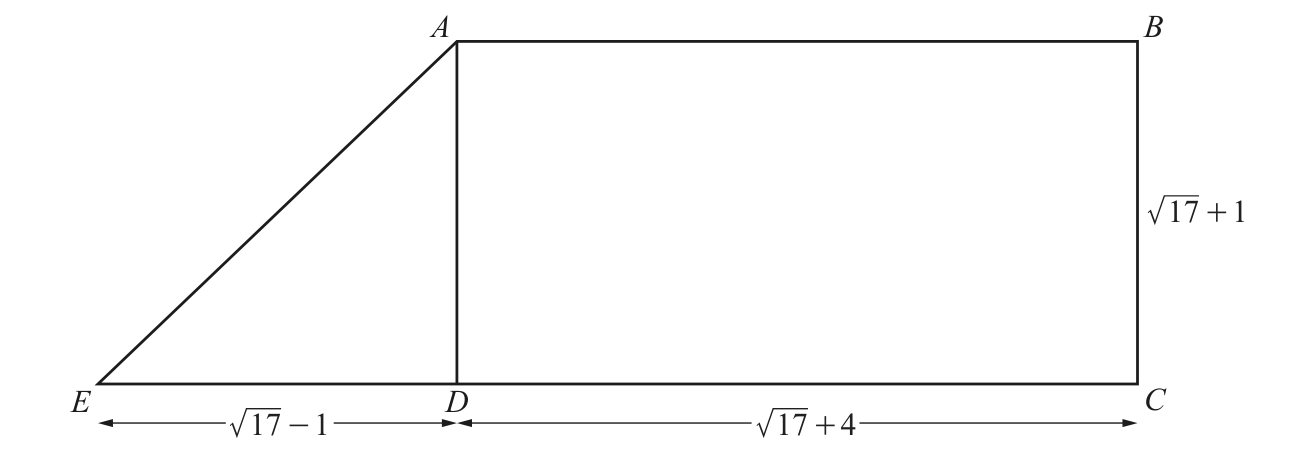
The diagram shows a trapezium \(ABCDE\) such that \(AB\) is parallel to \(EC\) and \(ABCD\) is a rectangle. It is given that \(BC=\sqrt{17}+1\), \(ED=\sqrt{17}-1\) and \(DC=\sqrt{17}+4\).
(a) Find the perimeter of the trapezium, giving your answer in the form \(a+b\sqrt{17}\), where \(a\) and \(b\) are integers.
(b) Find the area of the trapezium, giving your answer in the form \(c+d\sqrt{17}\), where \(c\) and \(d\) are integers.
(c) Find \(\tan AED\), giving your answer in the form \(\dfrac{e+f\sqrt{17}}{8}\), where \(e\) and \(f\) are integers.
(d) Hence show that \(\operatorname{sec}^2 AED=\dfrac{81+9\sqrt{17}}{32}\).
0606 P12 - Mar 2020 - Q5 - 7 marks
Do not use a calculator in this question.
The diagram shows the isosceles triangle \(ABC\), where \(AB=AC\) and \(BC=2+4\sqrt3\). The height, \(AD\), of the triangle is \(5-\sqrt3\).
(a) Find the area of the triangle \(ABC\), giving your answer in the form \(a+b\sqrt3\), where \(a\) and \(b\) are integers.
(b) Find \(\tan ABC\), giving your answer in the form \(c+d\sqrt3\), where \(c\) and \(d\) are integers.
(c) Find \(\operatorname{sec}^2 ABC\), giving your answer in the form \(e+f\sqrt3\), where \(e\) and \(f\) are integers.


0606 P21 - Nov 2020 - Q6 - 5 marks
In the diagram, all lengths are in centimetres. The triangle has \(\angle CAB=90^\circ\), \(AC=\sqrt3-1\), \(AB=\sqrt3+1\), and \(\angle ABC=15^\circ\).
(a) Show that \(\tan15^\circ=2-\sqrt3\).
(b) Find the exact length of \(BC\).


0606 P22 - Nov 2020 - Q8 - 8 marks
In triangle \(ABC\), \(AB=2\sqrt3+1\) cm and \(\angle BAC=30^\circ\). Given that the area of triangle \(ABC\) is \(5.5\text{ cm}^2\), find the exact length of \(AC\). Write your answer in the form \(a+b\sqrt3\), where \(a\) and \(b\) are integers.
(b) Show that \(BC^2=c+d\sqrt3\), where \(c\) and \(d\) are integers to be found.


0606 P23 - Nov 2019 - Q6 - 6 marks
Do not use a calculator in this question.
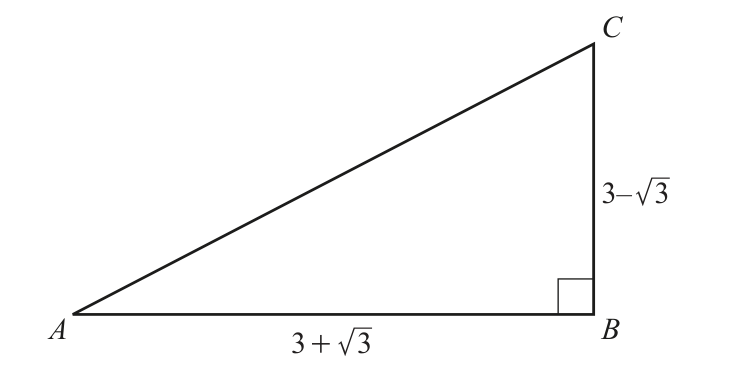
In the right-angled triangle, \(AB=3+\sqrt3\) and \(BC=3-\sqrt3\).
(i) Find \(\tan ACB\) in the form \(r+s\sqrt3\), where \(r\) and \(s\) are integers.
(ii) Find \(AC\) in the form \(t\sqrt u\), where \(t\) and \(u\) are integers and \(t\neq1\).

0606 P12 - Jun 2018 - Q10 - 8 marks
Do not use a calculator in this question.
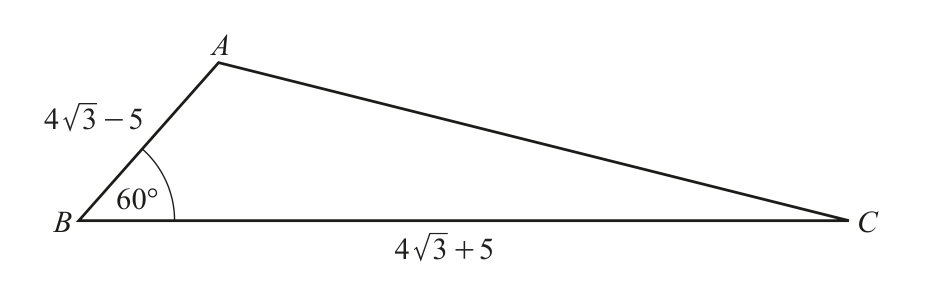
The triangle \(ABC\) has \(AB=4\sqrt3-5\), \(BC=4\sqrt3+5\) and \(\angle ABC=60^\circ\).
It is known that \(\sin60^\circ=\dfrac{\sqrt3}{2}\), \(\cos60^\circ=\dfrac12\), \(\tan60^\circ=\sqrt3\).
(i) Find the exact value of \(AC\).
(ii) Hence show that
\(\operatorname{cosec}ACB=\frac{2\sqrt p}{q}(4\sqrt3+5),\)
where \(p\) and \(q\) are integers.

0606 P13 - Nov 2018 - Q3 - 6 marks
Do not use a calculator in this question.
In this question, all lengths are in centimetres.
A triangle \(ABC\) is such that angle \(B=90^\circ\), \(AB=5\sqrt3+5\) and \(BC=5\sqrt3-5\).
(i) Find, in its simplest surd form, the length of \(AC\).
(ii) Find \(\tan BCA\), giving your answer in the form \(a+b\sqrt3\), where \(a\) and \(b\) are integers.

0606 P13 - Jun 2017 - Q4 - 5 marks
In this question, all dimensions are in centimetres.
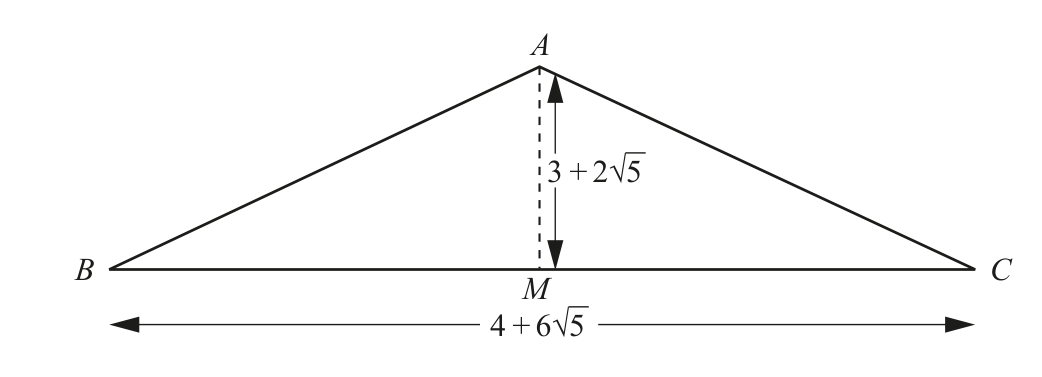
The diagram shows an isosceles triangle \(ABC\), where \(AB=AC\). The point \(M\) is the mid-point of \(BC\).
Given that \(AM=3+2\sqrt5\) and \(BC=4+6\sqrt5\), find, without using a calculator,
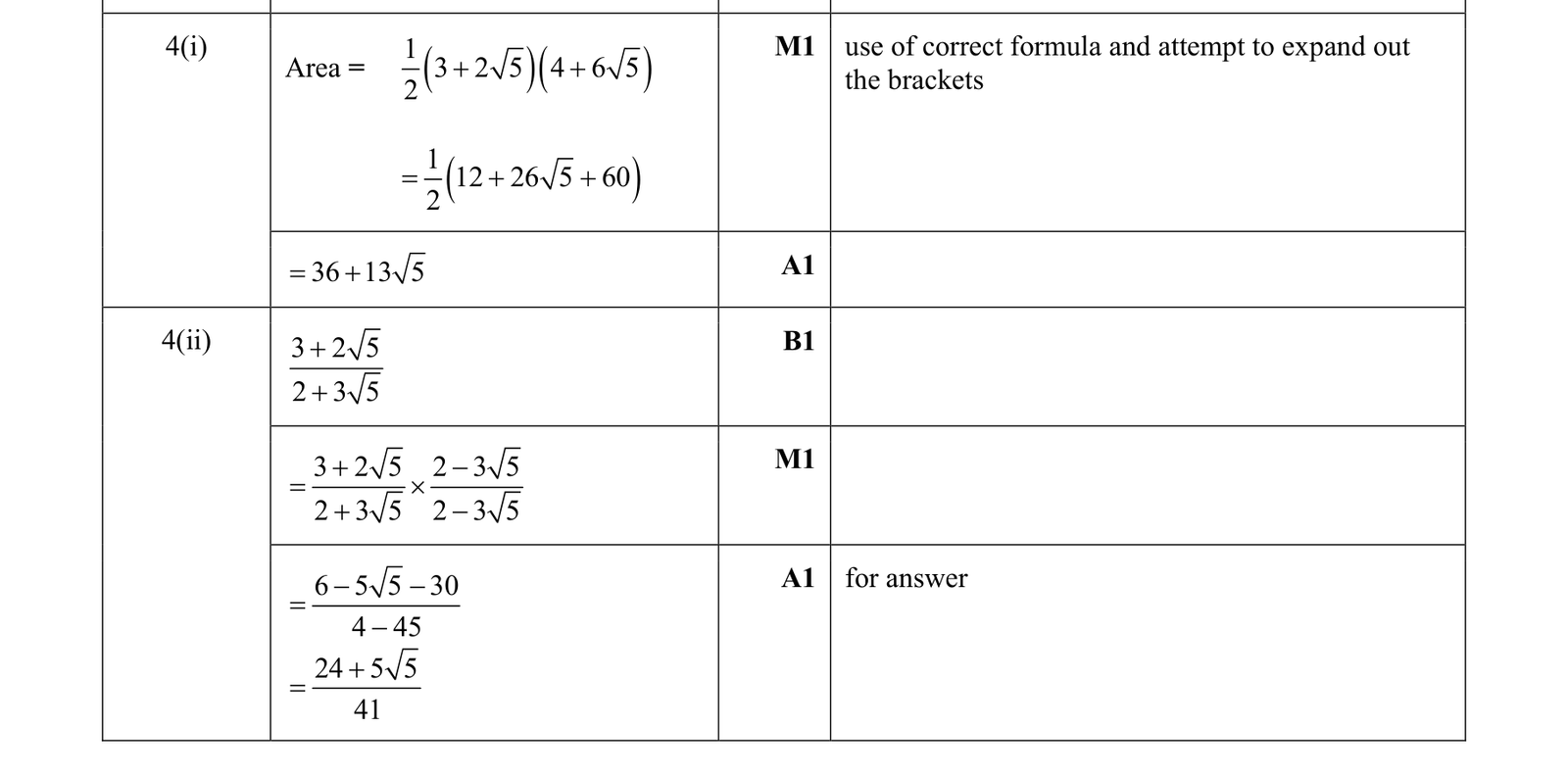
(i) the area of triangle \(ABC\),
(ii) \(\tan ABC\), giving your answer in the form \(\frac{a+b\sqrt5}{c}\), where \(a\), \(b\) and \(c\) are positive integers.