0606 P12 - Jun 2025 - Q10 - 8 marks
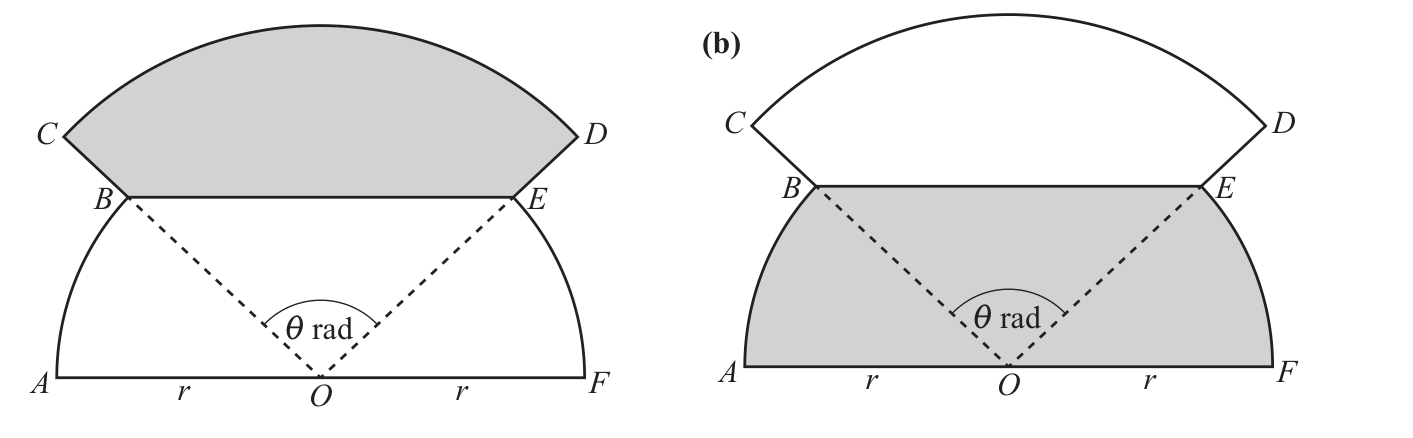
The diagram shows the shape \(OABCDEF\). \(AOF\) is a straight line.
\(OAB\) and \(OEF\) are sectors of a circle with centre \(O\) and radius \(r\). Angle \(BOA=\) angle \(EOF\).
\(OCD\) is a sector of a circle with centre \(O\) and radius \(\frac{4r}{3}\). Angle \(COD\) is \(\theta\) radians.
The point \(B\) lies on the line \(OC\) and the point \(E\) lies on the line \(OD\). The line \(BE\) is parallel to the line \(AOF\).
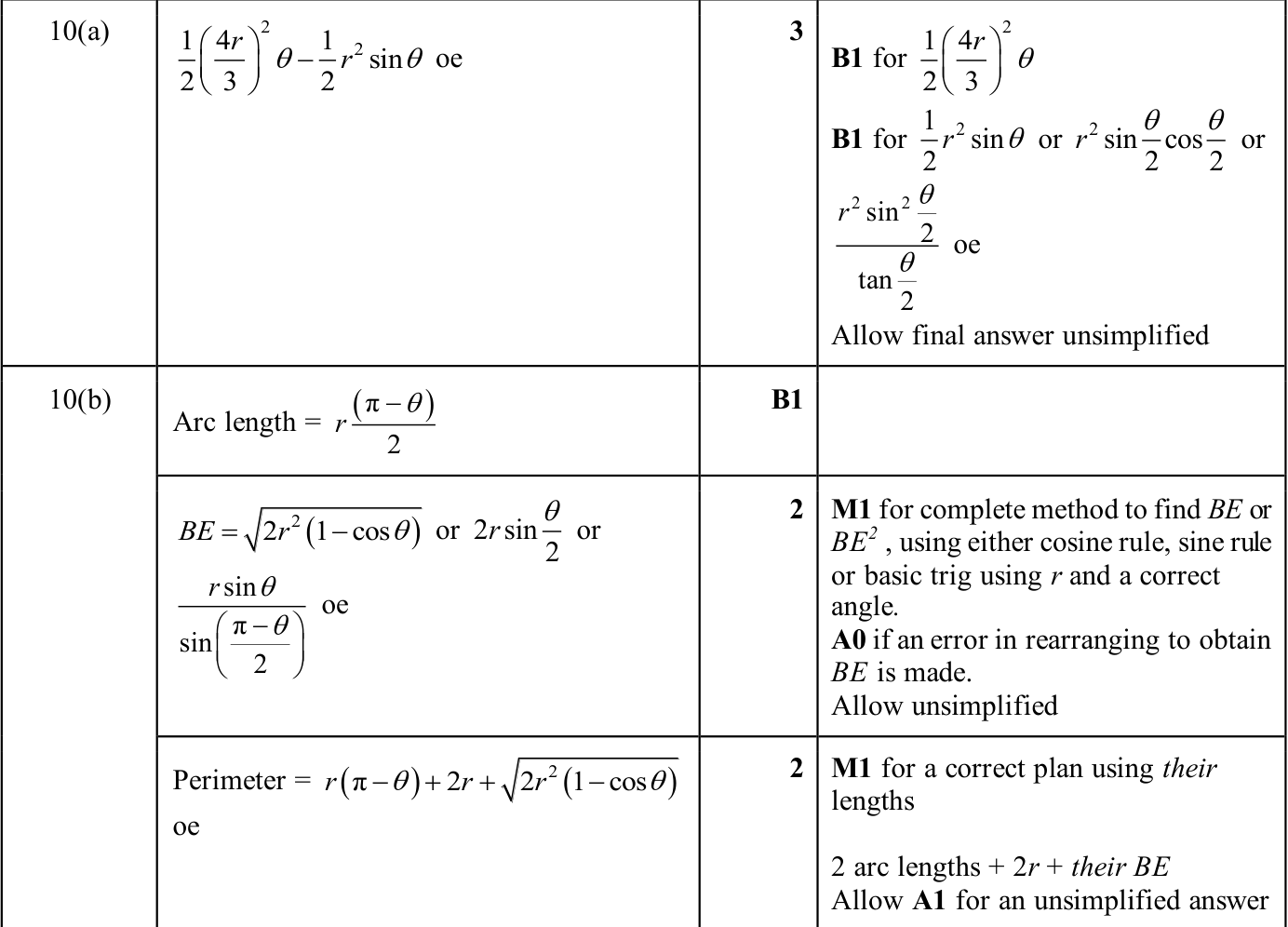
(a) Find, in terms of \(r\) and \(\theta\), the area of the shaded region \(BCDE\).
(b) The diagram shows the shape from part (a) with region \(OABEF\) shaded. Find, in terms of \(r\) and \(\theta\), the perimeter of the shaded region.
0606 P13 - Jun 2025 - Q7 - 6 marks
In this question, all lengths are in centimetres and all angles are in radians.
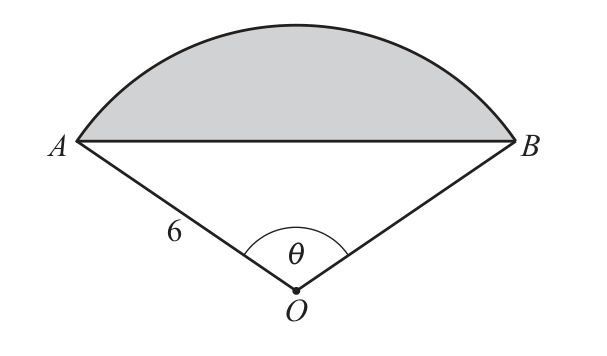
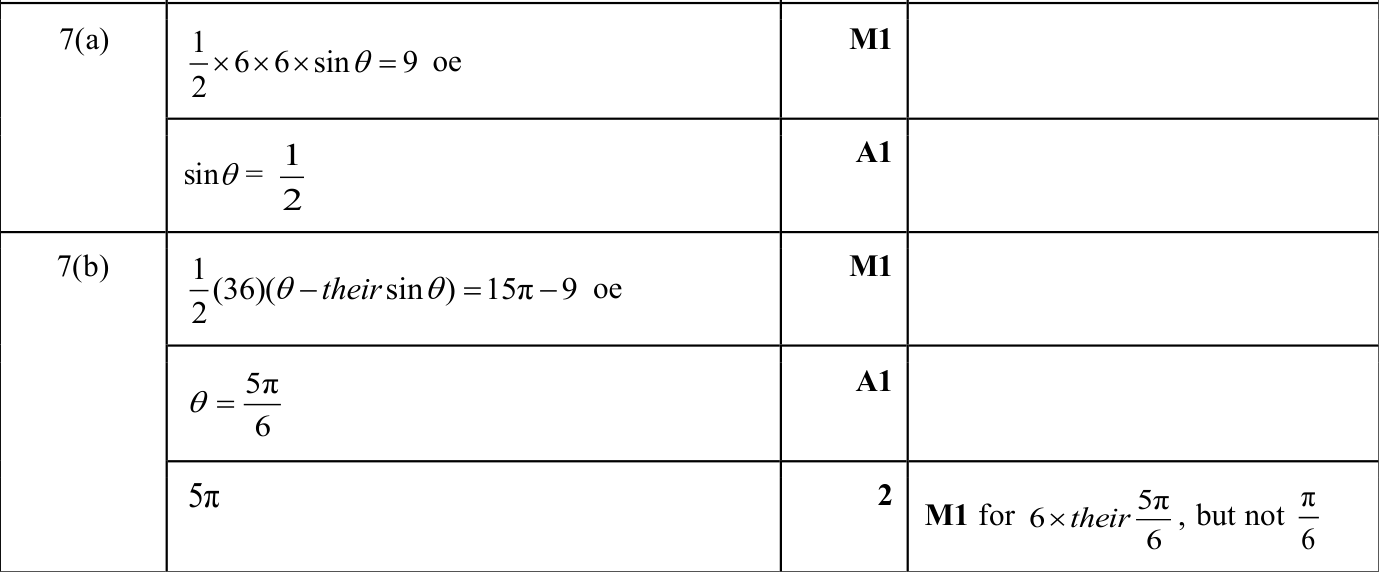
The diagram shows a sector of a circle with centre \(O\) and radius 6 . (a) It is given that the area of triangle \(A O B\) is \(9 \mathrm{~cm}^{2}\).
Find the value of \(\sin \theta\).
(b) It is also given that the exact area of the shaded segment is \((15 \pi-9) \mathrm{cm}^{2}\).
Find the exact length of the arc \(A B\).
0606 P21 - Jun 2025 - Q9 - 12 marks
In this question, all lengths are in centimetres and all angles are in radians.
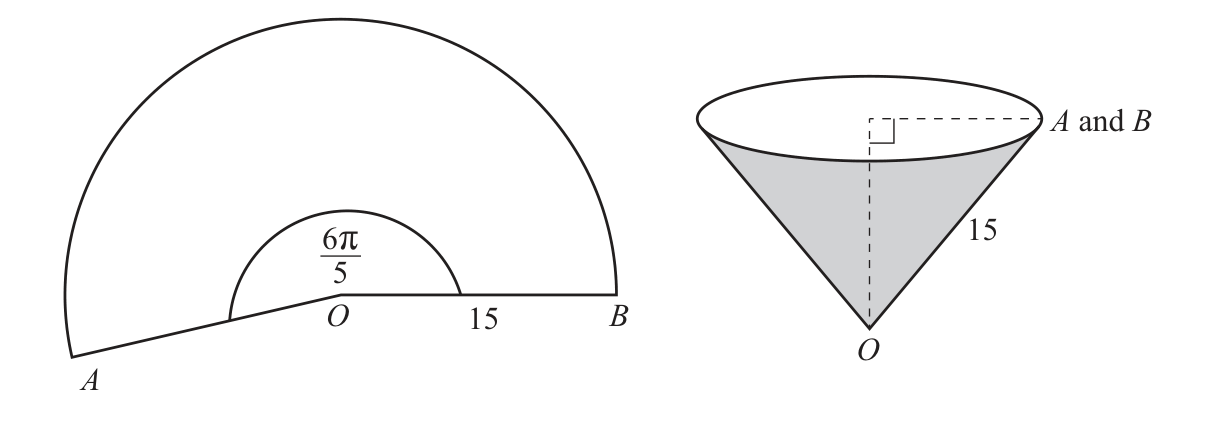
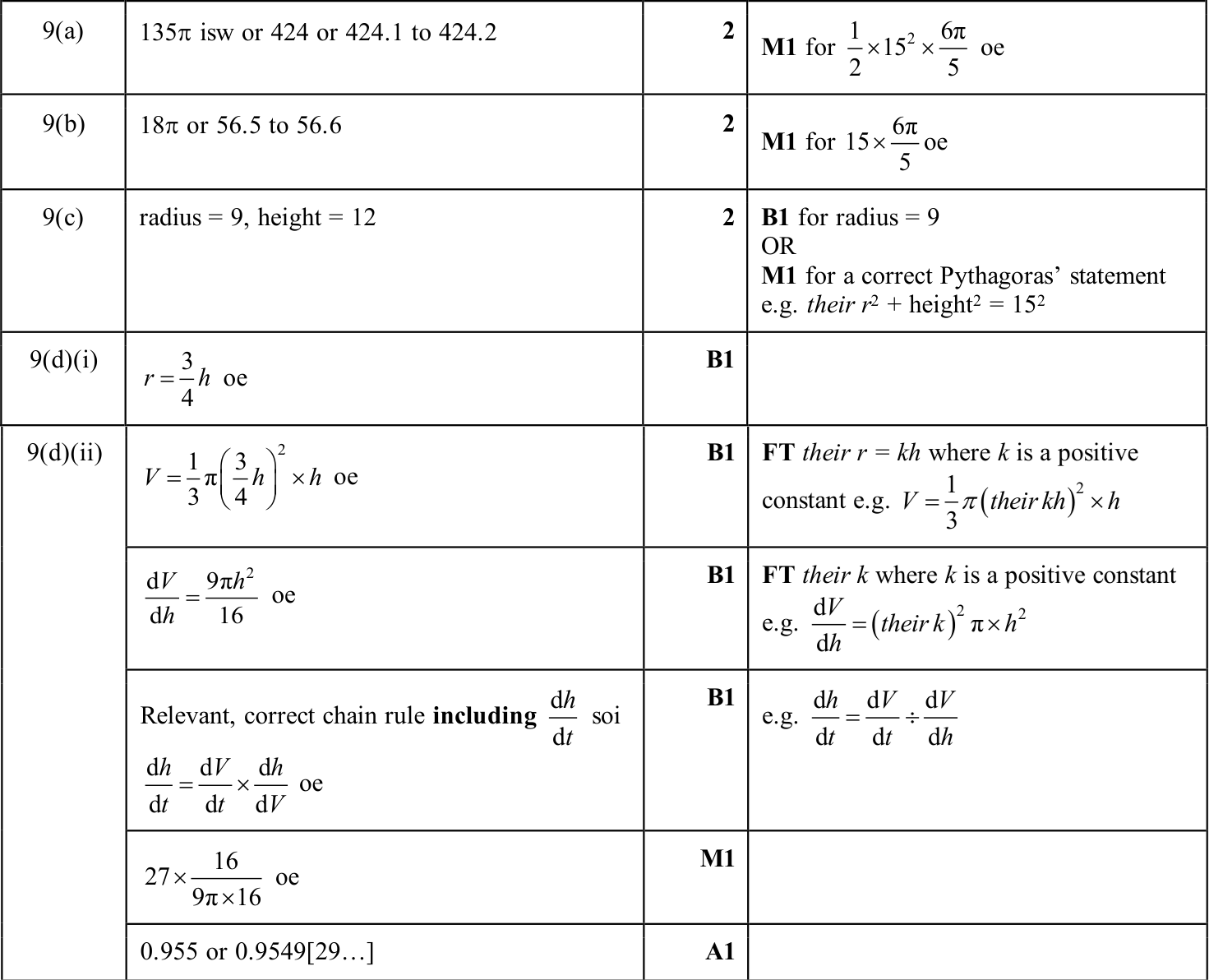
The diagram shows a sector \(A O B\) of a circle, centre \(O\), radius 15 . Angle \(A O B=\frac{6 \pi}{5}\). The sector is made into a cone with points \(A\) and \(B\) touching, as shown. (a) Find the curved surface area of the cone.
The top of the cone is a horizontal circle. (b) Find the circumference of the circular top.
(c) Hence find the radius of the circular top and the perpendicular height of the cone.
(d) Water is poured into the cone.
When the depth of the water in the cone is \(h\), the radius of the circular top of the water is \(r\). (i) Find an expression for \(r\) in terms of \(h\).
(ii) The water is poured into the cone at a constant rate of \(27 \mathrm{~cm}^{3}\) per second.
Find the rate at which the depth of the water is rising when the depth of the water is 4 .
0606 P12 - Nov 2024 - Q3 - 7 marks
In this question, all lengths are in centimetres and all angles are in radians.
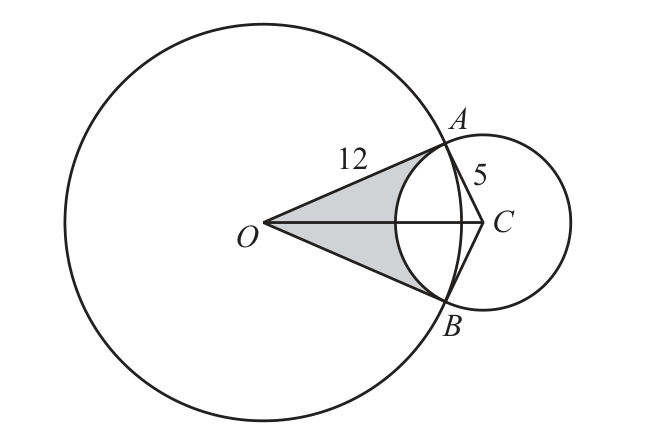
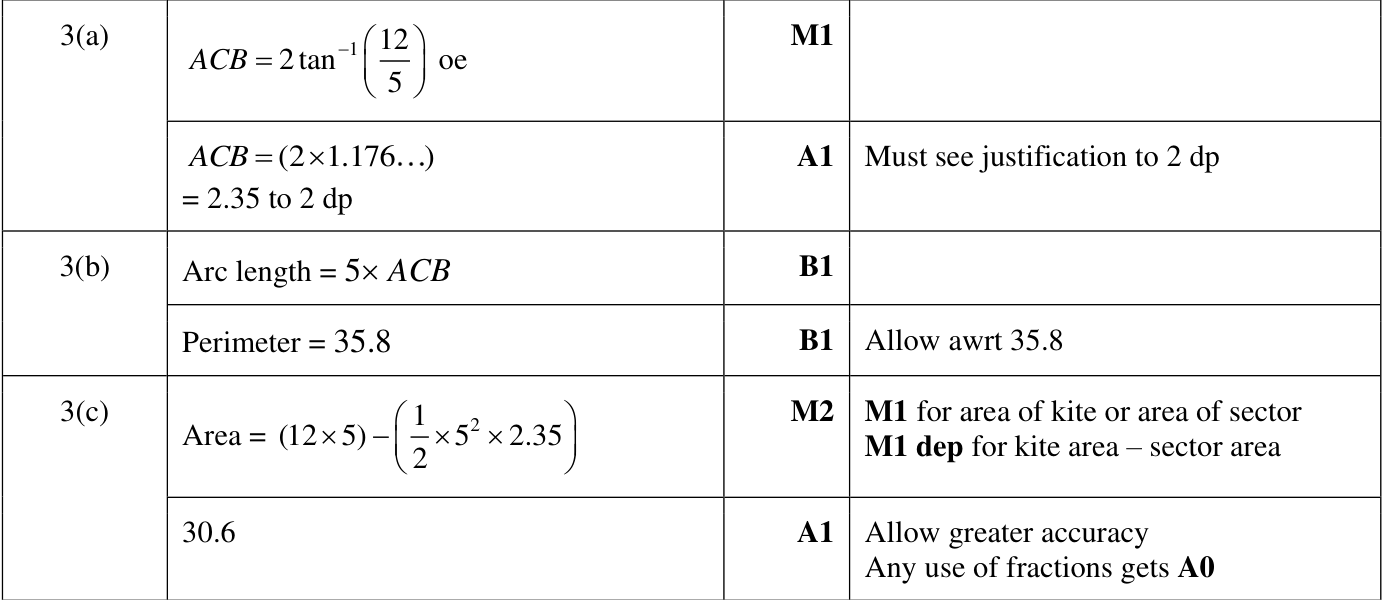
The diagram shows a circle with centre \(O\) and radius 12, and a circle with centre \(C\) and radius 5 . The circles intersect at the points \(A\) and \(B\), such that \(O A\) and \(O B\) are tangents to the circle with centre \(C\). (a) Show that the obtuse angle \(A C B\) is 2.35 radians, correct to 2 decimal places.
(b) Find the perimeter of the shaded region.
(c) Find the area of the shaded region.
0606 P12 - Jun 2024 - Q5 - 9 marks
DO NOT USE A CALCULATOR IN THIS QUESTION. In this question, all lengths are in centimetres.
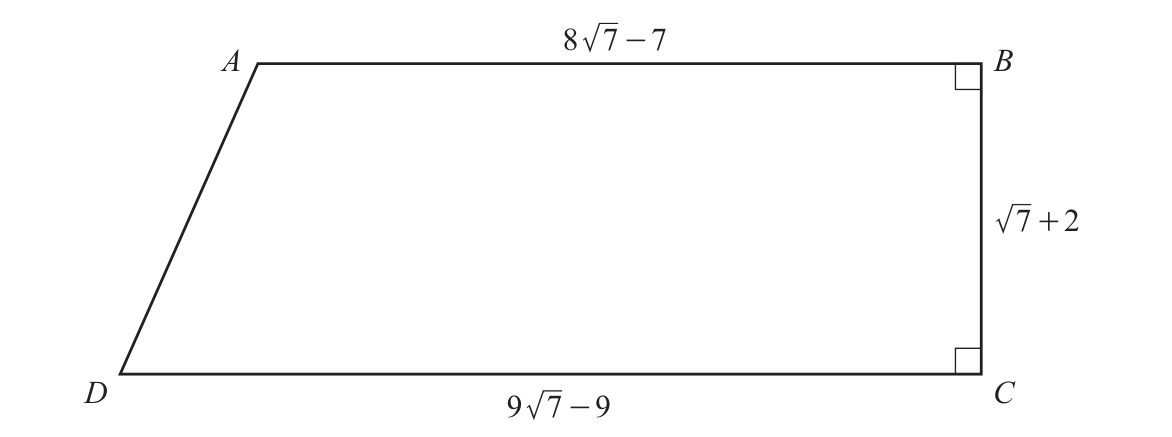
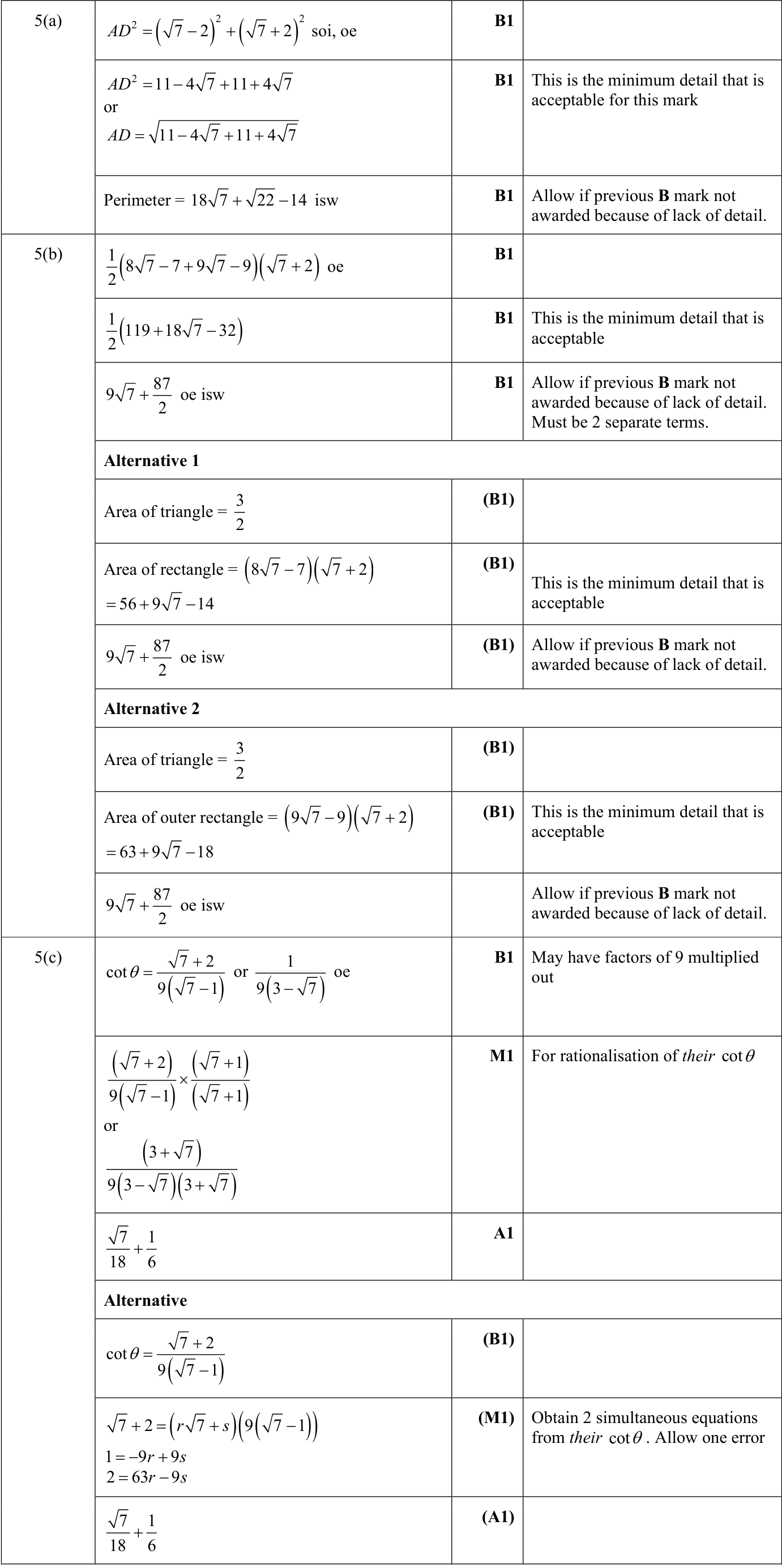
The diagram shows the trapezium \(A B C D\). The lengths of \(A B, B C\) and \(C D\) are \(8 \sqrt{7}-7, \sqrt{7}+2\) and \(9 \sqrt{7}-9\) respectively. The line \(B C\) is perpendicular to the lines \(A B\) and \(C D\). (a) Find the perimeter of the trapezium, giving your answer in its simplest form.
(b) Find the area of the trapezium, giving your answer in the form \(p \sqrt{7}+q\), where \(p\) and \(q\) are rational numbers.
(c) Find \(\cot D B C\), giving your answer in the form \(r \sqrt{7}+s\), where \(r\) and \(s\) are simplified rational numbers.
0606 P11 - Jun 2022 - Q9 - 9 marks
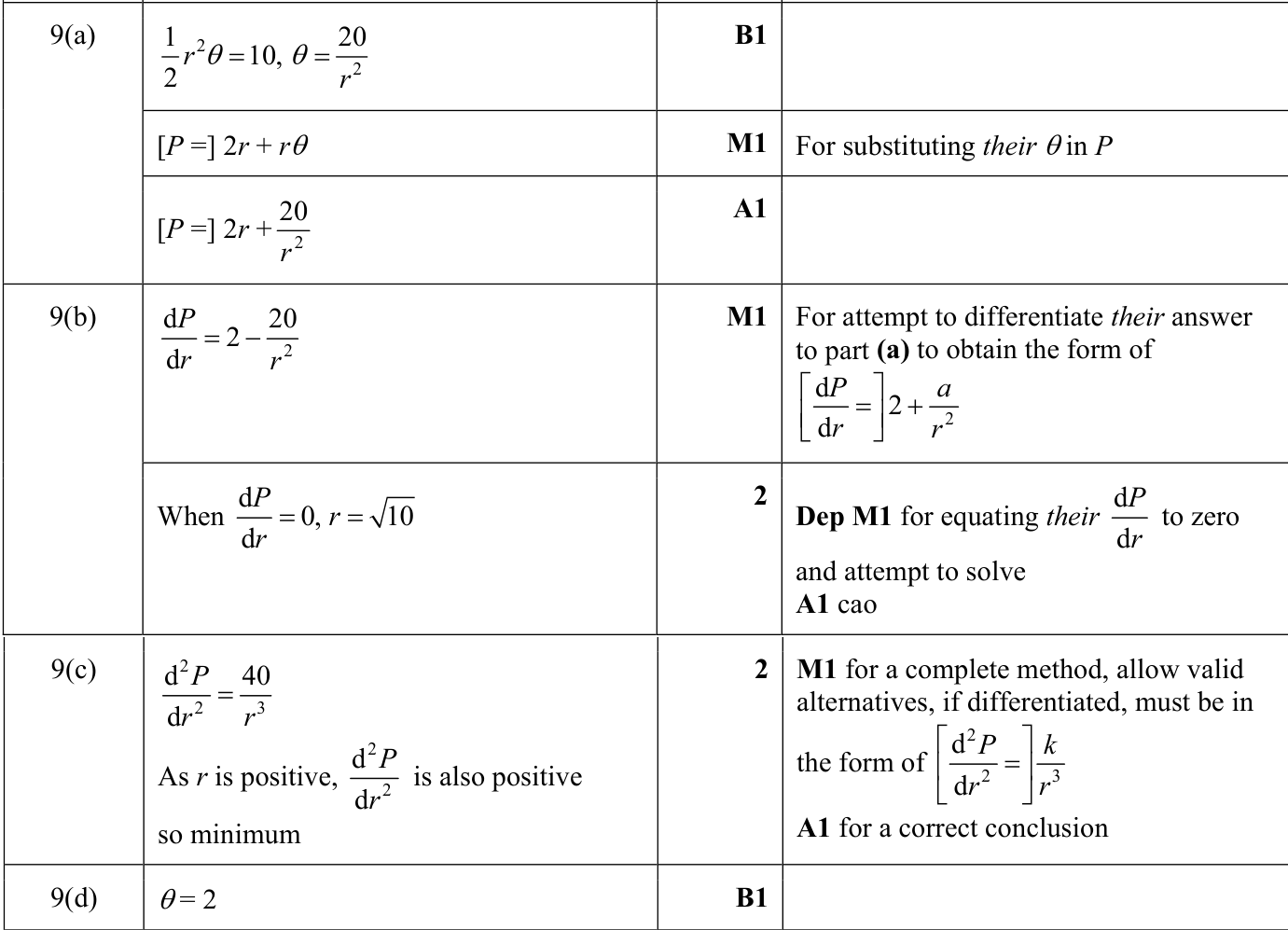
A circle, centre \(O\) and radius \(r\) cm, has a sector \(OAB\) of fixed area \(10\text{ cm}^2\). Angle \(AOB\) is \(\theta\) radians and the perimeter is \(P\) cm.
(a) Find \(P\) in terms of \(r\).
(b) Find \(r\) for which \(P\) has a stationary value.
(c) Determine the nature of this stationary value.
(d) Find \(\theta\) at this stationary value.