0606 P22 - Nov 2023 - Q1 - 7 marks
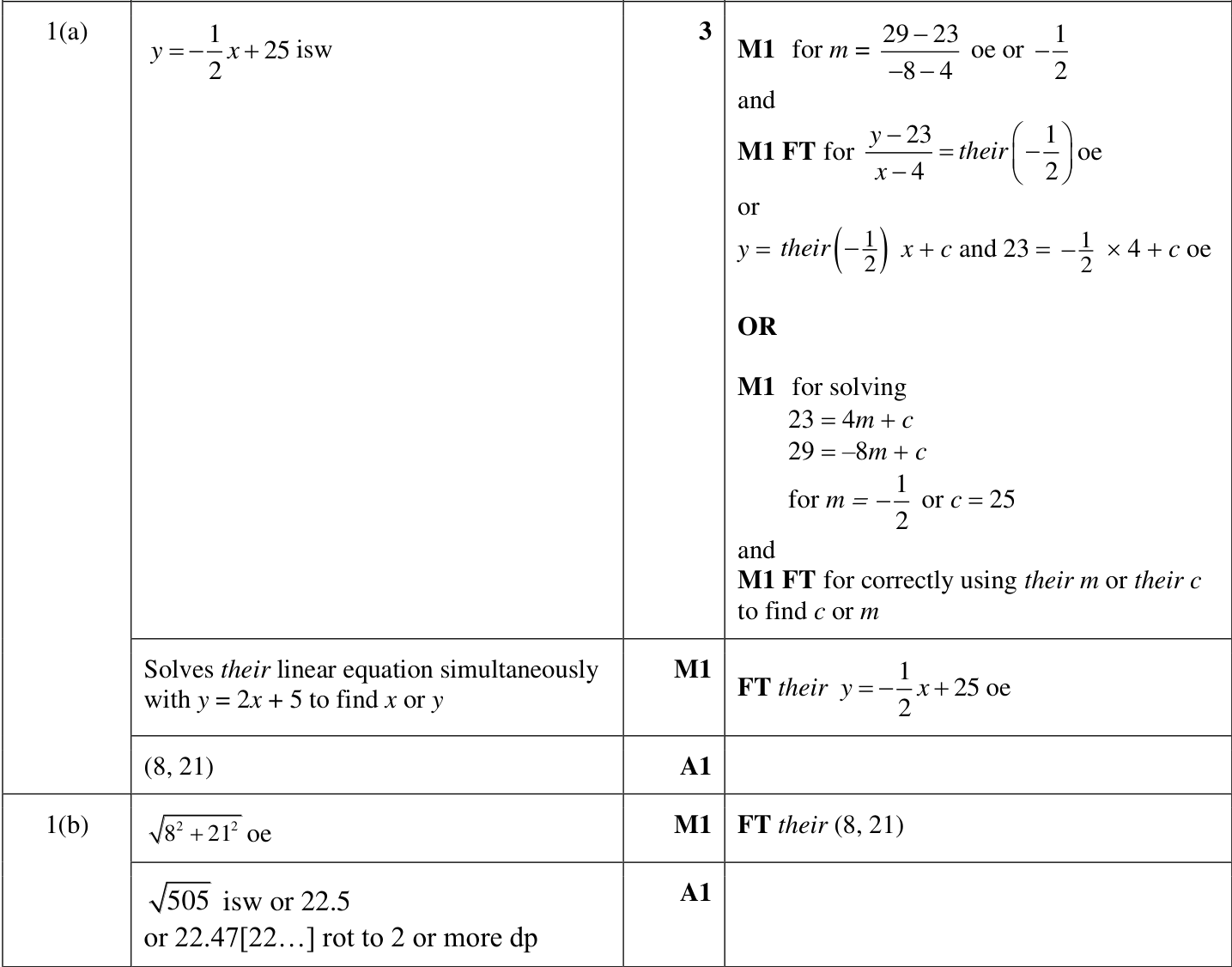
(a) A straight line passes through the points \((4,23)\) and \((-8,29)\). Find the point of intersection, \(P\), of this line with the line \(y=2x+5\).
(b) Find the distance of \(P\) from the origin.
0606 P13 - Nov 2022 - Q13 - 7 marks
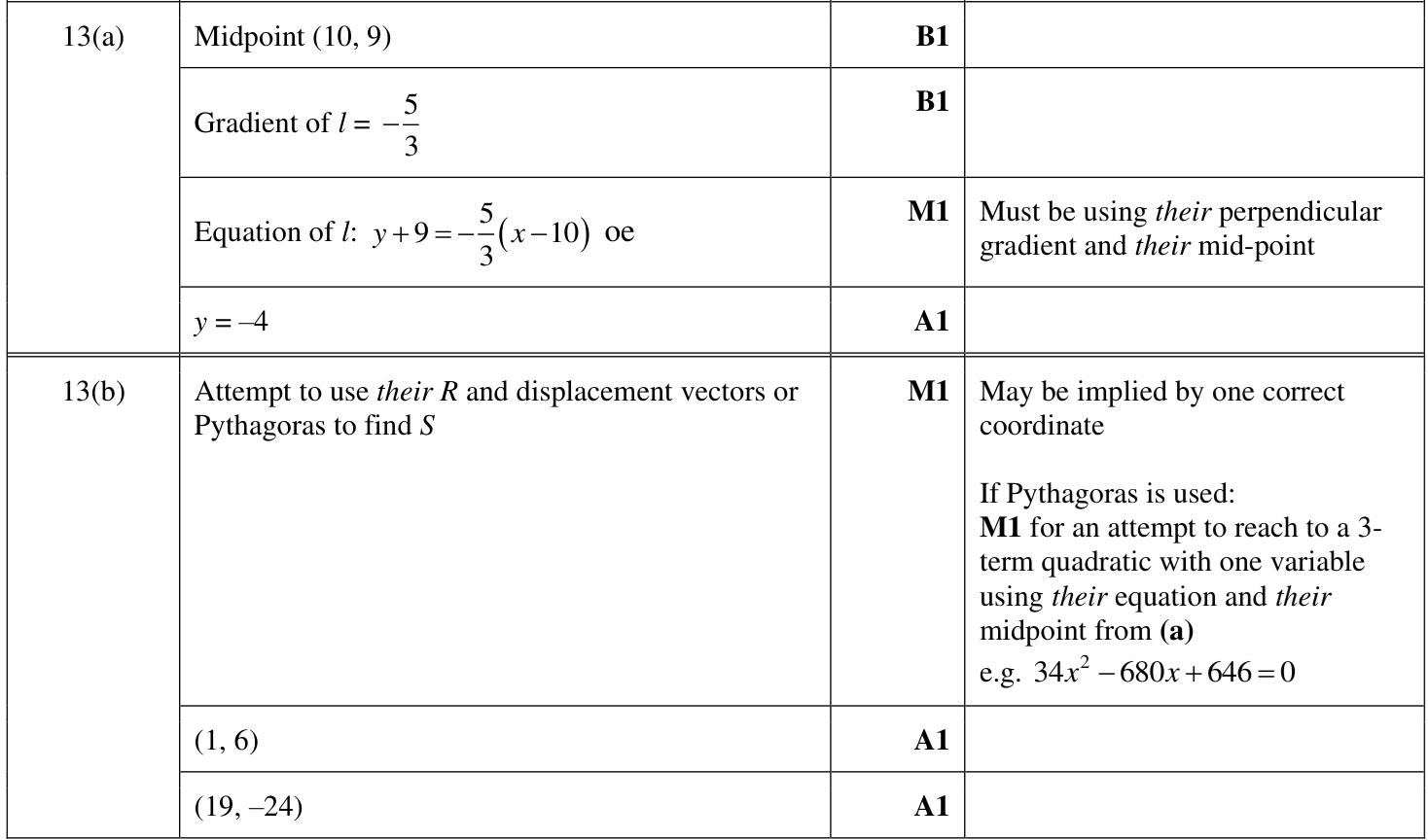
The points \(P\) and \(Q\) have coordinates \((5,-12)\) and \((15,-6)\) respectively. The point \(R\) lies on the line \(l\), the perpendicular bisector of the line \(PQ\). The \(x\)-coordinate of \(R\) is \(7\).
(a) Find the \(y\)-coordinate of \(R\).
(b) The point \(S\) lies on \(l\) such that its distance from \(PQ\) is \(3\) times the distance of \(R\) from \(PQ\). Find the coordinates of the two possible positions of \(S\).
0606 P22 - Nov 2022 - Q11 - 12 marks
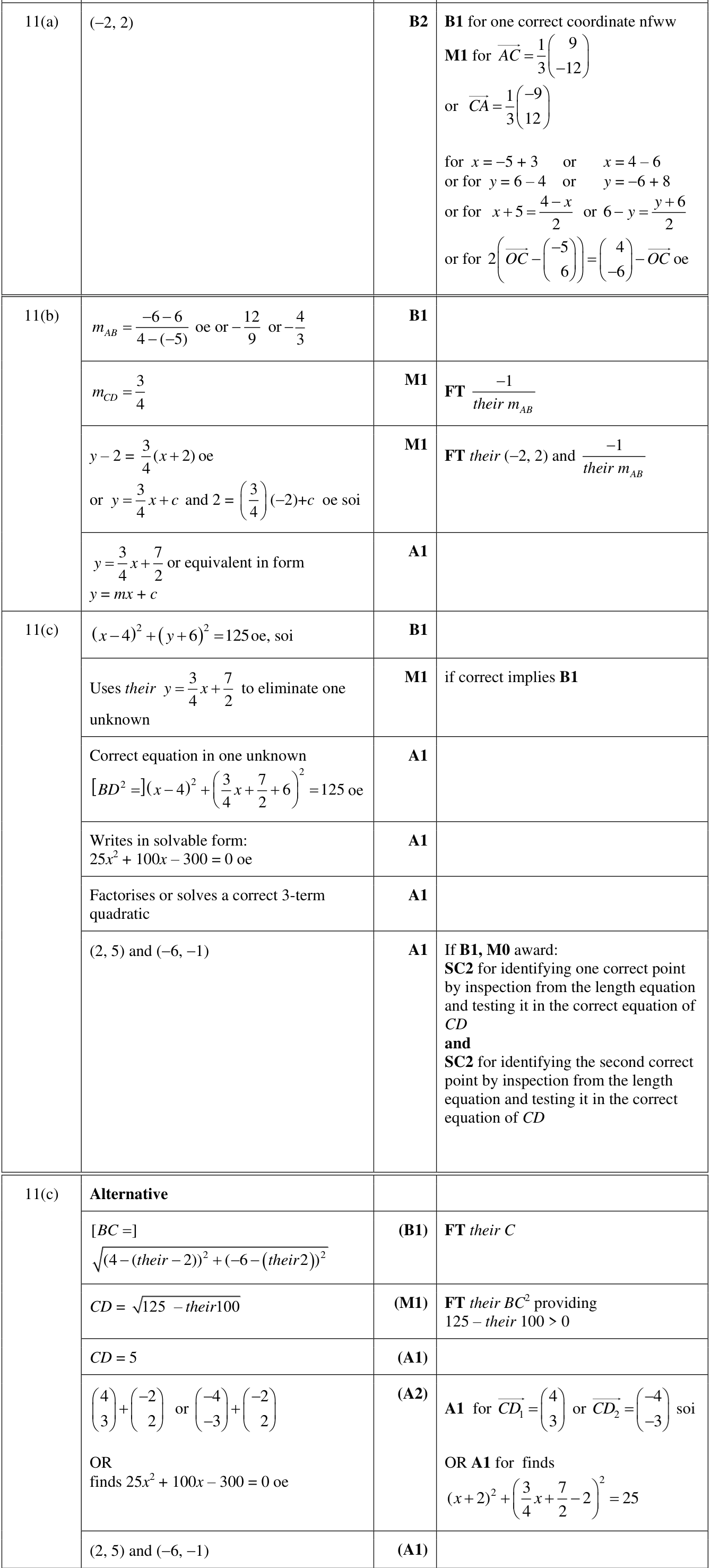
The coordinates of points \(A\) and \(B\) are \((-5,6)\) and \((4,-6)\) respectively. The point \(C\) lies on the line \(AB\), between \(A\) and \(B\), such that
\(\frac{AC}{CB}=\frac12.\)
(a) Find the coordinates of \(C\).
(b) The line \(CD\) is perpendicular to \(AB\). Find the equation of \(CD\) in the form \(y=mx+c\).
(c) The length of \(BD\) is \(\sqrt{125}\). Find the coordinates of the two possible positions of point \(D\).
0606 P11 - Nov 2021 - Q2 - 6 marks
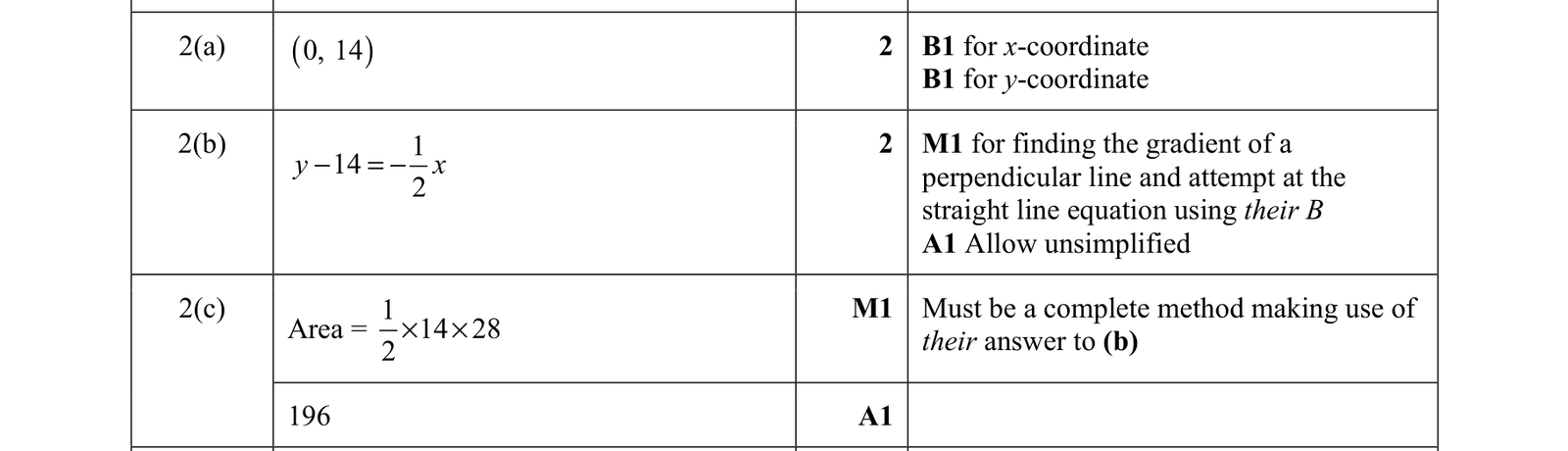
Points \(A\) and \(C\) have coordinates \((-4,6)\) and \((2,18)\) respectively. The point \(B\) lies on the line \(AC\) such that \(\overrightarrow{AB}=\frac23\overrightarrow{AC}\).
(a) Find the coordinates of \(B\).
(b) Find the equation of the line \(l\), which is perpendicular to \(AC\) and passes through \(B\).
(c) Find the area enclosed by the line \(l\) and the coordinate axes.
0606 P22 - Mar 2019 - Q5 - 6 marks
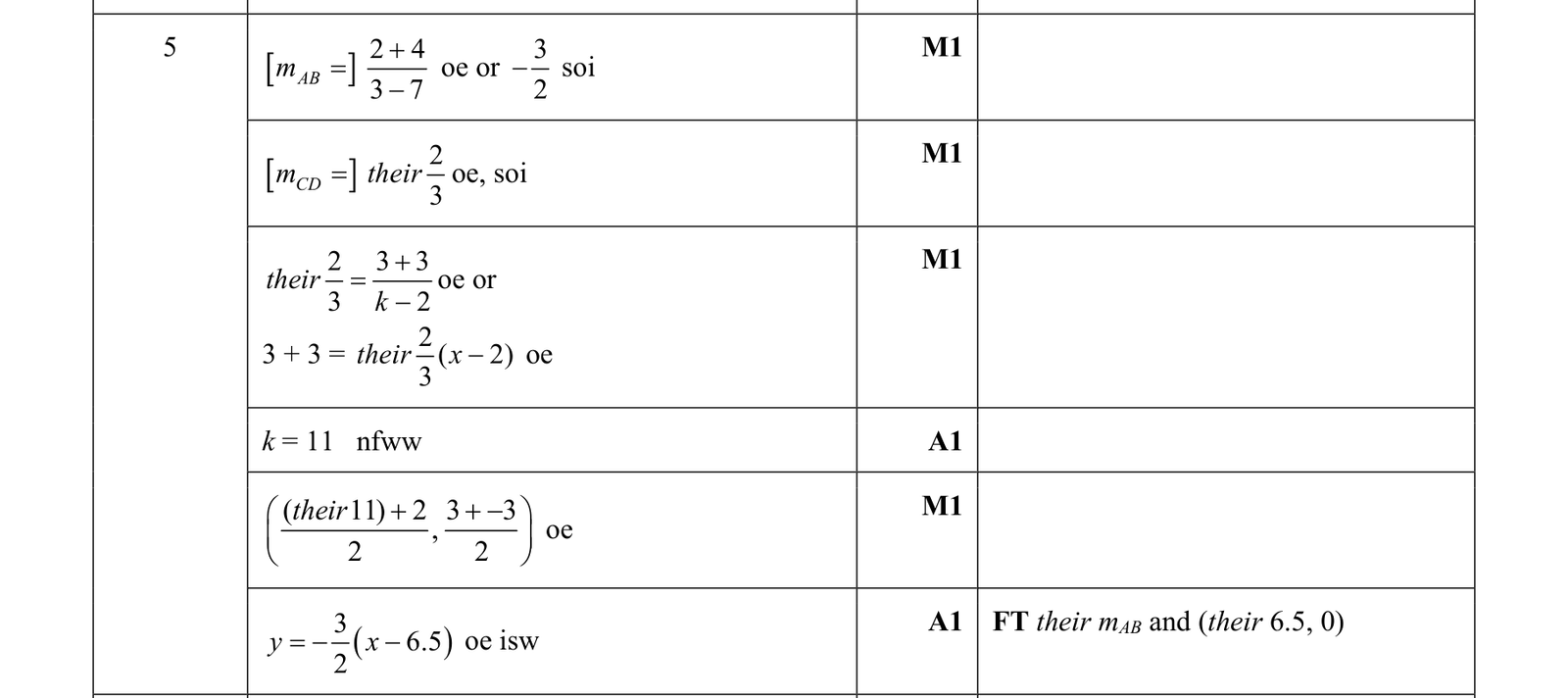
Solutions to this question by accurate drawing will not be accepted.
The points \(A(3,2)\), \(B(7,-4)\), \(C(2,-3)\) and \(D(k,3)\) are such that \(CD\) is perpendicular to \(AB\). Find the equation of the perpendicular bisector of \(CD\).
0606 P23 - Jun 2019 - Q3 - 5 marks
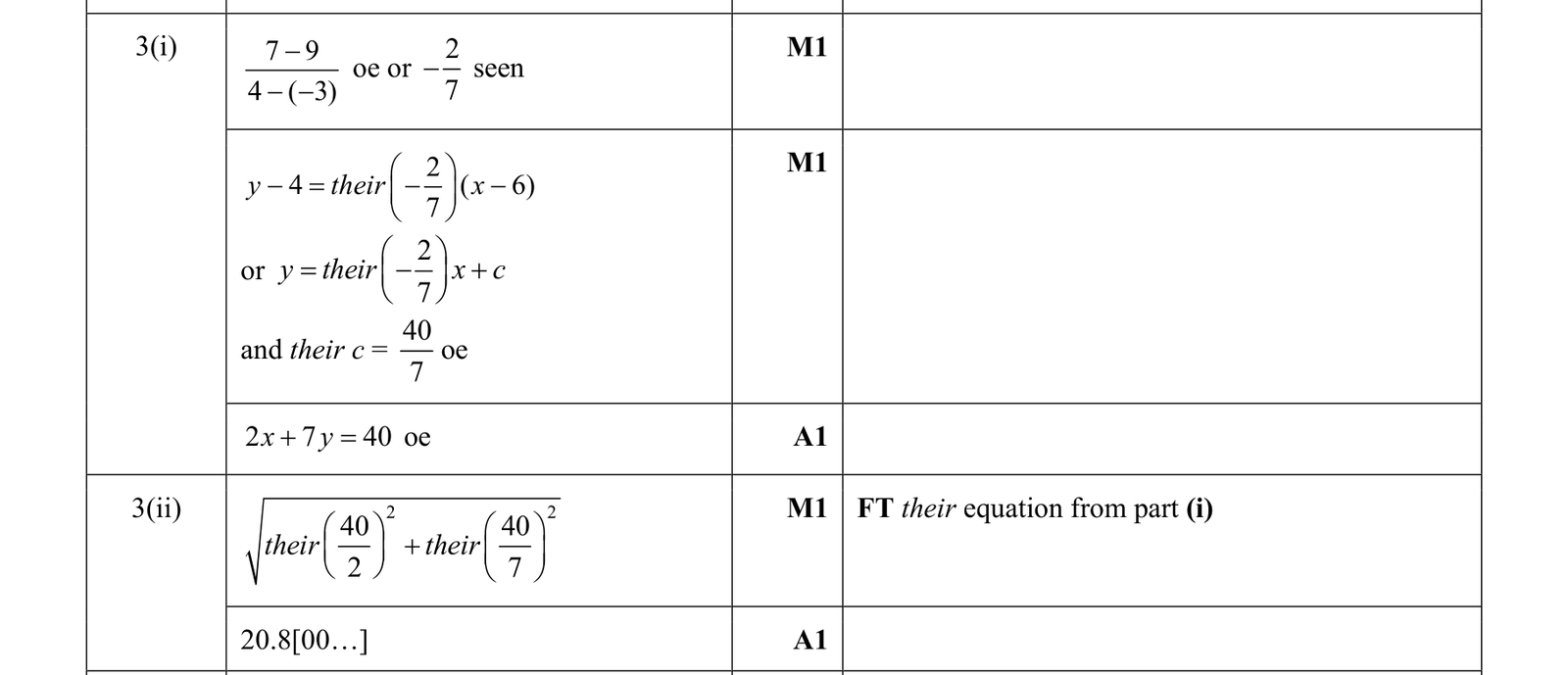
The points \(A\), \(B\) and \(C\) have coordinates \((4,7)\), \((-3,9)\) and \((6,4)\) respectively.
(i) Find the equation of the line \(L\), that is parallel to the line \(AB\) and passes through \(C\). Give your answer in the form \(ax+by=c\), where \(a\), \(b\) and \(c\) are integers.
(ii) The line \(L\) meets the \(x\)-axis at the point \(D\) and the \(y\)-axis at the point \(E\). Find the length of \(DE\).
0606 P22 - Nov 2019 - Q9 - 11 marks
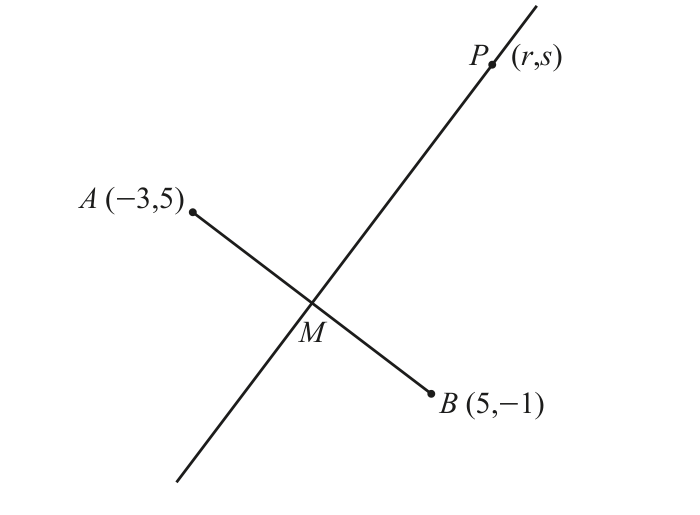
The diagram shows the points \(A(-3,5)\) and \(B(5,-1)\). The midpoint of \(AB\) is \(M\), and the line \(PM\) is perpendicular to \(AB\). The point \(P\) has coordinates \((r,s)\).
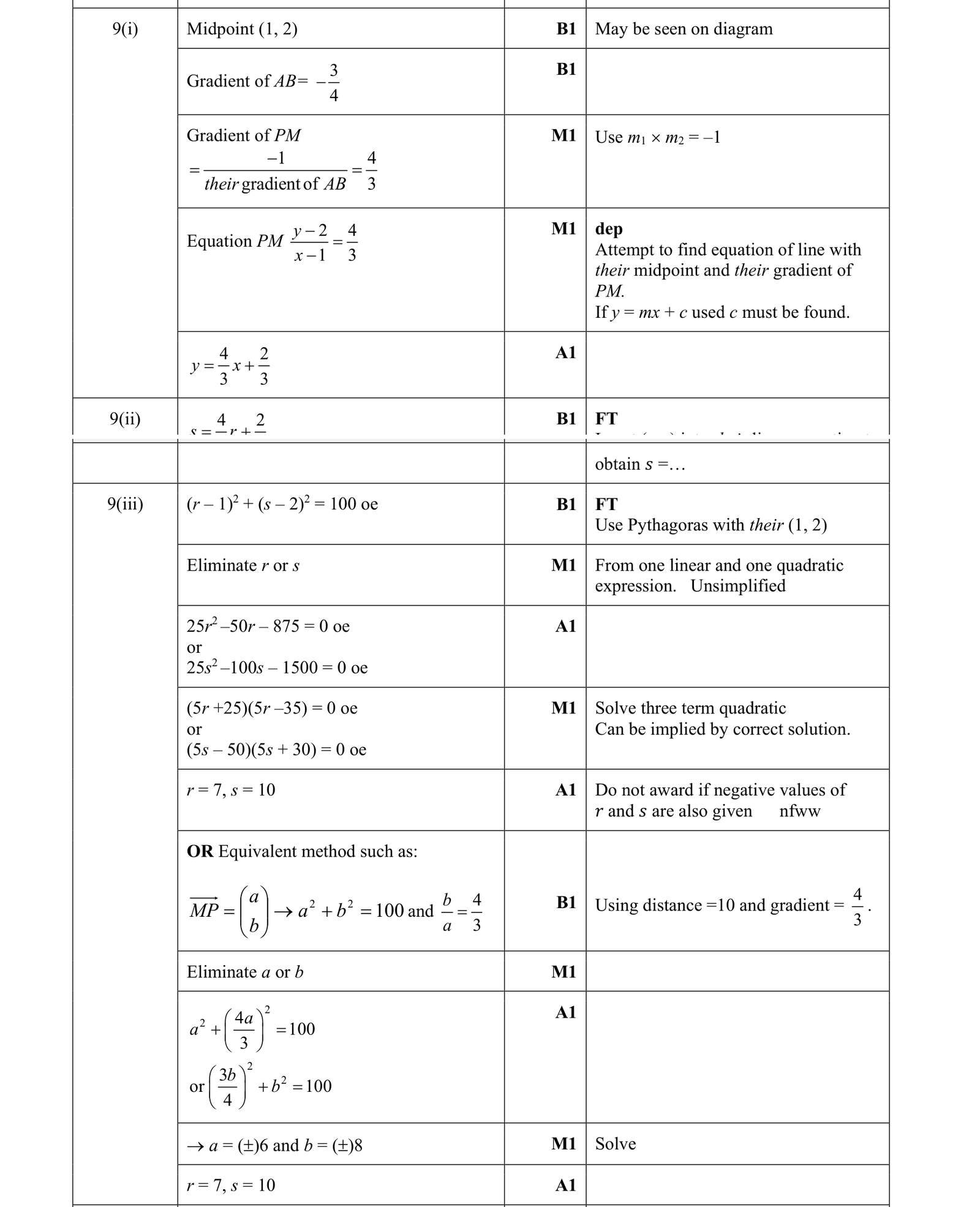
(i) Find the equation of the line \(PM\) in the form \(y=mx+c\), where \(m\) and \(c\) are exact constants.
(ii) Hence find an expression for \(s\) in terms of \(r\).
(iii) Given that the length of \(PM\) is \(10\) units, find the value of \(r\) and of \(s\).