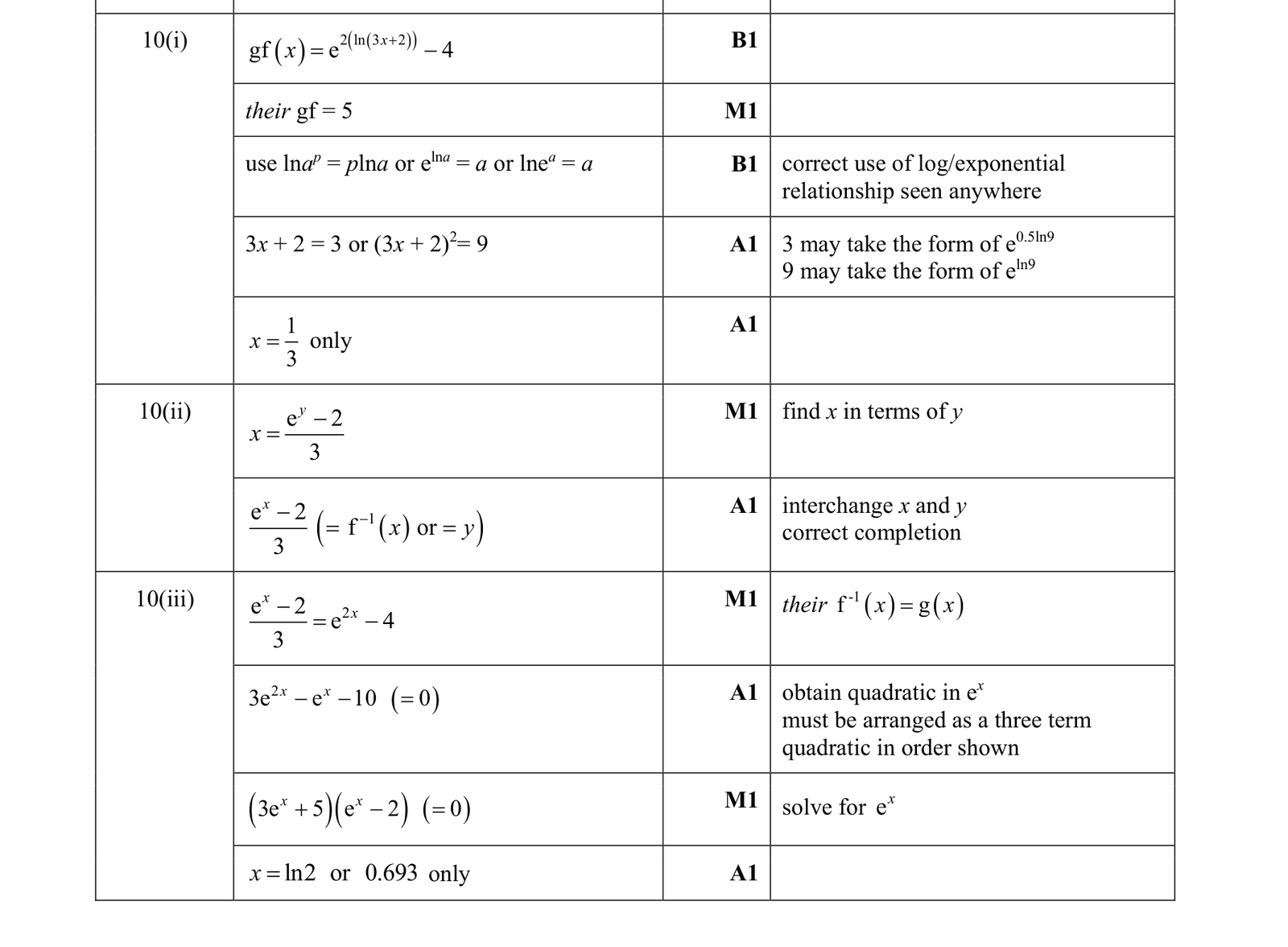
0606 P12 - Nov 2024 - Q4 - 13 marks
The function f is such that \(\mathrm{f}(x)=4 \ln (3 x-2)\), for \(x\gt a\), where \(a\) is as small as possible. (a) (i) Write down the value of \(a\).
(ii) Write down the range of f .
(iii) Find \(\mathrm{f}^{-1}(x)\), stating its domain and range.
(iv) On the axes sketch the graphs of \(y=\mathrm{f}(x)\) and \(y=\mathrm{f}^{-1}(x)\), stating the intercepts with the axes.
(b) Given that \(\mathrm{g}(x)=(2 x+1)^{\frac{1}{2}}+4\), for \(x\gt 0\), solve the equation \(\mathrm{gg}(x)=9\).
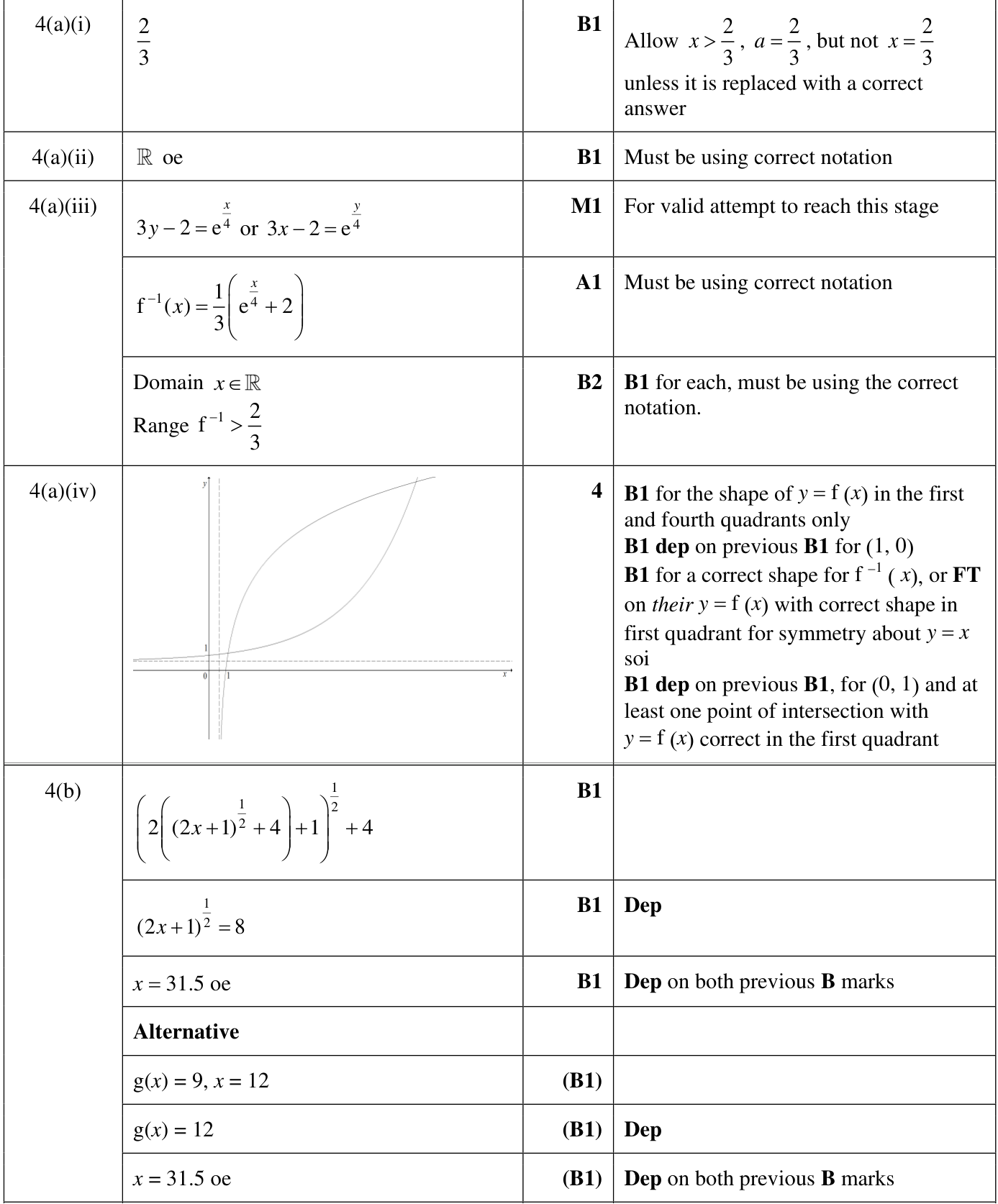
0606 P12 - Jun 2023 - Q8 - 10 marks
It is given that \(f(x)=2\ln(3x-4)\) for \(x\gt a\).
(a) Write down the least possible value of \(a\).
(b) Write down the range of \(f\).
(c) It is given that the equation \(f(x)=f^{-1}(x)\) has two solutions. Using your answer to part (a), sketch the graphs of \(y=f(x)\) and \(y=f^{-1}(x)\) on the axes, stating the coordinates of the points where the graphs meet the axes.
It is given that \(g(x)=2x-3\) for \(x\geq3\).
(d)(i) Find an expression for \(g(g(x))\).
(d)(ii) Hence solve the equation \(f(g(g(x)))=4\), giving your answer in exact form.
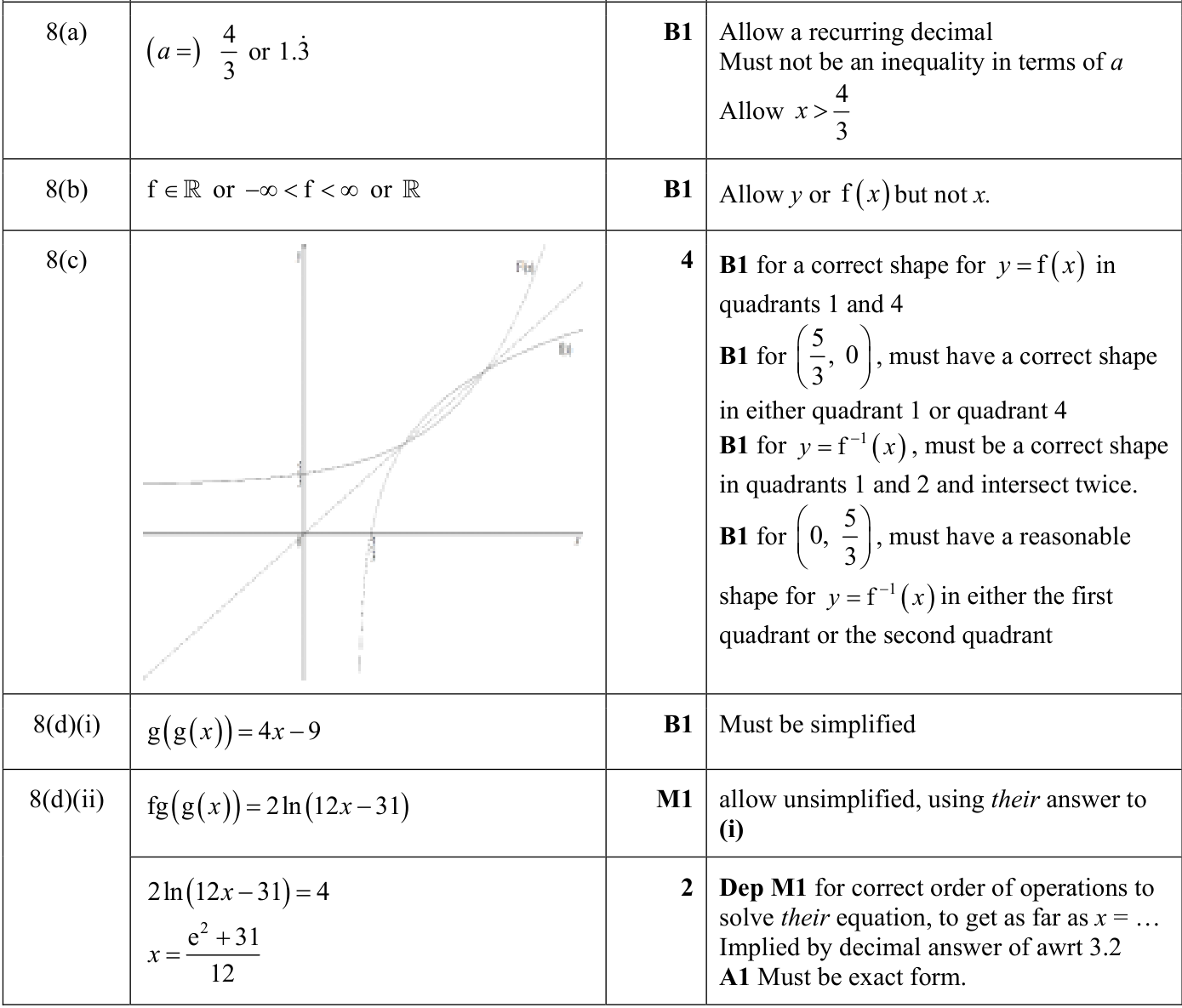
0606 P12 - Nov 2022 - Q8 - 10 marks
A function \(f(x)\) is such that
\(f(x)=\ln(2x+3)+\ln4,\)
for \(x\gt a\), where \(a\) is a constant.
(a) Write down the least possible value of \(a\).
(b) Using your value of \(a\), write down the range of \(f\).
(c) Using your value of \(a\), find \(f^{-1}(x)\), stating its range.
(d) On the axes below, sketch the graphs of \(y=f(x)\) and \(y=f^{-1}(x)\), stating the exact intercepts of each graph with the coordinate axes. Label each of your graphs.
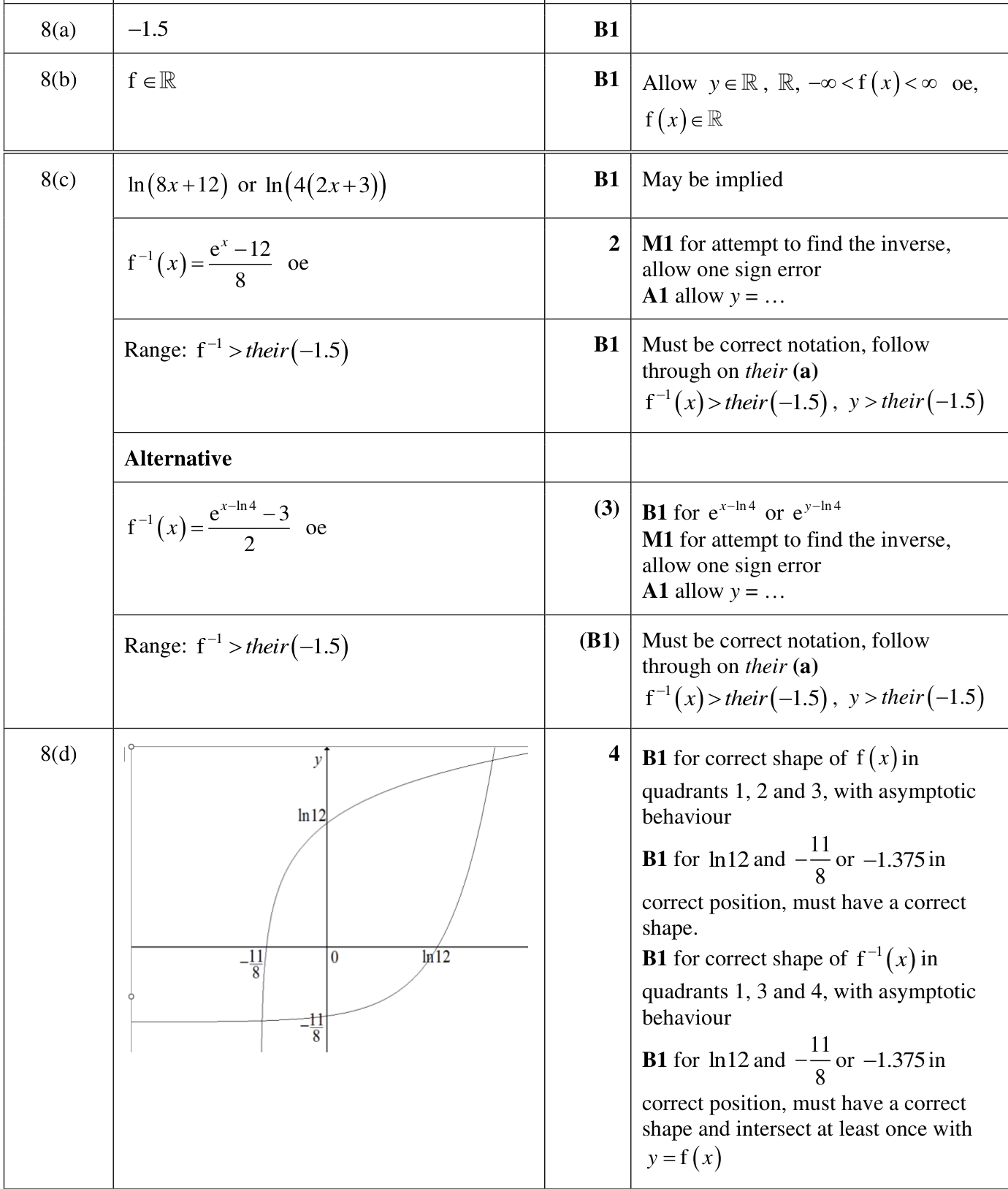
0606 P13 - Nov 2022 - Q6 - 7 marks
A function \(f(x)\) is such that
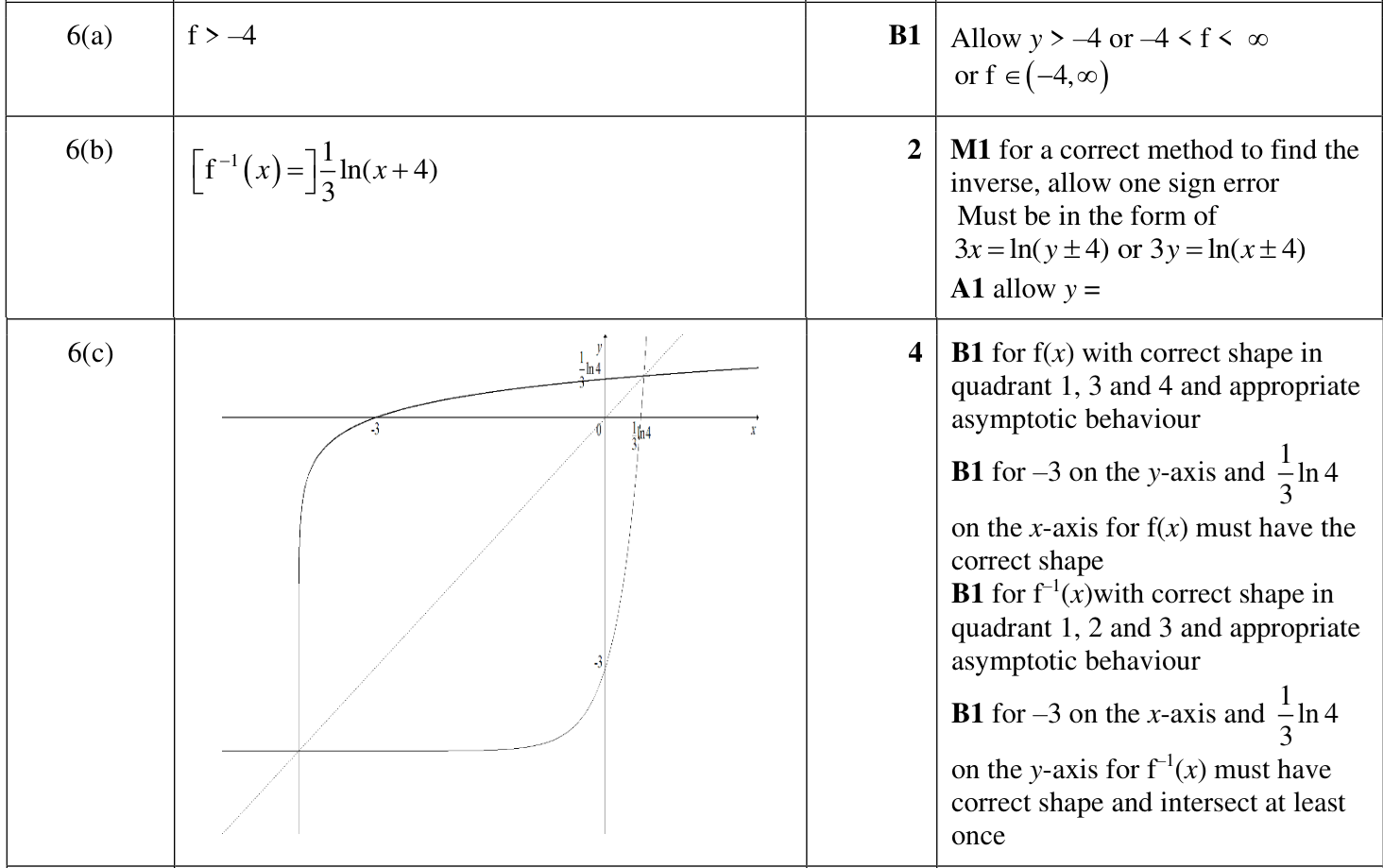
\(f(x)=e^{3x}-4,\)
for \(x\in\mathbb R\).
(a) Find the range of \(f\).
(b) Find an expression for \(f^{-1}(x)\).
(c) On the axes, sketch the graphs of \(y=f(x)\) and \(y=f^{-1}(x)\), stating the exact values of the intercepts with the coordinate axes.
0606 P11 - Nov 2020 - Q7 - 9 marks
It is given that \(f(x)=5\ln(2x+3)\) for \(x\gt -\dfrac{3}{2}\).
(a) Write down the range of \(f\).
(b) Find \(f^{-1}\) and state its domain.
(c) Sketch the graph of \(y=f(x)\) and the graph of \(y=f^{-1}(x)\). Label each curve and state the intercepts on the coordinate axes.

0606 P13 - Nov 2020 - Q3 - 7 marks
(a) The function \(\mathrm{f}\) is given by
\(\mathrm{f}(x)=4\ln(2x-1).\)
(i) Write down the largest possible domain for \(\mathrm{f}\).
(ii) Find \(\mathrm{f}^{-1}(x)\) and its domain.
(b) The functions \(\mathrm{g}\) and \(\mathrm{h}\) are given by
\(\mathrm{g}(x)=x+5,\qquad x\in\mathbb{R},\)
and
\(\mathrm{h}(x)=\sqrt{2x-3},\qquad x\geq \frac32.\)
Solve \(\mathrm{gh}(x)=7\).

0606 P11 - Jun 2019 - Q8 - 9 marks
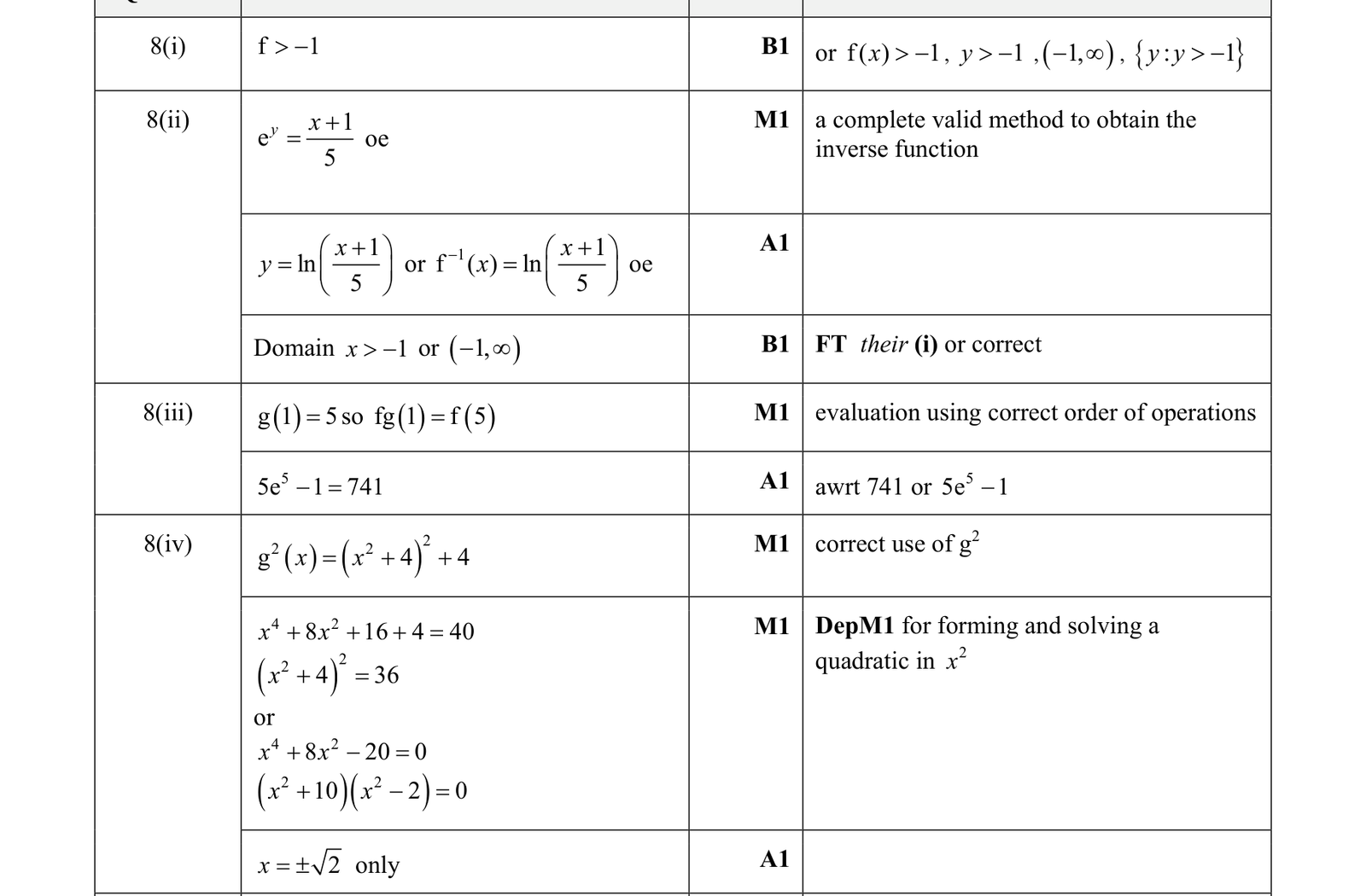
It is given that \(f(x)=5e^x-1\) for \(x\in\mathbb{R}\).
(i) Write down the range of \(f\).
(ii) Find \(f^{-1}\) and state its domain.
It is given also that \(g(x)=x^2+4\) for \(x\in\mathbb{R}\).
(iii) Find the value of \(fg(1)\).
(iv) Find the exact solutions of \(g^2(x)=40\).
0606 P23 - Nov 2019 - Q10 - 11 marks
The functions \(f\) and \(g\) are defined by
\(f(x)=\ln(3x+2),\quad x\gt-\frac23,\)
and
\(g(x)=e^{2x}-4,\quad x\in\mathbb{R}.\)
(i) Solve \(gf(x)=5\).
(ii) Find \(f^{-1}(x)\).
(iii) Solve \(f^{-1}(x)=g(x)\).