0606 P21 - Nov 2020 - Q8 - 8 marks
A population, \(P\) million, is modelled by
\(P=Ab^t,\)
where \(t\) is the number of years after 1 January 2000. The population was \(40\) million on 1 January 2010 and \(45\) million on 1 January 2013.
(a) Find \(b\), correct to 2 decimal places, and find \(A\), correct to the nearest integer.
(b) Use your values of \(A\) and \(b\) to estimate the population on 1 January 2020.
(c) Use your values of \(A\) and \(b\) to find the first year in which the population is predicted to exceed \(100\) million.

0606 P22 - Nov 2020 - Q10 - 8 marks
The number, \(b\), of bacteria in a sample is given by
\(b=P+Qe^{2t},\)
where \(P\) and \(Q\) are constants and \(t\) is time in weeks. Initially there are \(500\) bacteria, which increase to \(600\) after \(1\) week.
(a) Find the value of \(P\) and of \(Q\).
(b) Find the number of bacteria present after \(2\) weeks.
(c) Find the first week in which the number of bacteria is greater than \(1000000\).

0606 P11 - Jun 2018 - Q5 - 6 marks
The population, \(P\), of a certain bacterium \(t\) days after the start of an experiment is modelled by
\(P=800e^{kt},\)
where \(k\) is a constant.
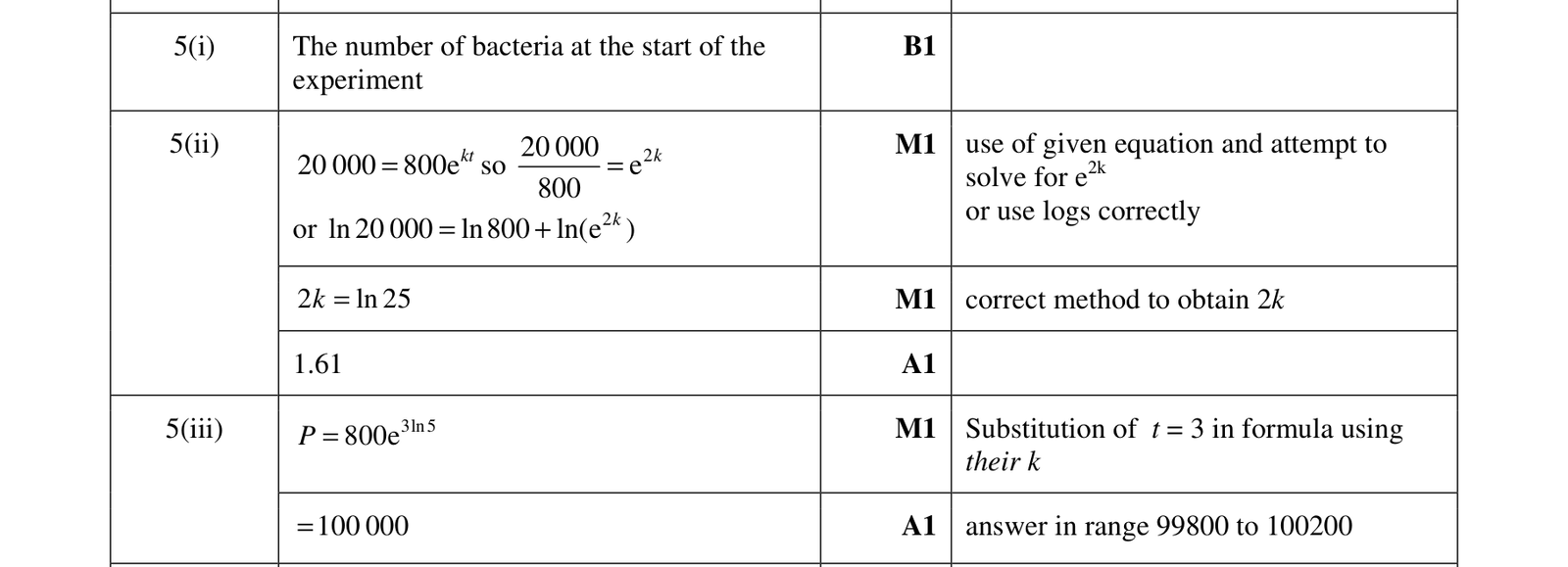
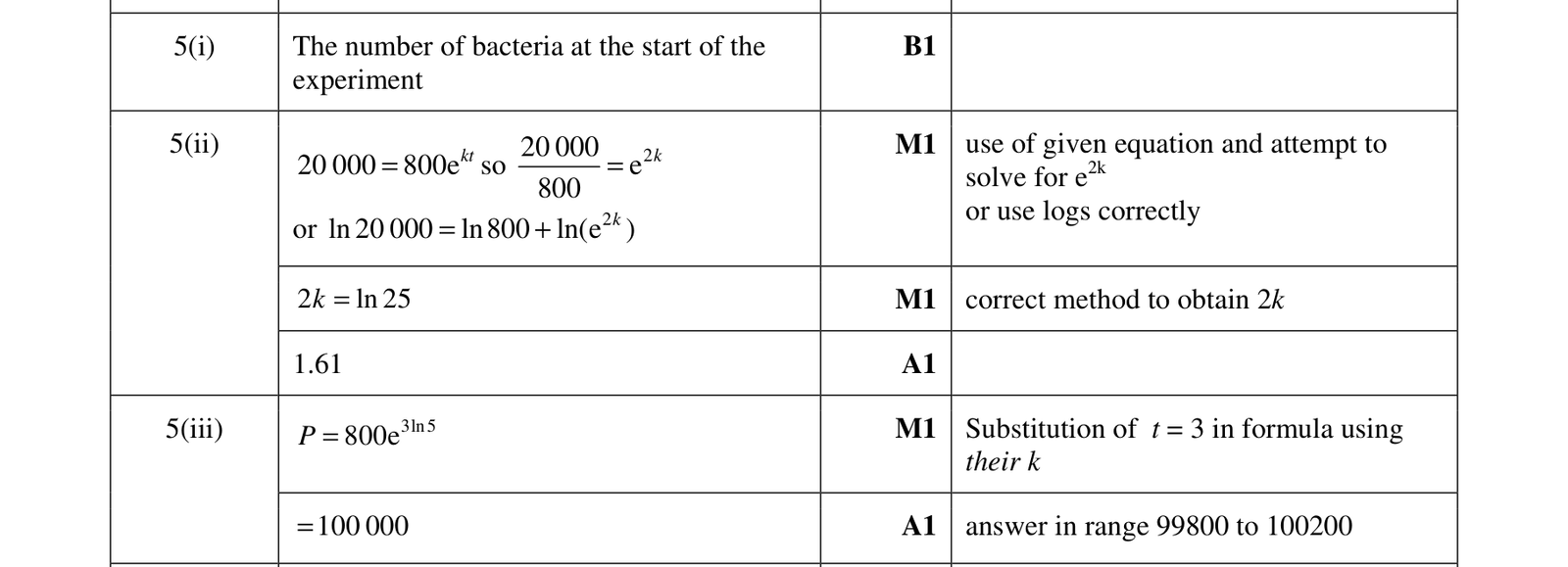
(i) State what the figure \(800\) represents in this experiment.
(ii) Given that the population is \(20000\) two days after the start of the experiment, calculate the value of \(k\).
(iii) Calculate the population three days after the start of the experiment.
0606 P12 - Jun 2018 - Q7 - 5 marks
A population, \(B\), of a particular bacterium, \(t\) hours after measurements began, is given by
\(B=1000e^{t/4}.\)
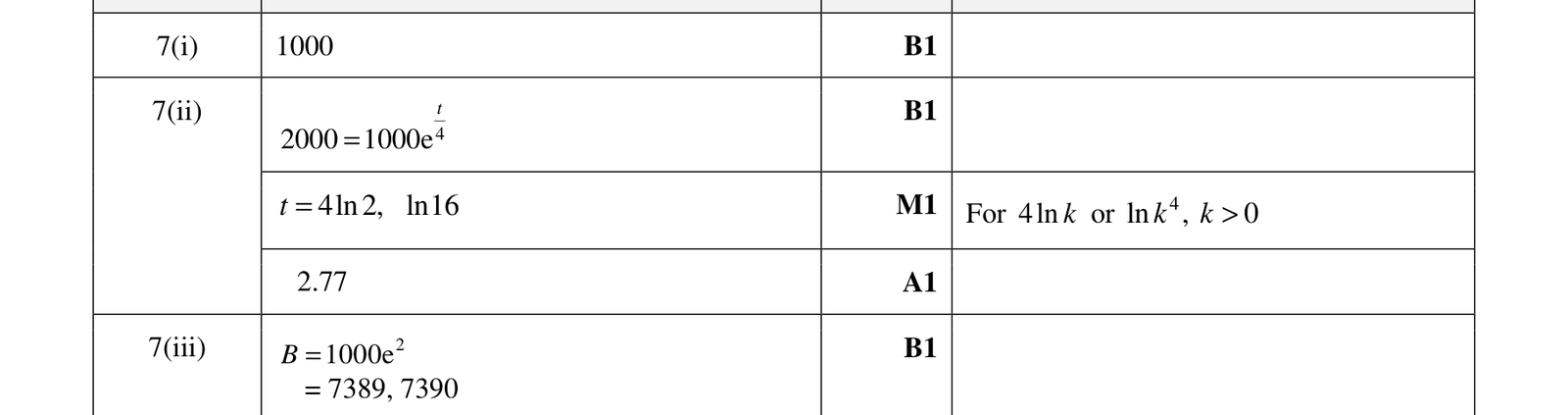
(i) Find the value of \(B\) when \(t=0\).
(ii) Find the time taken for \(B\) to double in size.
(iii) Find the value of \(B\) when \(t=8\).
0606 P13 - Jun 2018 - Q5 - 6 marks
The population, \(P\), of a certain bacterium \(t\) days after the start of an experiment is modelled by
\(P=800e^{kt},\)
where \(k\) is a constant.
(i) State what the figure \(800\) represents in this experiment.
(ii) Given that the population is \(20000\) two days after the start of the experiment, calculate the value of \(k\).
(iii) Calculate the population three days after the start of the experiment.