0606 P12 - Nov 2025 - Q1 - 5 marks
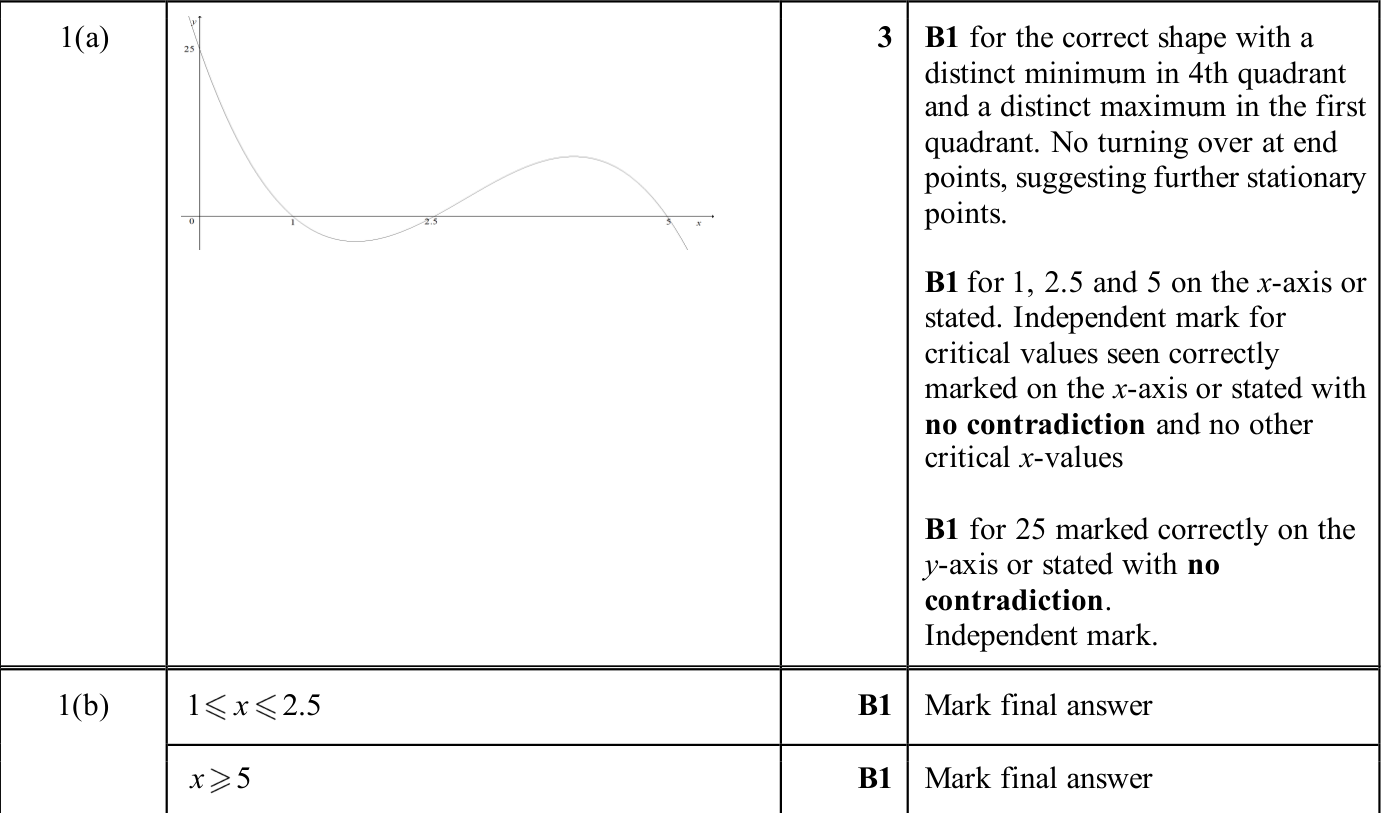
(a) On the axes, sketch the graph of \(y=(1-x)(x-5)(2x-5)\), stating the intercepts with the axes.
(b) Hence solve the inequality \((1-x)(x-5)(2x-5)\leqslant0\).
0606 P23 - Nov 2024 - Q1 - 3 marks
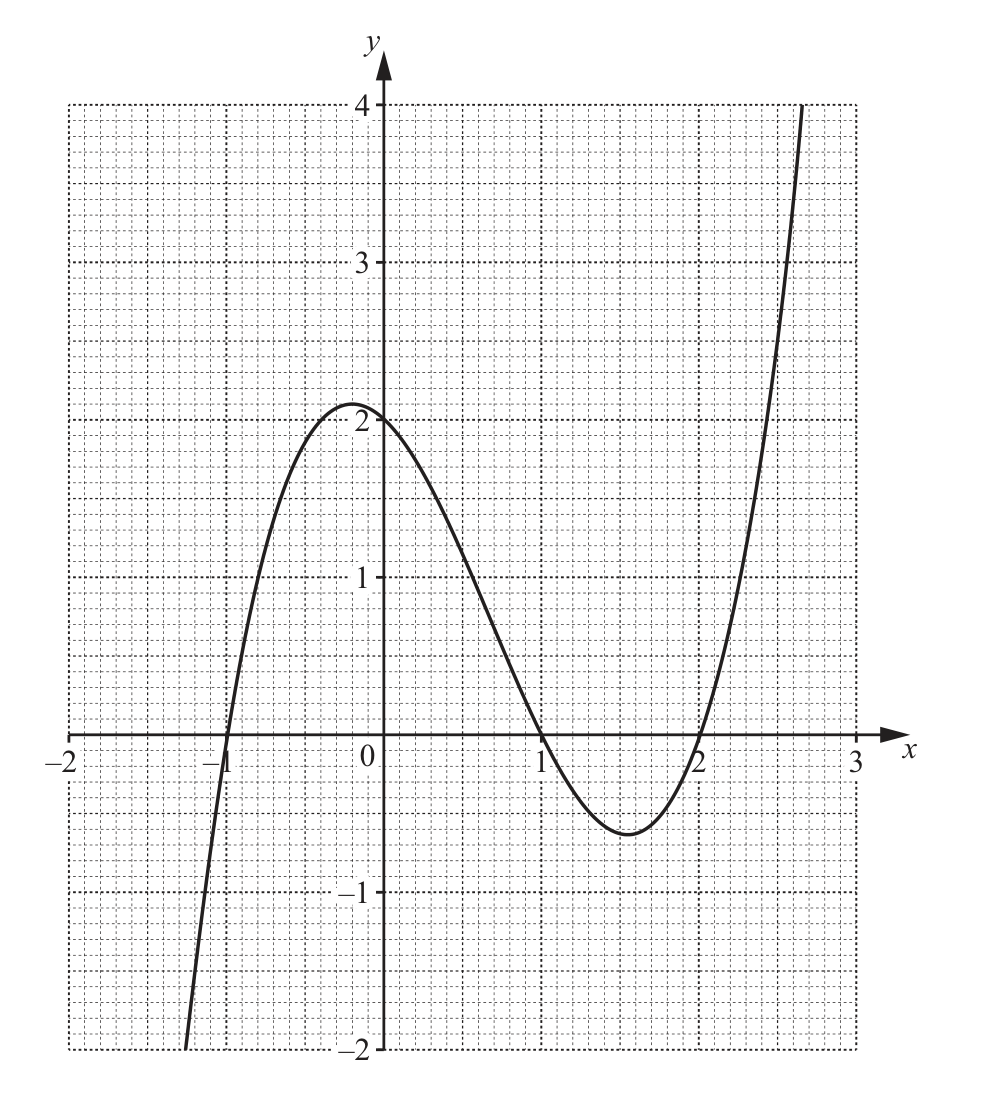
The diagram shows the graph of \(y=(x+1)(x-1)(x-2)\). Use the graph to solve the inequality \((x+1)(x-1)(x-2)\lt 1\).

0606 P11 - Jun 2024 - Q1 - 5 marks
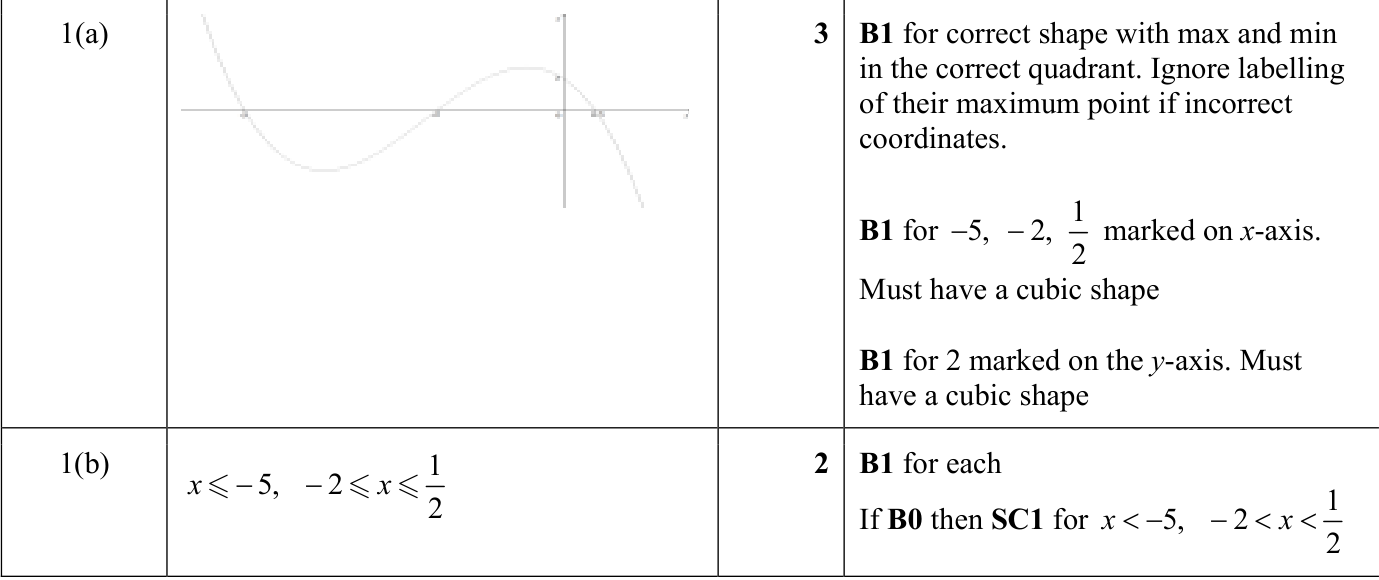
(a) On the axes, sketch the graph of \(y=-\frac{1}{5}(x+2)(2 x-1)(x+5)\), stating the intercepts with the axes.
(b) Hence solve the inequality \(-\frac{1}{5}(x+2)(2 x-1)(x+5) \geqslant 0\).
0606 P12 - Nov 2023 - Q1 - 5 marks
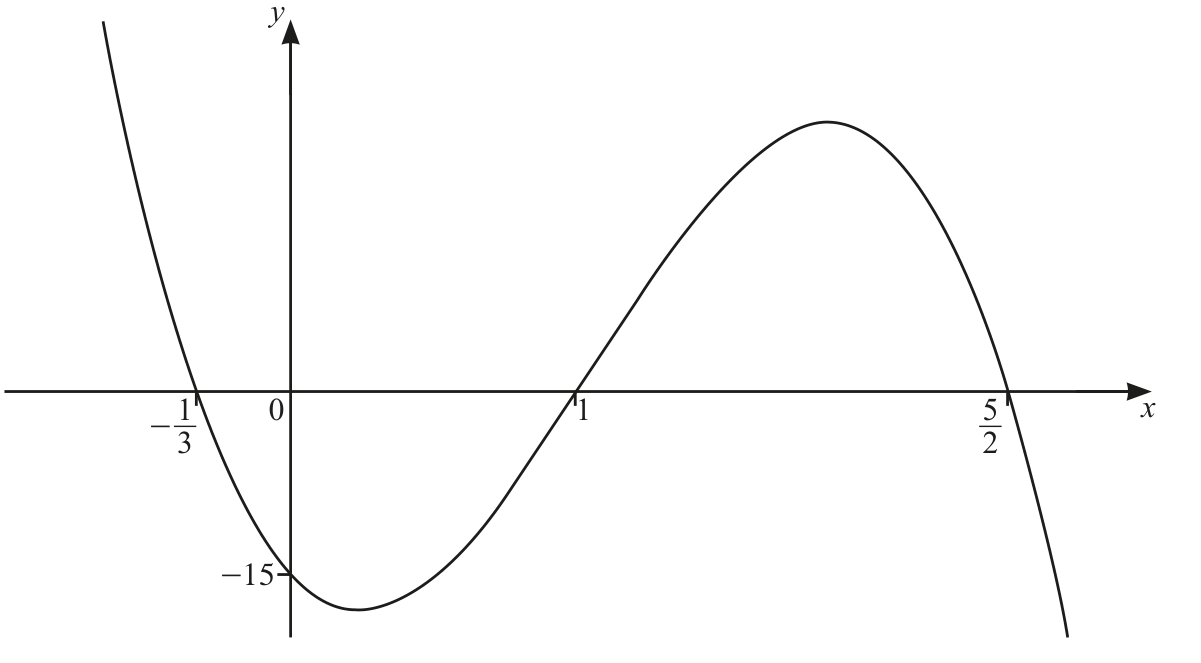
The diagram shows the graph of the cubic polynomial \(y=f(x)\).
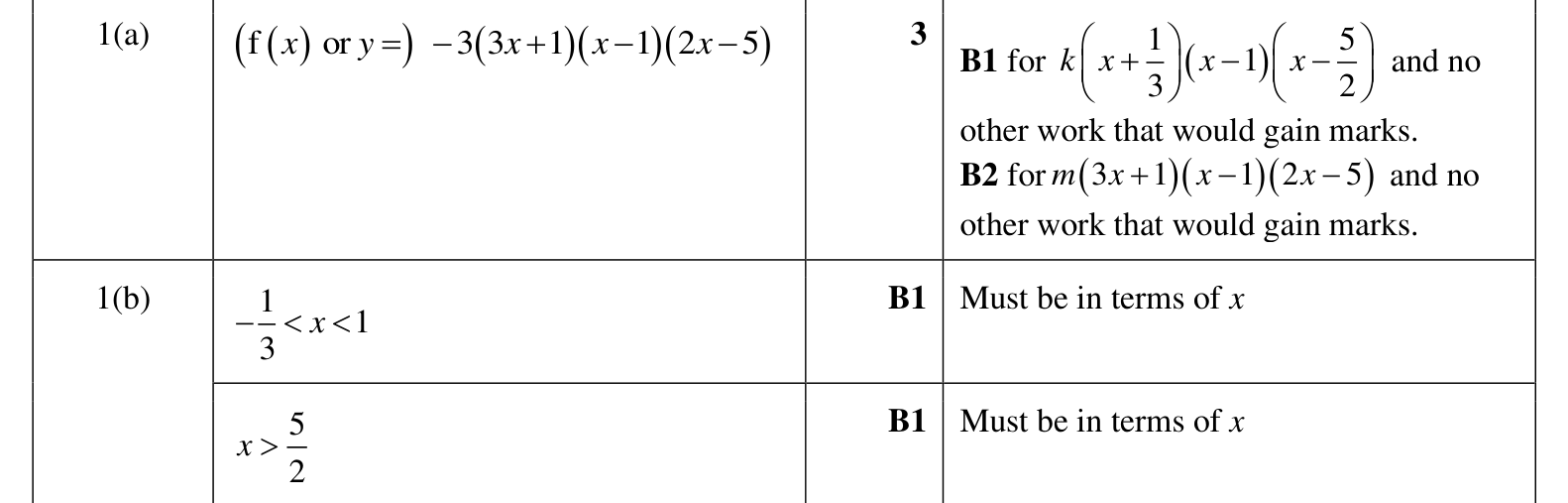
(a) Find an expression for \(f(x)\) in factorised form. Write each linear factor with its coefficients as integers.
(b) Write down the values of \(x\) such that \(f(x)\lt 0\).
0606 P22 - Mar 2021 - Q3 - 5 marks
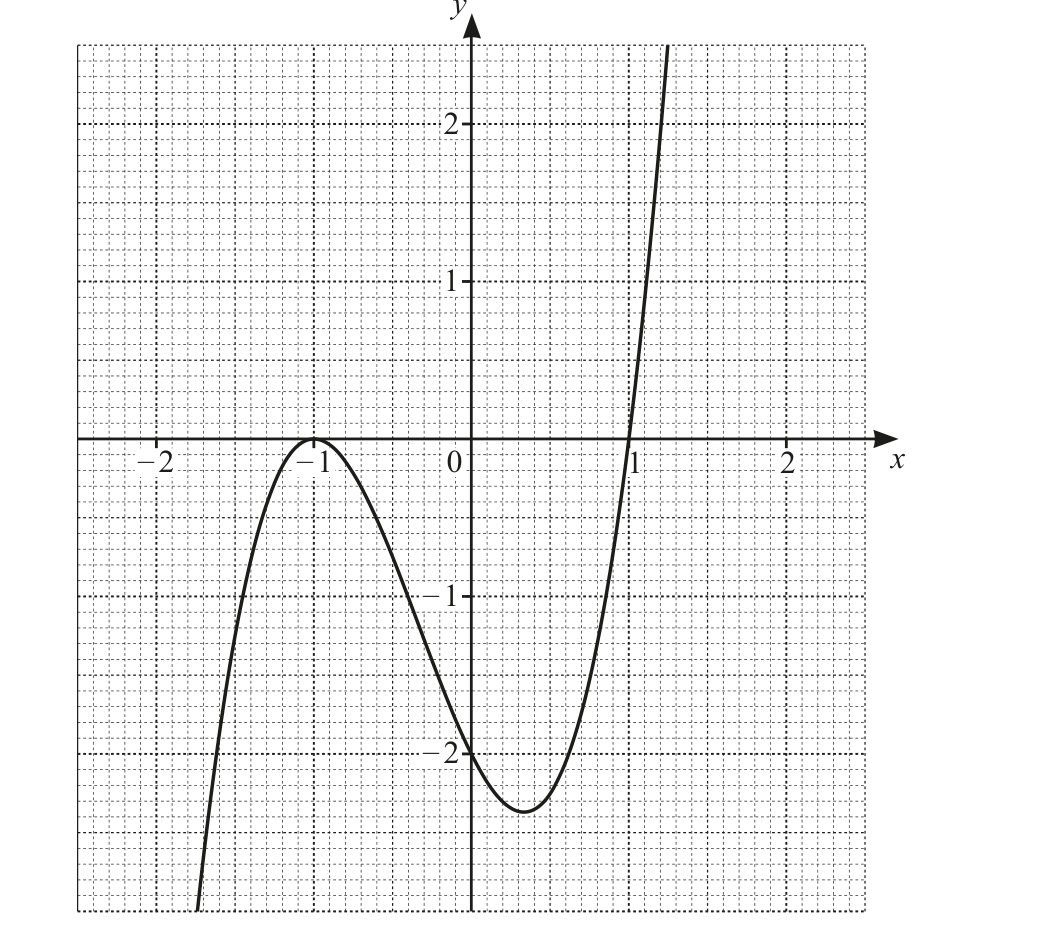
The diagram shows the graph of \(y=f(x)\), where \(f(x)=a(x+b)^2(x+c)\) and \(a\), \(b\) and \(c\) are integers.
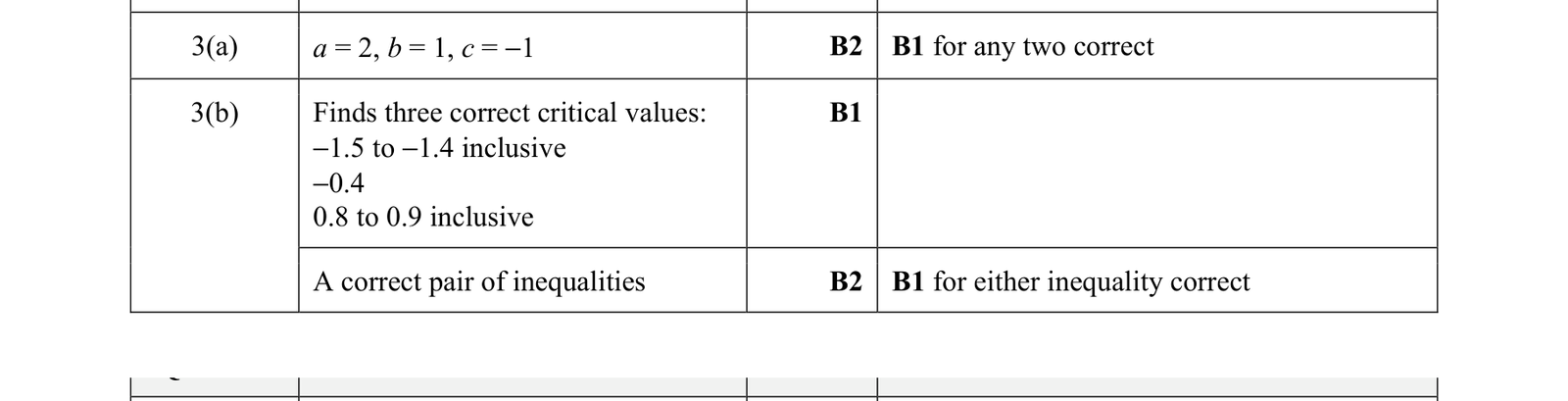
(a) Find the value of each of \(a\), \(b\) and \(c\).
(b) Hence solve the inequality \(f(x)\leqslant -1\).
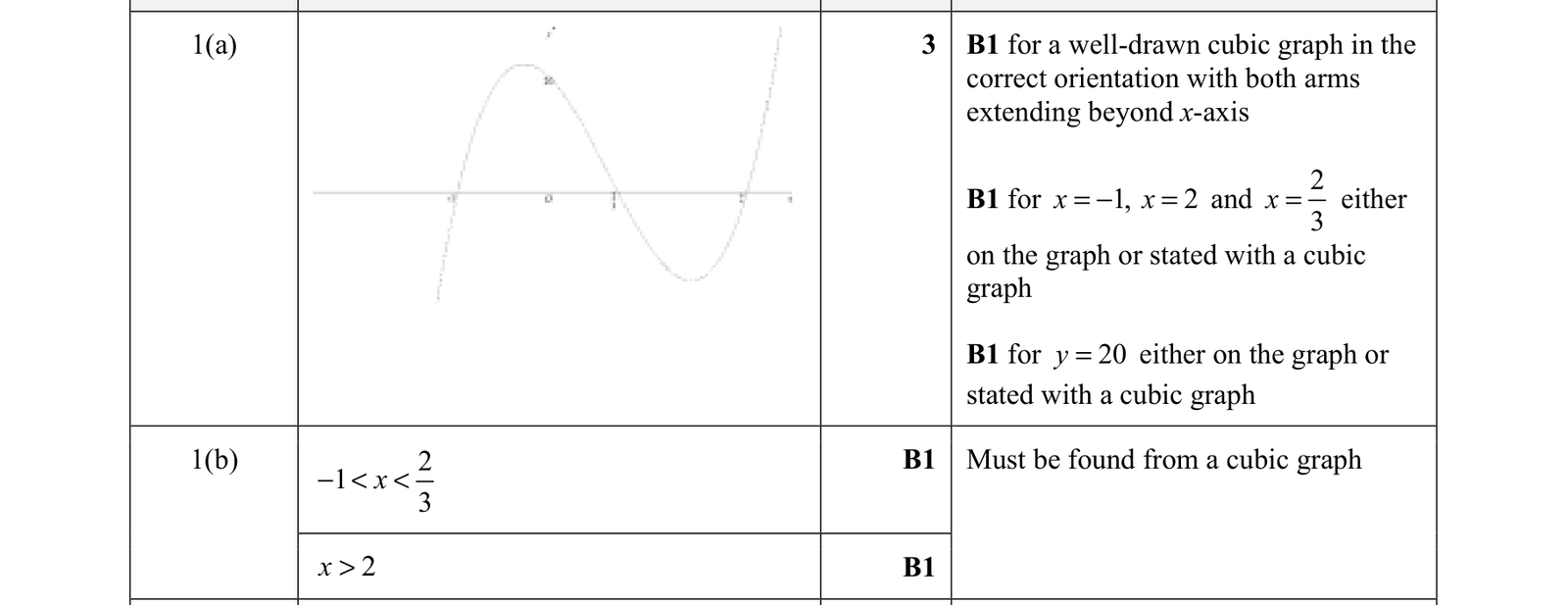
0606 P11 - Jun 2021 - Q1 - 5 marks
(a) On the axes, sketch the graph of
\(y=5(x+1)(3x-2)(x-2),\)
stating the intercepts with the coordinate axes.
(b) Hence find the values of \(x\) for which
\(5(x+1)(3x-2)(x-2)\gt0.\)
0606 P12 - Mar 2020 - Q1 - 5 marks
(a) Sketch the graph of
\(y=-3(x-2)(x-4)(x+1),\)
showing the coordinates of the points where the curve intersects the coordinate axes.
(b) Hence find the values of \(x\) for which
\(-3(x-2)(x-4)(x+1)\gt 0.\)

0606 P11 - Jun 2020 - Q1 - 4 marks
The diagram shows the graph of a cubic curve \(y=f(x)\).
(a) Find an expression for \(f(x)\).
(b) Solve \(f(x)\leq0\).


0606 P13 - Nov 2020 - Q1 - 5 marks
(a) On the axes below, sketch the graph of
\(y=(x-2)(x+1)(3-x),\)
stating the intercepts on the coordinate axes.
(b) Hence write down the values of \(x\) such that
\((x-2)(x+1)(3-x)\gt 0.\)
